

Tusculum University will hold a one-day AI Boot Camp for entrepreneurs, small business owners, nonprofit leaders, and other professionals on Tuesday, July 28, 2026, from 9 a.m. to 4:30 p.m. in Room 111 of the Meen Center on its Greeneville, Tennessee, campus. The $49 workshop is not being sold as a tour of futuristic abstractions, but as a practical session on using tools such as ChatGPT, Claude, Gemini, NotebookLM, and Lovable AI to run everyday operations more efficiently. That framing matters because it shows where generative AI has quietly moved in 2026: out of the keynote hall and into the spreadsheet, the inbox, the website draft, and the operating procedure. For WindowsForum readers, the story is less about one regional university than about the normalization of AI as a business productivity layer sitting beside Microsoft 365, Google Workspace, browsers, and the humble laptop.
The most interesting thing about Tusculum’s boot camp is its modesty. The university is not promising to mint machine-learning engineers in a day, nor is it presenting AI as a mystical replacement for management. It is offering business people a structured afternoon of prompt writing, document generation, competitor research, marketing content, and workflow planning.
That is exactly the kind of pitch that tends to survive contact with reality. For the last three years, generative AI has been sold in two incompatible ways: as a civilization-scale rupture and as a feature tucked into every app with a text box. Small organizations do not have the luxury of resolving that philosophical contradiction. They need to know whether a tool can save three hours on a grant proposal, produce a first draft of a standard operating procedure, or turn scattered notes into a usable marketing plan.
Tusculum’s program is aimed at that middle ground. The listed audience includes entrepreneurs, small business owners, nonprofit leaders, and professionals who may have neither developers on staff nor time to become prompt-engineering hobbyists. In other words, it is aimed at the people most likely to be told that AI is essential and least likely to have a clear path for adopting it.
The university’s choice of tools also says something about the moment. ChatGPT, Claude, Gemini, NotebookLM, and Lovable AI are not a single ecosystem. They represent a messy, overlapping market in which general-purpose chatbots, research assistants, document-grounded tools, and app-building platforms all compete to become the place where office work begins.
That messiness is precisely why training has become a product in its own right. The bottleneck is no longer awareness. Almost everyone has heard the pitch. The bottleneck is turning a blank prompt window into a repeatable business process without embarrassing the organization, leaking sensitive data, or mistaking fluent output for verified truth.
That role is especially important outside the major tech corridors. The AI industry’s center of gravity is still concentrated around model labs, hyperscale cloud providers, and venture-backed software companies. But the economic consequences are distributed through local businesses, county agencies, churches, nonprofits, clinics, schools, machine shops, accounting firms, and family-run operations that do not appear in the launch decks.
Those organizations are not asking the same questions as a Fortune 100 CIO. They are not debating whether to deploy a private model cluster or build an internal AI platform team. They are asking whether a laptop, a browser, and a subscription account can help a three-person office create better customer emails, summarize policy documents, draft job descriptions, research competitors, and plan next month’s social media posts.
This is where institutions like Tusculum can play a useful role. A regional university has credibility that a random AI influencer does not. It has classrooms, faculty, local relationships, and a civic mission that can translate abstract technology into community-level training.
David Hite, Tusculum’s associate professor of business and the boot camp leader, is being positioned as more than an instructor. The university describes him as someone who has embraced AI in business education and helped connect the campus with broader workforce-development conversations. That is the right kind of intermediary for a market drowning in tools but short on judgment.
The workshop format also acknowledges a truth that many AI vendors prefer to blur: generative AI is not self-explanatory. The tools can produce text instantly, but useful work still depends on context, constraints, examples, iteration, and domain knowledge. A business owner who asks for “a marketing plan” will get something generic. A business owner who can describe the market, audience, margin pressure, seasonal pattern, brand voice, and desired channel mix has a better chance of producing something usable.
That learning curve is why prompt guides, business writing templates, competitor research tools, website development resources, marketing templates, and a 30-day AI action plan are more than handouts. They are scaffolding. They turn a one-day class into a starting kit for repeatable behavior.
The inclusion of a 30-day plan is particularly telling. AI adoption often fails not because the first demo is unimpressive, but because the second week is lonely. People return to their offices, face real deadlines, and revert to familiar habits unless they have a short list of workflows to test and a way to measure whether the experiment helped.
A workshop that ends with artifacts gives participants something more durable than enthusiasm. It gives them prompts to reuse, templates to adapt, and a calendar for deciding whether the tools deserve a permanent place in the operation.
For Windows users and administrators, the notable absence is also obvious: Microsoft Copilot is not foregrounded in the provided announcement. That does not mean it will be irrelevant to the room. Many participants will likely bring Windows laptops, use Outlook, open Word documents, and manage files through OneDrive or Google Drive. The practical AI landscape is not cleanly divided by vendor boundaries.
That is one of the underappreciated challenges for IT support. A small business may use Microsoft 365 for email, Google Workspace for collaboration with partners, ChatGPT for drafting, Claude for policy summaries, NotebookLM for research, Canva for marketing assets, and a no-code AI tool for a landing page. There may be no central architecture, just a browser full of tabs and a credit card bill full of subscriptions.
The result is a shadow productivity stack. Employees are not necessarily trying to evade IT; they are trying to get work done. But every new AI account can introduce questions about data retention, access control, copyright exposure, prompt history, source accuracy, and whether sensitive customer or employee information is being pasted into systems that management has never reviewed.
That is why local AI education should not be treated as mere upskilling. It is also the first line of governance. If participants learn only how to generate faster copy, the workshop will be incomplete. If they learn when not to paste information, how to verify claims, how to separate drafts from decisions, and how to build repeatable review steps, the value rises sharply.
The upside is obvious. A nonprofit director can sketch a volunteer intake form. A contractor can mock up a job-tracking dashboard. A shop owner can create a landing page for a seasonal campaign. A consultant can move from idea to prototype without waiting for a developer or buying a heavyweight platform.
But the phrase no coding experience required can do too much work if nobody explains the boundary. Not needing to code is not the same as not needing to think like a system owner. A generated website still needs accessibility review, security hygiene, privacy policy alignment, content accuracy, backup planning, and a plan for what happens when the tool changes pricing or behavior.
This is where AI literacy needs to grow beyond prompting. The next generation of office workers will not all become programmers, but many will become accidental product managers. They will assemble workflows, connect tools, generate forms, create automations, and publish AI-assisted content. That is productive only if they understand risk at the edges.
The history of Windows computing is full of similar patterns. Excel macros, Access databases, SharePoint lists, Power Automate flows, and departmental scripts all emerged because people closest to a process could not wait for centralized IT. Some of those solutions became indispensable. Others became brittle, undocumented liabilities. AI-generated business tools are the same story at higher speed.
A good prompt is not magic language. It is a compact brief. It defines the role, audience, constraints, source material, output format, tone, and success criteria. Those are management skills disguised as software inputs.
This is why AI workshops can have benefits beyond AI. A business owner who learns to ask a model for a better job description may also learn to describe the job more clearly. A nonprofit leader who asks for donor email variations may sharpen the organization’s message. A manager who uses AI as a strategic thinking partner may discover that the first useful product is not the chatbot’s answer, but the clarified question.
The danger, of course, is that fluent output can hide weak inputs. A model will produce a polished strategic plan even when the user has provided vague assumptions. It will draft an operating procedure for a process it does not understand. It will summarize a market based on outdated or incomplete information if the workflow does not require current research and verification.
That is where the workshop leader’s responsibility becomes editorial as much as technical. Participants need to learn how to interrogate output, demand sources where appropriate, compare alternatives, and treat AI drafts as drafts. The skill is not asking once. The skill is building a conversation that improves the work while preserving human accountability.
This is not bureaucracy for its own sake. It is a recognition that generative AI collapses several office functions into one interface. The same tool can be a copywriter, analyst, HR assistant, programmer, tutor, translator, and brainstorming partner. That flexibility is useful, but it also means one careless paste can move confidential material into an environment the business does not control.
The risk is especially acute for nonprofits, health-adjacent organizations, legal offices, schools, and firms handling employee records or customer financial details. Many of these groups do not have dedicated compliance teams. They rely on common sense, trust, and established routines. AI breaks those routines by making it feel normal to upload whatever context might improve the answer.
A serious boot camp should therefore make room for plain rules. Do not paste sensitive personal data into tools unless the organization has approved the platform and settings. Do not treat generated legal, medical, financial, or HR language as final without qualified review. Do not publish competitive research without checking whether the claims are current. Do not let AI write policy in a vacuum.
The goal is not to frighten people away from the tools. It is to keep adoption from becoming a cleanup project. A $49 workshop that teaches ten useful workflows and five durable cautions may do more for a local business than an expensive enterprise AI strategy deck that never reaches the front office.
For smaller universities, this is also a positioning opportunity. AI lets an institution tell a regional economic story: we are not merely awarding degrees; we are helping local employers adapt. That message resonates especially in areas where workforce development, entrepreneurship, and civic engagement are part of the institution’s identity.
Tusculum’s announcement leans into that civic role. The university frames the boot camp as part of its commitment to helping the business community and strengthening operations through ethical and sound AI practices. That phrase matters because it tries to put values around productivity. AI adoption without ethics becomes automation theater; ethics without practical skills becomes a policy seminar no one attends.
The challenge for higher education is maintaining credibility as the tools change. A course built around a specific interface can age quickly. Model names, feature sets, pricing tiers, file limits, privacy controls, and integration options move faster than traditional curriculum cycles. The durable curriculum is not “how to click this button.” It is how to evaluate an AI tool, frame a task, protect data, verify output, and decide whether the result improved the work.
That is why the one-day format may be an advantage rather than a compromise. A boot camp can evolve faster than a semester course. It can focus on current tools while still teaching habits that survive the next product rename.
This is why the PC still matters in the AI era. Even when inference happens in the cloud, the work begins and ends locally: files are selected, text is copied, PDFs are uploaded, drafts are downloaded, screenshots are shared, and credentials are stored. The endpoint is where convenience and risk meet.
For sysadmins and technically minded users, the practical questions are immediate. Are employees using managed browsers or personal profiles? Are passwords protected by multifactor authentication? Are files being uploaded from synced folders containing sensitive material? Are AI outputs being stored in shared drives without review? Are browser extensions interacting with confidential pages?
Microsoft’s Copilot push, Google’s Gemini integration, and the rise of independent AI tools all converge on the same endpoint reality. The operating system may not be the AI product, but it is the workspace where AI-mediated decisions happen. Device management, identity, patching, browser policy, and data-loss prevention remain boring in exactly the way foundations are boring.
Small organizations often discover this only after the fact. They start with a productivity experiment and end up with a governance problem. The smarter path is to treat AI training and endpoint hygiene as connected subjects from the beginning.
The phrase is not wrong. Generative AI can be genuinely useful as a sparring partner. It can generate scenarios, identify blind spots, summarize tradeoffs, role-play customers, compare messaging angles, and help a user think through an operating problem from multiple perspectives. For a small business owner without a large management team, that can feel like gaining a boardroom in a browser.
But models do not know the business in the way an owner knows the business. They do not feel cash flow pressure, understand the emotional history of a family company, see the morale problem in the warehouse, or know which local competitor is quietly losing staff. They reason from supplied context and learned patterns. That can be powerful, but it is not judgment.
The best use of AI as a strategic partner is adversarial, not deferential. Ask it to challenge the plan. Ask it what assumptions would make the plan fail. Ask it to produce three versions of the same idea for different budget levels. Ask it to list what information is missing before a decision is made.
That kind of use preserves the human role. The model expands the thinking surface. The person still owns the decision.
But this is what adoption looks like after the spectacle fades. People gather in a classroom with laptops. They learn which tools are useful for which jobs. They practice prompts, compare outputs, save templates, and leave with a 30-day plan. The change is not dramatic in the moment, but it compounds if the habits stick.
The implications for IT pros are concrete. AI will not arrive only through sanctioned enterprise deployments. It will arrive through workshops, browser tabs, vendor webinars, YouTube tutorials, university certificates, chamber-of-commerce events, and employees who discover that a tool helps them finish work faster. Governance that assumes a single official rollout will miss the actual path.
The implications for workers are equally concrete. AI skill is becoming part of ordinary office literacy, much like spreadsheet competence or search literacy before it. The goal is not to worship the tools. It is to know when they help, when they mislead, and when a human conversation is still the better instrument.
 The AI Pitch Has Shrunk, and That Makes It More Serious
The most interesting thing about Tusculum’s boot camp is its modesty. The university is not promising to mint machine-learning engineers in a day, nor is it presenting AI as a mystical replacement for management. It is offering business people a structured afternoon of prompt writing, document generation, competitor research, marketing content, and workflow planning.That is exactly the kind of pitch that tends to survive contact with reality. For the last three years, generative AI has been sold in two incompatible ways: as a civilization-scale rupture and as a feature tucked into every app with a text box. Small organizations do not have the luxury of resolving that philosophical contradiction. They need to know whether a tool can save three hours on a grant proposal, produce a first draft of a standard operating procedure, or turn scattered notes into a usable marketing plan.
Tusculum’s program is aimed at that middle ground. The listed audience includes entrepreneurs, small business owners, nonprofit leaders, and professionals who may have neither developers on staff nor time to become prompt-engineering hobbyists. In other words, it is aimed at the people most likely to be told that AI is essential and least likely to have a clear path for adopting it.
The university’s choice of tools also says something about the moment. ChatGPT, Claude, Gemini, NotebookLM, and Lovable AI are not a single ecosystem. They represent a messy, overlapping market in which general-purpose chatbots, research assistants, document-grounded tools, and app-building platforms all compete to become the place where office work begins.
That messiness is precisely why training has become a product in its own right. The bottleneck is no longer awareness. Almost everyone has heard the pitch. The bottleneck is turning a blank prompt window into a repeatable business process without embarrassing the organization, leaking sensitive data, or mistaking fluent output for verified truth.
A Regional University Spots the Real AI Adoption Gap
Tusculum’s event follows its Appalachian AI Summit, held in March 2026, which brought together educators, business owners, nonprofit representatives, workforce-development figures, and students. That chronology matters. The boot camp is not an isolated marketing event; it is part of a larger push by the university’s business program to position itself as a regional broker for applied AI knowledge.That role is especially important outside the major tech corridors. The AI industry’s center of gravity is still concentrated around model labs, hyperscale cloud providers, and venture-backed software companies. But the economic consequences are distributed through local businesses, county agencies, churches, nonprofits, clinics, schools, machine shops, accounting firms, and family-run operations that do not appear in the launch decks.
Those organizations are not asking the same questions as a Fortune 100 CIO. They are not debating whether to deploy a private model cluster or build an internal AI platform team. They are asking whether a laptop, a browser, and a subscription account can help a three-person office create better customer emails, summarize policy documents, draft job descriptions, research competitors, and plan next month’s social media posts.
This is where institutions like Tusculum can play a useful role. A regional university has credibility that a random AI influencer does not. It has classrooms, faculty, local relationships, and a civic mission that can translate abstract technology into community-level training.
David Hite, Tusculum’s associate professor of business and the boot camp leader, is being positioned as more than an instructor. The university describes him as someone who has embraced AI in business education and helped connect the campus with broader workforce-development conversations. That is the right kind of intermediary for a market drowning in tools but short on judgment.
The Workshop Model Is a Quiet Rebuke to AI Theater
Tusculum says the boot camp will be hands-on rather than lecture-based. That may sound like a minor detail, but it is the difference between AI literacy and AI theater. Listening to someone demonstrate a chatbot is not the same thing as learning how to structure a useful prompt, evaluate the output, revise the request, and decide whether the answer is safe to use.The workshop format also acknowledges a truth that many AI vendors prefer to blur: generative AI is not self-explanatory. The tools can produce text instantly, but useful work still depends on context, constraints, examples, iteration, and domain knowledge. A business owner who asks for “a marketing plan” will get something generic. A business owner who can describe the market, audience, margin pressure, seasonal pattern, brand voice, and desired channel mix has a better chance of producing something usable.
That learning curve is why prompt guides, business writing templates, competitor research tools, website development resources, marketing templates, and a 30-day AI action plan are more than handouts. They are scaffolding. They turn a one-day class into a starting kit for repeatable behavior.
The inclusion of a 30-day plan is particularly telling. AI adoption often fails not because the first demo is unimpressive, but because the second week is lonely. People return to their offices, face real deadlines, and revert to familiar habits unless they have a short list of workflows to test and a way to measure whether the experiment helped.
A workshop that ends with artifacts gives participants something more durable than enthusiasm. It gives them prompts to reuse, templates to adapt, and a calendar for deciding whether the tools deserve a permanent place in the operation.
The Tool List Reveals the New Office Stack
The named tools in Tusculum’s boot camp form a snapshot of the current AI office stack. ChatGPT is the general-purpose assistant. Claude is often favored for long-form reasoning, writing, and document-heavy work. Gemini connects naturally to Google’s productivity world. NotebookLM is built around grounding responses in user-provided sources. Lovable AI points toward the fast-growing category of natural-language app and website creation.For Windows users and administrators, the notable absence is also obvious: Microsoft Copilot is not foregrounded in the provided announcement. That does not mean it will be irrelevant to the room. Many participants will likely bring Windows laptops, use Outlook, open Word documents, and manage files through OneDrive or Google Drive. The practical AI landscape is not cleanly divided by vendor boundaries.
That is one of the underappreciated challenges for IT support. A small business may use Microsoft 365 for email, Google Workspace for collaboration with partners, ChatGPT for drafting, Claude for policy summaries, NotebookLM for research, Canva for marketing assets, and a no-code AI tool for a landing page. There may be no central architecture, just a browser full of tabs and a credit card bill full of subscriptions.
The result is a shadow productivity stack. Employees are not necessarily trying to evade IT; they are trying to get work done. But every new AI account can introduce questions about data retention, access control, copyright exposure, prompt history, source accuracy, and whether sensitive customer or employee information is being pasted into systems that management has never reviewed.
That is why local AI education should not be treated as mere upskilling. It is also the first line of governance. If participants learn only how to generate faster copy, the workshop will be incomplete. If they learn when not to paste information, how to verify claims, how to separate drafts from decisions, and how to build repeatable review steps, the value rises sharply.
The No-Code Promise Is Powerful Because It Is Dangerous
Tusculum’s announcement emphasizes that participants do not need coding experience. That is an appropriate reassurance for a business workshop, and it reflects a real shift in software creation. Tools like Lovable AI and similar platforms have made it easier for non-developers to generate prototypes, websites, internal tools, and app-like experiences from natural-language instructions.The upside is obvious. A nonprofit director can sketch a volunteer intake form. A contractor can mock up a job-tracking dashboard. A shop owner can create a landing page for a seasonal campaign. A consultant can move from idea to prototype without waiting for a developer or buying a heavyweight platform.
But the phrase no coding experience required can do too much work if nobody explains the boundary. Not needing to code is not the same as not needing to think like a system owner. A generated website still needs accessibility review, security hygiene, privacy policy alignment, content accuracy, backup planning, and a plan for what happens when the tool changes pricing or behavior.
This is where AI literacy needs to grow beyond prompting. The next generation of office workers will not all become programmers, but many will become accidental product managers. They will assemble workflows, connect tools, generate forms, create automations, and publish AI-assisted content. That is productive only if they understand risk at the edges.
The history of Windows computing is full of similar patterns. Excel macros, Access databases, SharePoint lists, Power Automate flows, and departmental scripts all emerged because people closest to a process could not wait for centralized IT. Some of those solutions became indispensable. Others became brittle, undocumented liabilities. AI-generated business tools are the same story at higher speed.
Prompt Writing Is Becoming the New Office Grammar
One of the boot camp’s advertised outcomes is the ability to write prompts that generate useful business results. That phrasing may sound like the residue of 2023-era hype, when “prompt engineer” briefly became the job title of the future. But at the working level, prompt writing remains a real skill because it forces users to describe the job before delegating it.A good prompt is not magic language. It is a compact brief. It defines the role, audience, constraints, source material, output format, tone, and success criteria. Those are management skills disguised as software inputs.
This is why AI workshops can have benefits beyond AI. A business owner who learns to ask a model for a better job description may also learn to describe the job more clearly. A nonprofit leader who asks for donor email variations may sharpen the organization’s message. A manager who uses AI as a strategic thinking partner may discover that the first useful product is not the chatbot’s answer, but the clarified question.
The danger, of course, is that fluent output can hide weak inputs. A model will produce a polished strategic plan even when the user has provided vague assumptions. It will draft an operating procedure for a process it does not understand. It will summarize a market based on outdated or incomplete information if the workflow does not require current research and verification.
That is where the workshop leader’s responsibility becomes editorial as much as technical. Participants need to learn how to interrogate output, demand sources where appropriate, compare alternatives, and treat AI drafts as drafts. The skill is not asking once. The skill is building a conversation that improves the work while preserving human accountability.
Small Businesses Need AI Guardrails Before They Need AI Strategy
The language around AI in business often jumps too quickly to strategy. Strategy is important, but many small organizations first need basic operating rules. They need to decide what kinds of data can be entered into public AI tools, who approves AI-assisted customer communications, and how staff should disclose or review AI-generated material.This is not bureaucracy for its own sake. It is a recognition that generative AI collapses several office functions into one interface. The same tool can be a copywriter, analyst, HR assistant, programmer, tutor, translator, and brainstorming partner. That flexibility is useful, but it also means one careless paste can move confidential material into an environment the business does not control.
The risk is especially acute for nonprofits, health-adjacent organizations, legal offices, schools, and firms handling employee records or customer financial details. Many of these groups do not have dedicated compliance teams. They rely on common sense, trust, and established routines. AI breaks those routines by making it feel normal to upload whatever context might improve the answer.
A serious boot camp should therefore make room for plain rules. Do not paste sensitive personal data into tools unless the organization has approved the platform and settings. Do not treat generated legal, medical, financial, or HR language as final without qualified review. Do not publish competitive research without checking whether the claims are current. Do not let AI write policy in a vacuum.
The goal is not to frighten people away from the tools. It is to keep adoption from becoming a cleanup project. A $49 workshop that teaches ten useful workflows and five durable cautions may do more for a local business than an expensive enterprise AI strategy deck that never reaches the front office.
Higher Education Is Rebranding Workforce Development Around AI
Tusculum’s move fits a broader pattern across higher education. Colleges and universities are building AI minors, certificates, workshops, summits, and faculty-development programs because AI has become both a curricular problem and a workforce-development opportunity. Students are using the tools, employers are asking about them, and faculty are trying to distinguish cheating, assistance, literacy, and legitimate professional practice.For smaller universities, this is also a positioning opportunity. AI lets an institution tell a regional economic story: we are not merely awarding degrees; we are helping local employers adapt. That message resonates especially in areas where workforce development, entrepreneurship, and civic engagement are part of the institution’s identity.
Tusculum’s announcement leans into that civic role. The university frames the boot camp as part of its commitment to helping the business community and strengthening operations through ethical and sound AI practices. That phrase matters because it tries to put values around productivity. AI adoption without ethics becomes automation theater; ethics without practical skills becomes a policy seminar no one attends.
The challenge for higher education is maintaining credibility as the tools change. A course built around a specific interface can age quickly. Model names, feature sets, pricing tiers, file limits, privacy controls, and integration options move faster than traditional curriculum cycles. The durable curriculum is not “how to click this button.” It is how to evaluate an AI tool, frame a task, protect data, verify output, and decide whether the result improved the work.
That is why the one-day format may be an advantage rather than a compromise. A boot camp can evolve faster than a semester course. It can focus on current tools while still teaching habits that survive the next product rename.
The Windows Laptop Remains the Unspoken Platform
The announcement tells attendees to bring laptops. That simple instruction reveals the real deployment model for AI in small business: not a data center, not a corporate AI lab, but a personal computer on a desk or in a backpack. For many participants, that computer will be a Windows machine running a browser, Office apps, cloud storage clients, password managers, and perhaps a half-dozen AI accounts.This is why the PC still matters in the AI era. Even when inference happens in the cloud, the work begins and ends locally: files are selected, text is copied, PDFs are uploaded, drafts are downloaded, screenshots are shared, and credentials are stored. The endpoint is where convenience and risk meet.
For sysadmins and technically minded users, the practical questions are immediate. Are employees using managed browsers or personal profiles? Are passwords protected by multifactor authentication? Are files being uploaded from synced folders containing sensitive material? Are AI outputs being stored in shared drives without review? Are browser extensions interacting with confidential pages?
Microsoft’s Copilot push, Google’s Gemini integration, and the rise of independent AI tools all converge on the same endpoint reality. The operating system may not be the AI product, but it is the workspace where AI-mediated decisions happen. Device management, identity, patching, browser policy, and data-loss prevention remain boring in exactly the way foundations are boring.
Small organizations often discover this only after the fact. They start with a productivity experiment and end up with a governance problem. The smarter path is to treat AI training and endpoint hygiene as connected subjects from the beginning.
AI as a Strategic Thinking Partner Is the Most Tempting Claim
Among the boot camp’s advertised skills is using AI as a strategic thinking partner to solve business challenges. That is the most ambitious promise on the list and the one that deserves the most scrutiny. Drafting an email is one thing. Advising a business on strategy is another.The phrase is not wrong. Generative AI can be genuinely useful as a sparring partner. It can generate scenarios, identify blind spots, summarize tradeoffs, role-play customers, compare messaging angles, and help a user think through an operating problem from multiple perspectives. For a small business owner without a large management team, that can feel like gaining a boardroom in a browser.
But models do not know the business in the way an owner knows the business. They do not feel cash flow pressure, understand the emotional history of a family company, see the morale problem in the warehouse, or know which local competitor is quietly losing staff. They reason from supplied context and learned patterns. That can be powerful, but it is not judgment.
The best use of AI as a strategic partner is adversarial, not deferential. Ask it to challenge the plan. Ask it what assumptions would make the plan fail. Ask it to produce three versions of the same idea for different budget levels. Ask it to list what information is missing before a decision is made.
That kind of use preserves the human role. The model expands the thinking surface. The person still owns the decision.
The Local Boot Camp Is a Preview of Normalized AI Work
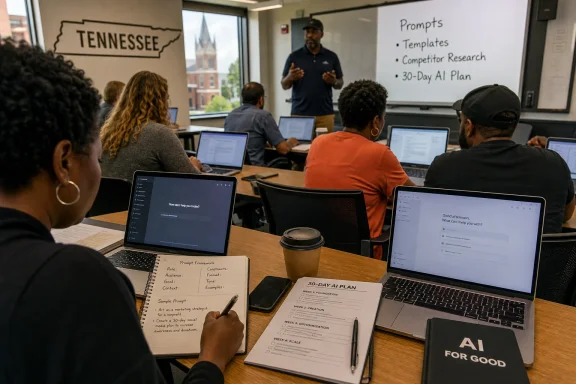
Tusculum’s July event is easy to underestimate because it is local, affordable, and practical. It lacks the spectacle of a major AI product launch. There is no new model benchmark, no sweeping claim about artificial general intelligence, no enterprise keynote about transforming every workflow.But this is what adoption looks like after the spectacle fades. People gather in a classroom with laptops. They learn which tools are useful for which jobs. They practice prompts, compare outputs, save templates, and leave with a 30-day plan. The change is not dramatic in the moment, but it compounds if the habits stick.
The implications for IT pros are concrete. AI will not arrive only through sanctioned enterprise deployments. It will arrive through workshops, browser tabs, vendor webinars, YouTube tutorials, university certificates, chamber-of-commerce events, and employees who discover that a tool helps them finish work faster. Governance that assumes a single official rollout will miss the actual path.
The implications for workers are equally concrete. AI skill is becoming part of ordinary office literacy, much like spreadsheet competence or search literacy before it. The goal is not to worship the tools. It is to know when they help, when they mislead, and when a human conversation is still the better instrument.
The Meen Center Test for Main Street AI
The clearest lessons from Tusculum’s boot camp are not about any single chatbot. They are about the shape of AI adoption when it reaches organizations that do not have time for hype and cannot afford avoidable mistakes.- Tusculum’s AI Boot Camp is scheduled for Tuesday, July 28, 2026, from 9 a.m. to 4:30 p.m. on the university’s Greeneville campus.
- The event is aimed at entrepreneurs, small business owners, nonprofit leaders, and professionals who want practical AI workflows without needing coding experience.
- The curriculum emphasizes prompts, business writing, marketing content, competitor research, strategic thinking, operational documents, and a 30-day action plan.
- The named tools show that small-business AI is already multi-vendor, spanning ChatGPT, Claude, Gemini, NotebookLM, and Lovable AI rather than a single official platform.
- The biggest value will come if participants learn verification, data caution, and repeatable review habits alongside productivity tricks.
- For Windows users and administrators, the laptop remains the control point where AI accounts, business files, browser sessions, and security practices collide.
References
- Primary source: Citizen Tribune
Published: Sat, 20 Jun 2026 17:43:13 GMT
Tusculum University to help people in business better run their operations by teaching them how to use AI Tools - Citizen Tribune
GREENEVILLE – Entrepreneurs and other business professionals who seek practical ways to apply artificial intelligence to their work will benefit from an upcoming boot camp Tusculum University’s Business Division is holding.www.citizentribune.com - Independent coverage: wgrv.com
Published: 2026-06-20T10:10:18.823744
AI Boot Camp To Be Given By Tusculum University – WGRV.com
Entrepreneurs and other business professionals who seek practical ways to apply artificial intelligence to their work will benefit from anwgrv.com - Related coverage: www3.tusculum.edu
Learn more about the practical uses of artificial intelligence from experts during a March summit at Tusculum University :: Tusculum University
GREENEVILLE – Individuals who are ready to embrace practical artificial intelligence will gain a greater understanding of this field and the ability to effectively and appropriately use it at the Appalachian AI Summit in March at Tusculum University. The summit will be held Wednesday, March 11...www3.tusculum.edu - Related coverage: designlab.com
AI Prototyping Camp: Prototype & Ship with Figma Make & Lovable
Learn to prototype, ship, and design smarter with AI tools like Figma Make & Lovable. 4-day program for designers, product managers, and builders. designlab.com
