

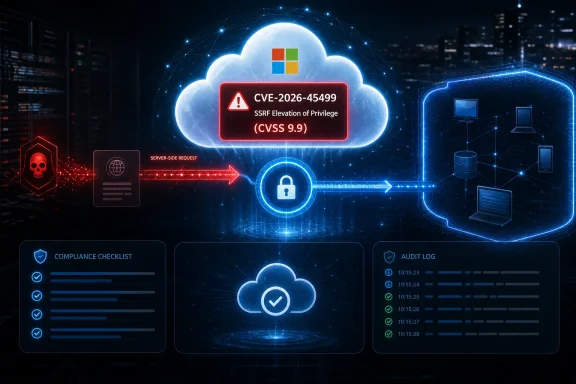
On July 2, 2026, Microsoft published CVE-2026-45499, a critical Azure OpenAI elevation-of-privilege vulnerability caused by server-side request forgery, saying the cloud-service flaw had already been fully mitigated and required no customer action. That last clause is the story’s hinge, not its footnote. Microsoft is telling customers that the risk was real enough to deserve a CVE, severe enough to score 9.9 under CVSS 3.1, and yet operationally finished before most administrators ever saw the advisory. For WindowsForum readers, the question is not whether to download a patch; it is how to treat a critical cloud vulnerability whose fix happens entirely on the vendor side.
CVE-2026-45499 is not a conventional Patch Tuesday entry. There is no KB article to chase, no MSI to deploy, no Windows build number to verify, and no fleet compliance dashboard that will light up red until an endpoint reboots. Microsoft’s advisory says the vulnerability affected Azure OpenAI, carried a critical maximum severity, and was already mitigated by Microsoft at publication.
That is a different kind of security notice from the one Windows administrators grew up with. In the old model, disclosure created work: test the update, deploy the update, watch for regressions, document exceptions, and then do it all again next month. In this model, disclosure creates accountability without a patch artifact. The provider has acted, the customer is told no action is required, and the public record becomes the main deliverable.
The flaw itself is described as server-side request forgery, or SSRF, in Azure OpenAI. SSRF is one of those vulnerability classes that sounds narrow until it appears inside cloud infrastructure. At its simplest, it means an attacker can cause a server-side component to make requests the attacker should not be able to make directly. In a cloud service, that can turn into a path across trust boundaries, especially when the vulnerable component sits near privileged internal services, metadata endpoints, identity plumbing, or backend management interfaces.
Microsoft’s CVSS vector says a lot in compressed form. The attack vector is network, attack complexity is low, privileges required are low, user interaction is none, and scope is changed. Confidentiality, integrity, and availability impacts are all rated high. Those values explain the 9.9 base score: this is not a bug that depends on a victim clicking a malicious document or a workstation running a specific driver. It is a service-side flaw where an already authorized attacker could potentially use the vulnerable component to affect something outside the component’s own security scope.
The temporal score is lower, at 8.6, because Microsoft lists an official fix and exploit code maturity as unproven. That is a meaningful reduction, but not a dismissal. It tells defenders that Microsoft considers the issue fixed and does not report public exploit code, while still confirming that the vulnerability existed and was severe in design terms.
But “no customer action” is not the same thing as “no customer consequence.” The action required to remove the vulnerable condition may be over, yet customers still need to understand whether the issue changes their risk model, audit story, and internal reporting. A critical vulnerability in a managed service can become a governance event even when it is not a change-management event.
That distinction matters for regulated organizations and large enterprises. Security teams are often asked whether a known critical CVE affected systems that processed sensitive data, whether exploitation occurred, and whether any compensating controls were in place. Microsoft’s advisory says the vulnerability was not publicly disclosed before publication and not exploited, according to the exploitability section. That is useful, but it is not the same as a bespoke customer impact assessment.
There is also a timing asymmetry baked into cloud security. The vendor knows when it identified the issue, how it mitigated it, and what telemetry it reviewed. The customer sees a public entry after the service has been fixed. This is normal for managed services, but it means defenders must increasingly evaluate trust signals rather than patch levels.
For Azure OpenAI customers, the immediate operational message is calm. The deeper architectural message is less comfortable: the most important security boundary in many AI deployments is no longer a Windows host or even a Kubernetes cluster the customer directly controls. It is a managed platform boundary, documented through advisories, service health communications, audit logs, contractual assurances, and the provider’s own incident-handling process.
AI services do not sit quietly in a corner anymore. They are connected to document repositories, codebases, ticketing systems, chat interfaces, vector stores, databases, workflow engines, and custom internal applications. They are often granted access to retrieve, transform, summarize, or act on data that used to be handled by narrower applications. That makes the service boundary around AI platforms unusually important.
An SSRF bug in such a setting is worrying because the attacker’s direct privilege may not reflect the vulnerable service’s indirect reach. The advisory’s “privileges required: low” field says the attacker must already be authorized at some basic level. The “scope: changed” field says successful exploitation can affect resources beyond the vulnerable component’s own security scope. Put together, those two values describe a familiar cloud danger: a modest foothold interacting with a highly connected backend.
This is also why elevation of privilege in cloud services can be conceptually different from elevation of privilege on a Windows machine. On a desktop, privilege escalation often means moving from a standard user to administrator or SYSTEM. In a cloud service, it can mean crossing from one permission plane to another, reaching backend capabilities that should be isolated, or causing a trusted service to perform actions on behalf of the attacker.
That does not mean customers should infer more than Microsoft disclosed. The advisory does not publish a step-by-step exploit, does not claim compromise of customer tenants, and does not say the bug was used in the wild. But the CVSS values make clear that Microsoft’s own severity model treated the theoretical impact as broad and serious. In security, the absence of public exploit code reduces urgency; it does not erase architectural significance.
That matters because cloud CVEs often leave customers with less technical detail than endpoint CVEs. Vendors are understandably cautious about publishing exploit paths for managed services, particularly when those details could aid attackers against similar systems. The result is a public record that gives the shape of the issue but not the machinery.
Report confidence helps separate “thin disclosure” from “uncertain disclosure.” This one is thin in public exploit detail, but not uncertain in existence. Microsoft assigns the CNA, identifies the product as Azure OpenAI, names the weakness as CWE-918, rates the issue critical, gives a CVSS vector, and says the service was fully mitigated.
That is not everything defenders might want, but it is enough to drive reasonable prioritization. Organizations do not need to scramble to apply a customer-side patch. They do need to record that a critical Azure OpenAI service vulnerability existed, that Microsoft says it was remediated, and that the disclosed exploitability status was not publicly disclosed and not exploited at original publication.
The confirmed confidence metric also has an attacker-side implication. It signals that the vulnerability was real, but the exploit code maturity field says public exploit code is unproven. That combination often defines the early window after cloud disclosures: attackers may look for analogous patterns, researchers may try to reconstruct classes of failure, and defenders may review whether their own integrations over-trust managed service boundaries.
Many organizations adopted Azure OpenAI precisely because it sits inside the Microsoft cloud trust envelope. They wanted private networking options, enterprise identity integration, regional controls, content filtering, logging hooks, and a vendor relationship their legal and security teams already understood. That makes a critical CVE in the service more important, not less. The promise of managed AI is that Microsoft absorbs much of the operational complexity; the tradeoff is that Microsoft also owns large parts of the failure and remediation story.
This is not an argument against using managed AI. Quite the opposite: the advisory shows one of the advantages of a managed service, because Microsoft could mitigate the vulnerability centrally without requiring customers to patch hundreds or thousands of deployments. In a self-hosted AI stack, a comparable flaw in an inference gateway or orchestration layer might require emergency upgrades across multiple environments.
But the managed-service model changes what “secure configuration” means. Customers still own identities, role assignments, data flows, network exposure, prompt and tool design, logging, and downstream integrations. Microsoft owns the service internals. CVE-2026-45499 sits on Microsoft’s side of that line, but its potential impact would have met customers at the boundary where their identities and data touch the platform.
That is why the right lesson is not panic, and it is not complacency. The lesson is that AI services must be inventoried and governed like production infrastructure. If a critical cloud CVE drops, the organization should already know which applications depend on Azure OpenAI, what data classes they process, what identities they use, and what logs would be reviewed if the vendor later updated its guidance.
If an organization’s vulnerability dashboard is built around missing patches, CVE-2026-45499 may not fit cleanly. There is no local package to scan for, no affected version string to compare, and no remediation button for desktop management tools. Yet the CVE is critical and belongs in security reporting. This creates a mismatch between risk reality and operational tooling.
Some teams will solve that mismatch by ignoring these entries, which is the wrong move. Others will overreact and try to invent customer-side mitigation work where Microsoft says none is required, which is also wrong. The better approach is to treat managed-service CVEs as a separate class of vulnerability record: confirmed, vendor-remediated, and relevant to asset owners whose systems consume the service.
That may sound bureaucratic, but it is increasingly necessary. Cloud services now receive CVEs for flaws that would previously have been handled quietly through backend changes and perhaps a service advisory. Microsoft has been moving toward greater transparency for cloud-service vulnerabilities, and CVE-2026-45499 is an example of that policy becoming visible in the AI stack.
Security leaders should be glad that these records exist. Public cloud CVEs give defenders a common identifier for risk discussions, audits, tabletop exercises, and vendor management. The downside is that they force organizations to mature beyond a patch-only worldview. A “fixed by Microsoft” critical CVE still belongs in the risk register until it is understood, documented, and closed with the right evidence.
Still, defenders should read those fields precisely. “Not exploited” in an advisory is a statement about known exploitation, not a mathematical proof that no one anywhere touched the bug. Cloud providers have enormous telemetry advantages, but they also decide how much of that telemetry analysis to summarize publicly. In this case, Microsoft’s statement is useful and calming, but it is not a substitute for customer-side logging discipline.
What should customers look for if Microsoft says no action is required? Not exploit signatures, because none are public. Instead, the sensible review is contextual. Teams should identify which applications used Azure OpenAI before July 2, 2026, what identities and network paths those applications used, and whether any unusual behavior appeared in surrounding systems. This is less about chasing an exploit and more about being ready if Microsoft revises the advisory or provides customer-specific notifications.
The absence of customer action also should not be treated as permission to defer least-privilege hygiene. A vulnerability with low privileges required is a reminder that low-privilege access is still access. If an Azure OpenAI deployment is reachable by too many users, service principals, pipelines, or experimental apps, then the organization’s exposure to any future service-side flaw is larger than it needs to be.
This is where security-minded administrators can do something useful without contradicting Microsoft’s guidance. Do not try to patch a service Microsoft has already fixed. Do use the moment to review role assignments, managed identities, network restrictions, private endpoint usage, diagnostic settings, and data access patterns around AI workloads. The CVE may be closed; the architecture around it still deserves attention.
For AI platforms, the pressure is even higher. Enterprises are being asked to trust hosted model services with sensitive prompts, retrieved documents, generated code, customer support content, operational runbooks, and business processes. If vendors want customers to treat these platforms as infrastructure, vendors must disclose infrastructure-grade security issues when they occur.
CVE-2026-45499 therefore cuts both ways for Microsoft. On one hand, a critical Azure OpenAI CVE is not flattering. It puts a severe vulnerability class next to one of the company’s most strategically important cloud services. On the other hand, publishing a CVE after mitigation is exactly the kind of transparency enterprise customers have said they want from cloud providers.
The challenge is that transparency without detail can feel unsatisfying. The advisory tells us the weakness class, severity, exploitability status, and remediation posture. It does not tell us the exact affected feature path, tenant isolation implications, detection logic, or timeline from report to mitigation. Some of that restraint is defensible; too much detail could create risk. But customers will continue to push for enough information to make audit and incident-response decisions without relying solely on trust.
This is the emerging bargain of cloud AI security. Vendors will fix many problems before customers can touch them, but customers will demand timely, structured, and candid records of what happened. CVEs like this one are a start. Over time, the market may reward providers that pair mitigation speed with clear customer-impact analysis, not merely terse advisory language.
That puts them closer to the blast radius than they may think. A department may prototype an Azure OpenAI-backed assistant using Entra ID, a Windows-hosted internal app, a PowerShell automation job, or a developer workstation with access to production credentials. The vulnerability may be in the cloud service, but the exposure pattern often begins with familiar enterprise plumbing.
The most important administrative task is inventory. Many organizations still do not have a clean list of AI-enabled applications, let alone the Azure OpenAI resources, deployments, keys, managed identities, and data sources behind them. When a CVE like this appears, teams should not be discovering their AI footprint from expense reports and chat messages.
The second task is privilege discipline. If low-privilege access can be enough to exploit a service-side flaw, then the definition of “low” deserves scrutiny. A user or service principal with basic access to an AI application may also have indirect reach to documents, plugins, retrieval indexes, or backend APIs. Least privilege in AI systems is not just about model access; it is about the tools and data wrapped around the model.
The third task is logging. Azure diagnostic settings, identity logs, application telemetry, and downstream system logs should be wired before a critical advisory appears. If the first response to a cloud CVE is a debate about whether the relevant logs were enabled, the organization has already lost time. Managed services reduce patching burden, but they do not remove the need for observability.
AI developers should not treat this as a Microsoft-only lesson. Modern AI systems are full of request-making components: retrieval connectors, tool invocation frameworks, plugin systems, web-browsing agents, document ingestion pipelines, function-calling APIs, and orchestration layers that glue internal services together. Each one can become a bridge between untrusted input and trusted infrastructure.
The industry’s early AI security conversations focused heavily on prompt injection, data leakage, and model behavior. Those topics matter, but CVE-2026-45499 is a reminder that the old web and cloud vulnerability classes have not gone away. They have been embedded in more complex systems with more automation and more trust.
For builders, the defensive pattern is familiar but harder to execute consistently. Server-side components should restrict outbound requests, validate destinations, isolate metadata access, avoid ambient credentials where possible, and separate user-controlled content from privileged service calls. Internal endpoints should not assume that only benign service components can reach them. Identity scopes should be narrow enough that a request forgery cannot become a privilege escalation.
For buyers, the procurement questions should become sharper. It is no longer enough to ask whether an AI service encrypts data at rest or supports private networking. Customers should ask how the provider isolates backend components, handles SSRF classes of bugs, monitors cross-scope access attempts, and communicates service-side vulnerabilities after mitigation.
The public advisory does not answer those questions. That does not mean the answers are bad; it means they are not public. Large customers with support relationships may seek additional guidance through Microsoft channels, especially if Azure OpenAI processes regulated or highly sensitive data. Smaller customers may have to rely on the advisory as written.
This uneven access to detail is one of the unresolved tensions in cloud security. The biggest customers can often ask more direct questions, escalate through account teams, and receive more tailored reassurance. Everyone else gets the public page. CVEs improve the baseline, but they do not eliminate information asymmetry.
There is also a broader communications challenge. When Microsoft says “no customer action,” some readers will hear “nothing to see here.” Others will hear “we will not tell you much more.” The healthiest interpretation is in between: there is no required technical remediation, but the advisory is still a meaningful security event.
Vendors can help by making cloud CVE advisories more operationally useful without exposing exploit details. Affected service regions, broad feature categories, mitigation completion times, and guidance on which logs customers might review would all improve defender value. Even when the answer remains “no action required,” customers benefit from knowing how that conclusion was reached.
That does not make traditional patching less important. Windows endpoints, servers, browsers, Office clients, drivers, and on-prem systems will remain major attack surfaces. But the center of gravity is shifting. For organizations that build on Azure, Microsoft 365, GitHub, and hosted AI services, security operations must track both patchable assets and provider-remediated services.
The difference is cultural as much as technical. Patch management is about control: the organization decides when and how to deploy a fix. Managed-service vulnerability management is about assurance: the organization evaluates a provider’s statement, maps it to its own exposure, and documents the outcome. Both require discipline, but they require different muscles.
Security teams should create workflows specifically for cloud CVEs. Those workflows should identify service owners, map affected cloud services to internal applications, capture vendor remediation statements, decide whether legal or compliance teams need notification, and preserve the record for audits. If the process depends on ad hoc Slack messages every time a cloud CVE appears, it will fail as the volume rises.
For WindowsForum’s audience, the practical message is that the administrator’s perimeter has expanded. The job is no longer only to keep Windows patched and Active Directory clean. It is to understand how cloud services, AI workloads, identities, and endpoints compose into a single operational risk surface.
CVE-2026-45499 is likely to be remembered less for the exploit details Microsoft did not publish than for the operating model it represents: critical vulnerabilities in managed AI services will be fixed in the cloud, disclosed after the fact, and handed to customers as trust-but-document events. That is better than silence, and it is certainly better than leaving customers exposed, but it also demands a more mature kind of security operations—one that treats AI platforms as infrastructure, treats provider advisories as evidence, and treats “no customer action” as the beginning of risk understanding rather than the end of the conversation.
 Microsoft Turns a Cloud Fix Into a Public Accounting
CVE-2026-45499 is not a conventional Patch Tuesday entry. There is no KB article to chase, no MSI to deploy, no Windows build number to verify, and no fleet compliance dashboard that will light up red until an endpoint reboots. Microsoft’s advisory says the vulnerability affected Azure OpenAI, carried a critical maximum severity, and was already mitigated by Microsoft at publication.That is a different kind of security notice from the one Windows administrators grew up with. In the old model, disclosure created work: test the update, deploy the update, watch for regressions, document exceptions, and then do it all again next month. In this model, disclosure creates accountability without a patch artifact. The provider has acted, the customer is told no action is required, and the public record becomes the main deliverable.
The flaw itself is described as server-side request forgery, or SSRF, in Azure OpenAI. SSRF is one of those vulnerability classes that sounds narrow until it appears inside cloud infrastructure. At its simplest, it means an attacker can cause a server-side component to make requests the attacker should not be able to make directly. In a cloud service, that can turn into a path across trust boundaries, especially when the vulnerable component sits near privileged internal services, metadata endpoints, identity plumbing, or backend management interfaces.
Microsoft’s CVSS vector says a lot in compressed form. The attack vector is network, attack complexity is low, privileges required are low, user interaction is none, and scope is changed. Confidentiality, integrity, and availability impacts are all rated high. Those values explain the 9.9 base score: this is not a bug that depends on a victim clicking a malicious document or a workstation running a specific driver. It is a service-side flaw where an already authorized attacker could potentially use the vulnerable component to affect something outside the component’s own security scope.
The temporal score is lower, at 8.6, because Microsoft lists an official fix and exploit code maturity as unproven. That is a meaningful reduction, but not a dismissal. It tells defenders that Microsoft considers the issue fixed and does not report public exploit code, while still confirming that the vulnerability existed and was severe in design terms.
The “No Customer Action” Sentence Does More Work Than It Seems
The most reassuring line in the advisory is also the one that deserves the closest reading: Microsoft says the vulnerability has already been fully mitigated and that Azure OpenAI users have no steps to take. For cloud customers, that is the best possible immediate operational outcome. Nobody wants to wake up to a critical AI-service CVE and then discover that protection depends on manually rotating half a dozen secrets, reconfiguring private endpoints, or redeploying production workloads.But “no customer action” is not the same thing as “no customer consequence.” The action required to remove the vulnerable condition may be over, yet customers still need to understand whether the issue changes their risk model, audit story, and internal reporting. A critical vulnerability in a managed service can become a governance event even when it is not a change-management event.
That distinction matters for regulated organizations and large enterprises. Security teams are often asked whether a known critical CVE affected systems that processed sensitive data, whether exploitation occurred, and whether any compensating controls were in place. Microsoft’s advisory says the vulnerability was not publicly disclosed before publication and not exploited, according to the exploitability section. That is useful, but it is not the same as a bespoke customer impact assessment.
There is also a timing asymmetry baked into cloud security. The vendor knows when it identified the issue, how it mitigated it, and what telemetry it reviewed. The customer sees a public entry after the service has been fixed. This is normal for managed services, but it means defenders must increasingly evaluate trust signals rather than patch levels.
For Azure OpenAI customers, the immediate operational message is calm. The deeper architectural message is less comfortable: the most important security boundary in many AI deployments is no longer a Windows host or even a Kubernetes cluster the customer directly controls. It is a managed platform boundary, documented through advisories, service health communications, audit logs, contractual assurances, and the provider’s own incident-handling process.
SSRF Is Old, but AI Infrastructure Gives It New Leverage
Server-side request forgery is not a new class of bug. Web applications, cloud metadata services, internal dashboards, and proxy-like components have been dealing with it for years. What makes an SSRF in Azure OpenAI attention-grabbing is the environment around the vulnerable service: identity-rich, networked, API-driven, and increasingly tied into business-critical workflows.AI services do not sit quietly in a corner anymore. They are connected to document repositories, codebases, ticketing systems, chat interfaces, vector stores, databases, workflow engines, and custom internal applications. They are often granted access to retrieve, transform, summarize, or act on data that used to be handled by narrower applications. That makes the service boundary around AI platforms unusually important.
An SSRF bug in such a setting is worrying because the attacker’s direct privilege may not reflect the vulnerable service’s indirect reach. The advisory’s “privileges required: low” field says the attacker must already be authorized at some basic level. The “scope: changed” field says successful exploitation can affect resources beyond the vulnerable component’s own security scope. Put together, those two values describe a familiar cloud danger: a modest foothold interacting with a highly connected backend.
This is also why elevation of privilege in cloud services can be conceptually different from elevation of privilege on a Windows machine. On a desktop, privilege escalation often means moving from a standard user to administrator or SYSTEM. In a cloud service, it can mean crossing from one permission plane to another, reaching backend capabilities that should be isolated, or causing a trusted service to perform actions on behalf of the attacker.
That does not mean customers should infer more than Microsoft disclosed. The advisory does not publish a step-by-step exploit, does not claim compromise of customer tenants, and does not say the bug was used in the wild. But the CVSS values make clear that Microsoft’s own severity model treated the theoretical impact as broad and serious. In security, the absence of public exploit code reduces urgency; it does not erase architectural significance.
The Confirmed Metric Narrows the Ambiguity
The user-provided text highlights the CVSS report confidence metric, and it is central here. Microsoft marks report confidence as confirmed. In plain English, that means this is not a rumor, a speculative research thread, or a theoretical weakness inferred from adjacent behavior. Microsoft is acknowledging the presence of the vulnerability in the affected technology.That matters because cloud CVEs often leave customers with less technical detail than endpoint CVEs. Vendors are understandably cautious about publishing exploit paths for managed services, particularly when those details could aid attackers against similar systems. The result is a public record that gives the shape of the issue but not the machinery.
Report confidence helps separate “thin disclosure” from “uncertain disclosure.” This one is thin in public exploit detail, but not uncertain in existence. Microsoft assigns the CNA, identifies the product as Azure OpenAI, names the weakness as CWE-918, rates the issue critical, gives a CVSS vector, and says the service was fully mitigated.
That is not everything defenders might want, but it is enough to drive reasonable prioritization. Organizations do not need to scramble to apply a customer-side patch. They do need to record that a critical Azure OpenAI service vulnerability existed, that Microsoft says it was remediated, and that the disclosed exploitability status was not publicly disclosed and not exploited at original publication.
The confirmed confidence metric also has an attacker-side implication. It signals that the vulnerability was real, but the exploit code maturity field says public exploit code is unproven. That combination often defines the early window after cloud disclosures: attackers may look for analogous patterns, researchers may try to reconstruct classes of failure, and defenders may review whether their own integrations over-trust managed service boundaries.
Azure OpenAI Has Become Infrastructure, Not Just a Model Endpoint
The phrase “Azure OpenAI vulnerability” can make the issue sound like it belongs only to machine-learning teams. That is outdated. Azure OpenAI has become part of enterprise application architecture, and its security posture now belongs to the same conversation as identity, network segmentation, logging, data governance, and procurement.Many organizations adopted Azure OpenAI precisely because it sits inside the Microsoft cloud trust envelope. They wanted private networking options, enterprise identity integration, regional controls, content filtering, logging hooks, and a vendor relationship their legal and security teams already understood. That makes a critical CVE in the service more important, not less. The promise of managed AI is that Microsoft absorbs much of the operational complexity; the tradeoff is that Microsoft also owns large parts of the failure and remediation story.
This is not an argument against using managed AI. Quite the opposite: the advisory shows one of the advantages of a managed service, because Microsoft could mitigate the vulnerability centrally without requiring customers to patch hundreds or thousands of deployments. In a self-hosted AI stack, a comparable flaw in an inference gateway or orchestration layer might require emergency upgrades across multiple environments.
But the managed-service model changes what “secure configuration” means. Customers still own identities, role assignments, data flows, network exposure, prompt and tool design, logging, and downstream integrations. Microsoft owns the service internals. CVE-2026-45499 sits on Microsoft’s side of that line, but its potential impact would have met customers at the boundary where their identities and data touch the platform.
That is why the right lesson is not panic, and it is not complacency. The lesson is that AI services must be inventoried and governed like production infrastructure. If a critical cloud CVE drops, the organization should already know which applications depend on Azure OpenAI, what data classes they process, what identities they use, and what logs would be reviewed if the vendor later updated its guidance.
A Critical Score Without a Patch Will Frustrate Traditional Patch Metrics
There is a practical problem hiding in the advisory: many security programs still measure vulnerability management through patch deployment. That works well enough for Windows cumulative updates, Exchange servers, SQL Server instances, and third-party software. It works poorly for fully managed cloud services where the fix is applied by the provider and customers receive only a disclosure notice.If an organization’s vulnerability dashboard is built around missing patches, CVE-2026-45499 may not fit cleanly. There is no local package to scan for, no affected version string to compare, and no remediation button for desktop management tools. Yet the CVE is critical and belongs in security reporting. This creates a mismatch between risk reality and operational tooling.
Some teams will solve that mismatch by ignoring these entries, which is the wrong move. Others will overreact and try to invent customer-side mitigation work where Microsoft says none is required, which is also wrong. The better approach is to treat managed-service CVEs as a separate class of vulnerability record: confirmed, vendor-remediated, and relevant to asset owners whose systems consume the service.
That may sound bureaucratic, but it is increasingly necessary. Cloud services now receive CVEs for flaws that would previously have been handled quietly through backend changes and perhaps a service advisory. Microsoft has been moving toward greater transparency for cloud-service vulnerabilities, and CVE-2026-45499 is an example of that policy becoming visible in the AI stack.
Security leaders should be glad that these records exist. Public cloud CVEs give defenders a common identifier for risk discussions, audits, tabletop exercises, and vendor management. The downside is that they force organizations to mature beyond a patch-only worldview. A “fixed by Microsoft” critical CVE still belongs in the risk register until it is understood, documented, and closed with the right evidence.
The Exploitability Fields Are Reassuring but Not Exculpatory
Microsoft says the vulnerability was not publicly disclosed and not exploited at the time of original publication. That is good news. It means this advisory does not describe a known zero-day campaign, at least based on the information Microsoft chose to publish. The exploit code maturity value of unproven further suggests there was no known public working exploit when the CVE went live.Still, defenders should read those fields precisely. “Not exploited” in an advisory is a statement about known exploitation, not a mathematical proof that no one anywhere touched the bug. Cloud providers have enormous telemetry advantages, but they also decide how much of that telemetry analysis to summarize publicly. In this case, Microsoft’s statement is useful and calming, but it is not a substitute for customer-side logging discipline.
What should customers look for if Microsoft says no action is required? Not exploit signatures, because none are public. Instead, the sensible review is contextual. Teams should identify which applications used Azure OpenAI before July 2, 2026, what identities and network paths those applications used, and whether any unusual behavior appeared in surrounding systems. This is less about chasing an exploit and more about being ready if Microsoft revises the advisory or provides customer-specific notifications.
The absence of customer action also should not be treated as permission to defer least-privilege hygiene. A vulnerability with low privileges required is a reminder that low-privilege access is still access. If an Azure OpenAI deployment is reachable by too many users, service principals, pipelines, or experimental apps, then the organization’s exposure to any future service-side flaw is larger than it needs to be.
This is where security-minded administrators can do something useful without contradicting Microsoft’s guidance. Do not try to patch a service Microsoft has already fixed. Do use the moment to review role assignments, managed identities, network restrictions, private endpoint usage, diagnostic settings, and data access patterns around AI workloads. The CVE may be closed; the architecture around it still deserves attention.
Transparency Is Becoming a Competitive Feature in Cloud AI
Cloud vendors used to avoid CVEs for many service-side vulnerabilities, partly because the customer could not patch them and partly because the industry lacked consistent expectations for cloud vulnerability disclosure. That stance has been changing. Customers want transparency, regulators want records, and security teams need identifiers that fit into established governance processes.For AI platforms, the pressure is even higher. Enterprises are being asked to trust hosted model services with sensitive prompts, retrieved documents, generated code, customer support content, operational runbooks, and business processes. If vendors want customers to treat these platforms as infrastructure, vendors must disclose infrastructure-grade security issues when they occur.
CVE-2026-45499 therefore cuts both ways for Microsoft. On one hand, a critical Azure OpenAI CVE is not flattering. It puts a severe vulnerability class next to one of the company’s most strategically important cloud services. On the other hand, publishing a CVE after mitigation is exactly the kind of transparency enterprise customers have said they want from cloud providers.
The challenge is that transparency without detail can feel unsatisfying. The advisory tells us the weakness class, severity, exploitability status, and remediation posture. It does not tell us the exact affected feature path, tenant isolation implications, detection logic, or timeline from report to mitigation. Some of that restraint is defensible; too much detail could create risk. But customers will continue to push for enough information to make audit and incident-response decisions without relying solely on trust.
This is the emerging bargain of cloud AI security. Vendors will fix many problems before customers can touch them, but customers will demand timely, structured, and candid records of what happened. CVEs like this one are a start. Over time, the market may reward providers that pair mitigation speed with clear customer-impact analysis, not merely terse advisory language.
The Windows Admin’s Role Moves Up the Stack
At first glance, a critical Azure OpenAI service vulnerability might seem outside the usual WindowsForum lane. There is no Windows update, no Group Policy setting, no Defender signature, and no server role to harden. But modern Windows administrators and IT pros increasingly manage the identities, endpoints, browsers, developer tools, and automation pipelines that connect users to cloud AI services.That puts them closer to the blast radius than they may think. A department may prototype an Azure OpenAI-backed assistant using Entra ID, a Windows-hosted internal app, a PowerShell automation job, or a developer workstation with access to production credentials. The vulnerability may be in the cloud service, but the exposure pattern often begins with familiar enterprise plumbing.
The most important administrative task is inventory. Many organizations still do not have a clean list of AI-enabled applications, let alone the Azure OpenAI resources, deployments, keys, managed identities, and data sources behind them. When a CVE like this appears, teams should not be discovering their AI footprint from expense reports and chat messages.
The second task is privilege discipline. If low-privilege access can be enough to exploit a service-side flaw, then the definition of “low” deserves scrutiny. A user or service principal with basic access to an AI application may also have indirect reach to documents, plugins, retrieval indexes, or backend APIs. Least privilege in AI systems is not just about model access; it is about the tools and data wrapped around the model.
The third task is logging. Azure diagnostic settings, identity logs, application telemetry, and downstream system logs should be wired before a critical advisory appears. If the first response to a cloud CVE is a debate about whether the relevant logs were enabled, the organization has already lost time. Managed services reduce patching burden, but they do not remove the need for observability.
Microsoft’s Severity Model Sends a Message to AI Builders
The CVSS 9.9 score is not just a number for security dashboards. It is a message to anyone building AI applications on top of cloud services: backend request behavior is a high-risk design surface. If your application lets user-controlled input influence what a trusted server fetches, calls, retrieves, or invokes, you are working near SSRF territory even if the user interface looks like a chatbot.AI developers should not treat this as a Microsoft-only lesson. Modern AI systems are full of request-making components: retrieval connectors, tool invocation frameworks, plugin systems, web-browsing agents, document ingestion pipelines, function-calling APIs, and orchestration layers that glue internal services together. Each one can become a bridge between untrusted input and trusted infrastructure.
The industry’s early AI security conversations focused heavily on prompt injection, data leakage, and model behavior. Those topics matter, but CVE-2026-45499 is a reminder that the old web and cloud vulnerability classes have not gone away. They have been embedded in more complex systems with more automation and more trust.
For builders, the defensive pattern is familiar but harder to execute consistently. Server-side components should restrict outbound requests, validate destinations, isolate metadata access, avoid ambient credentials where possible, and separate user-controlled content from privileged service calls. Internal endpoints should not assume that only benign service components can reach them. Identity scopes should be narrow enough that a request forgery cannot become a privilege escalation.
For buyers, the procurement questions should become sharper. It is no longer enough to ask whether an AI service encrypts data at rest or supports private networking. Customers should ask how the provider isolates backend components, handles SSRF classes of bugs, monitors cross-scope access attempts, and communicates service-side vulnerabilities after mitigation.
The Public Record Is Thin by Design, but Customers Need More Than Silence
Microsoft’s advisory credits a researcher, lists the weakness, and says the vulnerability has been fully mitigated. That is a responsible public baseline. But enterprise customers will understandably want to know whether their tenants were in scope, whether any logs indicate suspicious activity, and whether particular Azure OpenAI features or configurations were implicated.The public advisory does not answer those questions. That does not mean the answers are bad; it means they are not public. Large customers with support relationships may seek additional guidance through Microsoft channels, especially if Azure OpenAI processes regulated or highly sensitive data. Smaller customers may have to rely on the advisory as written.
This uneven access to detail is one of the unresolved tensions in cloud security. The biggest customers can often ask more direct questions, escalate through account teams, and receive more tailored reassurance. Everyone else gets the public page. CVEs improve the baseline, but they do not eliminate information asymmetry.
There is also a broader communications challenge. When Microsoft says “no customer action,” some readers will hear “nothing to see here.” Others will hear “we will not tell you much more.” The healthiest interpretation is in between: there is no required technical remediation, but the advisory is still a meaningful security event.
Vendors can help by making cloud CVE advisories more operationally useful without exposing exploit details. Affected service regions, broad feature categories, mitigation completion times, and guidance on which logs customers might review would all improve defender value. Even when the answer remains “no action required,” customers benefit from knowing how that conclusion was reached.
The AI Cloud’s Patch Tuesday Will Not Look Like Patch Tuesday
CVE-2026-45499 illustrates a future where some of the most important vulnerabilities in Microsoft ecosystems never arrive through Windows Update. They will arrive as cloud-service CVEs, service health notices, GitHub advisories, container image rebuilds, managed identity changes, and backend mitigations customers cannot directly inspect.That does not make traditional patching less important. Windows endpoints, servers, browsers, Office clients, drivers, and on-prem systems will remain major attack surfaces. But the center of gravity is shifting. For organizations that build on Azure, Microsoft 365, GitHub, and hosted AI services, security operations must track both patchable assets and provider-remediated services.
The difference is cultural as much as technical. Patch management is about control: the organization decides when and how to deploy a fix. Managed-service vulnerability management is about assurance: the organization evaluates a provider’s statement, maps it to its own exposure, and documents the outcome. Both require discipline, but they require different muscles.
Security teams should create workflows specifically for cloud CVEs. Those workflows should identify service owners, map affected cloud services to internal applications, capture vendor remediation statements, decide whether legal or compliance teams need notification, and preserve the record for audits. If the process depends on ad hoc Slack messages every time a cloud CVE appears, it will fail as the volume rises.
For WindowsForum’s audience, the practical message is that the administrator’s perimeter has expanded. The job is no longer only to keep Windows patched and Active Directory clean. It is to understand how cloud services, AI workloads, identities, and endpoints compose into a single operational risk surface.
The July 2 Advisory Leaves a Short Checklist, Not a Fire Drill
CVE-2026-45499 should not trigger emergency patching, but it should trigger a short, concrete review for organizations using Azure OpenAI. Microsoft’s statement that the vulnerability is fully mitigated is the operational anchor. Everything else is about documentation, exposure awareness, and future resilience.- Organizations should record CVE-2026-45499 as a critical Azure OpenAI service vulnerability published on July 2, 2026, with Microsoft stating that it was fully mitigated and required no customer action.
- Security teams should note that Microsoft rated the issue CVSS 3.1 9.9, with network attack vector, low attack complexity, low privileges required, no user interaction, changed scope, and high confidentiality, integrity, and availability impact.
- Azure owners should identify which applications, users, service principals, and managed identities had access to Azure OpenAI before publication, especially where sensitive data or privileged downstream tools were involved.
- Administrators should treat the advisory as a reason to verify least-privilege access, diagnostic logging, network restrictions, and ownership records around AI workloads, not as a reason to invent unsupported mitigations.
- Compliance teams should preserve Microsoft’s no-exploitation and no-public-disclosure status as of original publication, while recognizing that those statements describe known conditions at the time of the advisory.
- AI application teams should revisit any design that lets user-controlled input influence server-side requests, connector behavior, tool invocation, or access to internal endpoints.
CVE-2026-45499 is likely to be remembered less for the exploit details Microsoft did not publish than for the operating model it represents: critical vulnerabilities in managed AI services will be fixed in the cloud, disclosed after the fact, and handed to customers as trust-but-document events. That is better than silence, and it is certainly better than leaving customers exposed, but it also demands a more mature kind of security operations—one that treats AI platforms as infrastructure, treats provider advisories as evidence, and treats “no customer action” as the beginning of risk understanding rather than the end of the conversation.
References
- Primary source: MSRC
Published: 2026-07-02T07:00:00-07:00
Security Update Guide - Microsoft Security Response Center
 msrc.microsoft.com
