
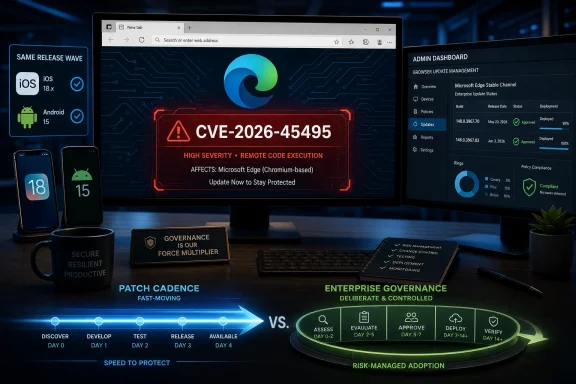
 Microsoft’s Edge Patch Is Small on Paper and Large in Blast Radius
CVE-2026-45495 arrived as one of several Microsoft Edge-specific security fixes bundled into the Edge 148 stable release. Microsoft’s public language is sparse: the bug is described as a remote code execution vulnerability in Chromium-based Edge, with a high CVSS score and user interaction required. That is enough to establish operational urgency, but not enough to satisfy anyone hoping for a neat root-cause write-up.
That ambiguity is normal for browser vulnerabilities. Vendors often disclose just enough for defenders to prioritize remediation without handing attackers a roadmap. In this case, the available record points to a bug that can be triggered over the network, requires no privileges, requires the user to interact with malicious content, and can affect confidentiality, integrity, and availability at a high level.
For Windows users, that usually means the classic browser attack shape: a crafted page, document-rendering path, extension-adjacent surface, or web content flow that reaches vulnerable code after the user visits or opens something. It does not necessarily mean a wormable flaw, and it does not mean an attacker can compromise an untouched machine from across the internet. But it does mean the browser is the front door, and the front door is open all day.
The affected-version story is cleaner than the technical story. Edge builds before 148.0.3967.70 are the practical concern for the May 15 desktop release, while Microsoft later shipped 148.0.3967.83 on May 21 as the latest stable build in the same branch. Mobile Edge also received CVE-2026-45495 references in the May 19 iOS and May 21 Android updates. That cross-platform appearance is a reminder that “Edge” is not a single binary so much as a product family wrapped around Chromium, Microsoft services, and platform-specific code.
The Report Confidence Is the Story Microsoft Does Not Spell Out
The user-facing phrase “remote code execution” does a lot of emotional work, but the more useful lens is report confidence. In vulnerability scoring, report confidence asks how sure we are that the vulnerability exists and how credible the known technical details are. It is a measure of certainty, not severity.
For CVE-2026-45495, the confidence picture is stronger than the public write-up might suggest. This is not a rumor from a paste site, a half-reproduced crash, or a speculative bug class inferred from a code diff. It has a Microsoft CVE entry, appears in Microsoft Edge security release notes, and is tied to concrete fixed builds. That is vendor acknowledgement, which is the highest practical tier of confidence for most enterprise triage.
What remains low is technical detail availability. We do not have a public root cause from Microsoft in the advisory text, and the public ecosystem is mostly repeating Microsoft’s framing rather than adding independent reverse engineering. That distinction matters. Defenders can be highly confident that the vulnerability exists while still knowing little about how exploitation works.
This is where some scoring systems confuse non-specialists. A vulnerability can be both real and opaque. Lack of public exploit detail should not be read as lack of risk; it should be read as a temporary information gap. The most dangerous window is often the one after a patch ships but before every endpoint has it, because attackers can begin patch-diffing while defenders are still waiting for update rings to converge.
A Browser RCE With User Interaction Is Still a Browser RCE
The CVSS vector associated with CVE-2026-45495 includes user interaction, which will tempt some organizations to downgrade it mentally. That is a mistake. Browser vulnerabilities almost always rely on the user doing something mundane: clicking a link, visiting a compromised site, opening a malicious page, or interacting with content delivered through a trusted workflow.
“User interaction required” does not mean “hard to exploit.” It means the attacker needs to steer a person into the vulnerable path. Phishing, malvertising, SEO poisoning, compromised legitimate websites, and chat links all exist to solve precisely that problem. In a browser context, user interaction is not a major obstacle; it is the normal delivery mechanism.
The vulnerability’s low attack complexity is the more important signal. Low complexity means successful exploitation is not expected to depend on rare environmental conditions or elaborate race timing from the attacker’s perspective. Combined with no privileges required and high impact ratings, the result is the kind of bug security teams patch quickly even when there is no public proof-of-concept.
The unchanged scope rating is also worth parsing. It suggests exploitation affects the security authority of the vulnerable component rather than automatically crossing into another trust boundary. In browser terms, that may still be serious. Modern browsers have sandboxing, site isolation, renderer boundaries, broker processes, and operating system mitigations, but a browser RCE can still be a foothold, a data-theft vector, or one link in a chain.
Edge’s Chromium Inheritance Cuts Both Ways
Microsoft Edge’s move to Chromium gave users a more compatible browser and gave administrators a more predictable patching model. It also means Edge inherits the tempo of Chromium security engineering: rapid releases, frequent fixes, and a constant background stream of memory safety, rendering, JavaScript, media, graphics, and platform integration bugs. That is the price of participating in the modern web.
CVE-2026-45495 is described as Microsoft Edge-specific, not merely a Chromium bug flowing downstream from Google’s project. That distinction matters because Edge is not just Chrome with a different icon. It includes Microsoft account integration, enterprise policy layers, sidebar and Copilot features, password manager behavior, SmartScreen integration, shopping and wallet components, sync paths, and platform hooks that can create Microsoft-specific attack surfaces.
The May 15 Edge 148 release is a good example of how security and product engineering now travel together. The same release line that fixed CVE-2026-45495 also changed password manager behavior so saved passwords no longer load into memory at startup. That is not the same vulnerability, but it shows Microsoft tuning Edge around post-exploitation realities: once code execution or process compromise is in play, secrets already resident in memory become part of the blast radius.
This is also why “just use another Chromium browser” is not a complete risk answer. Chrome, Edge, Brave, Vivaldi, and other Chromium-based browsers share plenty of code, but they do not share every feature, policy, updater, service integration, or platform-specific wrapper. A Chromium bug can be broad; an Edge-specific bug can be narrower but still widespread because Edge is preinstalled, enterprise-managed, and deeply present on Windows.
Patch Cadence Is Now a Security Boundary
The practical defense for CVE-2026-45495 is not clever: update Edge. The strategic question is whether your organization can prove that it did. Browser patching has become a security boundary as real as firewall policy or endpoint detection coverage.
Consumer Windows machines usually receive Edge updates automatically through Microsoft’s update mechanisms. But “usually” is doing a lot of work. Update services can be disabled, metered networks can delay activity, profile corruption can break update checks, managed policies can pin versions, and VDI or golden-image environments can freeze browsers longer than intended.
Enterprise environments add another layer of complexity. Many organizations use update rings, validation groups, app compatibility holds, and phased deployments. Those practices are reasonable for operating system feature updates; they become more dangerous when applied too slowly to browsers. A browser is a high-frequency exposure surface, and a high-severity RCE should not wait for the same governance cycle as a cosmetic UI change.
The minimum operational bar is simple: inventory Edge versions, identify anything below 148.0.3967.70 on desktop, and move those systems forward. Where possible, 148.0.3967.83 or later is the cleaner target because it incorporates subsequent security updates in the same stable branch. On iOS and Android, the task is less about Windows Update and more about mobile device management, app store update compliance, and whether Edge is actually in use as the managed browser.
The Absence of a Public Exploit Is Not a Comfort Blanket
There is no widely established public proof-of-concept for CVE-2026-45495 in the available reporting. That is good news, but it is not the same as safety. Public exploit availability is a lagging indicator, and browser bugs are especially prone to post-patch analysis.
Once a fixed build is available, researchers and attackers can compare old and new binaries, inspect Chromium and Edge-related changes where visible, and hunt for the code path behind the CVE. Microsoft’s sparse advisory reduces the initial signal, but it does not eliminate the forensic trail. Patch diffing has been part of vulnerability exploitation for decades, and modern automation only narrows the gap between disclosure and weaponization.
This is why the confidence metric matters more than exploit chatter. A vendor-confirmed, high-impact, low-complexity browser RCE deserves action even without exploit code in the wild. Waiting for exploitation telemetry is a strategy for organizations that want to be part of the telemetry.
There is also an asymmetry here. Defenders need broad deployment success across thousands of endpoints, multiple platforms, remote users, and occasionally broken update channels. Attackers need a subset of users who remain behind. The larger and more heterogeneous the Windows estate, the more likely it is that “we patched Edge” really means “most machines probably patched Edge.”
The Enterprise Risk Is Not the CVE; It Is the Exception List
The hardest machines to patch are often the most interesting ones. Kiosks, lab systems, call-center desktops, jump boxes, shared workstations, training rooms, medical carts, factory terminals, and long-lived VDI pools all have a way of drifting away from the happy path. They may not look like high-value assets in a spreadsheet, but they often sit close to credentials, intranet apps, or operational workflows.
Edge’s ubiquity makes this worse. An organization might standardize on Chrome or Firefox while still leaving Edge installed and usable. Users may launch it accidentally, applications may invoke it through default handlers, and Windows features may route web content through Microsoft’s browser components. “Not our primary browser” is not the same as “not exposed.”
Administrators should also be careful with extended stable assumptions. Extended stable channels are useful for reducing change velocity, but they are not a license to defer security thinking. When Microsoft ships Edge-specific fixes across stable channels, the job is to confirm the channel-appropriate fixed build rather than assume the major version tells the whole story.
The policy angle is equally important. Edge update controls, rollback settings, target channel policies, and application control rules can all create unexpected pockets of exposure. A security team that only asks for the installed version misses the more durable question: why was that version installed, and what will prevent the same lag during the next browser RCE?
The Password Manager Change Shows Microsoft Is Thinking Past the Patch
The Edge 148 release also changed how the browser handles saved passwords at startup, preventing passwords from loading into memory before they are needed. That change should not be conflated with CVE-2026-45495, but its timing is hard to ignore in a broader security sense. Microsoft is reducing the value of a compromised browser process by narrowing what secrets are conveniently present in memory.
This is the kind of defensive engineering that does not always get the same attention as CVE counts. A browser compromise is bad; a browser compromise with immediate access to resident secrets is worse. Reducing unnecessary memory exposure does not stop RCE, but it can change what an attacker gets after the first step.
For WindowsForum readers, this is a useful reminder that browser security is not just patching the bug of the week. It is a stack of mitigations: sandboxing, exploit protection, site isolation, credential handling, phishing protection, update hygiene, extension control, and user training. CVE-2026-45495 belongs in that stack, not in isolation.
The change also reflects a broader industry trend. Vendors increasingly assume that some bugs will escape review and that some users will encounter hostile content. The goal is no longer just to prevent every memory corruption flaw or input validation mistake; it is to reduce exploit reliability, limit post-exploitation value, and accelerate recovery when the inevitable bug ships.
Security Teams Should Treat Edge Like Infrastructure
There was a time when browsers were treated like user preference software. That era is over. Edge is now an enterprise access layer for SaaS, identity, collaboration, admin portals, internal dashboards, password managers, device compliance flows, and AI assistants. A browser RCE is therefore not just a desktop problem; it is an identity and data-access problem.
That framing changes prioritization. If a vulnerable Edge build runs on a machine used to access Microsoft 365 admin centers, cloud consoles, privileged SaaS dashboards, or internal management tools, the severity is not captured by the CVSS score alone. The browser is the session container for the modern enterprise.
It also changes monitoring. Security teams should be watching browser version distribution with the same seriousness they apply to endpoint agent health. A dashboard that shows Windows build compliance but not browser build compliance is incomplete. So is a vulnerability management program that scans servers beautifully while letting user endpoints drift.
For smaller organizations, the message is less grand but just as practical. Open Edge, check the version, let it update, restart the browser, and do not assume Windows Update has already done it. For managed fleets, use Intune, Group Policy, Defender Vulnerability Management, third-party RMM, or whatever inventory tool you trust — but verify the version after the update, not merely the deployment job.
The May 2026 Edge Fix Leaves a Short, Practical Checklist
CVE-2026-45495 is not a mystery in the way defenders care about most. Microsoft has acknowledged it, shipped fixes, and tied it to specific Edge releases. The mystery is technical, not operational, and that means the correct response is disciplined patch verification rather than waiting for a deeper postmortem.
- Organizations should treat Edge desktop builds earlier than 148.0.3967.70 as exposed to the May 15 CVE-2026-45495 fix gap.
- Administrators should prefer moving users to 148.0.3967.83 or later where available, because later stable builds include additional security fixes from the same release train.
- Mobile fleets using Edge on iOS or Android should be checked separately, because mobile app update compliance does not automatically follow Windows desktop patch logic.
- The lack of public exploit code should not delay remediation, because vendor confirmation and low-complexity browser exposure are enough to justify urgency.
- Edge should be inventoried even in organizations that standardize on another browser, because installed and callable software still contributes to attack surface.
- Update policies, rollback settings, frozen images, and exception groups should be reviewed after remediation so the next Edge RCE does not find the same stale machines.
The broader lesson of CVE-2026-45495 is that the browser has become too important to manage casually and too exposed to patch slowly. Microsoft can tighten memory handling, ship rapid Edge builds, and keep advisory details sparse for good reasons, but none of that substitutes for endpoint reality. The organizations that come out ahead will be the ones that treat browser version drift as a live security condition, not an audit artifact discovered weeks after the exploit window opens.
