

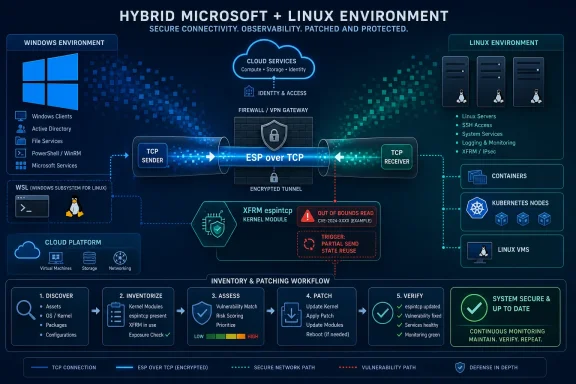
CVE-2026-52935 is a Linux kernel vulnerability disclosed through Microsoft’s Security Update Guide in late June 2026, affecting the XFRM subsystem’s ESP-in-TCP path where an unfinished partial send can be reused and trigger an out-of-bounds read in kernel networking code. The bug is not a Windows desktop flaw, but Microsoft publishing it is still a reminder that the Windows ecosystem now includes Linux in very practical places: WSL, Azure, containers, appliances, and hybrid infrastructure. The security lesson is less about panic and more about inventory. If your Microsoft estate runs Linux kernels anywhere, “not Windows” is no longer the same thing as “not my problem.”
There was a time when a Linux kernel CVE appearing under Microsoft’s security umbrella would have looked like a category error. That time is gone. Microsoft ships, hosts, brokers, secures, and documents Linux across Azure, developer tooling, container platforms, and enterprise security products, so a kernel bug in a narrow networking subsystem can legitimately surface in a Microsoft-facing vulnerability workflow.
CVE-2026-52935 sits in the Linux kernel’s XFRM framework, the machinery behind IPsec policy and transformation handling. More specifically, it involves
The underlying failure is a state-management mistake. The affected code keeps a single in-flight transmit object and, under certain blocking-send behavior, can treat a previous partial send as cleared when it is still pending. The next send can then overwrite live state, leaving stale offsets attached to a new message structure and creating the conditions for an out-of-bounds read.
That description sounds small, almost clerical. In kernel security, clerical mistakes are often where the worst bugs begin. A stale pointer, a reused buffer, or a half-finished state transition is not merely a coding style issue; it is the kind of ambiguity attackers look for when they try to turn normal system behavior into memory disclosure, instability, or privilege-oriented primitives.
Networking stacks are full of partial success. A send may not complete because buffers are full, the peer is slow, the socket is blocking, or the kernel is waiting for resources. Good network code must cope with those cases without losing the logical identity of the data being sent. Security bugs appear when the code accidentally treats “not failed” as “done.”
In CVE-2026-52935, the vulnerable path reportedly lets
That kind of fix is boring in the best possible way. It does not redesign IPsec, invent a new mitigation, or bolt on a policy layer. It preserves the invariant the subsystem should have honored all along: one in-flight transmit means one in-flight transmit.
But attention is not the same as alarmism. CVE-2026-52935 is tied to a specific Linux networking component and a specific ESP-over-TCP path. Systems that do not use this path are less exposed than systems that actively rely on IPsec-over-TCP behavior. That distinction matters, because enterprise patching has become a triage discipline as much as a compliance exercise.
The practical risk is highest where Linux kernels are exposed to complex networking workloads, VPN-like traffic patterns, containerized network functions, or appliances that lean on IPsec encapsulation. It is lower on general-purpose systems that never load or exercise the affected code. Still, “we do not think we use it” is not the same as proof, especially in environments where kernel modules, container hosts, and cloud images are managed by different teams.
This is the point where administrators should resist the temptation to read a CVE title and mentally file it under someone else’s platform. A Windows-heavy shop can still have Linux kernels in developer laptops through WSL, in CI runners, in Kubernetes nodes, in network security appliances, and in Azure-hosted workloads. The asset inventory, not the corporate desktop standard, determines exposure.
For WindowsForum readers, however, the Microsoft angle is still important. Microsoft’s customer base increasingly consumes Linux as part of Microsoft-managed or Microsoft-adjacent systems. Azure Linux images, container hosts, managed Kubernetes nodes, Defender coverage for Linux workloads, and WSL-based developer workflows all blur the old operating-system boundary.
WSL deserves careful wording. WSL 2 uses a Microsoft-provided Linux kernel, but exposure depends on whether the affected code is present, reachable, and exercised in that environment. A developer simply running Ubuntu userland tools under WSL is not automatically in the same risk category as a server routing IPsec-over-TCP traffic. But organizations that standardize WSL for engineering should still track kernel update cadence rather than assuming Windows Update alone answers every Linux-side question.
The same is true in Azure. A Windows admin may not personally manage a Linux VM, but the business may rely on Linux-based build systems, container registries, ingress controllers, VPN endpoints, or third-party virtual appliances. CVE-2026-52935 is a reminder that platform responsibility follows workloads, not job titles.
That means the right question is not simply, “Is Linux vulnerable?” The better question is, “Which kernels in our environment include the affected code, and which vendor package contains the backported fix?” Enterprise Linux vendors routinely backport security patches without changing to the newest upstream kernel version, so version numbers can mislead if read casually.
The CVE record indicates the affected file is
This is where disciplined vulnerability management pays off. If your scanner only says “Linux kernel vulnerable” without correlating the installed package, backport status, and runtime exposure, it is creating work rather than reducing risk. If your patch process can map CVE records to distribution advisories and deployed kernel builds, CVE-2026-52935 becomes a manageable maintenance item.
At the time of disclosure, the public framing around CVE-2026-52935 emphasizes the resolved kernel bug and the need to update rather than confirmed widespread exploitation. That distinction matters. Security teams should patch, but they should not rewrite their incident response plan around a speculative exploit chain without evidence.
The more realistic near-term concern is exposure in systems that process untrusted or semi-trusted network traffic through the affected path. An attacker who can influence ESP-over-TCP send behavior may have more room to exercise the bug than a local user on a locked-down desktop. Still, the exact exploitability depends on kernel configuration, reachable interfaces, traffic patterns, and surrounding mitigations.
Memory-safety bugs in networking code often age poorly. A flaw that looks hard to exploit on day one can become more interesting once researchers understand heap layout, reachable triggers, and adjacent primitives. That is why the sober answer is to patch without theatrics.
That is why a bug in
The risk is also asymmetric. A general-purpose server may never touch ESP-in-TCP, while a VPN concentrator or network appliance may depend on it constantly. A container host may not be configured for it directly, while a privileged network function container might bring the relevant path into play. That variability is exactly why blanket statements are unhelpful.
Administrators should treat the CVE as an inventory prompt. Find the systems with IPsec, XFRM-heavy workloads, custom networking, or vendor VPN components. Then ask whether those systems run kernels that include the fix. The answer will often be reassuring, but it should be earned.
That does not mean every Windows admin must become a kernel developer. It means the team needs enough fluency to understand when a Linux CVE matters, where the affected component might live, and how vendor kernel updates are delivered. In 2026, the phrase “Microsoft environment” can include a surprising amount of Linux.
The most dangerous operational gap is ownership. WSL may belong to developer experience, Azure Linux nodes to the cloud team, third-party appliances to networking, and vulnerability scanning to security operations. CVE-2026-52935 is the sort of issue that can fall between those groups because each assumes another team owns the Linux layer.
A healthy organization assigns responsibility by asset class and runtime reality. If a system boots a Linux kernel, someone owns kernel patching. If a Windows workstation runs WSL for production-adjacent development, someone owns WSL update policy. If a cloud service depends on Linux nodes, someone owns node image refreshes. That is not bureaucracy; it is how hybrid estates stop becoming blind spots.
For bare-metal and VM Linux servers, the familiar pattern applies: install the vendor’s updated kernel package, reboot into it, and verify the running kernel rather than the installed package list. For container hosts, patching the host kernel is what matters; rebuilding application containers will not fix a vulnerable host kernel. For managed Kubernetes, the answer may be a node image upgrade or node pool rotation rather than a traditional package update.
For WSL, administrators should think in terms of the WSL kernel distribution mechanism and organizational update controls. Individual developers may not know or care which kernel build WSL is using. In enterprise environments, that ignorance is normal and should be accounted for in policy.
For appliances, the answer is often less satisfying. The vendor may need to publish firmware, a virtual appliance update, or a maintenance release that includes the fixed kernel. Security teams should ask vendors directly whether their products include the affected
A CVE entry can tell you a bug exists. It can describe the vulnerable subsystem, point to fixed code, and summarize impact. It cannot tell you whether an old VPN appliance in a branch office is quietly running an affected kernel, whether a developer lab has drifted outside update policy, or whether a managed node image has actually rolled across every cluster.
That burden sits with the organization. Security guidance is not a substitute for asset management, change control, and verification. A vulnerability database is a map; it is not the terrain.
This is especially true for hybrid Microsoft environments. The fact that an advisory appears in Microsoft’s ecosystem may cause Windows teams to notice it, but remediation may require Linux package management, cloud node rotation, vendor firmware, or network architecture review. The work crosses the same boundaries the infrastructure does.
For enthusiasts, the bug is interesting because it shows how subtle kernel state bugs emerge in mature networking code. The vulnerable path is not new-user territory; it is the kind of subsystem most people never configure directly. Yet the consequences still trace back to a classic failure: live state was reused before it was truly finished.
For IT pros, the message is sharper. Look beyond the Windows endpoints and inspect the Linux surfaces in your Microsoft estate. Cloud images, container hosts, security appliances, VPN endpoints, CI runners, and WSL deployments deserve at least a quick exposure check.
For security teams, this is a prioritization exercise rather than a panic drill. Systems using IPsec-over-TCP or carrying complex XFRM workloads should move higher in the queue. Systems with no reachable path to the affected component can follow normal kernel patch cadence, provided that assessment is documented rather than assumed.
 Microsoft’s Linux CVE Is a Sign of the Platform Microsoft Now Operates
There was a time when a Linux kernel CVE appearing under Microsoft’s security umbrella would have looked like a category error. That time is gone. Microsoft ships, hosts, brokers, secures, and documents Linux across Azure, developer tooling, container platforms, and enterprise security products, so a kernel bug in a narrow networking subsystem can legitimately surface in a Microsoft-facing vulnerability workflow.CVE-2026-52935 sits in the Linux kernel’s XFRM framework, the machinery behind IPsec policy and transformation handling. More specifically, it involves
espintcp, the path that carries ESP traffic over TCP. That is already a clue about the scope: this is not a universal “every laptop is on fire” bug, but a flaw in specialized networking code used when encrypted IPsec traffic is encapsulated in a way that can traverse TCP-friendly environments.The underlying failure is a state-management mistake. The affected code keeps a single in-flight transmit object and, under certain blocking-send behavior, can treat a previous partial send as cleared when it is still pending. The next send can then overwrite live state, leaving stale offsets attached to a new message structure and creating the conditions for an out-of-bounds read.
That description sounds small, almost clerical. In kernel security, clerical mistakes are often where the worst bugs begin. A stale pointer, a reused buffer, or a half-finished state transition is not merely a coding style issue; it is the kind of ambiguity attackers look for when they try to turn normal system behavior into memory disclosure, instability, or privilege-oriented primitives.
The Bug Lives in the Space Between Correct Networking and Correct Memory Ownership
The most important phrase in the advisory is not “Linux kernel” or even “out-of-bounds read.” It is “in-progress partial send.” That phrase tells us this is a concurrency and lifecycle bug, where the software’s mental model of ownership diverges from what is actually happening in memory.Networking stacks are full of partial success. A send may not complete because buffers are full, the peer is slow, the socket is blocking, or the kernel is waiting for resources. Good network code must cope with those cases without losing the logical identity of the data being sent. Security bugs appear when the code accidentally treats “not failed” as “done.”
In CVE-2026-52935, the vulnerable path reportedly lets
espintcp_sendmsg() attempt to flush an existing partial message and then proceed as though it can build a new one. If the previous message is still alive, rebuilding the send message corrupts that live state. The fix is conceptually simple: do not rebuild when the partial send still exists; fail the new send rather than overwrite the one already in progress.That kind of fix is boring in the best possible way. It does not redesign IPsec, invent a new mitigation, or bolt on a policy layer. It preserves the invariant the subsystem should have honored all along: one in-flight transmit means one in-flight transmit.
Severity Is Real, but the Blast Radius Is Not Universal
Security teams are trained to react quickly to kernel CVEs, and for good reason. The kernel is the boundary between ordinary software and the machine itself. When memory safety fails there, the bug deserves attention even if exploitation is not straightforward.But attention is not the same as alarmism. CVE-2026-52935 is tied to a specific Linux networking component and a specific ESP-over-TCP path. Systems that do not use this path are less exposed than systems that actively rely on IPsec-over-TCP behavior. That distinction matters, because enterprise patching has become a triage discipline as much as a compliance exercise.
The practical risk is highest where Linux kernels are exposed to complex networking workloads, VPN-like traffic patterns, containerized network functions, or appliances that lean on IPsec encapsulation. It is lower on general-purpose systems that never load or exercise the affected code. Still, “we do not think we use it” is not the same as proof, especially in environments where kernel modules, container hosts, and cloud images are managed by different teams.
This is the point where administrators should resist the temptation to read a CVE title and mentally file it under someone else’s platform. A Windows-heavy shop can still have Linux kernels in developer laptops through WSL, in CI runners, in Kubernetes nodes, in network security appliances, and in Azure-hosted workloads. The asset inventory, not the corporate desktop standard, determines exposure.
The Microsoft Angle Is About Hybrid Reality, Not Windows Panic
The presence of this advisory in Microsoft’s orbit should not be misread as evidence that Windows itself is vulnerable. The described flaw is in Linux kernel code, not the Windows NT kernel. For ordinary Windows 10 or Windows 11 users who do not run Linux environments, there is no reason to treat CVE-2026-52935 like a monthly cumulative update emergency.For WindowsForum readers, however, the Microsoft angle is still important. Microsoft’s customer base increasingly consumes Linux as part of Microsoft-managed or Microsoft-adjacent systems. Azure Linux images, container hosts, managed Kubernetes nodes, Defender coverage for Linux workloads, and WSL-based developer workflows all blur the old operating-system boundary.
WSL deserves careful wording. WSL 2 uses a Microsoft-provided Linux kernel, but exposure depends on whether the affected code is present, reachable, and exercised in that environment. A developer simply running Ubuntu userland tools under WSL is not automatically in the same risk category as a server routing IPsec-over-TCP traffic. But organizations that standardize WSL for engineering should still track kernel update cadence rather than assuming Windows Update alone answers every Linux-side question.
The same is true in Azure. A Windows admin may not personally manage a Linux VM, but the business may rely on Linux-based build systems, container registries, ingress controllers, VPN endpoints, or third-party virtual appliances. CVE-2026-52935 is a reminder that platform responsibility follows workloads, not job titles.
Kernel Fixes Travel Through Distributions, Not Just Headlines
One of the recurring frustrations with Linux kernel CVEs is that the public vulnerability record often speaks in upstream commit language, while administrators live in distribution package versions. A fix may land in mainline Linux, then in stable branches, then in Ubuntu, Debian, Red Hat, SUSE, Amazon Linux, Azure Linux, or vendor appliance builds on different schedules.That means the right question is not simply, “Is Linux vulnerable?” The better question is, “Which kernels in our environment include the affected code, and which vendor package contains the backported fix?” Enterprise Linux vendors routinely backport security patches without changing to the newest upstream kernel version, so version numbers can mislead if read casually.
The CVE record indicates the affected file is
net/xfrm/espintcp.c, and the fix revolves around preserving partial-send state rather than allowing reuse. Upstream stable branches have associated fix commits, and distribution trackers are beginning to reflect the issue. But in a production environment, the authoritative answer will come from the vendor shipping the kernel you actually boot.This is where disciplined vulnerability management pays off. If your scanner only says “Linux kernel vulnerable” without correlating the installed package, backport status, and runtime exposure, it is creating work rather than reducing risk. If your patch process can map CVE records to distribution advisories and deployed kernel builds, CVE-2026-52935 becomes a manageable maintenance item.
The Exploit Story Is Less Clear Than the Memory-Safety Story
The technical write-up points to an out-of-bounds read in the send path, which is serious but not automatically equivalent to remote code execution. Memory disclosure and kernel instability can be valuable to attackers, especially when chained with other bugs, but there is a large gap between a kernel memory-safety flaw and a reliable weaponized exploit.At the time of disclosure, the public framing around CVE-2026-52935 emphasizes the resolved kernel bug and the need to update rather than confirmed widespread exploitation. That distinction matters. Security teams should patch, but they should not rewrite their incident response plan around a speculative exploit chain without evidence.
The more realistic near-term concern is exposure in systems that process untrusted or semi-trusted network traffic through the affected path. An attacker who can influence ESP-over-TCP send behavior may have more room to exercise the bug than a local user on a locked-down desktop. Still, the exact exploitability depends on kernel configuration, reachable interfaces, traffic patterns, and surrounding mitigations.
Memory-safety bugs in networking code often age poorly. A flaw that looks hard to exploit on day one can become more interesting once researchers understand heap layout, reachable triggers, and adjacent primitives. That is why the sober answer is to patch without theatrics.
IPsec Encapsulation Is Niche Until It Is Business-Critical
For many desktop users, IPsec is invisible infrastructure. For enterprises, it is the plumbing behind site-to-site VPNs, cloud connectivity, secure tunnels, and specialized overlay designs. ESP-over-TCP exists because real networks are messy: middleboxes block, NATs interfere, and organizations sometimes need encrypted traffic to survive paths that do not handle native ESP gracefully.That is why a bug in
espintcp should not be dismissed merely because it sounds obscure. Infrastructure features are often obscure to users and essential to the business. The more specialized the component, the more likely it is to be operated by a small team that already carries too many responsibilities.The risk is also asymmetric. A general-purpose server may never touch ESP-in-TCP, while a VPN concentrator or network appliance may depend on it constantly. A container host may not be configured for it directly, while a privileged network function container might bring the relevant path into play. That variability is exactly why blanket statements are unhelpful.
Administrators should treat the CVE as an inventory prompt. Find the systems with IPsec, XFRM-heavy workloads, custom networking, or vendor VPN components. Then ask whether those systems run kernels that include the fix. The answer will often be reassuring, but it should be earned.
Windows Administrators Need a Linux Kernel Habit
The deeper story here is cultural. Windows administrators have spent years expanding their remit from domain controllers and Group Policy to Entra ID, Intune, Defender, Azure, containers, and identity-driven access. Linux kernel literacy is now part of that same expansion, whether or not anyone formally changed the job description.That does not mean every Windows admin must become a kernel developer. It means the team needs enough fluency to understand when a Linux CVE matters, where the affected component might live, and how vendor kernel updates are delivered. In 2026, the phrase “Microsoft environment” can include a surprising amount of Linux.
The most dangerous operational gap is ownership. WSL may belong to developer experience, Azure Linux nodes to the cloud team, third-party appliances to networking, and vulnerability scanning to security operations. CVE-2026-52935 is the sort of issue that can fall between those groups because each assumes another team owns the Linux layer.
A healthy organization assigns responsibility by asset class and runtime reality. If a system boots a Linux kernel, someone owns kernel patching. If a Windows workstation runs WSL for production-adjacent development, someone owns WSL update policy. If a cloud service depends on Linux nodes, someone owns node image refreshes. That is not bureaucracy; it is how hybrid estates stop becoming blind spots.
The Fix Is Simple; Proving You Have It Is the Work
Technically, the fix preserves the send-state invariant inespintcp. Operationally, the fix is whatever kernel package or image update your vendor ships. Those are very different things.For bare-metal and VM Linux servers, the familiar pattern applies: install the vendor’s updated kernel package, reboot into it, and verify the running kernel rather than the installed package list. For container hosts, patching the host kernel is what matters; rebuilding application containers will not fix a vulnerable host kernel. For managed Kubernetes, the answer may be a node image upgrade or node pool rotation rather than a traditional package update.
For WSL, administrators should think in terms of the WSL kernel distribution mechanism and organizational update controls. Individual developers may not know or care which kernel build WSL is using. In enterprise environments, that ignorance is normal and should be accounted for in policy.
For appliances, the answer is often less satisfying. The vendor may need to publish firmware, a virtual appliance update, or a maintenance release that includes the fixed kernel. Security teams should ask vendors directly whether their products include the affected
espintcp code path and whether CVE-2026-52935 is remediated, not merely whether “Linux vulnerabilities are addressed.”The Advisory Disclaimer Is Boilerplate, but the Operational Risk Is Yours
The Microsoft Knowledge Base disclaimer attached to this CVE is standard legal armor: information provided as-is, no warranties, no liability for damages. It is easy to ignore because it appears everywhere. But in security operations, the disclaimer reflects a real truth: advisory publishers do not run your environment.A CVE entry can tell you a bug exists. It can describe the vulnerable subsystem, point to fixed code, and summarize impact. It cannot tell you whether an old VPN appliance in a branch office is quietly running an affected kernel, whether a developer lab has drifted outside update policy, or whether a managed node image has actually rolled across every cluster.
That burden sits with the organization. Security guidance is not a substitute for asset management, change control, and verification. A vulnerability database is a map; it is not the terrain.
This is especially true for hybrid Microsoft environments. The fact that an advisory appears in Microsoft’s ecosystem may cause Windows teams to notice it, but remediation may require Linux package management, cloud node rotation, vendor firmware, or network architecture review. The work crosses the same boundaries the infrastructure does.
The Practical Read for WindowsForum Readers
For home users, this CVE is unlikely to be a front-page emergency unless they run Linux kernels for networking experiments, VPN infrastructure, or WSL-heavy development. Keeping systems updated remains the right answer. There is no evidence from the CVE title alone that an ordinary Windows desktop is exposed.For enthusiasts, the bug is interesting because it shows how subtle kernel state bugs emerge in mature networking code. The vulnerable path is not new-user territory; it is the kind of subsystem most people never configure directly. Yet the consequences still trace back to a classic failure: live state was reused before it was truly finished.
For IT pros, the message is sharper. Look beyond the Windows endpoints and inspect the Linux surfaces in your Microsoft estate. Cloud images, container hosts, security appliances, VPN endpoints, CI runners, and WSL deployments deserve at least a quick exposure check.
For security teams, this is a prioritization exercise rather than a panic drill. Systems using IPsec-over-TCP or carrying complex XFRM workloads should move higher in the queue. Systems with no reachable path to the affected component can follow normal kernel patch cadence, provided that assessment is documented rather than assumed.
The Small Kernel Bug That Tests a Big Estate
CVE-2026-52935 will not be remembered as the defining vulnerability of 2026 unless exploitation details change dramatically, but it is a useful test of how mature an organization’s hybrid operations have become. The concrete lessons are straightforward:- Confirm whether any Linux kernels in your environment include and use the XFRM ESP-over-TCP code path affected by CVE-2026-52935.
- Prioritize VPN, IPsec, network appliance, container host, and cloud node workloads before ordinary systems with no plausible exposure to
espintcp. - Track distribution and vendor advisories rather than relying only on upstream kernel version numbers, because enterprise kernels often receive backported fixes.
- Verify the running kernel after patching, since installing a fixed kernel package does not protect a system that has not rebooted into it.
- Include WSL, Azure-hosted Linux, managed Kubernetes nodes, CI infrastructure, and third-party appliances in the inventory review, not just servers labeled “Linux.”
References
- Primary source: MSRC
Published: 2026-07-03T01:02:31-07:00
Security Update Guide - Microsoft Security Response Center
 msrc.microsoft.com
- Related coverage: sentinelone.com
CVE-2026-52935: Linux Kernel Use-After-Free Vulnerability
CVE-2026-52935 is a use-after-free vulnerability in Linux kernel's espintcp. Learn about its impact, affected versions, and mitigation methods.www.sentinelone.com
- Official source: microsoft.com
MSRC - Microsoft Security Response Center
The Microsoft Security Response Center is part of the defender community and on the front line of security response evolution. For over twenty years, we have been engaged with security researchers working to protect customers and the broader ecosystem.www.microsoft.com
- Official source: learn.microsoft.com
Security Advisories and Bulletins | Microsoft Learn
learn.microsoft.com - Related coverage: osv.dev

OSV - Open Source Vulnerabilities
Comprehensive vulnerability database for your open source projects and dependencies.
osv.dev
