

CVE-2026-41035 is a newly cataloged rsync vulnerability affecting versions 3.0.1 through 3.4.1, disclosed in April 2026, in which receivers using
Rsync’s enduring appeal is that it does one boring job unusually well: move file trees efficiently, especially when only a small portion of the data has changed. That is why it appears everywhere from Linux servers and BSD boxes to backup appliances, CI/CD runners, developer laptops, NAS devices, container images, and ad hoc migration scripts written long before today’s administrator inherited the environment.
CVE-2026-41035 narrows the blast radius with an important condition. The receiver must run rsync with
The vulnerable range, rsync 3.0.1 through 3.4.1, is broad enough to matter. It covers years of deployments, distro packages, bundled copies, and embedded builds. In many environments, rsync is not treated like a first-class application with its own patch calendar; it is treated like plumbing.
That is the discomforting part. Plumbing fails quietly until it fails loudly.
That explains why the CVE description draws a distinction between Linux and non-Linux platforms. On Linux, “many but not all” common configurations are vulnerable. On non-Linux systems, the advisory language says exposure is broader. That difference is less a footnote than a reminder that rsync is a cross-platform protocol and codebase operating across filesystems with very different ideas about what a file actually is.
For WindowsForum readers, this matters because Windows estates increasingly contain Linux and Unix semantics by design. WSL gives developers Linux userlands on Windows desktops. Azure workloads routinely mix Windows Server, Linux VMs, containers, and managed storage. Backup products and NAS systems expose SMB on one side and rsync on another. A vulnerability in a Unix synchronization utility can sit inside a Microsoft-heavy shop without showing up in the usual Windows Update mental model.
The most dangerous assumption is that “we do Windows” means “we don’t run rsync.” In 2026, that sentence is often false.
Use-after-free bugs are a familiar class of memory-safety failure. They can produce crashes, inconsistent state, and, in more severe cases, exploitation paths that depend on heap behavior, allocator details, platform behavior, and attacker control over surrounding memory. The advisory language here emphasizes reduced performance or interruptions in availability rather than a guaranteed catastrophic compromise.
That distinction matters, but it should not lull administrators into indifference. Availability bugs in file synchronization systems are operational bugs, and operational bugs can become security bugs when they disrupt backup jobs, mirror updates, package distribution, deployment pipelines, or recovery workflows. A sync receiver that intermittently falls over may not look like ransomware, but it can still break the assumptions behind resilience.
The nuance is that CVE scoring and real-world consequence rarely line up perfectly. A vulnerability can have “low” direct impact on confidentiality, integrity, and availability while still landing in a high-value maintenance window because the affected tool sits in the middle of something important.
That is the right move. Attackers do not care whether a vulnerable binary came from Redmond, a Linux distribution, a NAS vendor, a package manager, or a Docker base image. They care whether it is reachable, whether it processes attacker-controlled input, and whether it runs in a context worth abusing.
For administrators, the practical consequence is that Patch Tuesday cannot be the whole patch strategy. Windows Update is necessary, but it does not update every rsync binary hiding in an appliance, container, WSL image, GitHub Actions runner, Cygwin/MSYS2 environment, or custom backup host. The estate boundary is no longer the Windows installation boundary.
This is where vulnerability management becomes less glamorous and more important. Inventory beats intuition. If rsync exists in your environment, the next question is not whether the organization is “a Linux shop.” The question is which version is installed, how it is invoked, and whether
But backup and migration jobs are not casual. The more serious the job, the more likely the administrator is to care about preserving metadata. A bare-bones copy may skip xattrs; a compliance-minded archive, a Linux server migration, a macOS-like metadata-preserving transfer, or a careful filesystem replication task may include them.
There is another wrinkle. The danger is receiver-side, which means risk analysis must focus on which system is receiving data and from whom. If an internal backup server pulls from or receives data sent by less-trusted clients, a lower-privileged party may have a path to crash or destabilize a more important system. If an rsync daemon or service is exposed beyond a tightly controlled boundary, the problem becomes sharper.
The advisory’s availability framing should be read literally. The stated impact is reduced performance or interruptions in resource availability, not a complete and sustained denial of service against all legitimate users. That is less dramatic than “wormable RCE,” but infrastructure does not need drama to cause a bad week.
On Linux, distribution maintainers often carry patches, backports, hardening flags, and platform-specific behavior that can reduce exposure. That does not make Linux immune, and the advisory explicitly says many common Linux configurations are vulnerable. It does mean that administrators need vendor-specific status rather than a single upstream version check.
On non-Linux systems, especially where rsync is bundled into an appliance or ported environment, the update path may be slower or less visible. A NAS web UI may not advertise the rsync version prominently. A backup product may include a private copy. A developer workstation may have multiple rsync binaries installed through different toolchains.
That multiplicity is the real operational hazard. The command
WSL is the obvious example. Developers may install rsync inside Ubuntu, Debian, Kali, or other WSL distributions and use it to move code, test data, or configuration between local and remote systems. That copy of rsync is updated through the Linux distribution’s package manager, not through Windows Update.
Then there are hybrid backup paths. A Windows file server may feed a Linux backup host, or a Linux staging server may synchronize artifacts later served to Windows clients. Rsync can be the transport glue in environments that otherwise look Microsoft-centric. The machine affected by the vulnerability may not be a domain controller or Windows Server, but the business process it supports may still be a Windows service, a Windows deployment, or a Windows recovery plan.
Automation raises the stakes because flags become invisible. An administrator sees a green check mark in a monitoring dashboard, not the exact rsync command line. If a script uses
A receiver-side crash or instability during metadata-heavy synchronization may not destroy data, but it can produce partial transfers, failed jobs, noisy retries, stale mirrors, and false confidence. If the sync job is part of backup validation, disaster recovery staging, software distribution, or configuration management, an intermittent availability issue can quietly erode reliability.
The advisory’s wording says the attacker does not have the ability to completely deny service to legitimate users. That is useful, but it is not the same as harmless. Many IT systems are built around scheduled windows. If a backup job fails during the one window where it can run without saturating a link, the service may be “available” in a technical sense while the organization loses a recovery point.
This is why administrators should treat the bug as a patch-and-audit item, not just a CVSS debate. The question is not merely “can this be exploited repeatedly?” It is “what depends on this receiver completing its work?”
A sensible first pass is to identify systems that both run affected versions and use extended attributes. That means searching scripts, scheduled tasks, CI jobs, backup definitions, service files, and appliance configurations for
Temporarily removing
The better pattern is staged remediation. Patch first where packages are available. Restrict network access to rsync receivers. Validate that jobs still preserve required metadata. Then remove unnecessary xattr use where administrators discover it was copied forward from a template rather than required by the workload.
That discrepancy is not unusual. CVSS is a model, not a verdict. It expresses characteristics such as attack vector, complexity, privileges required, user interaction, scope, and impact. Distribution priority adds maintainer judgment, platform specifics, exploit maturity, default configuration, and packaging reality.
The right lesson is not that one label is “true” and the other is “wrong.” The right lesson is that administrators should map the vulnerability to their own architecture. A low-priority package bug on an isolated workstation may be a routine update. The same bug on a central rsync receiver handling semi-trusted client data may deserve faster action.
This is where security programs often stumble. They chase the universal number because it is easy to sort in a dashboard. The more mature approach asks where the affected code actually runs, who can reach it, what privileges it has, and what business process fails if it crashes.
The particular pattern here is painfully familiar. A value arrives from outside the trust boundary. Code uses it in a memory-sensitive operation. Under certain conditions, internal state no longer matches the assumptions of the sorting or allocation logic. The result is a dangling reference, a crash, or worse.
Memory-safe rewrites are easy to invoke and hard to ship. Rsync’s value is not just its code but its compatibility, performance, protocol behavior, and deployment footprint. Replacing it wholesale is not a weekend project for the organizations that rely on it.
That leaves the less satisfying but necessary work: hardening, fuzzing, careful patch review, conservative exposure, and faster updates. The industry is slowly moving toward memory-safe languages for new components, but the installed base of C infrastructure will be with us for a long time.
-X or --xattrs can hit a use-after-free condition while processing extended attributes during a qsort operation. The bug is not a Windows kernel emergency, but it is very much a Windows-world problem now that WSL, Git-for-Windows-adjacent tooling, NAS appliances, backup scripts, and cross-platform DevOps pipelines have made Unix utilities part of everyday Microsoft estates. Its real lesson is not that rsync suddenly became unsafe. It is that “optional” metadata handling has become infrastructure, and infrastructure tends to remember the flags administrators forgot they set years ago.
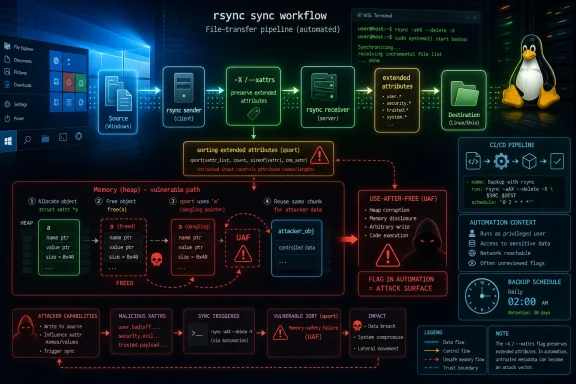 A Small Flag Turns a Workhorse Into an Attack Surface
Rsync’s enduring appeal is that it does one boring job unusually well: move file trees efficiently, especially when only a small portion of the data has changed. That is why it appears everywhere from Linux servers and BSD boxes to backup appliances, CI/CD runners, developer laptops, NAS devices, container images, and ad hoc migration scripts written long before today’s administrator inherited the environment.CVE-2026-41035 narrows the blast radius with an important condition. The receiver must run rsync with
-X, also known as --xattrs, which tells rsync to preserve extended attributes. That makes the bug less universal than a default-path remote code execution flaw, but it also puts it squarely in the path of serious backup and migration workflows, because extended attributes are exactly the kind of metadata careful administrators try not to lose.The vulnerable range, rsync 3.0.1 through 3.4.1, is broad enough to matter. It covers years of deployments, distro packages, bundled copies, and embedded builds. In many environments, rsync is not treated like a first-class application with its own patch calendar; it is treated like plumbing.
That is the discomforting part. Plumbing fails quietly until it fails loudly.
Extended Attributes Are No Longer Exotic Metadata
Extended attributes sound obscure until you remember what modern systems store outside the traditional filename, owner, group, permissions, and timestamp model. Linux security labels, access-control metadata, backup hints, desktop environment markers, and application-specific annotations can all live in these extra fields. Non-Linux platforms often lean even harder on metadata models that do not map cleanly onto old Unix assumptions.That explains why the CVE description draws a distinction between Linux and non-Linux platforms. On Linux, “many but not all” common configurations are vulnerable. On non-Linux systems, the advisory language says exposure is broader. That difference is less a footnote than a reminder that rsync is a cross-platform protocol and codebase operating across filesystems with very different ideas about what a file actually is.
For WindowsForum readers, this matters because Windows estates increasingly contain Linux and Unix semantics by design. WSL gives developers Linux userlands on Windows desktops. Azure workloads routinely mix Windows Server, Linux VMs, containers, and managed storage. Backup products and NAS systems expose SMB on one side and rsync on another. A vulnerability in a Unix synchronization utility can sit inside a Microsoft-heavy shop without showing up in the usual Windows Update mental model.
The most dangerous assumption is that “we do Windows” means “we don’t run rsync.” In 2026, that sentence is often false.
The Bug Lives Where Trust Crosses the Wire
The technical core of CVE-2026-41035 is compact:receive_xattr relies on an untrusted length value during a qsort call, creating a receiver use-after-free. In plain English, the receiving side processes extended-attribute data and ends up sorting based on a length value it should not trust. Under the wrong conditions, the code can reference memory after it has been freed.Use-after-free bugs are a familiar class of memory-safety failure. They can produce crashes, inconsistent state, and, in more severe cases, exploitation paths that depend on heap behavior, allocator details, platform behavior, and attacker control over surrounding memory. The advisory language here emphasizes reduced performance or interruptions in availability rather than a guaranteed catastrophic compromise.
That distinction matters, but it should not lull administrators into indifference. Availability bugs in file synchronization systems are operational bugs, and operational bugs can become security bugs when they disrupt backup jobs, mirror updates, package distribution, deployment pipelines, or recovery workflows. A sync receiver that intermittently falls over may not look like ransomware, but it can still break the assumptions behind resilience.
The nuance is that CVE scoring and real-world consequence rarely line up perfectly. A vulnerability can have “low” direct impact on confidentiality, integrity, and availability while still landing in a high-value maintenance window because the affected tool sits in the middle of something important.
Microsoft’s Listing Is a Signal About the Modern Windows Perimeter
The presence of this issue in Microsoft’s vulnerability guidance is notable precisely because rsync is not a native Windows feature in the way SMB, Hyper-V, Active Directory, or Remote Desktop are. MSRC’s ecosystem view has grown wider because Microsoft’s customer environments have grown wider. Windows administrators are now asked to understand risks in components that arrive via Linux distributions, developer tools, cross-platform packages, third-party appliances, and cloud workloads.That is the right move. Attackers do not care whether a vulnerable binary came from Redmond, a Linux distribution, a NAS vendor, a package manager, or a Docker base image. They care whether it is reachable, whether it processes attacker-controlled input, and whether it runs in a context worth abusing.
For administrators, the practical consequence is that Patch Tuesday cannot be the whole patch strategy. Windows Update is necessary, but it does not update every rsync binary hiding in an appliance, container, WSL image, GitHub Actions runner, Cygwin/MSYS2 environment, or custom backup host. The estate boundary is no longer the Windows installation boundary.
This is where vulnerability management becomes less glamorous and more important. Inventory beats intuition. If rsync exists in your environment, the next question is not whether the organization is “a Linux shop.” The question is which version is installed, how it is invoked, and whether
--xattrs is part of a trusted or exposed workflow.The Exploitability Story Is Conditional, Not Comforting
CVE-2026-41035 has one obvious mitigating factor: the victim must use-X or --xattrs. That makes the vulnerable path opt-in. Many casual rsync invocations do not preserve extended attributes and therefore would not trigger this specific bug.But backup and migration jobs are not casual. The more serious the job, the more likely the administrator is to care about preserving metadata. A bare-bones copy may skip xattrs; a compliance-minded archive, a Linux server migration, a macOS-like metadata-preserving transfer, or a careful filesystem replication task may include them.
There is another wrinkle. The danger is receiver-side, which means risk analysis must focus on which system is receiving data and from whom. If an internal backup server pulls from or receives data sent by less-trusted clients, a lower-privileged party may have a path to crash or destabilize a more important system. If an rsync daemon or service is exposed beyond a tightly controlled boundary, the problem becomes sharper.
The advisory’s availability framing should be read literally. The stated impact is reduced performance or interruptions in resource availability, not a complete and sustained denial of service against all legitimate users. That is less dramatic than “wormable RCE,” but infrastructure does not need drama to cause a bad week.
Linux Gets the Headlines, but Non-Linux May Be the Messier Case
The line about non-Linux platforms being more widely vulnerable deserves attention. Rsync has long been part of Unix and Unix-like environments, but its cross-platform uses are where assumptions tend to crack. Different filesystem APIs, metadata models, and allocator behaviors can turn a bug that is narrow on one platform into something more reproducible elsewhere.On Linux, distribution maintainers often carry patches, backports, hardening flags, and platform-specific behavior that can reduce exposure. That does not make Linux immune, and the advisory explicitly says many common Linux configurations are vulnerable. It does mean that administrators need vendor-specific status rather than a single upstream version check.
On non-Linux systems, especially where rsync is bundled into an appliance or ported environment, the update path may be slower or less visible. A NAS web UI may not advertise the rsync version prominently. A backup product may include a private copy. A developer workstation may have multiple rsync binaries installed through different toolchains.
That multiplicity is the real operational hazard. The command
rsync --version only answers the question for the binary first in the current shell’s path. It does not enumerate the copy a scheduled task invokes, the one an appliance uses internally, the one inside a container image, or the one bundled with a vendor backup agent.The Windows Angle Is WSL, Appliances, and Automation
Windows administrators should resist two bad reactions: panic and dismissal. Panic is unwarranted because the vulnerable path is conditional and the described impact is not a straightforward universal compromise. Dismissal is equally wrong because rsync commonly appears at the edges of Windows estates, where accountability is often fuzzier.WSL is the obvious example. Developers may install rsync inside Ubuntu, Debian, Kali, or other WSL distributions and use it to move code, test data, or configuration between local and remote systems. That copy of rsync is updated through the Linux distribution’s package manager, not through Windows Update.
Then there are hybrid backup paths. A Windows file server may feed a Linux backup host, or a Linux staging server may synchronize artifacts later served to Windows clients. Rsync can be the transport glue in environments that otherwise look Microsoft-centric. The machine affected by the vulnerability may not be a domain controller or Windows Server, but the business process it supports may still be a Windows service, a Windows deployment, or a Windows recovery plan.
Automation raises the stakes because flags become invisible. An administrator sees a green check mark in a monitoring dashboard, not the exact rsync command line. If a script uses
-aX, --xattrs, or a wrapper that expands to include xattr preservation, the vulnerable condition may be present without anyone remembering why.Availability Bugs Hit Backups at the Worst Time
Security teams tend to rank vulnerabilities by exploitability and impact. Operations teams rank them by what breaks at 2 a.m. CVE-2026-41035 lives in the overlap: a memory-safety bug in a tool commonly trusted to keep data moving.A receiver-side crash or instability during metadata-heavy synchronization may not destroy data, but it can produce partial transfers, failed jobs, noisy retries, stale mirrors, and false confidence. If the sync job is part of backup validation, disaster recovery staging, software distribution, or configuration management, an intermittent availability issue can quietly erode reliability.
The advisory’s wording says the attacker does not have the ability to completely deny service to legitimate users. That is useful, but it is not the same as harmless. Many IT systems are built around scheduled windows. If a backup job fails during the one window where it can run without saturating a link, the service may be “available” in a technical sense while the organization loses a recovery point.
This is why administrators should treat the bug as a patch-and-audit item, not just a CVSS debate. The question is not merely “can this be exploited repeatedly?” It is “what depends on this receiver completing its work?”
The Remediation Is Simple, but Finding Every Copy Is Not
The cleanest remediation is to update rsync to a fixed version or consume vendor packages that address the issue. That sounds straightforward until you try to inventory rsync across a real environment. Package-managed servers are the easy case. Embedded appliances, old build containers, vendor bundles, and developer-controlled environments are where the work begins.A sensible first pass is to identify systems that both run affected versions and use extended attributes. That means searching scripts, scheduled tasks, CI jobs, backup definitions, service files, and appliance configurations for
-X, --xattrs, and compound options that may include xattr preservation. It also means identifying receivers, not just senders.Temporarily removing
--xattrs can reduce exposure where metadata preservation is not required, but that should not be done casually. Extended attributes may carry security labels or application state. Dropping them can create subtle correctness and security problems of its own.The better pattern is staged remediation. Patch first where packages are available. Restrict network access to rsync receivers. Validate that jobs still preserve required metadata. Then remove unnecessary xattr use where administrators discover it was copied forward from a template rather than required by the workload.
Vendor Severity Labels Are Inputs, Not Orders
One interesting wrinkle in the public handling of CVE-2026-41035 is the apparent tension between severity labels. Some databases present the issue with a high CVSS score, while at least one major distribution has characterized its priority more conservatively, reportedly noting that rsync developers did not view it as having security impact in the same way automated scoring suggests.That discrepancy is not unusual. CVSS is a model, not a verdict. It expresses characteristics such as attack vector, complexity, privileges required, user interaction, scope, and impact. Distribution priority adds maintainer judgment, platform specifics, exploit maturity, default configuration, and packaging reality.
The right lesson is not that one label is “true” and the other is “wrong.” The right lesson is that administrators should map the vulnerability to their own architecture. A low-priority package bug on an isolated workstation may be a routine update. The same bug on a central rsync receiver handling semi-trusted client data may deserve faster action.
This is where security programs often stumble. They chase the universal number because it is easy to sort in a dashboard. The more mature approach asks where the affected code actually runs, who can reach it, what privileges it has, and what business process fails if it crashes.
Memory Safety Keeps Haunting the Infrastructure Layer
CVE-2026-41035 is also another entry in the long ledger of memory-management bugs in foundational tooling. Rsync is written in C, as are many of the utilities and libraries that still form the substrate of modern infrastructure. That does not make rsync uniquely negligent; it makes it typical of the software layer the industry continues to depend on.The particular pattern here is painfully familiar. A value arrives from outside the trust boundary. Code uses it in a memory-sensitive operation. Under certain conditions, internal state no longer matches the assumptions of the sorting or allocation logic. The result is a dangling reference, a crash, or worse.
Memory-safe rewrites are easy to invoke and hard to ship. Rsync’s value is not just its code but its compatibility, performance, protocol behavior, and deployment footprint. Replacing it wholesale is not a weekend project for the organizations that rely on it.
That leaves the less satisfying but necessary work: hardening, fuzzing, careful patch review, conservative exposure, and faster updates. The industry is slowly moving toward memory-safe languages for new components, but the installed base of C infrastructure will be with us for a long time.
The Flag Worth Hunting Before the Next Maintenance Window
The practical response to CVE-2026-41035 is not complicated, but it does require more than reading the headline. Administrators should look for the vulnerable version range, confirm whether extended attributes are enabled, and prioritize receivers that accept data from less-trusted sources. The biggest risk is not the rsync binary everyone knows about; it is the one hidden in a script, appliance, image, or developer environment.- Inventory rsync versions across servers, WSL distributions, containers, appliances, and build runners rather than assuming Windows Update covers the estate.
- Search job definitions and scripts for
-X,--xattrs, and compound rsync options that preserve extended attributes. - Prioritize patching receivers that accept data over the network, especially from users, clients, tenants, or automation outside a tightly trusted boundary.
- Avoid disabling extended-attribute preservation blindly, because those attributes may carry security labels or application metadata.
- Treat failed or flaky rsync jobs as a resilience issue, not merely a nuisance, when they support backup, recovery, deployment, or mirror workflows.
- Use vendor packages and appliance firmware updates where possible, because downstream maintainers may backport fixes without changing the upstream-looking version string.
References
- Primary source: MSRC
Published: 2026-05-23T01:39:39-07:00
Security Update Guide - Microsoft Security Response Center
 msrc.microsoft.com
- Related coverage: sentinelone.com
CVE-2026-41035: rsync Use-After-Free Vulnerability
CVE-2026-41035 is a use-after-free vulnerability in rsync. Learn about its impact, affected versions, and mitigation methods for this critical flaw.www.sentinelone.com
- Related coverage: securityvulnerability.io
CVE-2026-41035 : Use-After-Free Vulnerability in Rsync Affects Linux and Non-Linux Systems
Learn about the vulnerability affecting Rsync, including how it leads to a use-after-free issue in various platforms. CVE-2026-41035.securityvulnerability.io - Related coverage: thehackerwire.com
CVE-2026-41035 - High Vulnerability - TheHackerWire
TheHackerWire - Your daily source for cybersecurity news, CVE alerts, hacking tutorials, and security tool reviews. Stay ahead of cyber threats.www.thehackerwire.com
- Related coverage: zeropath.com
Brief Summary: Rsync CVE-2026-41035 Use After Free in Extended Attribute Processing - ZeroPath Blog | ZeroPath
A brief summary of CVE-2026-41035, a use after free vulnerability in rsync versions 3.0.1 through 3.4.1 triggered by a qsort call on stale extended attribute data. We cover the root cause, platform specific exposure, and available mitigations.zeropath.com - Related coverage: service.securitm.ru
CVE-2026-41035 - CVE уязвимости - SECURITM
In rsync 3.0.1 through 3.4.1, receive_xattr relies on an untrusted length value during a qsort call, leading to a receiver us...service.securitm.ru
- Related coverage: sra.io
