

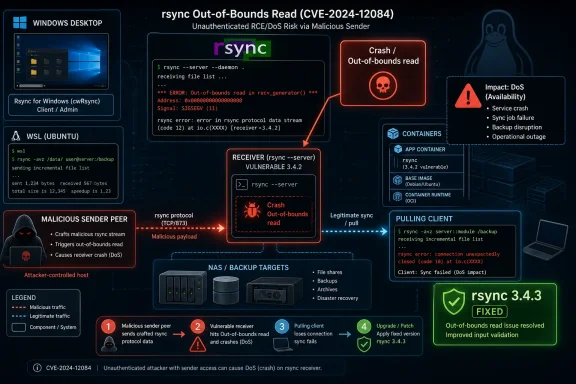
recv_files(). The headline sounds narrow, but the affected behavior sits in one of the most trusted file-transfer paths in Unix-like administration. For WindowsForum readers, the important point is not that native Windows is suddenly broken; it is that modern Windows estates increasingly depend on Linux tooling through WSL, containers, NAS appliances, backup products, and hybrid automation. This is the kind of bug that reminds IT teams that “not a Windows component” is no longer the same as “not in the Windows environment.”
Rsync’s Quiet Ubiquity Makes a Client Crash Matter
Rsync is not fashionable infrastructure, and that is precisely why it matters. It is the utility administrators reach for when they need files copied predictably, incrementally, and without a vendor platform standing in the middle. It appears in backup scripts, build pipelines, Linux servers, embedded appliances, NAS devices, academic mirrors, and disaster-recovery runbooks that have survived three generations of tooling churn.
CVE-2026-43620 does not hand an attacker a shell, rewrite files, or leak secrets according to the available advisory details. Its primary impact is availability: a malicious rsync server, or any peer playing the sender role, can cause a client pulling files to crash. In CVE language, that can sound like the lower tier of the security hierarchy; in operational language, it means jobs that are supposed to move data can be made to stop moving data.
That distinction matters because rsync is often found in scheduled and automated contexts. A crash in an interactive terminal is annoying. A crash in a backup job that nobody checks until restore day is a different class of risk. A crash in a content distribution process, a nightly synchronization task, or a fragile migration pipeline can create cascading failure even when the underlying vulnerability is “only” denial of service.
The bug also lands at a moment when administrators are rightly tired of vulnerability inflation. Not every CVE deserves emergency war-room treatment, and this one should not be confused with a wormable remote-code-execution flaw. But dismissing it entirely would be the opposite mistake, because the exploit model aligns with a common trust pattern: clients pulling from a server they believe is safe.
The Attack Runs Through Trust, Not Through Exotic Configuration
The most interesting part of CVE-2026-43620 is not the memory-safety label. It is the direction of attack. Many administrators mentally model rsync risk around exposed daemons: an internet-facing rsync service, a misconfigured module, or a server accepting untrusted clients. This advisory turns attention toward the client side, where a pulling client can be crashed by a malicious sender.
That means the victim does not need to be running a public rsync daemon. The victim needs to initiate a pull from a hostile or compromised endpoint. In practice, that includes explicit rsync:// pulls as well as remote-shell-style invocations such as pulling from a host over SSH syntax. If a script blindly syncs from a mirror, partner system, temporary staging host, or compromised internal machine, the vulnerable code path becomes reachable.
The trigger described in public advisories is highly specific. A malicious peer manipulates compatibility flags, sends a crafted file list whose sorted contents break an expected leading directory relationship, and then follows with a transfer record shaped to drive the receiver into an invalid array access. The practical result is deterministic: the client process dereferences an invalid pointer and crashes.
That specificity is both reassuring and unsettling. It is reassuring because the advisory describes a crash-only outcome on common glibc x86-64 Linux testing, not a known code-execution primitive. It is unsettling because the exploit does not rely on social engineering beyond convincing a client to pull from a malicious sender. The wire protocol is enough.
In other words, this is not a bug that asks the administrator to run a strange flag for the attack to work. Public advisory language indicates that the relevant incremental-recursion behavior is a default in modern rsync protocol use. That turns the vulnerability from “edge case in a dusty option” into “bug in a normal recursive pull against the wrong host.”
Microsoft’s Appearance in the Story Is a Supply-Chain Signal
The user-facing source for this issue is Microsoft’s Security Update Guide entry, which may look odd at first glance. Rsync is not a Microsoft-originated utility, and the canonical fix comes from the upstream rsync project in version 3.4.3. But MSRC tracking this CVE is entirely consistent with the shape of modern Windows security: Microsoft has to care about components that enter Windows-adjacent environments through developer stacks, Linux subsystems, images, packages, and services.
That is the quiet story behind a lot of contemporary vulnerability management. The boundary between “Windows vulnerability” and “vulnerability relevant to Windows administrators” has eroded. A Windows shop may run rsync inside WSL, in a Linux container on a Windows host, on Azure Linux systems, in backup software that interoperates with Windows file shares, or on a NAS that stores departmental data. The component may not live in System32, but its failure can still interrupt a Windows-dependent workflow.
For sysadmins, this changes the patching question. The old reflex would be to ask whether the vulnerable binary ships with Windows. The better question is whether vulnerable rsync versions are present anywhere in the estate where Windows data, identity, backups, builds, or operations depend on them. If the answer is yes, the CVE belongs in the same risk conversation as any other cross-platform dependency.
Microsoft’s listing also underlines a larger truth about advisory ecosystems. Security Update Guide entries increasingly serve as aggregation points for risk affecting Microsoft customers, not merely as patch notes for files Microsoft authored. That can frustrate teams trying to map CVEs cleanly to Windows Update, but it reflects reality more accurately than a neat vendor boundary would.
Version 3.4.3 Is the Line Administrators Should Care About
The remediation is refreshingly clear: rsync 3.4.3 is the patched release, and versions before it are affected. The upstream release was published on May 20, 2026, and it groups several CVEs together rather than treating CVE-2026-43620 as an isolated maintenance tweak. For anyone maintaining source-built rsync, appliance firmware, Linux images, or container bases, 3.4.3 is the version number to verify.
That does not mean every administrator will see 3.4.3 immediately in their package manager. Enterprise distributions often backport patches while retaining an older upstream version string. A Red Hat, Debian, Ubuntu, SUSE, or appliance vendor package may report a version that appears old while still carrying the security fix. The right check is vendor advisory status and package changelog detail, not version-string panic alone.
For self-compiled deployments, the answer is simpler. If the binary is older than 3.4.3 and has not been patched with the relevant fix, it should be treated as vulnerable. Rsync is small enough and old enough that some organizations have forgotten where they compiled it manually; those forgotten binaries are often the ones sitting in /usr/local/bin, embedded scripts, or legacy automation hosts.
Windows administrators should pay special attention to WSL distributions and third-party toolchains. A developer workstation may have Ubuntu under WSL, Cygwin, MSYS2, Git-adjacent environments, or container images with rsync installed. Those environments may not be patched by Windows Update. They live in the same operational universe as Windows but follow their own package lifecycles.
The Denial-of-Service Label Undersells the Operational Blast Radius
Security teams often triage denial-of-service flaws below privilege escalation and remote code execution, and generally they should. The problem is that availability is context-sensitive. A one-process crash in a user’s manual file copy is not the same as a crash in the only nightly backup path for a production dataset.
The advisory’s language describes a loss of availability in the impacted component. That is accurate, but it can sound sterile. Rsync is rarely the destination; it is the plumbing. When the plumbing stops, the failure may present as stale files, incomplete backups, delayed deployments, missing mirror updates, failed CI jobs, or recovery procedures that quietly drift out of date.
This is especially relevant because the attacker’s position can be indirect. If an organization pulls from a third-party mirror or partner system, it may be vulnerable to a compromised upstream rather than a deliberately malicious supplier. If a build process pulls artifacts from an internal staging box, a local compromise can become a reliability weapon against downstream automation.
Availability bugs also have a nasty relationship with monitoring. Many scripts log rsync failures and move on. Others retry indefinitely. Some alert loudly; many do not. A deterministic crash can therefore become either a visible outage or a silent erosion of data freshness, depending entirely on the maturity of the surrounding automation.
The Memory Bug Is Narrow, but the Pattern Is Familiar
At the code level, CVE-2026-43620 is an out-of-bounds read in recv_files() in receiver.c. The receiver ends up reading just before an allocated pointer array after a crafted file-list and transfer-record sequence. The dereferenced value is invalid, producing a crash rather than a useful disclosure or controlled execution path in the tested environment.
The advisory notes that the receiver-side issue resembles an earlier sender-side pattern. That is an important engineering clue. Vulnerabilities often survive not because developers miss one line, but because a class of assumption exists in multiple symmetrical paths. Fixing one side of a protocol implementation does not automatically fix the visually similar code on the other side.
This is where mature maintainership matters. The 3.4.3 fix reportedly adds a guard for a negative parent index on the receive side and audits similar reachable patterns. That kind of fix is less glamorous than a big rewrite, but it is exactly what stable infrastructure projects need: targeted correction, protocol validation, and a willingness to look for siblings.
Still, the bug demonstrates the tension in long-lived C codebases. Rsync’s performance and portability come from decades of careful engineering, but the same history means complicated state machines, compatibility logic, and memory assumptions persist over time. A protocol parser with many legitimate old behaviors is a hard place to eliminate every invalid edge case.
Windows Shops Should Inventory the Places Windows Update Cannot See
The practical question for WindowsForum readers is not whether rsync.exe appeared in a monthly cumulative update. In most environments, it did not. The question is where rsync is hiding in systems that Windows administrators are responsible for, even if those systems are not patched through the Windows servicing stack.
WSL is the obvious starting point. Developers and administrators frequently install Linux distributions on Windows machines, then use them for deployment scripts, website maintenance, repository mirroring, or ad hoc server administration. Those distributions need their own package updates. A fully patched Windows 11 host can still contain an outdated Ubuntu or Debian userland under WSL.
Containers are another likely hiding place. Rsync is often installed in utility images, CI runners, migration containers, and one-off operational images that nobody rebuilds unless forced. If an image pulls files from remote hosts during a pipeline, its rsync version matters. If the image is immutable but old, it may remain vulnerable until the base is rebuilt.
NAS devices and backup appliances deserve attention as well. Many expose rsync features through friendly web interfaces while shipping vendor-maintained builds under the hood. Administrators may not have direct control over the rsync binary, which means the remediation path is firmware, appliance update, or vendor confirmation. That is slower than apt upgrade, but it is still part of the same risk surface.
Then there are the hybrid scripts: PowerShell launching SSH into Linux, Windows Task Scheduler triggering a WSL command, backup jobs copying from Linux to SMB storage, and developer tooling that assumes Unix utilities are just there. These are the places where a Linux CVE becomes a Windows operations problem without ever becoming a Windows kernel problem.
Workarounds Buy Time, but They Are Not a Patch Strategy
The most direct fix is to update rsync. Where that is not immediately possible, public guidance points to disabling incremental recursion with --no-inc-recursive on the client and limiting pulls to trusted rsync hosts. Those are reasonable temporary measures, but neither should become the long-term plan.
Disabling incremental recursion can carry usability and performance costs on large recursive transfers. It may change behavior in ways that surprise scripts tuned over years. That makes it a classic emergency mitigation: useful, clear, and not something administrators want to carry indefinitely across a large estate.
Trusting only known hosts is common sense, but it is weaker than it sounds. The exploit scenario includes compromised trusted hosts, not just obviously malicious internet endpoints. A mirror, staging server, or partner box can become hostile after compromise. In security terms, “trusted” should mean authenticated, controlled, monitored, and patched — not merely familiar.
For administrators, the better sequence is straightforward. Identify where rsync clients pull data, prioritize systems that pull from external or semi-trusted sources, update to a fixed package or vendor build, and then remove temporary flags once the patch is confirmed. The workaround is the bridge; version hygiene is the destination.
Severity Scores Should Not Decide the Whole Response
CVE-2026-43620 has been characterized in public databases as a medium-severity issue, with high availability impact and no confidentiality or integrity impact in the common scoring model. That is a fair technical description. It is also incomplete as a business-risk description.
CVSS is good at describing a vulnerability in isolation. It is less good at describing what happens when that vulnerability sits inside a critical operational dependency. A medium-severity crash in a rarely used desktop utility may deserve routine patching. A medium-severity crash in a nightly replication job for production data may deserve immediate attention.
This is where IT teams should resist both extremes. There is no evidence in the public advisory material that this is a code-execution emergency requiring the same response as a wormable network service flaw. There is also no basis for ignoring it merely because the word “moderate” appears in an advisory. The right response depends on exposure and dependency.
The most useful triage question is simple: does any vulnerable rsync client in your environment pull from a system you do not fully control, or from a system whose compromise would plausibly go unnoticed? If yes, patching should move up the queue. If rsync is present only in a lab image used manually against known internal hosts, the urgency is lower.
The 2026 Rsync Release Is Really a Cluster, Not a Singleton
CVE-2026-43620 is one entry in a broader 3.4.3 security release. The upstream release notes list multiple CVEs fixed in the same version, including other rsync issues beyond this receiver-side out-of-bounds read. That clustering matters because it changes the administrative calculus.
If this were a single medium denial-of-service flaw, some teams might reasonably schedule it for the next maintenance window. When a release aggregates several security fixes, the cost-benefit shifts. Updating once closes multiple doors. Delaying because any one issue seems modest can leave the estate exposed to the combined risk of the set.
This is a recurring pattern in mature open-source infrastructure. Maintainers batch related hardening and security corrections into a point release, while downstream distributions decide how to backport and communicate the fixes. Administrators then see a blur of CVE IDs, package names, and version numbers. The temptation is to pick the scariest CVE and ignore the rest.
That is not the right lesson here. The right lesson is that rsync deserves the same dependency management discipline as OpenSSL, OpenSSH, curl, or zlib. It may not have the brand-name panic factor, but it sits in trusted paths where small bugs can become operationally meaningful.
The Real Risk Is the Automation Nobody Owns
Every organization has a few scripts that are older than the people currently responsible for them. Rsync is a frequent inhabitant of those scripts because it worked, kept working, and rarely demanded attention. CVE-2026-43620 is less a crisis than a flashlight aimed at that neglected layer.
The riskiest deployments may not be the ones in formal asset inventories. They may be a developer’s WSL distribution running a release script, a retired-but-still-scheduled VM copying logs, a departmental NAS pulling from a partner site, or a container image built two years ago and still used because “it only syncs files.” These systems often escape the clean lines of endpoint management and server patch policy.
That is why the vulnerability should be handled as an inventory exercise as much as a patch exercise. Find rsync binaries, but also find rsync workflows. A vulnerable binary that never pulls from anywhere is less interesting than a patched-looking host that launches an old container containing rsync. The command path matters.
This also argues for better failure handling. If rsync crashes, automation should fail closed, alert clearly, and avoid treating missing data as success. Availability vulnerabilities are most damaging when failure is quiet. A good monitoring system turns this CVE from a latent business problem into a visible job failure.
The Practical Read for WindowsForum Administrators
CVE-2026-43620 deserves a measured response: not panic, not neglect, and definitely not a Windows Update assumption. The patch target is rsync 3.4.3 or a vendor-backported equivalent, and the priority should be systems that pull from untrusted, semi-trusted, external, or easily compromised sources.
- Administrators should treat rsync versions before 3.4.3 as vulnerable unless their distribution or vendor confirms a backported fix.
- Windows Update should not be assumed to remediate rsync installed inside WSL distributions, containers, Cygwin-like environments, NAS firmware, or third-party backup products.
- The highest-priority workflows are recursive pulls from external mirrors, partner systems, staging hosts, or any sender-side peer outside direct administrative control.
- Temporary use of
--no-inc-recursivecan reduce exposure, but it may affect large transfers and should not replace updating. - Monitoring should verify that rsync jobs fail loudly, because a denial-of-service flaw in file synchronization is most dangerous when stale or missing data looks like success.
Those points are deliberately operational rather than dramatic. The danger in this CVE is not that every exposed system is on the brink of takeover. The danger is that rsync is often invisible until it fails, and many Windows-centered teams have Linux-side dependencies that are patched by habit rather than by policy.
The forward-looking lesson is that hybrid Windows administration now requires hybrid vulnerability thinking: a Microsoft advisory can point to an upstream Unix utility, a Linux package can affect a Windows workflow, and a medium-severity client crash can still break something important if it sits in the wrong automation path. Rsync 3.4.3 is the immediate fix, but the durable improvement is knowing where these quiet cross-platform dependencies live before the next CVE gives everyone a reason to look.
References
- CVE-2026-43620 Rsync < 3.4.3 Out-of-Bounds Array Read via recv_files() MSRC · 2026-05-23T01:38:23-07:00