

CVE-2026-45232 is a low-severity rsync vulnerability disclosed in May 2026 and fixed in rsync 3.4.3, affecting clients that use the
The headline metric on CVE-2026-45232 is reassuring at first glance. It is rated low severity, with high attack complexity and limited expected impact, and the vulnerable path only becomes reachable when rsync is configured to use an HTTP proxy through
But rsync is not an ordinary desktop utility. It is backup glue, deployment glue, mirroring glue, migration glue, and sometimes disaster-recovery glue. It appears in shell scripts written years ago by administrators who have since changed roles, in CI jobs whose logs no one reads unless a release fails, and in maintenance containers that get rebuilt less often than their owners would admit.
That is why CVE-2026-45232 deserves attention even while it does not deserve alarm. The security industry is bad at nuance: anything with a CVE becomes either “critical” marketing copy or “not exploitable” background noise. This one is neither. It is a small memory-safety flaw in a privileged position in many operational workflows.
The right response is not a war room. The right response is to treat rsync as a managed dependency rather than an inherited Unix fact of life.
That is an unusually specific exploit precondition. An attacker must either control the proxy server or sit in the network path between the rsync client and the proxy, then deliver the malformed response at the right moment. The victim also has to initiate an rsync operation in a configuration that uses the vulnerable proxy mechanism.
For home users and many small environments, that makes the bug largely theoretical. Most rsync usage is direct over SSH, not through an HTTP proxy. Even among Linux-heavy shops,
Enterprise networks are different. Proxies are not exotic there; they are policy enforcement points. Build systems, package mirrors, air-gapped staging networks, and restricted egress environments may route tools through proxy infrastructure because that is the only way traffic is allowed to leave a zone.
That is what makes the phrase “conditions beyond the attacker’s control” important but not dismissive. It means exploitation cannot be assumed on any random host. It does not mean the condition never appears in real environments.
There is no public basis, at least from the currently available advisory material, to claim reliable remote code execution from this flaw. The expected impact is availability, not confidentiality or integrity. In practical terms, administrators should think first about client crashes or disrupted automation, not immediate compromise.
Still, the boundary between “only a crash” and “more than a crash” is not a law of physics. It is a judgment based on known exploitability, mitigations, build options, and architecture. Stack canaries, ASLR, hardened libc behavior, and compiler choices all matter. So does whether the affected rsync process runs in a constrained job, an interactive shell, or a privileged automation chain.
Security teams should resist the temptation to overstate the bug. They should also resist the opposite temptation to say that low severity equals no action. Memory-safety defects in network-reachable parsing paths deserve cleanup because the cost of cleanup is usually lower than the cost of future surprise.
This is the modern Microsoft vulnerability story: the company is not merely patching Windows DLLs on the second Tuesday of each month. It is tracking open-source components that may affect Microsoft products, services, images, or customer environments. For WindowsForum readers, that shift matters because Windows administration increasingly includes Linux subsystems, containers, DevOps pipelines, and hybrid estate management.
Rsync can enter Windows-centric organizations through several side doors. It may appear inside WSL distributions, Git Bash-style tooling, Cygwin environments, backup appliances, NAS systems, container images, Azure-hosted Linux workloads, or vendor-supplied deployment scripts. The person responsible for patching Windows endpoints may not own all of those surfaces, but the security dashboard often collapses them into the same risk queue.
That convergence is healthy, but it creates noise. A CVE attached to a familiar open-source utility can appear in Microsoft-adjacent reporting without meaning that every Windows desktop is vulnerable. Administrators need to ask a better question than “Do we have this CVE?” They need to ask, “Where is rsync actually installed, what version is it, and is the vulnerable feature path used?”
Rsync has had a bruising run of security attention over the last couple of years. Earlier issues included more severe daemon-mode and client/server interaction problems, reminding administrators that even venerable infrastructure tools need active maintenance. The lesson is not that rsync is unusually bad. The lesson is that long-lived C code, broad deployment, and complex trust boundaries are a predictable recipe for recurring vulnerability work.
Version 3.4.3 is therefore best understood as a maintenance boundary. If your environment can move to it cleanly, that is the obvious answer. If your distribution backports patches instead of shipping the upstream version number, then the version string alone may not tell the full story, and administrators should check the vendor’s security tracker or package changelog.
That distinction is especially important in enterprise Linux. A scanner may flag “rsync 3.2.x” even when the distribution has backported the relevant fixes. Conversely, a custom build or pinned container image may remain vulnerable even when the host OS is patched. The package manager is not the whole asset inventory anymore.
The trouble is that environment variables are slippery evidence. They can be set in systemd unit files, CI variables, cron wrappers, container manifests, shell profiles, backup scripts, or orchestration secrets. They can be inherited from parent processes in ways that do not show up in a simple package audit.
That means the security check should not stop at
The network-path condition also deserves sober interpretation. A man-in-the-middle attacker is not magic; in a properly segmented and TLS-aware environment, network positioning is hard. But proxies are concentration points. If an attacker controls a proxy, compromises a proxy, poisons routing to a proxy, or abuses a weak internal network, the “high complexity” rating becomes less comforting for the affected enclave.
The first place to check is not every Windows workstation. It is the estate’s cross-platform tooling: WSL images used by developers, CI/CD runners, build containers, backup servers, NAS appliances, SFTP replacement scripts, artifact mirrors, and admin jump boxes. Those are the places where rsync is most likely to exist and where proxy variables are most likely to be configured.
WSL deserves particular attention because it blurs ownership. A developer may have an Ubuntu environment installed on a Windows laptop, with packages updated according to the Linux distribution’s cadence rather than Windows Update. The device may be compliant from an endpoint-management perspective while its userland packages lag behind.
Containers are another common blind spot. A base image may include rsync for convenience, even if the running application does not obviously depend on it. If that image is used in a pipeline that syncs artifacts through a proxy, the CVE becomes more relevant than it looks from the outside. If rsync is merely present and unused, the practical exposure is much lower, but the image still deserves cleanup during the next rebuild.
A crashing rsync client can mean a failed mirror, a stale artifact, a missed backup window, or a broken release job. If the job fails loudly, the operational impact may be small. If it fails in a script that suppresses errors or retries indefinitely, the impact can be harder to diagnose.
That is why this CVE is a reminder to treat file-transfer automation as production infrastructure. Administrators should know whether rsync failures page anyone, whether logs are retained, whether partial transfers are detected, and whether a failed synchronization could silently leave a recovery environment out of date.
Security and reliability meet here. A malformed proxy response is a security trigger, but the immediate symptom may look like ordinary operational flakiness. Mature shops will patch the bug and also ask whether their transfer workflows are observable enough to make such failures obvious.
The overstatement is familiar. A server may be flagged because it carries an older rsync package version, even though the vendor has backported the fix or the binary is never invoked with proxy support. That ticket still needs validation, but it may not deserve the same priority as an internet-facing service with a remotely exploitable flaw.
The understatement is more subtle. A build container or bundled rsync binary may not appear in normal host scans. A backup appliance may expose rsync-like functionality without giving administrators direct package visibility. A developer machine may run WSL packages outside the normal Windows software inventory.
The best response is to combine scanning with context. Find rsync. Determine provenance. Check whether the fix is present. Search for
On mainstream Linux distributions, administrators should rely on vendor packages unless they have a strong reason not to. Backports are normal, and the package version may not match upstream. The correct question is whether the vendor marks the CVE fixed for the installed package, not whether the displayed version number satisfies a simplistic comparison.
For source-built rsync deployments, the calculus is different. Custom builds should be rebuilt from the fixed upstream release or patched directly. The same applies to statically linked binaries copied into containers, appliances, or old automation directories. Those binaries are the sort of thing that survives three infrastructure migrations because nobody wants to touch a working backup job.
For temporary risk reduction, removing or avoiding
That fragmentation makes low-severity bugs harder to handle than high-severity ones. A critical remote-code-execution flaw creates urgency and budget. A low-severity rsync bug creates ambiguity: who owns it, how quickly must it be fixed, and how much investigation is enough?
The answer should be risk-based but not lazy. If rsync is present on a production server, update it during the next maintenance window. If it is present in a build image, rebuild the image and remove it if unnecessary. If it is present in a backup workflow using an HTTP proxy, treat it with more urgency because the vulnerable path is no longer hypothetical.
This is where asset management becomes security engineering. The organizations that handle CVE-2026-45232 well will not be the ones with the loudest scanner. They will be the ones that can answer, within a day, where rsync runs and why.
But it also describes a class of attacks that enterprises routinely model. Man-in-the-middle positioning is difficult on the open internet, but internal networks, proxy chains, split tunnels, and compromised infrastructure create opportunities. A hostile proxy is not science fiction; it is a plausible post-compromise tool.
The subtle point is that high attack complexity often shifts the threat model from opportunistic attacker to motivated attacker. A mass scanner is unlikely to exploit this bug broadly. An intruder already inside a network, looking to disrupt backups or tamper with operational workflows, may find narrower bugs more useful than their severity score suggests.
That does not make CVE-2026-45232 a top-tier incident-response priority. It makes it a reason to keep boring infrastructure current. Security teams spend too much time arguing about whether a bug is scary and too little time making sure old utilities are patched before they become part of a chain.
Every mature environment has a collection of tools like this. They are not glamorous. They are not part of the official application architecture diagram. They live in cron jobs, admin folders, backup scripts, and CI images. They get invoked by automation that predates the current security team.
Attackers do not need every one of those tools to be catastrophically broken. They only need enough weak edges to create options. A low-severity proxy parsing bug may be useless alone, but useful in a chain that includes weak network controls, stale packages, overprivileged automation, and poor monitoring.
The defensive lesson is not to distrust rsync. It is to stop treating infrastructure utilities as exempt from software lifecycle management. If a tool can move production data, authenticate to important systems, or determine whether backups are current, it belongs in the same inventory discipline as anything with a web login.
RSYNC_PROXY environment variable and receive a deliberately malformed HTTP proxy response from a hostile proxy or network-positioned attacker. That is a narrow lane for exploitation, but not a meaningless one. The bug sits in the awkward space where enterprise security teams can neither panic nor ignore it, because rsync is often invisible until it breaks—or until a scanner turns a forgotten automation path into a ticket. The real story is not that this looks like the next wormable infrastructure disaster; it is that old, trusted plumbing keeps acquiring modern supply-chain consequences.
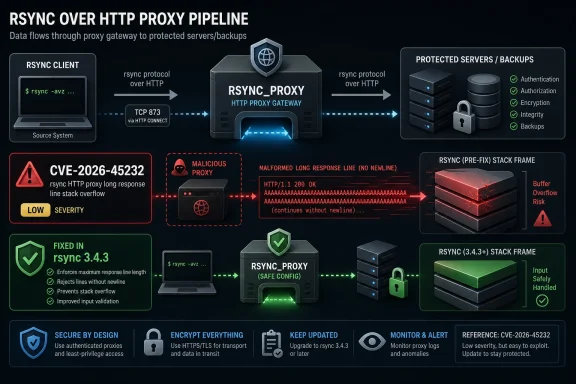 A Low Score Does Not Mean a Low-Value Asset
The headline metric on CVE-2026-45232 is reassuring at first glance. It is rated low severity, with high attack complexity and limited expected impact, and the vulnerable path only becomes reachable when rsync is configured to use an HTTP proxy through RSYNC_PROXY. That combination makes it a poor candidate for broad, opportunistic exploitation.But rsync is not an ordinary desktop utility. It is backup glue, deployment glue, mirroring glue, migration glue, and sometimes disaster-recovery glue. It appears in shell scripts written years ago by administrators who have since changed roles, in CI jobs whose logs no one reads unless a release fails, and in maintenance containers that get rebuilt less often than their owners would admit.
That is why CVE-2026-45232 deserves attention even while it does not deserve alarm. The security industry is bad at nuance: anything with a CVE becomes either “critical” marketing copy or “not exploitable” background noise. This one is neither. It is a small memory-safety flaw in a privileged position in many operational workflows.
The right response is not a war room. The right response is to treat rsync as a managed dependency rather than an inherited Unix fact of life.
The Bug Lives Behind a Proxy, Which Is Exactly Why Some Enterprises Should Care
The vulnerable code path is tied to rsync’s HTTP proxy support. WhenRSYNC_PROXY is set, rsync attempts to establish a proxy connection before proceeding with the file synchronization session. CVE-2026-45232 concerns an off-by-one stack write in that proxy-connection handling, triggered by a malformed proxy response line that is at least 1023 bytes long and lacks a newline terminator.That is an unusually specific exploit precondition. An attacker must either control the proxy server or sit in the network path between the rsync client and the proxy, then deliver the malformed response at the right moment. The victim also has to initiate an rsync operation in a configuration that uses the vulnerable proxy mechanism.
For home users and many small environments, that makes the bug largely theoretical. Most rsync usage is direct over SSH, not through an HTTP proxy. Even among Linux-heavy shops,
RSYNC_PROXY is not the everyday path for routine file transfer.Enterprise networks are different. Proxies are not exotic there; they are policy enforcement points. Build systems, package mirrors, air-gapped staging networks, and restricted egress environments may route tools through proxy infrastructure because that is the only way traffic is allowed to leave a zone.
That is what makes the phrase “conditions beyond the attacker’s control” important but not dismissive. It means exploitation cannot be assumed on any random host. It does not mean the condition never appears in real environments.
One Null Byte Is Still a Memory Corruption Bug
The technical impact described for CVE-2026-45232 is modest: a single null byte can be written out of bounds on the stack. That sounds almost quaint in an era of speculative-execution vulnerabilities, token theft, cloud metadata abuse, and supply-chain implants. Yet memory corruption has a long history of becoming more interesting once researchers understand the exact compiler, platform, stack layout, and calling context involved.There is no public basis, at least from the currently available advisory material, to claim reliable remote code execution from this flaw. The expected impact is availability, not confidentiality or integrity. In practical terms, administrators should think first about client crashes or disrupted automation, not immediate compromise.
Still, the boundary between “only a crash” and “more than a crash” is not a law of physics. It is a judgment based on known exploitability, mitigations, build options, and architecture. Stack canaries, ASLR, hardened libc behavior, and compiler choices all matter. So does whether the affected rsync process runs in a constrained job, an interactive shell, or a privileged automation chain.
Security teams should resist the temptation to overstate the bug. They should also resist the opposite temptation to say that low severity equals no action. Memory-safety defects in network-reachable parsing paths deserve cleanup because the cost of cleanup is usually lower than the cost of future surprise.
Microsoft’s Appearance in the Story Is About Ecosystem Gravity
The user-facing source here is Microsoft’s Security Update Guide entry, which is notable because rsync is historically associated with Unix-like systems rather than Windows itself. That does not make Microsoft’s involvement strange. Microsoft now operates across Windows, Azure, GitHub, Linux distributions, containers, developer tooling, and managed services where open-source components are part of the security surface.This is the modern Microsoft vulnerability story: the company is not merely patching Windows DLLs on the second Tuesday of each month. It is tracking open-source components that may affect Microsoft products, services, images, or customer environments. For WindowsForum readers, that shift matters because Windows administration increasingly includes Linux subsystems, containers, DevOps pipelines, and hybrid estate management.
Rsync can enter Windows-centric organizations through several side doors. It may appear inside WSL distributions, Git Bash-style tooling, Cygwin environments, backup appliances, NAS systems, container images, Azure-hosted Linux workloads, or vendor-supplied deployment scripts. The person responsible for patching Windows endpoints may not own all of those surfaces, but the security dashboard often collapses them into the same risk queue.
That convergence is healthy, but it creates noise. A CVE attached to a familiar open-source utility can appear in Microsoft-adjacent reporting without meaning that every Windows desktop is vulnerable. Administrators need to ask a better question than “Do we have this CVE?” They need to ask, “Where is rsync actually installed, what version is it, and is the vulnerable feature path used?”
The Rsync 3.4.3 Release Was Bigger Than This One CVE
CVE-2026-45232 arrived as part of the rsync 3.4.3 security release, which fixed multiple vulnerabilities. That context matters because patch prioritization should not treat this issue in isolation. If a system is running rsync older than 3.4.3, this proxy flaw may be the least interesting reason to update.Rsync has had a bruising run of security attention over the last couple of years. Earlier issues included more severe daemon-mode and client/server interaction problems, reminding administrators that even venerable infrastructure tools need active maintenance. The lesson is not that rsync is unusually bad. The lesson is that long-lived C code, broad deployment, and complex trust boundaries are a predictable recipe for recurring vulnerability work.
Version 3.4.3 is therefore best understood as a maintenance boundary. If your environment can move to it cleanly, that is the obvious answer. If your distribution backports patches instead of shipping the upstream version number, then the version string alone may not tell the full story, and administrators should check the vendor’s security tracker or package changelog.
That distinction is especially important in enterprise Linux. A scanner may flag “rsync 3.2.x” even when the distribution has backported the relevant fixes. Conversely, a custom build or pinned container image may remain vulnerable even when the host OS is patched. The package manager is not the whole asset inventory anymore.
The Proxy Requirement Narrows the Blast Radius, Not the Audit Trail
The most useful operational detail in this CVE is theRSYNC_PROXY requirement. It gives defenders a concrete way to separate plausible exposure from theoretical exposure. If rsync exists on a system but never uses that environment variable, the specific vulnerable path is not normally reachable.The trouble is that environment variables are slippery evidence. They can be set in systemd unit files, CI variables, cron wrappers, container manifests, shell profiles, backup scripts, or orchestration secrets. They can be inherited from parent processes in ways that do not show up in a simple package audit.
That means the security check should not stop at
rsync --version. Administrators should search code repositories, job definitions, deployment scripts, and configuration management for RSYNC_PROXY. They should look at build agents and legacy transfer jobs, not just production servers. The risky machines are often the ones that connect outward to fetch or push content under automation.The network-path condition also deserves sober interpretation. A man-in-the-middle attacker is not magic; in a properly segmented and TLS-aware environment, network positioning is hard. But proxies are concentration points. If an attacker controls a proxy, compromises a proxy, poisons routing to a proxy, or abuses a weak internal network, the “high complexity” rating becomes less comforting for the affected enclave.
Windows Shops Should Look in the Places Windows Patch Management Does Not Reach
For Windows-first organizations, the most common mistake will be assuming this is “a Linux thing” and moving on. The second most common mistake will be opening a universal emergency ticket because a vulnerability database mentions Microsoft. Both reactions miss the operational reality.The first place to check is not every Windows workstation. It is the estate’s cross-platform tooling: WSL images used by developers, CI/CD runners, build containers, backup servers, NAS appliances, SFTP replacement scripts, artifact mirrors, and admin jump boxes. Those are the places where rsync is most likely to exist and where proxy variables are most likely to be configured.
WSL deserves particular attention because it blurs ownership. A developer may have an Ubuntu environment installed on a Windows laptop, with packages updated according to the Linux distribution’s cadence rather than Windows Update. The device may be compliant from an endpoint-management perspective while its userland packages lag behind.
Containers are another common blind spot. A base image may include rsync for convenience, even if the running application does not obviously depend on it. If that image is used in a pipeline that syncs artifacts through a proxy, the CVE becomes more relevant than it looks from the outside. If rsync is merely present and unused, the practical exposure is much lower, but the image still deserves cleanup during the next rebuild.
The Availability Angle Is Not Trivial in Automation
Because CVE-2026-45232 is expected to affect availability rather than data confidentiality or integrity, it may be tempting to push it to the bottom of the queue. In many cases, that is reasonable. But availability bugs in automation tools can have outsized effects when the affected process sits in a backup, deployment, or replication path.A crashing rsync client can mean a failed mirror, a stale artifact, a missed backup window, or a broken release job. If the job fails loudly, the operational impact may be small. If it fails in a script that suppresses errors or retries indefinitely, the impact can be harder to diagnose.
That is why this CVE is a reminder to treat file-transfer automation as production infrastructure. Administrators should know whether rsync failures page anyone, whether logs are retained, whether partial transfers are detected, and whether a failed synchronization could silently leave a recovery environment out of date.
Security and reliability meet here. A malformed proxy response is a security trigger, but the immediate symptom may look like ordinary operational flakiness. Mature shops will patch the bug and also ask whether their transfer workflows are observable enough to make such failures obvious.
Scanner Output Will Overstate and Understate the Same Risk
Vulnerability scanners will likely handle CVE-2026-45232 in the usual imperfect way. They will identify systems with rsync packages below 3.4.3, sometimes without understanding distribution backports, feature usage, or runtime configuration. That produces false urgency on some assets and false comfort on others.The overstatement is familiar. A server may be flagged because it carries an older rsync package version, even though the vendor has backported the fix or the binary is never invoked with proxy support. That ticket still needs validation, but it may not deserve the same priority as an internet-facing service with a remotely exploitable flaw.
The understatement is more subtle. A build container or bundled rsync binary may not appear in normal host scans. A backup appliance may expose rsync-like functionality without giving administrators direct package visibility. A developer machine may run WSL packages outside the normal Windows software inventory.
The best response is to combine scanning with context. Find rsync. Determine provenance. Check whether the fix is present. Search for
RSYNC_PROXY. Identify where rsync runs automatically. Then decide priority based on actual reachability rather than CVE theater.The Patch Is Simple; The Inventory Is the Work
The direct remediation is straightforward: update to rsync 3.4.3 or a vendor-supported package containing the relevant fix. That is the easy part. The harder part is knowing where rsync exists and whether it is managed by the same update process as the rest of the system.On mainstream Linux distributions, administrators should rely on vendor packages unless they have a strong reason not to. Backports are normal, and the package version may not match upstream. The correct question is whether the vendor marks the CVE fixed for the installed package, not whether the displayed version number satisfies a simplistic comparison.
For source-built rsync deployments, the calculus is different. Custom builds should be rebuilt from the fixed upstream release or patched directly. The same applies to statically linked binaries copied into containers, appliances, or old automation directories. Those binaries are the sort of thing that survives three infrastructure migrations because nobody wants to touch a working backup job.
For temporary risk reduction, removing or avoiding
RSYNC_PROXY closes the specific path described for CVE-2026-45232. That may be practical for environments where proxy use was accidental or obsolete. It may not be acceptable where the proxy is required for egress control, in which case the real answer is patching and validating the proxy path.The Vendor Boundary Is Now a Shared Responsibility Boundary
This CVE also illustrates a broader reality for WindowsForum’s audience: security responsibility no longer maps cleanly to operating-system branding. A Windows administrator may be responsible for a laptop that runs WSL. A Linux administrator may rely on Azure images. A DevOps engineer may own the container that triggers the finding. A security team may see only the CVE and the asset name.That fragmentation makes low-severity bugs harder to handle than high-severity ones. A critical remote-code-execution flaw creates urgency and budget. A low-severity rsync bug creates ambiguity: who owns it, how quickly must it be fixed, and how much investigation is enough?
The answer should be risk-based but not lazy. If rsync is present on a production server, update it during the next maintenance window. If it is present in a build image, rebuild the image and remove it if unnecessary. If it is present in a backup workflow using an HTTP proxy, treat it with more urgency because the vulnerable path is no longer hypothetical.
This is where asset management becomes security engineering. The organizations that handle CVE-2026-45232 well will not be the ones with the loudest scanner. They will be the ones that can answer, within a day, where rsync runs and why.
Microsoft’s Language Signals Caution, Not Catastrophe
The attack-complexity language attached to this vulnerability is doing real work. It tells defenders that exploitation requires additional circumstances, such as environmental knowledge, preparation, or network-path positioning. That is a meaningful constraint and should lower the priority compared with bugs that are remotely exploitable at will.But it also describes a class of attacks that enterprises routinely model. Man-in-the-middle positioning is difficult on the open internet, but internal networks, proxy chains, split tunnels, and compromised infrastructure create opportunities. A hostile proxy is not science fiction; it is a plausible post-compromise tool.
The subtle point is that high attack complexity often shifts the threat model from opportunistic attacker to motivated attacker. A mass scanner is unlikely to exploit this bug broadly. An intruder already inside a network, looking to disrupt backups or tamper with operational workflows, may find narrower bugs more useful than their severity score suggests.
That does not make CVE-2026-45232 a top-tier incident-response priority. It makes it a reason to keep boring infrastructure current. Security teams spend too much time arguing about whether a bug is scary and too little time making sure old utilities are patched before they become part of a chain.
The Lesson From Rsync Is Bigger Than Rsync
Rsync endures because it solves a practical problem elegantly. It moves changed data efficiently, works in scripts, survives poor networks, and has been trusted for decades. That longevity is exactly why its security posture matters.Every mature environment has a collection of tools like this. They are not glamorous. They are not part of the official application architecture diagram. They live in cron jobs, admin folders, backup scripts, and CI images. They get invoked by automation that predates the current security team.
Attackers do not need every one of those tools to be catastrophically broken. They only need enough weak edges to create options. A low-severity proxy parsing bug may be useless alone, but useful in a chain that includes weak network controls, stale packages, overprivileged automation, and poor monitoring.
The defensive lesson is not to distrust rsync. It is to stop treating infrastructure utilities as exempt from software lifecycle management. If a tool can move production data, authenticate to important systems, or determine whether backups are current, it belongs in the same inventory discipline as anything with a web login.
The Practical Read on CVE-2026-45232 Is Narrow but Not Negligible
This is a cleanup-and-verify vulnerability, not a drop-everything vulnerability. The most concrete work is to identify rsync deployments, determine whether they are fixed, and pay special attention to environments using proxy-based rsync connections.- Systems running rsync versions older than 3.4.3 should be updated or confirmed fixed through a vendor backport.
- The highest-priority checks are automation paths where
RSYNC_PROXYis set and rsync communicates through an HTTP proxy. - Windows-first environments should inspect WSL distributions, CI runners, containers, backup appliances, and admin toolchains rather than assuming Windows Update covers the exposure.
- Scanner findings should be validated against vendor package status, because upstream version numbers and distribution security fixes may not match cleanly.
- Temporary mitigation can include removing unnecessary
RSYNC_PROXYuse, but patching remains the durable fix. - The likely impact is disruption rather than data theft, yet disruption in backup and deployment workflows can still matter operationally.
References
- Primary source: MSRC
Published: 2026-05-23T01:38:41-07:00
Security Update Guide - Microsoft Security Response Center
 msrc.microsoft.com
- Related coverage: sentinelone.com
CVE-2026-45232: Rsync Buffer Overflow Vulnerability
CVE-2026-45232 is a buffer overflow vulnerability in Rsync versions before 3.4.3. Learn about its impact, affected versions, and mitigation methods.www.sentinelone.com
- Related coverage: vulncheck.com
Rsync < 3.4.3 Off-by-One Stack Write via HTTP Proxy | Advisories | VulnCheck
CVE-2026-45232 | null | Affecting Rsync < 3.4.3 | Severity: LOW | CVSS: 2.1www.vulncheck.com - Related coverage: dbugs.ptsecurity.com
CVE-2026-45232 — Rsync+2 Rsync+2 | dbugs
Details on CVE-2026-45232: Rsync+2 Rsync+2. Includes CVSS score, affected versions, and references.dbugs.ptsecurity.com - Related coverage: thehackerwire.com
CVE-2026-45232 - Low Vulnerability - TheHackerWire
TheHackerWire - Your daily source for cybersecurity news, CVE alerts, hacking tutorials, and security tool reviews. Stay ahead of cyber threats.www.thehackerwire.com
- Related coverage: support.bull.com
- Related coverage: newreleases.io
RsyncProject/rsync v3.4.3 on GitHub
New release RsyncProject/rsync version v3.4.3 on GitHub. newreleases.io
- Related coverage: security.snyk.io
Off-by-one Error in rsync | CVE-2026-45232 | Snyk
Low severity (3.7) Off-by-one Error in rsync | CVE-2026-45232security.snyk.io - Related coverage: test.osv.dev

OSV - Open Source Vulnerabilities
Comprehensive vulnerability database for your open source projects and dependencies.
test.osv.dev
