

Microsoft listed CVE-2026-43618 in its Security Update Guide after rsync 3.4.3 shipped on May 20, 2026, fixing a high-severity integer overflow in versions 3.4.2 and earlier that can let a malicious sender make a receiver disclose process memory over the network. The bug is not a Windows kernel emergency, but it is very much a Windows ecosystem problem. Rsync sits in backup jobs, WSL workflows, NAS appliances, Git-for-Windows-adjacent toolchains, Cygwin/MSYS2 environments, and cross-platform automation where administrators often forget it exists until it breaks. The lesson is familiar: the most dangerous software in an estate is often the small, trusted utility that has become infrastructure by habit.
Rsync is not a Microsoft product, and that is precisely why this vulnerability deserves attention from Windows shops. The modern Windows environment is no longer a sealed monoculture of SMB shares, Group Policy, and PowerShell remoting. It is a mixed estate of Windows Server, Linux VMs, containers, WSL distributions, NAS targets, developer laptops, CI runners, and cloud-hosted backup workers.
That is where rsync lives. It is the glue for mirror jobs, build artifacts, static-site publishing, offsite backups, home-lab replication, and “temporary” migration scripts that somehow become permanent. Many administrators could inventory their domain controllers faster than they could name every rsync binary reachable from their automation.
CVE-2026-43618 exploits that blind spot. The affected code is in rsync’s compressed-token decoder, where a 32-bit signed counter was not checked for overflow. Under the right conditions, a malicious sender can push the receiver into reading and returning data outside the intended buffer.
That makes the bug more subtle than a crash-only denial-of-service issue. The provided MSRC impact language highlights serious availability loss, and related scoring lists availability impact as high, but the core technical concern is memory disclosure. A process that coughs up environment variables, passwords, heap data, stack data, or library pointers is handing an attacker the kind of material that turns one bug into a campaign.
That means defenders should resist the usual reflex of downgrading the issue because it is “only” authenticated. In backup and replication systems, authenticated peers are not always human users with carefully managed identities. They can be service accounts, partner systems, staging hosts, CI runners, or aging appliances with credentials that have not been rotated since the last office move.
The attack model is especially awkward because rsync is often used where trust is broad and logging is thin. A client may pull from a server because the server is assumed to be authoritative. A daemon may accept a connection because the peer is on a “safe” network segment. In those environments, the boundary between trusted sender and untrusted input has always been fuzzier than policy diagrams suggest.
This is why memory disclosure bugs deserve a different kind of urgency from administrators. They may not immediately encrypt files, spawn shells, or delete databases. But they can leak secrets, weaken address-space randomization, expose memory layout, and provide reconnaissance for a second-stage exploit.
That is the shape of many mature-software vulnerabilities. The risky code is not always where users think the product’s “security boundary” lives. It is often in parsing, compression, compatibility handling, metadata transfer, or wire-protocol bookkeeping — the plumbing that must accept remote input while pretending to be boring.
Integer overflow bugs thrive in this terrain. A counter seems harmless until it wraps. A size field seems mechanical until an attacker controls the sequence that drives it. A decoder seems like support code until its arithmetic decides what memory gets read.
The fix in rsync 3.4.3 bounds the counter and adds validation in adjacent wire-input paths. That phrasing matters. Security fixes in old network tools often repair not just one comparison, but a cluster of assumptions around it. Once a maintainer finds one unchecked length or signed counter, nearby code tends to receive a hard look.
The other issues in the batch span symlink races, hostname and ACL behavior under particular chroot conditions, denial-of-service risk in receiver logic, and a proxy-handling stack write. Not every bug applies to every deployment. Some require non-default daemon settings. Some apply only to client-side proxy use. Some are less severe in isolation.
But together they show rsync undergoing the kind of scrutiny that usually follows accumulated technical debt. That is not an indictment of rsync; it is the normal lifecycle of widely deployed C code that has been trusted for decades. The software is valuable because it is old, portable, and everywhere. Those same properties make security cleanup hard.
For administrators, the practical interpretation is straightforward. Treat 3.4.3 not as a feature update but as a security baseline. If your distribution backports the fixes into an older package version, track the vendor-fixed package rather than obsessing over the upstream version string. If you compile rsync yourself, the upstream version matters much more.
That is why this belongs on WindowsForum.com. A Windows administrator may never install rsync directly on a server and still depend on it indirectly. A backup appliance may use it under the hood. A Linux VM in Hyper-V may run it nightly. A WSL distribution may include it for developer workflows. A cloud build agent may use it to move artifacts. A security scanner may report it on hosts nobody considers part of the Windows fleet.
The danger is not that every Windows PC is suddenly exposed. The danger is that organizations often have better visibility into Microsoft Update compliance than into cross-platform utilities living inside developer and operations workflows. Patch dashboards can look green while the scripts that move the company’s data still rely on vulnerable components.
This is the hard edge of hybrid IT. The estate is managed as Windows, Linux, cloud, and appliance silos, but attackers experience it as one connected system. Rsync is one of the tools that quietly crosses those boundaries.
Still, the more strategic concern in CVE-2026-43618 is confidentiality. The published descriptions repeatedly center on out-of-bounds reads and disclosure of process memory. If exploitation leaks environment variables or credentials from an rsync process, the immediate transfer failure may be the least important event in the log.
That distinction matters because availability incidents are often treated operationally: restart the service, rerun the job, widen the backup window, move on. Memory disclosure requires an incident-response mindset. What secrets might that process have held? Were credentials passed through the environment? Did the rsync daemon or wrapper script have access to SSH keys, tokens, repository credentials, or backup repository passwords?
A small leak repeated often can become a large leak. A leak that reveals memory pointers can also reduce exploit mitigations for later attacks. In modern exploitation, information disclosure is frequently not the finale; it is the opening move.
It may mean a shared password in a configuration file. It may mean an SSH key used by an automation account. It may mean a daemon module exposed to a subnet. It may mean a vendor-managed device connecting into a replication path. It may mean a CI worker that is rebuilt often but whose secrets persist in a pipeline variable store.
In such environments, the attacker does not need to be “inside” in the way executives imagine. They need compromise of one peer, one credential, one build node, or one partner system. Once that happens, rsync’s trust assumptions can work against the defender.
This is particularly relevant for Windows-centric organizations that have invested heavily in identity controls for interactive users but less in service-to-service credentials. The rsync account that has worked for five years may be excluded from password rotation because no one wants to break backups. That is exactly the sort of exception attackers love.
But workarounds have a half-life. They can be applied inconsistently, overwritten by configuration management, forgotten during a migration, or bypassed by a separate rsync path that does not use the same daemon configuration. They may also trade security risk for performance or compatibility surprises, which encourages quiet rollback.
The better answer is to move to fixed packages. On mainstream Linux distributions, that may mean installing vendor updates with backported patches rather than expecting the visible version to read exactly 3.4.3. Debian and Ubuntu, for example, commonly patch older source versions while preserving distribution versioning conventions.
Windows users face a messier map. If rsync came from Cygwin, MSYS2, Git-adjacent tooling, cwRsync-style packages, a NAS vendor, or a WSL distribution, the update path depends on that channel. The same laptop can easily contain several rsync binaries, only one of which is patched.
The fix is not conceptually hard. Administrators and developers need to update packages inside each WSL distribution, not just the host OS. The difficulty is cultural. Many organizations treat WSL as a developer convenience rather than a managed software surface.
That posture is increasingly untenable. WSL instances can hold source code, credentials, SSH keys, cloud tokens, package caches, and automation scripts. If rsync is used inside those environments to pull from a malicious or compromised endpoint, the Windows host may not be the vulnerable component, but the user’s working environment is still at risk.
For enterprises, this is another argument for endpoint inventory that sees beyond traditional installed-program lists. If a developer workstation has three WSL distributions and two package managers, security tooling that only reads Add/Remove Programs is not seeing the real attack surface.
That makes availability language more important than it first appears. If exploitation can disrupt rsync receivers or transfer paths, it can interfere with backup freshness. A failed backup may not be catastrophic today, but it becomes catastrophic when paired with ransomware tomorrow.
The confidentiality angle is just as serious in backup contexts. Backup processes often have broad read access by design. They may traverse directories ordinary users cannot. They may handle secrets, configuration files, databases, and snapshots. If the process memory contains credentials or operational metadata, disclosure can undermine more than one host.
This is why backup infrastructure should not be treated as a utility closet. It is privileged infrastructure. It deserves segmentation, logging, credential hygiene, and patch velocity closer to identity systems than to office printers.
That may put a forgotten Linux VM above a flagship Windows server. It may put a build runner above a database host. It may put a NAS appliance above a user workstation. Risk follows the data flow and the trust relationship, not the asset owner’s org chart.
Administrators should map where rsync is invoked rather than merely where it is installed. A dormant binary on a locked-down host matters less than a nightly job pulling from a partner-controlled server. A client pulling from a server can be exposed if the server is malicious. A daemon accepting authenticated connections can be exposed if the peer credential is compromised.
The most useful question is not “Do we run rsync?” It is “Which systems do we allow to send rsync data into processes that hold secrets or access critical files?”
That is normal and defensible. Enterprise and long-term-support distributions backport security patches to older upstream versions to preserve stability. The visible version string may remain 3.2.7 or 3.4.1 with a distribution-specific suffix that carries the fix.
This creates a recurring problem for scanners and administrators. Some scanners understand vendor backports; others flag anything below the upstream fixed version. Some administrators assume a lower upstream number means vulnerable; others assume the package manager has handled everything. Both assumptions can be wrong without checking vendor advisory status.
For Windows environments pulling Linux packages through WSL or containers, this matters even more. A container image may lag behind the host. A WSL distro may be updated manually. A NAS vendor may publish firmware weeks after upstream. Version management becomes a supply-chain exercise, not a single command.
Security maturity often begins when a tool becomes too famous to ignore. OpenSSL had that moment. Log4j had that moment. OpenSSH has lived in that state for years. Rsync may not be entering the same class of internet-wide panic, but it is plainly receiving deeper protocol and daemon scrutiny.
That should change operational assumptions. If rsync is part of a critical workflow, it should be owned, inventoried, updated, and monitored. If no one owns it, then it is not a tool; it is technical debt with a command-line interface.
The upside is that rsync’s maintainers have shipped a concrete fix and documented practical mitigations. This is not a mystery bug with vague vendor language. The path forward is visible. The hard part is getting organizations to look in all the places rsync hides.
On servers, check Linux VMs, containers, appliance firmware, and jump boxes. On build systems, check runners and images. In backup environments, check both the control plane and the data movers. In cloud environments, check golden images and automation accounts that pull or push artifacts.
Then prioritize by exposure. Systems accepting rsync daemon connections from other hosts should move quickly. Systems pulling from hosts outside full administrative control should move quickly. Systems whose rsync processes can see secrets should move quickly. Systems used only for local file copies with no untrusted peer are lower priority, though still worth updating.
Finally, review credentials. A memory-disclosure vulnerability is a reminder that secrets should not casually live in environment variables or long-running process contexts. Where possible, use constrained accounts, rotate credentials, avoid broad read permissions, and segment backup paths from general-purpose networks.
The operational story is broader. Organizations often fail to define the trust boundary around file synchronization. A host is “internal,” a partner is “trusted,” a backup server is “safe,” and a build runner is “temporary.” Those labels are not security controls.
If a system can send data that influences another system’s memory, it is on a trust boundary. If a credential lets one machine impersonate a legitimate rsync peer, it is on a trust boundary. If a transfer process can access sensitive files, it is on a trust boundary. The fact that the command is old and familiar does not make the boundary disappear.
This is the uncomfortable value of CVEs like this one. They force administrators to see infrastructure not as a list of products, but as a graph of assumptions. Rsync’s assumption is that the other side of the transfer is allowed to speak the protocol. CVE-2026-43618 shows why that assumption still needs defensive limits.
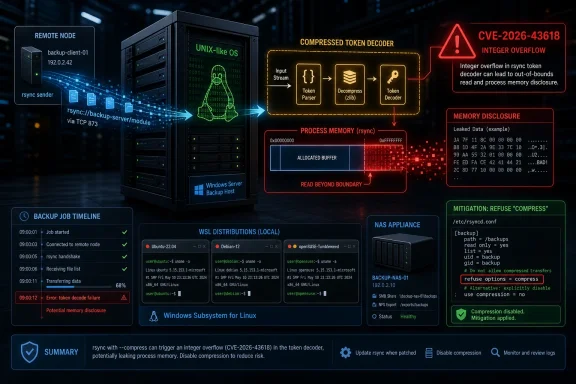 Rsync’s Quiet Ubiquity Turns a Unix Bug into a Windows Admin Problem
Rsync is not a Microsoft product, and that is precisely why this vulnerability deserves attention from Windows shops. The modern Windows environment is no longer a sealed monoculture of SMB shares, Group Policy, and PowerShell remoting. It is a mixed estate of Windows Server, Linux VMs, containers, WSL distributions, NAS targets, developer laptops, CI runners, and cloud-hosted backup workers.That is where rsync lives. It is the glue for mirror jobs, build artifacts, static-site publishing, offsite backups, home-lab replication, and “temporary” migration scripts that somehow become permanent. Many administrators could inventory their domain controllers faster than they could name every rsync binary reachable from their automation.
CVE-2026-43618 exploits that blind spot. The affected code is in rsync’s compressed-token decoder, where a 32-bit signed counter was not checked for overflow. Under the right conditions, a malicious sender can push the receiver into reading and returning data outside the intended buffer.
That makes the bug more subtle than a crash-only denial-of-service issue. The provided MSRC impact language highlights serious availability loss, and related scoring lists availability impact as high, but the core technical concern is memory disclosure. A process that coughs up environment variables, passwords, heap data, stack data, or library pointers is handing an attacker the kind of material that turns one bug into a campaign.
The High Score Is About Position, Not Just Severity
The CVSS score attached to CVE-2026-43618 is high, but the number alone does not explain the risk. The important detail is reachability. The rsync maintainers’ release notes for 3.4.3 distinguish between bugs that require unusual daemon configurations and bugs reachable through ordinary usage. CVE-2026-43618 falls into the more uncomfortable category: reachable from a normal pull or an authenticated daemon connection.That means defenders should resist the usual reflex of downgrading the issue because it is “only” authenticated. In backup and replication systems, authenticated peers are not always human users with carefully managed identities. They can be service accounts, partner systems, staging hosts, CI runners, or aging appliances with credentials that have not been rotated since the last office move.
The attack model is especially awkward because rsync is often used where trust is broad and logging is thin. A client may pull from a server because the server is assumed to be authoritative. A daemon may accept a connection because the peer is on a “safe” network segment. In those environments, the boundary between trusted sender and untrusted input has always been fuzzier than policy diagrams suggest.
This is why memory disclosure bugs deserve a different kind of urgency from administrators. They may not immediately encrypt files, spawn shells, or delete databases. But they can leak secrets, weaken address-space randomization, expose memory layout, and provide reconnaissance for a second-stage exploit.
Compression Becomes the Attack Surface Nobody Audited
The vulnerable component is not rsync’s headline feature. It is not the command-line syntax everyone remembers, the delta-transfer algorithm everyone praises, or the daemon configuration everyone argues about. It is the compressed-token decoder, a path that exists to make transfers efficient.That is the shape of many mature-software vulnerabilities. The risky code is not always where users think the product’s “security boundary” lives. It is often in parsing, compression, compatibility handling, metadata transfer, or wire-protocol bookkeeping — the plumbing that must accept remote input while pretending to be boring.
Integer overflow bugs thrive in this terrain. A counter seems harmless until it wraps. A size field seems mechanical until an attacker controls the sequence that drives it. A decoder seems like support code until its arithmetic decides what memory gets read.
The fix in rsync 3.4.3 bounds the counter and adds validation in adjacent wire-input paths. That phrasing matters. Security fixes in old network tools often repair not just one comparison, but a cluster of assumptions around it. Once a maintainer finds one unchecked length or signed counter, nearby code tends to receive a hard look.
The 3.4.3 Release Was a Security Sweep, Not a Routine Bump
CVE-2026-43618 arrived as part of a broader rsync 3.4.3 security release covering six CVEs. That broader context should affect patch prioritization. When a release fixes a single isolated bug, administrators can sometimes make a narrow decision about exposure. When a release lands with multiple protocol, daemon, proxy, and path-handling fixes, the argument for delay weakens.The other issues in the batch span symlink races, hostname and ACL behavior under particular chroot conditions, denial-of-service risk in receiver logic, and a proxy-handling stack write. Not every bug applies to every deployment. Some require non-default daemon settings. Some apply only to client-side proxy use. Some are less severe in isolation.
But together they show rsync undergoing the kind of scrutiny that usually follows accumulated technical debt. That is not an indictment of rsync; it is the normal lifecycle of widely deployed C code that has been trusted for decades. The software is valuable because it is old, portable, and everywhere. Those same properties make security cleanup hard.
For administrators, the practical interpretation is straightforward. Treat 3.4.3 not as a feature update but as a security baseline. If your distribution backports the fixes into an older package version, track the vendor-fixed package rather than obsessing over the upstream version string. If you compile rsync yourself, the upstream version matters much more.
Microsoft’s Appearance in the Story Is a Signal About Mixed Estates
MSRC’s listing may surprise users who think of rsync as something that belongs to Linux distributions and Unix administrators. But Microsoft has spent years making Windows a first-class citizen in mixed development and operations environments. WSL, Azure, DevOps pipelines, OpenSSH on Windows, container workflows, and hybrid identity have blurred the line between “Windows security” and “everything that touches a Windows-managed environment.”That is why this belongs on WindowsForum.com. A Windows administrator may never install rsync directly on a server and still depend on it indirectly. A backup appliance may use it under the hood. A Linux VM in Hyper-V may run it nightly. A WSL distribution may include it for developer workflows. A cloud build agent may use it to move artifacts. A security scanner may report it on hosts nobody considers part of the Windows fleet.
The danger is not that every Windows PC is suddenly exposed. The danger is that organizations often have better visibility into Microsoft Update compliance than into cross-platform utilities living inside developer and operations workflows. Patch dashboards can look green while the scripts that move the company’s data still rely on vulnerable components.
This is the hard edge of hybrid IT. The estate is managed as Windows, Linux, cloud, and appliance silos, but attackers experience it as one connected system. Rsync is one of the tools that quietly crosses those boundaries.
Availability Language Can Distract from the More Strategic Leak
The user-supplied impact description emphasizes total or serious availability loss. That is not irrelevant. A remotely triggerable condition that can repeatedly degrade or deny service in a transfer component matters, especially for backup windows, replication jobs, and recovery pipelines.Still, the more strategic concern in CVE-2026-43618 is confidentiality. The published descriptions repeatedly center on out-of-bounds reads and disclosure of process memory. If exploitation leaks environment variables or credentials from an rsync process, the immediate transfer failure may be the least important event in the log.
That distinction matters because availability incidents are often treated operationally: restart the service, rerun the job, widen the backup window, move on. Memory disclosure requires an incident-response mindset. What secrets might that process have held? Were credentials passed through the environment? Did the rsync daemon or wrapper script have access to SSH keys, tokens, repository credentials, or backup repository passwords?
A small leak repeated often can become a large leak. A leak that reveals memory pointers can also reduce exploit mitigations for later attacks. In modern exploitation, information disclosure is frequently not the finale; it is the opening move.
The “Authenticated Peer” Caveat Is Smaller Than It Looks
Security teams often triage vulnerabilities by asking whether an attacker must authenticate. That is reasonable, but it can be misleading for rsync. Authentication in a file-transfer utility does not necessarily mean a tightly governed enterprise identity with MFA, conditional access, and short-lived tokens.It may mean a shared password in a configuration file. It may mean an SSH key used by an automation account. It may mean a daemon module exposed to a subnet. It may mean a vendor-managed device connecting into a replication path. It may mean a CI worker that is rebuilt often but whose secrets persist in a pipeline variable store.
In such environments, the attacker does not need to be “inside” in the way executives imagine. They need compromise of one peer, one credential, one build node, or one partner system. Once that happens, rsync’s trust assumptions can work against the defender.
This is particularly relevant for Windows-centric organizations that have invested heavily in identity controls for interactive users but less in service-to-service credentials. The rsync account that has worked for five years may be excluded from password rotation because no one wants to break backups. That is exactly the sort of exception attackers love.
The Workaround Is Useful, but It Is Not a Strategy
For older releases, the rsync project identified a workaround: refusing thecompress option in rsyncd.conf. That is a meaningful mitigation because the vulnerable logic involves compressed-token decoding. Administrators who cannot immediately patch a daemon should consider it, especially on exposed or semi-trusted modules.But workarounds have a half-life. They can be applied inconsistently, overwritten by configuration management, forgotten during a migration, or bypassed by a separate rsync path that does not use the same daemon configuration. They may also trade security risk for performance or compatibility surprises, which encourages quiet rollback.
The better answer is to move to fixed packages. On mainstream Linux distributions, that may mean installing vendor updates with backported patches rather than expecting the visible version to read exactly 3.4.3. Debian and Ubuntu, for example, commonly patch older source versions while preserving distribution versioning conventions.
Windows users face a messier map. If rsync came from Cygwin, MSYS2, Git-adjacent tooling, cwRsync-style packages, a NAS vendor, or a WSL distribution, the update path depends on that channel. The same laptop can easily contain several rsync binaries, only one of which is patched.
WSL Makes Inventory Both Easier and Easier to Ignore
WSL deserves special mention because it has normalized Linux tooling on Windows endpoints. That is a good thing for developers, but it complicates vulnerability management. A Windows endpoint can be fully patched through Windows Update while an Ubuntu, Debian, or other WSL distribution inside it still carries vulnerable userland packages.The fix is not conceptually hard. Administrators and developers need to update packages inside each WSL distribution, not just the host OS. The difficulty is cultural. Many organizations treat WSL as a developer convenience rather than a managed software surface.
That posture is increasingly untenable. WSL instances can hold source code, credentials, SSH keys, cloud tokens, package caches, and automation scripts. If rsync is used inside those environments to pull from a malicious or compromised endpoint, the Windows host may not be the vulnerable component, but the user’s working environment is still at risk.
For enterprises, this is another argument for endpoint inventory that sees beyond traditional installed-program lists. If a developer workstation has three WSL distributions and two package managers, security tooling that only reads Add/Remove Programs is not seeing the real attack surface.
Backup Infrastructure Is Where “Just a File Tool” Becomes Critical
Rsync’s reputation as a simple file-copying tool understates its role in recovery. Many organizations use it in backup chains, either directly or embedded in appliances and scripts. Home users use it to mirror drives. Small businesses use it to push data to NAS boxes. Larger shops use it in pre- and post-processing around more formal backup systems.That makes availability language more important than it first appears. If exploitation can disrupt rsync receivers or transfer paths, it can interfere with backup freshness. A failed backup may not be catastrophic today, but it becomes catastrophic when paired with ransomware tomorrow.
The confidentiality angle is just as serious in backup contexts. Backup processes often have broad read access by design. They may traverse directories ordinary users cannot. They may handle secrets, configuration files, databases, and snapshots. If the process memory contains credentials or operational metadata, disclosure can undermine more than one host.
This is why backup infrastructure should not be treated as a utility closet. It is privileged infrastructure. It deserves segmentation, logging, credential hygiene, and patch velocity closer to identity systems than to office printers.
The Patch Priority Should Follow Data Flow, Not Asset Prestige
A domain controller running a vulnerable service would obviously demand attention. But rsync risk is not distributed according to server prestige. The most important systems to patch first are the ones that exchange data with less trusted peers, hold sensitive credentials in process environments, or sit in backup and deployment paths.That may put a forgotten Linux VM above a flagship Windows server. It may put a build runner above a database host. It may put a NAS appliance above a user workstation. Risk follows the data flow and the trust relationship, not the asset owner’s org chart.
Administrators should map where rsync is invoked rather than merely where it is installed. A dormant binary on a locked-down host matters less than a nightly job pulling from a partner-controlled server. A client pulling from a server can be exposed if the server is malicious. A daemon accepting authenticated connections can be exposed if the peer credential is compromised.
The most useful question is not “Do we run rsync?” It is “Which systems do we allow to send rsync data into processes that hold secrets or access critical files?”
Version Strings Will Mislead the Impatient
The upstream fix is rsync 3.4.3, but distribution packaging complicates the story. Ubuntu lists fixed packages with versions that do not necessarily say 3.4.3. Debian likewise shows fixed security builds for stable releases while unstable moves to a 3.4.3-based package.That is normal and defensible. Enterprise and long-term-support distributions backport security patches to older upstream versions to preserve stability. The visible version string may remain 3.2.7 or 3.4.1 with a distribution-specific suffix that carries the fix.
This creates a recurring problem for scanners and administrators. Some scanners understand vendor backports; others flag anything below the upstream fixed version. Some administrators assume a lower upstream number means vulnerable; others assume the package manager has handled everything. Both assumptions can be wrong without checking vendor advisory status.
For Windows environments pulling Linux packages through WSL or containers, this matters even more. A container image may lag behind the host. A WSL distro may be updated manually. A NAS vendor may publish firmware weeks after upstream. Version management becomes a supply-chain exercise, not a single command.
The Older Rsync CVE Cluster Still Haunts This One
CVE-2026-43618 also lands after earlier rsync security attention, including the 2024-era cluster of rsync vulnerabilities that forced many administrators to rediscover where the tool was deployed. That history matters because it suggests rsync is no longer an invisible background dependency. Researchers are looking at it. Attackers read the same advisories defenders do.Security maturity often begins when a tool becomes too famous to ignore. OpenSSL had that moment. Log4j had that moment. OpenSSH has lived in that state for years. Rsync may not be entering the same class of internet-wide panic, but it is plainly receiving deeper protocol and daemon scrutiny.
That should change operational assumptions. If rsync is part of a critical workflow, it should be owned, inventoried, updated, and monitored. If no one owns it, then it is not a tool; it is technical debt with a command-line interface.
The upside is that rsync’s maintainers have shipped a concrete fix and documented practical mitigations. This is not a mystery bug with vague vendor language. The path forward is visible. The hard part is getting organizations to look in all the places rsync hides.
Windows Defenders Need a Cross-Platform Patch Habit
The practical response starts with inventory. On Windows endpoints, that means looking beyond MSI-installed applications. Search WSL distributions, developer toolchains, Cygwin and MSYS2 environments, Git-related Unix utilities, backup products, NAS clients, and scripts that call bundled binaries.On servers, check Linux VMs, containers, appliance firmware, and jump boxes. On build systems, check runners and images. In backup environments, check both the control plane and the data movers. In cloud environments, check golden images and automation accounts that pull or push artifacts.
Then prioritize by exposure. Systems accepting rsync daemon connections from other hosts should move quickly. Systems pulling from hosts outside full administrative control should move quickly. Systems whose rsync processes can see secrets should move quickly. Systems used only for local file copies with no untrusted peer are lower priority, though still worth updating.
Finally, review credentials. A memory-disclosure vulnerability is a reminder that secrets should not casually live in environment variables or long-running process contexts. Where possible, use constrained accounts, rotate credentials, avoid broad read permissions, and segment backup paths from general-purpose networks.
The Real Fix Is Knowing Where the Trust Boundary Is
CVE-2026-43618 is best understood as a trust-boundary bug. Rsync receives structured data from another system and turns it into local memory operations. The vulnerability appears when arithmetic on that remote-influenced data escapes its expected bounds. That is the technical story in miniature.The operational story is broader. Organizations often fail to define the trust boundary around file synchronization. A host is “internal,” a partner is “trusted,” a backup server is “safe,” and a build runner is “temporary.” Those labels are not security controls.
If a system can send data that influences another system’s memory, it is on a trust boundary. If a credential lets one machine impersonate a legitimate rsync peer, it is on a trust boundary. If a transfer process can access sensitive files, it is on a trust boundary. The fact that the command is old and familiar does not make the boundary disappear.
This is the uncomfortable value of CVEs like this one. They force administrators to see infrastructure not as a list of products, but as a graph of assumptions. Rsync’s assumption is that the other side of the transfer is allowed to speak the protocol. CVE-2026-43618 shows why that assumption still needs defensive limits.
The Rsync Patch Belongs on This Week’s Windows Ops Agenda
The immediate work is not glamorous, but it is concrete. Treat this as a cross-platform maintenance item with security implications, not as a Linux footnote that Windows teams can ignore.- Upgrade rsync to 3.4.3 or install vendor packages that explicitly include the CVE-2026-43618 fix.
- If an rsync daemon cannot be patched immediately, refuse compression in the daemon configuration as a temporary mitigation.
- Inventory WSL distributions, Cygwin/MSYS2 installs, backup appliances, NAS firmware, containers, and build runners for bundled or packaged rsync binaries.
- Prioritize systems that pull from less trusted servers, accept authenticated daemon connections, or run rsync with access to sensitive files and credentials.
- Review service accounts, SSH keys, environment variables, and stored secrets used by rsync jobs, because memory disclosure can turn stale credentials into live exposure.
- Do not rely solely on upstream version numbers when using distribution packages, because vendors may backport the fix into older-looking package versions.
References
- Primary source: MSRC
Published: 2026-05-23T01:38:14-07:00
Security Update Guide - Microsoft Security Response Center
 msrc.microsoft.com
- Related coverage: sentinelone.com
CVE-2026-43618: Rsync Information Disclosure Vulnerability
CVE-2026-43618 is an information disclosure vulnerability in Rsync. Learn about its impact, affected versions, and mitigation methods.www.sentinelone.com
- Related coverage: mondoo.com
CVE-2026-43618 | Mondoo Vulnerability Intelligence
CVE-2026-43618 - HIGH severity: Rsync < 3.4.3 Integer Overflow Information Disclosuremondoo.com - Related coverage: echelongraph.io
CVE-2026-43618: Rsync < 3.4.3 Integer Overfl… | EchelonGraph
[High] Microsoft Security Response Center (MSRC) security advisory CVE-2026-43618 — CVE-2026-43618. Rsync < 3.4.3 Integer Overflow Information Disclosureechelongraph.io
- Related coverage: dbugs.ptsecurity.com
CVE-2026-43618 — Out of bounds Read in Rsync+2 Rsync+2 | dbugs
Details on CVE-2026-43618: Out of bounds Read in Rsync+2 Rsync+2. Includes CVSS score, affected versions, and references.dbugs.ptsecurity.com - Related coverage: radar.offseq.com
CVE-2026-43618: Integer Overflow or Wraparound in RsyncProject rsync - Live Threat Intelligence - Threat Radar | OffSeq.com
Detailed information about CVE-2026-43618: Integer Overflow or Wraparound in RsyncProject rsync affecting RsyncProject rsync. Get real-time updates, technical dradar.offseq.com
- Related coverage: caloes.ca.gov
- Related coverage: indusface.com
- Related coverage: support.bull.com
