

On May 20, 2026, CVE-2026-43617 was published for rsync 3.4.2 and earlier, describing a medium-severity authorization bypass in rsync daemon hostname-based access controls when the service is configured with chroot. The bug is not the kind of remote-code-execution siren that sends every SOC dashboard blinking red, but it lands in a place administrators tend to trust more than they should: name-based policy. Its lesson is blunt and familiar. If your security boundary depends on DNS telling the truth at exactly the right moment, you do not have a boundary so much as a polite request.
CVE-2026-43617 affects rsync versions before 3.4.3, specifically in the daemon’s handling of hostname-based access control lists. In the vulnerable scenario, an attacker who controls the PTR record for their source IP address can reportedly bypass deny rules that depend on hostname resolution, allowing access that an administrator intended to block.
That sounds narrow because it is narrow. The attack is network-based, requires no privileges, and does not require user interaction, but the complexity is rated high because the attacker needs conditions outside their immediate control. This is not “point scanner at the Internet, receive shell.” It is closer to “understand the target’s trust assumptions, shape a DNS answer, and exploit the gap between a failed lookup and an administrative policy.”
That distinction matters because the modern vulnerability economy often treats everything as either catastrophic or irrelevant. CVE-2026-43617 sits in the uncomfortable middle. It is unlikely to be the headline breach vector in a hardened enterprise, but it could be exactly the kind of overlooked misconfiguration-adjacent flaw that turns a supposedly restricted file-transfer service into an unexpected foothold.
Rsync is also not a fringe component. It is one of those Unix tools that quietly props up backups, mirrors, deployment workflows, embedded appliances, NAS devices, software repositories, and lab infrastructure. Many Windows-heavy shops still run it indirectly through Linux servers, WSL-backed tooling, Cygwin-style environments, storage appliances, or cross-platform backup systems. A bug in rsync is rarely just a Linux problem; it is often a supply-chain-of-habits problem.
Hostname-based access control has always carried a whiff of the old Internet: useful in trusted networks, convenient in labs, and dangerous when mistaken for strong authentication. Reverse DNS, in particular, is not an identity system. It is a naming mechanism whose answers can be influenced by whoever controls the relevant address space or delegation.
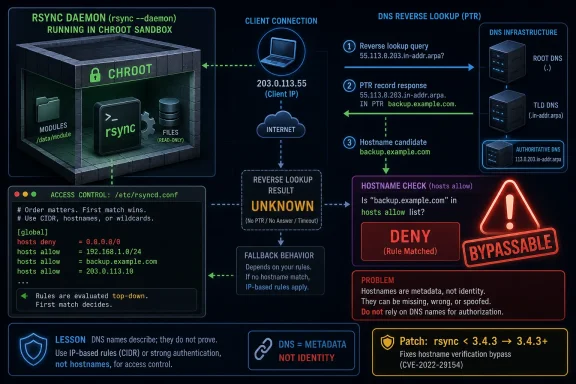
CVE-2026-43617 reportedly allows attackers to bypass hostname-based deny rules by controlling the PTR record for their source IP address. The interesting detail is the interaction with failed reverse DNS behavior and the fallback to an “UNKNOWN” hostname state. In plain English, a rule that an administrator expected to block a host by name may not behave as intended when the attacker can manipulate the name resolution path.
That is why the CVSS language about attack complexity is important rather than boilerplate. The advisory text says a successful attack depends on conditions beyond the attacker’s control and may require effort such as gathering environmental knowledge, preparing the target environment, or inserting themselves into a logical network path. For defenders, that should not translate to “safe.” It should translate to “exploitable by someone who has done reconnaissance.”
The best attackers do reconnaissance. They learn your naming patterns, your exposed daemons, your backup windows, your trust boundaries, and your stale assumptions. A high-complexity authorization bypass is often not attractive to opportunistic botnets, but it can be attractive to someone already studying a target.
Chroot is often treated as a containment measure, and in many contexts it is. But containment features do not automatically strengthen every other security decision made around them. Here, chroot is part of the vulnerable configuration story, not a magic shield that makes the daemon safe.
Administrators who run rsync daemons often do so because they need a service endpoint rather than a one-off SSH-based copy command. That daemon may be used for anonymous mirrors, authenticated modules, backup pulls, or tightly scoped replication. In those environments, “hosts allow” and “hosts deny” style controls can feel like a clean way to express network policy without building a larger access-control stack.
The danger is that a hostname rule looks more human-readable than an IP rule and therefore feels more intentional. A deny entry tied to a name appears to capture meaning: block that host, that domain, that class of machine. But the machine does not enforce meaning. It enforces the result of resolution logic, and this CVE is a reminder that resolution logic has edge cases.
This is the same old failure mode that has haunted security software for decades. Developers add a convenience feature, administrators use it as a control, and eventually someone discovers that the convenience feature never had the integrity properties required of a control.
For a patch manager drowning in browser zero-days, Exchange hardening, VPN appliances, kernel privilege escalations, and firmware advisories, that score will not force its way to the top of the queue. Nor should it automatically. Severity is a triage input, not an operational command.
But rsync is frequently deployed in places where low confidentiality or integrity impact can be misleading. A read-only mirror of public packages is one thing. A backup server, staging area, build artifact repository, or internal file drop is another. If bypassing a deny rule gives an attacker access to metadata, module listings, partial files, or writable locations, the practical consequences depend less on CVSS and more on what your environment has taught rsync to trust.
This is where vulnerability management often fails: it ranks the bug in isolation. CVE-2026-43617 should be ranked against local exposure. Is the daemon reachable from untrusted networks? Are hostname-based deny rules in use? Is chroot enabled? Are modules writable? Are secrets, backups, keys, database dumps, build artifacts, or deployment scripts present in reachable paths? Those answers can move the patch from “routine” to “do this before the weekend.”
The fact that exploitation is not reported as widely automated should not lull administrators into leaving it unresolved indefinitely. Medium-severity flaws in infrastructure utilities have a way of aging badly. Attackers do not need every target to be vulnerable; they need enough forgotten services to make the search worthwhile.
Hybrid estates are full of Linux-based backup boxes, NAS appliances, CI runners, virtualization hosts, container registries, package mirrors, security sensors, and file-transfer utilities that support Windows workloads. Rsync may be moving Windows images, profile backups, database exports, IIS logs, or application artifacts without ever showing up as a traditional Windows installed application.
This is particularly true in small and midsize environments where “the backup server” is a Linux machine maintained by one administrator, a vendor appliance, or an old VM that everyone is afraid to touch. It is also common in developer-heavy organizations where rsync quietly survives because it is fast, scriptable, and boring. Boring software is exactly where old assumptions accumulate.
For WindowsForum readers, the useful question is not “Do I run rsync on Windows?” It is “Where does rsync touch my Windows estate?” If it handles backup, deployment, recovery, migration, or mirror workflows, then an authorization bypass in daemon ACLs belongs in the same risk conversation as SMB exposure, RDP reachability, and credential hygiene.
Microsoft’s advisory presence also reflects how vulnerability tracking has become ecosystem-wide. MSRC is not only about Windows kernel bugs and Office macro issues; it increasingly acts as a clearinghouse for dependencies and third-party components that intersect with Microsoft customers. That does not make rsync a Microsoft product. It does make the vulnerability relevant to Microsoft-centered administrators who are responsible for everything their Windows systems depend on.
The more important work is configuration review. If rsync daemon access is controlled by hostnames, treat those rules as suspect until proven otherwise. Prefer IP-based controls enforced at the network layer, authenticated rsync-over-SSH workflows, VPN or private network reachability, and explicit account-level authorization over reverse-DNS-dependent policy.
This does not mean every hostname rule is instantly exploitable in every environment. It means hostname-based deny rules should not be your strongest lock. DNS can be part of observability, convenience, or routing; it should be handled cautiously when used for admission control.
Administrators should also look for exposed rsync daemons that no one remembers owning. Internet-facing rsync has long been a favorite subject of scanning and misconfiguration research because it can leak file lists or permit accidental data access even without a software CVE. A vulnerability like CVE-2026-43617 does not create that operational risk from scratch. It adds one more reason to clean it up.
The practical checklist is short: inventory rsync daemons, identify versions, inspect module configuration, review “hosts allow” and “hosts deny” patterns, confirm chroot usage, and determine whether the service is reachable from networks where source identity cannot be trusted. That last clause is the heart of the matter. If the requester can influence the name by which you identify them, your policy is already standing on sand.
Reverse DNS is especially treacherous. A PTR record can tell you what name an IP address claims, but that claim is not inherently proof that the host belongs to the domain you care about or that it should receive access. Stronger implementations perform forward-confirmed reverse DNS checks, but even those are not a substitute for cryptographic authentication and explicit authorization.
The pattern behind CVE-2026-43617 resembles a broader class of bugs where fallback behavior becomes a security decision. What happens when resolution fails? What name is assigned to the unknown? Does a deny rule match the intended object, or does it match the string produced by a failure path? These are the small seams where authorization bypasses live.
For defenders, this is a chance to revisit a long-standing mental model. The safer assumption is that DNS names are metadata, not identity. They are useful for logs, labels, dashboards, and operator comprehension. They are poor stand-ins for credentials.
That distinction has grown more important as infrastructure has become more dynamic. Cloud instances are created and destroyed constantly. Reverse zones are delegated across providers and tenants. Attackers rent infrastructure with legitimate address space and configure DNS however their provider allows. The old comfort of “that hostname looks like something I blocked” does not survive contact with modern hosting.
That is why utility hygiene matters. Organizations often have mature patch processes for Windows Server, SQL Server, Exchange, browsers, and endpoint agents, while the Linux utility layer beneath backup and deployment systems follows a more casual rhythm. If it is not part of a vendor console or monthly maintenance calendar, it becomes invisible.
The problem is not laziness. It is ownership. Rsync may sit between teams: infrastructure uses it, security scans it, developers script it, storage depends on it, and no one feels like the product owner. When a CVE arrives, everyone assumes someone else will patch the box.
This is where asset management has to become less theatrical and more useful. A CMDB entry saying “backup server” is not enough. Security teams need to know which services are listening, which utilities provide them, which configurations expose them, and which data flows depend on them. CVE-2026-43617 rewards that level of specificity.
The fix may be a package update, but the governance lesson is deeper. A small authorization bypass in a file-transfer daemon can reveal whether an organization actually knows how its data moves. If the answer is “some scripts on an old server,” the CVE is doing more than announcing a bug. It is pointing at a process gap.
An attacker does not need to accomplish an attack at will if the target is valuable enough. Preparation is part of intrusion work. If the precondition is controlling DNS for the source IP, that may be difficult in some cases and trivial in others, depending on hosting provider, network position, delegated reverse zones, or compromised infrastructure.
The “beyond the attacker’s control” phrase also does not mean beyond the attacker’s influence. It means exploitation may require measurable preparation or environmental knowledge. That is exactly the kind of work targeted operators perform before they touch production systems.
There is also a defensive asymmetry here. The administrator may not know whether an attacker can satisfy the preconditions, but the administrator can know whether the vulnerable configuration exists. That makes mitigation the cleaner path. Removing hostname-dependent authorization or applying the update is easier than trying to model every possible DNS manipulation scenario.
This is the right way to read medium infrastructure CVEs. Do not panic. Do not dismiss. Place the flaw in the context of exposure, sensitivity, and compensating controls. Then patch the systems where the gap between “unlikely” and “bad” is unacceptable.
Rsync will remain a dependable workhorse because infrastructure still needs simple, scriptable ways to move files, and the answer to every file-transfer risk cannot be a six-figure platform migration. But the next phase of practical security is going to be less forgiving of old conveniences masquerading as controls. Patch rsync, certainly; then look at every place where a name, a lookup, or a fallback string is being asked to prove identity, because attackers have learned to live in precisely those gaps.
 Rsync’s New Bug Is Small Enough to Ignore and Familiar Enough to Matter
CVE-2026-43617 affects rsync versions before 3.4.3, specifically in the daemon’s handling of hostname-based access control lists. In the vulnerable scenario, an attacker who controls the PTR record for their source IP address can reportedly bypass deny rules that depend on hostname resolution, allowing access that an administrator intended to block.That sounds narrow because it is narrow. The attack is network-based, requires no privileges, and does not require user interaction, but the complexity is rated high because the attacker needs conditions outside their immediate control. This is not “point scanner at the Internet, receive shell.” It is closer to “understand the target’s trust assumptions, shape a DNS answer, and exploit the gap between a failed lookup and an administrative policy.”
That distinction matters because the modern vulnerability economy often treats everything as either catastrophic or irrelevant. CVE-2026-43617 sits in the uncomfortable middle. It is unlikely to be the headline breach vector in a hardened enterprise, but it could be exactly the kind of overlooked misconfiguration-adjacent flaw that turns a supposedly restricted file-transfer service into an unexpected foothold.
Rsync is also not a fringe component. It is one of those Unix tools that quietly props up backups, mirrors, deployment workflows, embedded appliances, NAS devices, software repositories, and lab infrastructure. Many Windows-heavy shops still run it indirectly through Linux servers, WSL-backed tooling, Cygwin-style environments, storage appliances, or cross-platform backup systems. A bug in rsync is rarely just a Linux problem; it is often a supply-chain-of-habits problem.
The Vulnerability Lives Where DNS Becomes Policy
The core issue is not that rsync performs hostname resolution. Plenty of software does. The problem is what happens when hostname resolution is used as an authorization signal, especially in a daemon context where an administrator may believe a deny rule is deterministic.Hostname-based access control has always carried a whiff of the old Internet: useful in trusted networks, convenient in labs, and dangerous when mistaken for strong authentication. Reverse DNS, in particular, is not an identity system. It is a naming mechanism whose answers can be influenced by whoever controls the relevant address space or delegation.
CVE-2026-43617 reportedly allows attackers to bypass hostname-based deny rules by controlling the PTR record for their source IP address. The interesting detail is the interaction with failed reverse DNS behavior and the fallback to an “UNKNOWN” hostname state. In plain English, a rule that an administrator expected to block a host by name may not behave as intended when the attacker can manipulate the name resolution path.
That is why the CVSS language about attack complexity is important rather than boilerplate. The advisory text says a successful attack depends on conditions beyond the attacker’s control and may require effort such as gathering environmental knowledge, preparing the target environment, or inserting themselves into a logical network path. For defenders, that should not translate to “safe.” It should translate to “exploitable by someone who has done reconnaissance.”
The best attackers do reconnaissance. They learn your naming patterns, your exposed daemons, your backup windows, your trust boundaries, and your stale assumptions. A high-complexity authorization bypass is often not attractive to opportunistic botnets, but it can be attractive to someone already studying a target.
Chroot Makes the Bug More Specific, Not More Comforting
The vulnerability description includes an important condition: rsync daemon hostname-based ACL enforcement when configured with chroot. That is specific enough to keep the affected population smaller than “everyone who has rsync installed.” It also makes the issue easy to misread.Chroot is often treated as a containment measure, and in many contexts it is. But containment features do not automatically strengthen every other security decision made around them. Here, chroot is part of the vulnerable configuration story, not a magic shield that makes the daemon safe.
Administrators who run rsync daemons often do so because they need a service endpoint rather than a one-off SSH-based copy command. That daemon may be used for anonymous mirrors, authenticated modules, backup pulls, or tightly scoped replication. In those environments, “hosts allow” and “hosts deny” style controls can feel like a clean way to express network policy without building a larger access-control stack.
The danger is that a hostname rule looks more human-readable than an IP rule and therefore feels more intentional. A deny entry tied to a name appears to capture meaning: block that host, that domain, that class of machine. But the machine does not enforce meaning. It enforces the result of resolution logic, and this CVE is a reminder that resolution logic has edge cases.
This is the same old failure mode that has haunted security software for decades. Developers add a convenience feature, administrators use it as a control, and eventually someone discovers that the convenience feature never had the integrity properties required of a control.
Medium Severity Does Not Mean Middle Priority Everywhere
The published scoring puts CVE-2026-43617 in medium territory. CVSS 3.1 scoring has been reported at 4.8, while CVSS 4.0 scoring has been reported at 6.3. Both reflect a vulnerability that can be triggered over the network, requires no credentials, and has low confidentiality and integrity impact with no availability impact.For a patch manager drowning in browser zero-days, Exchange hardening, VPN appliances, kernel privilege escalations, and firmware advisories, that score will not force its way to the top of the queue. Nor should it automatically. Severity is a triage input, not an operational command.
But rsync is frequently deployed in places where low confidentiality or integrity impact can be misleading. A read-only mirror of public packages is one thing. A backup server, staging area, build artifact repository, or internal file drop is another. If bypassing a deny rule gives an attacker access to metadata, module listings, partial files, or writable locations, the practical consequences depend less on CVSS and more on what your environment has taught rsync to trust.
This is where vulnerability management often fails: it ranks the bug in isolation. CVE-2026-43617 should be ranked against local exposure. Is the daemon reachable from untrusted networks? Are hostname-based deny rules in use? Is chroot enabled? Are modules writable? Are secrets, backups, keys, database dumps, build artifacts, or deployment scripts present in reachable paths? Those answers can move the patch from “routine” to “do this before the weekend.”
The fact that exploitation is not reported as widely automated should not lull administrators into leaving it unresolved indefinitely. Medium-severity flaws in infrastructure utilities have a way of aging badly. Attackers do not need every target to be vulnerable; they need enough forgotten services to make the search worthwhile.
The Windows Angle Is the Infrastructure Around Windows
At first glance, rsync looks like a story for Linux administrators. Windows shops may be tempted to file it under “someone else’s package manager problem.” That would be a mistake, not because every Windows system has rsync, but because Windows environments rarely stop at Windows.Hybrid estates are full of Linux-based backup boxes, NAS appliances, CI runners, virtualization hosts, container registries, package mirrors, security sensors, and file-transfer utilities that support Windows workloads. Rsync may be moving Windows images, profile backups, database exports, IIS logs, or application artifacts without ever showing up as a traditional Windows installed application.
This is particularly true in small and midsize environments where “the backup server” is a Linux machine maintained by one administrator, a vendor appliance, or an old VM that everyone is afraid to touch. It is also common in developer-heavy organizations where rsync quietly survives because it is fast, scriptable, and boring. Boring software is exactly where old assumptions accumulate.
For WindowsForum readers, the useful question is not “Do I run rsync on Windows?” It is “Where does rsync touch my Windows estate?” If it handles backup, deployment, recovery, migration, or mirror workflows, then an authorization bypass in daemon ACLs belongs in the same risk conversation as SMB exposure, RDP reachability, and credential hygiene.
Microsoft’s advisory presence also reflects how vulnerability tracking has become ecosystem-wide. MSRC is not only about Windows kernel bugs and Office macro issues; it increasingly acts as a clearinghouse for dependencies and third-party components that intersect with Microsoft customers. That does not make rsync a Microsoft product. It does make the vulnerability relevant to Microsoft-centered administrators who are responsible for everything their Windows systems depend on.
The Patch Is Straightforward; The Audit Is the Real Work
The immediate remediation is simple: upgrade rsync to 3.4.3 or later where available. Distributions and vendors may backport the fix into packages with older-looking version strings, so administrators should rely on their vendor’s security metadata rather than version numbers alone when dealing with managed Linux distributions or appliances.The more important work is configuration review. If rsync daemon access is controlled by hostnames, treat those rules as suspect until proven otherwise. Prefer IP-based controls enforced at the network layer, authenticated rsync-over-SSH workflows, VPN or private network reachability, and explicit account-level authorization over reverse-DNS-dependent policy.
This does not mean every hostname rule is instantly exploitable in every environment. It means hostname-based deny rules should not be your strongest lock. DNS can be part of observability, convenience, or routing; it should be handled cautiously when used for admission control.
Administrators should also look for exposed rsync daemons that no one remembers owning. Internet-facing rsync has long been a favorite subject of scanning and misconfiguration research because it can leak file lists or permit accidental data access even without a software CVE. A vulnerability like CVE-2026-43617 does not create that operational risk from scratch. It adds one more reason to clean it up.
The practical checklist is short: inventory rsync daemons, identify versions, inspect module configuration, review “hosts allow” and “hosts deny” patterns, confirm chroot usage, and determine whether the service is reachable from networks where source identity cannot be trusted. That last clause is the heart of the matter. If the requester can influence the name by which you identify them, your policy is already standing on sand.
This Is Another Strike Against Name-Based Trust
The industry has spent years teaching administrators to stop trusting IP addresses too much. NAT, cloud elasticity, VPNs, IPv6 churn, and compromised internal hosts have all weakened the idea that an address equals an identity. But hostname-based trust is often worse because it can smuggle a human-friendly label into a machine-enforced decision.Reverse DNS is especially treacherous. A PTR record can tell you what name an IP address claims, but that claim is not inherently proof that the host belongs to the domain you care about or that it should receive access. Stronger implementations perform forward-confirmed reverse DNS checks, but even those are not a substitute for cryptographic authentication and explicit authorization.
The pattern behind CVE-2026-43617 resembles a broader class of bugs where fallback behavior becomes a security decision. What happens when resolution fails? What name is assigned to the unknown? Does a deny rule match the intended object, or does it match the string produced by a failure path? These are the small seams where authorization bypasses live.
For defenders, this is a chance to revisit a long-standing mental model. The safer assumption is that DNS names are metadata, not identity. They are useful for logs, labels, dashboards, and operator comprehension. They are poor stand-ins for credentials.
That distinction has grown more important as infrastructure has become more dynamic. Cloud instances are created and destroyed constantly. Reverse zones are delegated across providers and tenants. Attackers rent infrastructure with legitimate address space and configure DNS however their provider allows. The old comfort of “that hostname looks like something I blocked” does not survive contact with modern hosting.
Supply Chain Security Also Means Utility Hygiene
Rsync had a more dramatic security moment in early 2025, when multiple vulnerabilities in earlier versions drew attention to daemon exposure and file-transfer trust boundaries. CVE-2026-43617 is quieter, but it belongs to the same operational family. Tools that synchronize files inherit the sensitivity of the files they move.That is why utility hygiene matters. Organizations often have mature patch processes for Windows Server, SQL Server, Exchange, browsers, and endpoint agents, while the Linux utility layer beneath backup and deployment systems follows a more casual rhythm. If it is not part of a vendor console or monthly maintenance calendar, it becomes invisible.
The problem is not laziness. It is ownership. Rsync may sit between teams: infrastructure uses it, security scans it, developers script it, storage depends on it, and no one feels like the product owner. When a CVE arrives, everyone assumes someone else will patch the box.
This is where asset management has to become less theatrical and more useful. A CMDB entry saying “backup server” is not enough. Security teams need to know which services are listening, which utilities provide them, which configurations expose them, and which data flows depend on them. CVE-2026-43617 rewards that level of specificity.
The fix may be a package update, but the governance lesson is deeper. A small authorization bypass in a file-transfer daemon can reveal whether an organization actually knows how its data moves. If the answer is “some scripts on an old server,” the CVE is doing more than announcing a bug. It is pointing at a process gap.
Attack Complexity Is Not a Defender’s Get-Out-of-Patching Card
The advisory language emphasizes that successful exploitation depends on conditions beyond the attacker’s control. That is a meaningful constraint, and defenders should not inflate the bug into something it is not. But high complexity has often been misunderstood as low urgency.An attacker does not need to accomplish an attack at will if the target is valuable enough. Preparation is part of intrusion work. If the precondition is controlling DNS for the source IP, that may be difficult in some cases and trivial in others, depending on hosting provider, network position, delegated reverse zones, or compromised infrastructure.
The “beyond the attacker’s control” phrase also does not mean beyond the attacker’s influence. It means exploitation may require measurable preparation or environmental knowledge. That is exactly the kind of work targeted operators perform before they touch production systems.
There is also a defensive asymmetry here. The administrator may not know whether an attacker can satisfy the preconditions, but the administrator can know whether the vulnerable configuration exists. That makes mitigation the cleaner path. Removing hostname-dependent authorization or applying the update is easier than trying to model every possible DNS manipulation scenario.
This is the right way to read medium infrastructure CVEs. Do not panic. Do not dismiss. Place the flaw in the context of exposure, sensitivity, and compensating controls. Then patch the systems where the gap between “unlikely” and “bad” is unacceptable.
The Most Useful Response Is Boring and Immediate
The operational response to CVE-2026-43617 should be deliberately unglamorous. Patch the package, reduce exposure, and retire name-based trust where it matters. The bug does not demand a new security architecture, but it does argue for cleaning up a class of assumptions that should have been retired years ago.- Upgrade rsync to 3.4.3 or consume the fixed package from your operating system or appliance vendor.
- Identify rsync daemons that use hostname-based allow or deny rules, especially when chroot is enabled.
- Treat reverse DNS as advisory metadata rather than a durable authorization boundary.
- Restrict rsync daemon reachability with firewalls, private networks, VPNs, or authenticated transport wherever possible.
- Review rsync modules for sensitive readable or writable paths before assuming the impact is limited.
- Include Linux utilities and storage appliances that support Windows workflows in Windows-centered vulnerability management.
Rsync will remain a dependable workhorse because infrastructure still needs simple, scriptable ways to move files, and the answer to every file-transfer risk cannot be a six-figure platform migration. But the next phase of practical security is going to be less forgiving of old conveniences masquerading as controls. Patch rsync, certainly; then look at every place where a name, a lookup, or a fallback string is being asked to prove identity, because attackers have learned to live in precisely those gaps.
References
- Primary source: MSRC
Published: 2026-05-23T01:38:32-07:00
Security Update Guide - Microsoft Security Response Center
 msrc.microsoft.com
- Related coverage: thehackerwire.com
CVE-2026-43617 - Medium Vulnerability
CVE-2026-43617 is a Medium severity vulnerability (CVSS 4.8). Rsync version 3.4.2 and prior contain an authorization bypass vulnerability in the rsync daemon's hostname-based access control list enforcement when configured...www.thehackerwire.com
- Official source: microsoft.com
MSRC - Microsoft Security Response Center
The Microsoft Security Response Center is part of the defender community and on the front line of security response evolution. For over twenty years, we have been engaged with security researchers working to protect customers and the broader ecosystem.www.microsoft.com
- Related coverage: sentinelone.com
CVE-2026-41035: rsync Use-After-Free Vulnerability
CVE-2026-41035 is a use-after-free vulnerability in rsync. Learn about its impact, affected versions, and mitigation methods for this critical flaw.www.sentinelone.com
- Related coverage: ish.com.br
- Related coverage: support.bull.com
