

CVE-2026-29518 is a high-severity rsync vulnerability disclosed on May 20, 2026, affecting versions before 3.4.3, in which a daemon running without chroot protection can be raced into following attacker-controlled symlinks and writing files outside the intended module path. It is not the sort of bug that turns every laptop into a beachhead overnight. It is the kind of bug that exposes how much modern infrastructure still depends on old, trusted file-moving tools running in privileged corners. For Windows administrators, the lesson is less “panic about rsync” than “inventory the Unix-shaped plumbing hiding behind your backup, NAS, WSL, CI, and appliance workflows.”
Rsync occupies a strange place in security triage. It is both boring and everywhere: a synchronization utility old enough to feel like infrastructure rather than software, but still central to backups, mirrors, release pipelines, NAS replication, and cross-platform file movement. That combination means vulnerabilities in rsync rarely map neatly to a single product owner.
CVE-2026-29518 sits in rsync’s daemon file-handling logic. The short version is that affected versions before 3.4.3 could check that a path was safe, then later use that path after an attacker had swapped one of its parent directory components for a symbolic link. That gap between time of check and time of use is the classic TOCTOU failure: the software asks the right question, but the filesystem has changed by the time the answer matters.
The important qualifier is configuration. The rsync project’s own release note says this issue is reachable in daemon mode when a module is configured with
Defaults are a comforting fiction in long-lived infrastructure. Production systems are full of “temporary” exceptions, legacy compatibility flags, container shortcuts, NAS vendor templates, and backup modules tuned years ago by someone who no longer works there. A vulnerability that depends on a non-default setting can still matter when the non-default setting is common enough in real deployments.
That is why the bug is more than a denial-of-service nuisance. Arbitrary file write is one of those phrases that deserves its reputation, because file writes are often the shortest path from “limited access” to “control of something more important.” If the daemon runs with elevated privileges, a write primitive may become a privilege-escalation primitive.
The user-facing impact can still look like availability loss. A service can be rendered unusable if critical files are overwritten, configuration is corrupted, or data is redirected into places it should never go. The MSRC-style language around total loss of availability is not wrong; it is simply describing one outcome of a deeper problem, which is that a boundary intended to contain writes can be bypassed.
The more interesting security question is not whether every attacker can hit the race reliably. Race conditions often require timing, repetition, local footholds, or very specific environmental conditions. The real issue is that rsync daemon modules are frequently used precisely where file integrity matters most: backups, distribution mirrors, shared staging areas, and privileged automation paths.
That matters for administrators who treat chroot as an old Unix artifact rather than a practical containment layer. Chroot is not a complete sandbox by modern standards, and nobody should pretend it is equivalent to a hardened container, SELinux policy, Windows Defender Application Control, or a full virtualization boundary. But in this case, it is the relevant line between a module path and the rest of the filesystem.
The release also mentions that rsync 3.4.3 turns on stronger safe-opening behavior for the daemon-without-chroot case. That is the right fix: do not rely on checking string paths and hoping they stay true; resolve path components in a way that is anchored under the intended directory and resistant to symlink replacement. Modern filesystem security keeps rediscovering the same lesson: paths are promises, file descriptors are facts.
There is a useful humility in this bug. Rsync had already introduced hardened path-opening logic for a previous security issue, but this new advisory says the daemon-no-chroot case had not been using it. Security fixes often fail not because engineers do not understand the class of vulnerability, but because the codebase has more paths than the first patch covered.
That is where WindowsForum readers should pay attention. The vulnerable component may not be a Microsoft binary, but it may still protect Microsoft workloads. A Linux backup server pulling from Windows shares, a NAS replicating home directories, a WSL-based automation job, or a CI runner staging artifacts for Windows deployment can all make rsync part of the Windows estate in practice.
MSRC listing the CVE is a reminder of this wider dependency web. Microsoft’s ecosystem is now a mesh of first-party Windows components, Linux distributions under WSL, Azure images, developer tools, open-source packages, and third-party appliances. Vulnerability management that stops at “is this in Windows Update?” is too narrow for the way Windows is actually used.
The hard part is ownership. The Windows team may not manage the NAS. The Linux team may not know which rsync module backs a Windows file share. The security team may see a CVE in an advisory feed but not know whether it maps to a package, a container, a vendor firmware image, or an embedded appliance. CVE-2026-29518 is a good test of whether an organization’s inventory can follow a humble utility across platform boundaries.
But “requires write access” is not the clean comfort it appears to be. Many rsync modules are deliberately writable by automation accounts, backup identities, deployment jobs, mirrored build workers, or semi-trusted users. In messy environments, those identities are often less controlled than domain admins but more powerful than ordinary users.
That makes the vulnerability particularly relevant after an initial compromise. An attacker who lands on a low-privilege account may not be able to write to
This is why severity scoring can feel both accurate and incomplete. A CVSS rating captures exploit prerequisites and technical impact, but it cannot know whether your “limited” writable module is attached to a crown-jewel backup server. Local privilege escalation on a boring replication host can still become a serious incident if that host is trusted by the rest of the environment.
The story is that rsync’s maintainers and external researchers have been auditing old assumptions in code that operates at the dangerous intersection of remote input, filesystem semantics, and privilege. That is exactly where mature infrastructure tools accumulate risk. They work so reliably for so long that their threat models calcify.
For defenders, the existence of several CVEs in one release should change the upgrade calculus. If you were tempted to wait because CVE-2026-29518 requires
There is also a practical packaging wrinkle. Many distributions backport fixes rather than shipping upstream rsync 3.4.3 verbatim, so version-string checking alone may mislead you. Debian, for example, has fixed builds for supported releases that retain older upstream version numbers with distribution-specific security revisions. Inventory tools need to understand vendor patch levels, not just compare
A path is not an object. It is a lookup expression through a mutable namespace. If an attacker can change part of that namespace between validation and use, the program may operate on a different object than the one it inspected.
That distinction becomes sharper in synchronization software. Rsync is built to traverse trees, compare metadata, create directories, follow or preserve links depending on options, and write files efficiently. Those are exactly the behaviors that make symlink handling subtle. The tool is supposed to manipulate filesystem structure; the vulnerability appears when an attacker gets to manipulate the structure faster or more cleverly than the tool expects.
Modern mitigations tend to move away from path strings and toward anchored directory file descriptors,
Administrators should resist the urge to classify this as only a Linux server concern. Windows fleets routinely depend on Linux-based backup controllers, NAS appliances, rsync-over-SSH jobs, and containerized replication tasks. If those systems store Windows profile data, Hyper-V exports, database dumps, installer repositories, or golden images, they are part of the Windows security perimeter even when their shell prompt says otherwise.
The risk is highest where rsync daemons are long-lived and privileged. A scheduled
That is the triage map. Not every rsync instance deserves the same emergency page. But the instances that are writable, daemonized, privileged, and not chrooted deserve attention before the next routine maintenance window.
The configuration fix is equally plain: avoid
For Windows-heavy shops, the right move is to search outside the obvious places. Check WSL distributions on build machines. Check Git Bash, MSYS2, and Cygwin environments where rsync may have been installed for deployment scripts. Check Linux containers used by Windows application teams. Check backup appliances, storage arrays, and NAS boxes that expose rsync replication as a checkbox in a web UI.
The worst answer is “we do not run Linux.” In 2026, almost every serious Windows environment runs Linux somewhere, even if only as infrastructure glue. CVE-2026-29518 is exactly the kind of vulnerability that hides in that glue layer.
That expansion is good for visibility, but it complicates patch responsibility. A Windows admin may see the CVE and ask whether Windows Update fixes it. Often the answer will be no, because the vulnerable copy of rsync lives in Debian under WSL, a vendor NAS, an Azure Marketplace image, a container base layer, or a third-party backup appliance. Visibility is centralized; remediation is not.
This is the broader shift in vulnerability management. The operating system is no longer the only meaningful unit of exposure. The workload, the package, the container image, the appliance firmware, and the automation account are all first-class security objects. A CVE can be relevant to a Windows organization without being a Windows vulnerability.
That distinction should shape how teams communicate. Security should not drop CVE-2026-29518 into a Windows patch queue and assume it is handled. Infrastructure owners should not dismiss it because it mentions rsync. The useful question is narrower and harder: where do we run rsync daemon modules, which of them are writable, which run without chroot, and which run with privileges that matter?
That is a mouthful, but it is also a gift. Many vulnerability alerts are difficult to translate into action because the condition is vague. This one gives defenders concrete predicates to test.
The fix path should start with externally reachable services and backup infrastructure, then move inward to developer and automation systems. Internet exposure is not required for exploitation, but remotely reachable daemons deserve first attention because they widen the pool of possible attackers. Internal-only services still matter where lateral movement is a realistic concern.
Administrators should also examine logs and configuration history. A module that is read-only today may have been writable yesterday. A daemon that now runs unprivileged may have run as root during a migration. Security triage is not only a snapshot; it is a reconstruction of the assumptions around a service.
Mature software is not automatically safe. It is merely well-traveled. The dangerous code paths are often the ones preserved for compatibility, unusual deployment models, or legacy operational convenience. Daemon mode without chroot may exist for reasons that made sense in a given environment, but every exception becomes part of the attack surface.
The same reasoning applies beyond rsync. Archive extraction, backup restoration, artifact deployment, installer staging, and file synchronization all need explicit defenses against path traversal and symlink substitution. If a privileged process writes files based on names supplied by a less-trusted party, the burden of proof is on the process, not the party.
For Windows administrators, this should sound familiar. NTFS reparse points, junctions, symlinks, and object manager tricks have their own long history in privilege escalation research. The Unix vocabulary is different, but the underlying lesson travels well: indirection is powerful, and privileged file operations must assume indirection can be hostile.
CVE-2026-29518 will probably not be remembered as the defining vulnerability of 2026, and that is exactly why it is useful. It is a compact example of the security work that now defines real Windows administration: follow the dependency into the Linux corner, separate default-safe systems from exception-heavy ones, patch the old tool, and then ask why a file synchronization daemon ever had enough privilege to make a symlink race matter.
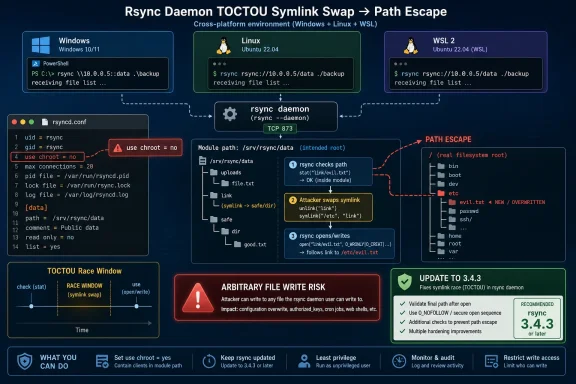 Rsync’s Quiet Ubiquity Makes a Local Bug Feel Larger
Rsync occupies a strange place in security triage. It is both boring and everywhere: a synchronization utility old enough to feel like infrastructure rather than software, but still central to backups, mirrors, release pipelines, NAS replication, and cross-platform file movement. That combination means vulnerabilities in rsync rarely map neatly to a single product owner.CVE-2026-29518 sits in rsync’s daemon file-handling logic. The short version is that affected versions before 3.4.3 could check that a path was safe, then later use that path after an attacker had swapped one of its parent directory components for a symbolic link. That gap between time of check and time of use is the classic TOCTOU failure: the software asks the right question, but the filesystem has changed by the time the answer matters.
The important qualifier is configuration. The rsync project’s own release note says this issue is reachable in daemon mode when a module is configured with
use chroot = no; the default use chroot = yes is not exposed in the same way. That distinction should keep the story from turning into alarmism, but it should not lull operators into ignoring it.Defaults are a comforting fiction in long-lived infrastructure. Production systems are full of “temporary” exceptions, legacy compatibility flags, container shortcuts, NAS vendor templates, and backup modules tuned years ago by someone who no longer works there. A vulnerability that depends on a non-default setting can still matter when the non-default setting is common enough in real deployments.
The Race Is Small, but the Security Boundary Is the Filesystem
The mechanics of CVE-2026-29518 are almost mundane. An attacker with write access inside an rsync module path replaces a parent directory with a symlink at the right moment, after rsync has decided the path is acceptable but before rsync actually opens or writes the file. If the daemon is not confined by chroot, that redirected path can land outside the directory tree the administrator thought was exposed.That is why the bug is more than a denial-of-service nuisance. Arbitrary file write is one of those phrases that deserves its reputation, because file writes are often the shortest path from “limited access” to “control of something more important.” If the daemon runs with elevated privileges, a write primitive may become a privilege-escalation primitive.
The user-facing impact can still look like availability loss. A service can be rendered unusable if critical files are overwritten, configuration is corrupted, or data is redirected into places it should never go. The MSRC-style language around total loss of availability is not wrong; it is simply describing one outcome of a deeper problem, which is that a boundary intended to contain writes can be bypassed.
The more interesting security question is not whether every attacker can hit the race reliably. Race conditions often require timing, repetition, local footholds, or very specific environmental conditions. The real issue is that rsync daemon modules are frequently used precisely where file integrity matters most: backups, distribution mirrors, shared staging areas, and privileged automation paths.
Chroot Was the Guardrail Everyone Forgot They Were Depending On
The rsync project’s note around this release is unusually helpful because it explains not just what was fixed, but where the exposed configuration lives. CVE-2026-29518 requires daemon mode without chroot for the vulnerable path. In other words, the safety mechanism was not merely a checkbox; it was the boundary that kept a symlink trick from turning into an escape.That matters for administrators who treat chroot as an old Unix artifact rather than a practical containment layer. Chroot is not a complete sandbox by modern standards, and nobody should pretend it is equivalent to a hardened container, SELinux policy, Windows Defender Application Control, or a full virtualization boundary. But in this case, it is the relevant line between a module path and the rest of the filesystem.
The release also mentions that rsync 3.4.3 turns on stronger safe-opening behavior for the daemon-without-chroot case. That is the right fix: do not rely on checking string paths and hoping they stay true; resolve path components in a way that is anchored under the intended directory and resistant to symlink replacement. Modern filesystem security keeps rediscovering the same lesson: paths are promises, file descriptors are facts.
There is a useful humility in this bug. Rsync had already introduced hardened path-opening logic for a previous security issue, but this new advisory says the daemon-no-chroot case had not been using it. Security fixes often fail not because engineers do not understand the class of vulnerability, but because the codebase has more paths than the first patch covered.
Windows Shops Are Exposed Through the Places They Pretend Are Not Windows
On a traditional Windows desktop, rsync is not a native household name. But Windows environments are no longer purely Windows environments. Rsync appears through Cygwin, MSYS2, Git-adjacent toolchains, WSL distributions, backup appliances, NAS devices, container images, Linux build runners, and hybrid file services that sit beside Active Directory but live in a Unix-flavored world.That is where WindowsForum readers should pay attention. The vulnerable component may not be a Microsoft binary, but it may still protect Microsoft workloads. A Linux backup server pulling from Windows shares, a NAS replicating home directories, a WSL-based automation job, or a CI runner staging artifacts for Windows deployment can all make rsync part of the Windows estate in practice.
MSRC listing the CVE is a reminder of this wider dependency web. Microsoft’s ecosystem is now a mesh of first-party Windows components, Linux distributions under WSL, Azure images, developer tools, open-source packages, and third-party appliances. Vulnerability management that stops at “is this in Windows Update?” is too narrow for the way Windows is actually used.
The hard part is ownership. The Windows team may not manage the NAS. The Linux team may not know which rsync module backs a Windows file share. The security team may see a CVE in an advisory feed but not know whether it maps to a package, a container, a vendor firmware image, or an embedded appliance. CVE-2026-29518 is a good test of whether an organization’s inventory can follow a humble utility across platform boundaries.
The Attack Requires a Foothold, Which Is Not the Same as Being Harmless
The most tempting way to down-rank this bug is to point out that an attacker needs write access to the rsync module path. That is true, and it matters. This is not an unauthenticated internet worm scenario based on the public details available at disclosure.But “requires write access” is not the clean comfort it appears to be. Many rsync modules are deliberately writable by automation accounts, backup identities, deployment jobs, mirrored build workers, or semi-trusted users. In messy environments, those identities are often less controlled than domain admins but more powerful than ordinary users.
That makes the vulnerability particularly relevant after an initial compromise. An attacker who lands on a low-privilege account may not be able to write to
/etc, a service directory, or a privileged script path directly. If that account can write inside an rsync module handled by a daemon running with more privilege and without chroot, the race becomes a possible escalation route.This is why severity scoring can feel both accurate and incomplete. A CVSS rating captures exploit prerequisites and technical impact, but it cannot know whether your “limited” writable module is attached to a crown-jewel backup server. Local privilege escalation on a boring replication host can still become a serious incident if that host is trusted by the rest of the environment.
The 3.4.3 Release Is Bigger Than One CVE
Rsync 3.4.3 did not ship as a single-bug patch. The release fixed six CVEs, including issues involving daemon configuration, compressed-token decoding, symlink races across other path-based system calls, client-side denial of service from a malicious server, and a proxy-handling stack write. Some are more constrained than others, but the cluster tells a story.The story is that rsync’s maintainers and external researchers have been auditing old assumptions in code that operates at the dangerous intersection of remote input, filesystem semantics, and privilege. That is exactly where mature infrastructure tools accumulate risk. They work so reliably for so long that their threat models calcify.
For defenders, the existence of several CVEs in one release should change the upgrade calculus. If you were tempted to wait because CVE-2026-29518 requires
use chroot = no, the companion fixes make that argument weaker. The package update is not just a response to one reachable configuration; it is a hardening release for a tool that regularly handles untrusted paths and remote peers.There is also a practical packaging wrinkle. Many distributions backport fixes rather than shipping upstream rsync 3.4.3 verbatim, so version-string checking alone may mislead you. Debian, for example, has fixed builds for supported releases that retain older upstream version numbers with distribution-specific security revisions. Inventory tools need to understand vendor patch levels, not just compare
rsync --version against 3.4.3 and call it done.The Symlink Problem Keeps Winning Because Paths Are a Bad Security Primitive
Symlink races are not new, and that is precisely why they remain embarrassing. The pattern has appeared for decades across installers, archive extractors, package managers, backup tools, temporary-file handlers, developer utilities, and privileged maintenance scripts. The recurring failure is almost always the same: software treats a path as if it is a stable object.A path is not an object. It is a lookup expression through a mutable namespace. If an attacker can change part of that namespace between validation and use, the program may operate on a different object than the one it inspected.
That distinction becomes sharper in synchronization software. Rsync is built to traverse trees, compare metadata, create directories, follow or preserve links depending on options, and write files efficiently. Those are exactly the behaviors that make symlink handling subtle. The tool is supposed to manipulate filesystem structure; the vulnerability appears when an attacker gets to manipulate the structure faster or more cleverly than the tool expects.
Modern mitigations tend to move away from path strings and toward anchored directory file descriptors,
openat-style APIs, no-follow flags, beneath-resolution constraints, and per-component checks. Those defenses are less elegant than a simple “normalize the path and compare prefixes,” but they are closer to how filesystems actually behave under attack.Backup Infrastructure Is Where “Just a File Write” Becomes a Business Problem
Rsync is often found in backup systems, and backup systems are where security language becomes operational reality. A file overwrite can be availability loss if it corrupts a restore point. It can be integrity loss if it modifies a mirrored artifact. It can be confidentiality loss if the same race also redirects reads or exposes basis files outside the intended tree.Administrators should resist the urge to classify this as only a Linux server concern. Windows fleets routinely depend on Linux-based backup controllers, NAS appliances, rsync-over-SSH jobs, and containerized replication tasks. If those systems store Windows profile data, Hyper-V exports, database dumps, installer repositories, or golden images, they are part of the Windows security perimeter even when their shell prompt says otherwise.
The risk is highest where rsync daemons are long-lived and privileged. A scheduled
rsync client run over SSH may have a different exposure profile than a network-accessible daemon module. A read-only module differs from a writable one. A chrooted module differs from one explicitly configured without chroot. A daemon running as root differs from one constrained to an unprivileged service account.That is the triage map. Not every rsync instance deserves the same emergency page. But the instances that are writable, daemonized, privileged, and not chrooted deserve attention before the next routine maintenance window.
The Fix Is Straightforward; Finding Every Instance Is Not
The clean fix is to update rsync to 3.4.3 or a vendor build that includes the relevant backported patches. On managed Linux distributions, that usually means applying security updates from the distribution rather than manually compiling upstream tarballs. On NAS devices and appliances, it means watching vendor firmware advisories and not assuming the exposed rsync version is visible in a normal package manager.The configuration fix is equally plain: avoid
use chroot = no unless there is a documented operational reason, and treat writable daemon modules as security-sensitive services. If chroot cannot be used, administrators should compensate with least-privilege service accounts, filesystem permissions, mandatory access controls where available, and network restrictions that limit who can reach the daemon.For Windows-heavy shops, the right move is to search outside the obvious places. Check WSL distributions on build machines. Check Git Bash, MSYS2, and Cygwin environments where rsync may have been installed for deployment scripts. Check Linux containers used by Windows application teams. Check backup appliances, storage arrays, and NAS boxes that expose rsync replication as a checkbox in a web UI.
The worst answer is “we do not run Linux.” In 2026, almost every serious Windows environment runs Linux somewhere, even if only as infrastructure glue. CVE-2026-29518 is exactly the kind of vulnerability that hides in that glue layer.
Microsoft’s Advisory Feed Is Now a Map of the Hybrid Estate
There was a time when seeing an rsync CVE in a Microsoft-facing security context would have felt odd. That time is over. Microsoft’s security world now includes Windows, Azure, Linux images, WSL, Defender telemetry, GitHub, open-source dependencies, container ecosystems, and enterprise customers who consume all of it as one operational surface.That expansion is good for visibility, but it complicates patch responsibility. A Windows admin may see the CVE and ask whether Windows Update fixes it. Often the answer will be no, because the vulnerable copy of rsync lives in Debian under WSL, a vendor NAS, an Azure Marketplace image, a container base layer, or a third-party backup appliance. Visibility is centralized; remediation is not.
This is the broader shift in vulnerability management. The operating system is no longer the only meaningful unit of exposure. The workload, the package, the container image, the appliance firmware, and the automation account are all first-class security objects. A CVE can be relevant to a Windows organization without being a Windows vulnerability.
That distinction should shape how teams communicate. Security should not drop CVE-2026-29518 into a Windows patch queue and assume it is handled. Infrastructure owners should not dismiss it because it mentions rsync. The useful question is narrower and harder: where do we run rsync daemon modules, which of them are writable, which run without chroot, and which run with privileges that matter?
The Practical Risk Lives in a Small Set of Bad Combinations
Most environments will find rsync somewhere. Fewer will find the exact dangerous combination. The highest-risk profile is an rsync daemon before 3.4.3, with a writable module, configured withuse chroot = no, reachable by a user or system that could be compromised, and running with enough privilege to write meaningful files outside the module tree.That is a mouthful, but it is also a gift. Many vulnerability alerts are difficult to translate into action because the condition is vague. This one gives defenders concrete predicates to test.
The fix path should start with externally reachable services and backup infrastructure, then move inward to developer and automation systems. Internet exposure is not required for exploitation, but remotely reachable daemons deserve first attention because they widen the pool of possible attackers. Internal-only services still matter where lateral movement is a realistic concern.
Administrators should also examine logs and configuration history. A module that is read-only today may have been writable yesterday. A daemon that now runs unprivileged may have run as root during a migration. Security triage is not only a snapshot; it is a reconstruction of the assumptions around a service.
The Patch Teaches a Better Habit Than the CVE Itself
The best outcome from CVE-2026-29518 would be a boring one: most systems patch, the exposed configurations shrink, and the bug becomes another reminder that symlink races are treacherous. But the better long-term lesson is about how administrators judge old tools.Mature software is not automatically safe. It is merely well-traveled. The dangerous code paths are often the ones preserved for compatibility, unusual deployment models, or legacy operational convenience. Daemon mode without chroot may exist for reasons that made sense in a given environment, but every exception becomes part of the attack surface.
The same reasoning applies beyond rsync. Archive extraction, backup restoration, artifact deployment, installer staging, and file synchronization all need explicit defenses against path traversal and symlink substitution. If a privileged process writes files based on names supplied by a less-trusted party, the burden of proof is on the process, not the party.
For Windows administrators, this should sound familiar. NTFS reparse points, junctions, symlinks, and object manager tricks have their own long history in privilege escalation research. The Unix vocabulary is different, but the underlying lesson travels well: indirection is powerful, and privileged file operations must assume indirection can be hostile.
The Rsync 3.4.3 Checklist Belongs Beside Your Windows Patch Tuesday Notes
The operational response does not need to be theatrical. It needs to be specific, prioritized, and cross-platform. Treat CVE-2026-29518 as a reason to inspect the file-transfer layer that usually escapes normal Windows patch routines.- Upgrade rsync to 3.4.3 or a vendor-supported build that explicitly includes the CVE-2026-29518 fix.
- Review
rsyncd.conffor writable modules usinguse chroot = no, and restore chroot confinement wherever operationally possible. - Prioritize rsync daemons that run with elevated privileges, serve backup or deployment paths, or are reachable from untrusted networks.
- Check WSL distributions, NAS appliances, Linux containers, CI runners, MSYS2, Cygwin, and backup products rather than limiting inventory to Windows Update.
- Treat vendor firmware and distribution backports as valid fixes only when the vendor advisory or package changelog confirms the relevant patch.
- Reduce the blast radius by running rsync daemons as dedicated low-privilege accounts and limiting network access to known clients.
CVE-2026-29518 will probably not be remembered as the defining vulnerability of 2026, and that is exactly why it is useful. It is a compact example of the security work that now defines real Windows administration: follow the dependency into the Linux corner, separate default-safe systems from exception-heavy ones, patch the old tool, and then ask why a file synchronization daemon ever had enough privilege to make a symlink race matter.
References
- Primary source: MSRC
Published: 2026-05-23T01:38:58-07:00
Security Update Guide - Microsoft Security Response Center
 msrc.microsoft.com
- Related coverage: vulncheck.com
Rsync < 3.4.3 TOCTOU Race Condition Allows Symlink-Based Arbitrary File Write | Advisories | VulnCheck
CVE-2026-29518 | null | Affecting Rsync < 3.4.3 | Severity: HIGH | CVSS: 7.3www.vulncheck.com - Related coverage: newreleases.io
RsyncProject/rsync v3.4.3 on GitHub
New release RsyncProject/rsync version v3.4.3 on GitHub. newreleases.io
- Related coverage: security.snyk.io
Time-of-check Time-of-use (TOCTOU) in rsync | CVE-2026-29518 | Snyk
High severity (7) Time-of-check Time-of-use (TOCTOU) in rsync | CVE-2026-29518security.snyk.io
