

CVE-2026-43619 is a newly listed rsync vulnerability affecting versions before 3.4.3, published in May 2026 and tracked by Microsoft’s Security Response Center, in which local attackers can exploit symlink race conditions in path-based system calls to escape intended rsync module boundaries. The bug is not the sort of one-click remote calamity that fills incident-response war rooms by lunchtime. It is more awkward, more conditional, and in many environments more revealing: it exposes how much enterprise security still depends on filesystem assumptions that were never designed to be security boundaries. For Windows shops, the lesson is not “rsync is a Linux problem,” but that modern infrastructure increasingly hides Unix-grade plumbing beneath Windows-first operations.
The core of CVE-2026-43619 is a race between what rsync thinks a path is and what that path becomes by the time a filesystem operation actually lands. In affected versions, rsync uses path-based system calls such as chmod, lchown, utimes, rename, unlink, mkdir, symlink, mknod, link, rmdir, and lstat in ways that can be abused if an attacker can swap path components with symbolic links at just the right moment.
That timing requirement matters. Microsoft’s scoring language describes the attack complexity as requiring conditions beyond the attacker’s control, meaning exploitation cannot simply be fired at a target with guaranteed results. An attacker may need knowledge of the environment, repeated attempts, local filesystem access, or positioning that improves reliability.
But “not guaranteed” is not the same thing as “not exploitable.” Race-condition bugs often live in that uncomfortable middle ground where a single attempt is unreliable, but automation, patience, and a cooperative workload can turn low probability into operational success. The history of local privilege escalation is full of bugs that began life as fiddly timing problems and matured into practical exploit chains once attackers learned the cadence of the target.
The boundary rsync is trying to preserve is the exported module: the directory tree a daemon is meant to expose. The vulnerability description is blunt about the consequence. Under the wrong configuration, a local attacker with filesystem access may redirect operations so that permissions, ownership, timestamps, or filenames supplied through rsync affect files outside that intended tree.
That ubiquity is also why this vulnerability lands differently from a flaw in a consumer app. Rsync is often embedded in backup routines, deployment scripts, appliance firmware, container images, and administrative habits built over years. Many organizations do not have a tidy inventory entry that says “rsync daemon exposed here, version there, chroot setting over there.”
The affected condition is narrower than “anyone using rsync.” Reports and vulnerability databases describe the risky case as rsync daemons configured with
This is the kind of vulnerability that rewards boring hygiene. If rsync is current, if daemon modules are chrooted where practical, if writable paths are isolated, if local users are constrained, and if backup identities do not have excessive rights, the blast radius shrinks. If rsync is a forgotten service running with a permissive configuration because “it’s only internal,” the story changes.
Windows estates are now cross-platform estates. They include Windows Server, Linux VMs on Hyper-V, WSL on developer workstations, Azure-hosted Linux workloads, containers, storage appliances, Git servers, CI runners, backup targets, and third-party tools that package Unix utilities behind a Windows-friendly interface. A vulnerability does not need to ship in the Windows kernel to become a Windows operations problem.
MSRC tracking a vulnerability like CVE-2026-43619 is part of that broader shift. Microsoft now has to speak to administrators who manage mixed fleets and hybrid workloads, not just patch Tuesday endpoints. A WindowsForum reader may never run an rsync daemon directly on a Windows box, but may depend on one for backups, code deployment, Linux subsystem workflows, or appliance replication.
That is why treating this as a Linux-only footnote would be a mistake. The practical question for a Windows-centric shop is not whether the bug lives in Win32. It is whether rsync exists anywhere in the dependency graph that keeps Windows services recoverable, deployable, or auditable.
Yet defenders often misread attack complexity as a reason to defer. In real networks, attackers do not always need the cleanest path. They chain weak footholds, steal credentials, land on a shared host, study cron jobs, watch file activity, and wait for privileged automation to do something useful.
A symlink race in rsync becomes more interesting when viewed through that post-compromise lens. An attacker with limited local access may not care that the race is unreliable if a backup or synchronization job runs every few minutes. The attacker can prepare the directory layout, observe timing, and keep trying until the window opens.
The most plausible risk is not cinematic remote takeover. It is boundary erosion. A tool configured to operate within one module may be tricked into affecting objects outside it, and that can matter if those objects are configuration files, authorized keys, application directories, or other files whose metadata or names influence behavior.
When chroot is disabled, rsync may gain flexibility. Some deployments avoid chroot because of path dependencies, filesystem layout complexity, device files, library needs, or historical workarounds. Administrators may have turned it off years ago to solve a compatibility problem and never revisited the risk.
That is how security debt accumulates. A setting that once looked like harmless operational glue becomes the exact condition that makes a new vulnerability meaningful. CVE-2026-43619 is less a condemnation of rsync than a reminder that every “temporarily relaxed” boundary tends to become permanent infrastructure.
For sysadmins, the immediate audit is straightforward: find rsync daemons, identify modules, check versions, inspect chroot settings, and understand who can write to the module paths. The harder part is cultural. Teams need to stop treating internal synchronization infrastructure as inherently trusted simply because it is not a web-facing API.
Symbolic links make this especially treacherous because they are designed to redirect path resolution. They are useful, ordinary filesystem objects, not malware. But when privileged or semi-privileged software follows paths without anchoring operations to already-open file descriptors or otherwise preventing substitution, a symlink can become a steering wheel.
Modern secure filesystem code increasingly avoids trusting strings as stable objects. Instead of repeatedly resolving pathnames, careful software opens directories, holds file descriptors, uses flags that avoid symlink traversal where appropriate, and performs operations relative to known directory handles. That approach reduces the gap between “the thing I checked” and “the thing I changed.”
CVE-2026-43619 shows why that distinction remains relevant in 2026. The bug is not about exotic cryptography or speculative execution. It is about the filesystem being a living environment while software treats it like a static map.
A single internet-facing rsync daemon with permissive modules is a different problem from a locked-down internal backup target. A multi-user Linux host where untrusted accounts can write into rsync-controlled paths is a different problem from an appliance that only accepts replication from a protected peer. A developer workstation with WSL scripts is a different problem from a production storage node.
The most urgent environments are those where local filesystem access is shared, rsync daemon mode is enabled, chroot is off, and the rsync process has rights that matter outside the exported module. That combination turns a conditional race into a credible escalation or lateral movement aid.
For Windows administrators, the inventory challenge is compounded by packaging. Rsync may arrive through Cygwin, MSYS2, Git-adjacent tooling, backup products, NAS firmware, Linux containers, WSL distributions, or vendor-managed appliances. Some of those will be updated through familiar package managers; others will wait for OEM firmware or product patches.
If an attacker can influence what backup or synchronization tooling touches, even indirectly, they may gain a route to persistence or sabotage. Changing metadata is not always as dramatic as overwriting a binary, but permissions, ownership, timestamps, and filenames can affect how applications load files, how administrators interpret events, and how recovery workflows behave.
The ransomware era has already taught organizations that backup infrastructure is part of the battlefield. Attackers target snapshots, replication jobs, retention settings, and recovery credentials because those systems determine whether an incident becomes a bad day or a company-wide crisis. A symlink race in a backup-adjacent tool deserves attention precisely because it may sit in a trusted lane.
That does not mean every rsync deployment is on fire. It means backup paths deserve the same threat modeling as production paths. If a synchronization daemon can be steered outside its intended module, the right response is not panic; it is to verify the boundary before an attacker does.
NAS devices are a particularly relevant category because rsync support is a common feature. Small-business storage boxes, home-lab gear, and branch-office appliances often expose rsync as a checkbox in a management UI. The administrator may never see the underlying version, daemon configuration, or whether chroot is used.
That creates a familiar lag. Upstream releases a fix; distributions package it; vendors ingest it; appliances receive firmware; customers schedule updates; some devices never get patched. The long tail is where moderate vulnerabilities linger long enough to become part of commodity playbooks.
WindowsForum readers who maintain mixed environments should resist the instinct to audit only servers with SSH access. Check storage appliances, backup targets, replication endpoints, and vendor products that advertise rsync compatibility. If the product cannot report its rsync version or configuration, that absence is itself a risk signal.
The safer design pattern is to reduce reliance on repeated global path resolution. Open trusted parent directories, operate relative to file descriptors, reject unexpected symlinks, minimize privilege, and assume that every writable directory is adversarial if another principal can modify it. That is not glamorous engineering, but it is the difference between containment and wishful thinking.
This matters beyond rsync. Build systems, deployment agents, package managers, backup tools, container volume handlers, and log processors all manipulate paths supplied directly or indirectly by users. Any one of them can recreate the same class of bug if it treats a checked path as stable.
Windows developers are not exempt simply because NTFS differs from Unix filesystems. Reparse points, junctions, hard links, case-insensitivity quirks, alternate data streams, and privilege boundaries all produce their own path confusion hazards. The lesson travels well across platforms: file identity must be anchored, not assumed.
Configuration review is just as important. If rsync daemon mode is not required, disable it. If daemon mode is required, use chroot where practical, constrain writable modules, avoid running as an unnecessarily privileged account, and separate trust zones so that a compromise in one module does not matter to the rest of the filesystem.
Monitoring should focus on behavior rather than just version strings. Unexpected symlink churn inside rsync module trees, repeated failed synchronization attempts, strange metadata changes, and file operations just outside exported directories all deserve attention. Race-condition exploitation can be noisy when attackers are brute-forcing timing windows.
There is also a documentation task. Many organizations cannot quickly answer where rsync is used, which identities run it, and what data crosses it. CVE-2026-43619 is a good excuse to turn that tribal knowledge into an inventory entry before the next rsync flaw arrives.
For enterprise IT, the most dangerous word around this vulnerability is “only.” It only affects older versions. It only matters with daemon mode. It only matters with chroot disabled. It only helps a local attacker. Each statement may be true, but attackers build chains out of “only.”
The right response is proportional but not dismissive. Patch where packages are available, pressure vendors where appliances lag, audit configurations, and reduce the privileges attached to synchronization workflows. If rsync is buried inside a product, ask the vendor whether CVE-2026-43619 is fixed and how to verify the deployed version.
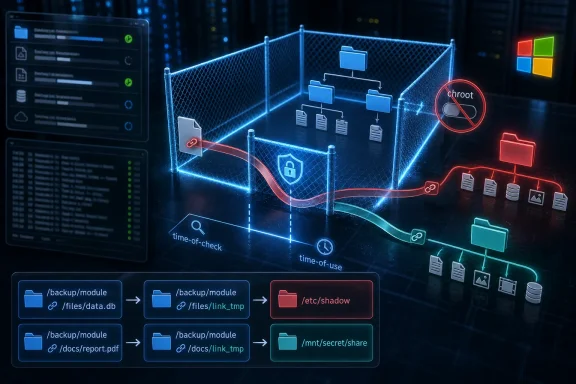 The Dangerous Part Is Not the Symlink, It Is the Boundary
The core of CVE-2026-43619 is a race between what rsync thinks a path is and what that path becomes by the time a filesystem operation actually lands. In affected versions, rsync uses path-based system calls such as chmod, lchown, utimes, rename, unlink, mkdir, symlink, mknod, link, rmdir, and lstat in ways that can be abused if an attacker can swap path components with symbolic links at just the right moment.That timing requirement matters. Microsoft’s scoring language describes the attack complexity as requiring conditions beyond the attacker’s control, meaning exploitation cannot simply be fired at a target with guaranteed results. An attacker may need knowledge of the environment, repeated attempts, local filesystem access, or positioning that improves reliability.
But “not guaranteed” is not the same thing as “not exploitable.” Race-condition bugs often live in that uncomfortable middle ground where a single attempt is unreliable, but automation, patience, and a cooperative workload can turn low probability into operational success. The history of local privilege escalation is full of bugs that began life as fiddly timing problems and matured into practical exploit chains once attackers learned the cadence of the target.
The boundary rsync is trying to preserve is the exported module: the directory tree a daemon is meant to expose. The vulnerability description is blunt about the consequence. Under the wrong configuration, a local attacker with filesystem access may redirect operations so that permissions, ownership, timestamps, or filenames supplied through rsync affect files outside that intended tree.
Rsync’s Boring Reputation Is Exactly Why This Matters
Rsync is one of the infrastructure tools that disappears because it works. It shuttles backups, mirrors repositories, synchronizes web roots, feeds NAS appliances, and quietly glues together systems that otherwise have little in common. It is not fashionable middleware, but it is everywhere enough that a medium-severity bug can still have a long tail.That ubiquity is also why this vulnerability lands differently from a flaw in a consumer app. Rsync is often embedded in backup routines, deployment scripts, appliance firmware, container images, and administrative habits built over years. Many organizations do not have a tidy inventory entry that says “rsync daemon exposed here, version there, chroot setting over there.”
The affected condition is narrower than “anyone using rsync.” Reports and vulnerability databases describe the risky case as rsync daemons configured with
use chroot = no, where the daemon is not isolating module access through a chroot jail. That detail will be comforting to administrators who already harden rsync daemons, but it will be less comforting to those inheriting old backup servers, vendor images, or NAS defaults whose configuration was last reviewed during a storage migration nobody wants to remember.This is the kind of vulnerability that rewards boring hygiene. If rsync is current, if daemon modules are chrooted where practical, if writable paths are isolated, if local users are constrained, and if backup identities do not have excessive rights, the blast radius shrinks. If rsync is a forgotten service running with a permissive configuration because “it’s only internal,” the story changes.
The Microsoft Angle Is a Warning About Cross-Platform Reality
At first glance, an rsync CVE in Microsoft’s Security Update Guide may look odd to Windows administrators. Rsync is historically associated with Unix and Linux, not Windows Update or monthly cumulative patches. But that reaction is increasingly out of date.Windows estates are now cross-platform estates. They include Windows Server, Linux VMs on Hyper-V, WSL on developer workstations, Azure-hosted Linux workloads, containers, storage appliances, Git servers, CI runners, backup targets, and third-party tools that package Unix utilities behind a Windows-friendly interface. A vulnerability does not need to ship in the Windows kernel to become a Windows operations problem.
MSRC tracking a vulnerability like CVE-2026-43619 is part of that broader shift. Microsoft now has to speak to administrators who manage mixed fleets and hybrid workloads, not just patch Tuesday endpoints. A WindowsForum reader may never run an rsync daemon directly on a Windows box, but may depend on one for backups, code deployment, Linux subsystem workflows, or appliance replication.
That is why treating this as a Linux-only footnote would be a mistake. The practical question for a Windows-centric shop is not whether the bug lives in Win32. It is whether rsync exists anywhere in the dependency graph that keeps Windows services recoverable, deployable, or auditable.
Attack Complexity Does Not Equal Operational Irrelevance
The user-facing language around this CVE emphasizes that exploitation requires effort and favorable conditions. That is accurate and important. A successful attack is not described as something a remote unauthenticated attacker can accomplish at will from across the internet.Yet defenders often misread attack complexity as a reason to defer. In real networks, attackers do not always need the cleanest path. They chain weak footholds, steal credentials, land on a shared host, study cron jobs, watch file activity, and wait for privileged automation to do something useful.
A symlink race in rsync becomes more interesting when viewed through that post-compromise lens. An attacker with limited local access may not care that the race is unreliable if a backup or synchronization job runs every few minutes. The attacker can prepare the directory layout, observe timing, and keep trying until the window opens.
The most plausible risk is not cinematic remote takeover. It is boundary erosion. A tool configured to operate within one module may be tricked into affecting objects outside it, and that can matter if those objects are configuration files, authorized keys, application directories, or other files whose metadata or names influence behavior.
The Chroot Setting Is the Administrative Plot Twist
The phraseuse chroot = no is the hinge on which much of this vulnerability turns. Chroot is an old Unix mechanism that changes a process’s apparent root directory, limiting what it can see within a filesystem subtree. It is not a perfect sandbox, but for rsync daemon modules it has long been a practical containment layer.When chroot is disabled, rsync may gain flexibility. Some deployments avoid chroot because of path dependencies, filesystem layout complexity, device files, library needs, or historical workarounds. Administrators may have turned it off years ago to solve a compatibility problem and never revisited the risk.
That is how security debt accumulates. A setting that once looked like harmless operational glue becomes the exact condition that makes a new vulnerability meaningful. CVE-2026-43619 is less a condemnation of rsync than a reminder that every “temporarily relaxed” boundary tends to become permanent infrastructure.
For sysadmins, the immediate audit is straightforward: find rsync daemons, identify modules, check versions, inspect chroot settings, and understand who can write to the module paths. The harder part is cultural. Teams need to stop treating internal synchronization infrastructure as inherently trusted simply because it is not a web-facing API.
Path-Based System Calls Are a Familiar Old Trap
The technical pattern here belongs to a long-running class of filesystem bugs: time-of-check to time-of-use races. A program checks a path, makes a decision, and later acts on what it believes is the same path. If an attacker can alter the filesystem between those moments, the program’s decision may apply to something different.Symbolic links make this especially treacherous because they are designed to redirect path resolution. They are useful, ordinary filesystem objects, not malware. But when privileged or semi-privileged software follows paths without anchoring operations to already-open file descriptors or otherwise preventing substitution, a symlink can become a steering wheel.
Modern secure filesystem code increasingly avoids trusting strings as stable objects. Instead of repeatedly resolving pathnames, careful software opens directories, holds file descriptors, uses flags that avoid symlink traversal where appropriate, and performs operations relative to known directory handles. That approach reduces the gap between “the thing I checked” and “the thing I changed.”
CVE-2026-43619 shows why that distinction remains relevant in 2026. The bug is not about exotic cryptography or speculative execution. It is about the filesystem being a living environment while software treats it like a static map.
The Severity Score Understates the Inventory Problem
Vulnerability scoring systems are useful, but they are often least useful at the moment an administrator needs to prioritize messy reality. CVE-2026-43619 has been described with medium-to-high severity depending on the scoring source and vector used. Those numbers are less important than exposure.A single internet-facing rsync daemon with permissive modules is a different problem from a locked-down internal backup target. A multi-user Linux host where untrusted accounts can write into rsync-controlled paths is a different problem from an appliance that only accepts replication from a protected peer. A developer workstation with WSL scripts is a different problem from a production storage node.
The most urgent environments are those where local filesystem access is shared, rsync daemon mode is enabled, chroot is off, and the rsync process has rights that matter outside the exported module. That combination turns a conditional race into a credible escalation or lateral movement aid.
For Windows administrators, the inventory challenge is compounded by packaging. Rsync may arrive through Cygwin, MSYS2, Git-adjacent tooling, backup products, NAS firmware, Linux containers, WSL distributions, or vendor-managed appliances. Some of those will be updated through familiar package managers; others will wait for OEM firmware or product patches.
Backups Are Security Infrastructure, Not Just Insurance
Rsync’s most sensitive role is often backup and replication. That makes any boundary bug more delicate than its headline severity may suggest. Backup systems tend to have broad read access, scheduled execution, privileged service accounts, and trust relationships that span production and recovery environments.If an attacker can influence what backup or synchronization tooling touches, even indirectly, they may gain a route to persistence or sabotage. Changing metadata is not always as dramatic as overwriting a binary, but permissions, ownership, timestamps, and filenames can affect how applications load files, how administrators interpret events, and how recovery workflows behave.
The ransomware era has already taught organizations that backup infrastructure is part of the battlefield. Attackers target snapshots, replication jobs, retention settings, and recovery credentials because those systems determine whether an incident becomes a bad day or a company-wide crisis. A symlink race in a backup-adjacent tool deserves attention precisely because it may sit in a trusted lane.
That does not mean every rsync deployment is on fire. It means backup paths deserve the same threat modeling as production paths. If a synchronization daemon can be steered outside its intended module, the right response is not panic; it is to verify the boundary before an attacker does.
Appliances May Be the Slow-Moving Risk
The cleanest fix is upstream: update rsync to 3.4.3 or later. On a general-purpose Linux server, that may be as simple as applying distribution updates once packages are available. On appliances, embedded systems, and vendor-managed storage products, the timeline can be slower and more opaque.NAS devices are a particularly relevant category because rsync support is a common feature. Small-business storage boxes, home-lab gear, and branch-office appliances often expose rsync as a checkbox in a management UI. The administrator may never see the underlying version, daemon configuration, or whether chroot is used.
That creates a familiar lag. Upstream releases a fix; distributions package it; vendors ingest it; appliances receive firmware; customers schedule updates; some devices never get patched. The long tail is where moderate vulnerabilities linger long enough to become part of commodity playbooks.
WindowsForum readers who maintain mixed environments should resist the instinct to audit only servers with SSH access. Check storage appliances, backup targets, replication endpoints, and vendor products that advertise rsync compatibility. If the product cannot report its rsync version or configuration, that absence is itself a risk signal.
Developers Should Read This as a Filesystem Design Lesson
For developers, CVE-2026-43619 is another reminder that pathnames are not capabilities. A string like/module/project/file is a request for resolution, not proof of identity. The filesystem can change underneath the program, particularly when untrusted users can write to directories involved in the path.The safer design pattern is to reduce reliance on repeated global path resolution. Open trusted parent directories, operate relative to file descriptors, reject unexpected symlinks, minimize privilege, and assume that every writable directory is adversarial if another principal can modify it. That is not glamorous engineering, but it is the difference between containment and wishful thinking.
This matters beyond rsync. Build systems, deployment agents, package managers, backup tools, container volume handlers, and log processors all manipulate paths supplied directly or indirectly by users. Any one of them can recreate the same class of bug if it treats a checked path as stable.
Windows developers are not exempt simply because NTFS differs from Unix filesystems. Reparse points, junctions, hard links, case-insensitivity quirks, alternate data streams, and privilege boundaries all produce their own path confusion hazards. The lesson travels well across platforms: file identity must be anchored, not assumed.
Defenders Need to Patch, Then Prove the Assumption
The practical remediation begins with upgrading rsync. Version 3.4.3 is the fixed upstream release associated with this vulnerability family, and administrators should prefer vendor-supported packages rather than hand-built binaries unless they have a controlled reason to do otherwise. Distribution backports may carry fixes without changing the visible upstream version, so package changelogs and vendor advisories matter.Configuration review is just as important. If rsync daemon mode is not required, disable it. If daemon mode is required, use chroot where practical, constrain writable modules, avoid running as an unnecessarily privileged account, and separate trust zones so that a compromise in one module does not matter to the rest of the filesystem.
Monitoring should focus on behavior rather than just version strings. Unexpected symlink churn inside rsync module trees, repeated failed synchronization attempts, strange metadata changes, and file operations just outside exported directories all deserve attention. Race-condition exploitation can be noisy when attackers are brute-forcing timing windows.
There is also a documentation task. Many organizations cannot quickly answer where rsync is used, which identities run it, and what data crosses it. CVE-2026-43619 is a good excuse to turn that tribal knowledge into an inventory entry before the next rsync flaw arrives.
The Rsync Fix Is Small; the Operational Question Is Larger
The immediate story is a fixed bug in a venerable file-transfer tool. The bigger story is that infrastructure tools are full of implied trust boundaries, and implied boundaries tend to fail at the exact moment defenders need them most. CVE-2026-43619 is a reminder that “inside the module,” “inside the share,” and “inside the backup path” are security claims, not mere configuration descriptions.For enterprise IT, the most dangerous word around this vulnerability is “only.” It only affects older versions. It only matters with daemon mode. It only matters with chroot disabled. It only helps a local attacker. Each statement may be true, but attackers build chains out of “only.”
The right response is proportional but not dismissive. Patch where packages are available, pressure vendors where appliances lag, audit configurations, and reduce the privileges attached to synchronization workflows. If rsync is buried inside a product, ask the vendor whether CVE-2026-43619 is fixed and how to verify the deployed version.
The Real Checklist Hides in the Edge Cases
The concrete work here is not dramatic, but it is the kind of work that separates resilient environments from lucky ones. Administrators should treat this CVE as both a patching task and a boundary review.- Confirm whether rsync exists on servers, appliances, WSL distributions, containers, backup systems, CI runners, and vendor products, not just on obvious Linux hosts.
- Upgrade affected rsync installations to 3.4.3 or a vendor package that explicitly backports the relevant fixes.
- Review rsync daemon modules for
use chroot = no, writable paths, overly broad permissions, and service accounts with unnecessary access outside the exported module. - Disable rsync daemon mode where SSH-based or alternative synchronization methods already meet the operational need.
- Monitor module directories for unusual symbolic-link changes, repeated synchronization failures, and metadata changes that do not match expected jobs.
- Treat backup and replication infrastructure as privileged security infrastructure, not as passive storage plumbing.
References
- Primary source: MSRC
Published: 2026-05-23T01:44:58-07:00
Security Update Guide - Microsoft Security Response Center
 msrc.microsoft.com
- Related coverage: mondoo.com
CVE-2026-43619 | Mondoo Vulnerability Intelligence
CVE-2026-43619 - HIGH severity: Rsync < 3.4.3 Symlink Race Condition via Path-Based Syscallsmondoo.com - Related coverage: vulncheck.com
Rsync < 3.4.3 TOCTOU Race Condition Allows Symlink-Based Arbitrary File Write | Advisories | VulnCheck
CVE-2026-29518 | null | Affecting Rsync < 3.4.3 | Severity: HIGH | CVSS: 7.3www.vulncheck.com - Related coverage: vulert.com
Symlink Race Condition Vulnerability in Rsync Package
Learn about the symlink race condition vulnerability in Rsync, its implications, and how to secure your system against it.vulert.com - Related coverage: sentinelone.com
CVE-2026-45232: Rsync Buffer Overflow Vulnerability
CVE-2026-45232 is a buffer overflow vulnerability in Rsync versions before 3.4.3. Learn about its impact, affected versions, and mitigation methods.www.sentinelone.com
- Related coverage: support.bull.com
- Related coverage: sra.io
- Related coverage: nti.nsfocus.com
