

SCS Software confirmed on July 1, 2026, that American Truck Simulator’s upcoming British Columbia DLC will include Grand Forks, Creston, Sparwood, Invermere, Golden, Princeton, and Campbell River as early revealed drivable destinations. That list matters less as a tourism brochure than as a map-reading exercise. The studio is not merely adding another rectangle to its long-haul atlas; it is testing whether American Truck Simulator can become a broader North American platform without losing the careful regional specificity that made its U.S. expansion model work. British Columbia is the border crossing that turns a successful map pipeline into a much bigger promise.
For most of its life, American Truck Simulator has been a game of incremental geography. SCS Software started with a western United States foundation and then built outward through paid map expansions, one state at a time, asking players to treat each DLC not as a sequel but as a new lane in an ever-thickening road network.
British Columbia changes the grammar. It is not another state, not another piece of the same federal jigsaw, and not another excuse to stretch Interstate mileage eastward. It is the first confirmed step outside the United States, which means every design decision suddenly carries more weight than the usual question of which city gets a depot and which road gets compressed.
That is why the first batch of confirmed towns is interesting. Vancouver, the obvious headline city, is not the story yet. Instead, SCS is showing Grand Forks, Creston, Sparwood, Invermere, Golden, Princeton, and Campbell River — a spread that points to border crossings, mountain corridors, resource towns, coastal logistics, and a ferry-linked Vancouver Island future.
The message is clear enough: British Columbia will not be a postcard pasted above Washington. It is being framed as a working province, with agriculture, mining, forestry, rail connections, highways, and coastal industry all doing the heavy lifting.
More likely, SCS is sequencing the reveal. Big cities are expensive in development terms and risky in marketing terms: show them too early and every missing landmark becomes a complaint; show them too late and the community fills the vacuum with speculation. By opening with smaller and mid-sized communities, SCS gets to define the DLC around routes and industries rather than skyline recognition.
That is a smart move for this particular province. British Columbia is not experienced as one urban center with scenery attached. It is a province of transitions: coast to valley, valley to pass, pass to interior, interior to Rockies, island to mainland. The towns SCS chose to reveal first are the connective tissue that makes those transitions playable.
Grand Forks and Creston suggest southern routes near the U.S. border. Sparwood and Golden point toward the Rockies and heavy transport corridors. Campbell River confirms that Vancouver Island is not just background texture. Princeton sits at a highway junction that could become one of those places players pass through constantly, only later realizing how important it is to the whole network.
SCS has not yet confirmed how deeply it will simulate Canadian border procedures. The studio could keep things light, using border stations as scenic checkpoints and letting gameplay flow much as it does across U.S. state lines. Or it could add more explicit customs flavor: inspection lanes, cargo checks, signage, and route constraints that make international hauling feel meaningfully different.
The risk is balance. Too much process and the game becomes a paperwork simulator at precisely the moment players want the open road. Too little and the first international expansion feels like a reskin. The best answer is probably atmospheric rather than punitive: enough border infrastructure to make the crossing memorable, not so much that every haul becomes a bureaucratic chore.
That distinction matters because American Truck Simulator has always been selective realism. It does not reproduce every minute of professional trucking, but it sells the illusion through accumulated details. British Columbia will need the same treatment. The border should feel consequential even if it does not become a spreadsheet.
British Columbia is a natural fit for that design language. Golden and Invermere sit in mountain country. Sparwood brings mining and heavy industrial traffic into the frame. Princeton offers a southern interior feel with forested routes and resource work. Campbell River adds coastal roads and island logistics.
That variety is not just scenic. In a driving sim, terrain is pacing. A long climb changes how a load feels. A descent changes how a player thinks about braking. A narrow town approach changes the mood after hours of highway. SCS can use British Columbia to create routes that feel less like map coverage and more like episodes in a journey.
The challenge is compression. The studio’s map scale cannot reproduce British Columbia in full, and the province’s real geography is unforgiving. Distances, mountain corridors, and urban regions all need to be condensed without turning the place into a theme park. The towns revealed so far imply a broad southern sweep, but the artistry will be in making that sweep feel plausible from behind the wheel.
That is exactly how American Truck Simulator expansions succeed. Players may come for the landmarks, but they stay when the freight economy gives them reasons to return. A pretty town that never generates a useful job is a screenshot stop. A town with distinctive depots becomes part of a career.
This is where British Columbia could outperform a more obvious city-first reveal. Vancouver will surely be important if it appears, but the health of the DLC depends on whether smaller places have enough purpose. The best SCS map expansions make secondary cities feel like they belong to a regional economy rather than existing only to fill space between major highways.
That is also why Campbell River is more significant than it first appears. Vancouver Island could have been treated as a novelty detour, but confirming a working coastal community suggests SCS wants the island to participate in the freight network. If ferries are handled well, island logistics could give the DLC a rhythm distinct from any U.S. state expansion.
This is especially true because American Truck Simulator players are trained observers. They notice when an interchange feels wrong. They notice when a skyline is compressed awkwardly. They notice when a local industry is missing or when a familiar landmark is approximated too loosely. That scrutiny can be harsh, but it is also the reason the game has become such a durable platform.
British Columbia will invite a new kind of local audit. Canadian players will judge it differently than tourists. Pacific Northwest players will compare it with Washington. Trucking fans will ask whether the routes make logistical sense. Map nerds will pore over every connection to Idaho, Montana, and Washington.
That is a lot of pressure for one DLC. It is also the opportunity. If SCS gets the texture right, British Columbia will feel like a genuine expansion of the simulator’s world rather than a novelty stamp in the passport.
Princeton is especially useful as a routing node. It sits in the kind of place that can connect multiple player fantasies: border-adjacent hauls, interior drives, resource jobs, and possible approaches toward larger urban areas. In a compressed map, such towns often become more important than their population size suggests.
Campbell River raises different questions. Its inclusion means Vancouver Island is not limited to Victoria imagery. That points toward ferry dependencies, coastal industry, and perhaps a more deliberate island corridor. If SCS can make the transition from mainland to island feel like part of the job rather than a loading-screen abstraction, British Columbia could add one of the most distinctive route experiences in the game.
The DLC’s success may ultimately depend less on how many cities appear and more on how well those cities are connected. A map expansion can survive omissions if the routes are satisfying. It cannot survive a network that feels like a series of disconnected sightseeing loops.
That production model is one of the quiet miracles of modern sim development. American Truck Simulator is not a traditional live-service game in the battle-pass sense, but it has become a live atlas. The base product persists while the studio extends, revises, and enriches it through a mixture of paid DLC and free updates.
The danger is that the calendar can become the product. Players begin to talk about states as if they are train stops: Illinois, then South Dakota, then Indiana, then maybe British Columbia, or some other combination depending on team readiness. That expectation is good for wishlists but hard on developers, because every reveal becomes a perceived promise of order.
British Columbia complicates that sequence. It does not simply continue the eastward crawl. It opens a northern branch, and that branch could eventually imply Alberta, Alaska dreams, or broader Canadian expansion. Even if SCS says nothing of the sort now, the community will naturally extrapolate.
That matters enormously for a place like British Columbia. Trucks are still the core identity of the game, and freight should remain the economic spine. But a pickup on mountain roads, ferry routes, coastal towns, and interior highways changes the emotional use of the map. Players may not always want to haul a load; sometimes they may want to drive.
This is the platform logic behind SCS’s current moment. Every new map DLC becomes more valuable if it can support multiple modes of play. A highway built for a logging haul can also become a road-trip route. A town modeled for deliveries can also become a place to pass through in a regular vehicle. A scenic overlook becomes more than decorative if the player has reasons to explore without a trailer.
That does not mean American Truck Simulator should become a general open-world driving game. Its discipline is part of its charm. But Road Trip makes the map’s fidelity more important, and British Columbia looks like one of the best possible showcases for that broader ambition.
That move is both commercially and creatively useful. If the game were forever restricted to the United States, the long-term map plan would still be huge, but conceptually bounded. Once Canada enters, the horizon changes. The map is no longer merely filling in the country; it is building a North American freight fantasy.
The important thing is that SCS should not rush that fantasy. Canada is not one aesthetic. British Columbia is not Alberta, and neither is Ontario or Quebec or the Maritimes. If the studio treats each region with the same specificity it has gradually learned to apply to U.S. states, the game can grow naturally. If it treats Canada as a generic northern skin, the expansion will feel thin.
The first city list is encouraging because it avoids that trap. It emphasizes local economies and varied geography rather than simply announcing Vancouver and calling the job done. That is the right instinct.
The Vancouver question will dominate until SCS answers it. So will border crossings. So will ferry mechanics. So will whether routes connect cleanly into Washington, Idaho, and Montana. The studio does not need to satisfy every wishlist, but it does need to provide a coherent map logic that players can understand once they are driving.
That is the difference between omission and incoherence. A missing town is acceptable if the network still feels designed. A compressed road is acceptable if it preserves the character of the drive. A simplified border is acceptable if the crossing still feels like a border. Players forgive abstraction when they can see the design intent.
SCS has earned a lot of goodwill because its maps usually feel authored rather than algorithmically assembled. British Columbia will test that reputation in a place where geography is dramatic, expectations are high, and the symbolic stakes are larger than usual.
That is a more confident reveal than it may appear. It assumes players care about more than famous places. It assumes the audience understands that trucking is about networks, not postcards. It assumes the map’s credibility will come from how these smaller communities fit together.
For a niche simulator with a devoted audience, that is the correct bet. The people still playing American Truck Simulator in 2026 are not only chasing novelty. They are invested in the slow construction of a believable world. A DLC that makes Grand Forks and Sparwood matter may ultimately be more satisfying than one that merely checks off Vancouver, Victoria, and Whistler.
The best case is that SCS eventually delivers both: the recognizable urban and tourist anchors, plus the working towns that make the province feel alive. The first reveal suggests the studio knows the second half is not optional.
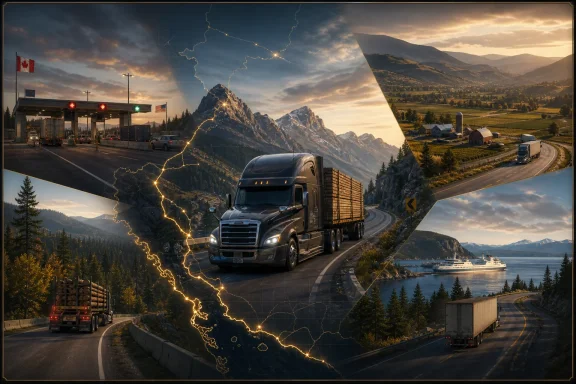 SCS Is Turning a State-by-State Game Into a Continental One
For most of its life, American Truck Simulator has been a game of incremental geography. SCS Software started with a western United States foundation and then built outward through paid map expansions, one state at a time, asking players to treat each DLC not as a sequel but as a new lane in an ever-thickening road network.British Columbia changes the grammar. It is not another state, not another piece of the same federal jigsaw, and not another excuse to stretch Interstate mileage eastward. It is the first confirmed step outside the United States, which means every design decision suddenly carries more weight than the usual question of which city gets a depot and which road gets compressed.
That is why the first batch of confirmed towns is interesting. Vancouver, the obvious headline city, is not the story yet. Instead, SCS is showing Grand Forks, Creston, Sparwood, Invermere, Golden, Princeton, and Campbell River — a spread that points to border crossings, mountain corridors, resource towns, coastal logistics, and a ferry-linked Vancouver Island future.
The message is clear enough: British Columbia will not be a postcard pasted above Washington. It is being framed as a working province, with agriculture, mining, forestry, rail connections, highways, and coastal industry all doing the heavy lifting.
The Missing Vancouver Reveal Is Probably the Point
The absence of Vancouver from this early city list is the sort of thing that makes map obsessives twitch. It is also almost certainly not evidence that SCS plans to ignore the province’s largest city. Vancouver was name-checked when the DLC was introduced in 2025, and it would be bizarre for a British Columbia expansion to skip the Lower Mainland entirely.More likely, SCS is sequencing the reveal. Big cities are expensive in development terms and risky in marketing terms: show them too early and every missing landmark becomes a complaint; show them too late and the community fills the vacuum with speculation. By opening with smaller and mid-sized communities, SCS gets to define the DLC around routes and industries rather than skyline recognition.
That is a smart move for this particular province. British Columbia is not experienced as one urban center with scenery attached. It is a province of transitions: coast to valley, valley to pass, pass to interior, interior to Rockies, island to mainland. The towns SCS chose to reveal first are the connective tissue that makes those transitions playable.
Grand Forks and Creston suggest southern routes near the U.S. border. Sparwood and Golden point toward the Rockies and heavy transport corridors. Campbell River confirms that Vancouver Island is not just background texture. Princeton sits at a highway junction that could become one of those places players pass through constantly, only later realizing how important it is to the whole network.
The Border Is a Design Problem, Not Just a Line on the Map
The romance of this announcement is obvious: passports, mountains, ferries, and a new country to explore. The harder problem is mechanical. A border in a trucking simulator is not just scenery. It is a place where logistics, law, signage, speed limits, road design, and driver expectations change.SCS has not yet confirmed how deeply it will simulate Canadian border procedures. The studio could keep things light, using border stations as scenic checkpoints and letting gameplay flow much as it does across U.S. state lines. Or it could add more explicit customs flavor: inspection lanes, cargo checks, signage, and route constraints that make international hauling feel meaningfully different.
The risk is balance. Too much process and the game becomes a paperwork simulator at precisely the moment players want the open road. Too little and the first international expansion feels like a reskin. The best answer is probably atmospheric rather than punitive: enough border infrastructure to make the crossing memorable, not so much that every haul becomes a bureaucratic chore.
That distinction matters because American Truck Simulator has always been selective realism. It does not reproduce every minute of professional trucking, but it sells the illusion through accumulated details. British Columbia will need the same treatment. The border should feel consequential even if it does not become a spreadsheet.
British Columbia Gives SCS the Terrain It Likes Best
SCS has spent years proving that flatland can be interesting if the road network, industry mix, and settlement density are handled well. But the studio’s strengths have often been most visible in the West, where geography does some of the narrative work. Mountain grades, desert basins, river crossings, and coastal highways give virtual trucking a shape that straight-line mileage cannot.British Columbia is a natural fit for that design language. Golden and Invermere sit in mountain country. Sparwood brings mining and heavy industrial traffic into the frame. Princeton offers a southern interior feel with forested routes and resource work. Campbell River adds coastal roads and island logistics.
That variety is not just scenic. In a driving sim, terrain is pacing. A long climb changes how a load feels. A descent changes how a player thinks about braking. A narrow town approach changes the mood after hours of highway. SCS can use British Columbia to create routes that feel less like map coverage and more like episodes in a journey.
The challenge is compression. The studio’s map scale cannot reproduce British Columbia in full, and the province’s real geography is unforgiving. Distances, mountain corridors, and urban regions all need to be condensed without turning the place into a theme park. The towns revealed so far imply a broad southern sweep, but the artistry will be in making that sweep feel plausible from behind the wheel.
The First Cities Point to Industries, Not Souvenirs
The revealed locations are not random dots. SCS describes Grand Forks with agriculture, transport, a sawmill, and building materials. Creston is tied to farming, a winery, and beverage production. Sparwood is anchored in coal mining. Golden includes a railyard. Princeton brings sawmill work and copper mining. Campbell River leans into forestry, fishing, transport, and marina service.That is exactly how American Truck Simulator expansions succeed. Players may come for the landmarks, but they stay when the freight economy gives them reasons to return. A pretty town that never generates a useful job is a screenshot stop. A town with distinctive depots becomes part of a career.
This is where British Columbia could outperform a more obvious city-first reveal. Vancouver will surely be important if it appears, but the health of the DLC depends on whether smaller places have enough purpose. The best SCS map expansions make secondary cities feel like they belong to a regional economy rather than existing only to fill space between major highways.
That is also why Campbell River is more significant than it first appears. Vancouver Island could have been treated as a novelty detour, but confirming a working coastal community suggests SCS wants the island to participate in the freight network. If ferries are handled well, island logistics could give the DLC a rhythm distinct from any U.S. state expansion.
Canada Forces the Simulator to Speak a Slightly Different Language
Crossing into Canada gives SCS a chance to make players notice small differences. Road signs, speed units, highway shields, lane markings, border facilities, service stations, police vehicles, vegetation, and architecture all become part of the authenticity test. The changes do not need to be loud, but they need to be consistent.This is especially true because American Truck Simulator players are trained observers. They notice when an interchange feels wrong. They notice when a skyline is compressed awkwardly. They notice when a local industry is missing or when a familiar landmark is approximated too loosely. That scrutiny can be harsh, but it is also the reason the game has become such a durable platform.
British Columbia will invite a new kind of local audit. Canadian players will judge it differently than tourists. Pacific Northwest players will compare it with Washington. Trucking fans will ask whether the routes make logistical sense. Map nerds will pore over every connection to Idaho, Montana, and Washington.
That is a lot of pressure for one DLC. It is also the opportunity. If SCS gets the texture right, British Columbia will feel like a genuine expansion of the simulator’s world rather than a novelty stamp in the passport.
The Route Network May Matter More Than the City List
The confirmed towns offer clues, but routes are the real story. Grand Forks and Creston suggest links along southern British Columbia near the U.S. border. Sparwood sits near the southeastern corner of the province, making Montana and Alberta-adjacent future planning hard to ignore. Golden is a transport gateway that naturally points toward mountain highways and connections deeper into Canada.Princeton is especially useful as a routing node. It sits in the kind of place that can connect multiple player fantasies: border-adjacent hauls, interior drives, resource jobs, and possible approaches toward larger urban areas. In a compressed map, such towns often become more important than their population size suggests.
Campbell River raises different questions. Its inclusion means Vancouver Island is not limited to Victoria imagery. That points toward ferry dependencies, coastal industry, and perhaps a more deliberate island corridor. If SCS can make the transition from mainland to island feel like part of the job rather than a loading-screen abstraction, British Columbia could add one of the most distinctive route experiences in the game.
The DLC’s success may ultimately depend less on how many cities appear and more on how well those cities are connected. A map expansion can survive omissions if the routes are satisfying. It cannot survive a network that feels like a series of disconnected sightseeing loops.
The Timing Shows SCS Is Managing a Bigger Production Machine
There is no release date for British Columbia, and players should not treat this city reveal as a sign that launch is imminent. Illinois arrived in May 2026, South Dakota is already public, and Indiana has also been announced. SCS is clearly running multiple map teams and multiple long-tail projects at once.That production model is one of the quiet miracles of modern sim development. American Truck Simulator is not a traditional live-service game in the battle-pass sense, but it has become a live atlas. The base product persists while the studio extends, revises, and enriches it through a mixture of paid DLC and free updates.
The danger is that the calendar can become the product. Players begin to talk about states as if they are train stops: Illinois, then South Dakota, then Indiana, then maybe British Columbia, or some other combination depending on team readiness. That expectation is good for wishlists but hard on developers, because every reveal becomes a perceived promise of order.
British Columbia complicates that sequence. It does not simply continue the eastward crawl. It opens a northern branch, and that branch could eventually imply Alberta, Alaska dreams, or broader Canadian expansion. Even if SCS says nothing of the sort now, the community will naturally extrapolate.
Project Road Trip Makes the Map More Valuable
The British Columbia news lands at the same time SCS is showing more of Project Road Trip, the initiative that brings regular vehicles into the American Truck Simulator ecosystem. The Ford F-150 preview is more than a side attraction. It hints at a future where the map is not only a trucking workplace but also a broader driving playground.That matters enormously for a place like British Columbia. Trucks are still the core identity of the game, and freight should remain the economic spine. But a pickup on mountain roads, ferry routes, coastal towns, and interior highways changes the emotional use of the map. Players may not always want to haul a load; sometimes they may want to drive.
This is the platform logic behind SCS’s current moment. Every new map DLC becomes more valuable if it can support multiple modes of play. A highway built for a logging haul can also become a road-trip route. A town modeled for deliveries can also become a place to pass through in a regular vehicle. A scenic overlook becomes more than decorative if the player has reasons to explore without a trailer.
That does not mean American Truck Simulator should become a general open-world driving game. Its discipline is part of its charm. But Road Trip makes the map’s fidelity more important, and British Columbia looks like one of the best possible showcases for that broader ambition.
The Name Was Always Bigger Than the United States
Some players have long joked that a Canadian expansion makes the title inaccurate. The joke is understandable, but it misses the point. “American” can mean the United States in everyday speech, yet it can also point toward a continental identity. SCS is now leaning into the larger interpretation.That move is both commercially and creatively useful. If the game were forever restricted to the United States, the long-term map plan would still be huge, but conceptually bounded. Once Canada enters, the horizon changes. The map is no longer merely filling in the country; it is building a North American freight fantasy.
The important thing is that SCS should not rush that fantasy. Canada is not one aesthetic. British Columbia is not Alberta, and neither is Ontario or Quebec or the Maritimes. If the studio treats each region with the same specificity it has gradually learned to apply to U.S. states, the game can grow naturally. If it treats Canada as a generic northern skin, the expansion will feel thin.
The first city list is encouraging because it avoids that trap. It emphasizes local economies and varied geography rather than simply announcing Vancouver and calling the job done. That is the right instinct.
The Community Will Measure the DLC in Familiar Obsessions
Every American Truck Simulator map reveal triggers the same rituals. Players speculate about road numbers, city omissions, scale compromises, hidden depots, landmark accuracy, and release order. British Columbia will intensify all of that because it is the first international test case.The Vancouver question will dominate until SCS answers it. So will border crossings. So will ferry mechanics. So will whether routes connect cleanly into Washington, Idaho, and Montana. The studio does not need to satisfy every wishlist, but it does need to provide a coherent map logic that players can understand once they are driving.
That is the difference between omission and incoherence. A missing town is acceptable if the network still feels designed. A compressed road is acceptable if it preserves the character of the drive. A simplified border is acceptable if the crossing still feels like a border. Players forgive abstraction when they can see the design intent.
SCS has earned a lot of goodwill because its maps usually feel authored rather than algorithmically assembled. British Columbia will test that reputation in a place where geography is dramatic, expectations are high, and the symbolic stakes are larger than usual.
The Small-Town Reveal Says More Than a Skyline Trailer Would Have
A flashy Vancouver trailer would have been easier to market. It also would have told us less. By starting with Grand Forks, Creston, Sparwood, Invermere, Golden, Princeton, and Campbell River, SCS is quietly saying that British Columbia will be judged by its routes, depots, and regional personality.That is a more confident reveal than it may appear. It assumes players care about more than famous places. It assumes the audience understands that trucking is about networks, not postcards. It assumes the map’s credibility will come from how these smaller communities fit together.
For a niche simulator with a devoted audience, that is the correct bet. The people still playing American Truck Simulator in 2026 are not only chasing novelty. They are invested in the slow construction of a believable world. A DLC that makes Grand Forks and Sparwood matter may ultimately be more satisfying than one that merely checks off Vancouver, Victoria, and Whistler.
The best case is that SCS eventually delivers both: the recognizable urban and tourist anchors, plus the working towns that make the province feel alive. The first reveal suggests the studio knows the second half is not optional.
The First Canadian Miles Already Tell Us Where This Is Going
British Columbia is still work in progress, but the outline is becoming clear enough to draw practical conclusions. The province is not just a new destination; it is a stress test for SCS’s map-building model as the simulator moves beyond the United States.- British Columbia is the first confirmed American Truck Simulator map expansion outside the United States, making it a symbolic turning point for the series.
- SCS has so far confirmed Grand Forks, Creston, Sparwood, Invermere, Golden, Princeton, and Campbell River, with more communities still to be revealed.
- The early city list points toward agriculture, mining, forestry, rail, coastal transport, and mountain driving rather than a simple big-city showcase.
- Vancouver is not in the first confirmed batch, but earlier SCS messaging and the logic of the province make its eventual inclusion highly likely.
- The DLC has no confirmed release date, and its position among Illinois, South Dakota, Indiana, and other SCS projects remains part of a broader production pipeline.
- Project Road Trip and the Ford vehicle work make British Columbia more important because future players may experience these roads as both truck routes and leisure drives.
References
- Primary source: Windows Central
Published: 2026-07-02T17:52:08.332146
As American Truck Simulator leaves the USA for the first time, here are the locations you'll be driving to in British Columbia | Windows Central
SCS has detailed towns and cities coming to ATS with the British Columbia DLC, the first time there's an official Canadian map.www.windowscentral.com - Related coverage: dlcompare.com
American Truck Simulator releases the official Illinois DLC
Explore the state of Illinois in American Truck Simulator! Drive through Chicago, conquer Route 66, and experience the new railway logistics chain.www.dlcompare.com - Related coverage: simulationdaily.com
American Truck Simulator Illinois DLC Gets Release Date - Simulation Daily
Today, SCS Software announced the release date of the next state DLC for American Truck Simulator, focusing on Illinois.simulationdaily.com - Related coverage: trucksimulator.wiki.gg
British Columbia, Canada (BC) - The Truck Simulator Wiki
This article (or the part below) is about a current (or future) project.Some information featured below might be incomplete or changed during the development of the project. Please watch SCS Software's blog and return often to this article to help Truck Simulator Wiki by expanding and...trucksimulator.wiki.gg - Related coverage: dlcompare.fr
American Truck Simulator publie le DLC officiel de l'Illinois
Explorez l'État de l'Illinois dans American Truck Simulator ! Traversez Chicago, partez à la conquête de la Route 66 et découvrez la nouvelle chaîne logistique ferroviaire.www.dlcompare.fr - Related coverage: soren.com
- Related coverage: truck-simulator.fandom.com
Illinois | Truck Simulator Wiki | Fandom
Illinois is a state of the United States, which is featured in the 18 Wheels of Steel series and American Truck Simulator, as a map expansion DLC. It has been released on the 14th May, 2026. It is the sixteenth map of DLC involving map expansions, but the fifteenth paid one. The state is...truck-simulator.fandom.com
- Related coverage: blog.scssoft.com
Introducing British Columbia
SCS Software's official blog - information, screens & movies from our truck simulator games Euro Truck Simulator 2 and American Truck Simulator.blog.scssoft.com