

OpenAI and Anthropic are racing in 2026 to make their AI models unavoidable inside enterprise technology, using cloud partnerships, consulting-style deployment teams, private-equity channels, marketplaces, and native software integrations to turn foundation models into operating infrastructure. That is the useful answer to Futurum’s “Everywhere Ecosystem” thesis. The more uncomfortable answer is that the AI labs are no longer behaving like software vendors at all. They are trying to become the layer through which software, services, capital, and corporate workflows are purchased.
For the first two years of the generative AI boom, the public argument was mostly about model quality. Which chatbot was smarter? Which benchmark mattered? Which company had the best coding model, the longest context window, the safest alignment story, or the fastest inference stack?
That fight still matters, but it is no longer the whole fight. Futurum’s central point is that OpenAI and Anthropic are building “Everywhere Ecosystems” because enterprise buyers do not adopt intelligence in the abstract. They adopt it where it touches email, documents, ERP systems, CRM records, security tooling, code repositories, finance workflows, and customer service queues.
The most powerful AI company may not be the one with the best model on any given leaderboard. It may be the one whose model is already present when a CIO signs a cloud contract, when a consultant writes the transformation roadmap, when a private-equity owner tells portfolio companies to standardize, when a developer browses an enterprise marketplace, and when a user opens Microsoft 365, Salesforce, Slack, Adobe, SAP, ServiceNow, Snowflake, or Databricks.
That is a very different competitive map from the SaaS era. Salesforce, Workday, ServiceNow, and Slack built category-defining products and then expanded through APIs, app stores, and partner channels. OpenAI and Anthropic are trying to skip several stages of that journey by embedding their reasoning engines directly into the platforms that already run the enterprise.
The thesis is not that SaaS disappears overnight. It is that the center of gravity moves. The system of record remains, but the system of action begins to look like a model-mediated layer sitting across everything.
OpenAI and Anthropic both need enormous quantities of GPU capacity, data center space, networking, power, and operational resilience. That requirement has turned infrastructure providers into something more important than hosting partners. Microsoft, Amazon Web Services, Google Cloud, Oracle, and the newer GPU-specialist “neoclouds” are now distribution channels, procurement intermediaries, and strategic choke points.
This matters because enterprises already buy much of their technology through cloud relationships. If a foundation model is available through a cloud provider’s existing procurement rails, security controls, billing structures, and compliance frameworks, it becomes easier to approve than a separate vendor relationship negotiated from scratch. The cloud marketplace becomes not merely a catalog, but a trust wrapper.
OpenAI’s historic alignment with Microsoft gave it an early version of this advantage. Azure became the corporate-friendly way to consume OpenAI models, especially for organizations that already trusted Microsoft with identity, productivity, compliance, and cloud infrastructure. For Windows-heavy enterprises, that mattered enormously: Azure, Entra ID, Microsoft 365, GitHub, and Copilot formed a familiar adoption path.
Anthropic has taken a more explicitly multi-cloud posture, with major distribution through AWS and Google Cloud while also pursuing broader enterprise integrations. That approach reflects a marketplace where CIOs dislike being cornered by a single infrastructure vendor. The more strategic AI becomes, the less comfortable customers are with a one-cloud dependency.
The irony is that “model independence” may still lead to ecosystem dependence. A company may be able to choose between OpenAI, Anthropic, Google, Meta, Mistral, or other models in theory. In practice, the available choices are shaped by where the enterprise already spends money, where its data sits, and which platform vendor controls the workflow.
The hard work is implementation. Enterprises need data access, permissions, auditing, workflow redesign, prompt and agent engineering, evaluation harnesses, integration with legacy systems, change management, and governance. That work is expensive, political, and highly specific to each organization.
This is where the old consulting and systems integration world enters the story. Accenture, KPMG, TCS, Capgemini, Deloitte, McKinsey, Bain, BCG, and their peers are not passive observers of the AI boom. They are the labor force that turns executive enthusiasm into production deployments.
Futurum calls this the “Implementation Gap,” and it is the right phrase. The gap is not between AI demos and AI capability. It is between AI capability and repeatable operating change inside a company that has decades of permissions, workflows, compliance rules, and custom software.
For OpenAI and Anthropic, relying entirely on outside integrators is risky. Consultants may recommend a model, but they also insert themselves between the lab and the customer. They control the roadmap, define the success metrics, and often capture much of the services revenue.
So the labs are moving closer to the work. OpenAI’s Deployment Company and Anthropic’s applied engineering push are not just support organizations. They are an attempt to put the model maker’s engineers inside the customer’s transformation project before someone else defines the architecture.
That should make the big consultancies nervous, but not obsolete. The labs need scale, and the GSIs have armies. The GSIs need credible frontier AI access, and the labs have it. The resulting relationship is not clean partnership or clean competition. It is coopetition with very high margins at stake.
OpenAI’s Deployment Company, backed by a consortium led by TPG and joined by major financial and consulting players, is designed to place forward-deployed engineers into companies that need bespoke AI systems. The acquisition of Tomoro gives that effort immediate services capacity and a consulting-style operating model from day one.
Anthropic’s deal with Blackstone, Hellman & Friedman, and Goldman Sachs Alternatives follows a parallel logic with a different flavor. Instead of merely selling Claude to individual customers, Anthropic gets a route into a large portfolio of businesses where the financial sponsor has influence, urgency, and a direct interest in operational efficiency.
This is a clever distribution hack. Private-equity firms own or influence companies that are under constant pressure to improve margins, consolidate technology spend, and standardize operations. If an AI deployment can reduce costs, accelerate reporting, automate back-office work, or improve sales productivity, it fits neatly into the private-equity value-creation playbook.
It also changes the buyer. The AI lab is not just selling to a CIO or CTO. It is selling to the capital allocator above the company, the operating partner advising management, and the board demanding measurable productivity gains. That shortens some sales cycles and complicates others.
For mid-market businesses, this may become the first serious route to frontier AI implementation. Many smaller enterprises do not have internal AI engineering teams or the appetite for a bespoke relationship with a foundation model provider. If their owner, investor, or lender packages AI deployment as part of a broader operating program, adoption becomes less optional.
But there is a cost. When AI enters through capital ownership rather than internal consensus, the implementation pressure can be intense. Workers may experience it less as a productivity tool and more as a mandate from above. IT departments may be asked to integrate systems at a pace that governance processes were never designed to support.
For WindowsForum readers, this is where the story gets practical. A mid-sized company with Microsoft 365, Windows endpoints, a hybrid Active Directory environment, a handful of SaaS applications, and a lean IT team may soon find AI projects arriving not from experimentation, but from board-level operating plans. That means identity, data loss prevention, endpoint management, logging, and user training become front-line issues, not afterthoughts.
The app store model works because it bundles discovery, trust, billing, permissions, updates, and ecosystem gravity. Once customers buy through a marketplace, the platform owner sees what is popular, shapes what is certified, controls commercial incentives, and becomes harder to remove.
OpenAI’s GPT Store and Anthropic’s emerging marketplace strategy should be understood in that context. The point is not merely to let users find clever assistants. The point is to create a governed distribution layer for AI-powered workflows, tools, and agents inside organizations.
For OpenAI, the ChatGPT workspace is the natural base. If employees create internal GPTs for sales research, policy lookup, engineering support, HR onboarding, or customer response drafting, those tools become part of the company’s daily operating rhythm. Over time, the organization does not just use ChatGPT. It accumulates process knowledge inside OpenAI’s environment.
Anthropic’s marketplace logic leans more heavily into enterprise procurement. If customers can burn down committed Claude spend by purchasing third-party Claude-powered tools, the marketplace becomes a financial flywheel. The customer has already committed the budget, so the incentive is to source additional software through the same ecosystem.
This is how cloud marketplaces became so powerful. A committed spend agreement with AWS, Azure, or Google Cloud does not merely buy infrastructure. It nudges procurement decisions toward whatever can be counted against that commitment. AI marketplaces can repeat the pattern at the model layer.
The risk for customers is subtle. Marketplace convenience can become architectural dependency. A company may begin with one approved AI assistant and end with dozens of workflows, third-party tools, automations, and internal agents that assume a particular model provider, identity structure, policy system, and billing path.
That is not inherently bad. Standardization can improve security and reduce chaos. But IT leaders should recognize it for what it is: the early formation of an AI application stack whose exit costs may be higher than expected.
That theory misunderstood enterprise software. Companies do not keep Salesforce, SAP, Workday, ServiceNow, Adobe, Databricks, Snowflake, HubSpot, or Microsoft 365 merely because the interfaces are delightful. They keep them because those systems contain governed data, permissions, business logic, audit trails, integrations, and institutional memory.
The more realistic future is not a mass extinction event for SaaS. It is a renegotiation of where value sits. The application remains the system of record, while the AI model becomes the reasoning and action layer that makes the system more useful.
This is why the platform-native integrations matter. Claude and GPT models embedded into Slack, Microsoft 365, Salesforce Agentforce, SAP Joule, Snowflake Cortex, Databricks workflows, Adobe Firefly, ServiceNow, CrowdStrike, and other enterprise platforms are not trying to replace every application directly. They are trying to become the intelligence inside those applications.
For Microsoft customers, this is already visible in Copilot’s evolution. Microsoft’s strategy is not to make Windows or Office disappear into a chatbot. It is to weave AI across Word, Excel, Outlook, Teams, SharePoint, Power Platform, GitHub, Edge, Windows, and Azure so that the interface changes without the estate being ripped out.
That is also why model diversity inside platforms will matter. Microsoft has deep ties to OpenAI, but enterprise customers increasingly expect choice, fallback options, and specialized models. If a platform can expose OpenAI for one workload, Anthropic for another, and smaller or local models for regulated use cases, the platform owner retains leverage.
The foundation labs know this, which is why they are racing to be present inside the software layer rather than merely adjacent to it. A model that lives only behind an API is replaceable. A model woven into procurement, workflow, governance, and user habit is much harder to dislodge.
AI adoption at scale raises old enterprise problems in new clothing. Who can access which data? Which prompts and outputs are logged? Are sensitive documents being summarized by approved services? Can employees paste regulated data into consumer tools? Are AI-generated actions auditable? What happens when an agent touches email, files, tickets, CRM records, and code repositories in the same workflow?
For Windows-centric organizations, the control points are familiar: identity, endpoint management, browser policy, information protection, conditional access, data classification, and telemetry. The difference is that AI tools blur the boundary between reading, writing, deciding, and acting.
An employee using an AI assistant to summarize a document is one thing. An agent that drafts a response, updates a CRM record, opens a support ticket, queries a data warehouse, and triggers a workflow is another. The latter behaves less like a productivity feature and more like a junior employee with API access.
That means admins need to think beyond license assignment. They need to map AI tools against data boundaries, retention policies, eDiscovery requirements, insider risk controls, and third-party vendor reviews. They also need to know whether a tool is using OpenAI, Anthropic, a cloud-hosted variant, a vendor-tuned model, or some combination hidden behind a SaaS feature.
The browser is another battleground. Edge, Chrome, and enterprise extensions will become enforcement points for which AI services users can reach and what data they can share. The same is true of Windows endpoint controls, especially where local capture, screen understanding, clipboard monitoring, or file access enters the AI workflow.
This is not a reason to block AI outright. Blanket bans tend to produce shadow IT. But it is a reason to treat AI adoption as infrastructure, not experimentation.
The CIO wants standardization and security. The CFO wants measurable productivity and cost reduction. The CEO wants an AI story for investors. Business units want faster tools. Legal wants indemnity and control. Employees want help without surveillance. Vendors want lock-in while calling it integration.
OpenAI and Anthropic are building ecosystems that speak to each of these constituencies. Cloud partnerships reassure IT. Consulting alliances reassure executives. Private-equity vehicles reassure owners. Marketplaces reassure procurement. Native integrations reassure business units. Model benchmarks reassure everyone just enough to keep the deal moving.
That is why Futurum’s “Everywhere Ecosystem” framing is useful. It captures the fact that enterprise AI competition is no longer a single-front war. It is being fought across infrastructure, services, capital, procurement, and application architecture at the same time.
The danger is that buyers may confuse ubiquity with maturity. A model being available everywhere does not mean every deployment is safe, governed, or valuable. The enterprise software industry has seen this pattern before: the platform arrives first, the governance catches up later, and the cleanup becomes someone else’s project.
There is also a competition concern. If the leading labs control model access, deployment labor, marketplaces, and preferred integrations, they can shape which startups survive and which enterprise tools get visibility. The old app-store gatekeeper problem may reappear in AI clothing.
The counterweight will be customer discipline. Enterprises that demand portability, logs, model choice, clean data boundaries, and transparent commercial terms will have more leverage than those that accept a black-box bundle because it demos well.
Forward-deployed engineers, bespoke consulting teams, and private-equity operating programs work for large enterprises and selected mid-market portfolios. They do not work for millions of small and midsize businesses that need packaged solutions, predictable pricing, local support, and trusted advisors.
This is where the traditional channel comes back into view. Managed service providers, value-added resellers, regional systems integrators, independent software vendors, and Microsoft-focused partners have the relationships that AI labs lack. They know the messy reality of small business IT: aging line-of-business apps, partial cloud migrations, inconsistent identity hygiene, limited security budgets, and owners who want outcomes rather than architecture diagrams.
If OpenAI and Anthropic want full market penetration, they will need a repeatable channel model. Certifications, partner tooling, deployment templates, security baselines, migration playbooks, and support escalation paths will matter as much as model quality.
Microsoft has an advantage here because its partner ecosystem already reaches deep into the SMB and mid-market world. If Copilot, Azure AI, Power Platform, and Windows management tools become the default AI packaging layer for smaller organizations, OpenAI benefits indirectly through Microsoft’s distribution. Anthropic will need equivalent routes through AWS, Google Cloud, SaaS partners, and dedicated channel programs.
The labs may discover that the last mile of enterprise AI looks surprisingly old-fashioned. It may involve local consultants, procurement portals, training sessions, packaged vertical solutions, and support tickets. The revolution still needs someone to configure permissions.
A company can test ChatGPT, Claude, Gemini, Copilot, and open models in parallel. It can compare answers, run pilots, and negotiate pricing. But once an AI system is tied into sales approvals, customer support escalation, vulnerability triage, contract review, data analysis, employee onboarding, and software development, the switching calculus changes.
The model becomes part of the process. The process creates training materials, governance policies, prompt libraries, evaluation sets, integrations, and user habits. Those assets may not be as visible as a database schema, but they are real.
That is the deeper purpose of the Everywhere Ecosystem. The labs are not just trying to sell access to intelligence. They are trying to attach intelligence to the places where companies already make decisions.
This is why model providers are willing to spend heavily on deployment capability. A successful implementation is not just revenue; it is a beachhead. Once the model is trusted inside one workflow, it can expand to adjacent workflows. Once it is approved by security and procurement, every additional use case gets easier.
For rivals, that makes displacement harder. A better model may win a benchmark and still lose the account if the incumbent is already embedded in the customer’s cloud contract, consulting plan, marketplace spend, and internal tools.
This should sound familiar to anyone who watched Microsoft’s enterprise rise. The winning move was rarely one product in isolation. It was the bundle, the identity layer, the developer story, the admin tooling, the file formats, the partner network, and the procurement relationship working together.
OpenAI and Anthropic are now trying to build their own version of that gravity, but faster.
One business unit may buy a SaaS tool powered by Claude. Another may deploy Microsoft 365 Copilot backed by OpenAI models. Developers may use GitHub tooling. Security teams may encounter AI inside CrowdStrike or ServiceNow. Finance may get AI through an ERP integration. A private-equity owner or board initiative may introduce a separate deployment partner.
That means AI inventory becomes a real discipline. Organizations need to know which AI services are in use, what data they touch, which vendors process that data, what contractual protections apply, and how outputs are reviewed. This is not glamorous work, but it is the difference between managed adoption and accidental sprawl.
The familiar Microsoft stack can help, but it cannot solve the whole problem automatically. Entra ID, Purview, Intune, Defender, Sentinel, Conditional Access, sensitivity labels, DLP, and audit tooling are useful only if AI services are routed through governed paths. If employees or departments adopt unmanaged tools, the control plane fractures.
Admins should also expect pressure from above. AI is no longer a lab experiment sponsored by enthusiastic developers. It is a board-level productivity narrative backed by large vendors, consultants, and investors. Saying “no” without an alternative will be less effective than offering a secure route to “yes.”
That secure route should include approved tools, clear data rules, monitored pilots, measurable outcomes, and a process for retiring failed experiments. The goal is not to slow AI adoption for its own sake. The goal is to prevent the organization from accidentally hard-wiring itself into tools it does not understand.
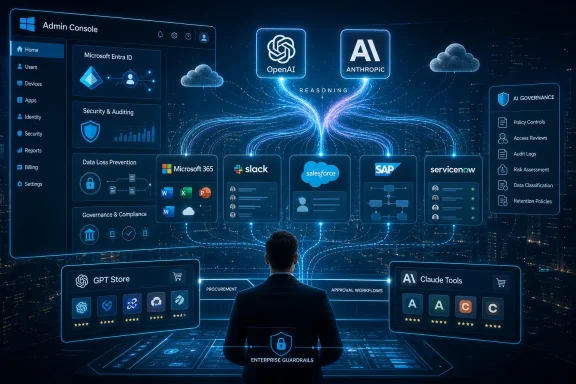 The Model Race Has Become a Distribution Race
For the first two years of the generative AI boom, the public argument was mostly about model quality. Which chatbot was smarter? Which benchmark mattered? Which company had the best coding model, the longest context window, the safest alignment story, or the fastest inference stack?That fight still matters, but it is no longer the whole fight. Futurum’s central point is that OpenAI and Anthropic are building “Everywhere Ecosystems” because enterprise buyers do not adopt intelligence in the abstract. They adopt it where it touches email, documents, ERP systems, CRM records, security tooling, code repositories, finance workflows, and customer service queues.
The most powerful AI company may not be the one with the best model on any given leaderboard. It may be the one whose model is already present when a CIO signs a cloud contract, when a consultant writes the transformation roadmap, when a private-equity owner tells portfolio companies to standardize, when a developer browses an enterprise marketplace, and when a user opens Microsoft 365, Salesforce, Slack, Adobe, SAP, ServiceNow, Snowflake, or Databricks.
That is a very different competitive map from the SaaS era. Salesforce, Workday, ServiceNow, and Slack built category-defining products and then expanded through APIs, app stores, and partner channels. OpenAI and Anthropic are trying to skip several stages of that journey by embedding their reasoning engines directly into the platforms that already run the enterprise.
The thesis is not that SaaS disappears overnight. It is that the center of gravity moves. The system of record remains, but the system of action begins to look like a model-mediated layer sitting across everything.
Cloud Providers Are No Longer Just Landlords
Compute is the least glamorous part of AI strategy until there is not enough of it. Then it becomes the whole strategy.OpenAI and Anthropic both need enormous quantities of GPU capacity, data center space, networking, power, and operational resilience. That requirement has turned infrastructure providers into something more important than hosting partners. Microsoft, Amazon Web Services, Google Cloud, Oracle, and the newer GPU-specialist “neoclouds” are now distribution channels, procurement intermediaries, and strategic choke points.
This matters because enterprises already buy much of their technology through cloud relationships. If a foundation model is available through a cloud provider’s existing procurement rails, security controls, billing structures, and compliance frameworks, it becomes easier to approve than a separate vendor relationship negotiated from scratch. The cloud marketplace becomes not merely a catalog, but a trust wrapper.
OpenAI’s historic alignment with Microsoft gave it an early version of this advantage. Azure became the corporate-friendly way to consume OpenAI models, especially for organizations that already trusted Microsoft with identity, productivity, compliance, and cloud infrastructure. For Windows-heavy enterprises, that mattered enormously: Azure, Entra ID, Microsoft 365, GitHub, and Copilot formed a familiar adoption path.
Anthropic has taken a more explicitly multi-cloud posture, with major distribution through AWS and Google Cloud while also pursuing broader enterprise integrations. That approach reflects a marketplace where CIOs dislike being cornered by a single infrastructure vendor. The more strategic AI becomes, the less comfortable customers are with a one-cloud dependency.
The irony is that “model independence” may still lead to ecosystem dependence. A company may be able to choose between OpenAI, Anthropic, Google, Meta, Mistral, or other models in theory. In practice, the available choices are shaped by where the enterprise already spends money, where its data sits, and which platform vendor controls the workflow.
The Consulting Layer Is Becoming the New Installer
The biggest mistake in early AI adoption was assuming that model access equaled transformation. It did not. Giving employees a chatbot did not automatically redesign finance close, automate support escalations, improve software delivery, or make compliance reviews faster.The hard work is implementation. Enterprises need data access, permissions, auditing, workflow redesign, prompt and agent engineering, evaluation harnesses, integration with legacy systems, change management, and governance. That work is expensive, political, and highly specific to each organization.
This is where the old consulting and systems integration world enters the story. Accenture, KPMG, TCS, Capgemini, Deloitte, McKinsey, Bain, BCG, and their peers are not passive observers of the AI boom. They are the labor force that turns executive enthusiasm into production deployments.
Futurum calls this the “Implementation Gap,” and it is the right phrase. The gap is not between AI demos and AI capability. It is between AI capability and repeatable operating change inside a company that has decades of permissions, workflows, compliance rules, and custom software.
For OpenAI and Anthropic, relying entirely on outside integrators is risky. Consultants may recommend a model, but they also insert themselves between the lab and the customer. They control the roadmap, define the success metrics, and often capture much of the services revenue.
So the labs are moving closer to the work. OpenAI’s Deployment Company and Anthropic’s applied engineering push are not just support organizations. They are an attempt to put the model maker’s engineers inside the customer’s transformation project before someone else defines the architecture.
That should make the big consultancies nervous, but not obsolete. The labs need scale, and the GSIs have armies. The GSIs need credible frontier AI access, and the labs have it. The resulting relationship is not clean partnership or clean competition. It is coopetition with very high margins at stake.
Private Equity Has Found Its AI Operating System
The most aggressive part of the new go-to-market model is the use of capital-backed deployment vehicles. This is where the AI ecosystem stops looking like software distribution and starts looking like industrial policy for corporate operations.OpenAI’s Deployment Company, backed by a consortium led by TPG and joined by major financial and consulting players, is designed to place forward-deployed engineers into companies that need bespoke AI systems. The acquisition of Tomoro gives that effort immediate services capacity and a consulting-style operating model from day one.
Anthropic’s deal with Blackstone, Hellman & Friedman, and Goldman Sachs Alternatives follows a parallel logic with a different flavor. Instead of merely selling Claude to individual customers, Anthropic gets a route into a large portfolio of businesses where the financial sponsor has influence, urgency, and a direct interest in operational efficiency.
This is a clever distribution hack. Private-equity firms own or influence companies that are under constant pressure to improve margins, consolidate technology spend, and standardize operations. If an AI deployment can reduce costs, accelerate reporting, automate back-office work, or improve sales productivity, it fits neatly into the private-equity value-creation playbook.
It also changes the buyer. The AI lab is not just selling to a CIO or CTO. It is selling to the capital allocator above the company, the operating partner advising management, and the board demanding measurable productivity gains. That shortens some sales cycles and complicates others.
For mid-market businesses, this may become the first serious route to frontier AI implementation. Many smaller enterprises do not have internal AI engineering teams or the appetite for a bespoke relationship with a foundation model provider. If their owner, investor, or lender packages AI deployment as part of a broader operating program, adoption becomes less optional.
But there is a cost. When AI enters through capital ownership rather than internal consensus, the implementation pressure can be intense. Workers may experience it less as a productivity tool and more as a mandate from above. IT departments may be asked to integrate systems at a pace that governance processes were never designed to support.
For WindowsForum readers, this is where the story gets practical. A mid-sized company with Microsoft 365, Windows endpoints, a hybrid Active Directory environment, a handful of SaaS applications, and a lean IT team may soon find AI projects arriving not from experimentation, but from board-level operating plans. That means identity, data loss prevention, endpoint management, logging, and user training become front-line issues, not afterthoughts.
Marketplaces Are the Lock-In Nobody Calls Lock-In
Enterprise software companies learned long ago that marketplaces are not just storefronts. They are control planes.The app store model works because it bundles discovery, trust, billing, permissions, updates, and ecosystem gravity. Once customers buy through a marketplace, the platform owner sees what is popular, shapes what is certified, controls commercial incentives, and becomes harder to remove.
OpenAI’s GPT Store and Anthropic’s emerging marketplace strategy should be understood in that context. The point is not merely to let users find clever assistants. The point is to create a governed distribution layer for AI-powered workflows, tools, and agents inside organizations.
For OpenAI, the ChatGPT workspace is the natural base. If employees create internal GPTs for sales research, policy lookup, engineering support, HR onboarding, or customer response drafting, those tools become part of the company’s daily operating rhythm. Over time, the organization does not just use ChatGPT. It accumulates process knowledge inside OpenAI’s environment.
Anthropic’s marketplace logic leans more heavily into enterprise procurement. If customers can burn down committed Claude spend by purchasing third-party Claude-powered tools, the marketplace becomes a financial flywheel. The customer has already committed the budget, so the incentive is to source additional software through the same ecosystem.
This is how cloud marketplaces became so powerful. A committed spend agreement with AWS, Azure, or Google Cloud does not merely buy infrastructure. It nudges procurement decisions toward whatever can be counted against that commitment. AI marketplaces can repeat the pattern at the model layer.
The risk for customers is subtle. Marketplace convenience can become architectural dependency. A company may begin with one approved AI assistant and end with dozens of workflows, third-party tools, automations, and internal agents that assume a particular model provider, identity structure, policy system, and billing path.
That is not inherently bad. Standardization can improve security and reduce chaos. But IT leaders should recognize it for what it is: the early formation of an AI application stack whose exit costs may be higher than expected.
The “SaaSpocalypse” Was the Wrong Story
One of the louder claims of the early generative AI cycle was that traditional SaaS was doomed. If users could ask an AI agent to do anything, why would they need the old software interfaces?That theory misunderstood enterprise software. Companies do not keep Salesforce, SAP, Workday, ServiceNow, Adobe, Databricks, Snowflake, HubSpot, or Microsoft 365 merely because the interfaces are delightful. They keep them because those systems contain governed data, permissions, business logic, audit trails, integrations, and institutional memory.
The more realistic future is not a mass extinction event for SaaS. It is a renegotiation of where value sits. The application remains the system of record, while the AI model becomes the reasoning and action layer that makes the system more useful.
This is why the platform-native integrations matter. Claude and GPT models embedded into Slack, Microsoft 365, Salesforce Agentforce, SAP Joule, Snowflake Cortex, Databricks workflows, Adobe Firefly, ServiceNow, CrowdStrike, and other enterprise platforms are not trying to replace every application directly. They are trying to become the intelligence inside those applications.
For Microsoft customers, this is already visible in Copilot’s evolution. Microsoft’s strategy is not to make Windows or Office disappear into a chatbot. It is to weave AI across Word, Excel, Outlook, Teams, SharePoint, Power Platform, GitHub, Edge, Windows, and Azure so that the interface changes without the estate being ripped out.
That is also why model diversity inside platforms will matter. Microsoft has deep ties to OpenAI, but enterprise customers increasingly expect choice, fallback options, and specialized models. If a platform can expose OpenAI for one workload, Anthropic for another, and smaller or local models for regulated use cases, the platform owner retains leverage.
The foundation labs know this, which is why they are racing to be present inside the software layer rather than merely adjacent to it. A model that lives only behind an API is replaceable. A model woven into procurement, workflow, governance, and user habit is much harder to dislodge.
Windows Administrators Will Inherit the Messy Middle
The “Everywhere Ecosystem” sounds like a boardroom strategy, but the consequences land in the admin console.AI adoption at scale raises old enterprise problems in new clothing. Who can access which data? Which prompts and outputs are logged? Are sensitive documents being summarized by approved services? Can employees paste regulated data into consumer tools? Are AI-generated actions auditable? What happens when an agent touches email, files, tickets, CRM records, and code repositories in the same workflow?
For Windows-centric organizations, the control points are familiar: identity, endpoint management, browser policy, information protection, conditional access, data classification, and telemetry. The difference is that AI tools blur the boundary between reading, writing, deciding, and acting.
An employee using an AI assistant to summarize a document is one thing. An agent that drafts a response, updates a CRM record, opens a support ticket, queries a data warehouse, and triggers a workflow is another. The latter behaves less like a productivity feature and more like a junior employee with API access.
That means admins need to think beyond license assignment. They need to map AI tools against data boundaries, retention policies, eDiscovery requirements, insider risk controls, and third-party vendor reviews. They also need to know whether a tool is using OpenAI, Anthropic, a cloud-hosted variant, a vendor-tuned model, or some combination hidden behind a SaaS feature.
The browser is another battleground. Edge, Chrome, and enterprise extensions will become enforcement points for which AI services users can reach and what data they can share. The same is true of Windows endpoint controls, especially where local capture, screen understanding, clipboard monitoring, or file access enters the AI workflow.
This is not a reason to block AI outright. Blanket bans tend to produce shadow IT. But it is a reason to treat AI adoption as infrastructure, not experimentation.
The Enterprise AI Stack Is Becoming Political
There is a political economy to all of this. Not partisan politics, but the politics of power inside the enterprise.The CIO wants standardization and security. The CFO wants measurable productivity and cost reduction. The CEO wants an AI story for investors. Business units want faster tools. Legal wants indemnity and control. Employees want help without surveillance. Vendors want lock-in while calling it integration.
OpenAI and Anthropic are building ecosystems that speak to each of these constituencies. Cloud partnerships reassure IT. Consulting alliances reassure executives. Private-equity vehicles reassure owners. Marketplaces reassure procurement. Native integrations reassure business units. Model benchmarks reassure everyone just enough to keep the deal moving.
That is why Futurum’s “Everywhere Ecosystem” framing is useful. It captures the fact that enterprise AI competition is no longer a single-front war. It is being fought across infrastructure, services, capital, procurement, and application architecture at the same time.
The danger is that buyers may confuse ubiquity with maturity. A model being available everywhere does not mean every deployment is safe, governed, or valuable. The enterprise software industry has seen this pattern before: the platform arrives first, the governance catches up later, and the cleanup becomes someone else’s project.
There is also a competition concern. If the leading labs control model access, deployment labor, marketplaces, and preferred integrations, they can shape which startups survive and which enterprise tools get visibility. The old app-store gatekeeper problem may reappear in AI clothing.
The counterweight will be customer discipline. Enterprises that demand portability, logs, model choice, clean data boundaries, and transparent commercial terms will have more leverage than those that accept a black-box bundle because it demos well.
The Channel Problem Is the Next Wall
Futurum’s most important late-stage point is that high-touch enterprise deployment does not scale all the way down.Forward-deployed engineers, bespoke consulting teams, and private-equity operating programs work for large enterprises and selected mid-market portfolios. They do not work for millions of small and midsize businesses that need packaged solutions, predictable pricing, local support, and trusted advisors.
This is where the traditional channel comes back into view. Managed service providers, value-added resellers, regional systems integrators, independent software vendors, and Microsoft-focused partners have the relationships that AI labs lack. They know the messy reality of small business IT: aging line-of-business apps, partial cloud migrations, inconsistent identity hygiene, limited security budgets, and owners who want outcomes rather than architecture diagrams.
If OpenAI and Anthropic want full market penetration, they will need a repeatable channel model. Certifications, partner tooling, deployment templates, security baselines, migration playbooks, and support escalation paths will matter as much as model quality.
Microsoft has an advantage here because its partner ecosystem already reaches deep into the SMB and mid-market world. If Copilot, Azure AI, Power Platform, and Windows management tools become the default AI packaging layer for smaller organizations, OpenAI benefits indirectly through Microsoft’s distribution. Anthropic will need equivalent routes through AWS, Google Cloud, SaaS partners, and dedicated channel programs.
The labs may discover that the last mile of enterprise AI looks surprisingly old-fashioned. It may involve local consultants, procurement portals, training sessions, packaged vertical solutions, and support tickets. The revolution still needs someone to configure permissions.
The Real Moat Is the Workflow, Not the Chatbot
Chatbots are easy to switch. Workflows are not.A company can test ChatGPT, Claude, Gemini, Copilot, and open models in parallel. It can compare answers, run pilots, and negotiate pricing. But once an AI system is tied into sales approvals, customer support escalation, vulnerability triage, contract review, data analysis, employee onboarding, and software development, the switching calculus changes.
The model becomes part of the process. The process creates training materials, governance policies, prompt libraries, evaluation sets, integrations, and user habits. Those assets may not be as visible as a database schema, but they are real.
That is the deeper purpose of the Everywhere Ecosystem. The labs are not just trying to sell access to intelligence. They are trying to attach intelligence to the places where companies already make decisions.
This is why model providers are willing to spend heavily on deployment capability. A successful implementation is not just revenue; it is a beachhead. Once the model is trusted inside one workflow, it can expand to adjacent workflows. Once it is approved by security and procurement, every additional use case gets easier.
For rivals, that makes displacement harder. A better model may win a benchmark and still lose the account if the incumbent is already embedded in the customer’s cloud contract, consulting plan, marketplace spend, and internal tools.
This should sound familiar to anyone who watched Microsoft’s enterprise rise. The winning move was rarely one product in isolation. It was the bundle, the identity layer, the developer story, the admin tooling, the file formats, the partner network, and the procurement relationship working together.
OpenAI and Anthropic are now trying to build their own version of that gravity, but faster.
The Practical Read for Windows Shops
The immediate lesson for IT pros is not to pick a religious side in the OpenAI-versus-Anthropic contest. It is to prepare for a world where both may show up inside the same estate through different doors.One business unit may buy a SaaS tool powered by Claude. Another may deploy Microsoft 365 Copilot backed by OpenAI models. Developers may use GitHub tooling. Security teams may encounter AI inside CrowdStrike or ServiceNow. Finance may get AI through an ERP integration. A private-equity owner or board initiative may introduce a separate deployment partner.
That means AI inventory becomes a real discipline. Organizations need to know which AI services are in use, what data they touch, which vendors process that data, what contractual protections apply, and how outputs are reviewed. This is not glamorous work, but it is the difference between managed adoption and accidental sprawl.
The familiar Microsoft stack can help, but it cannot solve the whole problem automatically. Entra ID, Purview, Intune, Defender, Sentinel, Conditional Access, sensitivity labels, DLP, and audit tooling are useful only if AI services are routed through governed paths. If employees or departments adopt unmanaged tools, the control plane fractures.
Admins should also expect pressure from above. AI is no longer a lab experiment sponsored by enthusiastic developers. It is a board-level productivity narrative backed by large vendors, consultants, and investors. Saying “no” without an alternative will be less effective than offering a secure route to “yes.”
That secure route should include approved tools, clear data rules, monitored pilots, measurable outcomes, and a process for retiring failed experiments. The goal is not to slow AI adoption for its own sake. The goal is to prevent the organization from accidentally hard-wiring itself into tools it does not understand.
The Five Moves That Make OpenAI and Anthropic Hard to Avoid
The strategic picture is now clear enough that IT leaders can start planning around it. OpenAI and Anthropic are using different styles, different partners, and different brand positions, but the shape of their enterprise ambitions is converging.- OpenAI and Anthropic are shifting the AI contest from model benchmarks alone toward control of distribution, implementation, procurement, and workflow integration.
- Cloud providers are becoming the primary enterprise on-ramp for foundation models because they already own trust, billing, compliance, and infrastructure relationships.
- Forward-deployed engineering and private-equity-backed services vehicles are turning AI deployment into a capital-intensive consulting business, not just a software subscription.
- Proprietary marketplaces could become the next lock-in layer by tying third-party AI tools to committed spend, governance systems, and internal workflow libraries.
- Traditional SaaS platforms are unlikely to vanish quickly, but their value may increasingly depend on which AI models they embed and how well those models act on governed enterprise data.
- Windows and Microsoft-centric IT teams should treat AI as a new operational layer that must be inventoried, governed, monitored, and integrated with identity and data protection controls.
References
- Primary source: The Futurum Group
Published: Wed, 01 Jul 2026 19:38:43 GMT
How Anthropic and OpenAI Are Building "Everywhere Ecosystems" - Futurum
Explore how OpenAI and Anthropic are creating Everywhere Ecosystems by embedding cognitive engines directly into the operational fabric of enterprises.futurumgroup.com - Official source: openai.com
OpenAI launches the OpenAI Deployment Company to help businesses build around intelligence | OpenAI
OpenAI launches DeployCo, a new enterprise deployment company built to help organizations bring frontier AI into production and turn it into measurable business impact.openai.com - Related coverage: claudeainews.com
Anthropic Launches $1.5 Billion Enterprise AI Firm with Blackstone and Goldman Sachs | ClaudeAINews
Anthropic, Blackstone, and Goldman Sachs have launched a $1.5 billion enterprise AI services firm to embed Claude engineers inside mid-size businesses.www.claudeainews.com - Related coverage: blackstone.com
Anthropic Partners with Blackstone, Hellman & Friedman, and Goldman Sachs to Launch Enterprise AI Services Firm - Blackstone
Press releases, portfolio company news, and timely updates on our business.www.blackstone.com - Related coverage: resultsense.com
OpenAI Deployment Company launches with $4bn and Tomoro buy
OpenAI Deployment Company starts with $4bn and acquires Tomoro, the consulting firm whose UK clients include Tesco and Virgin Atlantic.www.resultsense.com
- Related coverage: thetechportal.com
OpenAI launches enterprise AI service-focused $4Bn ‘OpenAI Deployment Company’, acquires Tomoro to scale corporate AI adoption - The Tech Portal
OpenAI has launched a new enterprise-focused venture called the 'OpenAI Deployment Company', with an initial commitment thetechportal.com
- Related coverage: fortune.com
Anthropic takes shot at consulting industry in joint venture with Wall Street giants | Fortune
The enterprise services firm with Blackstone, Goldman Sachs and Hellman & Friedman puts Anthropic in direct competition with McKinsey and the like.fortune.com
- Related coverage: digitalapplied.com
OpenAI Deployment Company: $4B Enterprise AI Push 2026
OpenAI launched the Deployment Company on May 11 with $4B+ investment and the Tomoro acquisition. Enterprise AI implementation, not just APIs.www.digitalapplied.com - Related coverage: briefs.co
Anthropic Launches $1.5B AI Firm With Goldman, Blackstone
Anthropic, Blackstone, Hellman & Friedman, and Goldman Sachs are launching a $1.5 billion AI services firm to embed Claude into mid-sized firms.www.briefs.co - Related coverage: ai-know.info
- Related coverage: axios.com
OpenAI launches AI consulting arm valued at $14 billion
This comes days after Anthropic launched its own AI consulting and services business.www.axios.com
- Related coverage: letsdatascience.com
OpenAI Launches $4B Deployment Company With TPG, Buys Tomoro | Let's Data Science
OpenAI's new Deployment Company opens with 4 billion dollars, 19 investors, a 14-billion-dollar valuation, a 17.5% guaranteed return, and 150 engineers from Tomoro. letsdatascience.com
- Related coverage: cincodias.elpais.com
- Related coverage: itpro.com
OpenAI ramps up enterprise AI push with new consultancy launch | IT Pro
The launch of the OpenAI Deployment Company comes with £4bn investment to help speed up enterprise Ai adoptionwww.itpro.com - Related coverage: gic.com.sg
</rdf:Alt> </dc:title> <dc:description> <rdf:Alt> <rdf:li xml:lang="x-default"/> </rdf:Alt> </dc:description> <dc:creator> <rdf:Seq> <rdf:li>Julia T
</rdf:Alt> </dc:description> <dc:creator> <rdf:Seq> <rdf:li>Julia Tarantinowww.gic.com.sg