

Android Authority’s Stephen Radochia argued on July 3, 2026, that owners of the Pixel 7 Pro, Galaxy S22 Ultra, Motorola Razr Plus 2023, Pixel 7a, Galaxy A54, and perhaps Moto G Power 2024 should reconsider whether those phones still deserve pocket space. The piece is ostensibly about Android upgrades, but the larger story is the end of the old two-year replacement rhythm. Phones now live long enough that the right upgrade decision is no longer about age alone. It is about heat, batteries, modems, update policy, and whether a device has become a daily tax on the person using it.
For years, the smartphone industry trained buyers to think in annual increments. A new chip arrived, a camera bump appeared, carriers dangled a trade-in offer, and last year’s flagship suddenly felt old. That machinery still exists, but the logic underneath it has weakened.
Android phones in 2026 are not disposable in the way many Android phones were a decade ago. Samsung and Google have normalized longer support windows on many higher-end and midrange devices, and hardware has improved enough that a three- or four-year-old phone can still handle messaging, streaming, banking, maps, and light productivity without embarrassment. Android Authority’s own reader poll attached to Radochia’s piece captured that mood: the largest group said they keep phones for four years or longer, effectively until the wheels fall off.
That is the right instinct. The environmental, financial, and practical case for holding onto a working phone is stronger than ever. But “working” is doing a lot of work in that sentence.
A phone can still boot, still take calls, and still run apps while being meaningfully past its prime. It may overheat in the car, lose signal during a commute, limp to dinner with 12 percent battery, or stop receiving the kind of software support that makes IT-minded users comfortable. The modern upgrade decision is not about novelty. It is about accumulated friction.
Google’s Tensor project was always about more than raw benchmark scores. The company wanted silicon optimized for its camera pipeline, speech features, AI-assisted software, and long-term platform control. That strategy made sense. But the Pixel 6 and Pixel 7 generations also taught buyers that ambition does not cancel out thermals, modem behavior, and battery life.
The Pixel 7 Pro corrected some of the Pixel 6 family’s rough edges. The hardware felt more mature, the fingerprint experience improved, and Android 13 arrived after the messy Android 12 transition. Yet the Tensor G2 never fully escaped the reputation of a chip that could get warm under ordinary pressure.
That matters more in year four than it did at launch. Batteries chemically age. Apps become heavier. Cellular networks evolve. A phone that was merely warm and inconsistent in 2022 can feel genuinely compromised in 2026 if the owner is asking it to navigate, hotspot, stream music, and juggle authentication prompts across a workday.
The upgrade case from a Pixel 7 Pro to a Pixel 10 Pro or Pixel 10 Pro XL is therefore not just “new camera good, old phone bad.” It is that Google’s newer hardware reportedly reduces the practical annoyances that made early Tensor ownership feel conditional. Better displays, cooler operation, and longer mixed-use battery life are the exact upgrades people notice because they remove pain rather than add spectacle.
For WindowsForum readers, the point is familiar from PC hardware. A laptop does not become obsolete the moment a faster CPU ships. It becomes obsolete when fan noise, battery degradation, driver weirdness, and security support make it a worse tool than its replacement cost can justify. The Pixel 7 Pro is reaching that kind of threshold for many owners.
The Pixel A-series has always depended on a delicate trade. Buyers accept cheaper materials, fewer luxury features, and modest charging in exchange for Google’s camera processing and clean software at a lower price. The Pixel 6a hit that bargain especially well. The Pixel 7a, despite meaningful improvements, carried too much of the early Tensor baggage into a midrange shell.
Overheating hurts any phone, but it hurts a cheaper phone more. A flagship can sometimes offset chip inefficiency with a better display, larger thermal system, faster storage, or more premium radios. A midrange handset has less room to hide. If the processor and modem misbehave, the whole product feels shaky.
That is why the modem complaints around the Pixel 7a are so important. A smartphone is still, before everything else, a network terminal. If it struggles to switch cleanly between 5G and LTE, holds weak connections too long, or burns battery searching for signal, the owner experiences that failure dozens of times a week.
The Pixel 10a, as described by Android Authority and other Android-focused outlets this year, is not necessarily a revolutionary midrange device. In fact, some coverage has framed it as a conservative update, especially because it keeps older-generation silicon relative to Google’s top phones. But an upgrade does not have to be revolutionary to be rational.
For someone on a Pixel 7a, the promise is simple: a better display, better efficiency, improved connectivity, and a much longer runway of software support. Those are not glamorous spec-sheet victories. They are the difference between a phone that constantly reminds you of its compromises and one that mostly disappears into the background.
The Snapdragon 8 Gen 1 was a powerful chip, but it was also notorious for heat and efficiency complaints in many devices. Radochia’s experience with the Galaxy S22 Ultra mirrors what many users felt at the time: a spectacular phone undermined by a processor generation that could make battery life feel smaller than the hardware suggested.
That is what makes the S22 Ultra such a frustrating device to evaluate in 2026. Much of it still looks excellent. The 6.8-inch OLED display remains beautiful. The integrated S Pen gives it a productivity identity most slab phones lack. The camera system still produces images that are more than good enough for most people.
But the S22 Ultra is also an example of how one weak subsystem can dominate the ownership experience. If a phone overheats under common workloads and struggles to deliver comfortable screen-on time, its premium features become conditional. You can admire the display while watching the battery percentage fall too quickly.
The software support picture also changes the calculus. Samsung’s recent flagships benefit from a much stronger long-term update posture than older models, and the Galaxy S26 Ultra is positioned as a device that should remain current for many years. That matters for consumers, but it matters even more for admins and security-conscious users who treat personal phones as part of a broader identity and authentication perimeter.
A phone that holds passkeys, authenticator apps, corporate email, Teams chats, banking apps, and family photos is not a toy. It is a security endpoint. Once an older flagship approaches the edge of meaningful platform support, the question shifts from “Can I tolerate this battery?” to “Why am I trusting my digital life to a device nearing retirement?”
The Galaxy S22 Ultra still has emotional appeal. It was the point where the Galaxy Note effectively became the Galaxy Ultra, and for many power users it remains a beloved design. But affection is not an update policy, and nostalgia does not cool a hot chip.
That context matters because foldables age differently from conventional phones. A slab phone’s decline is usually about battery, software, display burn-in, or performance. A foldable adds a mechanical variable: the hinge. Even when a hinge survives, newer models can feel dramatically more refined because the opening motion, screen crease, dust resistance, and cover display experience improve quickly from generation to generation.
The 2023 Razr Plus had style, a useful outer display for its time, and a Snapdragon 8+ Gen 1 chip that aged better than the hotter Snapdragon 8 Gen 1. It was not a disaster waiting to happen. It was a strong early entry in the modern flip-phone revival.
But foldables are still on a steeper hardware improvement curve than ordinary flagships. The newer Razr Plus and Razr Ultra models reportedly bring larger and more practical cover screens, more durable construction, and a hinge that immediately communicates the benefits of refinement. In the foldable world, tactile confidence is a feature.
That is easy to underestimate until the device is in your hand. A slightly larger outer display changes how often you open the phone. A better hinge changes how comfortable you feel using it one-handed. Stronger durability claims change whether the device feels like a delicate indulgence or a normal daily driver.
Motorola’s challenge is support. The company has improved in places, but it still does not carry the same update-policy reputation as Samsung or Google across the board. Anyone upgrading from a 2023 Razr Plus should therefore weigh not just the charming hardware but also the software runway attached to the newer model.
The Razr Plus is the upgrade case based on accumulated mechanical progress. It is less about escaping a bad phone and more about recognizing that a fast-moving category has made yesterday’s breakthrough feel like a prototype of today’s normal.
The A54 had the pieces that matter: a good Super AMOLED display, acceptable performance, solid battery life, and Samsung’s polished One UI. It also looked more like Samsung’s premium phones than its price suggested. For many buyers, that was enough.
In 2026, however, the A54’s replacement logic is about rising expectations in the middle of the market. The Galaxy A57, as described in recent Android coverage, pushes the A-series closer to the physical feel of a flagship, with more premium materials, a larger display, and stronger performance. The midrange phone is no longer merely the phone you settle for. It is increasingly the phone that makes flagship pricing harder to defend.
That shift cuts both ways. If the A54 still works well, its owner should not feel embarrassed. It was a good phone, and a good midrange phone can now have a surprisingly long life. But the A57’s improvements are the kind that make an upgrade feel visible every time the device is picked up.
Build quality is not vanity. A stronger frame and better glass affect drops, scratches, and long-term confidence. A brighter, larger display changes readability. Faster charging and better battery behavior change daily planning. These are quality-of-life upgrades that make the midrange segment more compelling without requiring a leap to Ultra pricing.
There is a tradeoff, though: the loss of the microSD card slot. For a certain kind of Android user, expandable storage was not a footnote but a reason to choose Samsung’s midrange devices in the first place. The A57 may feel more premium, but it also participates in the industry’s steady narrowing of user control.
That is the deeper lesson of the A54-to-A57 path. Midrange phones are getting better, but they are also inheriting flagship assumptions. The materials improve. The support improves. The screens improve. And little by little, the old Android virtues of removable or expandable flexibility disappear.
The Moto G Power line has long appealed to buyers who want the basics at a low price: large screen, big battery, acceptable performance, and minimal fuss. The 2024 model, often discounted aggressively, remains popular because it understands its job. It is not trying to be a pocket workstation or a computational photography showcase.
The problem is that the 2026 successor does not appear to offer enough improvement at its higher price to make the jump obvious. A slightly better chip is nice. Keeping the same broad memory class and an LCD panel at a much higher price is less persuasive. Budget phones become dangerous when they stop behaving like budget phones.
This is where upgrade advice often goes wrong. Reviewers are naturally drawn to the new because the new is what they test. But consumers live with prices, not just specs. A $130 phone that does the basics is a very different proposition from a $400 phone that only modestly improves them.
For a Moto G Power 2024 owner, the rational move may be maintenance rather than replacement. Replace a case. Clean up storage. Audit background apps. Keep an eye on battery health. If the phone still lasts through the day and receives the security updates the owner needs, there may be no urgent reason to move.
That does not mean the Moto G Power 2024 is immortal. Cheap phones often have shorter update windows, weaker cameras, dimmer displays, and less durable components. But the correct upgrade target may not be the Moto G Power 2026. It may be a discounted Pixel, Galaxy A-series device, or previous-generation flagship that offers a more meaningful jump for similar money.
The Moto G Power entry is the reminder that “newer” and “better value” are not synonyms. Sometimes the upgrade market asks budget buyers to pay more for too little, and the right answer is to wait.
Samsung and Google have made long support promises part of their premium pitch, and the effect is reshaping buyer expectations. A phone that will receive years of Android upgrades and security patches is not just a nicer product. It is a more predictable asset.
That matters because phones now sit at the center of identity. They hold password managers, passkeys, banking sessions, medical apps, travel documents, work profiles, and two-factor authentication. A compromised or unsupported phone is not merely inconvenient. It can become the weak link in a household or small business security model.
For Windows users, this should sound familiar. Nobody serious about security would recommend running an unsupported Windows build for daily banking and business access. Yet many people apply a softer standard to phones, even though those phones may be more intimate and more frequently used than their PCs.
The complication is that support promises vary by model, region, carrier, and vendor behavior. A flagship Galaxy and a budget Motorola do not exist in the same update universe. A Pixel A-series phone may outlast a more expensive device from another brand in software terms. The purchase price is no longer a reliable proxy for support quality.
This is why the Galaxy S22 Ultra and Pixel 7a can both belong in the same upgrade conversation despite being very different phones. One was a premium powerhouse. The other was a value-focused Pixel. In 2026, both raise questions about whether their owners are carrying devices that still fit the security and reliability expectations of modern smartphone life.
The Pixel 7 Pro, Pixel 7a, and Galaxy S22 Ultra all point to this problem. Their upgrade cases are not primarily about raw speed. They are about efficiency. A phone that gets hot wastes energy, throttles performance, ages its battery faster, and makes the owner less confident.
This is one reason mid-cycle chip reputations matter. The Snapdragon 8+ Gen 1 in the Razr Plus 2023 aged with more affection than the Snapdragon 8 Gen 1 in the Galaxy S22 Ultra because it corrected some of the efficiency pain. Tensor G2’s reputation, fairly or not, remains tied to heat and modem behavior because those are the issues users felt in ordinary life.
Manufacturers prefer to talk about peak performance and AI features because those make better launch slides. But the day-to-day winner is usually sustained performance per watt. The phone that stays cool, holds signal, and ends the day with battery left is the phone people recommend to friends.
That should shape upgrade thinking. If your old phone is merely slower than the newest model, patience may be wise. If it is hot, unstable on cellular networks, or unreliable away from a charger, the case for upgrading becomes much stronger.
A modern phone does not need to be exciting to be good. It needs to be trustworthy. Heat erodes trust.
If your Pixel 7 Pro still delivers all-day battery, stays cool enough, and remains within your comfort zone for updates, you may be able to keep it longer. If your Galaxy A54 is smooth, physically intact, and cheap to own, you do not need to upgrade just because the A57 looks nicer. If your Moto G Power 2024 remains a $130 workhorse, replacing it with a much pricier successor may be wasteful.
But if the phone has become a daily negotiation, the upgrade case changes. The warning signs are not subtle. They are the little routines owners build around failing devices: carrying a power bank everywhere, disabling features to avoid heat, manually toggling network modes, deleting apps to recover storage, or avoiding video calls because the phone cannot handle them comfortably.
That is when an upgrade becomes less like consumer indulgence and more like replacing worn tires. The old ones may still roll. That does not make them good.
For enthusiasts, this can feel counterintuitive. We are used to discussing specs, launches, and product tiers. Ordinary users make decisions around irritation. A phone that never causes anxiety can stay for years. A phone that creates friction every morning is already too old, regardless of its release date.
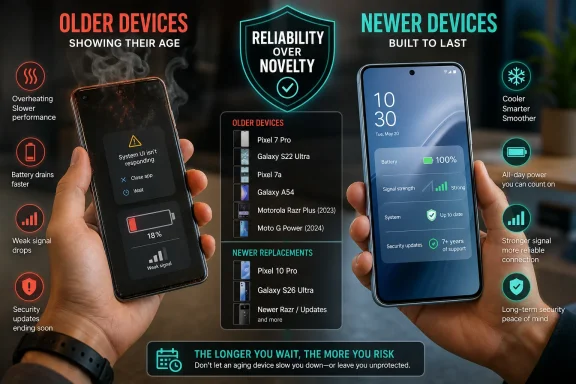 The Upgrade Cycle Has Become a Reliability Argument
For years, the smartphone industry trained buyers to think in annual increments. A new chip arrived, a camera bump appeared, carriers dangled a trade-in offer, and last year’s flagship suddenly felt old. That machinery still exists, but the logic underneath it has weakened.Android phones in 2026 are not disposable in the way many Android phones were a decade ago. Samsung and Google have normalized longer support windows on many higher-end and midrange devices, and hardware has improved enough that a three- or four-year-old phone can still handle messaging, streaming, banking, maps, and light productivity without embarrassment. Android Authority’s own reader poll attached to Radochia’s piece captured that mood: the largest group said they keep phones for four years or longer, effectively until the wheels fall off.
That is the right instinct. The environmental, financial, and practical case for holding onto a working phone is stronger than ever. But “working” is doing a lot of work in that sentence.
A phone can still boot, still take calls, and still run apps while being meaningfully past its prime. It may overheat in the car, lose signal during a commute, limp to dinner with 12 percent battery, or stop receiving the kind of software support that makes IT-minded users comfortable. The modern upgrade decision is not about novelty. It is about accumulated friction.
Google’s Pixel 7 Era Still Carries the Cost of Early Tensor
The Pixel 7 Pro is the cleanest example of a phone that has aged in two directions at once. On paper, it remains a capable flagship: premium build, strong cameras, a high-refresh display, and Google’s own software stack. In practice, Radochia’s criticism goes straight to the wound that defined early Tensor phones: heat.Google’s Tensor project was always about more than raw benchmark scores. The company wanted silicon optimized for its camera pipeline, speech features, AI-assisted software, and long-term platform control. That strategy made sense. But the Pixel 6 and Pixel 7 generations also taught buyers that ambition does not cancel out thermals, modem behavior, and battery life.
The Pixel 7 Pro corrected some of the Pixel 6 family’s rough edges. The hardware felt more mature, the fingerprint experience improved, and Android 13 arrived after the messy Android 12 transition. Yet the Tensor G2 never fully escaped the reputation of a chip that could get warm under ordinary pressure.
That matters more in year four than it did at launch. Batteries chemically age. Apps become heavier. Cellular networks evolve. A phone that was merely warm and inconsistent in 2022 can feel genuinely compromised in 2026 if the owner is asking it to navigate, hotspot, stream music, and juggle authentication prompts across a workday.
The upgrade case from a Pixel 7 Pro to a Pixel 10 Pro or Pixel 10 Pro XL is therefore not just “new camera good, old phone bad.” It is that Google’s newer hardware reportedly reduces the practical annoyances that made early Tensor ownership feel conditional. Better displays, cooler operation, and longer mixed-use battery life are the exact upgrades people notice because they remove pain rather than add spectacle.
For WindowsForum readers, the point is familiar from PC hardware. A laptop does not become obsolete the moment a faster CPU ships. It becomes obsolete when fan noise, battery degradation, driver weirdness, and security support make it a worse tool than its replacement cost can justify. The Pixel 7 Pro is reaching that kind of threshold for many owners.
The Pixel 7a Is the Stronger Case for Moving On
If the Pixel 7 Pro is a nuanced upgrade candidate, the Pixel 7a is less forgiving. Radochia calls it one of his least favorite phones, grouping it with the Pixel 6, and the complaint is again not that the phone lacked ideas. It is that the execution made the bargain feel less like a bargain.The Pixel A-series has always depended on a delicate trade. Buyers accept cheaper materials, fewer luxury features, and modest charging in exchange for Google’s camera processing and clean software at a lower price. The Pixel 6a hit that bargain especially well. The Pixel 7a, despite meaningful improvements, carried too much of the early Tensor baggage into a midrange shell.
Overheating hurts any phone, but it hurts a cheaper phone more. A flagship can sometimes offset chip inefficiency with a better display, larger thermal system, faster storage, or more premium radios. A midrange handset has less room to hide. If the processor and modem misbehave, the whole product feels shaky.
That is why the modem complaints around the Pixel 7a are so important. A smartphone is still, before everything else, a network terminal. If it struggles to switch cleanly between 5G and LTE, holds weak connections too long, or burns battery searching for signal, the owner experiences that failure dozens of times a week.
The Pixel 10a, as described by Android Authority and other Android-focused outlets this year, is not necessarily a revolutionary midrange device. In fact, some coverage has framed it as a conservative update, especially because it keeps older-generation silicon relative to Google’s top phones. But an upgrade does not have to be revolutionary to be rational.
For someone on a Pixel 7a, the promise is simple: a better display, better efficiency, improved connectivity, and a much longer runway of software support. Those are not glamorous spec-sheet victories. They are the difference between a phone that constantly reminds you of its compromises and one that mostly disappears into the background.
Samsung’s Galaxy S22 Ultra Shows That Qualcomm Had Its Own Bad Year
Android tribal debates often reduce chip criticism to brand identity. Pixel owners defend Tensor’s AI focus; Samsung owners boast about Snapdragon performance; everyone pretends their preferred vendor has escaped physics. The Galaxy S22 Ultra is a useful corrective.The Snapdragon 8 Gen 1 was a powerful chip, but it was also notorious for heat and efficiency complaints in many devices. Radochia’s experience with the Galaxy S22 Ultra mirrors what many users felt at the time: a spectacular phone undermined by a processor generation that could make battery life feel smaller than the hardware suggested.
That is what makes the S22 Ultra such a frustrating device to evaluate in 2026. Much of it still looks excellent. The 6.8-inch OLED display remains beautiful. The integrated S Pen gives it a productivity identity most slab phones lack. The camera system still produces images that are more than good enough for most people.
But the S22 Ultra is also an example of how one weak subsystem can dominate the ownership experience. If a phone overheats under common workloads and struggles to deliver comfortable screen-on time, its premium features become conditional. You can admire the display while watching the battery percentage fall too quickly.
The software support picture also changes the calculus. Samsung’s recent flagships benefit from a much stronger long-term update posture than older models, and the Galaxy S26 Ultra is positioned as a device that should remain current for many years. That matters for consumers, but it matters even more for admins and security-conscious users who treat personal phones as part of a broader identity and authentication perimeter.
A phone that holds passkeys, authenticator apps, corporate email, Teams chats, banking apps, and family photos is not a toy. It is a security endpoint. Once an older flagship approaches the edge of meaningful platform support, the question shifts from “Can I tolerate this battery?” to “Why am I trusting my digital life to a device nearing retirement?”
The Galaxy S22 Ultra still has emotional appeal. It was the point where the Galaxy Note effectively became the Galaxy Ultra, and for many power users it remains a beloved design. But affection is not an update policy, and nostalgia does not cool a hot chip.
Foldables Age in the Hinge Before They Age in the Spec Sheet
The Motorola Razr Plus from 2023 occupies a different category. Radochia’s case for upgrading is not that the phone was bad. Quite the opposite: he credits it with making him believe in Motorola’s revival and with proving that Samsung’s Galaxy Z Flip line did not have the entire clamshell foldable market to itself.That context matters because foldables age differently from conventional phones. A slab phone’s decline is usually about battery, software, display burn-in, or performance. A foldable adds a mechanical variable: the hinge. Even when a hinge survives, newer models can feel dramatically more refined because the opening motion, screen crease, dust resistance, and cover display experience improve quickly from generation to generation.
The 2023 Razr Plus had style, a useful outer display for its time, and a Snapdragon 8+ Gen 1 chip that aged better than the hotter Snapdragon 8 Gen 1. It was not a disaster waiting to happen. It was a strong early entry in the modern flip-phone revival.
But foldables are still on a steeper hardware improvement curve than ordinary flagships. The newer Razr Plus and Razr Ultra models reportedly bring larger and more practical cover screens, more durable construction, and a hinge that immediately communicates the benefits of refinement. In the foldable world, tactile confidence is a feature.
That is easy to underestimate until the device is in your hand. A slightly larger outer display changes how often you open the phone. A better hinge changes how comfortable you feel using it one-handed. Stronger durability claims change whether the device feels like a delicate indulgence or a normal daily driver.
Motorola’s challenge is support. The company has improved in places, but it still does not carry the same update-policy reputation as Samsung or Google across the board. Anyone upgrading from a 2023 Razr Plus should therefore weigh not just the charming hardware but also the software runway attached to the newer model.
The Razr Plus is the upgrade case based on accumulated mechanical progress. It is less about escaping a bad phone and more about recognizing that a fast-moving category has made yesterday’s breakthrough feel like a prototype of today’s normal.
The Galaxy A54 Proves Midrange Phones Are No Longer Disposable
The Samsung Galaxy A54 is perhaps the most interesting phone on Android Authority’s list because it was not a broken product. It was, in many ways, the moment Samsung’s A5x line recovered from the Galaxy A53’s performance stumble and reasserted itself as the safe Android recommendation for people who did not want flagship prices.The A54 had the pieces that matter: a good Super AMOLED display, acceptable performance, solid battery life, and Samsung’s polished One UI. It also looked more like Samsung’s premium phones than its price suggested. For many buyers, that was enough.
In 2026, however, the A54’s replacement logic is about rising expectations in the middle of the market. The Galaxy A57, as described in recent Android coverage, pushes the A-series closer to the physical feel of a flagship, with more premium materials, a larger display, and stronger performance. The midrange phone is no longer merely the phone you settle for. It is increasingly the phone that makes flagship pricing harder to defend.
That shift cuts both ways. If the A54 still works well, its owner should not feel embarrassed. It was a good phone, and a good midrange phone can now have a surprisingly long life. But the A57’s improvements are the kind that make an upgrade feel visible every time the device is picked up.
Build quality is not vanity. A stronger frame and better glass affect drops, scratches, and long-term confidence. A brighter, larger display changes readability. Faster charging and better battery behavior change daily planning. These are quality-of-life upgrades that make the midrange segment more compelling without requiring a leap to Ultra pricing.
There is a tradeoff, though: the loss of the microSD card slot. For a certain kind of Android user, expandable storage was not a footnote but a reason to choose Samsung’s midrange devices in the first place. The A57 may feel more premium, but it also participates in the industry’s steady narrowing of user control.
That is the deeper lesson of the A54-to-A57 path. Midrange phones are getting better, but they are also inheriting flagship assumptions. The materials improve. The support improves. The screens improve. And little by little, the old Android virtues of removable or expandable flexibility disappear.
The Moto G Power 2024 Is the Phone That Complicates the Whole Argument
The Moto G Power 2024 is the odd entry because Radochia does not really recommend upgrading from it. That restraint is what makes the list more credible. Not every older phone needs to be replaced, even if a newer model exists.The Moto G Power line has long appealed to buyers who want the basics at a low price: large screen, big battery, acceptable performance, and minimal fuss. The 2024 model, often discounted aggressively, remains popular because it understands its job. It is not trying to be a pocket workstation or a computational photography showcase.
The problem is that the 2026 successor does not appear to offer enough improvement at its higher price to make the jump obvious. A slightly better chip is nice. Keeping the same broad memory class and an LCD panel at a much higher price is less persuasive. Budget phones become dangerous when they stop behaving like budget phones.
This is where upgrade advice often goes wrong. Reviewers are naturally drawn to the new because the new is what they test. But consumers live with prices, not just specs. A $130 phone that does the basics is a very different proposition from a $400 phone that only modestly improves them.
For a Moto G Power 2024 owner, the rational move may be maintenance rather than replacement. Replace a case. Clean up storage. Audit background apps. Keep an eye on battery health. If the phone still lasts through the day and receives the security updates the owner needs, there may be no urgent reason to move.
That does not mean the Moto G Power 2024 is immortal. Cheap phones often have shorter update windows, weaker cameras, dimmer displays, and less durable components. But the correct upgrade target may not be the Moto G Power 2026. It may be a discounted Pixel, Galaxy A-series device, or previous-generation flagship that offers a more meaningful jump for similar money.
The Moto G Power entry is the reminder that “newer” and “better value” are not synonyms. Sometimes the upgrade market asks budget buyers to pay more for too little, and the right answer is to wait.
Software Support Has Become the New Battery Life
The smartphone industry used to sell upgrades through obvious hardware deltas. Better cameras. Bigger screens. Faster processors. More storage. Those still matter, but the more mature Android market increasingly turns on a quieter factor: support duration.Samsung and Google have made long support promises part of their premium pitch, and the effect is reshaping buyer expectations. A phone that will receive years of Android upgrades and security patches is not just a nicer product. It is a more predictable asset.
That matters because phones now sit at the center of identity. They hold password managers, passkeys, banking sessions, medical apps, travel documents, work profiles, and two-factor authentication. A compromised or unsupported phone is not merely inconvenient. It can become the weak link in a household or small business security model.
For Windows users, this should sound familiar. Nobody serious about security would recommend running an unsupported Windows build for daily banking and business access. Yet many people apply a softer standard to phones, even though those phones may be more intimate and more frequently used than their PCs.
The complication is that support promises vary by model, region, carrier, and vendor behavior. A flagship Galaxy and a budget Motorola do not exist in the same update universe. A Pixel A-series phone may outlast a more expensive device from another brand in software terms. The purchase price is no longer a reliable proxy for support quality.
This is why the Galaxy S22 Ultra and Pixel 7a can both belong in the same upgrade conversation despite being very different phones. One was a premium powerhouse. The other was a value-focused Pixel. In 2026, both raise questions about whether their owners are carrying devices that still fit the security and reliability expectations of modern smartphone life.
Heat Is the Enemy That Review Scores Understate
Thermals are hard to capture in a launch review. A phone can benchmark well, photograph beautifully, and feel responsive in a controlled testing period while still revealing annoying heat patterns over months of real use. That is especially true in hot cars, poor-signal areas, long video calls, and navigation-heavy travel days.The Pixel 7 Pro, Pixel 7a, and Galaxy S22 Ultra all point to this problem. Their upgrade cases are not primarily about raw speed. They are about efficiency. A phone that gets hot wastes energy, throttles performance, ages its battery faster, and makes the owner less confident.
This is one reason mid-cycle chip reputations matter. The Snapdragon 8+ Gen 1 in the Razr Plus 2023 aged with more affection than the Snapdragon 8 Gen 1 in the Galaxy S22 Ultra because it corrected some of the efficiency pain. Tensor G2’s reputation, fairly or not, remains tied to heat and modem behavior because those are the issues users felt in ordinary life.
Manufacturers prefer to talk about peak performance and AI features because those make better launch slides. But the day-to-day winner is usually sustained performance per watt. The phone that stays cool, holds signal, and ends the day with battery left is the phone people recommend to friends.
That should shape upgrade thinking. If your old phone is merely slower than the newest model, patience may be wise. If it is hot, unstable on cellular networks, or unreliable away from a charger, the case for upgrading becomes much stronger.
A modern phone does not need to be exciting to be good. It needs to be trustworthy. Heat erodes trust.
The Sensible Upgrade Is the One That Removes a Daily Annoyance
There is a temptation to read Android Authority’s list as a shopping prompt: own one of these, buy the suggested replacement. That is not quite the right takeaway. The smarter interpretation is diagnostic.If your Pixel 7 Pro still delivers all-day battery, stays cool enough, and remains within your comfort zone for updates, you may be able to keep it longer. If your Galaxy A54 is smooth, physically intact, and cheap to own, you do not need to upgrade just because the A57 looks nicer. If your Moto G Power 2024 remains a $130 workhorse, replacing it with a much pricier successor may be wasteful.
But if the phone has become a daily negotiation, the upgrade case changes. The warning signs are not subtle. They are the little routines owners build around failing devices: carrying a power bank everywhere, disabling features to avoid heat, manually toggling network modes, deleting apps to recover storage, or avoiding video calls because the phone cannot handle them comfortably.
That is when an upgrade becomes less like consumer indulgence and more like replacing worn tires. The old ones may still roll. That does not make them good.
For enthusiasts, this can feel counterintuitive. We are used to discussing specs, launches, and product tiers. Ordinary users make decisions around irritation. A phone that never causes anxiety can stay for years. A phone that creates friction every morning is already too old, regardless of its release date.
Six Phones, One More Honest Upgrade Rule
The useful lesson from Radochia’s Android Authority list is not that every 2022 or 2023 Android phone is finished. It is that upgrade timing has become personal, practical, and tied to failure modes that spec sheets often hide. A four-year cycle is healthy, but only if the device is still healthy too.- Pixel 7 Pro owners have the strongest reason to upgrade if heat, outdoor visibility, or battery life has become a recurring frustration.
- Galaxy S22 Ultra owners should weigh the phone’s excellent display and S Pen against aging thermals, battery behavior, and the appeal of a much longer support runway on newer Ultra models.
- Motorola Razr Plus 2023 owners are looking less at raw speed and more at hinge refinement, cover-screen usefulness, durability, and Motorola’s software commitment.
- Pixel 7a owners have a particularly practical upgrade case if modem behavior, overheating, or weak battery life has made the phone feel unreliable.
- Galaxy A54 owners do not need to panic, but the Galaxy A57 shows how much more premium the midrange tier has become.
- Moto G Power 2024 owners may be better served by waiting, because a cheap phone that still works can be a better value than a newer budget phone that costs too much.
References
- Primary source: Android Authority
Published: 2026-07-03T11:30:41.435769
Loading…
www.androidauthority.com - Related coverage: digitalcameraworld.com
Loading…
www.digitalcameraworld.com - Related coverage: androidcentral.com
Loading…
www.androidcentral.com - Related coverage: tomsguide.com
Best Android phones 2026 tested and rated: Our top picks | Tom's Guide
Our list of the best Android phones at every size and for every budget will help you make the right choice.www.tomsguide.com - Related coverage: slashgear.com
Loading…
www.slashgear.com - Related coverage: techradar.com
Loading…
www.techradar.com