

Google disclosed CVE-2026-14092 on June 30, 2026, as a low-severity Chrome privacy flaw fixed before version 150.0.7871.47, while NVD and CISA later described it as a cross-origin data leak requiring user interaction and a privileged network position. The bug is not the kind of browser vulnerability that usually dominates patch headlines. That is precisely why it deserves attention.
The obvious story is that Chrome 150 shipped with a large security rollup and one more low-rated Chromium CVE buried in the list. The more useful story, especially for Windows administrators and security teams, is that browser privacy boundaries now depend on a web of policy enforcement, network assumptions, and update discipline that is easy to underrate until something leaks.
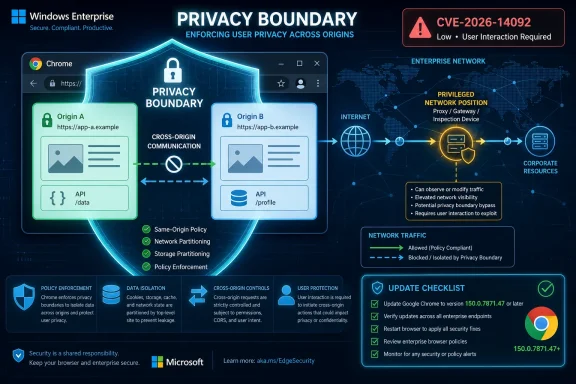
CVE-2026-14092 sits in Chrome’s Privacy component and is described by Google’s CVE entry as “insufficient policy enforcement.” In plain English, Chrome was not consistently enforcing a privacy boundary strongly enough, allowing an attacker in a privileged network position to leak cross-origin data through malicious network traffic.
That phrase, privileged network position, is doing a lot of work. This is not described as a drive-by remote code execution bug, and CISA’s ADP assessment lists exploitation as “none,” automatable as “no,” and technical impact as partial. The CVSS 3.1 vector assigned through CISA-ADP is 4.3, or medium, with network attack vector, low attack complexity, no privileges required, user interaction required, unchanged scope, low confidentiality impact, and no integrity or availability impact.
Chromium’s own severity rating is lower: Google classifies the issue as Low. That mismatch is not scandalous; it is a useful reminder that vendor severity and CVSS scoring often answer different questions. Google is judging the bug inside the browser’s threat model and exploitability expectations, while CVSS is trying to express a standardized risk profile that can be compared across products.
For most home users, the practical answer is simple: update Chrome. For IT teams, the better answer is slightly more complicated: confirm that managed Chrome installations are actually at or beyond the fixed build, and pay special attention to devices that spend time on hostile or semi-trusted networks.
CVE-2026-14092 is described as a leak of cross-origin data via malicious network traffic. That suggests a bug in how Chrome enforced a privacy policy under particular network conditions, rather than a universal bypass that any website could trigger from anywhere. The presence of user interaction in the CVSS vector further narrows the realistic attack path.
Still, the phrase “cross-origin data” should make administrators pause. A low-grade browser privacy failure can expose pieces of state that enterprises spend enormous effort trying to protect: identifiers, request behavior, timing-sensitive data, session-adjacent information, or other signals that are more useful when combined with network vantage and targeting.
This is the uncomfortable part of browser security in 2026. The highest-severity bugs still get the emergency patch cycles and the dramatic headlines. But privacy boundary bugs are the ones that quietly test whether an organization’s assumptions about TLS inspection, captive portals, proxying, VPN enforcement, and managed browser policy are coherent.
In a consumer setting, that may mean hostile Wi-Fi, compromised network equipment, malicious access points, or ISP-adjacent attack conditions. In a corporate setting, the list gets stranger. Enterprises deliberately put middleboxes, proxies, inspection devices, gateways, and traffic-shaping tools between the browser and the public internet.
Those devices are not automatically malicious, but they create places where policy mistakes, misconfigurations, or compromise can have amplified consequences. A browser flaw that needs a privileged network position becomes more relevant in environments where traffic is already being mediated by infrastructure the user does not control.
That does not mean CVE-2026-14092 should trigger panic. It does mean the “low” label should not be used as a reason to skip the patch window. Browser vulnerabilities that combine user interaction with network positioning are exactly the kind of bugs that can be dismissed in a risk register and then rediscovered during incident response.
That version-number detail matters because the NVD change history shows a potentially confusing affected-configuration entry: versions up to, but excluding, 150.0.7871.46 in one configuration line, while the CVE description and affected data point to fixes before 150.0.7871.47. In practice, administrators should not try to split hairs around the lower build. The safe operational threshold for CVE-2026-14092 is Chrome 150.0.7871.47 or later where that build is available.
This is also where WindowsForum readers should keep Chromium-based browsers in mind. Chrome is the named product in the CVE, but the underlying issue is tracked in Chromium. Whether and when a downstream browser is affected depends on its Chromium base, patch ingestion, and vendor release schedule.
Microsoft Edge, Brave, Vivaldi, Opera, and other Chromium derivatives do not become safe merely because the advisory says “Google Chrome.” They become safe when their vendors integrate the relevant Chromium fix and ship a build that contains it. For managed Windows estates, that distinction is not academic; Edge may update through Microsoft’s channels, Chrome through Google’s, and third-party browsers through their own updaters or packaging systems.
The CPE model is helpful for scanners, asset inventories, and vulnerability management platforms, but it can also flatten browser reality. Chrome is not just a Windows application, a macOS application, and a Linux application. It is also a moving Chromium branch, an auto-updating product, an enterprise-managed endpoint component, and in some organizations a dependency embedded in automation, kiosk systems, virtual desktops, and golden images.
If a scanner says Chrome is vulnerable because the installed version is lower than the fixed build, that finding is straightforward. If a scanner misses a Chromium-derived browser because there is no matching CPE, that does not prove the browser is unaffected. It only proves the scanner’s product mapping is incomplete.
This is one of the oldest tensions in vulnerability management. CPEs are catalog entries; exposure is a living system. Administrators should use NVD’s enrichment, but they should also check vendor release notes, installed browser versions, and endpoint telemetry.
But security teams do not patch individual CVEs in isolation. They patch browser releases. Chrome 150 carried a large bundle of fixes, with contemporary reporting from outlets such as PCWorld, Malwarebytes, and Born’s IT and Windows Blog describing the update as addressing hundreds of security issues and multiple critical vulnerabilities.
That bundling changes the administrative calculus. Even if CVE-2026-14092 alone would be a “next normal maintenance cycle” issue, the Chrome 150 update belongs in a faster browser patch lane because it contains far more than one privacy bug. The low-severity CVE is part of a larger release that administrators should already be pushing.
This is where vulnerability prioritization dashboards can mislead. If a dashboard isolates CVE-2026-14092 and gives it a medium or low risk score, someone may decide it can wait. If the browser itself is behind the stable security release, the actual decision is broader: how comfortable are you running an outdated browser build that missed an entire security train?
A user can interact by visiting a malicious page, clicking through a captive portal, loading attacker-controlled content, or using a network that injects or manipulates traffic in a way that triggers the relevant browser behavior. In environments with phishing, malvertising, compromised websites, or unmanaged Wi-Fi, user interaction is not a rare event. It is the default state of using the web.
The more interesting part is the combination of interaction and network privilege. An attacker may need both a user to browse and a network position to shape the conditions. That makes mass exploitation less attractive, but targeted exploitation more plausible in places like hotels, conferences, airports, shared offices, student networks, and compromised small-business routers.
For Windows administrators, that points to practical controls beyond the Chrome version number. Encourage or enforce VPN use on untrusted networks, keep HTTPS-only and secure DNS policies aligned with organizational requirements, and avoid security products that break browser privacy assumptions without careful testing.
Privacy bugs increasingly sit at the boundary between browser behavior and infrastructure behavior. They involve how the browser partitions state, enforces origin boundaries, handles network isolation, processes headers, separates storage, or defends against side channels. None of that makes for a neat exploit demo, but all of it determines whether one site can infer or extract information from another.
CVE-2026-14092’s description does not give enough public detail to say exactly which policy failed or what data could leak. The Chromium issue tracker entry referenced by the advisory requires permissions, which is normal for security bugs while users are still updating. That lack of public exploit detail should be interpreted carefully: it limits defenders’ ability to model the bug, but it also reduces opportunistic copycat exploitation.
In the meantime, administrators should focus on the facts that are available. The bug affected Chrome before 150.0.7871.47. It involved insufficient policy enforcement in Privacy. It could leak cross-origin data via malicious network traffic. It required a privileged network attacker and user interaction. It has no known exploitation according to CISA’s SSVC entry at the time of enrichment.
Some organizations pin browser versions for compatibility. Others package Chrome through software distribution tools that lag behind Google’s stable channel. Virtual desktop images, kiosk systems, offline machines, lab PCs, and shared workstations often miss the “it auto-updates” assumption that security teams rely on.
That makes CVE-2026-14092 a useful audit prompt. Not because this one bug is catastrophic, but because it reveals whether your browser fleet is actually current. If you cannot quickly answer which Chrome versions are installed across Windows endpoints, you have a browser management problem, not merely a CVE tracking problem.
Administrators should check Chrome’s version through endpoint management tooling, not by waiting for users to report the About page. For individual users, the path remains Help, About Google Chrome, followed by a relaunch if an update has been installed. For organizations, the relevant controls are update policies, reporting, ring deployment, and exception handling.
Microsoft Edge typically incorporates Chromium security fixes quickly, but administrators should verify the Edge release channel and version in their own environment. The same principle applies to Brave, Vivaldi, Opera, Electron-based applications, embedded browser components, and specialized Chromium builds used in kiosk or application shells.
The hardest cases are not mainstream browsers. They are applications that carry an embedded Chromium runtime and do not expose it as a browser in inventory systems. A vulnerability like CVE-2026-14092 may or may not be reachable in those contexts, depending on how the embedded component is used, but asset owners should not assume invisibility equals immunity.
This is where security teams should separate “Chrome the product” from “Chromium the dependency.” The CVE names Google Chrome because that is the affected product disclosed by Google. The engineering fix lives in Chromium, and the downstream risk depends on who consumed that fix and when.
For administrators, the harder part is assurance. Did the update install on machines where Chrome was open for weeks? Did users relaunch? Did packaged builds replace older versions? Did virtual images get refreshed? Did nonpersistent desktops start from a patched base? Did third-party Chromium browsers follow?
Those are not dramatic questions, but they are the questions that determine whether a low-severity issue remains low. Browser vulnerabilities live in the gap between release notes and deployed reality. The modern web browser is a critical endpoint application, and its patch state deserves the same seriousness as the operating system.
There is also a policy question here. If an organization delays browser updates for compatibility, it should have a compensating process for emergency and high-volume security releases. Chrome 150 appears to have been a broad security rollup, not a tiny cosmetic bump. Treating it as optional because one CVE carries a low rating is a category error.
Corporate TLS inspection, proxy injection, captive portal handling, DNS manipulation, and network-based data loss prevention can all change how browser traffic behaves. Some of those tools are legitimate; some are necessary in regulated environments. But each one becomes part of the browser’s effective attack surface.
If a privacy policy enforcement flaw can be exercised through malicious network traffic, then network architecture matters. The immediate fix is still the Chrome update, but the strategic lesson is that browser privacy depends on infrastructure that does not surprise the browser.
Security teams should review whether inspection devices are current, whether untrusted networks are treated consistently, and whether user traffic on public Wi-Fi is protected by policy rather than habit. The goal is not to eliminate every intermediary; it is to stop pretending intermediaries are invisible.
The affected-version language also deserves a note of caution. The CVE description says Chrome prior to 150.0.7871.47; the NVD configuration shown in the change history references versions up to but excluding 150.0.7871.46, alongside platform CPEs. When public vulnerability records disagree at the margins, defenders should follow the vendor-fixed version and choose the more conservative threshold.
That means Chrome 150.0.7871.47 or later for this CVE where applicable. Anything older should be considered exposed until proven otherwise. If an inventory product reports a different cutoff, validate it against Google’s release information rather than assuming the scanner is right.
This is not a sign that the vulnerability ecosystem is broken. It is a sign that machine-readable vulnerability data is always a translation layer. The authoritative story begins with the vendor advisory, gets enriched by NVD and CISA, and then gets interpreted by scanners, asset platforms, and administrators.
The obvious story is that Chrome 150 shipped with a large security rollup and one more low-rated Chromium CVE buried in the list. The more useful story, especially for Windows administrators and security teams, is that browser privacy boundaries now depend on a web of policy enforcement, network assumptions, and update discipline that is easy to underrate until something leaks.
 A Low-Severity Chrome Bug With an Enterprise-Shaped Shadow
CVE-2026-14092 sits in Chrome’s Privacy component and is described by Google’s CVE entry as “insufficient policy enforcement.” In plain English, Chrome was not consistently enforcing a privacy boundary strongly enough, allowing an attacker in a privileged network position to leak cross-origin data through malicious network traffic.That phrase, privileged network position, is doing a lot of work. This is not described as a drive-by remote code execution bug, and CISA’s ADP assessment lists exploitation as “none,” automatable as “no,” and technical impact as partial. The CVSS 3.1 vector assigned through CISA-ADP is 4.3, or medium, with network attack vector, low attack complexity, no privileges required, user interaction required, unchanged scope, low confidentiality impact, and no integrity or availability impact.
Chromium’s own severity rating is lower: Google classifies the issue as Low. That mismatch is not scandalous; it is a useful reminder that vendor severity and CVSS scoring often answer different questions. Google is judging the bug inside the browser’s threat model and exploitability expectations, while CVSS is trying to express a standardized risk profile that can be compared across products.
For most home users, the practical answer is simple: update Chrome. For IT teams, the better answer is slightly more complicated: confirm that managed Chrome installations are actually at or beyond the fixed build, and pay special attention to devices that spend time on hostile or semi-trusted networks.
Cross-Origin Leaks Are Small Until They Are Not
The web’s same-origin model is one of the quiet miracles that makes modern browsing tolerable. A page from one origin should not be able to read sensitive data from another origin just because both are open in the same browser. If that boundary weakens, the result may not be code execution, but it can still become a confidentiality problem.CVE-2026-14092 is described as a leak of cross-origin data via malicious network traffic. That suggests a bug in how Chrome enforced a privacy policy under particular network conditions, rather than a universal bypass that any website could trigger from anywhere. The presence of user interaction in the CVSS vector further narrows the realistic attack path.
Still, the phrase “cross-origin data” should make administrators pause. A low-grade browser privacy failure can expose pieces of state that enterprises spend enormous effort trying to protect: identifiers, request behavior, timing-sensitive data, session-adjacent information, or other signals that are more useful when combined with network vantage and targeting.
This is the uncomfortable part of browser security in 2026. The highest-severity bugs still get the emergency patch cycles and the dramatic headlines. But privacy boundary bugs are the ones that quietly test whether an organization’s assumptions about TLS inspection, captive portals, proxying, VPN enforcement, and managed browser policy are coherent.
The Attacker Is Not Everywhere — But They May Be Where Your Users Work
The vulnerability requires an attacker in a privileged network position. That phrase should not be read as “nation-state only,” nor should it be read as “anyone on the internet.” It points to an attacker who can influence, observe, or manipulate traffic in a way ordinary remote attackers cannot.In a consumer setting, that may mean hostile Wi-Fi, compromised network equipment, malicious access points, or ISP-adjacent attack conditions. In a corporate setting, the list gets stranger. Enterprises deliberately put middleboxes, proxies, inspection devices, gateways, and traffic-shaping tools between the browser and the public internet.
Those devices are not automatically malicious, but they create places where policy mistakes, misconfigurations, or compromise can have amplified consequences. A browser flaw that needs a privileged network position becomes more relevant in environments where traffic is already being mediated by infrastructure the user does not control.
That does not mean CVE-2026-14092 should trigger panic. It does mean the “low” label should not be used as a reason to skip the patch window. Browser vulnerabilities that combine user interaction with network positioning are exactly the kind of bugs that can be dismissed in a risk register and then rediscovered during incident response.
Chrome 150 Was a Security Event, Not Just a Version Bump
The fix for CVE-2026-14092 arrived in the Chrome 150 stable channel update for desktop. According to Google’s Chrome Releases blog, Chrome 150 moved to stable for Windows, macOS, and Linux at the end of June 2026, with Windows and Mac builds listed in the 150.0.7871.46/.47 range and Linux at 150.0.7871.46. NVD’s CVE record identifies Chrome prior to 150.0.7871.47 as affected for this specific vulnerability.That version-number detail matters because the NVD change history shows a potentially confusing affected-configuration entry: versions up to, but excluding, 150.0.7871.46 in one configuration line, while the CVE description and affected data point to fixes before 150.0.7871.47. In practice, administrators should not try to split hairs around the lower build. The safe operational threshold for CVE-2026-14092 is Chrome 150.0.7871.47 or later where that build is available.
This is also where WindowsForum readers should keep Chromium-based browsers in mind. Chrome is the named product in the CVE, but the underlying issue is tracked in Chromium. Whether and when a downstream browser is affected depends on its Chromium base, patch ingestion, and vendor release schedule.
Microsoft Edge, Brave, Vivaldi, Opera, and other Chromium derivatives do not become safe merely because the advisory says “Google Chrome.” They become safe when their vendors integrate the relevant Chromium fix and ship a build that contains it. For managed Windows estates, that distinction is not academic; Edge may update through Microsoft’s channels, Chrome through Google’s, and third-party browsers through their own updaters or packaging systems.
NVD’s CPE Entry Is Useful, But It Is Not the Source of Truth
The user-submitted NVD text asks the familiar question: are we missing a CPE here? That line appears often on NVD pages while enrichment is in progress or when product configuration data is incomplete. In this case, the initial NIST analysis added a CPE configuration for Google Chrome on Windows, Linux, and macOS.The CPE model is helpful for scanners, asset inventories, and vulnerability management platforms, but it can also flatten browser reality. Chrome is not just a Windows application, a macOS application, and a Linux application. It is also a moving Chromium branch, an auto-updating product, an enterprise-managed endpoint component, and in some organizations a dependency embedded in automation, kiosk systems, virtual desktops, and golden images.
If a scanner says Chrome is vulnerable because the installed version is lower than the fixed build, that finding is straightforward. If a scanner misses a Chromium-derived browser because there is no matching CPE, that does not prove the browser is unaffected. It only proves the scanner’s product mapping is incomplete.
This is one of the oldest tensions in vulnerability management. CPEs are catalog entries; exposure is a living system. Administrators should use NVD’s enrichment, but they should also check vendor release notes, installed browser versions, and endpoint telemetry.
The Severity Label Hides the Real Patch Priority
Google’s low severity rating is not meaningless. A bug that requires a privileged network position, user interaction, and yields only limited confidentiality impact is not in the same class as a sandbox escape or a V8 remote code execution flaw. It should not be treated as if attackers can instantly compromise every unpatched machine from a web page.But security teams do not patch individual CVEs in isolation. They patch browser releases. Chrome 150 carried a large bundle of fixes, with contemporary reporting from outlets such as PCWorld, Malwarebytes, and Born’s IT and Windows Blog describing the update as addressing hundreds of security issues and multiple critical vulnerabilities.
That bundling changes the administrative calculus. Even if CVE-2026-14092 alone would be a “next normal maintenance cycle” issue, the Chrome 150 update belongs in a faster browser patch lane because it contains far more than one privacy bug. The low-severity CVE is part of a larger release that administrators should already be pushing.
This is where vulnerability prioritization dashboards can mislead. If a dashboard isolates CVE-2026-14092 and gives it a medium or low risk score, someone may decide it can wait. If the browser itself is behind the stable security release, the actual decision is broader: how comfortable are you running an outdated browser build that missed an entire security train?
The User Interaction Requirement Is Not a Comfort Blanket
CISA’s vector says user interaction is required. That is reassuring in one sense: this is not described as a silent network-only attack. But “user interaction” in browser vulnerabilities is often a low bar.A user can interact by visiting a malicious page, clicking through a captive portal, loading attacker-controlled content, or using a network that injects or manipulates traffic in a way that triggers the relevant browser behavior. In environments with phishing, malvertising, compromised websites, or unmanaged Wi-Fi, user interaction is not a rare event. It is the default state of using the web.
The more interesting part is the combination of interaction and network privilege. An attacker may need both a user to browse and a network position to shape the conditions. That makes mass exploitation less attractive, but targeted exploitation more plausible in places like hotels, conferences, airports, shared offices, student networks, and compromised small-business routers.
For Windows administrators, that points to practical controls beyond the Chrome version number. Encourage or enforce VPN use on untrusted networks, keep HTTPS-only and secure DNS policies aligned with organizational requirements, and avoid security products that break browser privacy assumptions without careful testing.
Privacy Bugs Are Now Infrastructure Bugs
The word “Privacy” in the component field can make a CVE sound less urgent than “V8,” “Extensions,” or “GPU.” That is partly because browser security culture has trained everyone to associate danger with memory corruption and sandbox escapes. Those bugs are still dangerous, but they are not the only way a browser can fail its users.Privacy bugs increasingly sit at the boundary between browser behavior and infrastructure behavior. They involve how the browser partitions state, enforces origin boundaries, handles network isolation, processes headers, separates storage, or defends against side channels. None of that makes for a neat exploit demo, but all of it determines whether one site can infer or extract information from another.
CVE-2026-14092’s description does not give enough public detail to say exactly which policy failed or what data could leak. The Chromium issue tracker entry referenced by the advisory requires permissions, which is normal for security bugs while users are still updating. That lack of public exploit detail should be interpreted carefully: it limits defenders’ ability to model the bug, but it also reduces opportunistic copycat exploitation.
In the meantime, administrators should focus on the facts that are available. The bug affected Chrome before 150.0.7871.47. It involved insufficient policy enforcement in Privacy. It could leak cross-origin data via malicious network traffic. It required a privileged network attacker and user interaction. It has no known exploitation according to CISA’s SSVC entry at the time of enrichment.
Windows Shops Should Treat Browser Drift as Endpoint Drift
On Windows, Chrome updates are supposed to be boring. Google’s updater usually does its work quietly, and most consumer machines will move forward without user intervention. Enterprise environments are different.Some organizations pin browser versions for compatibility. Others package Chrome through software distribution tools that lag behind Google’s stable channel. Virtual desktop images, kiosk systems, offline machines, lab PCs, and shared workstations often miss the “it auto-updates” assumption that security teams rely on.
That makes CVE-2026-14092 a useful audit prompt. Not because this one bug is catastrophic, but because it reveals whether your browser fleet is actually current. If you cannot quickly answer which Chrome versions are installed across Windows endpoints, you have a browser management problem, not merely a CVE tracking problem.
Administrators should check Chrome’s version through endpoint management tooling, not by waiting for users to report the About page. For individual users, the path remains Help, About Google Chrome, followed by a relaunch if an update has been installed. For organizations, the relevant controls are update policies, reporting, ring deployment, and exception handling.
Chromium Derivatives Need Their Own Accounting
The Chrome advisory does not automatically tell you the state of Microsoft Edge or other Chromium-based browsers. That is inconvenient, but it is the reality of the Chromium ecosystem. Chromium is the upstream project; each vendor ships its own product.Microsoft Edge typically incorporates Chromium security fixes quickly, but administrators should verify the Edge release channel and version in their own environment. The same principle applies to Brave, Vivaldi, Opera, Electron-based applications, embedded browser components, and specialized Chromium builds used in kiosk or application shells.
The hardest cases are not mainstream browsers. They are applications that carry an embedded Chromium runtime and do not expose it as a browser in inventory systems. A vulnerability like CVE-2026-14092 may or may not be reachable in those contexts, depending on how the embedded component is used, but asset owners should not assume invisibility equals immunity.
This is where security teams should separate “Chrome the product” from “Chromium the dependency.” The CVE names Google Chrome because that is the affected product disclosed by Google. The engineering fix lives in Chromium, and the downstream risk depends on who consumed that fix and when.
The Patch Is Easy; The Assurance Is Hard
For most users, the patch is uneventful. Install Chrome 150.0.7871.47 or later, relaunch the browser, and move on. The browser’s own update mechanism should handle the heavy lifting.For administrators, the harder part is assurance. Did the update install on machines where Chrome was open for weeks? Did users relaunch? Did packaged builds replace older versions? Did virtual images get refreshed? Did nonpersistent desktops start from a patched base? Did third-party Chromium browsers follow?
Those are not dramatic questions, but they are the questions that determine whether a low-severity issue remains low. Browser vulnerabilities live in the gap between release notes and deployed reality. The modern web browser is a critical endpoint application, and its patch state deserves the same seriousness as the operating system.
There is also a policy question here. If an organization delays browser updates for compatibility, it should have a compensating process for emergency and high-volume security releases. Chrome 150 appears to have been a broad security rollup, not a tiny cosmetic bump. Treating it as optional because one CVE carries a low rating is a category error.
The Network Assumption Is the Part Worth Testing
CVE-2026-14092’s privileged-network requirement should push organizations to examine where they implicitly trust the network. The browser security model is built to survive hostile websites and hostile networks better than it once did, but “better” is not “perfect.”Corporate TLS inspection, proxy injection, captive portal handling, DNS manipulation, and network-based data loss prevention can all change how browser traffic behaves. Some of those tools are legitimate; some are necessary in regulated environments. But each one becomes part of the browser’s effective attack surface.
If a privacy policy enforcement flaw can be exercised through malicious network traffic, then network architecture matters. The immediate fix is still the Chrome update, but the strategic lesson is that browser privacy depends on infrastructure that does not surprise the browser.
Security teams should review whether inspection devices are current, whether untrusted networks are treated consistently, and whether user traffic on public Wi-Fi is protected by policy rather than habit. The goal is not to eliminate every intermediary; it is to stop pretending intermediaries are invisible.
The Public Record Still Has Gaps
There is not enough public technical detail to reconstruct the exploit path for CVE-2026-14092. Google’s linked Chromium issue is permission-restricted, which is standard practice for security issues while updates are still propagating. NVD has not supplied its own CVSS assessment at the time reflected in the provided record, though CISA-ADP supplied a CVSS 3.1 score and CWE mapping.The affected-version language also deserves a note of caution. The CVE description says Chrome prior to 150.0.7871.47; the NVD configuration shown in the change history references versions up to but excluding 150.0.7871.46, alongside platform CPEs. When public vulnerability records disagree at the margins, defenders should follow the vendor-fixed version and choose the more conservative threshold.
That means Chrome 150.0.7871.47 or later for this CVE where applicable. Anything older should be considered exposed until proven otherwise. If an inventory product reports a different cutoff, validate it against Google’s release information rather than assuming the scanner is right.
This is not a sign that the vulnerability ecosystem is broken. It is a sign that machine-readable vulnerability data is always a translation layer. The authoritative story begins with the vendor advisory, gets enriched by NVD and CISA, and then gets interpreted by scanners, asset platforms, and administrators.
The Real Test Is Whether Chrome 150 Is Already Everywhere It Should Be
The practical lesson from CVE-2026-14092 is not that every low-severity Chrome privacy bug should cause an emergency meeting. It is that browser patching should be fast enough, visible enough, and boring enough that a bug like this is gone before the risk debate becomes elaborate.- Chrome installations should be updated to 150.0.7871.47 or later where that fixed build applies.
- The issue is a confidentiality-focused privacy enforcement flaw, not a reported remote code execution bug.
- The attack scenario requires user interaction and a privileged network position, which lowers mass-exploitation risk but keeps targeted-network scenarios relevant.
- NVD and CISA enrichment is useful, but administrators should treat Google’s fixed-version guidance as the operational baseline.
- Chromium-based browsers and embedded Chromium components need separate verification rather than assumptions based on Chrome’s update status.
- Managed Windows environments should confirm relaunch and deployment completion, not merely approve the update package.
References
- Primary source: NVD / Chromium
Published: 2026-07-03T07:00:54-07:00
NVD - CVE-2026-14092
 nvd.nist.gov
- Security advisory: MSRC
Published: 2026-07-03T07:00:54-07:00
Original feed URL
Security Update Guide - Microsoft Security Response Center
 msrc.microsoft.com
- Related coverage: cvefeed.io
CVE-2026-14092 - Google Chrome Cross-Origin Data Leak
Insufficient policy enforcement in Privacy in Google Chrome prior to 150.0.7871.47 allowed an attacker in a privileged network position to leak cross-origin data via malicious network traffic. (Chromium security severity: Low)cvefeed.io