

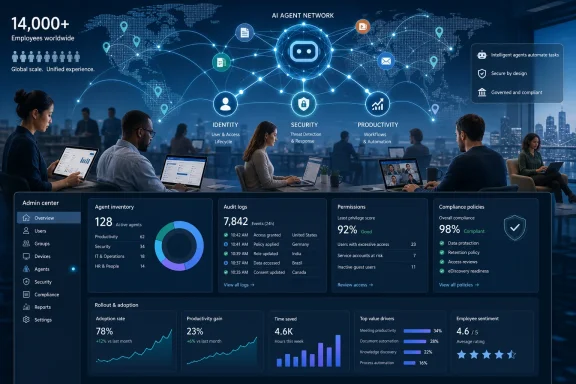
Insight has signed on as a launch partner for Microsoft 365 E7 and is rolling out Microsoft’s new Frontier Suite to more than 14,000 employees worldwide, according to reporting from ChannelLife Australia and supporting Microsoft partner materials published this year. The move is not just another channel announcement. It is a test of whether Microsoft’s most expensive, AI-heavy productivity bundle can be sold as an operating model rather than a license upgrade. For Windows shops and Microsoft 365 administrators, Insight’s rollout is a useful preview of the argument Microsoft wants every enterprise to accept next: AI adoption is now an identity, security, governance, and change-management problem all at once.
The most important part of Insight’s Microsoft 365 E7 announcement is not that the company will sell the suite. That was inevitable. Insight is a major Microsoft partner, and Microsoft’s channel needs large integrators to turn Copilot, Agent 365, Entra, Purview, Defender, and the rest of the stack into something customers can actually deploy.
The sharper point is that Insight is putting its own workforce in the sales deck. ChannelLife Australia reports that Insight is deploying E7 across more than 14,000 employees, positioning itself as one of the first companies to adopt the suite internally at global scale. That gives the company a useful claim in a market crowded with AI consultants: it is not merely advising clients to jump; it is jumping first.
That “client zero” posture is now a familiar move in enterprise AI. Vendors and partners know that many customers are tired of demo-stage artificial intelligence, where the proof of value is a polished keynote workflow and the risk is left for IT to discover later. A company that can say it has already put Copilot and agent governance into everyday use has a stronger pitch than one selling a workshop and a slide deck.
But this also raises the bar for Insight. If the company is going to turn its own rollout into a blueprint for customers, the interesting questions are no longer whether employees can be persuaded to open Copilot. They are whether usage remains high after the novelty fades, whether governance keeps pace with delegation, and whether the claimed productivity gains survive contact with finance, security, and compliance teams.
That bundle matters because Microsoft’s AI strategy has been moving beyond chat-in-a-sidebar. Copilot started as a productivity assistant inside familiar applications such as Word, Excel, Outlook, Teams, and PowerPoint. Agent 365 is the more consequential layer: Microsoft’s attempt to provide a control plane for AI agents that act across enterprise systems, carry permissions, generate audit trails, and require policy enforcement.
In other words, E7 is Microsoft’s answer to a problem it helped create. Once every department can build or buy agents, the old model of “approve the application and train the user” breaks down. Agents are not conventional apps, and they are not employees. They sit uncomfortably between the two, requiring identity, authorization, monitoring, lifecycle management, and a governance vocabulary that most organizations are still inventing.
Microsoft’s packaging pitch is straightforward: if AI agents are going to become part of the workforce, the tools for managing them should live next to the tools already used to manage people, devices, data, and risk. That is a compelling argument for Microsoft-centric enterprises. It is also a very Microsoft way of turning a new technology wave into a broader licensing conversation.
For administrators, that turns agentic AI into an identity and access management issue. Who owns an agent? What data can it see? What systems can it touch? What happens when the employee who created it leaves the company, changes roles, or forgets it exists?
These are not abstract concerns. The history of enterprise IT is full of abandoned scripts, over-permissioned service accounts, shadow SaaS tools, and “temporary” automations that became business-critical without ever becoming well-governed. AI agents threaten to reproduce that mess at greater speed, with more persuasive interfaces and less obvious failure modes.
E7’s promise is that organizations can move from experimentation to controlled deployment without stitching together separate governance systems after the fact. That promise is attractive. It is also expensive, and it assumes that customers want Microsoft to be the place where productivity, identity, security, and AI orchestration converge.
Those numbers are useful, though they should be read carefully. Adoption is not the same as transformation, and prompt volume is not the same as business value. Still, for anyone who has watched enterprise software rollouts die after the first training webinar, 91 percent workforce adoption is not trivial.
The detail that matters is not the gamification itself but the admission behind it: Copilot does not deploy itself. Organizations that treat AI as a license assignment problem tend to discover that users either ignore the tool, misuse it, or confine it to low-value tasks. Flight Academy suggests that Insight views adoption as a structured behavioral change program, not a procurement event.
That is probably the right lesson for Microsoft 365 E7 customers. Buying the Frontier Suite may unlock features, but the returns will depend on whether users can identify recurring workflows, managers can redesign processes, and IT can provide guardrails without smothering experimentation. The software is only one layer of the rollout.
Self-reported productivity is valuable as a sentiment indicator, but it is not the same as measured business output. An employee who saves time summarizing meetings may spend that time on higher-value work, or may simply absorb more meetings. A salesperson may draft faster emails without improving close rates. A project manager may generate cleaner summaries while the underlying project remains late.
The better question is where the hours go. If Copilot reduces administrative drag, organizations should be able to find evidence in shorter cycle times, reduced ticket backlog, faster proposal generation, better customer response times, or lower rework. If the benefit never appears outside a survey, the productivity story remains plausible but incomplete.
That does not make Insight’s claim meaningless. It means E7 deployments should be paired with more mature measurement than simple adoption dashboards. Microsoft and its partners are selling measurable value; customers should insist on measures that survive beyond employee enthusiasm.
That gap is the commercial opening for E7. Microsoft does not need to persuade every executive that AI is interesting; that battle is mostly over. The harder job is persuading boards, CISOs, legal teams, and data owners that AI can be introduced without creating a new layer of unmanaged risk.
The 60 percent figure is especially revealing. It suggests executives are not merely asking employees to use AI as a better autocomplete. They are beginning to imagine AI systems taking on more delegated work. That is exactly where governance becomes the limiting factor.
This is why Insight’s announcement is more significant than a standard partner rollout. The company is using its own deployment to argue that the path from pilot to scale runs through governance early, not governance later. For regulated industries and risk-sensitive enterprises, that may be the only politically viable path.
For decades, Microsoft partners made money by licensing, migrating, integrating, securing, training, and supporting Microsoft environments. Cloud changed that model by moving more infrastructure into Azure and more productivity into Microsoft 365 subscriptions. AI changes it again by making adoption continuous rather than episodic.
A Copilot rollout is not like a one-time Office upgrade. Agent governance is not like enabling a Teams policy. These systems evolve as departments discover use cases, data boundaries shift, models improve, and risk teams refine what is acceptable. That creates a lucrative services opportunity, but it also forces partners to prove operational credibility.
Insight is trying to occupy that space. Its Insight AI unit is being positioned as a way to guide customers from infrastructure readiness to deployment and optimization. That is exactly where large enterprises are likely to spend money: not on another inspirational AI briefing, but on making AI survivable inside the messy reality of corporate IT.
Enterprises already have Microsoft 365 licensing complexity, security backlogs, data governance gaps, conditional access exceptions, retention policy debates, and Teams sprawl. Adding an AI suite that touches productivity, identity, agents, compliance, and security is not a small decision. Even if the bundle is economically attractive compared with buying its components separately, it still asks customers to reorganize how they think about work.
That is where Insight’s internal rollout could help Microsoft. A large partner using E7 internally gives Microsoft a concrete example to show customers who are stuck between pilot enthusiasm and production hesitation. The message is not merely “this software works.” It is “this operating model is deployable.”
Still, inertia has a vote. Many organizations will decide that Microsoft 365 E5 plus selected Copilot licenses is enough for now. Others will want Agent 365 but not a full E7 move. Some will be wary of deepening dependence on Microsoft at precisely the moment AI becomes a strategic control point.
Admins should expect more conversations about agent inventory, data access, audit logs, sensitivity labels, conditional access, privileged roles, and cross-tenant risk. The governance of AI agents will likely become another routine part of Microsoft 365 hygiene, sitting beside endpoint management, identity protection, email security, and compliance configuration. That is a lot of surface area.
The old divide between productivity administration and security administration is already thin. E7 makes it thinner. If an agent can summarize confidential documents, act on behalf of a user, or connect to a business system, then the productivity decision becomes a security decision.
That creates organizational pressure. Help desks will need to understand Copilot behavior well enough to triage user complaints. Security teams will need visibility into agent actions. Compliance teams will need to know whether AI-generated work product is retained, discoverable, or governed. Business units will want faster approvals than IT is comfortable granting.
That can simplify procurement. It can also blur accountability. When a suite promises productivity, security, governance, and agent management, every stakeholder has a reason to participate and a reason to blame someone else when outcomes disappoint.
The CIO may see E7 as a platform modernization project. The CISO may see it as a necessary control layer for AI risk. The CFO may see it as a costly license expansion that needs hard savings. Business leaders may see it as permission to accelerate automation. Employees may see it as another tool they are expected to master while their workload remains unchanged.
Successful deployments will need a clearer social contract. What kinds of tasks should AI handle? What decisions remain human-only? Who approves agents? How are mistakes investigated? What productivity gains are expected, and who benefits from them?
Every serious AI rollout has them. Some users overtrust outputs. Others refuse to change established workflows. Sensitive data boundaries become harder to explain. Teams discover that the best use cases require process redesign, not just better prompts. Security teams find that the business wants speed while governance demands friction.
A credible E7 deployment framework should not pretend these issues vanish. It should make them explicit. Customers do not need a fantasy version of AI transformation; they need a map of the failure modes and a plan for reducing them.
This is where Insight’s internal rollout could become genuinely valuable. If the company can translate its own adoption program into practical guidance on roles, controls, measurement, and staged deployment, it has something more useful than marketing. If it only produces another “AI journey” deck, the client-zero claim will age quickly.
Macros, scripts, robotic process automation bots, workflow connectors, and service accounts often grew from departmental necessity. Governance arrived later, usually after something broke, became risky, or proved indispensable. Microsoft is trying to avoid that sequence by giving agents a management layer before they spread too widely.
That is good for security-minded customers. It is also good for Microsoft. If agents become “apps of the AI era,” as Microsoft has argued in other materials, then the company that manages agents has a powerful position in the enterprise stack.
The Windows analogy is useful. Administrators do not merely care that an application runs; they care how it is installed, patched, permissioned, monitored, and removed. Agent 365 extends that logic into AI labor. The agent is not just a prompt wrapper. It is a managed object with access, behavior, and lifecycle risk.
That shift changes the purchasing calculus. Organizations are no longer just buying better document creation or meeting summaries. They are buying an environment where work is observed, assisted, delegated, governed, and increasingly automated inside Microsoft’s ecosystem.
There are benefits to that integration. Data context can improve AI relevance. Existing identity and compliance controls can reduce risk. Users do not need to bounce between as many disconnected tools. Admins get a more unified surface than they would from a patchwork of AI vendors.
There are also trade-offs. The more work moves into a single vendor’s AI-mediated layer, the harder it becomes to maintain leverage, portability, and independent governance. Enterprises that already worry about Microsoft licensing gravity will not find E7 reassuring on that front.
But the E7 story is still early. Microsoft only made the suite generally available on May 1, 2026. Large-scale deployments will need time before anyone can judge durability, risk reduction, and actual business outcomes. The first wave of partner announcements will naturally emphasize momentum, not friction.
That does not make the rollout unimportant. Early deployments shape expectations. If Insight can show that E7 reduces the distance between AI pilot and enterprise operating model, Microsoft gets a stronger case for its premium bundle. If customers find that the governance promise is real but the organizational work remains heavy, the message will become more nuanced.
The realistic outcome is probably both. E7 may make the technical architecture of enterprise AI easier while leaving the politics, measurement, and behavior change as hard as ever. That is still valuable, but it is not magic.
 Insight Is Selling the Future by Becoming Its Own Case Study
The most important part of Insight’s Microsoft 365 E7 announcement is not that the company will sell the suite. That was inevitable. Insight is a major Microsoft partner, and Microsoft’s channel needs large integrators to turn Copilot, Agent 365, Entra, Purview, Defender, and the rest of the stack into something customers can actually deploy.The sharper point is that Insight is putting its own workforce in the sales deck. ChannelLife Australia reports that Insight is deploying E7 across more than 14,000 employees, positioning itself as one of the first companies to adopt the suite internally at global scale. That gives the company a useful claim in a market crowded with AI consultants: it is not merely advising clients to jump; it is jumping first.
That “client zero” posture is now a familiar move in enterprise AI. Vendors and partners know that many customers are tired of demo-stage artificial intelligence, where the proof of value is a polished keynote workflow and the risk is left for IT to discover later. A company that can say it has already put Copilot and agent governance into everyday use has a stronger pitch than one selling a workshop and a slide deck.
But this also raises the bar for Insight. If the company is going to turn its own rollout into a blueprint for customers, the interesting questions are no longer whether employees can be persuaded to open Copilot. They are whether usage remains high after the novelty fades, whether governance keeps pace with delegation, and whether the claimed productivity gains survive contact with finance, security, and compliance teams.
Microsoft 365 E7 Is Less a Product Than a Packaging Strategy
Microsoft introduced Microsoft 365 E7: The Frontier Suite in March 2026, with general availability beginning May 1, according to Microsoft’s official blog and Microsoft 365 materials. The company priced the bundle at $99 per user per month and positioned it as a unified package combining Microsoft 365 E5, Microsoft 365 Copilot, Agent 365, Entra Suite, and other security and management capabilities.That bundle matters because Microsoft’s AI strategy has been moving beyond chat-in-a-sidebar. Copilot started as a productivity assistant inside familiar applications such as Word, Excel, Outlook, Teams, and PowerPoint. Agent 365 is the more consequential layer: Microsoft’s attempt to provide a control plane for AI agents that act across enterprise systems, carry permissions, generate audit trails, and require policy enforcement.
In other words, E7 is Microsoft’s answer to a problem it helped create. Once every department can build or buy agents, the old model of “approve the application and train the user” breaks down. Agents are not conventional apps, and they are not employees. They sit uncomfortably between the two, requiring identity, authorization, monitoring, lifecycle management, and a governance vocabulary that most organizations are still inventing.
Microsoft’s packaging pitch is straightforward: if AI agents are going to become part of the workforce, the tools for managing them should live next to the tools already used to manage people, devices, data, and risk. That is a compelling argument for Microsoft-centric enterprises. It is also a very Microsoft way of turning a new technology wave into a broader licensing conversation.
The Agent Problem Gives E7 Its Real Business Case
Microsoft has described Agent 365 as a way to govern and scale AI agents across enterprise workflows. That framing is important because the productivity story alone is not enough to explain E7’s importance. Copilot can help draft, summarize, analyze, and search, but agents introduce a different kind of operational risk because they can be configured to perform tasks, connect systems, and act repeatedly.For administrators, that turns agentic AI into an identity and access management issue. Who owns an agent? What data can it see? What systems can it touch? What happens when the employee who created it leaves the company, changes roles, or forgets it exists?
These are not abstract concerns. The history of enterprise IT is full of abandoned scripts, over-permissioned service accounts, shadow SaaS tools, and “temporary” automations that became business-critical without ever becoming well-governed. AI agents threaten to reproduce that mess at greater speed, with more persuasive interfaces and less obvious failure modes.
E7’s promise is that organizations can move from experimentation to controlled deployment without stitching together separate governance systems after the fact. That promise is attractive. It is also expensive, and it assumes that customers want Microsoft to be the place where productivity, identity, security, and AI orchestration converge.
Insight’s Flight Academy Is the Most Useful Part of the Story
Insight’s announcement leans heavily on its Flight Academy program, which the company says helped it reach 91 percent adoption of Microsoft 365 Copilot across its global workforce. Microsoft’s partner case study on Insight’s program says the company reached that adoption level in nine months, with nearly 1 million prompts executed in a 28-day period and 25,000 internal AI “celebrations” logged.Those numbers are useful, though they should be read carefully. Adoption is not the same as transformation, and prompt volume is not the same as business value. Still, for anyone who has watched enterprise software rollouts die after the first training webinar, 91 percent workforce adoption is not trivial.
The detail that matters is not the gamification itself but the admission behind it: Copilot does not deploy itself. Organizations that treat AI as a license assignment problem tend to discover that users either ignore the tool, misuse it, or confine it to low-value tasks. Flight Academy suggests that Insight views adoption as a structured behavioral change program, not a procurement event.
That is probably the right lesson for Microsoft 365 E7 customers. Buying the Frontier Suite may unlock features, but the returns will depend on whether users can identify recurring workflows, managers can redesign processes, and IT can provide guardrails without smothering experimentation. The software is only one layer of the rollout.
Four Hours a Week Is a Claim That Needs Operational Proof
Insight says employees reported an average productivity gain of four hours per week from Microsoft 365 Copilot use. That is the kind of number every executive wants to hear and every operations leader should immediately interrogate.Self-reported productivity is valuable as a sentiment indicator, but it is not the same as measured business output. An employee who saves time summarizing meetings may spend that time on higher-value work, or may simply absorb more meetings. A salesperson may draft faster emails without improving close rates. A project manager may generate cleaner summaries while the underlying project remains late.
The better question is where the hours go. If Copilot reduces administrative drag, organizations should be able to find evidence in shorter cycle times, reduced ticket backlog, faster proposal generation, better customer response times, or lower rework. If the benefit never appears outside a survey, the productivity story remains plausible but incomplete.
That does not make Insight’s claim meaningless. It means E7 deployments should be paired with more mature measurement than simple adoption dashboards. Microsoft and its partners are selling measurable value; customers should insist on measures that survive beyond employee enthusiasm.
Australia’s AI Gap Makes the Governance Pitch More Plausible
ChannelLife Australia’s report highlights research commissioned by Insight showing that only 21 percent of organizations in Australia are scaling AI, while most remain in pilots or experimentation. The same research found that 60 percent of leaders are willing to delegate more to AI than their governance frameworks currently allow.That gap is the commercial opening for E7. Microsoft does not need to persuade every executive that AI is interesting; that battle is mostly over. The harder job is persuading boards, CISOs, legal teams, and data owners that AI can be introduced without creating a new layer of unmanaged risk.
The 60 percent figure is especially revealing. It suggests executives are not merely asking employees to use AI as a better autocomplete. They are beginning to imagine AI systems taking on more delegated work. That is exactly where governance becomes the limiting factor.
This is why Insight’s announcement is more significant than a standard partner rollout. The company is using its own deployment to argue that the path from pilot to scale runs through governance early, not governance later. For regulated industries and risk-sensitive enterprises, that may be the only politically viable path.
Microsoft’s Channel Is Being Recast Around AI Operations
Nicole Dezen, Microsoft’s chief partner officer and corporate vice president for global channel partner sales, framed Insight’s role as the future of the channel: a partner that lives the transformation it sells. That line is polished, but it captures a real shift in Microsoft’s ecosystem.For decades, Microsoft partners made money by licensing, migrating, integrating, securing, training, and supporting Microsoft environments. Cloud changed that model by moving more infrastructure into Azure and more productivity into Microsoft 365 subscriptions. AI changes it again by making adoption continuous rather than episodic.
A Copilot rollout is not like a one-time Office upgrade. Agent governance is not like enabling a Teams policy. These systems evolve as departments discover use cases, data boundaries shift, models improve, and risk teams refine what is acceptable. That creates a lucrative services opportunity, but it also forces partners to prove operational credibility.
Insight is trying to occupy that space. Its Insight AI unit is being positioned as a way to guide customers from infrastructure readiness to deployment and optimization. That is exactly where large enterprises are likely to spend money: not on another inspirational AI briefing, but on making AI survivable inside the messy reality of corporate IT.
The Real Competition Is Not Google or OpenAI, but Inertia
It is tempting to read Microsoft 365 E7 as another front in the platform war against Google Workspace, OpenAI, Anthropic, Salesforce, ServiceNow, and every other vendor trying to own the enterprise AI layer. That competition is real. But for many Microsoft customers, the more immediate competitor is inertia.Enterprises already have Microsoft 365 licensing complexity, security backlogs, data governance gaps, conditional access exceptions, retention policy debates, and Teams sprawl. Adding an AI suite that touches productivity, identity, agents, compliance, and security is not a small decision. Even if the bundle is economically attractive compared with buying its components separately, it still asks customers to reorganize how they think about work.
That is where Insight’s internal rollout could help Microsoft. A large partner using E7 internally gives Microsoft a concrete example to show customers who are stuck between pilot enthusiasm and production hesitation. The message is not merely “this software works.” It is “this operating model is deployable.”
Still, inertia has a vote. Many organizations will decide that Microsoft 365 E5 plus selected Copilot licenses is enough for now. Others will want Agent 365 but not a full E7 move. Some will be wary of deepening dependence on Microsoft at precisely the moment AI becomes a strategic control point.
Windows Administrators Will Feel This in the Admin Center Before the Boardroom
For the WindowsForum.com audience, the practical significance of E7 is not abstract AI strategy. It is the likely expansion of Microsoft 365 administration into a broader AI control surface.Admins should expect more conversations about agent inventory, data access, audit logs, sensitivity labels, conditional access, privileged roles, and cross-tenant risk. The governance of AI agents will likely become another routine part of Microsoft 365 hygiene, sitting beside endpoint management, identity protection, email security, and compliance configuration. That is a lot of surface area.
The old divide between productivity administration and security administration is already thin. E7 makes it thinner. If an agent can summarize confidential documents, act on behalf of a user, or connect to a business system, then the productivity decision becomes a security decision.
That creates organizational pressure. Help desks will need to understand Copilot behavior well enough to triage user complaints. Security teams will need visibility into agent actions. Compliance teams will need to know whether AI-generated work product is retained, discoverable, or governed. Business units will want faster approvals than IT is comfortable granting.
E7 May Simplify Licensing While Complicating Accountability
Microsoft’s strongest packaging argument is that E7 brings together capabilities many large customers were already evaluating separately. Microsoft 365 E5, Copilot, Agent 365, Entra Suite, Defender, Purview, and related controls are easier to sell as one frontier-ready platform than as a spreadsheet of add-ons.That can simplify procurement. It can also blur accountability. When a suite promises productivity, security, governance, and agent management, every stakeholder has a reason to participate and a reason to blame someone else when outcomes disappoint.
The CIO may see E7 as a platform modernization project. The CISO may see it as a necessary control layer for AI risk. The CFO may see it as a costly license expansion that needs hard savings. Business leaders may see it as permission to accelerate automation. Employees may see it as another tool they are expected to master while their workload remains unchanged.
Successful deployments will need a clearer social contract. What kinds of tasks should AI handle? What decisions remain human-only? Who approves agents? How are mistakes investigated? What productivity gains are expected, and who benefits from them?
“Client Zero” Is Persuasive Only If It Includes the Uncomfortable Lessons
Jack Azagury, Insight’s CEO and president, said the company is doing the hard work of building capability from the inside out and taking those lessons into client solutions. That is the right language. The question is whether the lessons shared with customers will include the uncomfortable parts.Every serious AI rollout has them. Some users overtrust outputs. Others refuse to change established workflows. Sensitive data boundaries become harder to explain. Teams discover that the best use cases require process redesign, not just better prompts. Security teams find that the business wants speed while governance demands friction.
A credible E7 deployment framework should not pretend these issues vanish. It should make them explicit. Customers do not need a fantasy version of AI transformation; they need a map of the failure modes and a plan for reducing them.
This is where Insight’s internal rollout could become genuinely valuable. If the company can translate its own adoption program into practical guidance on roles, controls, measurement, and staged deployment, it has something more useful than marketing. If it only produces another “AI journey” deck, the client-zero claim will age quickly.
The New Microsoft Stack Treats Agents Like First-Class Risk Objects
The most interesting conceptual shift in Microsoft’s E7 strategy is that agents are being treated as things that require enterprise management from the start. That may sound obvious, but it marks a departure from the way many automation tools entered companies.Macros, scripts, robotic process automation bots, workflow connectors, and service accounts often grew from departmental necessity. Governance arrived later, usually after something broke, became risky, or proved indispensable. Microsoft is trying to avoid that sequence by giving agents a management layer before they spread too widely.
That is good for security-minded customers. It is also good for Microsoft. If agents become “apps of the AI era,” as Microsoft has argued in other materials, then the company that manages agents has a powerful position in the enterprise stack.
The Windows analogy is useful. Administrators do not merely care that an application runs; they care how it is installed, patched, permissioned, monitored, and removed. Agent 365 extends that logic into AI labor. The agent is not just a prompt wrapper. It is a managed object with access, behavior, and lifecycle risk.
The Productivity Suite Is Becoming an AI Operations Platform
Microsoft 365 has been moving away from being a collection of Office applications for years. Teams made it a collaboration hub. Defender, Purview, and Entra tied it deeper into security and compliance. Copilot and Agent 365 push it toward something broader: an AI operations platform for knowledge work.That shift changes the purchasing calculus. Organizations are no longer just buying better document creation or meeting summaries. They are buying an environment where work is observed, assisted, delegated, governed, and increasingly automated inside Microsoft’s ecosystem.
There are benefits to that integration. Data context can improve AI relevance. Existing identity and compliance controls can reduce risk. Users do not need to bounce between as many disconnected tools. Admins get a more unified surface than they would from a patchwork of AI vendors.
There are also trade-offs. The more work moves into a single vendor’s AI-mediated layer, the harder it becomes to maintain leverage, portability, and independent governance. Enterprises that already worry about Microsoft licensing gravity will not find E7 reassuring on that front.
The Numbers Are Promising, but the Story Is Still Early
Insight’s adoption numbers are strong enough to get attention. A 91 percent Copilot adoption rate across a global workforce suggests the company did more than assign licenses and hope. A reported four-hour weekly productivity gain gives executives a simple value story to repeat.But the E7 story is still early. Microsoft only made the suite generally available on May 1, 2026. Large-scale deployments will need time before anyone can judge durability, risk reduction, and actual business outcomes. The first wave of partner announcements will naturally emphasize momentum, not friction.
That does not make the rollout unimportant. Early deployments shape expectations. If Insight can show that E7 reduces the distance between AI pilot and enterprise operating model, Microsoft gets a stronger case for its premium bundle. If customers find that the governance promise is real but the organizational work remains heavy, the message will become more nuanced.
The realistic outcome is probably both. E7 may make the technical architecture of enterprise AI easier while leaving the politics, measurement, and behavior change as hard as ever. That is still valuable, but it is not magic.
The Practical Reading for Microsoft Shops
The useful lesson from Insight’s rollout is not that every organization should immediately buy Microsoft 365 E7. It is that the next phase of Microsoft 365 planning should assume AI agents, not just Copilot chat, are coming into scope.- Organizations already invested in Microsoft 365 E5 and Copilot should evaluate whether Agent 365 and Entra Suite integration justify a move to E7 rather than continuing with separate add-ons.
- Administrators should start building an inventory mindset for AI agents before departments create unmanaged automations faster than IT can classify them.
- Security and compliance teams should treat AI delegation as an access-control issue, not merely a user-training issue.
- Business leaders should demand productivity metrics that connect Copilot and agent use to operational outcomes, not just adoption percentages and prompt counts.
- Partners pitching AI transformation should be judged by their own operating experience, including what went wrong and how they corrected it.
References
- Primary source: ChannelLife Australia
Published: 2026-07-03T06:12:10.976598
Loading…
channellife.com.au - Official source: blogs.microsoft.com
Introducing the First Frontier Suite built on Intelligence + Trust - The Official Microsoft Blog
Today Microsoft is announcing: Wave 3 of Microsoft 365 Copilot Expanded model diversity with Claude and next-gen OpenAI models available today General availability of Agent 365 on May 1 for $15 per user General availability of the new Microsoft 365 E7: The Frontier Suite on May 1 for $99 per...blogs.microsoft.com - Official source: microsoft.com
Powering Frontier Transformation with Copilot and agents | Microsoft 365 Blog
Wave 3 of Microsoft 365 Copilot introduces Copilot Cowork, multi‑model intelligence, and enterprise‑ready AI—built to get real work done.www.microsoft.com - Official source: learn.microsoft.com
Frontier previews for Microsoft Agent 365
Learn how to preview features for Microsoft Agent 365 through the Microsoft Frontier Program.learn.microsoft.com - Official source: info.microsoft.com
Loading…
info.microsoft.com - Official source: techcommunity.microsoft.com
Loading…
techcommunity.microsoft.com
- Related coverage: channellife.in
Loading…
channellife.in - Related coverage: insight.com
Loading…
www.insight.com - Official source: partner.microsoft.com
Loading…
partner.microsoft.com - Related coverage: techtask.com
Microsoft 365 E7 und Agent 365: Was hinter der «Frontier Suite» steckt • techtask consulting
Am 9. März 2026 hat Microsoft die nächste Stufe seiner Enterprise-Lizenzierungsstrategie eingeläutet, erstmals seit der Einführung von E5 im Jahr 2015 gibt es www.techtask.com
- Related coverage: techjacksolutions.com
Loading…
techjacksolutions.com - Related coverage: windowscentral.com
Microsoft 365 premium E7 tier is "the First Frontier Suite" | Windows Central
Microsoft’s latest subscription tier promises AI power at $99/month, but analysts are skeptical about its benefits compared to existing plans.www.windowscentral.com - Related coverage: itpro.com
Everything you need to know about the new E7 Microsoft 365 tier, including features, pricing, and release date | IT Pro
The new premium bundle for Microsoft 365 adds AI capabilities to traditional tierswww.itpro.com - Official source: adoption.microsoft.com