

Google disclosed CVE-2026-14150 on June 30, 2026, as a low-severity Chrome Speech-component flaw fixed in Chrome 150.0.7871.47 for Windows and Mac, allowing UI spoofing only after an attacker had already compromised the renderer process. The National Vulnerability Database then enriched the record on July 1 with a medium CVSS score and a Chrome CPE entry, before CISA’s ADP metadata briefly added and removed weakness information. The result is a small bug with a large lesson: modern browser security is no longer about whether a single CVE looks terrifying in isolation, but whether the update pipeline can keep pace with hundreds of small cracks in a platform everybody treats as trusted infrastructure.
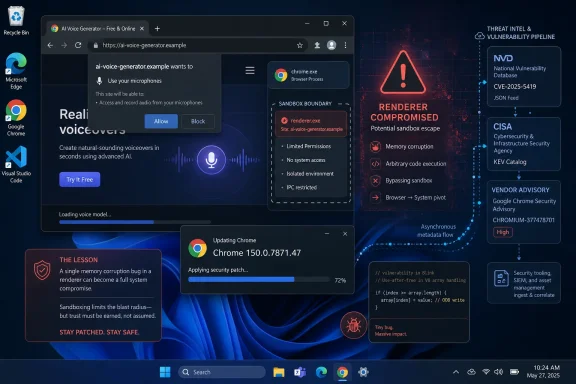
CVE-2026-14150 is not the sort of Chrome vulnerability that should send home users sprinting for the router. It does not read like a remote-code-execution disaster, and Google’s own Chromium severity rating is Low. But it sits in exactly the uncomfortable place where browser security now lives: after an initial foothold, inside a renderer, where a crafted web page can begin manipulating what the user thinks the browser is telling them.
The technical summary is blunt. Chrome’s Speech component failed to sufficiently validate untrusted input, and before version 150.0.7871.47 a remote attacker who had already compromised the renderer process could use a crafted HTML page to perform UI spoofing. NVD’s analysis assigned CVSS 3.1 score 5.4, while CISA’s ADP entry scored it 4.3, reflecting the same broad shape of the problem: network-reachable, low-complexity, no privileges required, but requiring user interaction and producing limited impact.
That mismatch between Google’s Low label and NVD’s Medium score is not a contradiction so much as a difference in lens. Chrome’s internal severity system weighs exploitability in the browser’s architecture and the prerequisite condition that the renderer must already be compromised. CVSS, by design, translates the bug into a standardized risk grammar, where network exposure and integrity impact can push even bounded spoofing into medium territory.
For Windows users, the practical interpretation is simple: this is not the first domino. It is a second-stage or chainable weakness. If an attacker can already compromise the renderer, CVE-2026-14150 may help make a malicious page more convincing by spoofing interface elements or trust cues that users rely on when deciding whether a site, prompt, or browser-mediated interaction is legitimate.
That is why dismissing it as “just spoofing” is too casual. UI spoofing is not glamorous, but it attacks the browser’s social contract. Chrome can sandbox code, isolate sites, and ship memory-safety hardening, but users still make security decisions based on what the browser appears to show them.
That prerequisite is why this CVE should not be treated like a standalone drive-by catastrophe. An ordinary crafted HTML page, by itself, is not described as sufficient. The attacker must first get to a position where the renderer is no longer trustworthy, and only then can the Speech flaw be used to spoof UI.
But this is also where browser security becomes frustratingly non-linear. Attack chains are assembled from bugs that look unimpressive alone. A memory corruption flaw gets execution in a renderer; a sandbox escape expands privileges; a UI spoofing flaw convinces the user to approve something they would otherwise reject. None of those pieces needs to be spectacular on its own to matter in combination.
That is especially relevant in enterprise environments where browsers are identity clients, document viewers, app runtimes, password managers, video-conferencing shells, and increasingly AI front ends. If a browser interface can be made to lie convincingly after compromise, the attacker’s goal may not be persistence on the endpoint. It may be consent.
That expansion creates a paradox. The more useful the browser becomes, the more privileged its interface feels, even when the underlying feature is exposed to web content. Users do not necessarily distinguish between a site’s custom prompt, a browser permission surface, and an operating-system mediated control. Attackers thrive in that ambiguity.
CVE-2026-14150 is described as insufficient validation of untrusted input in Speech, mapped initially to CWE-20, the broad category for improper input validation. That classification is almost boring, which is precisely the point. Some of the most stubborn security problems are not exotic cryptographic failures or cinematic zero-days; they are places where one component trusted input a little too much.
The fact that the Chromium issue tracker entry requires permissions also limits public technical detail. That is normal for newly fixed browser bugs, particularly when researchers and vendors want to reduce copycat exploitation before the update has propagated. It also means defenders should resist filling in the blanks with fantasy exploit narratives. The verified facts are enough: affected Chrome versions before 150.0.7871.47, Speech component, renderer compromise prerequisite, UI spoofing outcome.
That matters because CVE-2026-14150 should not be read as a one-off event. It is one tile in a very large mosaic. Chrome’s security model relies on a constant flow of patching, and the Stable channel is now less a monthly event than an ongoing maintenance stream with major milestones layered over frequent minor updates.
For consumers, Chrome’s automatic update system hides most of that machinery. The browser downloads updates in the background, and users often only notice the small relaunch indicator. For administrators, however, each large Chrome update is a compatibility event: extension behavior can change, managed policies may need review, and line-of-business web apps may reveal assumptions that were never tested against the next milestone.
The uncomfortable bargain is that delaying browser updates is increasingly hard to justify, even when the update itself introduces operational risk. Chrome is too exposed, too capable, and too heavily targeted to let a known fixed version sit unapplied for long. CVE-2026-14150 may be low severity, but the release carrying it is the real security boundary.
The messier part is the change history. The CVE arrived from Chrome on June 30 with an affected product statement, references to the Chrome Releases post and Chromium issue, and a CWE-20 mapping. NIST then added CVSS 3.1 scoring and a Chrome CPE on July 1. CISA’s ADP process later added its own CVSS vector, SSVC decision data, and CWE-20, then removed the CWE entry a few hours later.
This kind of metadata churn is not unusual, but it is dangerous when vulnerability management tools treat every field as equally authoritative at every moment. A scanner that ingests the CVE before CPE enrichment may not flag affected Chrome installations. A dashboard that ingests competing CVSS scores without context may show inconsistent severity. A workflow that keys policy exceptions to CWE fields may see the weakness classification appear and disappear.
That is the dull administrative edge of modern security: the exploit may be theoretical, but the data pipeline is real. If your patching system depends on NVD enrichment, vendor advisories, CISA ADP, OSV mirrors, and commercial vulnerability feeds all agreeing instantly, it is designed around a world that does not exist.
Home users can usually force the update through Chrome’s About page, then relaunch the browser. Enterprises should rely on their normal management stack: Google Update policies, Chrome Browser Cloud Management, Microsoft Intune, Configuration Manager, third-party patch tools, or whatever software distribution pipeline they trust. The critical check is not whether the installer ran, but whether users actually relaunched into the fixed build.
That last step is where browser patching still fails. Chrome can stage updates quietly, but the vulnerable code remains in use until the browser restarts. In organizations that keep web apps open for days, especially on shared workstations, kiosks, contact-center desktops, or developer machines with sprawling sessions, “updated” can mean “downloaded but not active.”
There is also an Edge angle, even though this CVE is filed against Chrome. Microsoft Edge is Chromium-based, and Edge typically receives corresponding Chromium security fixes through its own release train. Administrators should not assume a Chrome CVE automatically maps one-to-one to Edge exposure without checking Microsoft’s release notes, but they should treat Chromium component fixes as a prompt to verify every Chromium-family browser in the estate.
Browsers have spent years training users to look for specific trust signals: the address bar, permission prompts, lock icons, origin labels, file download warnings, sign-in surfaces, and now speech or microphone indicators. The attacker’s job is not always to break encryption or bypass authentication outright. Sometimes it is enough to make the wrong thing look like the right thing at the decisive moment.
That is why a vulnerability like CVE-2026-14150 belongs in the same conversation as phishing-resistant MFA and browser isolation. Technical controls reduce the blast radius of compromise, but user-mediated decisions remain part of the security boundary. When UI can be spoofed after renderer compromise, one layer of that boundary becomes less reliable.
The good news is that the prerequisite keeps this from being a broad phishing template for any website. The bad news is that sophisticated browser exploit chains are already built around sequencing. Attackers who can compromise a renderer are rarely interested in stopping there if another low-friction primitive helps them monetize access.
This is not just academic bookkeeping. Many organizations route vulnerabilities differently based on score bands, and subtle vector differences can change service-level agreements. A 5.4 and a 4.3 are both Medium, but they may be treated differently by prioritization models that combine CVSS with asset exposure, exploit availability, and business criticality.
CISA’s SSVC data is arguably more useful here than the raw score. The ADP entry reportedly marked exploitation as none, automatable as no, and technical impact as partial. In plain English, that means there was no known exploitation signal in that enrichment, the attack was not assessed as readily automatable, and the technical consequences were bounded.
That should push teams toward measured urgency rather than panic. Patch through the normal accelerated browser channel. Confirm version compliance. Watch for vendor follow-up. Do not burn an emergency incident bridge for a low-severity Chrome UI spoofing bug unless your environment has a specific exposure or active exploitation indicator.
For WindowsForum.com readers, the operational reality is that Chrome, Edge, Brave, Vivaldi, Opera, and other Chromium-derived browsers sit on a fast-moving substrate. Some vendors pull fixes quickly; others lag. Some enterprise channels trade feature stability for slower major updates, but still need critical security fixes. Some unmanaged endpoints simply depend on users clicking Relaunch.
That is where CVE-2026-14150 becomes a useful test case. If your inventory can tell you which machines are running Chrome before 150.0.7871.47, you are in decent shape. If it can tell you whether the fixed binary is installed but not yet active because the browser has not restarted, you are in better shape. If it can also tell you which other Chromium-based browsers remain on vulnerable engine versions, you are doing the work most organizations only claim to do.
The browser is now part of endpoint security posture in the same way the OS build is. Treating it as a user app is an anachronism. A stale browser is not just an old application; it is an exposed execution environment with privileged access to identity, files, microphones, cameras, enterprise SaaS, and user trust.
CVE-2026-14150 is not the sort of Chrome vulnerability that should send home users sprinting for the router. It does not read like a remote-code-execution disaster, and Google’s own Chromium severity rating is Low. But it sits in exactly the uncomfortable place where browser security now lives: after an initial foothold, inside a renderer, where a crafted web page can begin manipulating what the user thinks the browser is telling them.
 A Low-Severity Bug With Medium-Severity Implications
The technical summary is blunt. Chrome’s Speech component failed to sufficiently validate untrusted input, and before version 150.0.7871.47 a remote attacker who had already compromised the renderer process could use a crafted HTML page to perform UI spoofing. NVD’s analysis assigned CVSS 3.1 score 5.4, while CISA’s ADP entry scored it 4.3, reflecting the same broad shape of the problem: network-reachable, low-complexity, no privileges required, but requiring user interaction and producing limited impact.That mismatch between Google’s Low label and NVD’s Medium score is not a contradiction so much as a difference in lens. Chrome’s internal severity system weighs exploitability in the browser’s architecture and the prerequisite condition that the renderer must already be compromised. CVSS, by design, translates the bug into a standardized risk grammar, where network exposure and integrity impact can push even bounded spoofing into medium territory.
For Windows users, the practical interpretation is simple: this is not the first domino. It is a second-stage or chainable weakness. If an attacker can already compromise the renderer, CVE-2026-14150 may help make a malicious page more convincing by spoofing interface elements or trust cues that users rely on when deciding whether a site, prompt, or browser-mediated interaction is legitimate.
That is why dismissing it as “just spoofing” is too casual. UI spoofing is not glamorous, but it attacks the browser’s social contract. Chrome can sandbox code, isolate sites, and ship memory-safety hardening, but users still make security decisions based on what the browser appears to show them.
The Renderer Prerequisite Is the Whole Story
The phrase “who had compromised the renderer process” does a lot of work here. Chrome’s renderer process is where web content is parsed and executed; it is deliberately constrained because the modern web is hostile by default. A bug that requires renderer compromise usually assumes another vulnerability, a malicious extension-like condition, or an exploit chain that has already broken part of Chrome’s defense model.That prerequisite is why this CVE should not be treated like a standalone drive-by catastrophe. An ordinary crafted HTML page, by itself, is not described as sufficient. The attacker must first get to a position where the renderer is no longer trustworthy, and only then can the Speech flaw be used to spoof UI.
But this is also where browser security becomes frustratingly non-linear. Attack chains are assembled from bugs that look unimpressive alone. A memory corruption flaw gets execution in a renderer; a sandbox escape expands privileges; a UI spoofing flaw convinces the user to approve something they would otherwise reject. None of those pieces needs to be spectacular on its own to matter in combination.
That is especially relevant in enterprise environments where browsers are identity clients, document viewers, app runtimes, password managers, video-conferencing shells, and increasingly AI front ends. If a browser interface can be made to lie convincingly after compromise, the attacker’s goal may not be persistence on the endpoint. It may be consent.
Speech Is No Longer a Peripheral Feature
The affected component matters because Speech is not some decorative corner of the browser anymore. Speech recognition, dictation, accessibility workflows, live captions, web apps with microphone input, and voice-adjacent browser features all sit closer to ordinary user workflows than they did a decade ago. The web platform has steadily absorbed capabilities that used to belong to native applications.That expansion creates a paradox. The more useful the browser becomes, the more privileged its interface feels, even when the underlying feature is exposed to web content. Users do not necessarily distinguish between a site’s custom prompt, a browser permission surface, and an operating-system mediated control. Attackers thrive in that ambiguity.
CVE-2026-14150 is described as insufficient validation of untrusted input in Speech, mapped initially to CWE-20, the broad category for improper input validation. That classification is almost boring, which is precisely the point. Some of the most stubborn security problems are not exotic cryptographic failures or cinematic zero-days; they are places where one component trusted input a little too much.
The fact that the Chromium issue tracker entry requires permissions also limits public technical detail. That is normal for newly fixed browser bugs, particularly when researchers and vendors want to reduce copycat exploitation before the update has propagated. It also means defenders should resist filling in the blanks with fantasy exploit narratives. The verified facts are enough: affected Chrome versions before 150.0.7871.47, Speech component, renderer compromise prerequisite, UI spoofing outcome.
Chrome 150 Was a Large Security Train, Not a Single Patch
Google’s June 30 Stable Channel Update promoted Chrome 150 to stable on desktop, with 150.0.7871.46 for Linux and 150.0.7871.46/.47 for Windows and Mac. The Chrome Releases blog said the update contained numerous fixes and improvements, and third-party coverage from Born’s IT and Windows Blog and PCWorld characterized the release as addressing hundreds of security issues.That matters because CVE-2026-14150 should not be read as a one-off event. It is one tile in a very large mosaic. Chrome’s security model relies on a constant flow of patching, and the Stable channel is now less a monthly event than an ongoing maintenance stream with major milestones layered over frequent minor updates.
For consumers, Chrome’s automatic update system hides most of that machinery. The browser downloads updates in the background, and users often only notice the small relaunch indicator. For administrators, however, each large Chrome update is a compatibility event: extension behavior can change, managed policies may need review, and line-of-business web apps may reveal assumptions that were never tested against the next milestone.
The uncomfortable bargain is that delaying browser updates is increasingly hard to justify, even when the update itself introduces operational risk. Chrome is too exposed, too capable, and too heavily targeted to let a known fixed version sit unapplied for long. CVE-2026-14150 may be low severity, but the release carrying it is the real security boundary.
The CPE Confusion Is a Symptom of Vulnerability Data Lag
The user-facing NVD page includes the familiar line: “Are we missing a CPE here? Please let us know.” In this case, the change history says NIST added a CPE configuration for Google Chrome versions up to, but excluding, 150.0.7871.47 during initial analysis on July 1. So the short answer is: no, the record does not appear to be missing the core Chrome CPE after enrichment; the page language is part of the NVD interface and may lag or appear while configurations are loading.The messier part is the change history. The CVE arrived from Chrome on June 30 with an affected product statement, references to the Chrome Releases post and Chromium issue, and a CWE-20 mapping. NIST then added CVSS 3.1 scoring and a Chrome CPE on July 1. CISA’s ADP process later added its own CVSS vector, SSVC decision data, and CWE-20, then removed the CWE entry a few hours later.
This kind of metadata churn is not unusual, but it is dangerous when vulnerability management tools treat every field as equally authoritative at every moment. A scanner that ingests the CVE before CPE enrichment may not flag affected Chrome installations. A dashboard that ingests competing CVSS scores without context may show inconsistent severity. A workflow that keys policy exceptions to CWE fields may see the weakness classification appear and disappear.
That is the dull administrative edge of modern security: the exploit may be theoretical, but the data pipeline is real. If your patching system depends on NVD enrichment, vendor advisories, CISA ADP, OSV mirrors, and commercial vulnerability feeds all agreeing instantly, it is designed around a world that does not exist.
Windows Administrators Should Patch the Browser, Not Debate the Score
On Windows endpoints, the correct operational move is to get Chrome to 150.0.7871.47 or later. The version distinction matters because Google’s desktop release notes list 150.0.7871.46/.47 for Windows and Mac, while the CVE record names versions prior to 150.0.7871.47 as affected. In a managed fleet, administrators should verify the installed build rather than assuming “Chrome 150” is sufficient.Home users can usually force the update through Chrome’s About page, then relaunch the browser. Enterprises should rely on their normal management stack: Google Update policies, Chrome Browser Cloud Management, Microsoft Intune, Configuration Manager, third-party patch tools, or whatever software distribution pipeline they trust. The critical check is not whether the installer ran, but whether users actually relaunched into the fixed build.
That last step is where browser patching still fails. Chrome can stage updates quietly, but the vulnerable code remains in use until the browser restarts. In organizations that keep web apps open for days, especially on shared workstations, kiosks, contact-center desktops, or developer machines with sprawling sessions, “updated” can mean “downloaded but not active.”
There is also an Edge angle, even though this CVE is filed against Chrome. Microsoft Edge is Chromium-based, and Edge typically receives corresponding Chromium security fixes through its own release train. Administrators should not assume a Chrome CVE automatically maps one-to-one to Edge exposure without checking Microsoft’s release notes, but they should treat Chromium component fixes as a prompt to verify every Chromium-family browser in the estate.
UI Spoofing Attacks Aim at Trust, Not Code Execution
The term UI spoofing can sound minor because it lacks the visceral punch of remote code execution. But spoofing attacks target a different layer: the user’s interpretation of what is safe, official, or browser-controlled. If a compromised renderer can make a web page appear to present trustworthy UI, the attacker may be able to guide the user into revealing information, granting permissions, or ignoring warning signs.Browsers have spent years training users to look for specific trust signals: the address bar, permission prompts, lock icons, origin labels, file download warnings, sign-in surfaces, and now speech or microphone indicators. The attacker’s job is not always to break encryption or bypass authentication outright. Sometimes it is enough to make the wrong thing look like the right thing at the decisive moment.
That is why a vulnerability like CVE-2026-14150 belongs in the same conversation as phishing-resistant MFA and browser isolation. Technical controls reduce the blast radius of compromise, but user-mediated decisions remain part of the security boundary. When UI can be spoofed after renderer compromise, one layer of that boundary becomes less reliable.
The good news is that the prerequisite keeps this from being a broad phishing template for any website. The bad news is that sophisticated browser exploit chains are already built around sequencing. Attackers who can compromise a renderer are rarely interested in stopping there if another low-friction primitive helps them monetize access.
The CVSS Split Shows Why Security Teams Need Context
NVD scored CVE-2026-14150 as 5.4 Medium with confidentiality and integrity impact marked Low. CISA ADP scored it 4.3 Medium with integrity impact only. That difference likely reflects how each analyst interpreted the practical consequence of UI spoofing. Does a spoofed interface create some confidentiality exposure because a user might be tricked into revealing data, or is the direct technical impact limited to integrity?This is not just academic bookkeeping. Many organizations route vulnerabilities differently based on score bands, and subtle vector differences can change service-level agreements. A 5.4 and a 4.3 are both Medium, but they may be treated differently by prioritization models that combine CVSS with asset exposure, exploit availability, and business criticality.
CISA’s SSVC data is arguably more useful here than the raw score. The ADP entry reportedly marked exploitation as none, automatable as no, and technical impact as partial. In plain English, that means there was no known exploitation signal in that enrichment, the attack was not assessed as readily automatable, and the technical consequences were bounded.
That should push teams toward measured urgency rather than panic. Patch through the normal accelerated browser channel. Confirm version compliance. Watch for vendor follow-up. Do not burn an emergency incident bridge for a low-severity Chrome UI spoofing bug unless your environment has a specific exposure or active exploitation indicator.
The Real Risk Is Falling Behind the Chromium Release Conveyor Belt
Chrome’s scale creates a strange emotional fatigue. Hundreds of fixes in a single release can make individual CVEs feel meaningless, while individual CVEs can distract from the larger truth that the browser is a continuously patched operating environment. Both reactions are wrong.For WindowsForum.com readers, the operational reality is that Chrome, Edge, Brave, Vivaldi, Opera, and other Chromium-derived browsers sit on a fast-moving substrate. Some vendors pull fixes quickly; others lag. Some enterprise channels trade feature stability for slower major updates, but still need critical security fixes. Some unmanaged endpoints simply depend on users clicking Relaunch.
That is where CVE-2026-14150 becomes a useful test case. If your inventory can tell you which machines are running Chrome before 150.0.7871.47, you are in decent shape. If it can tell you whether the fixed binary is installed but not yet active because the browser has not restarted, you are in better shape. If it can also tell you which other Chromium-based browsers remain on vulnerable engine versions, you are doing the work most organizations only claim to do.
The browser is now part of endpoint security posture in the same way the OS build is. Treating it as a user app is an anachronism. A stale browser is not just an old application; it is an exposed execution environment with privileged access to identity, files, microphones, cameras, enterprise SaaS, and user trust.
The Small Chrome Speech Bug Tells Admins Where to Look Next
CVE-2026-14150 will probably not be remembered as a major Chrome security event. Its value is diagnostic: it shows how a modest component flaw, a large patch release, and shifting vulnerability metadata can create practical risk if organizations do not have disciplined browser management. The concrete lessons are narrow, but they travel well.- Chrome installations before 150.0.7871.47 should be treated as affected by CVE-2026-14150 and updated to the fixed release or later.
- The flaw requires renderer compromise first, so it is best understood as a chainable UI-spoofing primitive rather than a standalone drive-by exploit.
- NVD’s Chrome CPE was added during July 1 enrichment, so scanners that ingested the record early may need refreshed vulnerability data.
- Google rated the Chromium issue Low, while NVD and CISA ADP scored it Medium, making local prioritization more important than severity-label absolutism.
- Managed Windows environments should verify the active browser version after relaunch, not merely confirm that an update package was downloaded or staged.
- Chromium-based browsers other than Google Chrome should be checked against their vendors’ release notes because shared engine fixes do not always land everywhere at the same moment.
References
- Primary source: NVD / Chromium
Published: 2026-07-03T07:00:20-07:00
NVD - CVE-2026-14150
 nvd.nist.gov
- Security advisory: MSRC
Published: 2026-07-03T07:00:20-07:00
Original feed URL
Security Update Guide - Microsoft Security Response Center
 msrc.microsoft.com
- Related coverage: cvefeed.io
CVE-2026-14150 - Google Chrome UI Spoofing
Insufficient validation of untrusted input in Speech in Google Chrome prior to 150.0.7871.47 allowed a remote attacker who had compromised the renderer process to perform UI spoofing via a crafted HTML page. (Chromium security severity: Low)cvefeed.io