

Google Chrome before version 150.0.7871.47 contained CVE-2026-14109, a Mojo policy-enforcement flaw disclosed on June 30, 2026, that could let an attacker escape the browser sandbox after first compromising a renderer process with a crafted HTML page. The awkward part is not that Chrome had another sandbox-adjacent bug; that is practically a standing condition of modern browser engineering. The awkward part is the mismatch between labels: Chromium called the issue “Low,” while NVD and CISA-ADP assigned it a 9.6 Critical CVSS 3.1 score. For Windows users and administrators, that gap is the real story, because it exposes how browser risk is now less about a single scary CVE name and more about how quickly patch pipelines, browser forks, and enterprise controls converge on the fixed Chromium baseline.
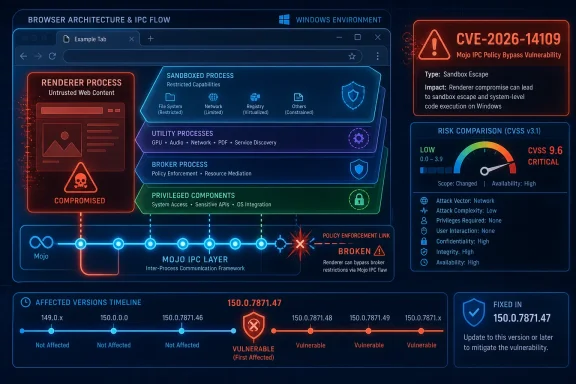
CVE-2026-14109 sits in Mojo, Chromium’s inter-process communication framework. Mojo is one of the pieces that lets Chrome’s many processes talk to each other without collapsing the entire security model into a single privileged blob. That architecture is why Chrome can contain so much hostile web content in the first place.
The bug description is concise but loaded: insufficient policy enforcement in Mojo allowed a remote attacker who had already compromised the renderer process to potentially perform a sandbox escape through a crafted HTML page. That phrase “already compromised the renderer” is doing a lot of work. It means CVE-2026-14109 is not, by itself, the opening move in an attack chain.
That is almost certainly why Chromium’s own severity label is Low. In Chrome’s internal security taxonomy, a bug that requires a prior renderer compromise may be less severe than a memory corruption flaw that grants renderer execution directly from ordinary browsing. But in operational security, a sandbox escape is rarely treated as background noise.
NVD’s enrichment, posted after the CVE was received from Chrome, gives the vulnerability a CVSS 3.1 base score of 9.6 Critical, with network attack vector, low attack complexity, no privileges required, user interaction required, changed scope, and high confidentiality, integrity, and availability impact. CISA-ADP attached the same 9.6 score and marked exploitation as “none,” automatable as “no,” and technical impact as “total.”
That split is not necessarily a contradiction. It is a collision between two scoring cultures. Chromium is judging the bug in the context of Chrome’s layered exploit model; CVSS is modeling what happens if the preconditions line up and the sandbox boundary falls.
The sandbox is the second wall. If a malicious page triggers code execution inside a renderer, the attacker should still be trapped in a constrained process with limited access to the file system, operating system APIs, devices, credentials, and other browser internals. A sandbox escape is the step that turns “bad tab” into “bad day.”
Mojo is part of the machinery that keeps that second wall from becoming ceremonial. It governs communication between sandboxed and more privileged processes. If policy enforcement around those communication paths is wrong, the renderer may be able to ask for something it should never receive, invoke an interface it should never reach, or cross a trust boundary that exists precisely because the renderer is not trusted.
That is why a Mojo policy bug deserves attention even when it is not known to be exploited. Modern browser compromises are often chains, not single vulnerabilities. One flaw gets code execution in a renderer; another flaw escapes the sandbox; a third may escalate privileges or persist. CVE-2026-14109 appears to occupy the second role in that chain.
Google’s Chrome Releases blog tied the fix to the Stable Channel update for desktop, moving Windows and Mac to the 150.0.7871.46/.47 line and Linux to 150.0.7871.46. Third-party vulnerability databases and security vendors subsequently repeated the key affected-version boundary: Chrome before 150.0.7871.47 is affected.
For WindowsForum readers, the version number is not trivia. It is the dividing line between “known bad” and “patched enough for this CVE,” at least for Google Chrome itself.
User interaction in a browser context often means visiting a page, clicking a link, opening a malicious HTML document, or being routed through compromised web content. That is not the same as needing local access, credentials, or a complex social engineering sequence. Browsers are built to interact with untrusted remote content all day.
The prior renderer compromise requirement is more meaningful. It says CVE-2026-14109 is not the bug that initially pierces Chrome’s rendering engine. But Chrome’s monthly and emergency update history makes clear that renderer-class vulnerabilities are not rare enough to treat as exotic. Attackers who can pair a renderer bug with a sandbox escape get the kind of chain defenders fear most.
This is also why CVSS can look alarmist next to Chromium’s Low. CVSS does not always express exploit choreography elegantly. Once the scenario includes a compromised renderer, a sandbox escape with high impact across confidentiality, integrity, and availability deserves a severe score. Chromium, meanwhile, is likely reflecting the dependency on another vulnerability.
The right operational interpretation is somewhere between panic and dismissal. CVE-2026-14109 is not described by Google or NVD as exploited in the wild. CISA-ADP’s SSVC data says exploitation is “none.” But it is also a sandbox escape class issue in the world’s dominant browser engine, patched in a release that administrators should not defer casually.
Security teams should read this as a chaining risk. If another renderer vulnerability emerges, especially one being exploited in the wild, any unpatched Mojo escape in the fleet becomes more valuable. The time to close that door is before the chain is assembled.
The harder question is what happens outside Google Chrome. Microsoft Edge, Brave, Vivaldi, Opera, and a long list of embedded browsers and Electron applications depend on Chromium code, but they do not all ship Google’s Chrome build on Google’s schedule. A fix landing in Chrome Stable is the start of the downstream race, not the end of it.
This is where Windows administrators have learned to be suspicious of the word “Chromium.” It describes a shared engine and codebase, not a synchronized update guarantee. Microsoft Edge usually tracks Chromium closely, but the meaningful question is always the deployed browser’s actual version and whether the vendor has incorporated the relevant upstream fix.
Electron complicates the picture further. Many Windows desktop applications package Chromium under the hood, often invisibly to users and sometimes sluggishly to enterprises. A browser CVE may therefore matter beyond the browser icon pinned to the taskbar. The vulnerable code path may live inside collaboration tools, management consoles, password managers, or line-of-business applications.
That does not mean every Chromium-based application is automatically exploitable by this CVE. Exposure depends on whether the relevant Mojo code and policies are present, reachable, and compiled in the same way. But it does mean inventory matters. Browser patching is no longer limited to browsers.
For CVE-2026-14109, NVD’s initial analysis added a CPE configuration for Google Chrome versions up to, but excluding, 150.0.7871.47. That is useful for direct Chrome detection. It is less useful for every downstream Chromium consumer, especially products that do not identify themselves as Google Chrome in standard software inventory.
This is the recurring problem with browser-engine CVEs. The public CVE may name Chrome because Chrome is the assigning source and the first fixed product, while the affected code may exist in Chromium and therefore in other products. Vulnerability databases can lag behind that reality, and scanners can miss software whose bundled Chromium is not represented cleanly in CPE form.
Admins should not overread the CPE prompt as proof that a particular product is missing from the affected list. It is a signal to validate, not to speculate. The responsible move is to check vendor advisories for Chromium-based browsers and apps, especially where those products expose web content from untrusted sources.
The broader lesson is uncomfortable: CPE is a useful indexing system, not an oracle. For high-value environments, browser-engine risk needs asset intelligence that understands bundled runtimes, not just installed application names.
Edge is the obvious checkpoint. Enterprises should verify the Microsoft Edge Stable version once Microsoft ships its corresponding Chromium update, rather than assuming Chrome’s version number applies directly. Edge uses its own versioning and release notes, and Microsoft’s update cadence may not mirror Google’s release exactly.
WebView2 is the subtler checkpoint. The Evergreen WebView2 Runtime updates independently and is designed to keep embedded Chromium current, but managed environments can still interfere with update flow through policy, packaging, offline servicing, or frozen base images. If an app depends on a fixed WebView2 runtime or bundles a Chromium runtime of its own, the update story becomes even less automatic.
This is why browser security has become part of Windows application governance. The traditional patch Tuesday mindset does not fit a world where the most attacked client-side component may update several times between Microsoft’s monthly OS releases. Browser engines are now infrastructure, and infrastructure needs ownership.
For sysadmins, the practical question is not “Do we use Chrome?” It is “Where does Chromium execute untrusted content in our environment?” That includes default browsers, secondary browsers, kiosk systems, helpdesk tools, chat clients, document viewers, embedded admin consoles, and third-party apps with web panels.
CVE-2026-14109 is a useful reminder that the browser boundary is not a neat rectangle around the browser window. On modern Windows desktops, web rendering is a platform service wearing many disguises.
Browser vendors live inside exploit chains. They know that a sandbox escape requiring renderer compromise is different from a one-click remote code execution bug that starts and finishes the compromise path. Their severity labels often reflect bug bounty economics, exploit preconditions, and internal architectural assumptions.
Enterprise vulnerability programs live in a different world. They need sortable risk queues, service-level agreements, dashboards, and defensible prioritization. A potential sandbox escape from remote web content, even with user interaction and a renderer precondition, naturally bubbles toward the top when scored under CVSS.
The result is a translation problem. “Low” can sound safe to a product team because it means “not directly exploitable without another bug.” “Critical” can sound correct to a SOC because it means “if paired, this breaks a major isolation boundary with total technical impact.” Neither label alone tells the whole story.
The better practice is to describe the exploit role. CVE-2026-14109 is a sandbox escape candidate, not an initial renderer compromise. It is not reported as exploited in the wild. It is fixed in Chrome 150.0.7871.47 and should be remediated promptly because sandbox escapes are high-value chain components.
That sentence is more useful than either severity label by itself.
The bad news is that “updated” is often a state people assume rather than verify. Chrome can download an update and wait for a browser restart. Users can keep sessions alive for days. Virtual desktop images can revert. Kiosk systems can be pinned. Security appliances can detect a vulnerable version long after administrators believe the issue is gone.
For CVE-2026-14109, the minimum operational task is to confirm that deployed Chrome instances are at 150.0.7871.47 or later where that build applies. The better task is to confirm that update policy allows urgent browser releases to move quickly, that restart prompts are not ignored indefinitely, and that browser version telemetry is visible to the team responsible for endpoint risk.
On Windows, this should include both user-installed Chrome and machine-wide Chrome installations. It should also include Edge once Microsoft’s corresponding Chromium-based fixes are available, plus any managed Chromium forks used for compatibility or application isolation.
There is a temptation to treat browser patching as a solved consumer problem. In enterprise fleets, it is still a governance problem. Auto-update is a mechanism, not an assurance.
But attackers do not exploit spreadsheets. They exploit combinations. They look for a renderer entry point, a sandbox escape, a privilege escalation, a credential theft path, and a persistence mechanism. Browser security has evolved into a contest over how many links can be made expensive, unreliable, or impossible.
A Mojo policy-enforcement flaw belongs in that chain-aware model. It is about the boundary between the dangerous content parser and the more trusted browser or system environment. If that boundary can be crossed after renderer compromise, then the renderer sandbox is weaker than defenders assumed.
This is especially relevant because Chrome’s sandbox is one of the main reasons users can survive the modern web. The renderer is the blast chamber. Mojo is part of the controlled plumbing. A policy mistake in that plumbing may not start the explosion, but it can route the pressure somewhere it was never supposed to go.
That is the kind of bug defenders should patch quickly even when exploit telemetry is quiet. Waiting for active exploitation before fixing a chain component is a strategy that benefits the people assembling the chain.
This can create alert fatigue. If every Chrome release contains dozens or hundreds of security changes, users and administrators stop reading individual CVE blurbs. The update becomes background weather.
That is understandable, but it is dangerous. The volume of fixes does not mean the individual bugs are unimportant; it means the attack surface is vast, heavily scrutinized, and constantly changing. Browsers now absorb the complexity that once belonged to operating systems, media frameworks, PDF readers, plugin runtimes, and application platforms.
The right response is not to hand-curate every Chrome CVE with equal drama. It is to build a process that treats browser updates as urgent infrastructure maintenance, then escalates particular bug classes when they appear. Sandbox escapes, type confusion in JavaScript engines, use-after-free flaws in exposed components, and GPU or media parsing bugs deserve more attention than their place in a long release note may suggest.
CVE-2026-14109 falls into that elevated-interest category because of what it could enable in an exploit chain. It is not the loudest bug in the release. It may still be one of the more strategically useful ones.
For home users, opening Chrome’s About page and allowing the browser to update and relaunch is enough. For managed environments, the work is broader but still familiar: inventory, policy validation, rollout monitoring, and exception cleanup.
The most important distinction is between patched software and patched exposure. A laptop with updated Chrome but an outdated Chromium-based remote support tool still has a browser-engine problem. A VDI image updated after login but reverted at shutdown still has a persistence-of-patching problem. A kiosk with blocked relaunches still has a remediation problem.
Security teams should also watch for vendor advisories from Chromium-based browser makers and application vendors. The Chrome CVE is the starting signal. Downstream confirmation is how administrators know whether their particular software stack has absorbed the fix.
None of this requires panic. It requires not letting a “Low” label talk the organization into inaction.
The public record is still limited. NVD’s entry describes the vulnerability and its scoring. Google’s release note identifies the fixed Chrome line. CISA-ADP adds decision-support data indicating no known exploitation at the time of enrichment. The restricted Chromium issue tracker entry means the deepest technical details are not yet available to the public.
That absence of detail should not be mistaken for absence of risk. Browser vendors frequently restrict bug details until users have had time to patch. That is responsible disclosure hygiene, not evidence that the bug is irrelevant.
For WindowsForum’s audience, the practical consequence is clear: treat Chrome 150.0.7871.47 as the important floor for Google Chrome on Windows and Mac, then verify the status of every Chromium-derived browser and runtime in the environment. The real failure mode is not misunderstanding Mojo. It is assuming the only copy of Chromium on a Windows system is the one with the Chrome icon.
 A “Low” Chrome Bug Becomes a Critical Patch Management Problem
CVE-2026-14109 sits in Mojo, Chromium’s inter-process communication framework. Mojo is one of the pieces that lets Chrome’s many processes talk to each other without collapsing the entire security model into a single privileged blob. That architecture is why Chrome can contain so much hostile web content in the first place.The bug description is concise but loaded: insufficient policy enforcement in Mojo allowed a remote attacker who had already compromised the renderer process to potentially perform a sandbox escape through a crafted HTML page. That phrase “already compromised the renderer” is doing a lot of work. It means CVE-2026-14109 is not, by itself, the opening move in an attack chain.
That is almost certainly why Chromium’s own severity label is Low. In Chrome’s internal security taxonomy, a bug that requires a prior renderer compromise may be less severe than a memory corruption flaw that grants renderer execution directly from ordinary browsing. But in operational security, a sandbox escape is rarely treated as background noise.
NVD’s enrichment, posted after the CVE was received from Chrome, gives the vulnerability a CVSS 3.1 base score of 9.6 Critical, with network attack vector, low attack complexity, no privileges required, user interaction required, changed scope, and high confidentiality, integrity, and availability impact. CISA-ADP attached the same 9.6 score and marked exploitation as “none,” automatable as “no,” and technical impact as “total.”
That split is not necessarily a contradiction. It is a collision between two scoring cultures. Chromium is judging the bug in the context of Chrome’s layered exploit model; CVSS is modeling what happens if the preconditions line up and the sandbox boundary falls.
Mojo Is Where Chrome’s Security Model Gets Very Real
To understand why this matters, it helps to remember what the Chrome sandbox is supposed to do. Chrome’s renderer processes handle complex, attacker-controlled content: HTML, CSS, JavaScript, fonts, images, media, WebAssembly, and more. Because that surface is enormous, the browser assumes renderer bugs will happen.The sandbox is the second wall. If a malicious page triggers code execution inside a renderer, the attacker should still be trapped in a constrained process with limited access to the file system, operating system APIs, devices, credentials, and other browser internals. A sandbox escape is the step that turns “bad tab” into “bad day.”
Mojo is part of the machinery that keeps that second wall from becoming ceremonial. It governs communication between sandboxed and more privileged processes. If policy enforcement around those communication paths is wrong, the renderer may be able to ask for something it should never receive, invoke an interface it should never reach, or cross a trust boundary that exists precisely because the renderer is not trusted.
That is why a Mojo policy bug deserves attention even when it is not known to be exploited. Modern browser compromises are often chains, not single vulnerabilities. One flaw gets code execution in a renderer; another flaw escapes the sandbox; a third may escalate privileges or persist. CVE-2026-14109 appears to occupy the second role in that chain.
Google’s Chrome Releases blog tied the fix to the Stable Channel update for desktop, moving Windows and Mac to the 150.0.7871.46/.47 line and Linux to 150.0.7871.46. Third-party vulnerability databases and security vendors subsequently repeated the key affected-version boundary: Chrome before 150.0.7871.47 is affected.
For WindowsForum readers, the version number is not trivia. It is the dividing line between “known bad” and “patched enough for this CVE,” at least for Google Chrome itself.
The Renderer Compromise Requirement Is a Condition, Not a Comfort Blanket
Security advisories often contain phrases that invite underreaction. “Requires user interaction” is one. “Attacker must first compromise the renderer process” is another. Both are true here in the scoring language, and neither should make administrators shrug.User interaction in a browser context often means visiting a page, clicking a link, opening a malicious HTML document, or being routed through compromised web content. That is not the same as needing local access, credentials, or a complex social engineering sequence. Browsers are built to interact with untrusted remote content all day.
The prior renderer compromise requirement is more meaningful. It says CVE-2026-14109 is not the bug that initially pierces Chrome’s rendering engine. But Chrome’s monthly and emergency update history makes clear that renderer-class vulnerabilities are not rare enough to treat as exotic. Attackers who can pair a renderer bug with a sandbox escape get the kind of chain defenders fear most.
This is also why CVSS can look alarmist next to Chromium’s Low. CVSS does not always express exploit choreography elegantly. Once the scenario includes a compromised renderer, a sandbox escape with high impact across confidentiality, integrity, and availability deserves a severe score. Chromium, meanwhile, is likely reflecting the dependency on another vulnerability.
The right operational interpretation is somewhere between panic and dismissal. CVE-2026-14109 is not described by Google or NVD as exploited in the wild. CISA-ADP’s SSVC data says exploitation is “none.” But it is also a sandbox escape class issue in the world’s dominant browser engine, patched in a release that administrators should not defer casually.
Security teams should read this as a chaining risk. If another renderer vulnerability emerges, especially one being exploited in the wild, any unpatched Mojo escape in the fleet becomes more valuable. The time to close that door is before the chain is assembled.
The Version Boundary Is Simple; the Chromium Ecosystem Is Not
For standalone Google Chrome, the remediation path is boring by design: update to 150.0.7871.47 or later on Windows and Mac, or the corresponding fixed 150.0.7871.46 line on Linux as indicated by Google’s desktop Stable Channel update. On managed Windows systems, that usually means checking browser version inventory, update policy health, and whether Chrome has actually relaunched after staging the update.The harder question is what happens outside Google Chrome. Microsoft Edge, Brave, Vivaldi, Opera, and a long list of embedded browsers and Electron applications depend on Chromium code, but they do not all ship Google’s Chrome build on Google’s schedule. A fix landing in Chrome Stable is the start of the downstream race, not the end of it.
This is where Windows administrators have learned to be suspicious of the word “Chromium.” It describes a shared engine and codebase, not a synchronized update guarantee. Microsoft Edge usually tracks Chromium closely, but the meaningful question is always the deployed browser’s actual version and whether the vendor has incorporated the relevant upstream fix.
Electron complicates the picture further. Many Windows desktop applications package Chromium under the hood, often invisibly to users and sometimes sluggishly to enterprises. A browser CVE may therefore matter beyond the browser icon pinned to the taskbar. The vulnerable code path may live inside collaboration tools, management consoles, password managers, or line-of-business applications.
That does not mean every Chromium-based application is automatically exploitable by this CVE. Exposure depends on whether the relevant Mojo code and policies are present, reachable, and compiled in the same way. But it does mean inventory matters. Browser patching is no longer limited to browsers.
The NVD CPE Note Is Not Just Bureaucratic Noise
The NVD entry’s “Are we missing a CPE here?” prompt may look like a footnote, but it points at a real weakness in vulnerability management. CPE matching is how many scanners, dashboards, and compliance workflows map a CVE to installed software. If the CPE data is incomplete, delayed, or too narrow, organizations can get a false sense of closure.For CVE-2026-14109, NVD’s initial analysis added a CPE configuration for Google Chrome versions up to, but excluding, 150.0.7871.47. That is useful for direct Chrome detection. It is less useful for every downstream Chromium consumer, especially products that do not identify themselves as Google Chrome in standard software inventory.
This is the recurring problem with browser-engine CVEs. The public CVE may name Chrome because Chrome is the assigning source and the first fixed product, while the affected code may exist in Chromium and therefore in other products. Vulnerability databases can lag behind that reality, and scanners can miss software whose bundled Chromium is not represented cleanly in CPE form.
Admins should not overread the CPE prompt as proof that a particular product is missing from the affected list. It is a signal to validate, not to speculate. The responsible move is to check vendor advisories for Chromium-based browsers and apps, especially where those products expose web content from untrusted sources.
The broader lesson is uncomfortable: CPE is a useful indexing system, not an oracle. For high-value environments, browser-engine risk needs asset intelligence that understands bundled runtimes, not just installed application names.
Microsoft Shops Should Watch Edge, WebView2, and the Invisible Browser Layer
Windows environments have a special relationship with Chromium because Microsoft Edge is Chromium-based and WebView2 has become a standard way to embed web content in Windows applications. That means the operational blast radius of a Chromium issue can extend into places that do not look like a traditional browser session.Edge is the obvious checkpoint. Enterprises should verify the Microsoft Edge Stable version once Microsoft ships its corresponding Chromium update, rather than assuming Chrome’s version number applies directly. Edge uses its own versioning and release notes, and Microsoft’s update cadence may not mirror Google’s release exactly.
WebView2 is the subtler checkpoint. The Evergreen WebView2 Runtime updates independently and is designed to keep embedded Chromium current, but managed environments can still interfere with update flow through policy, packaging, offline servicing, or frozen base images. If an app depends on a fixed WebView2 runtime or bundles a Chromium runtime of its own, the update story becomes even less automatic.
This is why browser security has become part of Windows application governance. The traditional patch Tuesday mindset does not fit a world where the most attacked client-side component may update several times between Microsoft’s monthly OS releases. Browser engines are now infrastructure, and infrastructure needs ownership.
For sysadmins, the practical question is not “Do we use Chrome?” It is “Where does Chromium execute untrusted content in our environment?” That includes default browsers, secondary browsers, kiosk systems, helpdesk tools, chat clients, document viewers, embedded admin consoles, and third-party apps with web panels.
CVE-2026-14109 is a useful reminder that the browser boundary is not a neat rectangle around the browser window. On modern Windows desktops, web rendering is a platform service wearing many disguises.
The Severity Split Reveals a Broken Conversation About Browser Risk
The Chromium Low versus CVSS Critical divide will be tempting fodder for scorekeeping. Vendors underrate their bugs, critics will say. CVSS exaggerates chain-dependent vulnerabilities, defenders will reply. Both arguments contain some truth and miss the more useful point.Browser vendors live inside exploit chains. They know that a sandbox escape requiring renderer compromise is different from a one-click remote code execution bug that starts and finishes the compromise path. Their severity labels often reflect bug bounty economics, exploit preconditions, and internal architectural assumptions.
Enterprise vulnerability programs live in a different world. They need sortable risk queues, service-level agreements, dashboards, and defensible prioritization. A potential sandbox escape from remote web content, even with user interaction and a renderer precondition, naturally bubbles toward the top when scored under CVSS.
The result is a translation problem. “Low” can sound safe to a product team because it means “not directly exploitable without another bug.” “Critical” can sound correct to a SOC because it means “if paired, this breaks a major isolation boundary with total technical impact.” Neither label alone tells the whole story.
The better practice is to describe the exploit role. CVE-2026-14109 is a sandbox escape candidate, not an initial renderer compromise. It is not reported as exploited in the wild. It is fixed in Chrome 150.0.7871.47 and should be remediated promptly because sandbox escapes are high-value chain components.
That sentence is more useful than either severity label by itself.
Patch Velocity Is the Control That Actually Matters
The good news is that Chrome’s update machinery is mature. On consumer systems, Chrome typically updates automatically and applies the fix after restart. On enterprise systems, the same machinery can be governed through policy, staged rollout rings, reporting tools, and update controls.The bad news is that “updated” is often a state people assume rather than verify. Chrome can download an update and wait for a browser restart. Users can keep sessions alive for days. Virtual desktop images can revert. Kiosk systems can be pinned. Security appliances can detect a vulnerable version long after administrators believe the issue is gone.
For CVE-2026-14109, the minimum operational task is to confirm that deployed Chrome instances are at 150.0.7871.47 or later where that build applies. The better task is to confirm that update policy allows urgent browser releases to move quickly, that restart prompts are not ignored indefinitely, and that browser version telemetry is visible to the team responsible for endpoint risk.
On Windows, this should include both user-installed Chrome and machine-wide Chrome installations. It should also include Edge once Microsoft’s corresponding Chromium-based fixes are available, plus any managed Chromium forks used for compatibility or application isolation.
There is a temptation to treat browser patching as a solved consumer problem. In enterprise fleets, it is still a governance problem. Auto-update is a mechanism, not an assurance.
The Exploit Chain Is the Unit of Risk Now
CVE-2026-14109 is not a spectacular bug by itself. It has no flashy public exploit in the advisory. Google’s own label says Low. CISA’s SSVC data says no known exploitation. If viewed as a standalone entry in a spreadsheet, it may look like one more item in the endless stream of Chrome CVEs.But attackers do not exploit spreadsheets. They exploit combinations. They look for a renderer entry point, a sandbox escape, a privilege escalation, a credential theft path, and a persistence mechanism. Browser security has evolved into a contest over how many links can be made expensive, unreliable, or impossible.
A Mojo policy-enforcement flaw belongs in that chain-aware model. It is about the boundary between the dangerous content parser and the more trusted browser or system environment. If that boundary can be crossed after renderer compromise, then the renderer sandbox is weaker than defenders assumed.
This is especially relevant because Chrome’s sandbox is one of the main reasons users can survive the modern web. The renderer is the blast chamber. Mojo is part of the controlled plumbing. A policy mistake in that plumbing may not start the explosion, but it can route the pressure somewhere it was never supposed to go.
That is the kind of bug defenders should patch quickly even when exploit telemetry is quiet. Waiting for active exploitation before fixing a chain component is a strategy that benefits the people assembling the chain.
Chrome’s Giant Security Releases Are Becoming the New Normal
The Chrome 150 desktop update that includes the CVE-2026-14109 fix was reported by outlets such as Malwarebytes and mirrored by security trackers as part of a large security release. Some third-party summaries described hundreds of fixes in the Chrome 150 line, underscoring how large and continuous Chromium hardening has become.This can create alert fatigue. If every Chrome release contains dozens or hundreds of security changes, users and administrators stop reading individual CVE blurbs. The update becomes background weather.
That is understandable, but it is dangerous. The volume of fixes does not mean the individual bugs are unimportant; it means the attack surface is vast, heavily scrutinized, and constantly changing. Browsers now absorb the complexity that once belonged to operating systems, media frameworks, PDF readers, plugin runtimes, and application platforms.
The right response is not to hand-curate every Chrome CVE with equal drama. It is to build a process that treats browser updates as urgent infrastructure maintenance, then escalates particular bug classes when they appear. Sandbox escapes, type confusion in JavaScript engines, use-after-free flaws in exposed components, and GPU or media parsing bugs deserve more attention than their place in a long release note may suggest.
CVE-2026-14109 falls into that elevated-interest category because of what it could enable in an exploit chain. It is not the loudest bug in the release. It may still be one of the more strategically useful ones.
The Windows Admin’s Real Checklist Is Shorter Than the Advisory
There is a practical danger in overexplaining browser CVEs: the fix can get buried under architectural nuance. The nuance matters, but the operational response is not complicated. Verify the version, close the update gap, and look beyond the obvious browser.For home users, opening Chrome’s About page and allowing the browser to update and relaunch is enough. For managed environments, the work is broader but still familiar: inventory, policy validation, rollout monitoring, and exception cleanup.
The most important distinction is between patched software and patched exposure. A laptop with updated Chrome but an outdated Chromium-based remote support tool still has a browser-engine problem. A VDI image updated after login but reverted at shutdown still has a persistence-of-patching problem. A kiosk with blocked relaunches still has a remediation problem.
Security teams should also watch for vendor advisories from Chromium-based browser makers and application vendors. The Chrome CVE is the starting signal. Downstream confirmation is how administrators know whether their particular software stack has absorbed the fix.
None of this requires panic. It requires not letting a “Low” label talk the organization into inaction.
The Patch Is Small; the Lesson Is Bigger
CVE-2026-14109 is best understood as a small window into a large truth: browser security now depends on layered containment, and the layers are only useful if defenders patch them before attackers chain around them. One flawed Mojo policy does not mean Chrome’s sandbox is broken in general. It means the sandbox is a living system with seams, assumptions, and constant repair work.The public record is still limited. NVD’s entry describes the vulnerability and its scoring. Google’s release note identifies the fixed Chrome line. CISA-ADP adds decision-support data indicating no known exploitation at the time of enrichment. The restricted Chromium issue tracker entry means the deepest technical details are not yet available to the public.
That absence of detail should not be mistaken for absence of risk. Browser vendors frequently restrict bug details until users have had time to patch. That is responsible disclosure hygiene, not evidence that the bug is irrelevant.
For WindowsForum’s audience, the practical consequence is clear: treat Chrome 150.0.7871.47 as the important floor for Google Chrome on Windows and Mac, then verify the status of every Chromium-derived browser and runtime in the environment. The real failure mode is not misunderstanding Mojo. It is assuming the only copy of Chromium on a Windows system is the one with the Chrome icon.
The Signal Hidden Inside CVE-2026-14109
CVE-2026-14109 should push administrators toward a few concrete conclusions, not another abstract debate about CVSS inflation. The useful reading is chain-aware, version-specific, and ecosystem-wide.- Chrome installations older than 150.0.7871.47 should be treated as exposed to this specific Mojo sandbox-escape issue on Windows and Mac.
- The vulnerability is not described as exploited in the wild, but it is valuable as a potential second stage after a renderer compromise.
- Chromium’s Low severity and NVD’s Critical score are measuring different things, so neither label should be used alone to drive patch priority.
- Chromium-based browsers, WebView2-dependent applications, Electron apps, and bundled browser runtimes deserve separate verification rather than assumed coverage.
- CPE data is useful for scanners, but it may not fully represent downstream Chromium exposure across a Windows software estate.
- The most reliable mitigation is fast browser-engine update velocity backed by inventory, relaunch enforcement, and exception tracking.
References
- Primary source: NVD / Chromium
Published: 2026-07-03T07:00:36-07:00
NVD - CVE-2026-14109
 nvd.nist.gov
- Security advisory: MSRC
Published: 2026-07-03T07:00:36-07:00
Original feed URL
Security Update Guide - Microsoft Security Response Center
 msrc.microsoft.com
- Related coverage: cvefeed.io
CVE-2026-14109 - Chrome Mojo Sandbox Escape
Insufficient policy enforcement in Mojo in Google Chrome prior to 150.0.7871.47 allowed a remote attacker who had compromised the renderer process to potentially perform a sandbox escape via a crafted HTML page. (Chromium security severity: Low)cvefeed.io