

No, NVD does not appear to be missing the core CPE for CVE-2026-14103: its July 2, 2026 analysis added Google Chrome versions before 150.0.7871.47 combined with ChromeOS, reflecting a Chrome-on-ChromeOS vulnerability rather than a general desktop Chrome exposure. The awkward part is not absence but modeling. This is a small bug with a big metadata lesson: vulnerability records are increasingly asking scanners to understand product context, not just product names. For WindowsForum readers, the practical takeaway is that Chrome version strings alone are no longer enough to decide whether a finding matters on a given endpoint.
CVE-2026-14103 is described by Chrome and NVD as a use-after-free flaw in SSL in Google Chrome on ChromeOS before version 150.0.7871.47. The stated impact is disclosure of potentially sensitive process memory through a crafted HTML page, with Chromium rating the issue Low while CISA-ADP assigned a CVSS 3.1 score of 6.5, Medium.
That mismatch will look strange at first glance, but it is not unusual. Browser vendors often rate bugs through the lens of exploitability inside their architecture, while CVSS scoring emphasizes abstract access conditions and security impact. Here, the CVSS vector says the attack is network-reachable, low complexity, needs no privileges, requires user interaction, and affects confidentiality without integrity or availability impact.
The important phrase is “Google Chrome on ChromeOS.” The record is not saying that every Windows, macOS, Linux, Android, and ChromeOS Chrome build below 150.0.7871.47 is equally affected. It is saying that this particular memory-disclosure condition was tied to Chrome running in the ChromeOS environment.
That is why NVD’s CPE configuration matters. According to the change history supplied in the NVD entry, NIST added a configuration that effectively combines an application CPE for Google Chrome versions before 150.0.7871.47 with an operating-system CPE for Google ChromeOS. In vulnerability-management terms, that is a logical “and,” not merely a flat list of products.
For CVE-2026-14103, the CPE modeling shown in the NVD change history appears to do what it should do. It identifies vulnerable Chrome versions up to, but excluding, 150.0.7871.47, and it constrains that application to ChromeOS. That tells downstream tools not to blindly flag every installed desktop Chrome below that version unless the host context also matches ChromeOS.
The record could still confuse readers because the CVE’s affected-product block from Chrome names “Google Chrome” as the product, while the description says “on ChromeOS.” That tension is common in CVE records where the browser is the vulnerable component but the exposure depends on the platform. NVD’s enrichment step is supposed to resolve that tension, and here it appears to have done so by adding both the Chrome application and ChromeOS operating-system CPEs in the same configuration.
The remaining caveat is tool behavior. Some vulnerability-management products flatten CPE configurations and treat every listed CPE as independently vulnerable. If your scanner does that, CVE-2026-14103 may show up as noise on non-ChromeOS Chrome installations even though the NVD configuration is trying to prevent exactly that.
In a Chrome stable update that includes hundreds of fixes, the low-severity ChromeOS-specific SSL issue is one line in a much longer patch story. Enterprise administrators do not typically schedule browser updates because one low-rated information-disclosure bug exists. They schedule browser updates because the browser is an internet-facing execution environment, and the cumulative risk curve moves quickly.
That is especially true for ChromeOS fleets. ChromeOS is designed around automatic updates, verified boot, sandboxing, and a relatively constrained management surface. But the same design also makes version precision central to risk management: if your policy pins devices behind the stable release, delays restarts, or holds channels for compatibility testing, your exposure window is defined by those operational choices.
For unmanaged users, the fix path is simple: update ChromeOS to 150.0.7871.47 or later and restart when prompted. For managed fleets, the more serious work is checking whether organizational update policies actually moved devices beyond the affected version.
But memory disclosure still matters because modern browser security is layered. Secrets, tokens, pointers, state, and fragments of user activity can all become useful in chained attacks. A bug that “only” leaks process memory may be uninteresting by itself and valuable as a supporting primitive in a larger exploit path.
CISA-ADP’s SSVC data reportedly marked exploitation as none, automatable as no, and technical impact as partial. That aligns with a practical reading of the issue: this is not a known exploited emergency, and it requires a user to interact with a crafted page. Still, user interaction is not much comfort in browser security; the whole product exists to fetch and render attacker-controlled content.
The better posture is to treat CVE-2026-14103 as a routine patch-management obligation, not a red-alert incident. There is no evidence in the provided record of active exploitation, and neither the NVD entry nor Chrome’s public phrasing suggests a crisis. But routine does not mean optional.
That does not mean CVE-2026-14103 breaks TLS, exposes every HTTPS session, or allows passive network attackers to read encrypted traffic. The public description says a remote attacker could obtain potentially sensitive process memory via a crafted HTML page. That is a narrower and more browser-like attack than the component name alone might imply.
This is where vulnerability summaries can mislead. A phrase like “use after free in SSL” sounds like a cryptographic failure, but the weakness enumeration is CWE-416: use after free. The bug class is memory lifetime management, not a failure of encryption algorithms.
For security teams, that distinction matters. The mitigation is not changing cipher suites, rotating certificates, or hardening a proxy. The mitigation is updating the affected browser environment.
If your vulnerability dashboard flags CVE-2026-14103 against Windows endpoints merely because Chrome is below 150.0.7871.47, you should inspect the detection logic. A correct finding should account for the ChromeOS condition. A simplistic finding may be matching only the Chrome application CPE and ignoring the operating-system half of the NVD configuration.
That is not just a nuisance. False positives create patch fatigue, distort executive reporting, and make it harder to identify the vulnerabilities that really do affect Windows endpoints. Browser updates are important enough without inflating the risk register with platform-mismatched CVEs.
The inverse problem is also possible. If a tool treats ChromeOS only as an operating-system update problem and ignores the embedded Chrome version, it may underreport browser-component vulnerabilities on managed Chromebooks. Either failure mode shows why CPE logic should be audited, not blindly trusted.
That is enough to patch, but not enough to reverse-engineer risk in detail. We do not know from the public record what memory could be disclosed, which process was affected, whether the bug was renderer-confined, or whether site isolation meaningfully limits the blast radius. Those are exactly the details that would let security researchers determine whether the Low rating is conservative, generous, or simply context-dependent.
This uncertainty is not a scandal. Browser vendors often withhold exploit details temporarily because public proof-of-concept code can move faster than enterprise patch cycles. But it does mean administrators should resist both extremes: panic is unjustified, and dismissal is premature.
The sane middle ground is version verification. If the device is ChromeOS and Chrome is below 150.0.7871.47, update. If the device is not ChromeOS, verify whether your tool is preserving the CPE configuration before treating the finding as real.
ChromeOS makes the issue especially visible because Chrome is both a browser and a central platform component. Saying “Google Chrome is affected” is true but incomplete. Saying “ChromeOS is affected” is also true but may obscure the vulnerable browser component. The most accurate statement is conditional: Chrome before 150.0.7871.47 is affected when running on ChromeOS.
That is what NVD’s “AND” configuration attempts to encode. Unfortunately, many humans — and too many tools — read vulnerability pages as if each product line is an independent answer. In this case, the logic operator is the story.
For vendors and vulnerability databases, the obligation is to make those relationships harder to miss. For buyers of vulnerability-management tools, the obligation is to test whether the product respects those relationships. For administrators, the obligation is to investigate noisy findings rather than letting dashboards become the source of truth.
That makes this a patching item, not an incident-response item. ChromeOS devices should be brought to 150.0.7871.47 or later, and administrators should confirm that auto-update policies, device restarts, and channel controls have not stranded machines below the fixed build. The fact that the bug is rated Low by Chromium does not change the operational answer.
For Windows fleets, the practical step is different. Do not assume a Chrome version below 150.0.7871.47 on Windows is vulnerable to this specific CVE unless your vendor provides separate evidence. If your scanner flags it anyway, challenge the detection and ask whether the NVD CPE configuration is being interpreted as an “AND” condition.
This is one of those cases where good security work looks like saying “no” to a dashboard. The goal is not to patch less; the goal is to patch accurately.
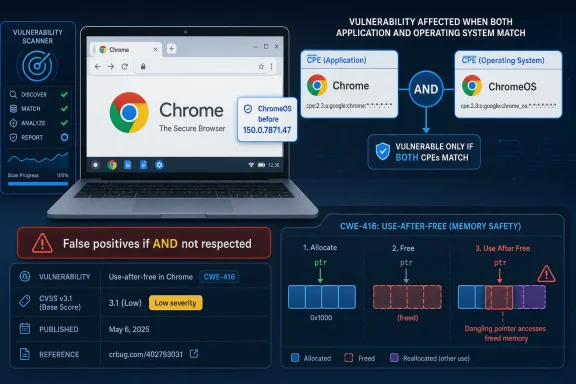 The Vulnerability Is Narrower Than the Word “Chrome” Suggests
CVE-2026-14103 is described by Chrome and NVD as a use-after-free flaw in SSL in Google Chrome on ChromeOS before version 150.0.7871.47. The stated impact is disclosure of potentially sensitive process memory through a crafted HTML page, with Chromium rating the issue Low while CISA-ADP assigned a CVSS 3.1 score of 6.5, Medium.That mismatch will look strange at first glance, but it is not unusual. Browser vendors often rate bugs through the lens of exploitability inside their architecture, while CVSS scoring emphasizes abstract access conditions and security impact. Here, the CVSS vector says the attack is network-reachable, low complexity, needs no privileges, requires user interaction, and affects confidentiality without integrity or availability impact.
The important phrase is “Google Chrome on ChromeOS.” The record is not saying that every Windows, macOS, Linux, Android, and ChromeOS Chrome build below 150.0.7871.47 is equally affected. It is saying that this particular memory-disclosure condition was tied to Chrome running in the ChromeOS environment.
That is why NVD’s CPE configuration matters. According to the change history supplied in the NVD entry, NIST added a configuration that effectively combines an application CPE for Google Chrome versions before 150.0.7871.47 with an operating-system CPE for Google ChromeOS. In vulnerability-management terms, that is a logical “and,” not merely a flat list of products.
The CPE Is There, but the Shape Is Easy to Misread
The user-facing question — “Are we missing a CPE here?” — gets at a recurring weakness in vulnerability data: CPEs are both machine-readable identifiers and editorial judgments. A scanner wants a clean product match. A CVE analyst often has to express a conditional reality.For CVE-2026-14103, the CPE modeling shown in the NVD change history appears to do what it should do. It identifies vulnerable Chrome versions up to, but excluding, 150.0.7871.47, and it constrains that application to ChromeOS. That tells downstream tools not to blindly flag every installed desktop Chrome below that version unless the host context also matches ChromeOS.
The record could still confuse readers because the CVE’s affected-product block from Chrome names “Google Chrome” as the product, while the description says “on ChromeOS.” That tension is common in CVE records where the browser is the vulnerable component but the exposure depends on the platform. NVD’s enrichment step is supposed to resolve that tension, and here it appears to have done so by adding both the Chrome application and ChromeOS operating-system CPEs in the same configuration.
The remaining caveat is tool behavior. Some vulnerability-management products flatten CPE configurations and treat every listed CPE as independently vulnerable. If your scanner does that, CVE-2026-14103 may show up as noise on non-ChromeOS Chrome installations even though the NVD configuration is trying to prevent exactly that.
Chrome’s Release Cadence Turns Tiny Bugs Into Fleet Events
Google’s Chrome Releases blog tied the fix to the late-June Stable Channel update, and outside coverage from outlets such as PCWorld and Born’s IT and Windows Blog noted that Chrome 150.0.7871.46 and 150.0.7871.47 arrived as part of a very large security update. That broader release matters because CVE-2026-14103 is not likely to be the bug that drives most administrators’ urgency.In a Chrome stable update that includes hundreds of fixes, the low-severity ChromeOS-specific SSL issue is one line in a much longer patch story. Enterprise administrators do not typically schedule browser updates because one low-rated information-disclosure bug exists. They schedule browser updates because the browser is an internet-facing execution environment, and the cumulative risk curve moves quickly.
That is especially true for ChromeOS fleets. ChromeOS is designed around automatic updates, verified boot, sandboxing, and a relatively constrained management surface. But the same design also makes version precision central to risk management: if your policy pins devices behind the stable release, delays restarts, or holds channels for compatibility testing, your exposure window is defined by those operational choices.
For unmanaged users, the fix path is simple: update ChromeOS to 150.0.7871.47 or later and restart when prompted. For managed fleets, the more serious work is checking whether organizational update policies actually moved devices beyond the affected version.
“Low” Does Not Mean “Ignore,” Especially for Memory Disclosure
The Chromium severity of Low should not be read as a declaration that the bug is harmless. It means Google’s security team judged this specific issue as relatively limited compared with the usual browser horror show of sandbox escapes, type confusion, renderer compromise, and arbitrary code execution. A memory disclosure bug is not the same thing as an attacker taking over the machine.But memory disclosure still matters because modern browser security is layered. Secrets, tokens, pointers, state, and fragments of user activity can all become useful in chained attacks. A bug that “only” leaks process memory may be uninteresting by itself and valuable as a supporting primitive in a larger exploit path.
CISA-ADP’s SSVC data reportedly marked exploitation as none, automatable as no, and technical impact as partial. That aligns with a practical reading of the issue: this is not a known exploited emergency, and it requires a user to interact with a crafted page. Still, user interaction is not much comfort in browser security; the whole product exists to fetch and render attacker-controlled content.
The better posture is to treat CVE-2026-14103 as a routine patch-management obligation, not a red-alert incident. There is no evidence in the provided record of active exploitation, and neither the NVD entry nor Chrome’s public phrasing suggests a crisis. But routine does not mean optional.
The SSL Label Is More Interesting Than the Score
The component label “SSL” gives the bug a little extra gravity, even if the CVE description is sparse. In browser architecture, SSL and TLS handling sits close to network trust decisions, certificate validation, session state, and encrypted transport. A memory-safety issue in that neighborhood naturally attracts attention from defenders.That does not mean CVE-2026-14103 breaks TLS, exposes every HTTPS session, or allows passive network attackers to read encrypted traffic. The public description says a remote attacker could obtain potentially sensitive process memory via a crafted HTML page. That is a narrower and more browser-like attack than the component name alone might imply.
This is where vulnerability summaries can mislead. A phrase like “use after free in SSL” sounds like a cryptographic failure, but the weakness enumeration is CWE-416: use after free. The bug class is memory lifetime management, not a failure of encryption algorithms.
For security teams, that distinction matters. The mitigation is not changing cipher suites, rotating certificates, or hardening a proxy. The mitigation is updating the affected browser environment.
Windows Administrators Should Read This as a Metadata Warning
At first glance, WindowsForum readers might shrug. ChromeOS is not Windows, and the CVE text specifically limits the affected environment. But the CPE modeling question is directly relevant to Windows shops because many enterprises run mixed fleets, ingest NVD data, and depend on scanners that do not always preserve platform nuance.If your vulnerability dashboard flags CVE-2026-14103 against Windows endpoints merely because Chrome is below 150.0.7871.47, you should inspect the detection logic. A correct finding should account for the ChromeOS condition. A simplistic finding may be matching only the Chrome application CPE and ignoring the operating-system half of the NVD configuration.
That is not just a nuisance. False positives create patch fatigue, distort executive reporting, and make it harder to identify the vulnerabilities that really do affect Windows endpoints. Browser updates are important enough without inflating the risk register with platform-mismatched CVEs.
The inverse problem is also possible. If a tool treats ChromeOS only as an operating-system update problem and ignores the embedded Chrome version, it may underreport browser-component vulnerabilities on managed Chromebooks. Either failure mode shows why CPE logic should be audited, not blindly trusted.
The Public Record Leaves Some Questions Open
The Chromium issue tracker reference for CVE-2026-14103 is permission-restricted, which is standard for many browser security bugs until enough users have updated or the details are no longer considered sensitive. That means defenders are working mostly from the CVE description, the Chrome release note, NVD enrichment, and CISA-ADP scoring.That is enough to patch, but not enough to reverse-engineer risk in detail. We do not know from the public record what memory could be disclosed, which process was affected, whether the bug was renderer-confined, or whether site isolation meaningfully limits the blast radius. Those are exactly the details that would let security researchers determine whether the Low rating is conservative, generous, or simply context-dependent.
This uncertainty is not a scandal. Browser vendors often withhold exploit details temporarily because public proof-of-concept code can move faster than enterprise patch cycles. But it does mean administrators should resist both extremes: panic is unjustified, and dismissal is premature.
The sane middle ground is version verification. If the device is ChromeOS and Chrome is below 150.0.7871.47, update. If the device is not ChromeOS, verify whether your tool is preserving the CPE configuration before treating the finding as real.
The CPE Lesson Is Bigger Than This CVE
CPE was designed to normalize product identification, not to perfectly model every modern software dependency. That limitation becomes obvious with browsers, mobile platforms, container images, embedded runtimes, and cloud-managed operating systems. Software is no longer a neat stack of separately installed products.ChromeOS makes the issue especially visible because Chrome is both a browser and a central platform component. Saying “Google Chrome is affected” is true but incomplete. Saying “ChromeOS is affected” is also true but may obscure the vulnerable browser component. The most accurate statement is conditional: Chrome before 150.0.7871.47 is affected when running on ChromeOS.
That is what NVD’s “AND” configuration attempts to encode. Unfortunately, many humans — and too many tools — read vulnerability pages as if each product line is an independent answer. In this case, the logic operator is the story.
For vendors and vulnerability databases, the obligation is to make those relationships harder to miss. For buyers of vulnerability-management tools, the obligation is to test whether the product respects those relationships. For administrators, the obligation is to investigate noisy findings rather than letting dashboards become the source of truth.
The Practical Answer for Patch Teams Is Boring, Which Is Good
There is no sign in the provided record that CVE-2026-14103 is being exploited in the wild. CISA-ADP’s SSVC entry says exploitation is none, and the technical impact is partial. The attack requires user interaction with a crafted HTML page, and the disclosed impact is confidentiality loss rather than code execution.That makes this a patching item, not an incident-response item. ChromeOS devices should be brought to 150.0.7871.47 or later, and administrators should confirm that auto-update policies, device restarts, and channel controls have not stranded machines below the fixed build. The fact that the bug is rated Low by Chromium does not change the operational answer.
For Windows fleets, the practical step is different. Do not assume a Chrome version below 150.0.7871.47 on Windows is vulnerable to this specific CVE unless your vendor provides separate evidence. If your scanner flags it anyway, challenge the detection and ask whether the NVD CPE configuration is being interpreted as an “AND” condition.
This is one of those cases where good security work looks like saying “no” to a dashboard. The goal is not to patch less; the goal is to patch accurately.
The Signal Hiding in a Low-Severity ChromeOS Bug
The concrete lessons from CVE-2026-14103 are small but useful, especially for teams trying to keep browser vulnerability noise under control.- CVE-2026-14103 affects Google Chrome on ChromeOS before 150.0.7871.47, not necessarily every Chrome installation on every operating system.
- NVD’s July 2 enrichment appears to include the needed CPE logic by combining the Chrome application CPE with the ChromeOS operating-system CPE.
- Security tools that flatten CPE entries may produce false positives on Windows, macOS, or Linux systems if they ignore the ChromeOS condition.
- The bug is a CWE-416 use-after-free issue with a confidentiality impact, not a publicly described TLS cryptography break.
- The right operational response is to update ChromeOS devices and verify scanner logic before escalating non-ChromeOS findings.
- The larger lesson is that vulnerability management increasingly depends on interpreting product context, not merely matching names and version numbers.
References
- Primary source: NVD / Chromium
Published: 2026-07-03T07:00:29-07:00
NVD - CVE-2026-14103
 nvd.nist.gov
- Security advisory: MSRC
Published: 2026-07-03T07:00:29-07:00
Original feed URL
Security Update Guide - Microsoft Security Response Center
 msrc.microsoft.com
- Related coverage: cvefeed.io
CVE-2026-14103 - Google Chrome Use-After-Free
Use after free in SSL in Google Chrome on ChromeOS prior to 150.0.7871.47 allowed a remote attacker to obtain potentially sensitive information from process memory via a crafted HTML page. (Chromium security severity: Low)cvefeed.io