

Google Chrome before 150.0.7871.47 contains CVE-2026-14086, an insufficient policy enforcement flaw in the browser’s HID handling that NVD says could let a remote attacker execute arbitrary code through a crafted HTML page. That sentence is both alarming and strangely understated, because Chromium labels the bug “Low” while CISA’s ADP enrichment scores it as a high-impact CVSS 8.8 issue. The tension between those two views is the real story: modern browser risk is increasingly shaped not only by the bug, but by the metadata that tells defenders how urgently to move. For Windows users and administrators, the safest reading is simple: update Chrome, verify the running build, and do not wait for vulnerability feeds to finish arguing with themselves.
As documented by NVD and sourced to Chrome’s own disclosure, CVE-2026-14086 was published on June 30, 2026, modified on July 2, 2026, and affects Google Chrome versions prior to 150.0.7871.47. NIST’s change history shows that a CPE configuration was added on July 1 for Google Chrome versions up to, but excluding, 150.0.7871.47, which answers the most immediate scanner question: no, defenders are not imagining the missing product mapping; the CPE was present in NIST’s initial analysis even if parts of the page or downstream tools still appear to lag. But that does not make the record clean. The page simultaneously says NVD has not yet provided its own CVSS assessment while displaying CISA-ADP’s 8.8 score, leaving security teams with a familiar patch-Tuesday-era problem in a Chrome wrapper: the machine-readable record is real, but not final.
The oddest fact about CVE-2026-14086 is not that Chrome had a security bug. Chrome has security bugs constantly, because a modern browser is a JavaScript engine, a media stack, a GPU client, a certificate policy engine, a file handler, an extension platform, and a hardware-permission broker wearing a single icon. The oddity is that the public description pairs “arbitrary code” with Chromium security severity “Low,” a combination that looks contradictory until you remember that vendor severity is often based on exploitability inside Chrome’s layered sandbox model rather than the worst-case phrasing in a CVE description.
CISA’s ADP enrichment reads the issue more harshly. Its CVSS 3.1 vector is network-accessible, low-complexity, no privileges required, user interaction required, unchanged scope, and high impact across confidentiality, integrity, and availability. That lands at 8.8, squarely in “High” territory, and it is the number many dashboards will show before anyone has read the actual advisory.
This mismatch matters because enterprises do not patch from prose; they patch from queues. A vulnerability with a low vendor label may sit behind exploited zero-days, VPN appliances, and critical server-side bugs. A vulnerability with a CVSS 8.8 may trigger SLAs, paging, and exception paperwork. CVE-2026-14086 lives in the gap between those systems.
The right operational answer is not to pick a favorite score. It is to understand why both can exist. Chromium may be saying the bug is constrained by browser-internal conditions, mitigations, or an exploit chain that is not straightforward. CISA’s enrichment is saying that if the described impact is reachable through a crafted page with user interaction, the consequences are severe enough to treat seriously.
Chrome’s WebHID model exists because there are legitimate reasons for web apps to communicate with hardware. Enterprise dashboards, lab tools, kiosk systems, games, assistive technology, point-of-sale systems, and device-management workflows all benefit when the browser can mediate access without requiring a native application. But mediation is the key word. The browser must enforce policy consistently, because users cannot be expected to audit USB report descriptors or understand which device capability a page is requesting.
“Insufficient policy enforcement” is therefore a quiet phrase with a large blast radius. It does not necessarily mean the browser forgot to show a permission prompt. It could mean a policy decision was made in one place and not honored in another, or that a renderer-side assumption escaped the control of a browser-side broker. Without access to the restricted Chromium issue, we should not pretend to know the exploit mechanics; Google commonly withholds bug details until most users are updated.
Still, the shape of the risk is visible. A crafted HTML page is enough to reach the vulnerable surface, and user interaction is required under CISA’s vector. That places the bug in the familiar browser-threat category where the attacker does not need to own the network, compromise credentials, or install malware first. The attacker needs a page, a lure, and an unpatched browser.
But defenders should not over-read the page furniture. NVD entries can appear incomplete while enrichment is still underway, and downstream tools often ingest updates at different speeds. One console may show the CPE. Another may flag the CVE without a reliable affected-product match. A third may normalize the Chrome version boundary differently depending on how it handles platform-specific stable builds.
This is not pedantry. In many Windows fleets, Chrome is present through multiple channels: user-installed Chrome, enterprise-managed Chrome, Chrome side by side with Edge, testing builds, packaged browser components inside third-party applications, and Chromium-derived runtimes. A clean CPE for Google Chrome does not magically answer whether every Chromium-based exposure in the environment is fixed.
The practical lesson is that vendor version checks still matter. For this CVE, the clear threshold is Chrome 150.0.7871.47 or later where that build applies. If an inventory tool says “Chrome fixed” but the endpoint is still running an older process because the browser has not restarted, the vulnerability remains operationally relevant. Browser patching is not complete when the installer lands; it is complete when the old browser process exits.
Phishing is user interaction. Malvertising is user interaction. Fake CAPTCHA pages, document previews, package-tracking scams, meeting invites, support portals, compromised forums, and poisoned search results are all user-interaction delivery systems. Requiring a click does not make a browser bug obscure; it makes it compatible with the way users already experience the web.
The more relevant question is whether exploitation is known in the wild. NVD’s displayed CISA SSVC data says exploitation is “none” and automatable is “no,” while technical impact is “total.” That is an important combination. It argues against panic, but not against urgency. No known exploitation today is not the same as no exploitation tomorrow, especially after a patch reveals enough shape for researchers and criminals to begin diffing builds.
Chrome bugs also have a peculiar afterlife. Once Google fixes the issue in Chrome, the Chromium patch trail can help other browser vendors and attackers alike understand what changed. That is a normal and unavoidable consequence of open-source browser development. It is also why lag time matters for downstream Chromium browsers and embedded runtimes.
That changes the patching calculus. A Chrome vulnerability with arbitrary-code language belongs in the same operational conversation as endpoint detection, application control, privilege boundaries, and credential theft. If the browser is the place where users authenticate to everything, then browser compromise is not a side issue. It is a route into the workday.
The good news is that Chrome’s update mechanism is mature, and enterprise controls are well understood. Google Update can handle most consumer and small-business cases automatically. Managed environments can enforce update policies, target channels, relaunch notifications, and version reporting. The bad news is that browser restarts remain the weak link. Users leave sessions open for days, and every tab becomes an excuse not to relaunch.
That is where administrators need to be less polite. For high-impact browser fixes, especially ones with remote-code-execution language, a forced relaunch window is not unreasonable. The inconvenience of a restored browser session is smaller than the cost of leaving a known browser code-execution path open across a fleet.
That does not mean every Chromium browser is automatically vulnerable in the same way. WebHID support, permissions plumbing, compile flags, platform integration, and release cadence can all change exposure. Microsoft, for example, ships Edge on its own schedule and may backport Chromium fixes under separate version numbers and advisories. Application vendors embedding Chromium may be slower still.
The operational pattern should be familiar. First patch Chrome itself, because the affected version is explicit. Then check Edge and other Chromium browsers for their corresponding security updates. Finally, identify applications that bundle Chromium or Electron but do not update with the system browser. That last category is the one most likely to surprise IT teams during incident response.
The web platform has made hardware-adjacent APIs more useful, but it has also created more places where “just a browser” is the wrong mental model. HID access is a perfect example. The browser is brokering a relationship between a remote page and local physical devices. If that broker fails to enforce policy correctly, the boundary being crossed is not abstract.
But the more useful conclusion is that scoring systems answer different questions. Chromium’s severity process helps the browser team prioritize engineering risk inside a heavily sandboxed architecture. CVSS tries to standardize technical impact across products. SSVC tries to help coordinators reason about exploitation, automability, and operational consequence. None of those systems can replace product-specific judgment.
For defenders, the presence of arbitrary-code language should raise the floor. Even if the exploit requires user interaction and even if Chrome’s internal severity is low, the affected component sits in a high-value application exposed to untrusted content all day. That makes the remediation priority higher than the word “Low” suggests.
It is also worth noting what this CVE does not say. The public record does not say the bug is being exploited in the wild. It does not provide a proof of concept. It does not say the issue bypasses the entire Chrome sandbox by itself. Those absences are meaningful. They are the difference between emergency incident mode and disciplined accelerated patching.
Security teams should also watch for scanner churn over the next several days. Because NVD had not yet provided its own CVSS assessment at the time reflected in the record, and because CISA-ADP enrichment was updated on July 2, severity and metadata may continue to shift. That can produce duplicate tickets, changing SLA categories, or confusing deltas in vulnerability-management platforms.
The fix is still the fix. Metadata uncertainty is not a reason to delay patching a browser. If anything, it is a reason to anchor on the vendor version boundary and move on.
As documented by NVD and sourced to Chrome’s own disclosure, CVE-2026-14086 was published on June 30, 2026, modified on July 2, 2026, and affects Google Chrome versions prior to 150.0.7871.47. NIST’s change history shows that a CPE configuration was added on July 1 for Google Chrome versions up to, but excluding, 150.0.7871.47, which answers the most immediate scanner question: no, defenders are not imagining the missing product mapping; the CPE was present in NIST’s initial analysis even if parts of the page or downstream tools still appear to lag. But that does not make the record clean. The page simultaneously says NVD has not yet provided its own CVSS assessment while displaying CISA-ADP’s 8.8 score, leaving security teams with a familiar patch-Tuesday-era problem in a Chrome wrapper: the machine-readable record is real, but not final.
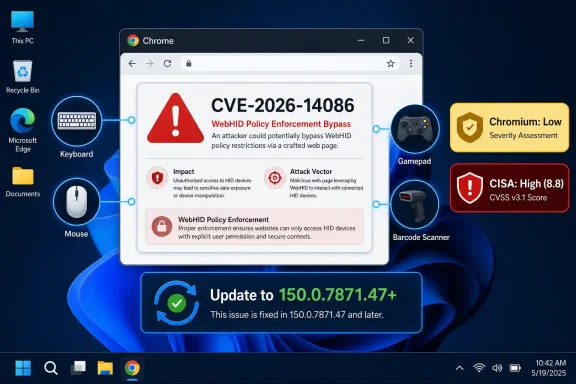 Chrome’s “Low” Label Collides With a High-Impact Score
The oddest fact about CVE-2026-14086 is not that Chrome had a security bug. Chrome has security bugs constantly, because a modern browser is a JavaScript engine, a media stack, a GPU client, a certificate policy engine, a file handler, an extension platform, and a hardware-permission broker wearing a single icon. The oddity is that the public description pairs “arbitrary code” with Chromium security severity “Low,” a combination that looks contradictory until you remember that vendor severity is often based on exploitability inside Chrome’s layered sandbox model rather than the worst-case phrasing in a CVE description.CISA’s ADP enrichment reads the issue more harshly. Its CVSS 3.1 vector is network-accessible, low-complexity, no privileges required, user interaction required, unchanged scope, and high impact across confidentiality, integrity, and availability. That lands at 8.8, squarely in “High” territory, and it is the number many dashboards will show before anyone has read the actual advisory.
This mismatch matters because enterprises do not patch from prose; they patch from queues. A vulnerability with a low vendor label may sit behind exploited zero-days, VPN appliances, and critical server-side bugs. A vulnerability with a CVSS 8.8 may trigger SLAs, paging, and exception paperwork. CVE-2026-14086 lives in the gap between those systems.
The right operational answer is not to pick a favorite score. It is to understand why both can exist. Chromium may be saying the bug is constrained by browser-internal conditions, mitigations, or an exploit chain that is not straightforward. CISA’s enrichment is saying that if the described impact is reachable through a crafted page with user interaction, the consequences are severe enough to treat seriously.
HID Is Where the Web Starts Touching the Desk
HID stands for Human Interface Device, the class of hardware that includes keyboards, mice, gamepads, barcode scanners, specialized controllers, security peripherals, and other devices that sit at the edge between user intent and machine input. On the open web, that boundary is sensitive by design. A browser that lets websites talk too freely to input devices risks turning ordinary hardware into a channel for spoofing, data capture, command injection, or device misuse.Chrome’s WebHID model exists because there are legitimate reasons for web apps to communicate with hardware. Enterprise dashboards, lab tools, kiosk systems, games, assistive technology, point-of-sale systems, and device-management workflows all benefit when the browser can mediate access without requiring a native application. But mediation is the key word. The browser must enforce policy consistently, because users cannot be expected to audit USB report descriptors or understand which device capability a page is requesting.
“Insufficient policy enforcement” is therefore a quiet phrase with a large blast radius. It does not necessarily mean the browser forgot to show a permission prompt. It could mean a policy decision was made in one place and not honored in another, or that a renderer-side assumption escaped the control of a browser-side broker. Without access to the restricted Chromium issue, we should not pretend to know the exploit mechanics; Google commonly withholds bug details until most users are updated.
Still, the shape of the risk is visible. A crafted HTML page is enough to reach the vulnerable surface, and user interaction is required under CISA’s vector. That places the bug in the familiar browser-threat category where the attacker does not need to own the network, compromise credentials, or install malware first. The attacker needs a page, a lure, and an unpatched browser.
The CPE Question Is a Symptom of a Bigger Metadata Problem
The user-facing NVD page asks, as many NVD pages do, whether a CPE is missing. In this case, the change history says NIST added a CPE configuration on July 1 forcpe:2.3:a:google:chrome:*:*:*:*:*:*:*:* with versions up to, but excluding, 150.0.7871.47. That is the product mapping vulnerability scanners need in order to connect the CVE to installed Chrome versions.But defenders should not over-read the page furniture. NVD entries can appear incomplete while enrichment is still underway, and downstream tools often ingest updates at different speeds. One console may show the CPE. Another may flag the CVE without a reliable affected-product match. A third may normalize the Chrome version boundary differently depending on how it handles platform-specific stable builds.
This is not pedantry. In many Windows fleets, Chrome is present through multiple channels: user-installed Chrome, enterprise-managed Chrome, Chrome side by side with Edge, testing builds, packaged browser components inside third-party applications, and Chromium-derived runtimes. A clean CPE for Google Chrome does not magically answer whether every Chromium-based exposure in the environment is fixed.
The practical lesson is that vendor version checks still matter. For this CVE, the clear threshold is Chrome 150.0.7871.47 or later where that build applies. If an inventory tool says “Chrome fixed” but the endpoint is still running an older process because the browser has not restarted, the vulnerability remains operationally relevant. Browser patching is not complete when the installer lands; it is complete when the old browser process exits.
User Interaction Is Not a Comfort Blanket
CISA’s vector includes UI:R, meaning exploitation requires user interaction. That is often treated as a downgrade, and sometimes it should be. A vulnerability that triggers only after a user visits a page and performs some action is less wormable than a server-side flaw reachable without authentication. But in browser security, user interaction is the default business model of the attacker.Phishing is user interaction. Malvertising is user interaction. Fake CAPTCHA pages, document previews, package-tracking scams, meeting invites, support portals, compromised forums, and poisoned search results are all user-interaction delivery systems. Requiring a click does not make a browser bug obscure; it makes it compatible with the way users already experience the web.
The more relevant question is whether exploitation is known in the wild. NVD’s displayed CISA SSVC data says exploitation is “none” and automatable is “no,” while technical impact is “total.” That is an important combination. It argues against panic, but not against urgency. No known exploitation today is not the same as no exploitation tomorrow, especially after a patch reveals enough shape for researchers and criminals to begin diffing builds.
Chrome bugs also have a peculiar afterlife. Once Google fixes the issue in Chrome, the Chromium patch trail can help other browser vendors and attackers alike understand what changed. That is a normal and unavoidable consequence of open-source browser development. It is also why lag time matters for downstream Chromium browsers and embedded runtimes.
Windows Admins Should Treat Chrome Like Infrastructure
For years, many organizations treated browsers as userland conveniences. That model died sometime between the rise of SaaS and the normalization of zero-click-ish browser exploit chains. In a Windows enterprise, Chrome is not merely an app; it is the front door to identity, productivity, finance, admin consoles, internal dashboards, and customer data.That changes the patching calculus. A Chrome vulnerability with arbitrary-code language belongs in the same operational conversation as endpoint detection, application control, privilege boundaries, and credential theft. If the browser is the place where users authenticate to everything, then browser compromise is not a side issue. It is a route into the workday.
The good news is that Chrome’s update mechanism is mature, and enterprise controls are well understood. Google Update can handle most consumer and small-business cases automatically. Managed environments can enforce update policies, target channels, relaunch notifications, and version reporting. The bad news is that browser restarts remain the weak link. Users leave sessions open for days, and every tab becomes an excuse not to relaunch.
That is where administrators need to be less polite. For high-impact browser fixes, especially ones with remote-code-execution language, a forced relaunch window is not unreasonable. The inconvenience of a restored browser session is smaller than the cost of leaving a known browser code-execution path open across a fleet.
Edge and Other Chromium Browsers Sit in the Shadow
CVE-2026-14086 is listed against Google Chrome, but WindowsForum readers know the uncomfortable truth: Chromium is a family, not a single product. Microsoft Edge, Brave, Vivaldi, Opera, Electron applications, embedded WebViews, and other Chromium-based software may share affected code paths depending on the component, branch, feature exposure, and patch timing. The NVD CPE for Google Chrome is necessary, but it is not a universal Chromium risk inventory.That does not mean every Chromium browser is automatically vulnerable in the same way. WebHID support, permissions plumbing, compile flags, platform integration, and release cadence can all change exposure. Microsoft, for example, ships Edge on its own schedule and may backport Chromium fixes under separate version numbers and advisories. Application vendors embedding Chromium may be slower still.
The operational pattern should be familiar. First patch Chrome itself, because the affected version is explicit. Then check Edge and other Chromium browsers for their corresponding security updates. Finally, identify applications that bundle Chromium or Electron but do not update with the system browser. That last category is the one most likely to surprise IT teams during incident response.
The web platform has made hardware-adjacent APIs more useful, but it has also created more places where “just a browser” is the wrong mental model. HID access is a perfect example. The browser is brokering a relationship between a remote page and local physical devices. If that broker fails to enforce policy correctly, the boundary being crossed is not abstract.
The Low-Severity Label Should Not Survive Contact With Patch Policy
There is a temptation to use this CVE as a dunk on scoring systems. Chromium says Low. CISA says High. NVD says it has not yet assessed its own CVSS. NIST’s change log shows enrichment still moving. Security vendors will almost certainly decorate the same CVE with their own ratings, exploit predictions, and dashboard colors.But the more useful conclusion is that scoring systems answer different questions. Chromium’s severity process helps the browser team prioritize engineering risk inside a heavily sandboxed architecture. CVSS tries to standardize technical impact across products. SSVC tries to help coordinators reason about exploitation, automability, and operational consequence. None of those systems can replace product-specific judgment.
For defenders, the presence of arbitrary-code language should raise the floor. Even if the exploit requires user interaction and even if Chrome’s internal severity is low, the affected component sits in a high-value application exposed to untrusted content all day. That makes the remediation priority higher than the word “Low” suggests.
It is also worth noting what this CVE does not say. The public record does not say the bug is being exploited in the wild. It does not provide a proof of concept. It does not say the issue bypasses the entire Chrome sandbox by itself. Those absences are meaningful. They are the difference between emergency incident mode and disciplined accelerated patching.
The Fix Is Boring, Which Is Exactly the Point
The remediation path is not exotic. Update Google Chrome to 150.0.7871.47 or later, restart the browser, and verify the running version. On unmanaged Windows systems,chrome://settings/help remains the quickest route for users to trigger an update check and confirm the installed build. In managed environments, inventory should confirm not just installed package version but active process version after relaunch.Security teams should also watch for scanner churn over the next several days. Because NVD had not yet provided its own CVSS assessment at the time reflected in the record, and because CISA-ADP enrichment was updated on July 2, severity and metadata may continue to shift. That can produce duplicate tickets, changing SLA categories, or confusing deltas in vulnerability-management platforms.
The fix is still the fix. Metadata uncertainty is not a reason to delay patching a browser. If anything, it is a reason to anchor on the vendor version boundary and move on.
The Chrome 150 Lesson Is Bigger Than One HID Bug
CVE-2026-14086 is a neat little case study in how browser security now works. The most important details are not hidden in an exploit write-up; they are scattered across a vendor release, an NVD record, a CISA enrichment, a CPE change, and a restricted Chromium issue. The defender’s job is to assemble those fragments into action without waiting for perfect certainty.- Chrome versions prior to 150.0.7871.47 should be treated as vulnerable to CVE-2026-14086, according to the public NVD record and Chrome-sourced description.
- NIST’s change history shows a Google Chrome CPE configuration was added for versions below 150.0.7871.47, even if downstream tooling may still display incomplete or delayed product mapping.
- CISA-ADP scores the issue as CVSS 8.8 High, while Chromium labels the vulnerability Low, so patch policy should consider both exploitability context and worst-case impact.
- The public record says exploitation requires user interaction and shows no known exploitation in CISA’s SSVC data, which argues for prompt patching rather than panic.
- Windows administrators should verify that Chrome has restarted into the patched build, because installed updates do not protect users still running old browser processes.
- Chromium-based browsers and embedded Chromium runtimes should be reviewed separately, since a Google Chrome CPE does not prove every Chromium-derived product in the environment has received the fix.
References
- Primary source: NVD / Chromium
Published: 2026-07-03T07:00:12-07:00
NVD - CVE-2026-14086
 nvd.nist.gov
- Security advisory: MSRC
Published: 2026-07-03T07:00:12-07:00
Original feed URL
Security Update Guide - Microsoft Security Response Center
 msrc.microsoft.com
- Related coverage: cvefeed.io
CVE-2026-14086 - Google Chrome HID Policy Bypass
Insufficient policy enforcement in HID in Google Chrome prior to 150.0.7871.47 allowed a remote attacker to execute arbitrary code via a crafted HTML page. (Chromium security severity: Low)cvefeed.io