

The Associated Press reported on July 3, 2026, that artificial intelligence tools are already reshaping the work of U.S. administrative assistants, a mostly female profession whose employment has fallen sharply since 2004 and is projected by federal data to keep weakening in most specialties through 2034. The story is not simply that ChatGPT, Claude, and Microsoft Copilot are coming for the front desk. It is that a job family built around adaptation is being asked to absorb another wave of office automation without the training budgets, career ladders, or institutional respect that usually accompany strategic technology change. For Windows-heavy workplaces, this is not an abstract labor-market trend; it is arriving through Microsoft 365, Teams, Outlook, Edge, and Copilot, right in the daily workflow of the people who keep organizations functioning.
Every era of office technology has promised to reduce clerical labor, and every era has depended on clerical workers to make the promise usable. The typewriter did not eliminate office coordination; it standardized it. Word processors, voicemail, email, calendar software, shared drives, and cloud collaboration each removed some tasks while creating new layers of coordination, etiquette, and failure recovery.
That history matters because “administrative assistant” has always been a misleadingly modest title. The work is part logistics, part diplomacy, part document control, part executive memory, and part social operating system. A good assistant knows which meeting can move, which request is political, which vendor needs a nudge, and which executive will never read the attachment unless the first paragraph frames the decision correctly.
AI is different because it goes after the visible surface of that work. It can draft the email, summarize the meeting, produce the agenda, extract action items, clean up a spreadsheet, and turn a rough idea into a presentable memo. That makes the technology feel like a direct substitute for administrative labor in a way that earlier tools often did not.
But the visible surface was never the whole job. The danger is that employers will confuse the automatable portion of administrative work with the value of the role itself. The opportunity is that assistants who master AI can move closer to the center of decision-making, because they can spend less time transcribing the organization and more time interpreting it.
That decline predates the current generative AI boom. Emily Rolen, a lead economist for employment projections at the Bureau of Labor Statistics, told the AP that productivity-enhancing technologies have been limiting demand for administrative employment for multiple projection cycles. Word processing, speech-to-text software, digital scheduling, collaboration suites, and mobile apps have steadily transferred clerical work to managers, professionals, and automated systems.
The BLS outlook is not a single neat collapse. Its Occupational Outlook Handbook says overall employment for secretaries and administrative assistants is expected to show little or no change from 2024 to 2034, while some individual categories decline and medical secretaries and administrative assistants benefit from healthcare demand. The broader point, however, is unavoidable: this is not a growth occupation in the traditional office economy.
The June labor numbers add a more immediate note of stress. According to the Labor Department data cited by the AP, unemployment among office and administrative support workers rose to 4 percent in June 2026, up from 3.6 percent a year earlier. That is not proof that AI is already eliminating the profession wholesale, but it is a warning light in a labor category where automation has been a long-running pressure.
That finding should make executives uncomfortable. The AI transition is often narrated as a white-collar productivity story, where knowledge workers receive magical assistants and companies get faster output. Brookings reminds us that exposure is not distributed evenly, and neither is the ability to recover from displacement.
Administrative work is especially exposed because many tasks are language- and coordination-heavy. Scheduling, summarizing, drafting, routing requests, creating standard operating procedures, and preparing meeting materials are precisely the kinds of activities vendors showcase in AI demos. Those demos often feature a manager or executive using AI directly, bypassing the person who previously handled the coordination.
The gender dimension is not incidental. Administrative professions have long offered stable office employment to women without necessarily requiring expensive degrees. If AI compresses these roles without opening credible paths into higher-value work, the productivity gain will come with a familiar social cost: the people who made offices run will be told they were merely overhead.
Danger uses AI to take meeting notes, freeing her to participate rather than act as a human recorder. She told the AP that some tasks that once took hours can now be finished in less than five minutes. That is the productivity pitch in its most humane form: not fewer people in the room, but more attention available from the people already there.
This is where the WindowsForum audience should pay attention. In Microsoft-centric organizations, the assistant is often the practical integrator of Outlook, Teams, SharePoint, OneDrive, Word, Excel, PowerPoint, and whatever line-of-business system the company never quite replaced. Add Copilot or another AI layer, and the assistant may become the person who knows which prompts work, which summaries miss nuance, which files are safe to feed into a workflow, and which output needs human rewriting before it reaches the executive suite.
That is a real skill set. It is also not automatically rewarded. Too many organizations will happily let administrative staff discover AI efficiencies on their own, then quietly raise expectations without changing title, pay, or authority.
That integration is powerful precisely because it is mundane. Administrative assistants do not need a separate AI lab to feel the change; they feel it when a Teams meeting generates a recap, when Outlook suggests a polished reply, when PowerPoint turns a document into a deck, or when Word rewrites a messy draft. The operating terrain of administrative work is becoming AI-mediated.
This raises a subtle management issue. If an executive uses AI badly, the result may be a clumsy email or a missed nuance. If an assistant uses AI badly, the result may be a calendar mistake, a confidentiality breach, a misrouted document, or a reputational error committed at executive speed. The same tool that saves time can amplify institutional sloppiness.
Windows admins and Microsoft 365 administrators will increasingly be pulled into this. They will need to decide who can use which AI features, what data can be indexed, how retention and compliance rules apply, and whether meeting transcription is appropriate in sensitive contexts. The assistant’s job may look “soft” from the outside, but its AI risks are deeply technical.
Administrative assistants handle the material most organizations least want sprayed into the wrong system: executive travel, personnel issues, board communications, budget drafts, customer escalations, legal correspondence, internal politics, and meeting notes that can become discoverable records. A generic chatbot prompt is not just a productivity shortcut when the input contains confidential context.
The issue is not limited to public AI tools. Enterprise AI systems also require governance. Microsoft and other vendors emphasize tenant boundaries, permissions, compliance controls, and enterprise data protection, but those features only help when organizations configure them properly and train employees to understand the boundaries. “Copilot can only see what you can see” is not a complete reassurance if permissions are already too broad.
This is where assistants may become early-warning sensors for bad AI governance. They know when meeting notes include information that should not be widely circulated. They know when a draft email is legally sensitive. They know when a file name looks harmless but contains salary data. If management treats them as passive users rather than governance partners, companies will miss a practical source of risk intelligence.
AI training for administrative staff should therefore start with data judgment, not prompt gimmicks. The first question is not “How do I make the model write faster?” It is “What should never go into this system, and who is accountable if it does?”
That shift is important. The old standard for office software competence was procedural: know how to use mail merge, build a deck, manage a calendar, or format a document. The AI standard is more evaluative: know whether the generated answer is right, appropriate, complete, and safe to send.
This makes the assistant’s soft skills more valuable, not less. Emotional intelligence, relationship management, and sound judgment are not sentimental extras; they are the control layer above automation. An AI tool can summarize a tense meeting, but it cannot reliably tell whether the quietest person in the room was agreeing, withholding, or politically boxed in.
The best administrative professionals will become editors of organizational intent. They will use AI to produce first drafts, surface options, scan communications, and prepare materials. Then they will apply context: what the executive actually means, what the recipient needs to hear, what the company can safely say, and what should never be written down that way.
This is the global labor angle that many U.S. office workers understand instinctively. AI does not only automate tasks; it makes remote coordination smoother, more scalable, and more competitive across borders. A capable assistant with AI support can operate across time zones with more context and less friction than before.
For employers, that can be a win. For domestic administrative workers, it may increase pressure. If AI reduces the need for tacit local office knowledge while improving remote support, companies may rethink where administrative labor needs to sit and how many people they need.
But the remote example also cuts against a simplistic replacement story. Manolache told the AP that AI cannot replace Martinez. Instead, it changes the shape of her work. That distinction matters because the future of administrative labor may be less about eliminating every assistant than about concentrating responsibility in fewer, more technically fluent, more strategically positioned assistants.
Executives love to describe AI adoption as a cultural transformation. In practice, many will buy licenses, send a few links to vendor webinars, and assume the organization will figure it out. That approach is especially unfair to administrative staff, whose calendars are already built around everyone else’s priorities.
If companies want assistants to become AI-augmented operators, they need to create room for that development. Training cannot be something squeezed into lunch breaks between expense reports and travel changes. It needs protected time, clear policies, scenario-based practice, and explicit permission to challenge unsafe or unrealistic use.
There is also a compensation issue. If an assistant learns to automate reporting, prepare executive briefs, manage AI-generated meeting intelligence, and support customer analysis, that person is no longer doing the same job under a shinier interface. The job has moved up the value chain. Pay and title structures should move with it.
That exercise produces a seductive but incomplete answer. It treats the assistant as a bundle of outputs rather than as a node in the organization’s trust network. The person who knows how to get a decision unstuck, how to read an executive’s priorities, and how to keep a sensitive issue from becoming a public mess is not captured by counting drafts and summaries.
AI is very good at making routine administrative output cheaper. It is much weaker at owning consequences. When a generated meeting summary misses a commitment, when an executive sends a tone-deaf note, when a confidential item appears in the wrong deck, or when an important relationship needs careful handling, the organization still needs humans who understand accountability.
That does not mean every current role survives unchanged. It does mean that companies should be wary of headcount reductions based on demo-room productivity claims. The first wave of savings can look obvious; the second-order costs often arrive later, in miscommunication, executive overload, compliance problems, and frayed relationships.
At the same time, high-trust executive support may become more valuable. The assistant who can manage AI tools, enforce information discipline, prepare decision-ready materials, coordinate across stakeholders, and protect executive attention is not just an office helper. That person is a productivity strategist.
This split will be uneven. Large technology companies and well-funded organizations may create AI-enabled administrative career paths, while smaller firms simply expect fewer people to do more. Healthcare may remain a relative bright spot because demographic demand and patient-facing complexity preserve administrative need, though medical privacy rules make AI adoption more sensitive.
The geography of the transition also matters. Brookings warned that adaptive capacity varies by local opportunity, savings, age, and skill portability. Losing an administrative job in a diversified metro area is not the same as losing one in a college town, regional government hub, or smaller market where clerical roles cluster around a handful of employers.
A Microsoft 365 administrator can enable or restrict features, but cannot by policy alone teach people when a summary is misleading or when a prompt crosses a confidentiality line. A security team can write acceptable-use rules, but cannot anticipate every executive assistant workflow unless it actually talks to the people doing the work. A CIO can announce AI transformation, but the transformation will be judged in the boring moments: the meeting recap, the customer email, the board packet, the travel change, the confidential memo.
That makes administrative professionals a critical pilot group. They touch communication, scheduling, documents, meetings, and executive priorities. If AI works for them safely, it can work across much of the office. If it fails there, the failure will expose weaknesses in governance, training, and organizational trust.
WindowsForum readers have seen this movie with every major platform shift. The users who hold the workflow together often become informal support, trainers, and testers long before anyone updates the org chart. With AI, that invisible labor needs to become visible before the next round of productivity targets lands.
The optimistic version of this story is compelling. AI removes drudgery, assistants reclaim attention, executives get better support, and organizations promote administrative professionals into more strategic roles. The technology becomes a lever for recognition.
The darker version is equally plausible. AI removes visible tasks, employers cut roles, remaining assistants inherit more work, and training becomes an unfunded expectation. The technology becomes a rationale for extracting more from a workforce that already had limited leverage.
Which version wins will depend less on the model names than on management choices. ChatGPT, Claude, and Copilot are tools. The labor system around them decides whether they become career accelerators or displacement engines.
For organizations trying to make sense of this transition, a few practical conclusions stand out.
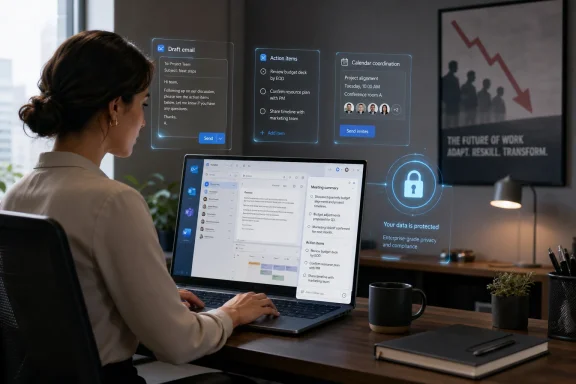 The Office Assistant Was Always the Original Automation Layer
Every era of office technology has promised to reduce clerical labor, and every era has depended on clerical workers to make the promise usable. The typewriter did not eliminate office coordination; it standardized it. Word processors, voicemail, email, calendar software, shared drives, and cloud collaboration each removed some tasks while creating new layers of coordination, etiquette, and failure recovery.That history matters because “administrative assistant” has always been a misleadingly modest title. The work is part logistics, part diplomacy, part document control, part executive memory, and part social operating system. A good assistant knows which meeting can move, which request is political, which vendor needs a nudge, and which executive will never read the attachment unless the first paragraph frames the decision correctly.
AI is different because it goes after the visible surface of that work. It can draft the email, summarize the meeting, produce the agenda, extract action items, clean up a spreadsheet, and turn a rough idea into a presentable memo. That makes the technology feel like a direct substitute for administrative labor in a way that earlier tools often did not.
But the visible surface was never the whole job. The danger is that employers will confuse the automatable portion of administrative work with the value of the role itself. The opportunity is that assistants who master AI can move closer to the center of decision-making, because they can spend less time transcribing the organization and more time interpreting it.
The Numbers Show a Profession Already Under Pressure
The labor-market backdrop is grim. The Associated Press, citing government data, reported that roughly 3.5 million Americans worked as secretaries and administrative assistants in 2004, with women making up nearly 97 percent of the workforce. By 2024, that figure had fallen to about 2.1 million, even as total U.S. employment grew.That decline predates the current generative AI boom. Emily Rolen, a lead economist for employment projections at the Bureau of Labor Statistics, told the AP that productivity-enhancing technologies have been limiting demand for administrative employment for multiple projection cycles. Word processing, speech-to-text software, digital scheduling, collaboration suites, and mobile apps have steadily transferred clerical work to managers, professionals, and automated systems.
The BLS outlook is not a single neat collapse. Its Occupational Outlook Handbook says overall employment for secretaries and administrative assistants is expected to show little or no change from 2024 to 2034, while some individual categories decline and medical secretaries and administrative assistants benefit from healthcare demand. The broader point, however, is unavoidable: this is not a growth occupation in the traditional office economy.
The June labor numbers add a more immediate note of stress. According to the Labor Department data cited by the AP, unemployment among office and administrative support workers rose to 4 percent in June 2026, up from 3.6 percent a year earlier. That is not proof that AI is already eliminating the profession wholesale, but it is a warning light in a labor category where automation has been a long-running pressure.
Brookings Puts a Gendered Risk Map Under the AI Boom
The Brookings Institution sharpened the debate in January 2026 with a report on workers’ capacity to adapt to AI-driven displacement. Brookings found that about 6.1 million U.S. workers sit in a particularly vulnerable zone: high exposure to generative AI and low adaptive capacity because of factors such as limited savings, older age, scarce local opportunities, and narrower skill sets. The group is concentrated in clerical and administrative roles, and about 86 percent are women.That finding should make executives uncomfortable. The AI transition is often narrated as a white-collar productivity story, where knowledge workers receive magical assistants and companies get faster output. Brookings reminds us that exposure is not distributed evenly, and neither is the ability to recover from displacement.
Administrative work is especially exposed because many tasks are language- and coordination-heavy. Scheduling, summarizing, drafting, routing requests, creating standard operating procedures, and preparing meeting materials are precisely the kinds of activities vendors showcase in AI demos. Those demos often feature a manager or executive using AI directly, bypassing the person who previously handled the coordination.
The gender dimension is not incidental. Administrative professions have long offered stable office employment to women without necessarily requiring expensive degrees. If AI compresses these roles without opening credible paths into higher-value work, the productivity gain will come with a familiar social cost: the people who made offices run will be told they were merely overhead.
The Best Assistants Are Not Waiting to Be Automated
The most interesting figure in the AP report is not an economist or a vendor. It is Deanna Danger, an executive assistant to Vanderbilt University’s chief information officer, who has worked as an administrative professional since 2003 and began using AI at work in 2022. Her view is blunt: adaptation has always been part of the job.Danger uses AI to take meeting notes, freeing her to participate rather than act as a human recorder. She told the AP that some tasks that once took hours can now be finished in less than five minutes. That is the productivity pitch in its most humane form: not fewer people in the room, but more attention available from the people already there.
This is where the WindowsForum audience should pay attention. In Microsoft-centric organizations, the assistant is often the practical integrator of Outlook, Teams, SharePoint, OneDrive, Word, Excel, PowerPoint, and whatever line-of-business system the company never quite replaced. Add Copilot or another AI layer, and the assistant may become the person who knows which prompts work, which summaries miss nuance, which files are safe to feed into a workflow, and which output needs human rewriting before it reaches the executive suite.
That is a real skill set. It is also not automatically rewarded. Too many organizations will happily let administrative staff discover AI efficiencies on their own, then quietly raise expectations without changing title, pay, or authority.
Copilot Makes the Trend a Windows Workplace Problem
For Microsoft shops, AI is not arriving as a separate robot. It is arriving as a button inside the software employees already use. Microsoft 365 Copilot sits in Word, Excel, PowerPoint, Outlook, Teams, and other services, offering to draft, summarize, analyze, and retrieve information across business data where permissions allow.That integration is powerful precisely because it is mundane. Administrative assistants do not need a separate AI lab to feel the change; they feel it when a Teams meeting generates a recap, when Outlook suggests a polished reply, when PowerPoint turns a document into a deck, or when Word rewrites a messy draft. The operating terrain of administrative work is becoming AI-mediated.
This raises a subtle management issue. If an executive uses AI badly, the result may be a clumsy email or a missed nuance. If an assistant uses AI badly, the result may be a calendar mistake, a confidentiality breach, a misrouted document, or a reputational error committed at executive speed. The same tool that saves time can amplify institutional sloppiness.
Windows admins and Microsoft 365 administrators will increasingly be pulled into this. They will need to decide who can use which AI features, what data can be indexed, how retention and compliance rules apply, and whether meeting transcription is appropriate in sensitive contexts. The assistant’s job may look “soft” from the outside, but its AI risks are deeply technical.
Privacy Is the Fault Line Under the Productivity Story
The AP report notes that administrative professionals discussing AI through the American Society of Administrative Professionals have raised concerns about privacy, security, and the lack of clear regulation. Those concerns are not technophobia. They are operational realism.Administrative assistants handle the material most organizations least want sprayed into the wrong system: executive travel, personnel issues, board communications, budget drafts, customer escalations, legal correspondence, internal politics, and meeting notes that can become discoverable records. A generic chatbot prompt is not just a productivity shortcut when the input contains confidential context.
The issue is not limited to public AI tools. Enterprise AI systems also require governance. Microsoft and other vendors emphasize tenant boundaries, permissions, compliance controls, and enterprise data protection, but those features only help when organizations configure them properly and train employees to understand the boundaries. “Copilot can only see what you can see” is not a complete reassurance if permissions are already too broad.
This is where assistants may become early-warning sensors for bad AI governance. They know when meeting notes include information that should not be widely circulated. They know when a draft email is legally sensitive. They know when a file name looks harmless but contains salary data. If management treats them as passive users rather than governance partners, companies will miss a practical source of risk intelligence.
AI training for administrative staff should therefore start with data judgment, not prompt gimmicks. The first question is not “How do I make the model write faster?” It is “What should never go into this system, and who is accountable if it does?”
The New Administrative Skill Is Judgment at Machine Speed
Fiona Young, founder of the AI training company Carve and a former executive assistant, told the AP that demand for AI training has increased sharply since 2023. She has trained administrative professionals at companies including Google, Amazon, Uber, Salesforce, and LinkedIn. Her view is that employers increasingly expect staff to make AI part of everyday work rather than merely understand it.That shift is important. The old standard for office software competence was procedural: know how to use mail merge, build a deck, manage a calendar, or format a document. The AI standard is more evaluative: know whether the generated answer is right, appropriate, complete, and safe to send.
This makes the assistant’s soft skills more valuable, not less. Emotional intelligence, relationship management, and sound judgment are not sentimental extras; they are the control layer above automation. An AI tool can summarize a tense meeting, but it cannot reliably tell whether the quietest person in the room was agreeing, withholding, or politically boxed in.
The best administrative professionals will become editors of organizational intent. They will use AI to produce first drafts, surface options, scan communications, and prepare materials. Then they will apply context: what the executive actually means, what the recipient needs to hear, what the company can safely say, and what should never be written down that way.
The Remote Assistant Gets a Bigger Toolkit and a Sharper Edge
The AP’s example of Stephanie Martinez, an executive assistant working remotely from El Salvador through Viva Talent for Sequel.io CEO Oana Manolache, shows another side of the shift. Martinez uses AI for repetitive work such as note-taking and meeting preparation, and also to analyze customer communications, identify satisfied clients, and draft emails requesting product reviews. That saved time while letting her focus on creative problem-solving and relationship support.This is the global labor angle that many U.S. office workers understand instinctively. AI does not only automate tasks; it makes remote coordination smoother, more scalable, and more competitive across borders. A capable assistant with AI support can operate across time zones with more context and less friction than before.
For employers, that can be a win. For domestic administrative workers, it may increase pressure. If AI reduces the need for tacit local office knowledge while improving remote support, companies may rethink where administrative labor needs to sit and how many people they need.
But the remote example also cuts against a simplistic replacement story. Manolache told the AP that AI cannot replace Martinez. Instead, it changes the shape of her work. That distinction matters because the future of administrative labor may be less about eliminating every assistant than about concentrating responsibility in fewer, more technically fluent, more strategically positioned assistants.
The Executive Suite Has to Stop Treating Training as a Favor
Melissa Peoples, an executive assistant coach in Austin, told the AP that many assistants want to use AI but lack the time, training, or employer support to do so. That is the quiet scandal of this transition. The workers closest to the automatable workflow are often the least likely to receive structured training before expectations change.Executives love to describe AI adoption as a cultural transformation. In practice, many will buy licenses, send a few links to vendor webinars, and assume the organization will figure it out. That approach is especially unfair to administrative staff, whose calendars are already built around everyone else’s priorities.
If companies want assistants to become AI-augmented operators, they need to create room for that development. Training cannot be something squeezed into lunch breaks between expense reports and travel changes. It needs protected time, clear policies, scenario-based practice, and explicit permission to challenge unsafe or unrealistic use.
There is also a compensation issue. If an assistant learns to automate reporting, prepare executive briefs, manage AI-generated meeting intelligence, and support customer analysis, that person is no longer doing the same job under a shinier interface. The job has moved up the value chain. Pay and title structures should move with it.
Managers Will Be Tempted to Count Tasks Instead of Value
The easiest mistake is to make a spreadsheet of administrative tasks and mark the automatable ones. Meeting notes? Automated. Draft emails? Automated. Calendar coordination? Partly automated. Travel planning? Partly automated. Presentation drafts? Automated enough.That exercise produces a seductive but incomplete answer. It treats the assistant as a bundle of outputs rather than as a node in the organization’s trust network. The person who knows how to get a decision unstuck, how to read an executive’s priorities, and how to keep a sensitive issue from becoming a public mess is not captured by counting drafts and summaries.
AI is very good at making routine administrative output cheaper. It is much weaker at owning consequences. When a generated meeting summary misses a commitment, when an executive sends a tone-deaf note, when a confidential item appears in the wrong deck, or when an important relationship needs careful handling, the organization still needs humans who understand accountability.
That does not mean every current role survives unchanged. It does mean that companies should be wary of headcount reductions based on demo-room productivity claims. The first wave of savings can look obvious; the second-order costs often arrive later, in miscommunication, executive overload, compliance problems, and frayed relationships.
The Profession’s Future Splits Between Clerical Compression and Strategic Leverage
The administrative field is likely to bifurcate. Routine clerical work will continue to shrink as AI improves and as managers become more comfortable handling some coordination themselves. Roles built mainly around transcription, formatting, simple scheduling, and repetitive document preparation are exposed.At the same time, high-trust executive support may become more valuable. The assistant who can manage AI tools, enforce information discipline, prepare decision-ready materials, coordinate across stakeholders, and protect executive attention is not just an office helper. That person is a productivity strategist.
This split will be uneven. Large technology companies and well-funded organizations may create AI-enabled administrative career paths, while smaller firms simply expect fewer people to do more. Healthcare may remain a relative bright spot because demographic demand and patient-facing complexity preserve administrative need, though medical privacy rules make AI adoption more sensitive.
The geography of the transition also matters. Brookings warned that adaptive capacity varies by local opportunity, savings, age, and skill portability. Losing an administrative job in a diversified metro area is not the same as losing one in a college town, regional government hub, or smaller market where clerical roles cluster around a handful of employers.
The Windows Shop Has a Human Upgrade Problem
For IT departments, this story should sound familiar. Technology rollouts fail when organizations buy software but underinvest in process, identity, permissions, support, and training. AI for administrative work is no different, except the workflow is closer to executives and more sensitive than many departments realize.A Microsoft 365 administrator can enable or restrict features, but cannot by policy alone teach people when a summary is misleading or when a prompt crosses a confidentiality line. A security team can write acceptable-use rules, but cannot anticipate every executive assistant workflow unless it actually talks to the people doing the work. A CIO can announce AI transformation, but the transformation will be judged in the boring moments: the meeting recap, the customer email, the board packet, the travel change, the confidential memo.
That makes administrative professionals a critical pilot group. They touch communication, scheduling, documents, meetings, and executive priorities. If AI works for them safely, it can work across much of the office. If it fails there, the failure will expose weaknesses in governance, training, and organizational trust.
WindowsForum readers have seen this movie with every major platform shift. The users who hold the workflow together often become informal support, trainers, and testers long before anyone updates the org chart. With AI, that invisible labor needs to become visible before the next round of productivity targets lands.
The Real Test Is Whether Adaptation Comes With Power
Deanna Danger’s “all you have to do is evolve” is both inspiring and incomplete. Workers can evolve, and many administrative professionals clearly are. But evolution in the workplace is not just a personal attitude; it is shaped by access to training, managerial support, time, tools, and bargaining power.The optimistic version of this story is compelling. AI removes drudgery, assistants reclaim attention, executives get better support, and organizations promote administrative professionals into more strategic roles. The technology becomes a lever for recognition.
The darker version is equally plausible. AI removes visible tasks, employers cut roles, remaining assistants inherit more work, and training becomes an unfunded expectation. The technology becomes a rationale for extracting more from a workforce that already had limited leverage.
Which version wins will depend less on the model names than on management choices. ChatGPT, Claude, and Copilot are tools. The labor system around them decides whether they become career accelerators or displacement engines.
The Assistant Who Learns Copilot May Become the Office’s Most Practical AI Expert
The clearest lesson from the AP’s reporting is that administrative assistants are not passive victims of automation. They are experimenting, sharing workflows, questioning risks, and using AI to reclaim time from tasks that never deserved human attention in the first place. The danger is not that assistants cannot adapt; it is that employers will benefit from that adaptation without investing in it.For organizations trying to make sense of this transition, a few practical conclusions stand out.
- Companies should treat administrative professionals as priority AI trainees because their workflows touch meetings, documents, communications, and executive decision-making every day.
- Microsoft 365 Copilot and similar tools should be deployed with explicit rules for confidential data, meeting transcription, retention, and human review.
- Managers should evaluate administrative roles by judgment, coordination, and risk reduction, not merely by the number of drafts, notes, or calendar actions AI can generate.
- Assistants who use AI to produce executive briefs, customer analysis, operating procedures, and decision support should see that higher-value work reflected in career paths and compensation.
- Organizations that cut administrative headcount too aggressively may save on visible tasks while creating hidden costs in miscommunication, compliance exposure, and executive overload.
- Workers who build AI fluency now will be better positioned, but individual adaptation is not a substitute for employer-funded training and fair advancement.