

Google fixed CVE-2026-14040 in Chrome 150.0.7871.47, released through the Stable Channel for desktop on June 30, 2026, after documenting a low-severity use-after-free flaw in BrowserTag that required a malicious Chrome extension and user installation to become exploitable. That narrow attack path is the reason Chromium rated the bug low. It is not, however, a reason for administrators to ignore it. The more interesting story is how a “low” Chrome bug can still earn a high CVSS score once enterprise risk models account for what compromised extensions can do.
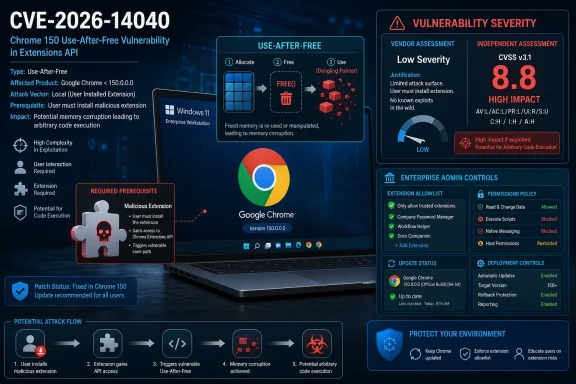
CVE-2026-14040 is, on paper, a familiar Chrome memory-safety issue: a use-after-free condition in a browser component, with the potential for heap corruption. The twist is the delivery mechanism. Google’s description says exploitation depends on convincing a user to install a malicious extension, rather than simply visiting a hostile web page.
That distinction matters. Browser vendors tend to reserve their highest urgency labels for bugs that can be triggered at web scale: a crafted page, a compromised ad network, a drive-by exploit chain, or a renderer-to-sandbox escape sequence. A bug that first requires extension installation sits behind a different gate, and Chromium’s own severity label reflects that.
But the National Vulnerability Database entry adds a second lens. CISA’s ADP enrichment assigned a CVSS 3.1 score of 8.8, with high impact to confidentiality, integrity, and availability. NVD itself had not yet provided its own CVSS assessment as of the July 2 modification noted in the record, leaving administrators with the now-common sight of a vendor severity and an enrichment score that appear to be speaking different languages.
They are not necessarily contradictory. They are measuring different things. Chromium is weighing exploitability in the context of browser security triage; CVSS is scoring the consequence once the attacker clears the prerequisite.
That matters because extensions are not ordinary web pages. Even under Manifest V3’s more constrained model, extensions can request powerful permissions, observe browsing behavior, modify page content, interact with tabs, and influence the user’s browser experience in ways a normal site cannot. Chrome’s extension model is built on permission prompts and store review, but those controls are only as strong as the user’s understanding, the developer’s intent, and the review pipeline’s ability to detect abuse.
A malicious extension is therefore not just “another app.” It is code installed inside the browser’s trust fabric. If such an extension can reach a memory-corruption bug in a browser component, the practical risk begins to look less like a niche corner case and more like the kind of escalation path defenders have learned to take seriously.
This is the gap between vendor severity and operational severity. Google can reasonably call the Chromium security severity low because exploitation requires a user-assisted extension path. A security team can also reasonably treat the same CVE as urgent because browser extensions are one of the messiest software supply chains in the enterprise.
The timing is also awkward in a broader Chrome sense. Chrome 150 has been discussed by users as another milestone in Google’s long-running phaseout of Manifest V2 extensions. Reddit threads and extension-community discussions around the release have focused less on CVEs and more on old extension workarounds breaking, especially for users trying to keep legacy content blockers and other MV2 tools alive.
That context does not make CVE-2026-14040 a Manifest V2 vulnerability. The CVE description points to a crafted Chrome Extension, not to a specific manifest generation. But it does sharpen the tradeoff Google has been pushing for years: extensions are both a core browser feature and a persistent attack surface.
Enterprise IT tends to live in the uncomfortable middle. Users want extensions because they make the browser useful. Security teams want fewer extensions because every add-on is another vendor, another update channel, another permission prompt, and another possible compromise. Chrome 150’s extension drama and this BrowserTag bug are separate events, but they rhyme.
The browser extension store model creates a false sense of containment. Users often assume that if an extension appears in a store, it has been fully vetted. Administrators know better: store review can reduce abuse, but it cannot eliminate malicious updates, abandoned projects sold to new owners, permission creep, typosquatting, or narrowly targeted extensions designed to evade broad detection.
That is why the phrase “user interaction required” can be misleading in enterprise risk conversations. In consumer scoring, it suggests friction. In a corporate environment with thousands of employees, it describes an inevitability. Someone will click, someone will install, and someone will grant a permission they do not fully understand.
The right question is not whether the attacker must trick the user. The right question is whether the organization has limited what happens after the trick succeeds. Extension allowlisting, permission governance, browser management policies, and telemetry all matter more than a training slide that says “don’t install suspicious things.”
Modern Chrome is not the browser of a decade ago. Site isolation, sandboxing, memory allocators, exploit mitigations, and faster patch delivery have raised the cost of exploitation dramatically. Google has also invested heavily in memory-safety work, fuzzing, and hardening across Chromium.
Yet the release notes never quite stop featuring memory-corruption bugs. Some are in rendering. Some are in GPU or graphics layers. Some are in UI components. Some are in extension-related code. The pattern is not that Chrome is uniquely sloppy; it is that browsers are operating systems in miniature, and operating systems in miniature accumulate dangerous edge cases.
CVE-2026-14040 sits in the quieter end of that spectrum. There is no public indication in the supplied NVD record that it has been exploited in the wild. CISA’s SSVC entry lists exploitation as “none” and automatable as “no.” That places it far away from a panic-button zero-day. But “not exploited” is not the same as “not worth patching,” especially once a fix is already available.
It is better understood as a reminder that severity labels are editorial products. They compress assumptions. Vendor severity usually includes exploit preconditions, mitigation context, and product-specific triage. CVSS tries to describe impact and exploit characteristics in a standardized way. SSVC attempts to support decision-making by asking whether exploitation is observed, whether exploitation is automatable, and what the technical impact could be.
Those systems are useful, but none of them replaces judgment. A low-severity Chrome bug may be safely deprioritized on a kiosk with no extension installation allowed and automatic updates enforced. The same bug deserves faster attention in a company where users can install extensions freely and sensitive SaaS workflows live entirely in the browser.
The BrowserTag case is a clean example of why security teams should resist single-number thinking. A CVSS score can tell you the blast radius if the attack lands. A vendor severity can tell you how likely the vendor thinks that landing is. Your environment determines whether the attacker has a runway.
That makes browser patching a first-tier administrative function. Chrome’s automatic updater is good for unmanaged consumers, but enterprises need proof, not hope. Version reporting through endpoint management, browser cloud management, EDR inventory, or software asset tooling should confirm that Chrome has reached 150.0.7871.47 or later.
Extension governance deserves the same seriousness. If users can install anything from the Chrome Web Store, then the organization has effectively delegated part of its endpoint security policy to a marketplace. That may be acceptable for some environments, but it should be a conscious decision, not the default residue of convenience.
Administrators should also remember that Chromium risk is not limited to Google Chrome. Microsoft Edge, Brave, Vivaldi, Opera, and other Chromium-based browsers depend on the same upstream codebase to varying degrees, though each vendor ships on its own schedule and may or may not be affected in exactly the same way. The CVE record here names Google Chrome; other Chromium-based browsers should still be tracked through their own advisories and release channels.
The second move is to review extension policy. Organizations that already operate with an allowlist are in a much better position: the attacker’s first requirement, malicious extension installation, is blocked by design. Organizations that rely on user discretion should at least inventory installed extensions and inspect high-permission add-ons.
The third move is communication. Users do not need a lecture about heap corruption. They need to understand that browser extensions are software, that software can be malicious, and that “just adding a small helper” to Chrome can grant deep access to their workday.
This is where many patch programs fail. They treat browser updates as hygiene but treat extension installs as preference. CVE-2026-14040 shows why those two policies belong together.
 The Low-Severity Bug That Does Not Look Low on a Risk Dashboard
CVE-2026-14040 is, on paper, a familiar Chrome memory-safety issue: a use-after-free condition in a browser component, with the potential for heap corruption. The twist is the delivery mechanism. Google’s description says exploitation depends on convincing a user to install a malicious extension, rather than simply visiting a hostile web page.That distinction matters. Browser vendors tend to reserve their highest urgency labels for bugs that can be triggered at web scale: a crafted page, a compromised ad network, a drive-by exploit chain, or a renderer-to-sandbox escape sequence. A bug that first requires extension installation sits behind a different gate, and Chromium’s own severity label reflects that.
But the National Vulnerability Database entry adds a second lens. CISA’s ADP enrichment assigned a CVSS 3.1 score of 8.8, with high impact to confidentiality, integrity, and availability. NVD itself had not yet provided its own CVSS assessment as of the July 2 modification noted in the record, leaving administrators with the now-common sight of a vendor severity and an enrichment score that appear to be speaking different languages.
They are not necessarily contradictory. They are measuring different things. Chromium is weighing exploitability in the context of browser security triage; CVSS is scoring the consequence once the attacker clears the prerequisite.
BrowserTag Is a Small Name for a Big Trust Boundary
The public record does not yet give us enough technical detail to describe BrowserTag internals with confidence. The linked Chromium issue is access-restricted, which is normal for security bugs while the ecosystem is still catching up. What we can say is that the flaw sits inside Chrome’s browser-side handling rather than being described as a generic web content bug.That matters because extensions are not ordinary web pages. Even under Manifest V3’s more constrained model, extensions can request powerful permissions, observe browsing behavior, modify page content, interact with tabs, and influence the user’s browser experience in ways a normal site cannot. Chrome’s extension model is built on permission prompts and store review, but those controls are only as strong as the user’s understanding, the developer’s intent, and the review pipeline’s ability to detect abuse.
A malicious extension is therefore not just “another app.” It is code installed inside the browser’s trust fabric. If such an extension can reach a memory-corruption bug in a browser component, the practical risk begins to look less like a niche corner case and more like the kind of escalation path defenders have learned to take seriously.
This is the gap between vendor severity and operational severity. Google can reasonably call the Chromium security severity low because exploitation requires a user-assisted extension path. A security team can also reasonably treat the same CVE as urgent because browser extensions are one of the messiest software supply chains in the enterprise.
Chrome 150 Arrives With Security Fixes and Extension Politics in the Background
The fix landed in Chrome 150.0.7871.47, the same version referenced in Google’s Stable Channel update and in NVD’s affected-product configuration. For Windows admins, that means the practical remediation line is straightforward: anything older than 150.0.7871.47 is exposed to this specific issue, and the update should be allowed to complete across managed endpoints.The timing is also awkward in a broader Chrome sense. Chrome 150 has been discussed by users as another milestone in Google’s long-running phaseout of Manifest V2 extensions. Reddit threads and extension-community discussions around the release have focused less on CVEs and more on old extension workarounds breaking, especially for users trying to keep legacy content blockers and other MV2 tools alive.
That context does not make CVE-2026-14040 a Manifest V2 vulnerability. The CVE description points to a crafted Chrome Extension, not to a specific manifest generation. But it does sharpen the tradeoff Google has been pushing for years: extensions are both a core browser feature and a persistent attack surface.
Enterprise IT tends to live in the uncomfortable middle. Users want extensions because they make the browser useful. Security teams want fewer extensions because every add-on is another vendor, another update channel, another permission prompt, and another possible compromise. Chrome 150’s extension drama and this BrowserTag bug are separate events, but they rhyme.
“Install This Extension” Remains One of the Web’s Oldest Social Engineering Tricks
The exploit prerequisite in CVE-2026-14040 should not comfort anyone too much. Convincing users to install extensions is not an exotic attack. Fake productivity tools, coupon add-ons, video downloaders, PDF converters, crypto wallet helpers, AI writing assistants, and “security” extensions have all served as plausible bait at one time or another.The browser extension store model creates a false sense of containment. Users often assume that if an extension appears in a store, it has been fully vetted. Administrators know better: store review can reduce abuse, but it cannot eliminate malicious updates, abandoned projects sold to new owners, permission creep, typosquatting, or narrowly targeted extensions designed to evade broad detection.
That is why the phrase “user interaction required” can be misleading in enterprise risk conversations. In consumer scoring, it suggests friction. In a corporate environment with thousands of employees, it describes an inevitability. Someone will click, someone will install, and someone will grant a permission they do not fully understand.
The right question is not whether the attacker must trick the user. The right question is whether the organization has limited what happens after the trick succeeds. Extension allowlisting, permission governance, browser management policies, and telemetry all matter more than a training slide that says “don’t install suspicious things.”
Use-After-Free Bugs Are the Browser Vulnerability That Refuses to Retire
Use-after-free flaws are old, well-understood, and stubbornly durable. They occur when software continues to reference memory after it has been released, creating an opportunity for corruption if an attacker can shape what occupies that memory next. In browsers, where complex object lifetimes collide with untrusted input, asynchronous events, graphics pipelines, scripting engines, and extension APIs, that class of bug has proven difficult to stamp out.Modern Chrome is not the browser of a decade ago. Site isolation, sandboxing, memory allocators, exploit mitigations, and faster patch delivery have raised the cost of exploitation dramatically. Google has also invested heavily in memory-safety work, fuzzing, and hardening across Chromium.
Yet the release notes never quite stop featuring memory-corruption bugs. Some are in rendering. Some are in GPU or graphics layers. Some are in UI components. Some are in extension-related code. The pattern is not that Chrome is uniquely sloppy; it is that browsers are operating systems in miniature, and operating systems in miniature accumulate dangerous edge cases.
CVE-2026-14040 sits in the quieter end of that spectrum. There is no public indication in the supplied NVD record that it has been exploited in the wild. CISA’s SSVC entry lists exploitation as “none” and automatable as “no.” That places it far away from a panic-button zero-day. But “not exploited” is not the same as “not worth patching,” especially once a fix is already available.
The CVSS Mismatch Is a Warning About How We Talk About Browser Risk
The most confusing part of this CVE is not the bug. It is the scoring. Chromium says low. CISA’s ADP enrichment says 8.8 high. NVD has not yet issued its own CVSS vector. For anyone managing patch queues, that looks like a contradiction begging for a policy exception.It is better understood as a reminder that severity labels are editorial products. They compress assumptions. Vendor severity usually includes exploit preconditions, mitigation context, and product-specific triage. CVSS tries to describe impact and exploit characteristics in a standardized way. SSVC attempts to support decision-making by asking whether exploitation is observed, whether exploitation is automatable, and what the technical impact could be.
Those systems are useful, but none of them replaces judgment. A low-severity Chrome bug may be safely deprioritized on a kiosk with no extension installation allowed and automatic updates enforced. The same bug deserves faster attention in a company where users can install extensions freely and sensitive SaaS workflows live entirely in the browser.
The BrowserTag case is a clean example of why security teams should resist single-number thinking. A CVSS score can tell you the blast radius if the attack lands. A vendor severity can tell you how likely the vendor thinks that landing is. Your environment determines whether the attacker has a runway.
Windows Admins Should Treat Chrome as Managed Infrastructure, Not Userland
For WindowsForum readers, the operational lesson is familiar but still under-applied: Chrome is infrastructure. It is not merely an application that happens to sit on endpoints. It is the runtime for identity providers, admin consoles, payroll systems, CRM platforms, developer tools, internal dashboards, and nearly every modern SaaS workflow.That makes browser patching a first-tier administrative function. Chrome’s automatic updater is good for unmanaged consumers, but enterprises need proof, not hope. Version reporting through endpoint management, browser cloud management, EDR inventory, or software asset tooling should confirm that Chrome has reached 150.0.7871.47 or later.
Extension governance deserves the same seriousness. If users can install anything from the Chrome Web Store, then the organization has effectively delegated part of its endpoint security policy to a marketplace. That may be acceptable for some environments, but it should be a conscious decision, not the default residue of convenience.
Administrators should also remember that Chromium risk is not limited to Google Chrome. Microsoft Edge, Brave, Vivaldi, Opera, and other Chromium-based browsers depend on the same upstream codebase to varying degrees, though each vendor ships on its own schedule and may or may not be affected in exactly the same way. The CVE record here names Google Chrome; other Chromium-based browsers should still be tracked through their own advisories and release channels.
The Practical Fix Is Boring, Which Is Exactly the Point
There is no clever mitigation that beats updating the browser. Chrome 150.0.7871.47 is the remediation boundary named in the CVE record, and anything before it should be considered vulnerable for this issue. On managed Windows fleets, the highest-value action is to confirm installation and relaunch completion, because Chrome updates often stage successfully but do not fully take effect until the browser restarts.The second move is to review extension policy. Organizations that already operate with an allowlist are in a much better position: the attacker’s first requirement, malicious extension installation, is blocked by design. Organizations that rely on user discretion should at least inventory installed extensions and inspect high-permission add-ons.
The third move is communication. Users do not need a lecture about heap corruption. They need to understand that browser extensions are software, that software can be malicious, and that “just adding a small helper” to Chrome can grant deep access to their workday.
This is where many patch programs fail. They treat browser updates as hygiene but treat extension installs as preference. CVE-2026-14040 shows why those two policies belong together.
The Lesson Hidden Inside a Low-Rated Chrome CVE
CVE-2026-14040 is not a five-alarm Chrome emergency. It is more useful than that: it is a compact case study in how browser security actually fails at the edge of policy, permissions, and human behavior. The organizations that come out ahead will not be the ones that argue over whether “low” or “high” is the correct adjective; they will be the ones that already know which extensions are running, which browsers are patched, and which users can change that state.- Chrome installations older than 150.0.7871.47 should be updated, with relaunch completion verified rather than assumed.
- The vulnerability requires a malicious extension path, which makes extension governance the central mitigation rather than a side issue.
- Chromium’s low severity and CISA’s high CVSS enrichment can both be defensible because they emphasize different parts of the risk equation.
- There is no public indication in the provided NVD record that CVE-2026-14040 is being exploited in the wild.
- Managed environments should use extension allowlists, permission review, and browser version telemetry instead of relying on user judgment alone.
References
- Primary source: NVD / Chromium
Published: 2026-07-03T07:00:21-07:00
NVD - CVE-2026-14040
 nvd.nist.gov
- Security advisory: MSRC
Published: 2026-07-03T07:00:21-07:00
Original feed URL
Security Update Guide - Microsoft Security Response Center
 msrc.microsoft.com
- Related coverage: cvefeed.io
CVE-2026-14040 - Google Chrome Use-After-Free in BrowserTag
Use after free in BrowserTag in Google Chrome prior to 150.0.7871.47 allowed an attacker who convinced a user to install a malicious extension to potentially exploit heap corruption via a crafted Chrome Extension. (Chromium security severity: Low)cvefeed.io - Related coverage: radar.offseq.com
CVE-2026-13774: Use after free in Google Chrome - Live Threat Intelligence - Threat Radar | OffSeq.com
Detailed information about CVE-2026-13774: Use after free in Google Chrome affecting Google Chrome. Get real-time updates, technical details, and mitigation strradar.offseq.com