

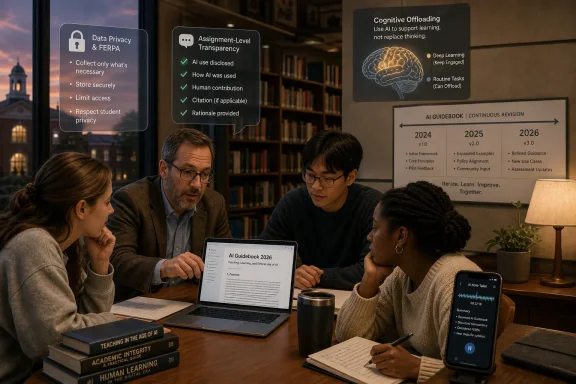
Arkansas State University-Mountain Home has published and repeatedly revised an open AI guidebook for students, faculty, and peer institutions, most recently updating it in 2026 to clarify ethical classroom use, AI note-taking, data privacy, FERPA concerns, and cognitive offloading. The small two-year college is not treating generative AI as a passing academic nuisance. It is treating it as infrastructure — messy, useful, risky, and already embedded in student life. That makes ASU-Mountain Home’s guidebook less a local campus policy document than a snapshot of where higher education is being forced to land: not prohibition, not surrender, but governed use.
As reported by the Arkansas Democrat-Gazette, the guidebook grew out of work led by science faculty member Jessica Clanton, with English faculty member Michael Thomas joining as co-author of the latest version and the college’s Workgroup on Artificial Intelligence supporting the project. The school first published the guide in May 2024, then revised it in 2025 and again in 2026. That revision cycle matters. In the AI era, a policy that sits still for two academic years is not a policy; it is an artifact.
The most interesting thing about ASU-Mountain Home’s AI guide is not that it exists. By 2026, every college with a learning management system, a plagiarism policy, and a nervous faculty senate has had some version of the AI conversation. The interesting thing is that ASU-Mountain Home appears to have moved past the fantasy that institutions can solve AI by announcing a ban and waiting for the semester to behave.
Clanton’s framing, as quoted by the Arkansas Democrat-Gazette, is blunt: AI is “a fact of life.” That is not a marketing slogan. It is a concession to reality. Students are already using ChatGPT, Google Gemini, Microsoft Copilot, AI writing aids, transcription tools, résumé helpers, coding assistants, and browser-integrated summarizers whether or not a syllabus acknowledges them.
The guidebook’s premise is therefore practical rather than utopian. It assumes students need explicit rules, that faculty need adaptable language, and that the same tool can be either legitimate support or academic misconduct depending on the assignment. That is the kind of nuance higher education has often struggled to produce, especially when technology moves faster than committee governance.
The school’s student survey appears to have sharpened that point. According to Clanton, more than 80 percent of respondents wanted more guidance on proper AI use. That is a crucial detail because it undercuts the lazy institutional story that students are simply looking for loopholes. Many are looking for boundaries.
In other words, ASU-Mountain Home is not just policing students. It is acknowledging that unclear rules create their own form of unfairness. If one instructor silently tolerates AI brainstorming, another treats grammar assistance as cheating, and a third has no idea what AI note-takers are doing with class discussions, students are left to reverse-engineer policy from vibes.
But the cheating panic was always too small for the problem. Generative AI did not merely create a new way to plagiarize. It created a new layer of mediation between students and intellectual work. It can summarize, translate, debug, outline, quiz, paraphrase, cite badly, cite convincingly, hallucinate, simplify, flatter, and fabricate — often in the same session.
That is why ASU-Mountain Home’s guidebook is more interesting than a list of forbidden tools. It addresses the ethical use of AI as a matter of learning design, communication, privacy, transparency, and professional preparation. Those are harder problems than “catch the cheater,” and they are the problems colleges actually have to solve.
The guide’s flexibility is also important. Clanton told the Arkansas Democrat-Gazette that instructors may allow broad AI use in some courses or almost none in others, so long as they clearly define the boundaries in advance. That approach respects disciplinary difference. A nursing simulation, an English composition draft, a programming exercise, and an exam in anatomy do not pose the same AI risks.
This is where many institutional policies fail. They write one grand statement about academic integrity and then expect it to govern every classroom interaction. ASU-Mountain Home’s model seems to recognize that the unit of AI policy is often not the college, or even the department. It is the assignment.
When students do not know whether AI use is allowed, they face a perverse set of incentives. The most cautious students avoid helpful tools that could support learning. The most aggressive students use them anyway. The most anxious students spend more time worrying about whether they have crossed a hidden line than thinking about the work itself.
Clear expectations do not eliminate misconduct, but they do make misconduct easier to define. They also make legitimate use less shameful. A student who uses AI to generate practice questions, explain a confusing passage, or identify gaps in a draft should not have to operate as if every interaction with software is a potential confession.
The guidebook’s emphasis on transparency also points toward a healthier academic culture. If AI use is permitted, students can be asked to disclose how they used it. If it is prohibited, the reason can be attached to the learning objective. If partial use is allowed, the permitted zone can be described before the work begins.
That last point is essential. Students are often told that AI should not replace “original thinking,” but that phrase can become uselessly vague unless instructors say what kind of thinking the assignment is meant to measure. Is the goal to test recall, synthesis, revision, source evaluation, rhetorical judgment, coding fluency, or professional communication? AI’s appropriateness depends on the answer.
That level of adoption makes blanket prohibition feel theatrical. A college can declare that AI tools are banned, but students are living in a software ecosystem where AI is increasingly built into search engines, office suites, phones, browsers, coding environments, and note-taking applications. The line between “using AI” and “using normal software” is getting blurrier by the month.
Microsoft Copilot is a useful example for a WindowsForum audience because it shows how fast AI moves from novelty to default surface. What began as a chatbot category is now embedded into productivity software, developer tools, operating system experiences, and enterprise workflows. Google and OpenAI are pushing in the same direction through Gemini and ChatGPT integrations. Students are not walking into a separate AI lab; the AI lab is following them into every text box.
The policy challenge, then, is not whether AI appears on campus. It is whether campuses can describe the conditions under which AI use is educationally meaningful, ethically transparent, and legally safe. A ban may still make sense for some exams, some clinical competencies, some writing assignments, and some early-stage skill building. But as a total institutional posture, prohibition is brittle.
ASU-Mountain Home’s guidebook is important because it treats AI literacy as part of education rather than an exception to it. That does not mean celebrating every tool or trusting every vendor. It means recognizing that students who graduate without learning how to evaluate AI output, protect sensitive data, disclose assisted work, and preserve their own judgment are being underprepared for the workplace they are entering.
The MIT Media Lab study cited in the Arkansas Democrat-Gazette has become part of this debate because it gave a scientific vocabulary to what many instructors were already seeing. The study, posted as a June 2025 preprint under the title “Your Brain on ChatGPT: Accumulation of Cognitive Debt when Using an AI Assistant for Essay Writing Task,” compared participants writing essays with ChatGPT, with search engines, or without outside tools. Reports from Time, Le Monde, and MIT’s own Media Lab coverage emphasized that the ChatGPT group showed lower engagement measures during the writing task and produced work that raised concerns about originality and ownership.
The study should not be oversold. It was a specific essay-writing experiment with a limited participant pool, and as several educators and researchers have noted, lower measured brain activity during tool use does not automatically prove long-term cognitive decline. A calculator reduces the mental burden of arithmetic; that fact alone does not mean calculators rot mathematical reasoning.
But the study still lands because it illuminates the danger of outsourcing too early. If a student asks AI to generate the thesis, structure the argument, select the evidence, draft the prose, and revise the tone, what exactly is left for the student to learn? The issue is not that the final paragraph may sound robotic. The issue is that the learner may never have practiced the internal struggle that produces durable skill.
ASU-Mountain Home’s guidebook appears to understand this distinction. AI can help a student learn to program, as Edwards said it helped her. It can help a tutor create examples, help a reader unpack a dense source, or help a multilingual student clarify phrasing. But if AI becomes the first mover in every intellectual task, the student risks becoming an editor of machine output before becoming a thinker.
That is why the cognitive offloading discussion belongs in policy, not just faculty lounge conversation. Academic integrity has traditionally focused on authorship: did you submit work that was not yours? AI forces a second question: did you bypass the learning process the work was supposed to require? That is harder to detect, but it is closer to the heart of education.
This is where the conversation moves from academic honesty to privacy and compliance. In the United States, colleges must think about the Family Educational Rights and Privacy Act, better known as FERPA, which protects student education records. Not every classroom comment automatically becomes a protected record in the same way, but the more institutions capture, store, identify, and redistribute student information, the more serious the compliance questions become.
AI note-taking also creates consent problems. If one participant invites an automated transcription tool into a meeting, other participants may not realize that their remarks are being recorded or processed. In a classroom, that can chill discussion. In advising, tutoring, disability services, clinical training, or disciplinary settings, it can expose sensitive information.
The enterprise world is already wrestling with similar issues. Microsoft Teams, Zoom, Google Meet, Otter.ai, and a growing fleet of AI assistants can summarize meetings and extract action items. In business settings, administrators can often govern these tools through tenant policies, retention settings, and data-loss prevention controls. In higher education, the environment is messier because students, adjuncts, staff, and outside services may all bring their own tools.
That makes ASU-Mountain Home’s transparency emphasis especially valuable. AI note-takers should not be treated like invisible pens. They are active recording and processing systems. Faculty and staff need to know when they are allowed, what they capture, where the data goes, who can access it, and whether students have meaningful notice.
For IT administrators, this is the part of the story that should ring loudest. The AI policy conversation cannot remain trapped in academic affairs. It now touches identity management, procurement, endpoint controls, accessibility accommodations, records retention, cybersecurity, vendor risk management, and incident response. A guidebook that reminds faculty to think about FERPA is a start; a mature institution will eventually need the technical controls to match.
Open educational resources have long promised scale through sharing. AI policy may be one of the areas where that promise becomes unusually practical. A community college in Arkansas, a rural nursing program, a regional technical institute, and a small liberal arts college may face different local needs, but they share many of the same core questions: what counts as student work, how should AI be disclosed, what data should never be entered, and how do instructors communicate assignment-level rules?
The guidebook’s modularity matters here. Clanton told the Arkansas Democrat-Gazette that institutions can use existing policies rather than making sweeping changes, adjusting ready-made resources to fit local needs. That is a sensible posture because AI does not erase every old category. Plagiarism, privacy, accessibility, acceptable use, data protection, and professional ethics already have institutional homes.
The trick is mapping AI onto those homes without pretending nothing has changed. Existing academic integrity policies can cover undisclosed authorship substitution, but they may not explain acceptable AI brainstorming. Existing privacy policies can cover sensitive data, but they may not mention consumer chatbots or AI transcription. Existing classroom technology rules can cover recordings, but they may not account for automated summaries generated by third parties.
An open guidebook helps institutions avoid both extremes: panic-driven reinvention and complacent copy-paste. It gives faculty language, administrators a starting point, and students a visible framework. Just as important, it can be revised in public as norms evolve.
That revision process may be the most honest part of the whole project. ASU-Mountain Home updated the guide in 2025 and again in 2026 because the ground moved. That is how AI governance will have to work for the foreseeable future: versioned, revisable, and humble enough to admit that today’s good answer may need editing by next spring.
But faculty autonomy cannot be the entire governance model. If every instructor invents their own AI policy from scratch, students experience the institution as a maze. Worse, faculty who are less familiar with the technology may write rules that are unenforceable, unclear, or accidentally punitive.
The best version of the ASU-Mountain Home model seems to be layered. The institution provides shared principles, policy language, privacy warnings, and examples. Faculty then adapt those materials to specific courses and assignments. Students receive consistent categories, even when the permissions differ.
That kind of structure is especially important for adjunct instructors and high-turnover programs. Not every instructor has time to track changes in ChatGPT, Gemini, Copilot, Claude, Perplexity, Grammarly, Turnitin, Zoom, Teams, and whatever AI feature was added to a browser last week. A central guide lowers the cost of responsible teaching.
It also protects faculty from having to become forensic AI detectors. The early market for AI detection tools promised more certainty than it could deliver, and false positives can be devastating for students. A policy built around clear expectations, process documentation, and assignment design is less flashy than a detector dashboard, but it is more educationally defensible.
That does not mean enforcement disappears. It means enforcement is tied to stated rules. If an instructor says AI may be used for brainstorming but not drafting, students can be asked to submit prompts, notes, outlines, drafts, or reflection statements. If AI is prohibited on an exam, the institution can treat unauthorized use like any other exam violation. The clarity comes first.
In the workplace, AI mistakes have consequences beyond a grade. A worker who pastes confidential data into a public chatbot may create a privacy breach. A manager who uses AI-generated summaries without checking them may make decisions from fabricated details. A developer who accepts generated code without review may introduce a vulnerability. A health worker who overtrusts AI output may endanger care.
These are not science-fiction scenarios. They are ordinary governance problems in AI-enabled offices. The employee who knows how to use AI transparently, verify output, protect sensitive data, and recognize when human judgment is required will be more valuable than the employee who merely knows how to generate fluent text.
That is why ASU-Mountain Home’s guidebook should interest IT pros beyond education. The same habits apply in enterprise environments. Define acceptable use. Identify prohibited data. Require disclosure where appropriate. Train users to validate output. Distinguish between assistance and delegation. Review vendor terms. Control recording and transcription tools. Update the rules as the tools change.
The difference is that colleges have to teach these habits while also preserving learning. In a business setting, using AI to accelerate a routine email may be fine. In a writing course, the same behavior might defeat the assignment. In a coding job, Copilot may be an expected productivity tool. In an introductory programming class, unrestricted code generation may prevent students from understanding loops, state, and error handling.
That tension is not a reason to avoid AI. It is a reason to be precise. The workplace does not need graduates who have never touched AI. It needs graduates who know when AI is useful, when it is unsafe, and when it is doing the thinking they were hired to do.
For Windows users and administrators, Microsoft’s role is especially consequential. Copilot is not simply a chatbot website. It is part of Microsoft’s broader attempt to make AI a user interface across Windows, Microsoft 365, Edge, GitHub, security tooling, and enterprise management. Whether one likes that direction or not, it means AI literacy is becoming part of basic digital literacy in Microsoft-centric environments.
Google is making a parallel move through Gemini in Workspace, Android, search, and developer services. OpenAI continues to push ChatGPT as a general-purpose assistant, with education, coding, research, and productivity use cases converging into one interface. Students move among these tools without necessarily understanding their data practices, limitations, or institutional acceptability.
That platform reality limits what any campus can control. A college can block a site on its network, but students have phones. It can ban a tool in a course, but AI may appear inside software that remains allowed. It can ask for disclosure, but it must define what counts as AI assistance when spellcheckers, grammar tools, translation systems, and search summaries increasingly use machine learning.
This is why the guidebook model is stronger than a tool blacklist. Tool lists age quickly. Principles age more slowly. The names will change, the interfaces will merge, and some features that seem exotic now will become ordinary. Students still need the same core judgment: what am I allowed to do, what am I expected to learn, what data am I exposing, and can I defend the accuracy of what I submit?
The platform companies will continue to sell AI as empowerment. Colleges have to add the harder sentence: empowerment without judgment is just automation with a prettier interface.
The new honor code has to be more procedural. It must ask students to describe process, not just ownership. Did you use AI to brainstorm? Did you ask it to draft? Did you revise AI-generated text? Did you verify sources? Did you submit output you did not understand? Did the assignment permit that use?
This may sound bureaucratic, but it is closer to how professional accountability works. Engineers document assumptions. Nurses chart care. Lawyers track sources and responsibility. IT teams maintain audit logs. Writers disclose conflicts and correct errors. Process is part of integrity.
For faculty, this shift can also improve assignment design. If a task can be completed acceptably by asking a chatbot for a generic answer, perhaps the task needs more local context, staged drafting, oral defense, data analysis, reflection, or in-class work. AI does not make traditional assignments worthless, but it does reveal which ones were already vulnerable to low-engagement completion.
For students, process-based policy can reduce fear. Instead of wondering whether an invisible detector will accuse them, they can learn to keep records of legitimate assistance. They can cite AI use in a course-approved way. They can understand that disclosure is not punishment; it is part of responsible practice.
The challenge is cultural. Institutions must avoid creating a surveillance atmosphere in which every student is treated as suspect. The better approach is to normalize AI process literacy the same way colleges normalized citation, lab notebooks, revision history, and source evaluation. The message should be firm but not paranoid: tools are allowed when the learning goal allows them, and honesty about process is part of the work.
That modesty is a strength. The most durable AI governance may emerge not from grand manifestos but from iterative documents written by faculty who have to face students on Monday morning. They know where ambiguity causes friction. They know which assignments break. They know which students are using AI to cheat and which are using it to survive.
Community and regional institutions also serve students for whom AI may be an equalizer. Edwards’ comment that AI helped her learn programming and support tutoring is a reminder that these tools are not merely shortcuts for the lazy. For students with limited prior access, uneven preparation, work obligations, disabilities, language barriers, or scarce tutoring resources, AI can offer immediate support that institutions cannot always staff at scale.
That is the argument for ethical use rather than reflexive suspicion. A good policy protects learning without denying students access to useful tools. It recognizes that the same AI assistant can help one student understand a concept and help another avoid understanding it. The difference lies in context, intention, transparency, and design.
ASU-Mountain Home’s guidebook seems built around that uncomfortable duality. AI can be “extremely beneficial,” as Edwards said, and still dangerous when used incorrectly. It can prepare students for work and undermine their learning. It can widen access and deepen dependency. An honest guide has to hold all of that at once.
A 2024 guidebook updated in 2025 and again in 2026 is a policy lifecycle, not a one-off announcement. The inclusion of student survey results is user research. The addition of note-taking tools and cognitive offloading is feature response. The open sharing with other institutions is distribution. The analogy is not perfect, but it is useful.
For WindowsForum readers, that should sound familiar. IT departments already know that acceptable-use rules must evolve as endpoints, cloud services, identity systems, collaboration platforms, and threat models change. AI simply brings that maintenance burden into the classroom with unusual speed.
The institutions that do this well will not be the ones with the most dramatic AI slogan. They will be the ones with clear assignment language, trained faculty, privacy-aware tool policies, student-facing examples, and a habit of revision. They will have enough central governance to avoid chaos and enough local flexibility to preserve teaching judgment.
The institutions that do it poorly will either pretend AI can be banned everywhere or allow it everywhere without asking what it does to learning. Both paths are easier than governance. Both paths fail students.
As reported by the Arkansas Democrat-Gazette, the guidebook grew out of work led by science faculty member Jessica Clanton, with English faculty member Michael Thomas joining as co-author of the latest version and the college’s Workgroup on Artificial Intelligence supporting the project. The school first published the guide in May 2024, then revised it in 2025 and again in 2026. That revision cycle matters. In the AI era, a policy that sits still for two academic years is not a policy; it is an artifact.
 A Small Arkansas Campus Is Saying the Quiet Part Out Loud
The most interesting thing about ASU-Mountain Home’s AI guide is not that it exists. By 2026, every college with a learning management system, a plagiarism policy, and a nervous faculty senate has had some version of the AI conversation. The interesting thing is that ASU-Mountain Home appears to have moved past the fantasy that institutions can solve AI by announcing a ban and waiting for the semester to behave.Clanton’s framing, as quoted by the Arkansas Democrat-Gazette, is blunt: AI is “a fact of life.” That is not a marketing slogan. It is a concession to reality. Students are already using ChatGPT, Google Gemini, Microsoft Copilot, AI writing aids, transcription tools, résumé helpers, coding assistants, and browser-integrated summarizers whether or not a syllabus acknowledges them.
The guidebook’s premise is therefore practical rather than utopian. It assumes students need explicit rules, that faculty need adaptable language, and that the same tool can be either legitimate support or academic misconduct depending on the assignment. That is the kind of nuance higher education has often struggled to produce, especially when technology moves faster than committee governance.
The school’s student survey appears to have sharpened that point. According to Clanton, more than 80 percent of respondents wanted more guidance on proper AI use. That is a crucial detail because it undercuts the lazy institutional story that students are simply looking for loopholes. Many are looking for boundaries.
In other words, ASU-Mountain Home is not just policing students. It is acknowledging that unclear rules create their own form of unfairness. If one instructor silently tolerates AI brainstorming, another treats grammar assistance as cheating, and a third has no idea what AI note-takers are doing with class discussions, students are left to reverse-engineer policy from vibes.
The Cheating Panic Was Too Small for the Problem
For much of 2023 and 2024, campus AI debates were trapped inside one narrow question: how do we stop students from submitting machine-written essays? That was an understandable first reaction. ChatGPT arrived with the uncanny ability to produce plausible prose at scale, and the traditional essay suddenly looked less like a secure assessment than an unlocked door.But the cheating panic was always too small for the problem. Generative AI did not merely create a new way to plagiarize. It created a new layer of mediation between students and intellectual work. It can summarize, translate, debug, outline, quiz, paraphrase, cite badly, cite convincingly, hallucinate, simplify, flatter, and fabricate — often in the same session.
That is why ASU-Mountain Home’s guidebook is more interesting than a list of forbidden tools. It addresses the ethical use of AI as a matter of learning design, communication, privacy, transparency, and professional preparation. Those are harder problems than “catch the cheater,” and they are the problems colleges actually have to solve.
The guide’s flexibility is also important. Clanton told the Arkansas Democrat-Gazette that instructors may allow broad AI use in some courses or almost none in others, so long as they clearly define the boundaries in advance. That approach respects disciplinary difference. A nursing simulation, an English composition draft, a programming exercise, and an exam in anatomy do not pose the same AI risks.
This is where many institutional policies fail. They write one grand statement about academic integrity and then expect it to govern every classroom interaction. ASU-Mountain Home’s model seems to recognize that the unit of AI policy is often not the college, or even the department. It is the assignment.
Students Do Not Need Mystery Rules
Miranda Edwards, the ASU-Mountain Home nursing student and tutor who contributed to the guidebook revision, put the student-side problem plainly in the Arkansas Democrat-Gazette: students should not be “guessing” how much AI use is permitted. That sentence deserves more attention than most institutional AI statements will give it. Guessing is not rigor. Guessing is institutional ambiguity passed downward.When students do not know whether AI use is allowed, they face a perverse set of incentives. The most cautious students avoid helpful tools that could support learning. The most aggressive students use them anyway. The most anxious students spend more time worrying about whether they have crossed a hidden line than thinking about the work itself.
Clear expectations do not eliminate misconduct, but they do make misconduct easier to define. They also make legitimate use less shameful. A student who uses AI to generate practice questions, explain a confusing passage, or identify gaps in a draft should not have to operate as if every interaction with software is a potential confession.
The guidebook’s emphasis on transparency also points toward a healthier academic culture. If AI use is permitted, students can be asked to disclose how they used it. If it is prohibited, the reason can be attached to the learning objective. If partial use is allowed, the permitted zone can be described before the work begins.
That last point is essential. Students are often told that AI should not replace “original thinking,” but that phrase can become uselessly vague unless instructors say what kind of thinking the assignment is meant to measure. Is the goal to test recall, synthesis, revision, source evaluation, rhetorical judgment, coding fluency, or professional communication? AI’s appropriateness depends on the answer.
The Gallup Numbers Make Prohibition Look Like Theater
The broader data makes ASU-Mountain Home’s approach look less optional than inevitable. Gallup and the Lumina Foundation reported in their 2026 State of Higher Education work that 57 percent of U.S. college students use AI tools for coursework at least weekly, including roughly one in five who use them daily. Those figures, based on surveys conducted in fall 2025, describe a campus reality that has already arrived.That level of adoption makes blanket prohibition feel theatrical. A college can declare that AI tools are banned, but students are living in a software ecosystem where AI is increasingly built into search engines, office suites, phones, browsers, coding environments, and note-taking applications. The line between “using AI” and “using normal software” is getting blurrier by the month.
Microsoft Copilot is a useful example for a WindowsForum audience because it shows how fast AI moves from novelty to default surface. What began as a chatbot category is now embedded into productivity software, developer tools, operating system experiences, and enterprise workflows. Google and OpenAI are pushing in the same direction through Gemini and ChatGPT integrations. Students are not walking into a separate AI lab; the AI lab is following them into every text box.
The policy challenge, then, is not whether AI appears on campus. It is whether campuses can describe the conditions under which AI use is educationally meaningful, ethically transparent, and legally safe. A ban may still make sense for some exams, some clinical competencies, some writing assignments, and some early-stage skill building. But as a total institutional posture, prohibition is brittle.
ASU-Mountain Home’s guidebook is important because it treats AI literacy as part of education rather than an exception to it. That does not mean celebrating every tool or trusting every vendor. It means recognizing that students who graduate without learning how to evaluate AI output, protect sensitive data, disclose assisted work, and preserve their own judgment are being underprepared for the workplace they are entering.
Cognitive Offloading Is the Real Academic Integrity Problem
The most timely addition to the guidebook may be its section on cognitive offloading. That phrase sounds academic, but the concern is simple: students can use AI in ways that support thinking, or they can use AI in ways that replace the very mental work an assignment was designed to build. The distinction is not moral panic. It is pedagogy.The MIT Media Lab study cited in the Arkansas Democrat-Gazette has become part of this debate because it gave a scientific vocabulary to what many instructors were already seeing. The study, posted as a June 2025 preprint under the title “Your Brain on ChatGPT: Accumulation of Cognitive Debt when Using an AI Assistant for Essay Writing Task,” compared participants writing essays with ChatGPT, with search engines, or without outside tools. Reports from Time, Le Monde, and MIT’s own Media Lab coverage emphasized that the ChatGPT group showed lower engagement measures during the writing task and produced work that raised concerns about originality and ownership.
The study should not be oversold. It was a specific essay-writing experiment with a limited participant pool, and as several educators and researchers have noted, lower measured brain activity during tool use does not automatically prove long-term cognitive decline. A calculator reduces the mental burden of arithmetic; that fact alone does not mean calculators rot mathematical reasoning.
But the study still lands because it illuminates the danger of outsourcing too early. If a student asks AI to generate the thesis, structure the argument, select the evidence, draft the prose, and revise the tone, what exactly is left for the student to learn? The issue is not that the final paragraph may sound robotic. The issue is that the learner may never have practiced the internal struggle that produces durable skill.
ASU-Mountain Home’s guidebook appears to understand this distinction. AI can help a student learn to program, as Edwards said it helped her. It can help a tutor create examples, help a reader unpack a dense source, or help a multilingual student clarify phrasing. But if AI becomes the first mover in every intellectual task, the student risks becoming an editor of machine output before becoming a thinker.
That is why the cognitive offloading discussion belongs in policy, not just faculty lounge conversation. Academic integrity has traditionally focused on authorship: did you submit work that was not yours? AI forces a second question: did you bypass the learning process the work was supposed to require? That is harder to detect, but it is closer to the heart of education.
The Note-Taker Problem Brings Privacy Into the Classroom
The guidebook’s new attention to AI-powered meeting tools and transcription apps is another sign that the AI debate is maturing. A student using ChatGPT to polish a paragraph is one kind of issue. A bot joining a class, recording discussion, generating summaries, storing transcripts, and possibly processing data through third-party systems is another.This is where the conversation moves from academic honesty to privacy and compliance. In the United States, colleges must think about the Family Educational Rights and Privacy Act, better known as FERPA, which protects student education records. Not every classroom comment automatically becomes a protected record in the same way, but the more institutions capture, store, identify, and redistribute student information, the more serious the compliance questions become.
AI note-taking also creates consent problems. If one participant invites an automated transcription tool into a meeting, other participants may not realize that their remarks are being recorded or processed. In a classroom, that can chill discussion. In advising, tutoring, disability services, clinical training, or disciplinary settings, it can expose sensitive information.
The enterprise world is already wrestling with similar issues. Microsoft Teams, Zoom, Google Meet, Otter.ai, and a growing fleet of AI assistants can summarize meetings and extract action items. In business settings, administrators can often govern these tools through tenant policies, retention settings, and data-loss prevention controls. In higher education, the environment is messier because students, adjuncts, staff, and outside services may all bring their own tools.
That makes ASU-Mountain Home’s transparency emphasis especially valuable. AI note-takers should not be treated like invisible pens. They are active recording and processing systems. Faculty and staff need to know when they are allowed, what they capture, where the data goes, who can access it, and whether students have meaningful notice.
For IT administrators, this is the part of the story that should ring loudest. The AI policy conversation cannot remain trapped in academic affairs. It now touches identity management, procurement, endpoint controls, accessibility accommodations, records retention, cybersecurity, vendor risk management, and incident response. A guidebook that reminds faculty to think about FERPA is a start; a mature institution will eventually need the technical controls to match.
Open Source Is a Governance Strategy, Not Just a Nice Gesture
Chancellor Bentley Wallace described the guidebook as an “open-sourced document” shared with other colleges and universities, according to the Arkansas Democrat-Gazette. In higher education, that choice is more than civic generosity. It is a recognition that small institutions cannot each reinvent AI governance from scratch every semester.Open educational resources have long promised scale through sharing. AI policy may be one of the areas where that promise becomes unusually practical. A community college in Arkansas, a rural nursing program, a regional technical institute, and a small liberal arts college may face different local needs, but they share many of the same core questions: what counts as student work, how should AI be disclosed, what data should never be entered, and how do instructors communicate assignment-level rules?
The guidebook’s modularity matters here. Clanton told the Arkansas Democrat-Gazette that institutions can use existing policies rather than making sweeping changes, adjusting ready-made resources to fit local needs. That is a sensible posture because AI does not erase every old category. Plagiarism, privacy, accessibility, acceptable use, data protection, and professional ethics already have institutional homes.
The trick is mapping AI onto those homes without pretending nothing has changed. Existing academic integrity policies can cover undisclosed authorship substitution, but they may not explain acceptable AI brainstorming. Existing privacy policies can cover sensitive data, but they may not mention consumer chatbots or AI transcription. Existing classroom technology rules can cover recordings, but they may not account for automated summaries generated by third parties.
An open guidebook helps institutions avoid both extremes: panic-driven reinvention and complacent copy-paste. It gives faculty language, administrators a starting point, and students a visible framework. Just as important, it can be revised in public as norms evolve.
That revision process may be the most honest part of the whole project. ASU-Mountain Home updated the guide in 2025 and again in 2026 because the ground moved. That is how AI governance will have to work for the foreseeable future: versioned, revisable, and humble enough to admit that today’s good answer may need editing by next spring.
Faculty Autonomy Still Needs Institutional Backstops
One appealing feature of ASU-Mountain Home’s approach is that it preserves instructor discretion. Clanton may prohibit AI on exams while allowing it for some activities and assignments. Another faculty member may choose a different balance. That is appropriate because teaching is contextual work.But faculty autonomy cannot be the entire governance model. If every instructor invents their own AI policy from scratch, students experience the institution as a maze. Worse, faculty who are less familiar with the technology may write rules that are unenforceable, unclear, or accidentally punitive.
The best version of the ASU-Mountain Home model seems to be layered. The institution provides shared principles, policy language, privacy warnings, and examples. Faculty then adapt those materials to specific courses and assignments. Students receive consistent categories, even when the permissions differ.
That kind of structure is especially important for adjunct instructors and high-turnover programs. Not every instructor has time to track changes in ChatGPT, Gemini, Copilot, Claude, Perplexity, Grammarly, Turnitin, Zoom, Teams, and whatever AI feature was added to a browser last week. A central guide lowers the cost of responsible teaching.
It also protects faculty from having to become forensic AI detectors. The early market for AI detection tools promised more certainty than it could deliver, and false positives can be devastating for students. A policy built around clear expectations, process documentation, and assignment design is less flashy than a detector dashboard, but it is more educationally defensible.
That does not mean enforcement disappears. It means enforcement is tied to stated rules. If an instructor says AI may be used for brainstorming but not drafting, students can be asked to submit prompts, notes, outlines, drafts, or reflection statements. If AI is prohibited on an exam, the institution can treat unauthorized use like any other exam violation. The clarity comes first.
The Workplace Argument Is Stronger Than the Hype
Edwards told the Arkansas Democrat-Gazette that the guidebook will help students with AI use in the workplace. That claim is easy to wave away as the usual “career readiness” language, but in this case it is probably correct. Students are not merely learning how to pass courses with AI. They are learning how not to get themselves, their patients, their clients, or their employers into trouble.In the workplace, AI mistakes have consequences beyond a grade. A worker who pastes confidential data into a public chatbot may create a privacy breach. A manager who uses AI-generated summaries without checking them may make decisions from fabricated details. A developer who accepts generated code without review may introduce a vulnerability. A health worker who overtrusts AI output may endanger care.
These are not science-fiction scenarios. They are ordinary governance problems in AI-enabled offices. The employee who knows how to use AI transparently, verify output, protect sensitive data, and recognize when human judgment is required will be more valuable than the employee who merely knows how to generate fluent text.
That is why ASU-Mountain Home’s guidebook should interest IT pros beyond education. The same habits apply in enterprise environments. Define acceptable use. Identify prohibited data. Require disclosure where appropriate. Train users to validate output. Distinguish between assistance and delegation. Review vendor terms. Control recording and transcription tools. Update the rules as the tools change.
The difference is that colleges have to teach these habits while also preserving learning. In a business setting, using AI to accelerate a routine email may be fine. In a writing course, the same behavior might defeat the assignment. In a coding job, Copilot may be an expected productivity tool. In an introductory programming class, unrestricted code generation may prevent students from understanding loops, state, and error handling.
That tension is not a reason to avoid AI. It is a reason to be precise. The workplace does not need graduates who have never touched AI. It needs graduates who know when AI is useful, when it is unsafe, and when it is doing the thinking they were hired to do.
Microsoft, Google, and OpenAI Have Already Changed the Default
The guidebook names the tools students are actually using: OpenAI’s ChatGPT, Google Gemini, and Microsoft Copilot. That naming matters. Higher education is not dealing with obscure academic software. It is dealing with products backed by some of the largest platform companies in the world.For Windows users and administrators, Microsoft’s role is especially consequential. Copilot is not simply a chatbot website. It is part of Microsoft’s broader attempt to make AI a user interface across Windows, Microsoft 365, Edge, GitHub, security tooling, and enterprise management. Whether one likes that direction or not, it means AI literacy is becoming part of basic digital literacy in Microsoft-centric environments.
Google is making a parallel move through Gemini in Workspace, Android, search, and developer services. OpenAI continues to push ChatGPT as a general-purpose assistant, with education, coding, research, and productivity use cases converging into one interface. Students move among these tools without necessarily understanding their data practices, limitations, or institutional acceptability.
That platform reality limits what any campus can control. A college can block a site on its network, but students have phones. It can ban a tool in a course, but AI may appear inside software that remains allowed. It can ask for disclosure, but it must define what counts as AI assistance when spellcheckers, grammar tools, translation systems, and search summaries increasingly use machine learning.
This is why the guidebook model is stronger than a tool blacklist. Tool lists age quickly. Principles age more slowly. The names will change, the interfaces will merge, and some features that seem exotic now will become ordinary. Students still need the same core judgment: what am I allowed to do, what am I expected to learn, what data am I exposing, and can I defend the accuracy of what I submit?
The platform companies will continue to sell AI as empowerment. Colleges have to add the harder sentence: empowerment without judgment is just automation with a prettier interface.
The New Honor Code Has to Be Operational
Academic honor codes traditionally rely on a shared moral language: do your own work, do not cheat, do not plagiarize. That language remains necessary, but AI exposes its operational weakness. Students can sincerely believe they are “doing their own work” while accepting extensive machine-generated structure, phrasing, and analysis.The new honor code has to be more procedural. It must ask students to describe process, not just ownership. Did you use AI to brainstorm? Did you ask it to draft? Did you revise AI-generated text? Did you verify sources? Did you submit output you did not understand? Did the assignment permit that use?
This may sound bureaucratic, but it is closer to how professional accountability works. Engineers document assumptions. Nurses chart care. Lawyers track sources and responsibility. IT teams maintain audit logs. Writers disclose conflicts and correct errors. Process is part of integrity.
For faculty, this shift can also improve assignment design. If a task can be completed acceptably by asking a chatbot for a generic answer, perhaps the task needs more local context, staged drafting, oral defense, data analysis, reflection, or in-class work. AI does not make traditional assignments worthless, but it does reveal which ones were already vulnerable to low-engagement completion.
For students, process-based policy can reduce fear. Instead of wondering whether an invisible detector will accuse them, they can learn to keep records of legitimate assistance. They can cite AI use in a course-approved way. They can understand that disclosure is not punishment; it is part of responsible practice.
The challenge is cultural. Institutions must avoid creating a surveillance atmosphere in which every student is treated as suspect. The better approach is to normalize AI process literacy the same way colleges normalized citation, lab notebooks, revision history, and source evaluation. The message should be firm but not paranoid: tools are allowed when the learning goal allows them, and honesty about process is part of the work.
The Mountain Home Model Is Modest, Which Is Why It Matters
There is a temptation in AI coverage to focus only on elite universities, giant ed-tech vendors, and sweeping claims about the future of knowledge work. ASU-Mountain Home’s guidebook is a useful corrective because it is modest. It does not claim to have solved AI. It gives people language for the next semester.That modesty is a strength. The most durable AI governance may emerge not from grand manifestos but from iterative documents written by faculty who have to face students on Monday morning. They know where ambiguity causes friction. They know which assignments break. They know which students are using AI to cheat and which are using it to survive.
Community and regional institutions also serve students for whom AI may be an equalizer. Edwards’ comment that AI helped her learn programming and support tutoring is a reminder that these tools are not merely shortcuts for the lazy. For students with limited prior access, uneven preparation, work obligations, disabilities, language barriers, or scarce tutoring resources, AI can offer immediate support that institutions cannot always staff at scale.
That is the argument for ethical use rather than reflexive suspicion. A good policy protects learning without denying students access to useful tools. It recognizes that the same AI assistant can help one student understand a concept and help another avoid understanding it. The difference lies in context, intention, transparency, and design.
ASU-Mountain Home’s guidebook seems built around that uncomfortable duality. AI can be “extremely beneficial,” as Edwards said, and still dangerous when used incorrectly. It can prepare students for work and undermine their learning. It can widen access and deepen dependency. An honest guide has to hold all of that at once.
The Practical Lesson Is That AI Policy Now Has to Behave Like Software
The clearest lesson from ASU-Mountain Home’s approach is that AI policy can no longer be written like a static handbook paragraph. It has to behave more like software: versioned, maintained, modular, and responsive to user feedback. That is a cultural shift for institutions that often move slowly by design.A 2024 guidebook updated in 2025 and again in 2026 is a policy lifecycle, not a one-off announcement. The inclusion of student survey results is user research. The addition of note-taking tools and cognitive offloading is feature response. The open sharing with other institutions is distribution. The analogy is not perfect, but it is useful.
For WindowsForum readers, that should sound familiar. IT departments already know that acceptable-use rules must evolve as endpoints, cloud services, identity systems, collaboration platforms, and threat models change. AI simply brings that maintenance burden into the classroom with unusual speed.
The institutions that do this well will not be the ones with the most dramatic AI slogan. They will be the ones with clear assignment language, trained faculty, privacy-aware tool policies, student-facing examples, and a habit of revision. They will have enough central governance to avoid chaos and enough local flexibility to preserve teaching judgment.
The institutions that do it poorly will either pretend AI can be banned everywhere or allow it everywhere without asking what it does to learning. Both paths are easier than governance. Both paths fail students.
The Semester-by-Semester Rules Are Becoming the Real Curriculum
ASU-Mountain Home’s guidebook is not a national standard, but it offers a useful template for what responsible AI adoption in education now looks like. The most concrete lessons are not abstract principles; they are operational habits that students, faculty, and IT leaders can act on.- Colleges should define AI permissions at the assignment level because a single campus-wide rule cannot sensibly govern exams, essays, coding labs, clinical work, tutoring, and routine study support.
- Students should be told in advance when AI is allowed, when it is prohibited, and when disclosure of prompts, drafts, or assistance is expected.
- Faculty should treat cognitive offloading as a learning-design problem, not merely a cheating problem, because the central risk is often the loss of practice rather than the presence of software.
- AI note-takers and transcription tools should be governed as recording and data-processing systems, especially when classroom discussion, advising, tutoring, or FERPA-related information may be involved.
- Institutions should revise AI guidance regularly because the tools, integrations, and student behaviors are changing faster than traditional academic policy cycles.
- AI literacy should be framed as workplace preparation, but only if students also learn verification, privacy discipline, disclosure, and the limits of automated output.
References
- Primary source: The Arkansas Democrat-Gazette
Published: 2026-07-04T01:50:18.734704
Loading…
www.arkansasonline.com