

Tesla’s refreshed Model 3 Performance was effectively previewed in April 2024 when Tesla website source code exposed references to new adaptive suspension, Track Mode V3, redesigned aero pieces, sport seats, and more than 500 combined horsepower before the car’s formal launch. The leak, first surfaced by Tesla Motors Club sleuths and amplified by Electrek and Mashable, mattered because it showed Tesla’s own site doing what Tesla’s PR operation often refuses to do: explain the product. A hidden feature list became the closest thing to a pre-launch briefing. For a company that treats silence as strategy, the source code was unusually chatty.
The most interesting thing about the Model 3 Performance leak was not that the car existed. By then, camouflaged sightings, Malibu presentation chatter, and enthusiast decoding had already made the return of a hot Model 3 feel inevitable. The revelation was that Tesla’s own site appeared to contain a near-complete marketing skeleton for the car, down to copy about adaptive damping, forged wheels, brake heat management, and a carbon-fiber interior treatment.
Mashable reported that the feature list was visible in the source code of Tesla’s UK site, and InsideEVs, Carscoops, and other EV outlets corroborated the same broad details. The code reportedly described “all-new high-performance drive units” delivering more than 500 combined horsepower, while leaving the 0–60 mph figure as a placeholder. That placeholder mattered: it showed the page was not random debris, but a launch asset waiting for final values.
The leak also settled, or at least narrowed, one branding fight. Enthusiasts had been calling the car “Ludicrous” because prototype badging and earlier references hinted at Tesla’s old performance vocabulary. But the leaked copy overwhelmingly used Model 3 Performance, suggesting Tesla was more interested in continuity than theatrics.
That was the right call. “Ludicrous” made sense when Tesla was still trying to turn EV acceleration into a circus act. The refreshed Model 3 Performance needed to prove something more mature: that Tesla could build a sharper driver’s car, not merely a quicker stoplight weapon.
But horsepower was never the whole story. The outgoing Model 3 Performance was already absurdly quick by normal sedan standards, and the cheaper Long Range variants had long blurred the line between commuter car and stealth missile. Tesla did not need only more thrust; it needed a better argument for why the Performance trim should exist.
That argument came through in the hardware details. Adaptive suspension, revised chassis tuning, staggered forged wheels, stronger braking consistency, and bolstered ventilated sport seats all pointed to a car aimed at repeatable performance rather than one launch-control party trick. The leaked copy’s emphasis on high-speed stability and heat management was more revealing than the power figure.
This is where Tesla’s product maturity shows. Early EV performance was about embarrassing gasoline cars in a straight line. The newer problem is harder: making a heavy, battery-powered sedan feel controlled, durable, and communicative when driven hard for more than ten seconds.
That is a very Tesla way to solve a car problem. Traditional performance brands sell mechanical theater: steering racks, dampers, limited-slip differentials, brake packages, exhaust notes, transmission maps. Tesla sells a systems layer, where hardware exists but the software is the star.
There is a risk in that approach. A performance car cannot be entirely abstracted into sliders and calibration tables, because the best ones communicate through the seat, wheel, and brake pedal before they communicate through a screen. Still, Tesla’s strength has always been integration, and Track Mode V3 sounded less like a gimmick than a recognition that performance EVs need orchestration.
The adaptive suspension was especially important. The standard refreshed Model 3, often called “Highland,” improved ride comfort and cabin refinement, but a Performance variant has to live in a narrower band. It must be firm without becoming brittle, playful without becoming nervous, and comfortable enough that owners do not regret choosing the fast one every Monday morning.
By 2024, EV acceleration was no longer a Tesla-only party trick. Hyundai, Kia, Porsche, Lucid, BMW, Mercedes, and others had all learned how to make electric torque feel dramatic. The mere promise of a silly mode name was not enough to separate a Model 3 from the pack.
Keeping the Model 3 Performance badge made the car easier to understand. It told buyers that this was the return of the top Model 3 trim after the Highland refresh, not a strange sub-brand experiment. It also kept attention on the actual engineering changes.
There is a larger branding lesson here. Tesla no longer needs to convince the world that electric cars can be fast. It needs to convince buyers that its fast cars are polished, durable, and worth choosing in an increasingly crowded EV market.
That dynamic suits Tesla because its fan base treats product forensics like sport. Website code, parts catalogs, homologation filings, app strings, delivery estimates, and configurator changes are all mined for clues. The company benefits from this unpaid intelligence network, even when it occasionally loses control of the timing.
But there is a cost. Leaks can make product launches feel less like announcements and more like confirmations of things already known. They can also create confusion when placeholders, regional specs, or abandoned copy are mistaken for final truth.
The Model 3 Performance leak sat in the safer zone because many of its claims were later reflected in the launched car. Still, it is a reminder that Tesla’s opacity often pushes customers and journalists toward imperfect evidence. When the company refuses to narrate its own roadmap clearly, the browser’s “view source” window becomes a press conference.
That matters because the Model 3 is no longer the cultural shockwave it was in 2017 and 2018. It is now a known quantity, a common sight, and in many markets a default EV choice rather than a novelty. Performance variants help keep aging nameplates emotionally alive.
They also help margins, at least when priced correctly. Buyers who choose the Performance trim are not merely buying transportation; they are buying identity, acceleration, and the feeling that they got the complete version. Tesla has always understood that software-like upsell psychology can apply to cars.
The leak’s feature list read like an attempt to defend that upsell. Better seats, better brakes, forged wheels, adaptive suspension, carbon-fiber décor, and aero revisions all say: this is not just the regular Model 3 with the power slider pushed right.
That comparison is both flattering and dangerous. On raw acceleration per dollar, Tesla’s formula is brutally effective. On steering feel, brake confidence, thermal consistency, sound, and emotional texture, gasoline performance sedans still have arguments to make.
The leaked details showed Tesla trying to close that second gap. Adaptive damping and Track Mode V3 are not needed for the supermarket run. Bolstered ventilated seats and improved brake heat management are admissions that performance buyers care about what happens after the first launch.
This is the right battlefield. If Tesla wants the Performance badge to mean more than “quickest trim,” it has to make the car feel intentional at the limit. Numbers win headlines; consistency wins credibility.
For Tesla, the trace was source code. For other automakers, it might be a dealer ordering guide, a certification document, a mobile app update, or a supplier page. The old clean line between “secret” and “announced” has been replaced by a long gray corridor of semi-public evidence.
That gray corridor rewards obsessives. It also rewards companies that can turn leaks into momentum instead of panic. Tesla has been unusually good at that because its customers are used to incomplete information, rolling updates, and product definitions that change over time.
But the Model 3 Performance case also shows the limits of that tolerance. Buyers still need firm specs, pricing, delivery timing, regional differences, and warranty implications. Enthusiast sleuthing can build anticipation; it cannot replace official clarity forever.
The source-code copy pointed to a car with a broader performance envelope. The official launch later filled in the numbers: 510 hp in the U.S., a claimed 2.9-second 0–60 mph run, adaptive suspension, Track Mode V3, and more purposeful hardware throughout. The leak was not merely gossip; it was a reasonably accurate preview of Tesla’s product direction.
For WindowsForum readers, the parallels to software are hard to miss. Tesla’s cars are increasingly defined by configuration, calibration, and release management. A hidden string in production web code can reveal product strategy just as surely as a leaked Windows build can reveal Microsoft’s next UI bet.
That does not make the car less mechanical. It makes the boundary between mechanical and digital harder to see.
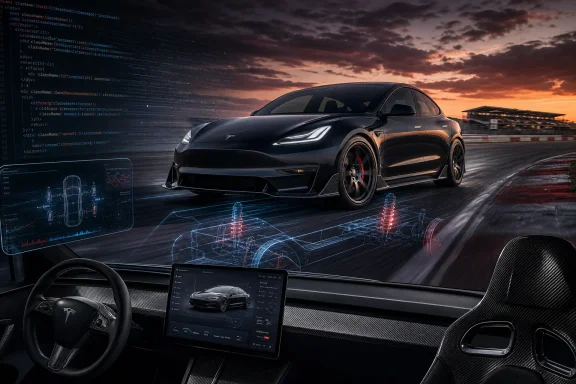 Tesla’s Website Said the Quiet Part Before the Launch Team Did
The most interesting thing about the Model 3 Performance leak was not that the car existed. By then, camouflaged sightings, Malibu presentation chatter, and enthusiast decoding had already made the return of a hot Model 3 feel inevitable. The revelation was that Tesla’s own site appeared to contain a near-complete marketing skeleton for the car, down to copy about adaptive damping, forged wheels, brake heat management, and a carbon-fiber interior treatment.Mashable reported that the feature list was visible in the source code of Tesla’s UK site, and InsideEVs, Carscoops, and other EV outlets corroborated the same broad details. The code reportedly described “all-new high-performance drive units” delivering more than 500 combined horsepower, while leaving the 0–60 mph figure as a placeholder. That placeholder mattered: it showed the page was not random debris, but a launch asset waiting for final values.
The leak also settled, or at least narrowed, one branding fight. Enthusiasts had been calling the car “Ludicrous” because prototype badging and earlier references hinted at Tesla’s old performance vocabulary. But the leaked copy overwhelmingly used Model 3 Performance, suggesting Tesla was more interested in continuity than theatrics.
That was the right call. “Ludicrous” made sense when Tesla was still trying to turn EV acceleration into a circus act. The refreshed Model 3 Performance needed to prove something more mature: that Tesla could build a sharper driver’s car, not merely a quicker stoplight weapon.
The Horsepower Number Was the Least Subtle Clue
The phrase “more than combined 500 horsepower” was the line that made the leak travel. It was easy to quote, easy to compare, and easy to understand. Tesla’s later official launch numbers put the U.S. car at 510 hp with a claimed 0–60 mph time of 2.9 seconds, confirming that the leaked copy had been directionally correct.But horsepower was never the whole story. The outgoing Model 3 Performance was already absurdly quick by normal sedan standards, and the cheaper Long Range variants had long blurred the line between commuter car and stealth missile. Tesla did not need only more thrust; it needed a better argument for why the Performance trim should exist.
That argument came through in the hardware details. Adaptive suspension, revised chassis tuning, staggered forged wheels, stronger braking consistency, and bolstered ventilated sport seats all pointed to a car aimed at repeatable performance rather than one launch-control party trick. The leaked copy’s emphasis on high-speed stability and heat management was more revealing than the power figure.
This is where Tesla’s product maturity shows. Early EV performance was about embarrassing gasoline cars in a straight line. The newer problem is harder: making a heavy, battery-powered sedan feel controlled, durable, and communicative when driven hard for more than ten seconds.
Track Mode Became the Product Philosophy
Track Mode V3 was the clearest sign that Tesla understood the criticism of the old Performance formula. The previous Model 3 Performance was fast enough to humble serious sports sedans, but its brakes, tires, and thermal behavior could make sustained hard driving feel like an argument with physics. The new software promised coordinated calibration across the powertrain and adaptive suspension, with driver control over handling balance, stability systems, and regenerative braking.That is a very Tesla way to solve a car problem. Traditional performance brands sell mechanical theater: steering racks, dampers, limited-slip differentials, brake packages, exhaust notes, transmission maps. Tesla sells a systems layer, where hardware exists but the software is the star.
There is a risk in that approach. A performance car cannot be entirely abstracted into sliders and calibration tables, because the best ones communicate through the seat, wheel, and brake pedal before they communicate through a screen. Still, Tesla’s strength has always been integration, and Track Mode V3 sounded less like a gimmick than a recognition that performance EVs need orchestration.
The adaptive suspension was especially important. The standard refreshed Model 3, often called “Highland,” improved ride comfort and cabin refinement, but a Performance variant has to live in a narrower band. It must be firm without becoming brittle, playful without becoming nervous, and comfortable enough that owners do not regret choosing the fast one every Monday morning.
The “Ludicrous” Badge Was a Distraction Tesla Was Wise to Avoid
The rumored Ludicrous name gave the leak its tabloid energy, but it was also the least useful part of the story. Tesla’s performance naming has always carried a faint adolescent charge, from Insane Mode to Ludicrous Mode to Plaid. That language helped sell the company’s early rebellion against automotive convention, but the market has changed.By 2024, EV acceleration was no longer a Tesla-only party trick. Hyundai, Kia, Porsche, Lucid, BMW, Mercedes, and others had all learned how to make electric torque feel dramatic. The mere promise of a silly mode name was not enough to separate a Model 3 from the pack.
Keeping the Model 3 Performance badge made the car easier to understand. It told buyers that this was the return of the top Model 3 trim after the Highland refresh, not a strange sub-brand experiment. It also kept attention on the actual engineering changes.
There is a larger branding lesson here. Tesla no longer needs to convince the world that electric cars can be fast. It needs to convince buyers that its fast cars are polished, durable, and worth choosing in an increasingly crowded EV market.
The Leak Showed How Tesla Markets Without Marketing
Most automakers would have staged the rollout with embargoed drives, executive quotes, studio photography, and carefully measured technical briefings. Tesla, characteristically, let the internet do part of the work. Whether accidental or not, source-code discoveries are now part of the company’s launch ecosystem.That dynamic suits Tesla because its fan base treats product forensics like sport. Website code, parts catalogs, homologation filings, app strings, delivery estimates, and configurator changes are all mined for clues. The company benefits from this unpaid intelligence network, even when it occasionally loses control of the timing.
But there is a cost. Leaks can make product launches feel less like announcements and more like confirmations of things already known. They can also create confusion when placeholders, regional specs, or abandoned copy are mistaken for final truth.
The Model 3 Performance leak sat in the safer zone because many of its claims were later reflected in the launched car. Still, it is a reminder that Tesla’s opacity often pushes customers and journalists toward imperfect evidence. When the company refuses to narrate its own roadmap clearly, the browser’s “view source” window becomes a press conference.
The Timing Was About More Than a Fast Sedan
The refreshed Model 3 Performance arrived at a delicate moment for Tesla. The company had updated the mainstream Model 3, but the broader EV market was becoming more price-sensitive, more competitive, and less forgiving of hype. A flagship compact sedan trim gave Tesla a way to inject excitement into a familiar product line without launching an entirely new vehicle.That matters because the Model 3 is no longer the cultural shockwave it was in 2017 and 2018. It is now a known quantity, a common sight, and in many markets a default EV choice rather than a novelty. Performance variants help keep aging nameplates emotionally alive.
They also help margins, at least when priced correctly. Buyers who choose the Performance trim are not merely buying transportation; they are buying identity, acceleration, and the feeling that they got the complete version. Tesla has always understood that software-like upsell psychology can apply to cars.
The leak’s feature list read like an attempt to defend that upsell. Better seats, better brakes, forged wheels, adaptive suspension, carbon-fiber décor, and aero revisions all say: this is not just the regular Model 3 with the power slider pushed right.
The Real Competition Was the Gas Sports Sedan
The Model 3 Performance has always lived in two markets at once. In EV terms, it is Tesla’s compact performance sedan. In enthusiast terms, it inevitably gets compared with BMW M cars, Mercedes-AMG sedans, Audi RS models, Cadillac Blackwings, and anything else that promises daily usability with track-day credibility.That comparison is both flattering and dangerous. On raw acceleration per dollar, Tesla’s formula is brutally effective. On steering feel, brake confidence, thermal consistency, sound, and emotional texture, gasoline performance sedans still have arguments to make.
The leaked details showed Tesla trying to close that second gap. Adaptive damping and Track Mode V3 are not needed for the supermarket run. Bolstered ventilated seats and improved brake heat management are admissions that performance buyers care about what happens after the first launch.
This is the right battlefield. If Tesla wants the Performance badge to mean more than “quickest trim,” it has to make the car feel intentional at the limit. Numbers win headlines; consistency wins credibility.
The Source-Code Slip Became a Preview of Tesla’s Next Normal
The Model 3 Performance leak now looks less like an isolated mistake than a snapshot of modern car launches. Vehicles are software products, web products, regulatory products, and consumer products all at once. That means they leave traces before they are officially ready.For Tesla, the trace was source code. For other automakers, it might be a dealer ordering guide, a certification document, a mobile app update, or a supplier page. The old clean line between “secret” and “announced” has been replaced by a long gray corridor of semi-public evidence.
That gray corridor rewards obsessives. It also rewards companies that can turn leaks into momentum instead of panic. Tesla has been unusually good at that because its customers are used to incomplete information, rolling updates, and product definitions that change over time.
But the Model 3 Performance case also shows the limits of that tolerance. Buyers still need firm specs, pricing, delivery timing, regional differences, and warranty implications. Enthusiast sleuthing can build anticipation; it cannot replace official clarity forever.
The Details That Actually Mattered Survived the Hype
The useful lesson from the leak is not that Tesla had another fast Model 3 coming. That was obvious. The useful lesson is that the performance story had shifted from acceleration theater to integrated vehicle control.The source-code copy pointed to a car with a broader performance envelope. The official launch later filled in the numbers: 510 hp in the U.S., a claimed 2.9-second 0–60 mph run, adaptive suspension, Track Mode V3, and more purposeful hardware throughout. The leak was not merely gossip; it was a reasonably accurate preview of Tesla’s product direction.
For WindowsForum readers, the parallels to software are hard to miss. Tesla’s cars are increasingly defined by configuration, calibration, and release management. A hidden string in production web code can reveal product strategy just as surely as a leaked Windows build can reveal Microsoft’s next UI bet.
That does not make the car less mechanical. It makes the boundary between mechanical and digital harder to see.
The Hidden Copy Told Buyers Where to Look
The source-code leak was a reminder that the most important product changes are not always the loudest ones.- The refreshed Model 3 Performance was previewed by Tesla’s own website code before its formal announcement.
- The leaked copy emphasized adaptive suspension, Track Mode V3, aero changes, forged wheels, sport seats, and improved braking consistency.
- The rumored Ludicrous branding generated attention, but Tesla’s final direction centered on the familiar Model 3 Performance identity.
- The later official launch broadly confirmed the leak’s substance, including more than 500 horsepower and a 2.9-second claimed 0–60 mph time in the U.S. market.
- The car’s significance was less about peak acceleration than about Tesla trying to make performance feel more repeatable, tunable, and complete.
References
- Primary source: Mashable
Published: 2026-07-03T19:20:19.246403
Tesla leaks details about upcoming Model 3 Performance | Mashable
Tesla has accidentally leaked numerous details about upcoming Model 3 Performance "Ludicrous" car.mashable.com - Related coverage: insideevs.com
Upgraded Tesla Model 3 Performance Packs Adaptive Suspension, Over 500 HP: Website Leak
The source code on Tesla UK’s website spilled the beans ahead of schedule. So let's see what the refreshed Model 3 Performance is all about insideevs.com
- Related coverage: notebookcheck.info
A Tesla detalha os recursos de desempenho do Model 3 com o exclusivo Track Mode V3, mas a potência pode decepcionar - NotebookCheck.info News
O Model 3 Performance 2024 virá com o Track Mode V3 personalizado e "uma calibração totalmente nova para o trem de força e a suspensão adaptativa para dar ao senhor mais autoridade ao volante", diz a Tesla. www.notebookcheck.info
- Related coverage: notebookcheck.net
Model 3 Ludicrous interface outs Track mode acceleration and Tesla's new Autoshift option - Notebookcheck News
In a post already taken down by Elon Musk's X platform, the new Model 3 Ludicrous/Performance trim was given the preview treatment. For the first time, it was from inside, with an interface walkthrough. www.notebookcheck.net
- Related coverage: autoevolution.com
Tesla Website Leak Confirms Model 3 Performance Name, Adaptive Suspension, and Power Level - autoevolution
Tesla's UK website code revealed some of the refreshed Model 3 Performance details, including power level, configuration, and name www.autoevolution.com
- Related coverage: carscoops.com
New Tesla Model 3 Performance To Have Over 500 HP And Adaptive Suspension | Carscoops
The new Model 3 Performance will come standard with upgraded dual electric motorswww.carscoops.com
- Related coverage: evxl.co
Tesla Model 3 Performance "Ludicrous" Details Leaked On Company Website
Tesla enthusiasts eagerly awaiting the release of the Model 3 Performance "Ludicrous" variant may not have to wait much longer. The company inadvertentlyevxl.co - Related coverage: notebookcheck.biz
La nouvelle Tesla Model 3 Ludicrous accélérera en 3 secondes et les spécifications de vitesse et d'autonomie apparaissent - NotebookCheck.biz News
Tesla semble prêt à publier sur son site web la version 2024 de la Model 3 Performance, sous le nom de Ludicrous. Le code source a enfin révélé son autonomie exacte, sa vitesse maximale et ses chiffres d'accélération. www.notebookcheck.biz
- Related coverage: teslanorth.com
Tesla Model 3 Performance Tidbits: ‘Insane’ Acceleration, Track Mode V3 and More | TeslaNorth.com
Tesla today finally announced a new Model 3 Performance, built on its latest upgraded design of its electric sedan (Highland). The Model 3 Performance has started making its way to select U.S. showrooms, and now we are learning some interesting tidbits Tesla has not talked about yet. For...teslanorth.com - Related coverage: caranddriver.com
2024 Tesla Model 3 Performance Boasts 510 HP
The sportier version of Tesla's refreshed Model 3 has arrived, and adds upgraded suspension and a new Track driving mode along with the extra power.www.caranddriver.com
- Related coverage: electrek.co
Tesla claims it produced the first builds of its 'new affordable' electric car models | Electrek
Tesla claims to have produced the “first builds” of its new “more affordable” electric car models, which are expected to... electrek.co
- Related coverage: notebookcheck.com
Tesla Model 3 Ludicrous: Neue Details über enorme Beschleunigung im Track-Modus und Autoshift-Funktion - Notebookcheck News
In einem gelöschten Beitrag auf der X-Plattform von Elon Musk wurde zum ersten Mal die neue Ausstattungsvariante des Model 3 Performance/Ludicrous im Detail gezeigt. Es gab einen Einblick in die Benutzeroberfläche des Fahrzeugs, einschließlich einer Tour durch die verschiedenen Funktionen. www.notebookcheck.com
- Related coverage: notebookcheck.org
La interfaz Ludicrous del Model 3 desvela la aceleración del modo Track y la nueva opción Autoshift de Tesla - NotebookCheck.org News
En un post ya retirado por la plataforma X de Elon Musk, el nuevo acabado Ludicrous/Performance del Model 3 recibía el tratamiento de avance. Por primera vez, fue desde el interior, con un recorrido por la interfaz. www.notebookcheck.org
- Related coverage: i.blackhat.com
us 20 Kiley Reverse Engineering The Tesla Battery Management System To Increase Power Available wp
PDF documenti.blackhat.com
- Related coverage: cars.com
New 2024 Tesla Model 3 Performance: 510 HP, 0-60 MPH in 2.9 Seconds | Cars.com
The Model 3 Performance’s smaller size means it can accelerate from 0-60 mph in less than three seconds at a savings of $35,000 compared to the Model S Plaid.www.cars.com - Related coverage: techcrunch.com
Tesla launches new Model 3 Performance variant to rev up demand | TechCrunch
Tesla has officially revealed a new Performance variant of the recently-refreshed Model 3 as the company looks to fight off receding demand.techcrunch.com - Related coverage: motor1.com
The New Tesla Model 3 Performance Hits 60 MPH in 2.9 Seconds
There's a new Tesla Model 3 Performance with 510 horsepower and a 0-60 mph time of 2.9 seconds. It's the most powerful Model 3 ever. www.motor1.com
- Related coverage: everytesla.com
2024 Tesla Model 3 Performance – Every Tesla
 everytesla.com
- Related coverage: motortrend.com
2024 Tesla Model 3 Performance First Look: Highland Goes to Higher Land
With over 500 hp, it is the most powerful Model 3 ever. It's also something of a performance bargain.www.motortrend.com - Related coverage: roadandtrack.com
New Tesla Model 3 Performance Claims 510 HP and 2.9-Second 0-60 Time
The new Model 3 Performance is here. From power to pricing, here's everything you need to know.www.roadandtrack.com
- Related coverage: ev.com
2024 Tesla Model 3 Performance: What You Need To Know | EV.com
Starting at $53,990 Categories: Review Tags: Tesla, Model 3 Performance 5 min read By EV.com • April 28, 2024 The 2024 Tesla Model 3 Performance has recently laev.com - Related coverage: tesla.com