

Google fixed CVE-2026-14106 in Chrome 150 for Android after a Text-component input-validation flaw, published by the National Vulnerability Database on June 30, 2026, was found to let an attacker with an already-compromised renderer potentially escape Chrome’s sandbox through a crafted HTML page. The uncomfortable part is not the word “Low” in Chromium’s severity label; it is the phrase that follows the precondition. A sandbox escape is rarely the opening move, but it is exactly the sort of second move that turns a browser bug chain from annoying into consequential.
As detailed by Google’s Chrome Releases blog and enriched by NVD and CISA’s ADP program, this is a small entry in a very large Chrome 150 security train. That scale matters. CVE-2026-14106 is not the headline-grabbing critical memory-corruption bug in the batch, but it sits in the class of flaws that defenders cannot afford to dismiss merely because exploitation requires an earlier renderer compromise.
Chromium’s own severity rating for CVE-2026-14106 is Low, and on its face that sounds reassuring. The bug is described as insufficient validation of untrusted input in Text, affecting Google Chrome on Android before version 150.0.7871.47. It requires a remote attacker to have already compromised the renderer process before the crafted HTML page can potentially be used for a sandbox escape.
That precondition is doing a lot of work. Chrome’s renderer sandbox is supposed to contain the blast radius of hostile web content, so a bug that helps escape it belongs in the second stage of an exploit chain rather than the first. In isolation, CVE-2026-14106 may not hand an attacker a device; in combination with a renderer code-execution bug, it may help convert web-content compromise into something closer to system-level impact.
This is why the NVD scoring looks jarring next to Chromium’s severity. NVD and CISA-ADP list a CVSS 3.1 base score of 9.6, with high confidentiality, integrity, and availability impact, while Chromium classifies the individual issue as Low. That is not necessarily a contradiction. It is a collision between two ways of describing risk: one focused on the bug as found inside Chromium’s triage model, the other on the theoretical impact of a successful chained exploit.
For administrators, the lesson is simple: do not let vendor severity become a substitute for deployment urgency. Browser bugs live in an ecosystem where chaining is the norm, not an academic edge case.
The sheer size of the release is impossible to ignore. Google said the Chrome 150 update included 433 security fixes, a number large enough to make any single CVE easy to miss. Many of the surrounding entries are classic browser-danger fare: use-after-free bugs, type confusion, out-of-bounds reads and writes, GPU and graphics stack issues, and validation failures scattered across major browser subsystems.
That volume is part of the modern Chromium bargain. Chrome’s security model is strong because it assumes hostile input, isolates components, and patches aggressively; Chrome’s security burden is enormous because the browser is now an operating environment in its own right. Text rendering, PDF handling, GPU acceleration, WebUSB, extensions, password management, accessibility, and web app installation are all attack surface.
The result is an update rhythm that can feel absurd to normal users and exhausting to IT teams. Yet the alternative is worse. A browser that waits for perfect clarity before patching becomes a browser that gives exploit developers a predictable window.
For BYOD-heavy organizations, this is where “just update Chrome” becomes a governance problem. A user’s Android browser may be the path into cloud mail, identity portals, device enrollment pages, SaaS dashboards, and internal web apps. If that browser is lagging behind the patched build, the organization’s exposure is not limited to consumer browsing.
Sandbox escapes are especially relevant on mobile because the browser sits at the boundary between hostile public content and heavily permissioned personal and work data. Android’s app sandbox still matters, and Chrome’s own renderer sandbox still matters, but exploit chains are designed precisely to hop from one boundary to the next. A bug that weakens one boundary is not automatically catastrophic, but it is a meaningful link in the chain.
For managed fleets, the immediate control is version visibility. If administrators cannot answer which Android devices are running Chrome 150.0.7871.47 or later, they do not have a patching problem; they have an inventory problem wearing a patching mask.
This is a place where automated vulnerability management can get noisy. A scanner that sees only
The practical answer is that the CPE structure is trying to express “Chrome, when on Android,” but asset systems vary widely in how well they consume that nuance. If your tooling reports CVE-2026-14106 against Windows Chrome installations, that may be a matching artifact rather than a true platform exposure. If your tooling does not report it against Android devices at all, that may be the more dangerous failure.
This is why vulnerability management still needs human review. The CPE is not just clerical metadata; it is the bridge between a public advisory and the assets your organization actually owns. When that bridge is incomplete or interpreted poorly, patch prioritization becomes theater.
CVE-2026-14106 is explicitly described in that middle role. The attacker must already have compromised the renderer process. That makes the bug less useful to opportunistic drive-by attackers with only a single primitive, but more useful to sophisticated actors building chains from multiple vulnerabilities.
This is also why CVSS can feel unsatisfying. A score may model the impact of a successful exploit, but it cannot fully capture whether the missing first stage is easy, hard, public, private, patched, or already in use by a commercial spyware vendor. A Low-rated sandbox escape with a reliable paired renderer exploit can be more dangerous in practice than a flashy standalone bug that is difficult to weaponize.
At the time of the NVD data provided, CISA’s SSVC entry listed exploitation as “none” and automatable as “no,” while technical impact was marked “total.” That combination is the right mental model. There is no public signal here of active exploitation in the supplied data, but the consequence of a successful chain is still serious enough to justify fast patching.
But the same restraint creates a familiar defender problem. Security teams must act on sparse descriptions: component name, vulnerability class, affected version, severity, and sometimes a reward or reporter. “Insufficient validation of untrusted input in Text” is accurate, but it is not a playbook. It does not tell a SOC what indicators to hunt for, what telemetry to prioritize, or whether specific site behaviors are likely to trigger the flaw.
That gap is the cost of responsible disclosure at browser scale. For most organizations, the right answer is not to wait for proof-of-concept code or deeper technical write-ups. By the time those arrive, the update should already be deployed.
The browser is a high-churn security product now. Treating every Chrome stable update as a mini-change-management project may feel disciplined, but it can also be a liability when hundreds of fixes land at once and adversaries know exactly which version boundaries matter.
A compromised Android browser can still matter to a Windows-centric organization if it becomes the route to tokens, email, administrative portals, or device enrollment workflows. Browser compromise is not just about local files on the endpoint. It is about authenticated sessions and the cloud control planes those sessions can reach.
There is also a Chromium ecosystem angle. Microsoft Edge, Brave, Vivaldi, Opera, and other Chromium-derived browsers inherit large portions of the same upstream codebase, though platform exposure and patch timing vary by vendor. CVE-2026-14106 is described for Google Chrome on Android, so it should not be blindly mapped to every Chromium browser on every platform. But the broader Chrome 150 security wave is a reminder that Chromium patch velocity is a dependency for much of the desktop and mobile web.
For Windows administrators, the action is not panic over this specific Android CVE. It is making sure browser patching is treated as part of endpoint security policy across platforms, not as an afterthought handled by users when they happen to notice a relaunch button.
That does not mean reckless deployment. Browser updates can break extensions, web apps, media playback, authentication flows, and line-of-business portals. Anyone who has managed Chrome or Edge at scale knows the pain of a “security update” that also changes behavior users depend on.
But the answer is faster rings, not slower patches. A small pilot group, rapid telemetry, and an accelerated production rollout beat a long validation cycle that leaves the majority of users exposed. The goal is not to eliminate testing; it is to stop pretending browser updates can be handled like quarterly firmware.
For Android, that means pushing managed Play updates where possible, requiring minimum browser versions for access to sensitive services, and using mobile threat defense or UEM reporting to identify stale devices. For unmanaged devices, conditional access may be the only realistic enforcement point.
Users can check Chrome’s version through the app settings path or the Android system’s app details, depending on device and management configuration. Administrators should rely on device inventory rather than user self-reporting wherever possible. In enterprise environments, the meaningful question is not whether Google released the fix; it is whether your fleet has absorbed it.
The same principle applies to desktop Chrome 150, even though this specific CVE is Android-scoped. Google’s June 30 stable channel release included a broad set of security fixes for Windows, Mac, and Linux as well. Organizations that pause desktop browser updates because one CVE appears mobile-specific may miss the larger release context.
The patched build is not a suggestion. It is the line between a known-vulnerable state and a fixed one.
That is the browser security paradox. The safest-looking features often sit atop decades of complexity. A crafted HTML page does not need to look exotic to exercise deep rendering behavior. It only needs to reach a path where assumptions about input validation, object state, or policy boundaries do not hold.
The fact that Google reported this bug internally also matters. Internal discovery suggests the vulnerability came from Google’s own security work rather than an outside researcher publicly probing the edge. That is good news in one sense, because it may reduce the chance of pre-disclosure exploitation. It is also a reminder that the Chromium project is finding and fixing problems at a rate that defenders can barely track.
When hundreds of security fixes ship in one stable release, the question is no longer whether any individual bug sounds scary. The question is whether your update process can keep pace with the browser you have standardized on.
As detailed by Google’s Chrome Releases blog and enriched by NVD and CISA’s ADP program, this is a small entry in a very large Chrome 150 security train. That scale matters. CVE-2026-14106 is not the headline-grabbing critical memory-corruption bug in the batch, but it sits in the class of flaws that defenders cannot afford to dismiss merely because exploitation requires an earlier renderer compromise.
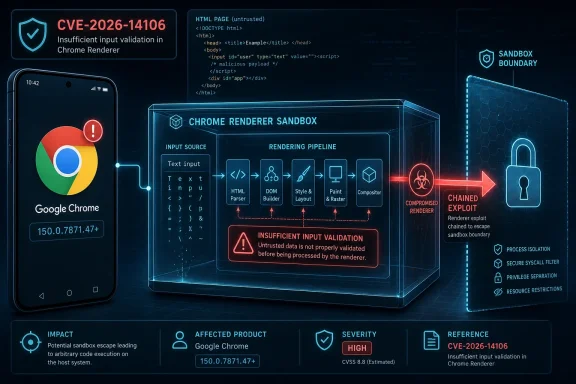 The “Low” Label Hides the Browser Security Story
Chromium’s own severity rating for CVE-2026-14106 is Low, and on its face that sounds reassuring. The bug is described as insufficient validation of untrusted input in Text, affecting Google Chrome on Android before version 150.0.7871.47. It requires a remote attacker to have already compromised the renderer process before the crafted HTML page can potentially be used for a sandbox escape.That precondition is doing a lot of work. Chrome’s renderer sandbox is supposed to contain the blast radius of hostile web content, so a bug that helps escape it belongs in the second stage of an exploit chain rather than the first. In isolation, CVE-2026-14106 may not hand an attacker a device; in combination with a renderer code-execution bug, it may help convert web-content compromise into something closer to system-level impact.
This is why the NVD scoring looks jarring next to Chromium’s severity. NVD and CISA-ADP list a CVSS 3.1 base score of 9.6, with high confidentiality, integrity, and availability impact, while Chromium classifies the individual issue as Low. That is not necessarily a contradiction. It is a collision between two ways of describing risk: one focused on the bug as found inside Chromium’s triage model, the other on the theoretical impact of a successful chained exploit.
For administrators, the lesson is simple: do not let vendor severity become a substitute for deployment urgency. Browser bugs live in an ecosystem where chaining is the norm, not an academic edge case.
Chrome 150 Arrived as a Security Avalanche, Not a Routine Dot Release
Google’s June 30 Chrome Releases post promoted Chrome 150 to the stable channel for Windows, Mac, and Linux, with rollout over the following days and weeks. The same page says Android releases contain the same security fixes as their corresponding desktop releases unless otherwise noted. CVE-2026-14106 appears in that security list as a Low-severity Text issue reported by Google on May 15, 2026.The sheer size of the release is impossible to ignore. Google said the Chrome 150 update included 433 security fixes, a number large enough to make any single CVE easy to miss. Many of the surrounding entries are classic browser-danger fare: use-after-free bugs, type confusion, out-of-bounds reads and writes, GPU and graphics stack issues, and validation failures scattered across major browser subsystems.
That volume is part of the modern Chromium bargain. Chrome’s security model is strong because it assumes hostile input, isolates components, and patches aggressively; Chrome’s security burden is enormous because the browser is now an operating environment in its own right. Text rendering, PDF handling, GPU acceleration, WebUSB, extensions, password management, accessibility, and web app installation are all attack surface.
The result is an update rhythm that can feel absurd to normal users and exhausting to IT teams. Yet the alternative is worse. A browser that waits for perfect clarity before patching becomes a browser that gives exploit developers a predictable window.
Android Makes the Sandbox Conversation More Practical
CVE-2026-14106 is specifically called out as affecting Chrome on Android prior to 150.0.7871.47. That Android detail changes the operational conversation. On Windows desktops, Chrome and Edge patching can often be forced through enterprise tooling, browser policies, and managed update channels. On Android, the reality is more fragmented: Play Store update behavior, device management posture, user habits, OEM constraints, and work-profile policies all matter.For BYOD-heavy organizations, this is where “just update Chrome” becomes a governance problem. A user’s Android browser may be the path into cloud mail, identity portals, device enrollment pages, SaaS dashboards, and internal web apps. If that browser is lagging behind the patched build, the organization’s exposure is not limited to consumer browsing.
Sandbox escapes are especially relevant on mobile because the browser sits at the boundary between hostile public content and heavily permissioned personal and work data. Android’s app sandbox still matters, and Chrome’s own renderer sandbox still matters, but exploit chains are designed precisely to hop from one boundary to the next. A bug that weakens one boundary is not automatically catastrophic, but it is a meaningful link in the chain.
For managed fleets, the immediate control is version visibility. If administrators cannot answer which Android devices are running Chrome 150.0.7871.47 or later, they do not have a patching problem; they have an inventory problem wearing a patching mask.
NVD’s CPE Entry Is Awkward but Not Meaningless
The user-submitted NVD change history raises a fair question: are we missing a CPE here? NVD’s configuration shows an AND relationship containing a Chrome application CPE up to, but excluding, 150.0.7871.47, and an Android operating system CPE. That reflects the vulnerability description’s platform specificity: Chrome on Android, not Chrome everywhere in the same way.This is a place where automated vulnerability management can get noisy. A scanner that sees only
google:chrome may overgeneralize the exposure to every platform. A scanner that mishandles the AND condition may miss the Android-specific nature of the issue. A scanner that lacks mobile browser inventory may not see the exposure at all.The practical answer is that the CPE structure is trying to express “Chrome, when on Android,” but asset systems vary widely in how well they consume that nuance. If your tooling reports CVE-2026-14106 against Windows Chrome installations, that may be a matching artifact rather than a true platform exposure. If your tooling does not report it against Android devices at all, that may be the more dangerous failure.
This is why vulnerability management still needs human review. The CPE is not just clerical metadata; it is the bridge between a public advisory and the assets your organization actually owns. When that bridge is incomplete or interpreted poorly, patch prioritization becomes theater.
The Exploit Chain Is the Real Unit of Risk
Browser security teams have spent years making one-shot compromise harder. A crafted web page should not, by itself, be able to leap from parsing HTML into broad device control. The modern attack therefore becomes modular: first compromise the renderer, then escape the sandbox, then escalate or persist depending on the target and platform.CVE-2026-14106 is explicitly described in that middle role. The attacker must already have compromised the renderer process. That makes the bug less useful to opportunistic drive-by attackers with only a single primitive, but more useful to sophisticated actors building chains from multiple vulnerabilities.
This is also why CVSS can feel unsatisfying. A score may model the impact of a successful exploit, but it cannot fully capture whether the missing first stage is easy, hard, public, private, patched, or already in use by a commercial spyware vendor. A Low-rated sandbox escape with a reliable paired renderer exploit can be more dangerous in practice than a flashy standalone bug that is difficult to weaponize.
At the time of the NVD data provided, CISA’s SSVC entry listed exploitation as “none” and automatable as “no,” while technical impact was marked “total.” That combination is the right mental model. There is no public signal here of active exploitation in the supplied data, but the consequence of a successful chain is still serious enough to justify fast patching.
Google’s Disclosure Style Still Leaves Defenders Reading Between the Lines
Google’s Chrome Releases blog routinely restricts access to bug details until a majority of users are updated. That policy is sensible. Publishing exploit-relevant technical detail before patch uptake would be an invitation to reverse engineering and copycat exploitation.But the same restraint creates a familiar defender problem. Security teams must act on sparse descriptions: component name, vulnerability class, affected version, severity, and sometimes a reward or reporter. “Insufficient validation of untrusted input in Text” is accurate, but it is not a playbook. It does not tell a SOC what indicators to hunt for, what telemetry to prioritize, or whether specific site behaviors are likely to trigger the flaw.
That gap is the cost of responsible disclosure at browser scale. For most organizations, the right answer is not to wait for proof-of-concept code or deeper technical write-ups. By the time those arrive, the update should already be deployed.
The browser is a high-churn security product now. Treating every Chrome stable update as a mini-change-management project may feel disciplined, but it can also be a liability when hundreds of fixes land at once and adversaries know exactly which version boundaries matter.
Windows Shops Should Care Even When the CVE Says Android
WindowsForum readers may reasonably ask why an Android Chrome CVE belongs in their queue. The answer is that few Windows environments are only Windows environments anymore. The same identity stack, the same SaaS estate, and often the same conditional access policies span Windows laptops, Android phones, iPads, unmanaged home machines, and virtual desktops.A compromised Android browser can still matter to a Windows-centric organization if it becomes the route to tokens, email, administrative portals, or device enrollment workflows. Browser compromise is not just about local files on the endpoint. It is about authenticated sessions and the cloud control planes those sessions can reach.
There is also a Chromium ecosystem angle. Microsoft Edge, Brave, Vivaldi, Opera, and other Chromium-derived browsers inherit large portions of the same upstream codebase, though platform exposure and patch timing vary by vendor. CVE-2026-14106 is described for Google Chrome on Android, so it should not be blindly mapped to every Chromium browser on every platform. But the broader Chrome 150 security wave is a reminder that Chromium patch velocity is a dependency for much of the desktop and mobile web.
For Windows administrators, the action is not panic over this specific Android CVE. It is making sure browser patching is treated as part of endpoint security policy across platforms, not as an afterthought handled by users when they happen to notice a relaunch button.
Patch Management Has Outgrown the Monthly Ritual
The old enterprise rhythm was built around monthly operating-system updates, staged testing, and predictable maintenance windows. Browsers broke that model years ago, and Chrome 150’s 433-fix release underscores why. Web-facing software cannot wait for the next tidy calendar slot when the version number itself becomes a public map of patched attack surface.That does not mean reckless deployment. Browser updates can break extensions, web apps, media playback, authentication flows, and line-of-business portals. Anyone who has managed Chrome or Edge at scale knows the pain of a “security update” that also changes behavior users depend on.
But the answer is faster rings, not slower patches. A small pilot group, rapid telemetry, and an accelerated production rollout beat a long validation cycle that leaves the majority of users exposed. The goal is not to eliminate testing; it is to stop pretending browser updates can be handled like quarterly firmware.
For Android, that means pushing managed Play updates where possible, requiring minimum browser versions for access to sensitive services, and using mobile threat defense or UEM reporting to identify stale devices. For unmanaged devices, conditional access may be the only realistic enforcement point.
The Version Number Is the Control
For CVE-2026-14106, the key threshold is straightforward: Chrome on Android should be at 150.0.7871.47 or later. Anything before that is within the described vulnerable range. Because Chrome updates roll out over days or weeks, merely assuming that devices have received the update is not enough.Users can check Chrome’s version through the app settings path or the Android system’s app details, depending on device and management configuration. Administrators should rely on device inventory rather than user self-reporting wherever possible. In enterprise environments, the meaningful question is not whether Google released the fix; it is whether your fleet has absorbed it.
The same principle applies to desktop Chrome 150, even though this specific CVE is Android-scoped. Google’s June 30 stable channel release included a broad set of security fixes for Windows, Mac, and Linux as well. Organizations that pause desktop browser updates because one CVE appears mobile-specific may miss the larger release context.
The patched build is not a suggestion. It is the line between a known-vulnerable state and a fixed one.
The Small Text Bug That Explains the Big Browser Problem
CVE-2026-14106 is easy to underestimate because its component name sounds mundane. “Text” does not have the menace of GPU memory corruption or V8 type confusion. Yet text handling is core browser territory: parsing, shaping, rendering, selection, editing, accessibility integration, internationalization, and layout all touch complicated code paths fed by untrusted content.That is the browser security paradox. The safest-looking features often sit atop decades of complexity. A crafted HTML page does not need to look exotic to exercise deep rendering behavior. It only needs to reach a path where assumptions about input validation, object state, or policy boundaries do not hold.
The fact that Google reported this bug internally also matters. Internal discovery suggests the vulnerability came from Google’s own security work rather than an outside researcher publicly probing the edge. That is good news in one sense, because it may reduce the chance of pre-disclosure exploitation. It is also a reminder that the Chromium project is finding and fixing problems at a rate that defenders can barely track.
When hundreds of security fixes ship in one stable release, the question is no longer whether any individual bug sounds scary. The question is whether your update process can keep pace with the browser you have standardized on.
The Chrome 150 Lesson for This CVE Is Narrow but Unmistakable
CVE-2026-14106 should not be oversold as a standalone catastrophe, but it should not be dismissed as a harmless Low either. It is a sandbox-escape candidate with a renderer-compromise precondition, affecting Chrome on Android before 150.0.7871.47, and it landed inside a massive Chrome 150 security update that deserves prompt deployment.- Chrome on Android should be updated to 150.0.7871.47 or later to close the vulnerable range described for CVE-2026-14106.
- The bug’s Low Chromium severity reflects its role and preconditions, not the full potential impact of a successful exploit chain.
- NVD and CISA-ADP’s 9.6 CVSS score is best read as a warning about chained impact rather than proof of known exploitation.
- Asset tools should treat the Android platform condition carefully, because careless CPE matching can either overreport Windows exposure or underreport mobile exposure.
- Windows-focused administrators should still care because Android browsers often carry the same identities, sessions, and enterprise access as managed PCs.
- The practical response is rapid browser update verification, not waiting for public exploit details.
References
- Primary source: NVD / Chromium
Published: 2026-07-03T07:00:33-07:00
NVD - CVE-2026-14106
 nvd.nist.gov
- Security advisory: MSRC
Published: 2026-07-03T07:00:33-07:00
Original feed URL
Security Update Guide - Microsoft Security Response Center
 msrc.microsoft.com
- Related coverage: cvefeed.io
CVE-2026-14106 - Google Chrome for Android Sandbox Escape
Insufficient validation of untrusted input in Text in Google Chrome on Android prior to 150.0.7871.47 allowed a remote attacker who had compromised the renderer process to potentially perform a sandbox escape via a crafted HTML page. (Chromium security severity: Low)cvefeed.io