

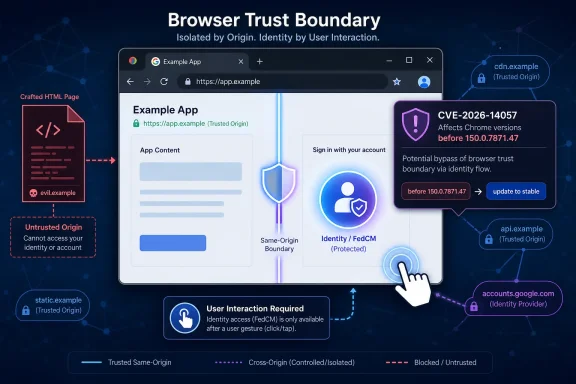
Google Chrome before version 150.0.7871.47 contains CVE-2026-14057, a FedCM implementation flaw published by NVD on June 30, 2026, that could let a remote attacker bypass same-origin policy with a crafted HTML page after user interaction. The short answer to the CPE question is: for Chrome itself, no, the core CPE appears to be present after NIST’s July 1 enrichment. The more interesting answer is that Chromium vulnerabilities increasingly expose the limits of CPE as a way to describe browser risk. This is a low-severity Chrome bug on paper, but it sits in one of the browser’s most sensitive new trust layers: identity.
NVD’s change history for CVE-2026-14057 says NIST added the affected configuration on July 1, 2026:
So if the question is whether the NVD entry is missing the basic Google Chrome CPE, the answer is no. It may have appeared absent while the page was still loading or before NIST’s enrichment landed, but the record now includes the standard Chrome product mapping.
The caveat is that CPE does not automatically solve the Chromium ecosystem problem. Microsoft Edge, Brave, Vivaldi, Opera, Electron-based applications, embedded Chromium views, and Linux distribution packages may inherit related code paths on different timelines, but they do not become “affected CPEs” in a Chrome CVE merely because they use Chromium. Their vendors typically need their own advisories, version mappings, or package metadata.
That distinction matters for admins. Vulnerability scanners often flatten “Chromium bug” into “Chrome CPE,” then leave security teams to determine whether the same fix is present in Edge, Chromium packages, or application runtimes. CVE-2026-14057 is a small example of a recurring browser-era problem: the vulnerability database can describe the upstream product cleanly while still leaving downstream exposure ambiguous.
The bug description is terse: inappropriate implementation in FedCM allowed a remote attacker to bypass same-origin policy via a crafted HTML page. CISA also mapped the issue to CWE-346, an origin validation error. In browser security terms, those words carry weight even when the score is modest, because origin boundaries are the organizing principle of the web.
FedCM, short for Federated Credential Management, is Google’s browser-mediated replacement path for some login flows that historically depended on third-party cookies and redirects. Chrome’s developer documentation describes it as a privacy-preserving identity federation API, and MDN similarly frames it as a standardized way for identity providers to support sign-in without relying on legacy cross-site tracking mechanics.
That is why this bug is more interesting than its “low” label suggests. FedCM is not a random rendering corner of the browser. It is part of the machinery that decides how a user, a relying party, and an identity provider recognize one another across origins.
FedCM changes the role of the browser from passive courier to active mediator. The browser presents account choices, enforces permissions, limits cross-site leakage, and tries to prevent relying parties from silently probing whether a user is logged into an identity provider. That is the right direction for privacy, but it also concentrates policy enforcement in code that must be correct across origins, frames, permissions, and user gestures.
CVE-2026-14057 appears to be one of those policy enforcement failures. The public record does not provide exploit code, and the linked Chromium issue requires permission, which is normal for newly fixed browser security bugs. Google commonly restricts bug details until a sufficient share of users has received the update.
The absence of public details should not be mistaken for irrelevance. A same-origin-policy bypass in an identity API does not need to be a full sandbox escape to create risk. It can still undermine assumptions that developers, identity providers, and security teams build into login flows.
In practical terms, the attacker would need to get a user to a crafted page and exploit a specific FedCM behavior before the browser is updated. There is no indication in the NVD or CISA enrichment that CVE-2026-14057 is being exploited in the wild. CISA’s SSVC data marks exploitation as “none,” automatable as “no,” and technical impact as “partial.”
That should calm home users and help enterprise teams prioritize. This is a patch-now-through-normal-browser-update-channels issue, not a disconnect-the-network incident. But “normal channels” should still mean promptly, especially because Chrome 150.0.7871.47 shipped with many other security fixes in the same Stable Channel update.
The browser update cadence is now part of the security perimeter. If an organization still treats browser patching as desktop hygiene rather than active threat reduction, it is already behind the architecture of modern web apps.
That scale changes how security teams should read individual CVEs. A single low-severity FedCM bug may not justify emergency action by itself, but it is bundled with a broader release that includes more serious flaws. Browser updates are cumulative risk events; admins rarely get to patch only the CVE that caught their eye.
This is where scanner dashboards can mislead. A low or medium item may appear as a minor row in a backlog, while the actual remediation action is simply “get Chrome to the current stable build.” Once that action is taken, dozens or hundreds of issues disappear together.
For Windows environments, the operational advice is straightforward. Confirm Chrome is at 150.0.7871.47 or later on Windows endpoints, verify policy-managed update channels are not stuck, and make sure restart deferrals are not preventing the patched browser from actually launching.
FedCM sits close to that wall because identity federation is inherently cross-origin. A relying party wants to know whether an identity provider can authenticate the user. The identity provider wants to offer an account without leaking too much. The browser has to enforce who can ask, what can be shown, what can be returned, and when user consent is meaningful.
An origin validation error in that context is not automatically catastrophic, but it is structurally important. It means some boundary check did not behave as intended. The public description says the attacker could bypass same-origin policy, not merely spoof a dialog or crash a renderer.
That wording should catch the attention of web developers using federated sign-in. Even when the fix is entirely browser-side, application teams should understand that browser-mediated identity APIs are still young compared with cookies, redirects, and traditional OAuth flows.
Microsoft Edge has its own release channel and security notes, even though it draws heavily from Chromium. Edge may receive equivalent fixes under Microsoft’s versioning and advisory process, not under Google Chrome’s CPE. The same is true for other Chromium-based browsers and for Linux distributions that package Chromium separately from Google’s official Chrome builds.
That means “Are we missing a CPE?” is often the wrong first question. The better question is whether your inventory distinguishes products that embed Chromium from products that merely share an upstream lineage. A scanner that only keys off the Google Chrome CPE may miss downstream software; a scanner that overgeneralizes may produce noise.
The answer is boring but necessary: trust vendor-specific version data where available, then use Chromium release ancestry as a prompt for investigation rather than as proof of exposure. In security operations, precision beats panic.
Admins should not stop at “update available.” They should verify the running version after relaunch. Chrome can download an update but continue running vulnerable code until the browser restarts, and long-lived browser sessions are common on both desktops and servers used for administrative consoles.
In managed environments, the most useful signal is not only installed version but active version. Endpoint telemetry should show whether users are still running pre-150.0.7871.47 Chrome processes. If the answer is yes, the remediation problem may be user behavior, not patch distribution.
The same logic applies to golden images and nonpersistent desktops. A patched user session today can become an unpatched session tomorrow if the base image is stale. Browser CVEs are now frequent enough that image maintenance cannot lag behind the stable channel by weeks.
That tradeoff is worth making. Browser-mediated identity can be better for users than invisible redirects and third-party cookie dependencies. But it also means browser vendors are now writing and enforcing more of the web’s authentication policy directly.
CVE-2026-14057 is therefore less a referendum on FedCM than a reminder that new privacy architecture still has bugs. The goal is not to avoid FedCM because one low-severity vulnerability exists. The goal is to treat the browser as an identity component and patch it with the seriousness that role deserves.
Developers should also resist the temptation to assume that browser mediation absolves their own systems from validation. Relying parties and identity providers still need robust server-side checks, strict origin configuration, careful token handling, and sane fallback behavior. Browser APIs reduce some classes of risk; they do not repeal defense in depth.
That appears to be what happened here. The CVE was received from Chrome on June 30, CISA added CVSS and CWE data on July 1, and NIST added the Chrome CPE configuration shortly afterward. Anyone checking the page midstream could reasonably wonder whether the affected product mapping was missing.
This is one reason security teams should avoid treating the first version of a CVE record as the final truth. NVD records are living documents, especially in the first 24 to 72 hours after publication. Vendor advisories, CISA enrichment, package maintainers, and scanner vendors all converge at different speeds.
For a Chrome issue, Google’s release note is usually the first operational source. NVD is useful for normalization and inventory mapping, but the vendor version number tells you what to deploy.
Yet dismissing it entirely would miss the direction of travel. Identity, privacy, and browser security are converging. FedCM exists because the web is trying to replace old cross-site login plumbing with something less leaky, and any flaw in that mediation layer deserves attention from people who run real environments.
The fix is also uncomplicated. Chrome before 150.0.7871.47 is the affected line for this CVE, and Chrome 150.0.7871.47 or later is the remediation target for Windows and macOS users following Google’s Stable Channel update. Linux users should follow their distribution or Google Chrome package channel, noting that Google listed 150.0.7871.46 for Linux in the same desktop update.
The inventory nuance should not delay patching. If your scanner has the Chrome CPE now, use it. If it does not, key off installed Chrome versions. If you run Chromium-derived browsers, check those vendors separately rather than assuming the Google Chrome CPE tells the whole story.
 The CPE Was Added, but the Inventory Story Is Still Messy
NVD’s change history for CVE-2026-14057 says NIST added the affected configuration on July 1, 2026: cpe:2.3:a:google:chrome:*:*:*:*:*:*:*:*, covering versions up to but excluding 150.0.7871.47. That is the expected CPE for Google Chrome as an application, and it lines up with Google’s Chrome Releases advisory for the Stable Channel update.So if the question is whether the NVD entry is missing the basic Google Chrome CPE, the answer is no. It may have appeared absent while the page was still loading or before NIST’s enrichment landed, but the record now includes the standard Chrome product mapping.
The caveat is that CPE does not automatically solve the Chromium ecosystem problem. Microsoft Edge, Brave, Vivaldi, Opera, Electron-based applications, embedded Chromium views, and Linux distribution packages may inherit related code paths on different timelines, but they do not become “affected CPEs” in a Chrome CVE merely because they use Chromium. Their vendors typically need their own advisories, version mappings, or package metadata.
That distinction matters for admins. Vulnerability scanners often flatten “Chromium bug” into “Chrome CPE,” then leave security teams to determine whether the same fix is present in Edge, Chromium packages, or application runtimes. CVE-2026-14057 is a small example of a recurring browser-era problem: the vulnerability database can describe the upstream product cleanly while still leaving downstream exposure ambiguous.
A Low-Severity Bug in a High-Trust Feature Is Not Nothing
Google classified CVE-2026-14057 as low severity in Chromium’s security taxonomy, while CISA’s ADP enrichment assigned a CVSS 3.1 score of 4.3, or medium. That difference is not scandalous; it reflects two different lenses. Chromium’s internal severity process weighs exploitability and product impact in context, while CVSS tries to encode attack conditions and technical impact in a portable scoring language.The bug description is terse: inappropriate implementation in FedCM allowed a remote attacker to bypass same-origin policy via a crafted HTML page. CISA also mapped the issue to CWE-346, an origin validation error. In browser security terms, those words carry weight even when the score is modest, because origin boundaries are the organizing principle of the web.
FedCM, short for Federated Credential Management, is Google’s browser-mediated replacement path for some login flows that historically depended on third-party cookies and redirects. Chrome’s developer documentation describes it as a privacy-preserving identity federation API, and MDN similarly frames it as a standardized way for identity providers to support sign-in without relying on legacy cross-site tracking mechanics.
That is why this bug is more interesting than its “low” label suggests. FedCM is not a random rendering corner of the browser. It is part of the machinery that decides how a user, a relying party, and an identity provider recognize one another across origins.
FedCM Moves Identity Into the Browser, So Browser Bugs Matter More
The web’s old federated login model was messy but familiar. A site redirected you to an identity provider, cookies carried state, and the browser mostly acted as a transport and display layer. Privacy interventions against third-party cookies disrupted that model, forcing browser vendors to offer new APIs that preserve sign-in flows without preserving all the old tracking surface.FedCM changes the role of the browser from passive courier to active mediator. The browser presents account choices, enforces permissions, limits cross-site leakage, and tries to prevent relying parties from silently probing whether a user is logged into an identity provider. That is the right direction for privacy, but it also concentrates policy enforcement in code that must be correct across origins, frames, permissions, and user gestures.
CVE-2026-14057 appears to be one of those policy enforcement failures. The public record does not provide exploit code, and the linked Chromium issue requires permission, which is normal for newly fixed browser security bugs. Google commonly restricts bug details until a sufficient share of users has received the update.
The absence of public details should not be mistaken for irrelevance. A same-origin-policy bypass in an identity API does not need to be a full sandbox escape to create risk. It can still undermine assumptions that developers, identity providers, and security teams build into login flows.
The User-Interaction Requirement Keeps This Out of Panic Territory
CISA’s vector says the attack is network-accessible, low complexity, requires no privileges, and requires user interaction. It also records no confidentiality or availability impact, with low integrity impact. That profile explains why this is not a “drop everything” emergency in the same class as an actively exploited V8 or GPU sandbox escape.In practical terms, the attacker would need to get a user to a crafted page and exploit a specific FedCM behavior before the browser is updated. There is no indication in the NVD or CISA enrichment that CVE-2026-14057 is being exploited in the wild. CISA’s SSVC data marks exploitation as “none,” automatable as “no,” and technical impact as “partial.”
That should calm home users and help enterprise teams prioritize. This is a patch-now-through-normal-browser-update-channels issue, not a disconnect-the-network incident. But “normal channels” should still mean promptly, especially because Chrome 150.0.7871.47 shipped with many other security fixes in the same Stable Channel update.
The browser update cadence is now part of the security perimeter. If an organization still treats browser patching as desktop hygiene rather than active threat reduction, it is already behind the architecture of modern web apps.
Chrome 150’s Giant Patch Load Makes Single-CVE Triage Harder
CVE-2026-14057 did not arrive alone. Google’s June 30 Stable Channel update moved Chrome to 150.0.7871.46/.47 on Windows and macOS and 150.0.7871.46 on Linux, with rollout over the following days and weeks. Security coverage from Malwarebytes and Born’s IT and Windows Blog noted the unusually large number of fixes in the Chrome 150 release.That scale changes how security teams should read individual CVEs. A single low-severity FedCM bug may not justify emergency action by itself, but it is bundled with a broader release that includes more serious flaws. Browser updates are cumulative risk events; admins rarely get to patch only the CVE that caught their eye.
This is where scanner dashboards can mislead. A low or medium item may appear as a minor row in a backlog, while the actual remediation action is simply “get Chrome to the current stable build.” Once that action is taken, dozens or hundreds of issues disappear together.
For Windows environments, the operational advice is straightforward. Confirm Chrome is at 150.0.7871.47 or later on Windows endpoints, verify policy-managed update channels are not stuck, and make sure restart deferrals are not preventing the patched browser from actually launching.
Same-Origin Policy Is the Web’s Load-Bearing Wall
The same-origin policy is one of those security concepts that sounds academic until it fails. It is the rule that prevents one site from freely reading or manipulating another site’s data in the browser. Without it, the web’s tabbed convenience would become a cross-site data spill waiting to happen.FedCM sits close to that wall because identity federation is inherently cross-origin. A relying party wants to know whether an identity provider can authenticate the user. The identity provider wants to offer an account without leaking too much. The browser has to enforce who can ask, what can be shown, what can be returned, and when user consent is meaningful.
An origin validation error in that context is not automatically catastrophic, but it is structurally important. It means some boundary check did not behave as intended. The public description says the attacker could bypass same-origin policy, not merely spoof a dialog or crash a renderer.
That wording should catch the attention of web developers using federated sign-in. Even when the fix is entirely browser-side, application teams should understand that browser-mediated identity APIs are still young compared with cookies, redirects, and traditional OAuth flows.
Enterprise Exposure Depends on More Than Chrome.exe
For many WindowsForum readers, the relevant asset is not just Chrome installed on a laptop. It is the full Chromium footprint: Chrome, Edge, WebView2, embedded browser controls, developer tools, kiosk systems, VDI images, and unmanaged browsers on BYOD machines. CVE-2026-14057’s NVD CPE points to Google Chrome, but the operational question is broader.Microsoft Edge has its own release channel and security notes, even though it draws heavily from Chromium. Edge may receive equivalent fixes under Microsoft’s versioning and advisory process, not under Google Chrome’s CPE. The same is true for other Chromium-based browsers and for Linux distributions that package Chromium separately from Google’s official Chrome builds.
That means “Are we missing a CPE?” is often the wrong first question. The better question is whether your inventory distinguishes products that embed Chromium from products that merely share an upstream lineage. A scanner that only keys off the Google Chrome CPE may miss downstream software; a scanner that overgeneralizes may produce noise.
The answer is boring but necessary: trust vendor-specific version data where available, then use Chromium release ancestry as a prompt for investigation rather than as proof of exposure. In security operations, precision beats panic.
The Patch Is Simple; Proving It Landed Is the Work
For individual users, Chrome’s built-in updater remains the path of least resistance. Opening Chrome’s About page triggers an update check, and a relaunch completes installation. On managed Windows systems, Google Update policies, enterprise deployment tools, and restart behavior determine whether that simple path actually happens.Admins should not stop at “update available.” They should verify the running version after relaunch. Chrome can download an update but continue running vulnerable code until the browser restarts, and long-lived browser sessions are common on both desktops and servers used for administrative consoles.
In managed environments, the most useful signal is not only installed version but active version. Endpoint telemetry should show whether users are still running pre-150.0.7871.47 Chrome processes. If the answer is yes, the remediation problem may be user behavior, not patch distribution.
The same logic applies to golden images and nonpersistent desktops. A patched user session today can become an unpatched session tomorrow if the base image is stale. Browser CVEs are now frequent enough that image maintenance cannot lag behind the stable channel by weeks.
The FedCM Angle Is a Warning About the Post-Cookie Web
The industry’s move away from third-party cookies was never going to eliminate cross-site complexity. It was going to move that complexity into new APIs, permission models, browser UI, and identity flows. FedCM is one of the more important examples because it tries to preserve federated sign-in while limiting the tracking and leakage that old web primitives made too easy.That tradeoff is worth making. Browser-mediated identity can be better for users than invisible redirects and third-party cookie dependencies. But it also means browser vendors are now writing and enforcing more of the web’s authentication policy directly.
CVE-2026-14057 is therefore less a referendum on FedCM than a reminder that new privacy architecture still has bugs. The goal is not to avoid FedCM because one low-severity vulnerability exists. The goal is to treat the browser as an identity component and patch it with the seriousness that role deserves.
Developers should also resist the temptation to assume that browser mediation absolves their own systems from validation. Relying parties and identity providers still need robust server-side checks, strict origin configuration, careful token handling, and sane fallback behavior. Browser APIs reduce some classes of risk; they do not repeal defense in depth.
NVD Enrichment Lag Is a Feature of the System, Not a Conspiracy
The user-visible confusion around CPEs often comes from timing. A CVE can be published by the assigning authority, modified by CISA ADP, and enriched by NIST on different schedules. During that window, pages can show incomplete scoring, missing configurations, or placeholder language.That appears to be what happened here. The CVE was received from Chrome on June 30, CISA added CVSS and CWE data on July 1, and NIST added the Chrome CPE configuration shortly afterward. Anyone checking the page midstream could reasonably wonder whether the affected product mapping was missing.
This is one reason security teams should avoid treating the first version of a CVE record as the final truth. NVD records are living documents, especially in the first 24 to 72 hours after publication. Vendor advisories, CISA enrichment, package maintainers, and scanner vendors all converge at different speeds.
For a Chrome issue, Google’s release note is usually the first operational source. NVD is useful for normalization and inventory mapping, but the vendor version number tells you what to deploy.
The Practical Read on CVE-2026-14057 Is Narrow but Not Dismissive
CVE-2026-14057 is not the browser bug that should keep defenders awake by itself. There is no public indication of exploitation, the required interaction lowers urgency, and the technical impact has been scored as partial. If this were the only issue in the release, it would still deserve timely patching but not emergency theatrics.Yet dismissing it entirely would miss the direction of travel. Identity, privacy, and browser security are converging. FedCM exists because the web is trying to replace old cross-site login plumbing with something less leaky, and any flaw in that mediation layer deserves attention from people who run real environments.
The fix is also uncomplicated. Chrome before 150.0.7871.47 is the affected line for this CVE, and Chrome 150.0.7871.47 or later is the remediation target for Windows and macOS users following Google’s Stable Channel update. Linux users should follow their distribution or Google Chrome package channel, noting that Google listed 150.0.7871.46 for Linux in the same desktop update.
The inventory nuance should not delay patching. If your scanner has the Chrome CPE now, use it. If it does not, key off installed Chrome versions. If you run Chromium-derived browsers, check those vendors separately rather than assuming the Google Chrome CPE tells the whole story.
The Browser Boundary That Admins Should Actually Draw
The most concrete lesson from CVE-2026-14057 is that browser security work increasingly lives at the boundary between web standards and enterprise operations. A FedCM bug is not just a developer curiosity, and a CPE record is not just a vulnerability-management artifact. Both determine whether the new web identity stack can be trusted at scale.- Chrome installations older than 150.0.7871.47 should be treated as vulnerable to CVE-2026-14057 and updated through normal stable-channel processes.
- The NVD record now includes the expected Google Chrome CPE, so the basic Chrome product mapping does not appear to be missing.
- Chromium-based products outside Google Chrome need vendor-specific verification rather than automatic assumptions based on Chrome’s CPE.
- The public record does not indicate active exploitation, and CISA’s SSVC enrichment marks exploitation as none.
- The FedCM connection makes the bug worth understanding even though Chromium rated it low severity, because browser-mediated identity is becoming core web infrastructure.
- Security teams should verify the running browser version after restart, not merely whether the update package was offered or downloaded.
References
- Primary source: NVD / Chromium
Published: 2026-07-03T07:00:41-07:00
NVD - CVE-2026-14057
 nvd.nist.gov
- Security advisory: MSRC
Published: 2026-07-03T07:00:41-07:00
Original feed URL
Security Update Guide - Microsoft Security Response Center
 msrc.microsoft.com
- Official source: developer.mozilla.org
Federated Credential Management (FedCM) API - Web APIs | MDN
The Federated Credential Management API (or FedCM API) provides a standard mechanism for identity providers (IdPs) to make identity federation services available on the web in a privacy-preserving way, without the need for third-party cookies and redirects. This includes a JavaScript API that...developer.mozilla.org
- Related coverage: developer.chrome.com
FedCM: A privacy-preserving identity federation API | Identity | Chrome for Developers
A web platform API that allows users to login to websites with their federated accounts in a manner compatible with improvements to browser privacy. developer.chrome.com
- Related coverage: mdn.org.cn
- Related coverage: mdn.club.tw
聯邦身份憑證管理 (FedCM) API - Web API | MDN - MDN 文件
mdn.club.tw