

Google Chrome CVE-2026-14007 is a medium-severity PermissionsPolicy enforcement flaw, disclosed June 30, 2026, that affects Chrome versions before 150.0.7871.47 and can let a remote attacker bypass navigation restrictions through a crafted HTML page. The short answer to the CPE question is: NVD’s initial analysis now shows a Chrome CPE for vulnerable versions up to, but excluding, 150.0.7871.47. The more important answer is that this is exactly the kind of browser bug that looks modest in isolation but matters because it weakens one of the policy layers modern web applications rely on to contain untrusted content.
Google disclosed the issue in its Chrome Stable Channel update, while NVD and CISA-ADP filled in the vulnerability bookkeeping on July 1. NVD’s record describes the affected product as Google Chrome and adds the expected CPE pattern for Chrome, but the page still carries “assessment not yet provided” for NVD’s own CVSS scoring. CISA-ADP, meanwhile, assigns a CVSS 3.1 score of 6.5, with user interaction required and high integrity impact. That combination tells us the bug is not a drive-by remote code execution emergency — but it is also not a harmless browser-paper-cut.
The user-facing oddity in this CVE is the “Are we missing a CPE here?” language on NVD, a familiar placeholder that often appears while enrichment catches up with vendor disclosure. In the change history, NIST’s July 1 initial analysis added the CPE entry for Google Chrome, covering versions before 150.0.7871.47. So if the question is whether the vulnerability should map to Chrome as affected software, yes — and NVD’s own change record says that mapping has been added.
What still feels incomplete is the broader ecosystem mapping. Chromium is not merely Chrome’s engine; it is the supply chain foundation for Microsoft Edge, Brave, Vivaldi, Opera, Electron-based desktop apps, embedded browsers, and custom enterprise shells. NVD may correctly list Google Chrome as the affected CPE because Chrome is the vendor source of the CVE, but administrators should not confuse “Chrome CPE present” with “Chrome is the only thing I need to think about.”
That distinction matters because browser CVEs often propagate unevenly. Google can ship a fix to Chrome Stable, Microsoft can ship a corresponding Edge update on its own cadence, and downstream Chromium consumers may take longer still. The CPE record is useful for vulnerability scanners, but it is a map of vendor accountability, not a complete model of every browser surface in a fleet.
This is where CVE metadata regularly disappoints IT teams. A scanner may light up once the CPE appears, but it may not tell you whether the same Chromium commit has landed in every embedded runtime your business uses. The CPE tells you where the official vulnerability record points. It does not absolve anyone from checking the actual Chromium version in deployed software.
That sounds abstract until you remember how much modern web security depends on browser-enforced boundaries. A page may embed third-party content, isolate an iframe, restrict what that frame can request, and use policy headers to limit what navigation or API behavior is available. If the browser fails to enforce that policy consistently, the site’s assumptions are wrong even if the site’s own code is well designed.
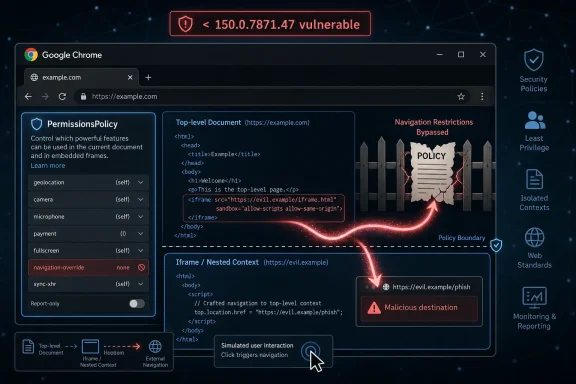
CVE-2026-14007 sits in that uncomfortable category. Google’s description says insufficient policy enforcement in PermissionsPolicy allowed a remote attacker to bypass navigation restrictions using a crafted HTML page. That is not a memory corruption bug, and it does not imply code execution outside the browser sandbox. But it does suggest a failure in the browser’s role as referee.
The CISA-ADP CWE assignment is also telling: CWE-602, client-side enforcement of server-side security. That classification is a warning label. It says the vulnerable system relied on client-side enforcement for a security decision, and an attacker could find a way around it. In the browser world, that does not mean policies are useless; it means enforcement bugs are especially consequential because developers treat the browser as the trusted policy engine.
That “user interaction required” component is why this is not being treated like a zero-day fire drill. There is no public indication in the supplied NVD data that the vulnerability is being exploited in the wild. CISA’s SSVC data also marks exploitation as “none” and automation as “no,” while describing the technical impact as partial. Those are calming signals, but not dismissal signals.
Integrity impact is the notable part. A navigation restriction bypass is about making a browser go somewhere, load something, or allow a transition that policy said should not happen. For consumer users, that might sound vague. For application teams using embedded content, payment flows, identity redirects, tenant isolation, administrative dashboards, or sandboxed documentation viewers, navigation control is part of the trust model.
The risk is not that every Chrome user is one click from catastrophe. The risk is that a carefully designed web containment strategy may have had a browser-level hole in it until Chrome 150.0.7871.47. That is exactly the sort of bug that vanishes into a routine update for most users and becomes a post-incident forensic breadcrumb for the unlucky few.
That silence is not a conspiracy; it is how browser vulnerability disclosure works now. If Google publishes a detailed proof path before the majority of users are updated, the advisory becomes attacker documentation. The tradeoff is that defenders must act on incomplete information: patch first, understand the exact exploit mechanics later.
This is a reasonable bargain for consumer browsers, where automatic updates are fast and largely invisible. It is more complicated in managed environments, where Chrome updates may be staged, tested, deferred, or pinned for compatibility reasons. A medium-severity browser policy bug may not jump to the front of a risk queue already crowded with critical remote code execution fixes, VPN vulnerabilities, and identity platform incidents.
Still, Chrome is not a normal desktop application. It is the runtime for SaaS, admin portals, identity sessions, password managers, internal dashboards, and remote work. Even medium Chrome vulnerabilities deserve a shorter patch runway than most line-of-business apps because the browser is exposed to hostile input all day.
Microsoft Edge is the first place most Windows shops will look, and rightly so. Edge shares the Chromium foundation but ships through Microsoft’s channel and enterprise update controls. A Chrome CVE does not automatically mean Edge is vulnerable at the same moment, but it does mean Edge administrators should verify whether Microsoft has incorporated the relevant Chromium fix into the current Stable release.
Then there are Electron applications. Teams, Slack, Visual Studio Code, Discord, countless internal tools, and bespoke kiosk applications have all used Chromium-derived runtimes in one form or another. Not every Electron app exposes the same browser behavior or attack surface, but the lesson of Chromium CVEs is that “we patched Chrome” is not the same as “we patched all Chromium.”
This is why CPE-based vulnerability management can undercount browser-engine risk. A product inventory may show Chrome clean after the update while an older embedded runtime remains present in a desktop app that opens remote content. Mature vulnerability programs increasingly treat browser engines as components, not products.
Modern attacks often chain boring primitives. A UI confusion bug, a navigation bypass, a policy enforcement failure, and a permissive redirect can combine into something much more serious than any single CVE description suggests. Browser vendors know this, which is why they keep tightening controls around frames, permissions, popups, downloads, storage, and cross-origin behavior.
PermissionsPolicy is part of that layered defense. If it says an embedded document cannot do something, developers may build product behavior around that guarantee. A bypass can turn an intended one-way containment boundary into a suggestion.
The CVE description does not tell us enough to claim a specific exploit chain. We should not invent one. But the category is enough to justify urgency, especially for organizations that host sensitive workflows in web apps and rely on browser policy headers to enforce boundaries between trusted and untrusted content.
Security teams should resist both extremes here. Treating every medium Chrome CVE as an emergency produces alert fatigue and burns political capital with users. Treating browser medium CVEs as background noise leaves real exposure in one of the most attacked pieces of software on the endpoint.
The better approach is to classify this as a fast routine patch. It should not require war-room escalation absent evidence of exploitation, but it should not wait for a monthly desktop image refresh either. If Chrome auto-update is healthy, the fix should flow naturally. If Chrome updates are pinned, delayed, or blocked, this CVE is another argument for revisiting that policy.
The SSVC fields support that middle lane. No known exploitation, not automatable, partial technical impact. That is the language of “patch promptly,” not “drop everything.” For most WindowsForum readers, that means checking version compliance, validating managed update policies, and watching Edge or Chromium-based app advisories.
That does not mean the vulnerability was ambiguous. Google’s advisory and the CVE description already identified Chrome before 150.0.7871.47 as affected. The absence or delay of a fully enriched NVD record should not be a blocker for patching a browser.
This is an important operational lesson. NVD is a normalization layer, not the first source of truth for every vulnerability. For Chrome, the Chrome Releases blog is often the practical starting point. For Windows and Edge, Microsoft’s release notes and security update guidance should be checked directly. For Linux distributions, distro advisories matter because package maintainers may backport fixes under version schemes that do not match upstream Chrome numbering.
A vulnerability workflow that waits for perfect NVD metadata will always trail reality. The better workflow consumes vendor advisories first, then uses NVD enrichment to improve asset matching and reporting once the record catches up.
For administrators, the work depends on how Chrome is managed. Google Update policies, enterprise templates, update rings, software deployment tools, and endpoint management platforms can all affect timing. A Chrome version check in inventory is more reliable than assuming automatic update succeeded.
The second administrative task is communication. Users often keep browser windows open for days or weeks, especially on workstations that sleep rather than reboot. If the update is downloaded but Chrome is waiting for relaunch, the fleet may look patched on paper later than it is patched in memory. Browser restart nudges are not glamorous, but they close the loop.
The third task is downstream verification. If your environment depends heavily on Edge, Electron apps, web kiosks, managed WebView controls, or packaged Chromium runtimes, ask whether the relevant fix has landed there too. The answer may vary by vendor and application.
The alternative would be worse. Asking every web developer to reinvent sandboxing, permission delegation, and cross-origin containment would produce more bugs, not fewer. Centralizing enforcement in browsers is the right architecture. But it means browser security updates are now application security updates by proxy.
That is the subtle point many organizations still miss. A Chrome update is not only a desktop maintenance event. It is a security update for the web applications your company uses, the identity provider sessions your employees rely on, and the administrative consoles your IT staff open every day.
This also explains why medium browser CVEs accumulate importance. A single policy enforcement issue may be limited. A steady stream of them shows how much pressure the browser is under as the web platform becomes more powerful and more security-sensitive.
The lack of detail should not be mistaken for lack of seriousness. Browser vendors deliberately minimize exploit guidance while patches are propagating. Attackers reverse-engineer patches quickly enough without help.
The more productive reading is to focus on the component and impact. PermissionsPolicy plus navigation restrictions points to web application containment. Crafted HTML page plus user interaction points to a classic malicious-site or compromised-site delivery path. Medium severity plus high integrity impact points to behavior manipulation rather than data theft or crash.
That is enough to set a patch priority and threat model without overclaiming. We do not need to pretend this is a catastrophic zero-day. We also do not need to wait for a weaponized proof of concept before treating it as relevant.
The secondary action is Edge awareness. Because Edge is Chromium-based, administrators should verify Microsoft’s current Edge Stable release and its Chromium base, rather than assuming Chrome’s fixed version maps one-to-one onto Edge’s versioning. Microsoft usually ships Chromium security fixes quickly, but enterprise controls can still delay deployment.
The third action is inventory hygiene. If your vulnerability scanner only reports installed Chrome and Edge, it may miss embedded Chromium runtimes. That does not mean every Electron application is exploitable through this CVE, but it does mean browser-engine visibility remains an unsolved problem for many endpoint teams.
Finally, web application owners should treat this as a reminder to avoid single-layer assumptions. PermissionsPolicy is valuable, but sensitive flows should also use server-side validation, origin checks, state tokens, frame controls, and careful redirect handling. Browser policy is a fence, not the only wall.
Google disclosed the issue in its Chrome Stable Channel update, while NVD and CISA-ADP filled in the vulnerability bookkeeping on July 1. NVD’s record describes the affected product as Google Chrome and adds the expected CPE pattern for Chrome, but the page still carries “assessment not yet provided” for NVD’s own CVSS scoring. CISA-ADP, meanwhile, assigns a CVSS 3.1 score of 6.5, with user interaction required and high integrity impact. That combination tells us the bug is not a drive-by remote code execution emergency — but it is also not a harmless browser-paper-cut.
 The Missing CPE Was the Symptom, Not the Story
The user-facing oddity in this CVE is the “Are we missing a CPE here?” language on NVD, a familiar placeholder that often appears while enrichment catches up with vendor disclosure. In the change history, NIST’s July 1 initial analysis added the CPE entry for Google Chrome, covering versions before 150.0.7871.47. So if the question is whether the vulnerability should map to Chrome as affected software, yes — and NVD’s own change record says that mapping has been added.What still feels incomplete is the broader ecosystem mapping. Chromium is not merely Chrome’s engine; it is the supply chain foundation for Microsoft Edge, Brave, Vivaldi, Opera, Electron-based desktop apps, embedded browsers, and custom enterprise shells. NVD may correctly list Google Chrome as the affected CPE because Chrome is the vendor source of the CVE, but administrators should not confuse “Chrome CPE present” with “Chrome is the only thing I need to think about.”
That distinction matters because browser CVEs often propagate unevenly. Google can ship a fix to Chrome Stable, Microsoft can ship a corresponding Edge update on its own cadence, and downstream Chromium consumers may take longer still. The CPE record is useful for vulnerability scanners, but it is a map of vendor accountability, not a complete model of every browser surface in a fleet.
This is where CVE metadata regularly disappoints IT teams. A scanner may light up once the CPE appears, but it may not tell you whether the same Chromium commit has landed in every embedded runtime your business uses. The CPE tells you where the official vulnerability record points. It does not absolve anyone from checking the actual Chromium version in deployed software.
PermissionsPolicy Is Supposed to Be the Browser’s Contract With the Page
PermissionsPolicy, formerly known in part through the older Feature Policy work, is one of the web platform’s attempts to make browsers less trusting by default. It lets sites define which browser features, APIs, and behaviors can be used by a document or by embedded frames. In practical terms, it is a policy fence around powerful capabilities and cross-document behavior.That sounds abstract until you remember how much modern web security depends on browser-enforced boundaries. A page may embed third-party content, isolate an iframe, restrict what that frame can request, and use policy headers to limit what navigation or API behavior is available. If the browser fails to enforce that policy consistently, the site’s assumptions are wrong even if the site’s own code is well designed.
CVE-2026-14007 sits in that uncomfortable category. Google’s description says insufficient policy enforcement in PermissionsPolicy allowed a remote attacker to bypass navigation restrictions using a crafted HTML page. That is not a memory corruption bug, and it does not imply code execution outside the browser sandbox. But it does suggest a failure in the browser’s role as referee.
The CISA-ADP CWE assignment is also telling: CWE-602, client-side enforcement of server-side security. That classification is a warning label. It says the vulnerable system relied on client-side enforcement for a security decision, and an attacker could find a way around it. In the browser world, that does not mean policies are useless; it means enforcement bugs are especially consequential because developers treat the browser as the trusted policy engine.
A Medium Bug Can Still Break a Security Assumption
Chrome’s own security severity is Medium, and CISA-ADP’s CVSS score of 6.5 lands in the same zone. The vector is network exploitable, low complexity, no privileges required, user interaction required, unchanged scope, no confidentiality impact, high integrity impact, and no availability impact. Translated from scoring jargon, an attacker needs to get a user to a crafted page, but the successful result is a meaningful violation of intended behavior rather than system compromise.That “user interaction required” component is why this is not being treated like a zero-day fire drill. There is no public indication in the supplied NVD data that the vulnerability is being exploited in the wild. CISA’s SSVC data also marks exploitation as “none” and automation as “no,” while describing the technical impact as partial. Those are calming signals, but not dismissal signals.
Integrity impact is the notable part. A navigation restriction bypass is about making a browser go somewhere, load something, or allow a transition that policy said should not happen. For consumer users, that might sound vague. For application teams using embedded content, payment flows, identity redirects, tenant isolation, administrative dashboards, or sandboxed documentation viewers, navigation control is part of the trust model.
The risk is not that every Chrome user is one click from catastrophe. The risk is that a carefully designed web containment strategy may have had a browser-level hole in it until Chrome 150.0.7871.47. That is exactly the sort of bug that vanishes into a routine update for most users and becomes a post-incident forensic breadcrumb for the unlucky few.
Chrome’s Patch Cadence Is Doing Its Job, But It Also Hides the Blast Radius
Google’s Chrome Releases blog announced the Stable Channel update at the end of June, moving desktop Chrome to the fixed 150.0.7871.47 line on affected platforms. As usual, Google’s advisory language is sparse. Chromium issue details are restricted, which is normal while the fix is still rolling out and while downstream projects may still be absorbing the patch.That silence is not a conspiracy; it is how browser vulnerability disclosure works now. If Google publishes a detailed proof path before the majority of users are updated, the advisory becomes attacker documentation. The tradeoff is that defenders must act on incomplete information: patch first, understand the exact exploit mechanics later.
This is a reasonable bargain for consumer browsers, where automatic updates are fast and largely invisible. It is more complicated in managed environments, where Chrome updates may be staged, tested, deferred, or pinned for compatibility reasons. A medium-severity browser policy bug may not jump to the front of a risk queue already crowded with critical remote code execution fixes, VPN vulnerabilities, and identity platform incidents.
Still, Chrome is not a normal desktop application. It is the runtime for SaaS, admin portals, identity sessions, password managers, internal dashboards, and remote work. Even medium Chrome vulnerabilities deserve a shorter patch runway than most line-of-business apps because the browser is exposed to hostile input all day.
The Enterprise Problem Is Not Installing Chrome, It Is Knowing Where Chromium Lives
For Windows administrators, the obvious check is simple: Chrome should be at 150.0.7871.47 or later. That covers the mainstream endpoint scenario. But the less obvious work is discovering where Chromium is present without being called Chrome.Microsoft Edge is the first place most Windows shops will look, and rightly so. Edge shares the Chromium foundation but ships through Microsoft’s channel and enterprise update controls. A Chrome CVE does not automatically mean Edge is vulnerable at the same moment, but it does mean Edge administrators should verify whether Microsoft has incorporated the relevant Chromium fix into the current Stable release.
Then there are Electron applications. Teams, Slack, Visual Studio Code, Discord, countless internal tools, and bespoke kiosk applications have all used Chromium-derived runtimes in one form or another. Not every Electron app exposes the same browser behavior or attack surface, but the lesson of Chromium CVEs is that “we patched Chrome” is not the same as “we patched all Chromium.”
This is why CPE-based vulnerability management can undercount browser-engine risk. A product inventory may show Chrome clean after the update while an older embedded runtime remains present in a desktop app that opens remote content. Mature vulnerability programs increasingly treat browser engines as components, not products.
Navigation Restrictions Are Boring Until They Are Part of an Attack Chain
A bypass of navigation restrictions is not a Hollywood exploit. It does not sound like popping calc.exe, stealing tokens, or escaping the sandbox. That is precisely why it is easy to underrate.Modern attacks often chain boring primitives. A UI confusion bug, a navigation bypass, a policy enforcement failure, and a permissive redirect can combine into something much more serious than any single CVE description suggests. Browser vendors know this, which is why they keep tightening controls around frames, permissions, popups, downloads, storage, and cross-origin behavior.
PermissionsPolicy is part of that layered defense. If it says an embedded document cannot do something, developers may build product behavior around that guarantee. A bypass can turn an intended one-way containment boundary into a suggestion.
The CVE description does not tell us enough to claim a specific exploit chain. We should not invent one. But the category is enough to justify urgency, especially for organizations that host sensitive workflows in web apps and rely on browser policy headers to enforce boundaries between trusted and untrusted content.
The CVSS Score Gets the Priority Mostly Right
CISA-ADP’s 6.5 score is a fair reflection of the known facts. The attack can be delivered remotely, the complexity is low, and no privileges are required. But the need for user interaction and the lack of direct confidentiality or availability impact keep it out of the high-severity band.Security teams should resist both extremes here. Treating every medium Chrome CVE as an emergency produces alert fatigue and burns political capital with users. Treating browser medium CVEs as background noise leaves real exposure in one of the most attacked pieces of software on the endpoint.
The better approach is to classify this as a fast routine patch. It should not require war-room escalation absent evidence of exploitation, but it should not wait for a monthly desktop image refresh either. If Chrome auto-update is healthy, the fix should flow naturally. If Chrome updates are pinned, delayed, or blocked, this CVE is another argument for revisiting that policy.
The SSVC fields support that middle lane. No known exploitation, not automatable, partial technical impact. That is the language of “patch promptly,” not “drop everything.” For most WindowsForum readers, that means checking version compliance, validating managed update policies, and watching Edge or Chromium-based app advisories.
NVD’s Lag Is Annoying, But It Is Not a Reason to Wait
NVD enrichment has become a recurring pain point for defenders because vulnerability records often arrive before scoring, CPEs, and complete metadata are finalized. CVE-2026-14007 illustrates the problem neatly. The CVE came from Chrome on June 30, CISA-ADP added scoring and CWE data on July 1, and NIST added the Chrome CPE configuration shortly afterward. During that window, scanners and dashboards may have shown partial or inconsistent data.That does not mean the vulnerability was ambiguous. Google’s advisory and the CVE description already identified Chrome before 150.0.7871.47 as affected. The absence or delay of a fully enriched NVD record should not be a blocker for patching a browser.
This is an important operational lesson. NVD is a normalization layer, not the first source of truth for every vulnerability. For Chrome, the Chrome Releases blog is often the practical starting point. For Windows and Edge, Microsoft’s release notes and security update guidance should be checked directly. For Linux distributions, distro advisories matter because package maintainers may backport fixes under version schemes that do not match upstream Chrome numbering.
A vulnerability workflow that waits for perfect NVD metadata will always trail reality. The better workflow consumes vendor advisories first, then uses NVD enrichment to improve asset matching and reporting once the record catches up.
The Fix Is Simple for Users and Messier for Administrators
For individual users, the remediation is mundane: update Chrome and restart it. Chrome’s update mechanism usually downloads fixes automatically, but the browser must relaunch to apply them. The version target is 150.0.7871.47 or later.For administrators, the work depends on how Chrome is managed. Google Update policies, enterprise templates, update rings, software deployment tools, and endpoint management platforms can all affect timing. A Chrome version check in inventory is more reliable than assuming automatic update succeeded.
The second administrative task is communication. Users often keep browser windows open for days or weeks, especially on workstations that sleep rather than reboot. If the update is downloaded but Chrome is waiting for relaunch, the fleet may look patched on paper later than it is patched in memory. Browser restart nudges are not glamorous, but they close the loop.
The third task is downstream verification. If your environment depends heavily on Edge, Electron apps, web kiosks, managed WebView controls, or packaged Chromium runtimes, ask whether the relevant fix has landed there too. The answer may vary by vendor and application.
The Web Platform Keeps Moving Security Into the Browser
CVE-2026-14007 is part of a larger trend: web security increasingly depends on browser-enforced policy, not just application code. Content Security Policy, PermissionsPolicy, cross-origin isolation, SameSite cookies, storage partitioning, frame restrictions, and navigation controls all push security decisions into the browser. That is good because browsers can enforce rules uniformly at scale. It is also risky because a browser enforcement bug can invalidate assumptions across many sites at once.The alternative would be worse. Asking every web developer to reinvent sandboxing, permission delegation, and cross-origin containment would produce more bugs, not fewer. Centralizing enforcement in browsers is the right architecture. But it means browser security updates are now application security updates by proxy.
That is the subtle point many organizations still miss. A Chrome update is not only a desktop maintenance event. It is a security update for the web applications your company uses, the identity provider sessions your employees rely on, and the administrative consoles your IT staff open every day.
This also explains why medium browser CVEs accumulate importance. A single policy enforcement issue may be limited. A steady stream of them shows how much pressure the browser is under as the web platform becomes more powerful and more security-sensitive.
The Patch Note Is Small Because the Attack Surface Is Enormous
Google’s terse disclosure gives us a CVE, a component, a severity, and a fixed version. That is standard, but it can feel unsatisfying. Security professionals want to know whether an exploit requires a sandboxed iframe, a particular header, a same-origin relationship, a malicious redirect, or a browser UI gesture. Those details are hidden for now.The lack of detail should not be mistaken for lack of seriousness. Browser vendors deliberately minimize exploit guidance while patches are propagating. Attackers reverse-engineer patches quickly enough without help.
The more productive reading is to focus on the component and impact. PermissionsPolicy plus navigation restrictions points to web application containment. Crafted HTML page plus user interaction points to a classic malicious-site or compromised-site delivery path. Medium severity plus high integrity impact points to behavior manipulation rather than data theft or crash.
That is enough to set a patch priority and threat model without overclaiming. We do not need to pretend this is a catastrophic zero-day. We also do not need to wait for a weaponized proof of concept before treating it as relevant.
The Practical Reading for Windows Shops Is Narrow but Urgent
For WindowsForum readers, the immediate action is version validation. Chrome installations below 150.0.7871.47 should be updated. Managed fleets should confirm policy health, update service status, and relaunch completion.The secondary action is Edge awareness. Because Edge is Chromium-based, administrators should verify Microsoft’s current Edge Stable release and its Chromium base, rather than assuming Chrome’s fixed version maps one-to-one onto Edge’s versioning. Microsoft usually ships Chromium security fixes quickly, but enterprise controls can still delay deployment.
The third action is inventory hygiene. If your vulnerability scanner only reports installed Chrome and Edge, it may miss embedded Chromium runtimes. That does not mean every Electron application is exploitable through this CVE, but it does mean browser-engine visibility remains an unsolved problem for many endpoint teams.
Finally, web application owners should treat this as a reminder to avoid single-layer assumptions. PermissionsPolicy is valuable, but sensitive flows should also use server-side validation, origin checks, state tokens, frame controls, and careful redirect handling. Browser policy is a fence, not the only wall.
What This Particular Chrome Bug Tells Patch Teams to Do Next
CVE-2026-14007 is not the loudest Chrome vulnerability of the year, but it is a clean example of how modern browser risk works: a modest score, a narrow description, a real policy bypass, and a fix that must move faster than ordinary desktop software. The useful response is concrete rather than dramatic.- Chrome installations should be updated to 150.0.7871.47 or later, with a browser relaunch confirmed rather than merely assumed.
- NVD’s change history indicates that the Google Chrome CPE configuration has been added for versions before 150.0.7871.47.
- CISA-ADP scores the issue as medium severity with no known exploitation, no automation, and partial technical impact.
- Administrators should verify Chromium-based browsers and embedded runtimes separately, because a Chrome CPE does not describe the entire Chromium ecosystem.
- Web application teams should avoid relying on browser-side policy enforcement as the only control for sensitive navigation or trust decisions.
References
- Primary source: NVD / Chromium
Published: 2026-07-03T07:00:43-07:00
Loading…
nvd.nist.gov - Security advisory: MSRC
Published: 2026-07-03T07:00:43-07:00
Original feed URL
Loading…
msrc.microsoft.com - Related coverage: cvefeed.io
Loading…
cvefeed.io - Related coverage: radar.offseq.com
Loading…
radar.offseq.com - Related coverage: encyb.com