

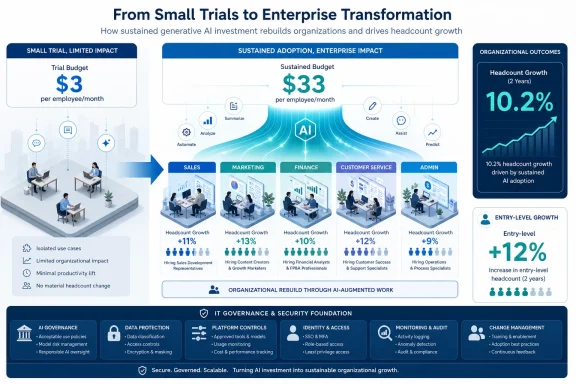
Ramp and Revelio Labs’ June 2026 study of 21,559 U.S. firms found that companies with the heaviest sustained generative AI software spending increased headcount by 10.2 percent over the two years after adoption, rather than shrinking their workforces. That finding, first amplified in coverage by Softonic and also reported by outlets including CoinDesk, does not end the AI-jobs argument. It makes the argument more interesting. The companies spending real money on AI appear to be reorganizing around it, and for now that often means hiring more people, not fewer.
For the last two years, the popular version of the AI employment story has been clean, brutal, and easy to headline: machines write the emails, draft the code, summarize the tickets, and eventually the people who used to do those things disappear from payroll. It is a compelling story because it has obvious victims, obvious villains, and enough real layoffs in tech and finance to feel true.
The Ramp and Revelio Labs study complicates that story because it looks not at vibes, job-posting language, or executive speeches, but at observed AI spending connected to workforce records. Ramp sees corporate payments for AI tools. Revelio Labs tracks labor-market and company headcount data. Put together, the two firms are trying to answer a question that surveys usually only gesture toward: what happens after a company actually starts paying for generative AI in a sustained way?
Their answer is inconvenient for the doom loop. In the study’s panel, firms that became high-intensity adopters — the top tier of early AI spending per employee — expanded headcount by 10.2 percent over two years after adoption. Low-intensity adopters, by contrast, did not show statistically significant employment gains.
That distinction matters. The study is not saying that a ChatGPT subscription magically creates jobs. It is saying that firms which spend enough on generative software to suggest serious operational adoption are also the firms growing their workforces. The intensity of adoption is the signal.
Ramp and Revelio then divided adopters by spending intensity. High-intensity firms spent about $33 per employee per month in the first three months after adoption. Low-intensity firms spent closer to $3 per employee per month. That gap is the difference between sprinkling a tool across the org chart and actually attempting to rebuild work around it.
This is where the study becomes useful for IT leaders. A company paying a few dollars per employee is probably still in the experimentation phase. Someone in marketing is drafting copy, someone in engineering is testing a coding assistant, and someone in finance is asking a model to summarize policy language. That is adoption in the press-release sense, but not necessarily adoption in the operational sense.
At $33 per employee, the posture changes. The company is more likely buying multiple tools, paying for team or enterprise seats, using API access, experimenting with AI-native workflows, or routing parts of software development, research, support, sales enablement, and back-office work through generative systems. That kind of spend usually drags process change behind it.
The important point is that workflow change is labor-intensive. Someone has to evaluate tools, secure them, integrate them, write policies, train users, inspect outputs, repair failures, and decide which workflows are safe enough to automate. AI may reduce the time required for a task, but deploying AI across a firm creates a new layer of operational work around the task.
That is a meaningful detail because those are precisely the categories often treated as most exposed to generative AI. Salespeople generate outreach. Marketers create content. Administrators summarize, schedule, document, and coordinate. Finance teams process recurring information. Customer service teams answer repetitive questions. If the instant-replacement model were already dominating, these functions should be obvious places to find contraction.
Instead, the study suggests something more evolutionary. The companies leaning hardest into generative software may be using it to increase throughput, widen their operating surface area, or support faster growth. A sales team that can personalize more outbound communication may need more account executives, not fewer. A support team that can triage faster may expand coverage. A finance team that can process more exceptions may take on more complex reporting and control work.
This is not sentimental optimism. It is the old productivity paradox arriving in a new costume. When a tool lowers the cost of doing something, firms do not always do the same amount of it with fewer people. Sometimes they do much more of it with more people.
Ramp and Revelio’s result points in the other direction, at least for the firms in their data. Heavy adopters increased entry-level hiring rather than freezing it out. That does not mean junior workers are safe. It does mean the apprenticeship story is not as simple as “AI takes the junior work, so junior workers vanish.”
There are several plausible explanations. Fast-growing firms may hire junior workers because AI makes them more productive sooner. Managers may become more willing to take a chance on less experienced staff when tools can scaffold research, drafting, coding, and analysis. Companies may also need more employees who are comfortable working inside AI-mediated processes, even if they lack long traditional résumés.
But there is a warning buried inside the good news. If entry-level roles increasingly require AI fluency from day one, the nature of junior work changes. The new graduate is not being hired to learn how to write the first draft slowly by hand. They may be hired to supervise, correct, prompt, combine, and operationalize machine-generated first drafts at speed.
That is still a job. It is not necessarily the same job.
That matters because the firms most likely to show up in this kind of analysis may already be more tech-forward, more growth-oriented, and more comfortable with software procurement than the average American business. They are not necessarily representative of every law office, hospital department, local manufacturer, school district, or insurance back office trying to decide what to do with generative AI.
The study also does not prove that AI caused the headcount growth. The careful reading is that heavy adopters grew after adoption relative to the comparison framework used in the paper. But high-intensity adopters may have been firms already positioned for growth, already venture-backed, already hiring, or already in sectors where AI spend is a symptom of expansion rather than its cause.
This does not make the study useless. It makes it more realistic. In the real economy, technologies are not randomly assigned. Ambitious companies adopt them early, invest more deeply, and reorganize faster. The labor-market effect of AI will be mediated by exactly those kinds of selection effects.
Bloomberg reporting republished by The Straits Times found that payrolls in financial activities and information — sectors where AI adoption has moved quickly — were declining by an average of 28,000 jobs a month in 2026, even as the broader U.S. labor market continued adding jobs. Challenger, Gray & Christmas has tracked nearly 102,000 announced job cuts attributed to AI so far in 2026, according to that same reporting.
Those numbers do not neatly cancel out the Ramp-Revelio finding. They describe a different slice of the economy. Large incumbent firms can cut staff while smaller or faster-growing adopters add them. A bank can reduce back-office roles while an AI-heavy startup hires sales, support, and product staff. A software company can lay off one team while creating new roles around infrastructure, model evaluation, security, and enterprise deployment.
The AI labor market is not one market. It is a collision between expansion and substitution.
That is why the public debate feels so incoherent. Workers see layoffs and conclude that AI is already eating jobs. Executives see productivity gains and argue that AI is augmenting teams. Economists look at noisy sector data and caution that macro effects are still hard to isolate. All three can be partly right at the same time.
That distinction explains why AI can show up as both hiring and firing. A company may buy AI tools to help existing teams do more, then hire additional people because demand grows. Another company may buy similar tools during a cost-cutting cycle and use the same productivity story to justify attrition or layoffs. The technology is the same; the business context is not.
This is particularly relevant for WindowsForum readers because most enterprise AI adoption does not happen in a vacuum. It passes through Microsoft 365, Windows endpoints, identity systems, compliance reviews, data-loss prevention policies, browser controls, endpoint management, and security operations. The labor effect depends on whether AI becomes a governed productivity layer or a shadow-IT sprawl of unsanctioned tools and copied corporate data.
For sysadmins and IT managers, the study’s most practical implication is not “AI creates jobs.” It is that serious AI adoption creates new operational burdens. Someone has to manage licenses, identities, permissions, retention rules, audit logs, endpoint exposure, model access, and user training. If the business thinks AI is just another SaaS bill, it is underestimating the work required to make it safe and useful.
Microsoft has spent the last several years pitching Copilot as an augmentation layer rather than a replacement engine. That framing is not accidental. Enterprise buyers are more likely to adopt AI when it promises to make existing workers more effective, not when it openly advertises a headcount-reduction plan that invites regulatory, labor, and reputational blowback.
But augmentation can still be disruptive. If Copilot helps a project manager do in minutes what previously took a coordinator half a day, the company may not fire the coordinator tomorrow. It may simply hire fewer coordinators next year. Or it may ask coordinators to manage more projects, more reporting, and more cross-functional workflows than before. The job survives, but the workload and expectations change.
This is where the Ramp-Revelio findings are most helpful. They suggest that firms making serious investments may not be using AI merely to shave headcount. They may be expanding the amount of work they attempt. That is consistent with how Microsoft wants the enterprise market to think about AI, but it does not guarantee a painless transition for workers.
Experimenters buy tools. Rebuilders change processes. Experimenters tolerate inconsistent usage. Rebuilders create rules, templates, integrations, review loops, and metrics. Experimenters ask whether employees like the chatbot. Rebuilders ask which workflows should now be redesigned because the cost of producing, searching, summarizing, translating, coding, or classifying information has fallen.
That difference has labor consequences. Experimentation may produce isolated efficiency gains but little measurable change in headcount. Rebuilding can create whole new operating models. It can generate hiring in some roles, eliminate demand in others, and change the skill requirements across nearly all of them.
For enterprise IT, the rebuild phase is where governance either becomes strategy or becomes theater. If AI is woven into customer support, engineering, finance, sales, and administration, IT cannot treat it like a browser plug-in. It becomes part of the company’s production system.
That would still matter. Technologies often widen the gap between companies that can reorganize and companies that cannot. The spreadsheet did not merely replace bookkeepers; it changed who could model, budget, forecast, and manage complexity. Cloud computing did not simply reduce server-room labor; it favored firms that could ship software faster. Generative AI may do something similar for administrative, analytical, and creative throughput.
The risk is that the job gains cluster in firms and regions already plugged into the software economy, while job losses or hiring freezes hit more traditional back-office roles elsewhere. That would produce exactly the confusing pattern we are seeing: upbeat firm-level adoption studies alongside grim sector-level layoff stories.
This is why broad forecasts vary so wildly. The World Economic Forum has projected large net job gains from technology transformation over time, while Goldman Sachs has warned that hundreds of millions of jobs are exposed to automation, and McKinsey has put tens of millions of potential occupational transitions on the table by 2030. These are not merely disagreements about AI capability. They are disagreements about adaptation speed, demand growth, retraining, regulation, and whether displaced workers can move into the roles that expanding firms create.
That changes what education and training need to deliver. The junior analyst may need to know how to verify model output, interrogate assumptions, and trace sources. The junior developer may need to review generated code, understand architecture, and debug systems they did not fully write. The junior support agent may need to handle escalations that are harder because AI already resolved the easy cases.
In other words, AI can preserve entry-level headcount while raising entry-level difficulty. That is a better outcome than mass exclusion, but it is not a free lunch. It puts pressure on schools, bootcamps, managers, and internal training programs to teach judgment earlier.
For Windows-heavy organizations, this will also show up in help desks and operations teams. AI can summarize tickets, suggest remediations, draft PowerShell, and surface knowledge-base content. But a junior admin still has to know when not to run the command, when the suggested fix is stale, and when a pattern indicates a bigger identity, endpoint, or network issue. The apprenticeship path survives only if organizations deliberately protect the learning, not just the output.
This measurement problem will define the next phase of the debate. Layoff trackers capture announced cuts, but companies have incentives to describe restructuring in whatever language markets currently reward. Surveys capture sentiment and intention, but executives may overstate sophistication. Job postings capture demand, but titles lag actual work. Spending data captures real purchases, but misses informal usage and may overrepresent certain kinds of firms.
No single dataset will settle the argument. The better approach is triangulation. If spending data shows heavy adopters hiring, payroll data shows weakness in AI-exposed sectors, unemployment claims rise in certain occupations, and job postings shift toward AI-fluent skills, the conclusion is not contradiction. It is transition.
That transition will be uneven. Some companies will use AI to grow. Some will use it to cut. Some will buy expensive tools and achieve very little. Some will discover that the hardest part of AI adoption is not model capability but organizational discipline.
 The AI Layoff Story Just Ran Into an Awkward Data Point
For the last two years, the popular version of the AI employment story has been clean, brutal, and easy to headline: machines write the emails, draft the code, summarize the tickets, and eventually the people who used to do those things disappear from payroll. It is a compelling story because it has obvious victims, obvious villains, and enough real layoffs in tech and finance to feel true.The Ramp and Revelio Labs study complicates that story because it looks not at vibes, job-posting language, or executive speeches, but at observed AI spending connected to workforce records. Ramp sees corporate payments for AI tools. Revelio Labs tracks labor-market and company headcount data. Put together, the two firms are trying to answer a question that surveys usually only gesture toward: what happens after a company actually starts paying for generative AI in a sustained way?
Their answer is inconvenient for the doom loop. In the study’s panel, firms that became high-intensity adopters — the top tier of early AI spending per employee — expanded headcount by 10.2 percent over two years after adoption. Low-intensity adopters, by contrast, did not show statistically significant employment gains.
That distinction matters. The study is not saying that a ChatGPT subscription magically creates jobs. It is saying that firms which spend enough on generative software to suggest serious operational adoption are also the firms growing their workforces. The intensity of adoption is the signal.
Spending $33 Per Employee Is Not the Same Thing as Letting Staff Play With a Chatbot
The study defines adoption in a deliberately conservative way. A company had to record at least $100 in AI vendor spend for three consecutive months to count as a sustained adopter. That excludes the stray expense-card experiment, the one-off team trial, and the executive who briefly subscribed to a chatbot after reading a Sunday column about productivity.Ramp and Revelio then divided adopters by spending intensity. High-intensity firms spent about $33 per employee per month in the first three months after adoption. Low-intensity firms spent closer to $3 per employee per month. That gap is the difference between sprinkling a tool across the org chart and actually attempting to rebuild work around it.
This is where the study becomes useful for IT leaders. A company paying a few dollars per employee is probably still in the experimentation phase. Someone in marketing is drafting copy, someone in engineering is testing a coding assistant, and someone in finance is asking a model to summarize policy language. That is adoption in the press-release sense, but not necessarily adoption in the operational sense.
At $33 per employee, the posture changes. The company is more likely buying multiple tools, paying for team or enterprise seats, using API access, experimenting with AI-native workflows, or routing parts of software development, research, support, sales enablement, and back-office work through generative systems. That kind of spend usually drags process change behind it.
The important point is that workflow change is labor-intensive. Someone has to evaluate tools, secure them, integrate them, write policies, train users, inspect outputs, repair failures, and decide which workflows are safe enough to automate. AI may reduce the time required for a task, but deploying AI across a firm creates a new layer of operational work around the task.
The Hiring Shows Up Where the Replacement Narrative Said It Shouldn’t
The most striking part of the Ramp-Revelio finding is not merely that headcount rose. It is where the study says the growth appeared. According to Softonic’s summary of the study, the hiring was not confined to engineering. It showed up across sales, marketing, administration, finance, and customer service.That is a meaningful detail because those are precisely the categories often treated as most exposed to generative AI. Salespeople generate outreach. Marketers create content. Administrators summarize, schedule, document, and coordinate. Finance teams process recurring information. Customer service teams answer repetitive questions. If the instant-replacement model were already dominating, these functions should be obvious places to find contraction.
Instead, the study suggests something more evolutionary. The companies leaning hardest into generative software may be using it to increase throughput, widen their operating surface area, or support faster growth. A sales team that can personalize more outbound communication may need more account executives, not fewer. A support team that can triage faster may expand coverage. A finance team that can process more exceptions may take on more complex reporting and control work.
This is not sentimental optimism. It is the old productivity paradox arriving in a new costume. When a tool lowers the cost of doing something, firms do not always do the same amount of it with fewer people. Sometimes they do much more of it with more people.
Entry-Level Hiring Is the Study’s Most Politically Explosive Claim
The finding that entry-level jobs rose by roughly 12 percent among heavy adopters deserves special attention because it cuts directly against one of the bleakest AI labor-market fears. The standard warning is that generative AI will hollow out the junior tier first. If software can draft the first memo, write the first version of code, prepare the first spreadsheet, or answer the first customer email, then the first rung of the career ladder looks vulnerable.Ramp and Revelio’s result points in the other direction, at least for the firms in their data. Heavy adopters increased entry-level hiring rather than freezing it out. That does not mean junior workers are safe. It does mean the apprenticeship story is not as simple as “AI takes the junior work, so junior workers vanish.”
There are several plausible explanations. Fast-growing firms may hire junior workers because AI makes them more productive sooner. Managers may become more willing to take a chance on less experienced staff when tools can scaffold research, drafting, coding, and analysis. Companies may also need more employees who are comfortable working inside AI-mediated processes, even if they lack long traditional résumés.
But there is a warning buried inside the good news. If entry-level roles increasingly require AI fluency from day one, the nature of junior work changes. The new graduate is not being hired to learn how to write the first draft slowly by hand. They may be hired to supervise, correct, prompt, combine, and operationalize machine-generated first drafts at speed.
That is still a job. It is not necessarily the same job.
The Study Measures Growth Firms, Not the Whole Economy
The first trap in reading the Ramp-Revelio study is to treat it as a universal verdict. It is not. The study’s sample is based on firms visible through Ramp spending data and matchable to Revelio workforce records. The authors themselves note that this kind of data is better suited to measuring paid, sustained AI adoption than informal usage across the entire economy.That matters because the firms most likely to show up in this kind of analysis may already be more tech-forward, more growth-oriented, and more comfortable with software procurement than the average American business. They are not necessarily representative of every law office, hospital department, local manufacturer, school district, or insurance back office trying to decide what to do with generative AI.
The study also does not prove that AI caused the headcount growth. The careful reading is that heavy adopters grew after adoption relative to the comparison framework used in the paper. But high-intensity adopters may have been firms already positioned for growth, already venture-backed, already hiring, or already in sectors where AI spend is a symptom of expansion rather than its cause.
This does not make the study useless. It makes it more realistic. In the real economy, technologies are not randomly assigned. Ambitious companies adopt them early, invest more deeply, and reorganize faster. The labor-market effect of AI will be mediated by exactly those kinds of selection effects.
The Layoff Data Has Not Gone Away
The second trap is to wave the Ramp-Revelio study around as proof that AI job-loss fears are overblown. That is too glib. Other 2026 labor-market reporting points in the opposite direction, especially in finance and information.Bloomberg reporting republished by The Straits Times found that payrolls in financial activities and information — sectors where AI adoption has moved quickly — were declining by an average of 28,000 jobs a month in 2026, even as the broader U.S. labor market continued adding jobs. Challenger, Gray & Christmas has tracked nearly 102,000 announced job cuts attributed to AI so far in 2026, according to that same reporting.
Those numbers do not neatly cancel out the Ramp-Revelio finding. They describe a different slice of the economy. Large incumbent firms can cut staff while smaller or faster-growing adopters add them. A bank can reduce back-office roles while an AI-heavy startup hires sales, support, and product staff. A software company can lay off one team while creating new roles around infrastructure, model evaluation, security, and enterprise deployment.
The AI labor market is not one market. It is a collision between expansion and substitution.
That is why the public debate feels so incoherent. Workers see layoffs and conclude that AI is already eating jobs. Executives see productivity gains and argue that AI is augmenting teams. Economists look at noisy sector data and caution that macro effects are still hard to isolate. All three can be partly right at the same time.
Automation Is Not a Single Event; It Is a Budget Reallocation
The word “automation” makes people imagine a direct swap: one person out, one machine in. That can happen, but it is often not how white-collar restructuring works. More often, companies automate pieces of jobs, slow hiring, consolidate teams, move work offshore, change performance expectations, and redirect budget toward software, infrastructure, and a smaller number of higher-leverage workers.That distinction explains why AI can show up as both hiring and firing. A company may buy AI tools to help existing teams do more, then hire additional people because demand grows. Another company may buy similar tools during a cost-cutting cycle and use the same productivity story to justify attrition or layoffs. The technology is the same; the business context is not.
This is particularly relevant for WindowsForum readers because most enterprise AI adoption does not happen in a vacuum. It passes through Microsoft 365, Windows endpoints, identity systems, compliance reviews, data-loss prevention policies, browser controls, endpoint management, and security operations. The labor effect depends on whether AI becomes a governed productivity layer or a shadow-IT sprawl of unsanctioned tools and copied corporate data.
For sysadmins and IT managers, the study’s most practical implication is not “AI creates jobs.” It is that serious AI adoption creates new operational burdens. Someone has to manage licenses, identities, permissions, retention rules, audit logs, endpoint exposure, model access, and user training. If the business thinks AI is just another SaaS bill, it is underestimating the work required to make it safe and useful.
Microsoft’s AI Push Sits Right in the Middle of This Fight
The Ramp-Revelio study is not a Microsoft study, but it lands directly in Microsoft’s world. For Windows shops, generative AI is increasingly arriving through familiar channels: Microsoft 365 Copilot, GitHub Copilot, Azure AI services, Windows integration points, Teams workflows, Power Platform, and security tooling. The question is no longer whether employees will use AI. The question is whether IT can shape that use before procurement, line-of-business teams, and individual workers create an unmanageable mess.Microsoft has spent the last several years pitching Copilot as an augmentation layer rather than a replacement engine. That framing is not accidental. Enterprise buyers are more likely to adopt AI when it promises to make existing workers more effective, not when it openly advertises a headcount-reduction plan that invites regulatory, labor, and reputational blowback.
But augmentation can still be disruptive. If Copilot helps a project manager do in minutes what previously took a coordinator half a day, the company may not fire the coordinator tomorrow. It may simply hire fewer coordinators next year. Or it may ask coordinators to manage more projects, more reporting, and more cross-functional workflows than before. The job survives, but the workload and expectations change.
This is where the Ramp-Revelio findings are most helpful. They suggest that firms making serious investments may not be using AI merely to shave headcount. They may be expanding the amount of work they attempt. That is consistent with how Microsoft wants the enterprise market to think about AI, but it does not guarantee a painless transition for workers.
The Real Divide Is Between Experimenters and Rebuilders
The $3-versus-$33-per-employee gap is the study’s quiet center of gravity. It implies that the relevant dividing line is not between AI users and non-users. It is between companies dabbling with AI and companies rebuilding around it.Experimenters buy tools. Rebuilders change processes. Experimenters tolerate inconsistent usage. Rebuilders create rules, templates, integrations, review loops, and metrics. Experimenters ask whether employees like the chatbot. Rebuilders ask which workflows should now be redesigned because the cost of producing, searching, summarizing, translating, coding, or classifying information has fallen.
That difference has labor consequences. Experimentation may produce isolated efficiency gains but little measurable change in headcount. Rebuilding can create whole new operating models. It can generate hiring in some roles, eliminate demand in others, and change the skill requirements across nearly all of them.
For enterprise IT, the rebuild phase is where governance either becomes strategy or becomes theater. If AI is woven into customer support, engineering, finance, sales, and administration, IT cannot treat it like a browser plug-in. It becomes part of the company’s production system.
AI May Be Creating Jobs in the Places That Already Know How to Grow
One uncomfortable interpretation of the Ramp-Revelio study is that AI is not independently creating employment so much as amplifying firms that already have growth capacity. High-intensity adopters may be more likely to be startups, tech-adjacent firms, or companies with management teams capable of absorbing new tools quickly. If so, AI becomes another advantage for organizations that were already better positioned.That would still matter. Technologies often widen the gap between companies that can reorganize and companies that cannot. The spreadsheet did not merely replace bookkeepers; it changed who could model, budget, forecast, and manage complexity. Cloud computing did not simply reduce server-room labor; it favored firms that could ship software faster. Generative AI may do something similar for administrative, analytical, and creative throughput.
The risk is that the job gains cluster in firms and regions already plugged into the software economy, while job losses or hiring freezes hit more traditional back-office roles elsewhere. That would produce exactly the confusing pattern we are seeing: upbeat firm-level adoption studies alongside grim sector-level layoff stories.
This is why broad forecasts vary so wildly. The World Economic Forum has projected large net job gains from technology transformation over time, while Goldman Sachs has warned that hundreds of millions of jobs are exposed to automation, and McKinsey has put tens of millions of potential occupational transitions on the table by 2030. These are not merely disagreements about AI capability. They are disagreements about adaptation speed, demand growth, retraining, regulation, and whether displaced workers can move into the roles that expanding firms create.
The Junior Worker Problem Is Not Solved by One Positive Study
Even if heavy AI adopters are hiring more entry-level workers, the structure of early-career work remains under pressure. Many junior roles historically existed because organizations needed people to perform repetitive tasks while learning judgment. If AI compresses those tasks, companies may still hire juniors but expect them to climb the learning curve faster.That changes what education and training need to deliver. The junior analyst may need to know how to verify model output, interrogate assumptions, and trace sources. The junior developer may need to review generated code, understand architecture, and debug systems they did not fully write. The junior support agent may need to handle escalations that are harder because AI already resolved the easy cases.
In other words, AI can preserve entry-level headcount while raising entry-level difficulty. That is a better outcome than mass exclusion, but it is not a free lunch. It puts pressure on schools, bootcamps, managers, and internal training programs to teach judgment earlier.
For Windows-heavy organizations, this will also show up in help desks and operations teams. AI can summarize tickets, suggest remediations, draft PowerShell, and surface knowledge-base content. But a junior admin still has to know when not to run the command, when the suggested fix is stale, and when a pattern indicates a bigger identity, endpoint, or network issue. The apprenticeship path survives only if organizations deliberately protect the learning, not just the output.
The Next Labor Fight Will Be Over Measurement
The biggest service Ramp and Revelio provide is methodological. They show that measuring AI adoption by asking companies whether they “use AI” is no longer enough. Everyone uses AI, or says they do. The meaningful questions are how much they spend, where the tools sit in the workflow, which tasks change, and what happens to hiring afterward.This measurement problem will define the next phase of the debate. Layoff trackers capture announced cuts, but companies have incentives to describe restructuring in whatever language markets currently reward. Surveys capture sentiment and intention, but executives may overstate sophistication. Job postings capture demand, but titles lag actual work. Spending data captures real purchases, but misses informal usage and may overrepresent certain kinds of firms.
No single dataset will settle the argument. The better approach is triangulation. If spending data shows heavy adopters hiring, payroll data shows weakness in AI-exposed sectors, unemployment claims rise in certain occupations, and job postings shift toward AI-fluent skills, the conclusion is not contradiction. It is transition.
That transition will be uneven. Some companies will use AI to grow. Some will use it to cut. Some will buy expensive tools and achieve very little. Some will discover that the hardest part of AI adoption is not model capability but organizational discipline.
The Numbers Windows Shops Should Actually Remember
The Ramp-Revelio study is most useful when read as a warning against lazy certainty. It does not prove that AI is harmless, and it does not prove that layoffs are a mirage. It shows that serious adoption can coincide with expansion, especially when companies spend enough to move beyond experimentation.- Ramp and Revelio Labs studied 21,559 U.S. firms by linking observed AI spending with workforce data.
- High-intensity adopters grew headcount by 10.2 percent over the two years after sustained AI adoption.
- The strongest adopters spent about $33 per employee per month early in adoption, compared with about $3 for low-intensity adopters.
- Employment gains reportedly appeared across sales, marketing, administration, finance, customer service, and engineering rather than only in technical teams.
- Entry-level employment rose by roughly 12 percent among heavy adopters, complicating the claim that generative AI is already wiping out junior roles.
- The study should be read alongside 2026 layoff and payroll data showing real weakness in AI-exposed sectors such as information and finance.
References
- Primary source: en.softonic.com
Published: 2026-07-03T13:50:13.433881
Loading…
en.softonic.com - Related coverage: coindesk.com
Loading…
www.coindesk.com - Related coverage: techcrunch.com
Loading…
techcrunch.com - Related coverage: learningnews.com
Loading…
learningnews.com - Related coverage: aiweekly.co
Loading…
aiweekly.co - Related coverage: ramp.com
Loading…
ramp.com