

Google fixed CVE-2026-13965 in Chrome 150.0.7871.47 for Windows and Mac on June 30, 2026, closing a use-after-free flaw in Chromium’s Oilpan garbage collector that could let a remote attacker run code inside Chrome’s sandbox through a crafted HTML page. The vulnerability is not the loudest bug in the late-June Chrome security dump, but it is exactly the kind of memory-safety defect that keeps browser patching on an emergency cadence. As documented by NVD and Google’s Chrome Releases blog, this is a user-interaction bug, not a wormable one. That distinction matters, but it should not make anyone comfortable.
The interesting part is the mismatch between labels. Google assigned the issue Chromium’s “Medium” security severity, while CISA’s ADP scoring attached a CVSS 3.1 base score of 8.8, which lands in “High” territory. That is not necessarily a contradiction; it is a window into how browser vendors, vulnerability databases, and enterprise risk teams see the same bug through different lenses.
Browser vulnerability severity has always required translation. Google’s internal Chromium severity rating reflects how the bug behaves inside Chrome’s architecture, including sandbox boundaries, exploit prerequisites, and the component involved. CVSS, by contrast, tries to normalize risk across products and environments, which is why a remotely reachable memory-corruption bug that needs only a malicious page and user interaction can score high even when the vendor’s browser-specific label is more restrained.
CVE-2026-13965 sits squarely in that gap. According to the NVD entry sourced from Chrome, the flaw affects Google Chrome versions prior to 150.0.7871.47 and is categorized as CWE-416, use after free. The attacker path is familiar: persuade a user to visit a crafted HTML page, trigger memory misuse in a browser component, and gain code execution within the sandbox.
The phrase “inside a sandbox” is doing a lot of work here. It means the bug, on its own, is not described as a full system compromise. It also means defenders should assume attackers will look for a second vulnerability or configuration weakness to chain with it, because modern browser exploitation is often a sequence rather than a single cinematic break-in.
CISA’s ADP record, as reflected in NVD’s change history, says there was no known exploitation at the time of assessment, marks the issue as not automatable, and still describes the technical impact as total. That is the enterprise headache in miniature: no confirmed exploitation, no self-propagation, but potentially severe impact if a user can be steered into the trap.
A use-after-free vulnerability occurs when software continues to use memory after it has been released. In a browser, where complex web content constantly creates, mutates, and destroys objects, mistakes in object lifetime can become exploitable primitives. Attackers do not need the user to download an executable; they need the browser to interpret hostile content in a vulnerable state.
That is why a crafted HTML page remains such a powerful delivery mechanism. HTML is not “just text” in the operational sense. It is the front door to a large programmable runtime composed of layout engines, JavaScript execution, graphics paths, media stacks, networking, storage APIs, and component-specific memory management.
The medium vendor severity should therefore be read as bounded, not benign. Google’s description says arbitrary code execution occurs inside the sandbox, which limits the blast radius compared with a sandbox escape. But for a phishing operator, spyware broker, or targeted intrusion team, sandboxed code execution can still be a useful beachhead.
That matters for administrators because the question is not whether this one CVE deserves a special maintenance window. The question is whether endpoints are actually crossing the fixed-version line quickly enough. In managed Windows environments, Chrome’s update mechanism is usually reliable, but “usually” is not an audit result.
The minimum useful check is simple: devices running Chrome below 150.0.7871.47 on Windows or Mac should be treated as exposed to this specific issue. For Linux, administrators should validate against the vendor-packaged Chromium or Chrome build available for their distribution, because package timing can diverge from Google’s desktop release notes.
For end users, the consumer answer is even less romantic. Open Chrome’s About page, let it check for updates, and relaunch. The relaunch is not optional theater; until the browser restarts into the new build, the patched code may not be the code protecting the session.
When CPE data lags or looks odd, security teams can see false negatives, duplicate findings, or inconsistent exposure counts across tools. In this case, NVD’s record indicates that the configuration was added after the CVE was initially received from Chrome on June 30. That is normal enough, but it also explains why some scanners may have briefly disagreed about whether they could detect the issue cleanly.
There is one wrinkle in the affected-version text from the CVE record. The JSON-style affected block shown in the NVD history lists version “150.0.7871.47,” lessThan “150.0.7871.47,” and status “affected,” which reads awkwardly to humans because the fixed version and the upper bound share the same number. The meaningful interpretation is the CPE line NIST later added: Chrome versions before 150.0.7871.47 are vulnerable.
That is the version logic administrators should use. Do not over-index on a single confusing affected-version field when the description, CPE configuration, and vendor release all point to the same fixed threshold.
For WindowsForum readers, Edge is the obvious second-order concern. Microsoft’s browser is deeply integrated into Windows fleets, and many organizations treat it as a managed default even if Chrome is also installed. A Chrome fixed build does not automatically mean every Chromium-derived browser on the machine is fixed.
The practical inventory question is therefore wider than “is Chrome patched?” It is “which Chromium-based browsers are installed, which channel are they on, and which Chromium base have they absorbed?” Consumer machines often accumulate browsers through OEM images, developer tools, gaming launchers, and user preference. Corporate machines do it through sanctioned exceptions.
This is also where vulnerability scanners can become strangely political. A scanner may flag Google Chrome quickly because the NVD CPE is present, while lagging on Chromium derivatives until their vendors publish corresponding metadata. The absence of a finding is not proof that the shared code path was never affected.
Google’s restriction of detailed Chromium issue data is part of that reality. The public bug tracker entry exists, but access to sensitive details is commonly restricted until enough users have updated. That is not secrecy for secrecy’s sake; it is a race-management tactic.
The user-interaction requirement also deserves a careful reading. CVSS marks UI:R because the victim must do something, generally visit or interact with malicious content. In 2026, that is not a high bar. Email links, compromised ad supply chains, poisoned search results, malicious collaboration invites, and fake support pages all exist to convert “user interaction required” into a routine condition.
Still, it is important not to overstate the case. The available public record does not say CVE-2026-13965 is being exploited in the wild. It does not describe a sandbox escape. It does not establish that a single page view yields full device compromise. The responsible conclusion is sharper and narrower: this is a memory-corruption bug with plausible exploit value, fixed in a specific Chrome version, and risky enough that delayed patching is hard to justify.
That makes Chrome updates operationally similar to OS updates, except faster and more frequent. The late-June Chrome 150 release wave reportedly fixed hundreds of security issues, which is both a tribute to the scale of browser security engineering and a reminder that the attack surface is enormous. The security model depends on rapid patch ingestion as much as it depends on sandboxing.
For small businesses and home users, automatic updates remain the main line of defense. For enterprises, the story is more complicated. Change control, line-of-business app compatibility, extension policy, virtual desktop images, and browser channel choices can all slow deployment.
The uncomfortable truth is that attackers benefit from that lag. A vulnerability with no known exploitation on publication day can become more attractive once the patch is available and unpatched populations remain measurable. In browser security, the patch itself can become a map.
Enterprise policy can help, but it can also create friction. Forced relaunch settings reduce exposure windows, yet they can disrupt meetings, forms, dashboards, and unsaved web-app state. Soft prompts preserve user control, yet they can turn patching into a days-long negotiation with the corner of the screen.
The right answer depends on risk tolerance, but CVE-2026-13965 is a useful reminder that relaunch debt is real debt. If an endpoint has downloaded Chrome 150.0.7871.47 but has not restarted the browser, the security team should not count victory too early.
Extension policy is the adjacent concern. The Reddit noise around Chrome 150 suggests some users noticed extension-related breakage or behavior changes after updating, though those anecdotal reports should not be treated as security advisories. Still, they illustrate why organizations hesitate: browser updates can touch workflows in unexpected ways even when the headline is “security fixes.”
But seatbelts do not make crashes desirable. A sandboxed code-execution bug can still expose browser-process data reachable from the compromised context, enable further exploitation attempts, or serve as the first stage in a chain. Attackers with a second bug may care less about the first bug’s standalone severity than about its reliability.
This is why the “Medium” label should not become a procurement excuse or patch-delay slogan. Browser vendors must grade issues within an architecture; defenders must grade them within an environment. A locked-down kiosk, a developer workstation with privileged cloud sessions, and a domain-joined executive laptop do not have the same practical risk profile.
The better mental model is layered failure. The crafted HTML page is the lure. The Oilpan use-after-free is the execution primitive. The sandbox is the containment layer. The user’s active sessions, extensions, credentials, and network position determine what comes next.
A mature Windows fleet should be able to answer a few questions quickly. How many machines still run Chrome below 150.0.7871.47? How many have pending relaunches? Are Edge and other Chromium-based browsers being tracked separately? Are VDI and golden images updated, or only live endpoints?
If those answers are hard to obtain, that is the larger finding. CVE-2026-13965 will not be the last browser memory bug this year, and it is unlikely to be the scariest. The organizations that handle this well will be the ones that treat browser version state as first-class security telemetry.
For home users, the equivalent is simpler. Update Chrome, restart it, and do the same for any other browser you actually use. If a browser has been sitting unused but installed for months, either update it or remove it.
The interesting part is the mismatch between labels. Google assigned the issue Chromium’s “Medium” security severity, while CISA’s ADP scoring attached a CVSS 3.1 base score of 8.8, which lands in “High” territory. That is not necessarily a contradiction; it is a window into how browser vendors, vulnerability databases, and enterprise risk teams see the same bug through different lenses.
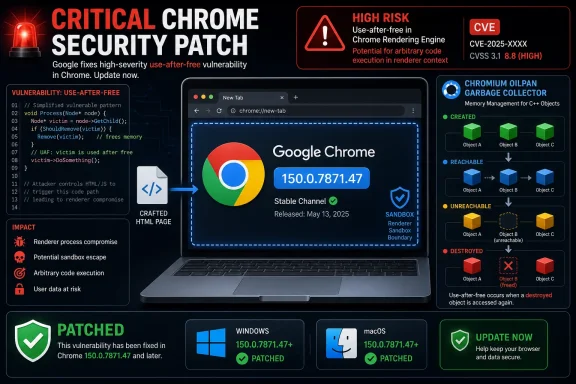 A “Medium” Chrome Bug Can Still Be a High-Risk Enterprise Event
Browser vulnerability severity has always required translation. Google’s internal Chromium severity rating reflects how the bug behaves inside Chrome’s architecture, including sandbox boundaries, exploit prerequisites, and the component involved. CVSS, by contrast, tries to normalize risk across products and environments, which is why a remotely reachable memory-corruption bug that needs only a malicious page and user interaction can score high even when the vendor’s browser-specific label is more restrained.CVE-2026-13965 sits squarely in that gap. According to the NVD entry sourced from Chrome, the flaw affects Google Chrome versions prior to 150.0.7871.47 and is categorized as CWE-416, use after free. The attacker path is familiar: persuade a user to visit a crafted HTML page, trigger memory misuse in a browser component, and gain code execution within the sandbox.
The phrase “inside a sandbox” is doing a lot of work here. It means the bug, on its own, is not described as a full system compromise. It also means defenders should assume attackers will look for a second vulnerability or configuration weakness to chain with it, because modern browser exploitation is often a sequence rather than a single cinematic break-in.
CISA’s ADP record, as reflected in NVD’s change history, says there was no known exploitation at the time of assessment, marks the issue as not automatable, and still describes the technical impact as total. That is the enterprise headache in miniature: no confirmed exploitation, no self-propagation, but potentially severe impact if a user can be steered into the trap.
Oilpan Is the Kind of Plumbing Attackers Love Because Users Never See It
Oilpan is Chromium’s garbage collection system for Blink-managed objects, part of the memory-management machinery beneath the visible web platform. Users do not interact with Oilpan; they interact with web pages, video players, enterprise dashboards, identity portals, and help-desk ticketing systems. That abstraction is precisely why browser memory bugs are so valuable.A use-after-free vulnerability occurs when software continues to use memory after it has been released. In a browser, where complex web content constantly creates, mutates, and destroys objects, mistakes in object lifetime can become exploitable primitives. Attackers do not need the user to download an executable; they need the browser to interpret hostile content in a vulnerable state.
That is why a crafted HTML page remains such a powerful delivery mechanism. HTML is not “just text” in the operational sense. It is the front door to a large programmable runtime composed of layout engines, JavaScript execution, graphics paths, media stacks, networking, storage APIs, and component-specific memory management.
The medium vendor severity should therefore be read as bounded, not benign. Google’s description says arbitrary code execution occurs inside the sandbox, which limits the blast radius compared with a sandbox escape. But for a phishing operator, spyware broker, or targeted intrusion team, sandboxed code execution can still be a useful beachhead.
The Patch Number Is the Only Detail Most Admins Need Today
For practical purposes, the fixed desktop build is Chrome 150.0.7871.47 for Windows and Mac, with Google’s late-June stable-channel update also moving Linux to the 150.0.7871.46 line. Malwarebytes, covering the same release wave, reported that the update carried hundreds of security fixes, reinforcing that CVE-2026-13965 is one piece of a much larger hardening push rather than a standalone emergency bulletin.That matters for administrators because the question is not whether this one CVE deserves a special maintenance window. The question is whether endpoints are actually crossing the fixed-version line quickly enough. In managed Windows environments, Chrome’s update mechanism is usually reliable, but “usually” is not an audit result.
The minimum useful check is simple: devices running Chrome below 150.0.7871.47 on Windows or Mac should be treated as exposed to this specific issue. For Linux, administrators should validate against the vendor-packaged Chromium or Chrome build available for their distribution, because package timing can diverge from Google’s desktop release notes.
For end users, the consumer answer is even less romantic. Open Chrome’s About page, let it check for updates, and relaunch. The relaunch is not optional theater; until the browser restarts into the new build, the patched code may not be the code protecting the session.
NVD’s CPE Change Is Not Just Metadata Noise
The user-supplied NVD change history shows that NIST added a CPE configuration for Google Chrome versions up to, but excluding, 150.0.7871.47 on July 2, 2026. That may look like database housekeeping, but CPE mappings are what many vulnerability scanners, dashboards, and compliance systems use to connect an abstract CVE to installed software.When CPE data lags or looks odd, security teams can see false negatives, duplicate findings, or inconsistent exposure counts across tools. In this case, NVD’s record indicates that the configuration was added after the CVE was initially received from Chrome on June 30. That is normal enough, but it also explains why some scanners may have briefly disagreed about whether they could detect the issue cleanly.
There is one wrinkle in the affected-version text from the CVE record. The JSON-style affected block shown in the NVD history lists version “150.0.7871.47,” lessThan “150.0.7871.47,” and status “affected,” which reads awkwardly to humans because the fixed version and the upper bound share the same number. The meaningful interpretation is the CPE line NIST later added: Chrome versions before 150.0.7871.47 are vulnerable.
That is the version logic administrators should use. Do not over-index on a single confusing affected-version field when the description, CPE configuration, and vendor release all point to the same fixed threshold.
Chromium’s Shared Codebase Turns One Chrome CVE Into a Browser Ecosystem Watch
CVE-2026-13965 is formally a Google Chrome CVE, but the component at issue lives in Chromium. That makes the patch relevant beyond Chrome in the broader sense, even when downstream browsers do not publish identical advisories on the same day. Microsoft Edge, Brave, Vivaldi, Opera, and other Chromium-based browsers inherit large parts of the same engine and must pull, test, and ship upstream fixes on their own schedules.For WindowsForum readers, Edge is the obvious second-order concern. Microsoft’s browser is deeply integrated into Windows fleets, and many organizations treat it as a managed default even if Chrome is also installed. A Chrome fixed build does not automatically mean every Chromium-derived browser on the machine is fixed.
The practical inventory question is therefore wider than “is Chrome patched?” It is “which Chromium-based browsers are installed, which channel are they on, and which Chromium base have they absorbed?” Consumer machines often accumulate browsers through OEM images, developer tools, gaming launchers, and user preference. Corporate machines do it through sanctioned exceptions.
This is also where vulnerability scanners can become strangely political. A scanner may flag Google Chrome quickly because the NVD CPE is present, while lagging on Chromium derivatives until their vendors publish corresponding metadata. The absence of a finding is not proof that the shared code path was never affected.
The Exploitability Story Is Constrained, Not Closed
The NVD/CISA enrichment notes indicate no observed exploitation at the time of the July 1 assessment. That is good news, but it is not a permanent property of the vulnerability. Browser bugs can move from patched advisory to working exploit after attackers diff the fix, study the bug class, and determine whether it can be reached reliably.Google’s restriction of detailed Chromium issue data is part of that reality. The public bug tracker entry exists, but access to sensitive details is commonly restricted until enough users have updated. That is not secrecy for secrecy’s sake; it is a race-management tactic.
The user-interaction requirement also deserves a careful reading. CVSS marks UI:R because the victim must do something, generally visit or interact with malicious content. In 2026, that is not a high bar. Email links, compromised ad supply chains, poisoned search results, malicious collaboration invites, and fake support pages all exist to convert “user interaction required” into a routine condition.
Still, it is important not to overstate the case. The available public record does not say CVE-2026-13965 is being exploited in the wild. It does not describe a sandbox escape. It does not establish that a single page view yields full device compromise. The responsible conclusion is sharper and narrower: this is a memory-corruption bug with plausible exploit value, fixed in a specific Chrome version, and risky enough that delayed patching is hard to justify.
The Browser Patch Treadmill Is Now Part of Windows Operations
Windows administrators used to think of browser patching as a desktop support chore. That framing has not survived the modern web. The browser is now an application runtime, identity surface, document viewer, video stack, password vault, extension host, and increasingly the place where SaaS work actually happens.That makes Chrome updates operationally similar to OS updates, except faster and more frequent. The late-June Chrome 150 release wave reportedly fixed hundreds of security issues, which is both a tribute to the scale of browser security engineering and a reminder that the attack surface is enormous. The security model depends on rapid patch ingestion as much as it depends on sandboxing.
For small businesses and home users, automatic updates remain the main line of defense. For enterprises, the story is more complicated. Change control, line-of-business app compatibility, extension policy, virtual desktop images, and browser channel choices can all slow deployment.
The uncomfortable truth is that attackers benefit from that lag. A vulnerability with no known exploitation on publication day can become more attractive once the patch is available and unpatched populations remain measurable. In browser security, the patch itself can become a map.
Extension Policy, Relaunch Debt, and the Human Side of Patch Latency
There is another reason Chrome security updates do not always land cleanly: users keep browsers open forever. Tabs become workspaces, sessions become memory, and the relaunch button becomes a psychological threat. The browser may download the update, but the vulnerable process can persist until restart.Enterprise policy can help, but it can also create friction. Forced relaunch settings reduce exposure windows, yet they can disrupt meetings, forms, dashboards, and unsaved web-app state. Soft prompts preserve user control, yet they can turn patching into a days-long negotiation with the corner of the screen.
The right answer depends on risk tolerance, but CVE-2026-13965 is a useful reminder that relaunch debt is real debt. If an endpoint has downloaded Chrome 150.0.7871.47 but has not restarted the browser, the security team should not count victory too early.
Extension policy is the adjacent concern. The Reddit noise around Chrome 150 suggests some users noticed extension-related breakage or behavior changes after updating, though those anecdotal reports should not be treated as security advisories. Still, they illustrate why organizations hesitate: browser updates can touch workflows in unexpected ways even when the headline is “security fixes.”
The Sandbox Is a Seatbelt, Not a Permission Slip
Chrome’s sandbox remains one of the most important defenses in consumer and enterprise computing. It is designed to contain renderer compromise and make browser exploitation more expensive. CVE-2026-13965’s “inside a sandbox” language shows that containment working as a boundary in the vulnerability description.But seatbelts do not make crashes desirable. A sandboxed code-execution bug can still expose browser-process data reachable from the compromised context, enable further exploitation attempts, or serve as the first stage in a chain. Attackers with a second bug may care less about the first bug’s standalone severity than about its reliability.
This is why the “Medium” label should not become a procurement excuse or patch-delay slogan. Browser vendors must grade issues within an architecture; defenders must grade them within an environment. A locked-down kiosk, a developer workstation with privileged cloud sessions, and a domain-joined executive laptop do not have the same practical risk profile.
The better mental model is layered failure. The crafted HTML page is the lure. The Oilpan use-after-free is the execution primitive. The sandbox is the containment layer. The user’s active sessions, extensions, credentials, and network position determine what comes next.
Security Teams Should Treat This as a Verification Drill
The best response to CVE-2026-13965 is not panic; it is verification. The fix is available, the affected boundary is clear, and the public record does not currently indicate exploitation in the wild. That makes this a useful drill for browser hygiene rather than a crisis with unknown blast radius.A mature Windows fleet should be able to answer a few questions quickly. How many machines still run Chrome below 150.0.7871.47? How many have pending relaunches? Are Edge and other Chromium-based browsers being tracked separately? Are VDI and golden images updated, or only live endpoints?
If those answers are hard to obtain, that is the larger finding. CVE-2026-13965 will not be the last browser memory bug this year, and it is unlikely to be the scariest. The organizations that handle this well will be the ones that treat browser version state as first-class security telemetry.
For home users, the equivalent is simpler. Update Chrome, restart it, and do the same for any other browser you actually use. If a browser has been sitting unused but installed for months, either update it or remove it.
The Chrome 150 Fix Is Small; the Lesson Is Not
CVE-2026-13965 does not need theatrical treatment to matter. It is a concrete, patched memory-safety flaw in a dominant browser engine, with a crafted-page attack path and a clear fixed version. The useful takeaways are operational, not dramatic.- Chrome users on Windows and Mac should be on 150.0.7871.47 or later to clear CVE-2026-13965.
- The flaw is a use-after-free in Chromium’s Oilpan garbage collector and is tracked as CWE-416.
- Public records from NVD and CISA did not indicate known exploitation when the vulnerability was enriched in early July 2026.
- The attack requires user interaction, but visiting a malicious or compromised page is a realistic condition in browser threat models.
- The phrase “inside a sandbox” lowers the implied blast radius, but it does not make delayed patching safe.
- Organizations should verify Chromium-based browsers beyond Chrome, because shared engine code can create shared exposure before downstream advisories catch up.
References
- Primary source: NVD / Chromium
Published: 2026-07-03T07:00:10-07:00
NVD - CVE-2026-13965
 nvd.nist.gov
- Security advisory: MSRC
Published: 2026-07-03T07:00:10-07:00
Original feed URL
Security Update Guide - Microsoft Security Response Center
 msrc.microsoft.com
- Related coverage: cvefeed.io
CVE-2026-13965 - Google Chrome Use-After-Free
Use after free in Oilpan in Google Chrome prior to 150.0.7871.47 allowed a remote attacker to execute arbitrary code inside a sandbox via a crafted HTML page. (Chromium security severity: Medium)cvefeed.io