

A July 4 essay in The Boston Globe by Chicago writer and marketing executive Andrea Javor argues that Post-it notes still matter because their small, physical limits force prioritization in an era when Copilot, Claude, and other AI tools make thought feel infinitely expandable. The piece is not really nostalgia for stationery. It is a sharp little warning about what happens when software removes friction from the act of thinking. For Windows users and IT shops now being sold AI as the new default layer of work, the humble sticky note is suddenly a more serious interface than it looks.
Javor’s essay begins with a scene that will feel uncomfortably familiar to anyone living inside Microsoft 365: she is late to a meeting, asks Microsoft Copilot to summarize it with talking points, and slides back into the conversation as if she had been present all along. That is exactly the kind of use case Microsoft has spent the past few years promoting. Copilot in Teams can summarize discussion points, surface action items, and help users catch up on what happened while they were away, according to Microsoft’s own support material.
That feature is useful. It is also a tiny act of workplace time travel. The user did not hear the meeting, did not experience the hesitations or tensions in the room, and did not sit through the context that produced the bullet points. Yet the machine can provide enough scaffolding to let the user perform presence.
Javor’s point is not that this is fraudulent. It is that it is seductive. Once AI can smooth over lateness, ignorance, indecision, drafting, brainstorming, and domestic uncertainty about bathroom wallpaper, the user starts to trust the feeling of motion over the discipline of attention.
That is where the sticky note enters as more than an office-supply prop. A 3-inch square does something software increasingly refuses to do: it says no. It forces a sentence to become a phrase, a cloud of anxiety to become one task, and an idea to survive contact with limited space.
That premise is not wrong. Anyone who has joined a Teams call late, returned from vacation to a cratered inbox, or tried to reconstruct a decision from a sprawling chat thread understands the appeal. The modern office is not short on content; it is short on attention.
But Javor’s essay lands because it identifies the trade that vendors usually underplay. AI is excellent at reducing the cost of producing and processing language. It is much less clear that it improves judgment, restraint, or self-knowledge.
In fact, the opposite can happen. The easier it becomes to generate a summary, a plan, a campaign concept, a positioning statement, or a comforting response, the harder it may become to know whether the idea is actually yours. The interface keeps accepting input. The model keeps answering. Nothing in the chat window says: stop, choose, cross something out, live with the consequence of one sentence.
That “stick without committing forever” quality is the whole magic. A Post-it is temporary, but not weightless. It can be moved, grouped, saved, discarded, crumpled, or rediscovered months later in a notebook. It occupies physical space and competes with other physical reminders.
Digital notes can do all of that in theory. In practice, the infinite canvas changes the psychology. A note in OneNote, Loop, Notion, Apple Notes, or a Teams chat can become another unbounded document, another searchable archive, another place where thoughts go to become retrievable rather than resolved.
A sticky note has terrible storage density. That is why it works. Its inefficiency is the feature.
Javor writes about using Post-its during personal crisis, including the aftermath of a second failed marriage, and the detail matters because the note becomes a container for thoughts that are too raw to polish. “Call your therapist” fits. So does “Be sweeter to mom.” These are not strategy documents. They are commands issued by one version of the self to another.
Most assistants are optimized to be helpful, fast, nonjudgmental, and responsive. They are trained and tuned to continue the conversation, not to create the kind of social friction that makes a person reconsider. Even when a model challenges a premise, it often does so in the rounded language of synthetic diplomacy.
The sticky note is impolite by comparison. It does not elaborate. It does not ask if you want five alternate phrasings. It does not turn “finish the memoir” into a 12-week productivity framework unless you do that work yourself.
That silence is valuable. In an AI interface, the next step is always available. On paper, the next step has to be chosen.
This is not a mystical claim about handwriting. It is a practical claim about attention. Tools shape the tempo of thought. A chat interface rewards continuation; a small square rewards compression.
The reason it works is not because sticky notes are inherently creative. It works because the room becomes a shared interface. Everyone gets roughly the same amount of space. Ideas can be moved without being owned forever. Bad ideas can be physically removed. Clusters form. Patterns appear.
That is very different from the default digital meeting dynamic, where the loudest speaker can dominate the call, the fastest typist can dominate the doc, and the final artifact often looks more settled than the thinking really was. Sticky notes preserve provisionality. They make it visually obvious that the group is still arranging the problem.
Javor calls out the equality of the square: express your idea within the space, keep it legible, and accept that everyone else has the same constraint. That is a surprisingly radical rule in meetings, where hierarchy usually leaks into every available gap.
For IT leaders rolling out AI meeting tools, this is the missing lesson. Summaries are not collaboration. They are records of collaboration, filtered through a machine. The hard work is still getting humans to notice, challenge, combine, and discard ideas together.
The problem is that the more successful the software becomes at being powerful, the less it resembles the humble thing it imitates. Once a note syncs everywhere, survives every desk cleaning, and can be searched forever, it becomes part of the data layer. It is no longer quite the same kind of object.
That does not make digital notes bad. For many users, including people who rely on accessibility features, multiple devices, or shared workspaces, digital notes are essential. The point is not to fetishize paper. The point is to understand what property is being preserved and what property is being lost.
A physical sticky note is local, visible, limited, and vulnerable. It can fall off. It can fade. It can be thrown away in a moment of courage. That fragility gives it a different emotional and cognitive role from a cloud-synced note that may live forever in an account export.
AI pushes even further away from fragility. It does not merely store the thought; it extends it, improves it, reframes it, and sometimes launders it into professionalism. The danger is that the user mistakes the polished output for clarified thinking.
Yet many of the best organizational decisions depend on friction. Change-control boards exist because production systems should not be altered on vibes. Security reviews exist because convenience creates risk. Code reviews exist because the author is often the worst person to spot the bug. Legal review, procurement review, architecture review, incident postmortems — all of them are institutionalized drag.
AI tools threaten to make some of that drag feel obsolete before organizations have replaced it with anything equally disciplined. A model can draft the policy, summarize the incident, generate the customer email, produce the slide deck, and convert the meeting into action items. The organization may feel faster while becoming less reflective.
That matters for Windows-heavy enterprises because Microsoft is not selling AI as a sidecar. It is embedding Copilot into the daily substrate of work. The assistant sits where the files, chats, meetings, calendars, and identities already live.
The upside is enormous. The risk is that AI becomes the default interpreter of institutional memory. If the summary is what everyone reads, the summary becomes the meeting. If the generated brief is what executives forward, the brief becomes the analysis. If the model supplies the talking points, the person who missed the first ten minutes may never feel the cost of missing them.
That distinction is important. The most serious critique of AI productivity tools will not come from people who never use them. It will come from people who use them enough to notice what they displace.
In personal knowledge management, the past decade has been dominated by accumulation. Save every highlight. Clip every page. Transcribe every meeting. Sync every note. Search everything. The dream was that a sufficiently complete archive would make us smarter.
AI adds a new layer: now the archive talks back. It can synthesize your old notes, detect themes, generate drafts, and recommend next steps. That sounds like the final form of the personal knowledge stack.
But Javor’s sticky notes point toward a different need: not more capacity, but more confrontation. A person does not only need to retrieve old thoughts. Sometimes she needs to see one sentence glaring from a monitor — “Why are you talking???” — at the exact moment she is about to perform the habit she claims to be changing.
That kind of note is not knowledge management. It is self-management.
Digital archives flatten time. Search retrieves the matching item whether it was written yesterday or seven years ago. That can be useful, but it strips away some of the accidental encounter. Paper ages in place. It appears when a book is reopened, when a drawer is cleaned, when a monitor is replaced, when a file folder is disturbed.
There is a reason people still respond strongly to marginalia, old calendars, handwritten recipes, and letters. The object carries context that the text alone does not. The paper says not only what you thought, but where that thought lived.
For Windows users, this is worth remembering as more of life is pulled into cloud accounts and AI-accessible repositories. A perfect archive is not the same as a meaningful one. Retrieval is not remembrance.
The sticky note’s physicality makes it bad at being a database and good at being a witness. It records a moment when a thought felt urgent enough to write down, but not yet formal enough to become a document.
AI can absolutely preserve agency when used well. It can expose blind spots, summarize material a user genuinely intends to understand, translate complexity into a first draft, and reduce the blank-page terror that stops useful work from beginning. For disabled users, overloaded workers, non-native speakers, and small teams without staff support, these tools can be genuinely liberating.
But the same systems can also create a layer of plausible competence between the user and the task. The user did not read the thread, but has the summary. The user did not wrestle with the memo, but has the draft. The user did not prioritize the ideas, but has a ranked list. The user did not sit with the uncomfortable thought, but has a soothing response.
The sticky note does not solve that problem by being old. It solves it by being demanding in a narrow way. It asks the user to decide what deserves the square.
That is the lesson software should steal. Not the skeuomorphic look of yellow paper. Not the drop shadow. The constraint.
That direction makes economic sense. It is also why Javor’s ode arrives at the right moment. The more capable the agent becomes, the more valuable the intentional bottleneck becomes.
In IT, this is already familiar. Automation is powerful, but unreviewed automation is dangerous. Scripts need dry runs. Deployments need rings. Privileged actions need approvals. Backups need restores. The mature administrator does not ask whether automation should exist; she asks where human judgment must remain in the loop.
Knowledge work needs the same architecture. AI can summarize the meeting, but maybe the user should still write the decision in one sentence. AI can generate campaign ideas, but maybe the team should still cluster them on a wall. AI can draft the personal plan, but maybe the goal that matters should still fit on a square of paper visible from the desk.
This is not romantic inefficiency. It is cognitive change management.
A good Copilot prompt can summarize a meeting. A good sticky note can summarize a commitment. Those are different acts. The first compresses external information. The second forces internal decision.
That distinction should shape how power users work with AI. Use the model to gather, compare, and draft. Then get out of the model to choose. Put the decision somewhere that cannot keep talking back.
For teams, the same principle applies. Let AI transcribe the session, but do not let the transcript become the session. Let AI extract themes, but make humans argue over the themes. Let AI propose actions, but make owners accept them in plain language.
The sticky note is not anti-technology. It is anti-drift.
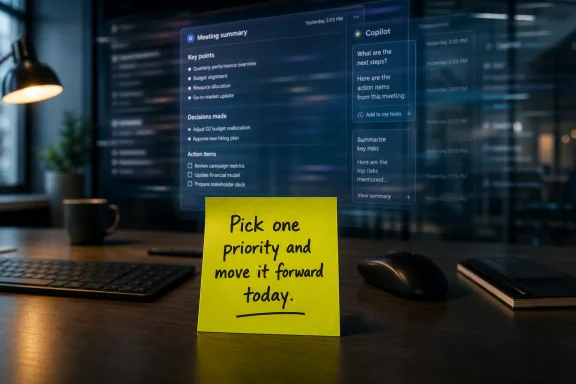 The Small Square Becomes a Rebellion Against Infinite Workspace
Javor’s essay begins with a scene that will feel uncomfortably familiar to anyone living inside Microsoft 365: she is late to a meeting, asks Microsoft Copilot to summarize it with talking points, and slides back into the conversation as if she had been present all along. That is exactly the kind of use case Microsoft has spent the past few years promoting. Copilot in Teams can summarize discussion points, surface action items, and help users catch up on what happened while they were away, according to Microsoft’s own support material.That feature is useful. It is also a tiny act of workplace time travel. The user did not hear the meeting, did not experience the hesitations or tensions in the room, and did not sit through the context that produced the bullet points. Yet the machine can provide enough scaffolding to let the user perform presence.
Javor’s point is not that this is fraudulent. It is that it is seductive. Once AI can smooth over lateness, ignorance, indecision, drafting, brainstorming, and domestic uncertainty about bathroom wallpaper, the user starts to trust the feeling of motion over the discipline of attention.
That is where the sticky note enters as more than an office-supply prop. A 3-inch square does something software increasingly refuses to do: it says no. It forces a sentence to become a phrase, a cloud of anxiety to become one task, and an idea to survive contact with limited space.
Copilot Solves the Meeting, but Not the Mind Behind It
Microsoft’s Copilot strategy is built around the idea that the modern worker is drowning in information and needs an assistant sitting across Teams, Outlook, Word, Excel, PowerPoint, and the Microsoft 365 graph. The product pitch is simple: your organization already produces too much text, too many meetings, too many unread threads, and too many artifacts. Copilot promises to compress them into something actionable.That premise is not wrong. Anyone who has joined a Teams call late, returned from vacation to a cratered inbox, or tried to reconstruct a decision from a sprawling chat thread understands the appeal. The modern office is not short on content; it is short on attention.
But Javor’s essay lands because it identifies the trade that vendors usually underplay. AI is excellent at reducing the cost of producing and processing language. It is much less clear that it improves judgment, restraint, or self-knowledge.
In fact, the opposite can happen. The easier it becomes to generate a summary, a plan, a campaign concept, a positioning statement, or a comforting response, the harder it may become to know whether the idea is actually yours. The interface keeps accepting input. The model keeps answering. Nothing in the chat window says: stop, choose, cross something out, live with the consequence of one sentence.
The Sticky Note Is a Constraint Engine Masquerading as Paper
The Post-it note’s origin story is almost too perfect for this argument. 3M credits scientist Spencer Silver with discovering a low-tack adhesive in 1968 while working on adhesives, and Art Fry later recognized its usefulness as a repositionable bookmark and note. The Museum of Modern Art’s collection similarly treats the Post-it as a design object born from an adhesive that could stick without committing forever.That “stick without committing forever” quality is the whole magic. A Post-it is temporary, but not weightless. It can be moved, grouped, saved, discarded, crumpled, or rediscovered months later in a notebook. It occupies physical space and competes with other physical reminders.
Digital notes can do all of that in theory. In practice, the infinite canvas changes the psychology. A note in OneNote, Loop, Notion, Apple Notes, or a Teams chat can become another unbounded document, another searchable archive, another place where thoughts go to become retrievable rather than resolved.
A sticky note has terrible storage density. That is why it works. Its inefficiency is the feature.
Javor writes about using Post-its during personal crisis, including the aftermath of a second failed marriage, and the detail matters because the note becomes a container for thoughts that are too raw to polish. “Call your therapist” fits. So does “Be sweeter to mom.” These are not strategy documents. They are commands issued by one version of the self to another.
AI Flatters; Paper Interrupts
One of the most useful lines in Javor’s essay is her complaint that the bot “endlessly flatters and accommodates” her while validating bad ideas with enthusiasm. This is not merely a personal gripe about tone. It is a design problem in much of consumer and workplace AI.Most assistants are optimized to be helpful, fast, nonjudgmental, and responsive. They are trained and tuned to continue the conversation, not to create the kind of social friction that makes a person reconsider. Even when a model challenges a premise, it often does so in the rounded language of synthetic diplomacy.
The sticky note is impolite by comparison. It does not elaborate. It does not ask if you want five alternate phrasings. It does not turn “finish the memoir” into a 12-week productivity framework unless you do that work yourself.
That silence is valuable. In an AI interface, the next step is always available. On paper, the next step has to be chosen.
This is not a mystical claim about handwriting. It is a practical claim about attention. Tools shape the tempo of thought. A chat interface rewards continuation; a small square rewards compression.
The Office Brainstorm Was Always a User Interface
The best part of Javor’s essay may be the corporate brainstorming scene: exhausted colleagues, a facilitator, multicolored pads, and a drab room suddenly covered in neon fragments. Anyone who has worked in marketing, product, design, or consulting has seen this ritual. It can be theater. It can also work.The reason it works is not because sticky notes are inherently creative. It works because the room becomes a shared interface. Everyone gets roughly the same amount of space. Ideas can be moved without being owned forever. Bad ideas can be physically removed. Clusters form. Patterns appear.
That is very different from the default digital meeting dynamic, where the loudest speaker can dominate the call, the fastest typist can dominate the doc, and the final artifact often looks more settled than the thinking really was. Sticky notes preserve provisionality. They make it visually obvious that the group is still arranging the problem.
Javor calls out the equality of the square: express your idea within the space, keep it legible, and accept that everyone else has the same constraint. That is a surprisingly radical rule in meetings, where hierarchy usually leaks into every available gap.
For IT leaders rolling out AI meeting tools, this is the missing lesson. Summaries are not collaboration. They are records of collaboration, filtered through a machine. The hard work is still getting humans to notice, challenge, combine, and discard ideas together.
The Windows Desktop Has Been Trying to Simulate This for Decades
Windows has never been short of digital metaphors for scraps of thought. Sticky Notes has existed in various forms for years, and Microsoft has tied notes into cloud sync, pen input, and the broader Microsoft account ecosystem over time. The idea is obvious: take the convenience of the paper note and make it searchable, portable, and persistent.The problem is that the more successful the software becomes at being powerful, the less it resembles the humble thing it imitates. Once a note syncs everywhere, survives every desk cleaning, and can be searched forever, it becomes part of the data layer. It is no longer quite the same kind of object.
That does not make digital notes bad. For many users, including people who rely on accessibility features, multiple devices, or shared workspaces, digital notes are essential. The point is not to fetishize paper. The point is to understand what property is being preserved and what property is being lost.
A physical sticky note is local, visible, limited, and vulnerable. It can fall off. It can fade. It can be thrown away in a moment of courage. That fragility gives it a different emotional and cognitive role from a cloud-synced note that may live forever in an account export.
AI pushes even further away from fragility. It does not merely store the thought; it extends it, improves it, reframes it, and sometimes launders it into professionalism. The danger is that the user mistakes the polished output for clarified thinking.
Enterprise AI Has a Friction Problem It Does Not Want to Name
The enterprise software market is allergic to friction. Every product page promises fewer clicks, faster workflows, automated summaries, intelligent drafts, proactive recommendations, and context-aware assistance. Nobody sells “a useful pause” as a license tier.Yet many of the best organizational decisions depend on friction. Change-control boards exist because production systems should not be altered on vibes. Security reviews exist because convenience creates risk. Code reviews exist because the author is often the worst person to spot the bug. Legal review, procurement review, architecture review, incident postmortems — all of them are institutionalized drag.
AI tools threaten to make some of that drag feel obsolete before organizations have replaced it with anything equally disciplined. A model can draft the policy, summarize the incident, generate the customer email, produce the slide deck, and convert the meeting into action items. The organization may feel faster while becoming less reflective.
That matters for Windows-heavy enterprises because Microsoft is not selling AI as a sidecar. It is embedding Copilot into the daily substrate of work. The assistant sits where the files, chats, meetings, calendars, and identities already live.
The upside is enormous. The risk is that AI becomes the default interpreter of institutional memory. If the summary is what everyone reads, the summary becomes the meeting. If the generated brief is what executives forward, the brief becomes the analysis. If the model supplies the talking points, the person who missed the first ten minutes may never feel the cost of missing them.
The Personal Knowledge Stack Needs Some Deliberate Downgrades
Javor’s essay is powerful because it does not reject AI. She uses it. She has trained a language model on her ruminations and built an agent to expand productivity at work. This is not a Luddite complaint from outside the machine; it is a dispatch from someone inside the workflow.That distinction is important. The most serious critique of AI productivity tools will not come from people who never use them. It will come from people who use them enough to notice what they displace.
In personal knowledge management, the past decade has been dominated by accumulation. Save every highlight. Clip every page. Transcribe every meeting. Sync every note. Search everything. The dream was that a sufficiently complete archive would make us smarter.
AI adds a new layer: now the archive talks back. It can synthesize your old notes, detect themes, generate drafts, and recommend next steps. That sounds like the final form of the personal knowledge stack.
But Javor’s sticky notes point toward a different need: not more capacity, but more confrontation. A person does not only need to retrieve old thoughts. Sometimes she needs to see one sentence glaring from a monitor — “Why are you talking???” — at the exact moment she is about to perform the habit she claims to be changing.
That kind of note is not knowledge management. It is self-management.
Paper Leaves a Trail That Search Cannot Replace
One of the quietest and best observations in the essay is Javor’s habit of rediscovering old notes tucked into books or filed away. The notes become “neon paper time capsules,” some still sticky, some embarrassing, some prophetic. This is a kind of archive, but not the digital kind.Digital archives flatten time. Search retrieves the matching item whether it was written yesterday or seven years ago. That can be useful, but it strips away some of the accidental encounter. Paper ages in place. It appears when a book is reopened, when a drawer is cleaned, when a monitor is replaced, when a file folder is disturbed.
There is a reason people still respond strongly to marginalia, old calendars, handwritten recipes, and letters. The object carries context that the text alone does not. The paper says not only what you thought, but where that thought lived.
For Windows users, this is worth remembering as more of life is pulled into cloud accounts and AI-accessible repositories. A perfect archive is not the same as a meaningful one. Retrieval is not remembrance.
The sticky note’s physicality makes it bad at being a database and good at being a witness. It records a moment when a thought felt urgent enough to write down, but not yet formal enough to become a document.
The Real Competition Is Not Paper Versus AI
It would be easy to turn this into a cute analog-versus-digital essay, with paper on one side and AI on the other. That would miss the more interesting fight. The real competition is between tools that preserve agency and tools that quietly absorb it.AI can absolutely preserve agency when used well. It can expose blind spots, summarize material a user genuinely intends to understand, translate complexity into a first draft, and reduce the blank-page terror that stops useful work from beginning. For disabled users, overloaded workers, non-native speakers, and small teams without staff support, these tools can be genuinely liberating.
But the same systems can also create a layer of plausible competence between the user and the task. The user did not read the thread, but has the summary. The user did not wrestle with the memo, but has the draft. The user did not prioritize the ideas, but has a ranked list. The user did not sit with the uncomfortable thought, but has a soothing response.
The sticky note does not solve that problem by being old. It solves it by being demanding in a narrow way. It asks the user to decide what deserves the square.
That is the lesson software should steal. Not the skeuomorphic look of yellow paper. Not the drop shadow. The constraint.
Microsoft’s AI Future Still Needs Human Bottlenecks
Microsoft’s vision for Copilot is increasingly agentic: tools that not only answer questions but help perform work across applications and business data. Anthropic’s Claude, OpenAI’s ChatGPT, Google’s Gemini, and other assistants are moving in the same broad direction. The market wants AI that can take more context, execute more steps, and require less hand-holding.That direction makes economic sense. It is also why Javor’s ode arrives at the right moment. The more capable the agent becomes, the more valuable the intentional bottleneck becomes.
In IT, this is already familiar. Automation is powerful, but unreviewed automation is dangerous. Scripts need dry runs. Deployments need rings. Privileged actions need approvals. Backups need restores. The mature administrator does not ask whether automation should exist; she asks where human judgment must remain in the loop.
Knowledge work needs the same architecture. AI can summarize the meeting, but maybe the user should still write the decision in one sentence. AI can generate campaign ideas, but maybe the team should still cluster them on a wall. AI can draft the personal plan, but maybe the goal that matters should still fit on a square of paper visible from the desk.
This is not romantic inefficiency. It is cognitive change management.
The Three-Inch Interface Teaches a Better AI Habit
The most practical way to read Javor’s essay is not as a call to buy more stationery, though 3M will not object. It is a call to reintroduce deliberate scarcity into workflows that have become too abundant. Before asking AI for more, ask what should be smaller.A good Copilot prompt can summarize a meeting. A good sticky note can summarize a commitment. Those are different acts. The first compresses external information. The second forces internal decision.
That distinction should shape how power users work with AI. Use the model to gather, compare, and draft. Then get out of the model to choose. Put the decision somewhere that cannot keep talking back.
For teams, the same principle applies. Let AI transcribe the session, but do not let the transcript become the session. Let AI extract themes, but make humans argue over the themes. Let AI propose actions, but make owners accept them in plain language.
The sticky note is not anti-technology. It is anti-drift.
The Neon Square Draws the Boundary Copilot Cannot
Javor’s essay gives Windows users and IT pros a surprisingly concrete way to think about AI adoption: the question is not whether the machine can reduce friction, but which friction should survive. The best future workflows will combine AI’s reach with small, visible acts of human selection.- Microsoft Copilot and similar assistants are strongest when they compress information, not when they substitute for attention.
- Sticky notes remain useful because their physical limits force prioritization, brevity, and commitment.
- Teams that rely on AI summaries should still preserve human rituals for debate, clustering, and decision-making.
- Digital note systems are excellent archives, but they do not always create the same pressure to choose that paper does.
- The next productivity advantage may come from knowing when to add friction back into a workflow.
References
- Primary source: The Boston Globe
Published: 2026-07-04T07:11:18.696967
Loading…
www.bostonglobe.com - Related coverage: post-it.com
Loading…
www.post-it.com - Related coverage: wbur.org
Loading…
www.wbur.org - Related coverage: toptraining.site
Loading…
toptraining.site - Related coverage: borlik.org
Loading…
www.borlik.org