

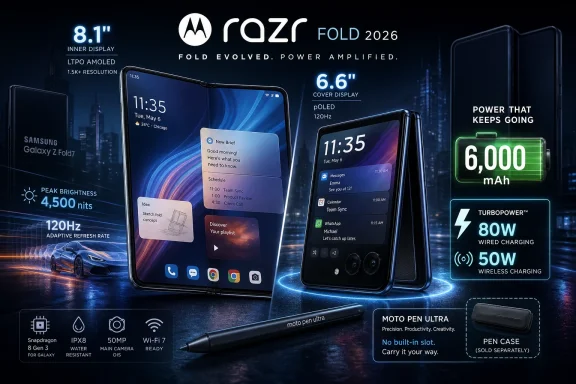
Motorola’s Razr Fold arrived in the United States in spring 2026 as the company’s first book-style foldable, pairing an 8.1-inch inner display, a 6,000mAh silicon-carbon battery, stylus support, and a $1,899 launch price against Samsung’s Galaxy Z Fold line. That is not merely a spec-sheet provocation. It is Motorola choosing the one part of the foldable market where Samsung has looked most comfortable and attacking the weak points Samsung has taught buyers to tolerate. As Memeburn framed it this week, the Razr Fold’s battery number is the headline — but the more interesting story is how many long-standing foldable compromises Motorola decided not to treat as inevitable.
For years, Motorola’s modern Razr strategy has lived in the shadow of its own name. The company revived a beloved flip-phone brand, wrapped it around flexible OLED panels, and competed in the clamshell lane against Samsung’s Galaxy Z Flip rather than the larger, more expensive Fold. That made sense: the Razr name already meant pocketable style, and flip foldables were easier to sell as fashion-forward upgrades rather than laptop-replacement fantasies.
The Razr Fold changes that calculation. A book-style foldable is not a nostalgia product; it is a productivity product, or at least it has to pretend to be one. It asks buyers to spend laptop money on a phone that becomes a small tablet, then justifies the bulk with multitasking, reading, gaming, note-taking, and media.
That is why Motorola’s move matters beyond the obvious brand expansion. In the US, Samsung has enjoyed an unusually long run with limited direct pressure in the book-style foldable category. Google’s Pixel Fold efforts brought competition, but Samsung still defined the mainstream Android foldable template: thinness, software polish, a high price, and a familiar set of trade-offs around battery capacity, camera hardware, and stylus compromise.
Motorola has entered by refusing to be polite. The Razr Fold does not merely say “we have one too.” It says the category leader has been under-serving the category.
Motorola’s answer is silicon-carbon battery chemistry. In plain English, the technology allows more energy to fit into a similar volume by using silicon in the anode mix rather than relying only on conventional graphite. Chinese phone makers have been pushing this approach aggressively, and Motorola bringing it into a US book-style foldable is significant because it moves a once-exotic battery advantage into a mainstream carrier-adjacent conversation.
Memeburn’s comparison is blunt: the Razr Fold’s battery is roughly 20 percent larger than the Pixel 10 Pro Fold’s and more than 25 percent larger than the Galaxy Z Fold7’s. Even if Samsung’s next Fold moves to a rumored 5,000mAh pack, Motorola would still hold the raw-capacity lead. For buyers, the number is easy to understand in a way that peak nits, sensor sizes, and hinge alloys often are not.
Review data strengthens the argument. PhoneArena reportedly measured 7 hours and 42 minutes of video streaming on the inner display, about an hour ahead of comparable Galaxy and Pixel foldables. Tom’s Guide has also placed the Razr Fold at the top of its foldable battery conversation, reporting unusually strong endurance in its own testing.
The important point is not that Motorola has discovered battery life. It is that Motorola has made battery life the product’s argument. Foldables have spent years selling futuristic form factors while asking users to plan around chargers. The Razr Fold reverses the pitch: the futuristic form factor is less interesting than the fact that it may finally behave like an all-day phone.
Still, this is one of those moments where the spec sheet reflects a philosophical divide. Samsung’s charging strategy has long favored caution, heat management, and battery longevity messaging over headline wattage. That posture has its defenders, especially among users who keep phones for years and distrust ultra-fast charging claims. But at $1,899, restraint starts to look less like prudence and more like inertia.
Motorola is betting that foldable buyers want relief more than lectures. A large foldable is the kind of device people use heavily: maps on the cover screen, Slack or Teams on the inside, photos, videos, games, hotspot duty, and late-night streaming. Fast top-ups matter more when the device itself is more central to the day.
The absence of Qi2 is not trivial. Magnetic alignment is becoming one of the cleanest quality-of-life improvements in wireless charging, and a premium 2026 phone without it feels oddly unfinished. But it does not erase the broader point: Motorola has made the charging experience feel modern in the places buyers will notice first.
Peak brightness figures are always partly theater. They usually describe small-window HDR conditions rather than full-screen sustained brightness, and they should not be mistaken for what the whole panel delivers indefinitely under summer sun. But brightness still matters on foldables because the inner screen is where users expect a tablet-like experience, and tablet-like experiences often happen outdoors, on trains, in cars, or under office lights that punish reflective glass.
Reviewers have treated the Razr Fold’s displays as one of the device’s strongest claims. TechRadar praised the phone as thin enough, light enough, and fast enough, while also giving Motorola credit for the battery technology and pen support. Android Central has gone further on the display experience, emphasizing eye-comfort features and the quality of the panels against competing North American foldables.
This is where Motorola’s old Razr instincts may help. The flip Razr line forced the company to care about external displays as more than notification windows. On a book-style foldable, the cover screen cannot feel like a compromise panel taped to the front of the “real” device. If the outer display is awkward, the whole product becomes annoying dozens of times per day.
The Razr Fold appears to understand that. It is not enough for the inside screen to be impressive during demos. The outside screen has to be livable, because that is where many users will type quick replies, authenticate apps, triage notifications, and take calls without unfolding a $1,899 slab in a grocery line.
This is the trade-off Motorola has chosen: bigger battery, more ambitious camera hardware, stylus support, and a large display package at the cost of mass. Some reviewers have been more forgiving than the numbers suggest. PhoneArena noted concern about the weight and thickness before finding the rounded design easier to handle than expected.
The camera plateau complicates the ergonomics further. TechRadar called out the large camera array on the back, and that detail matters because foldables already struggle with table behavior. A phone that wobbles when placed camera-side down can make pen use, typing, and reading feel less premium than the internal specs imply.
Samsung’s advantage here is real. The Galaxy Z Fold line has spent generations sanding down the physical absurdity of a phone that opens into a tablet. A lighter, thinner foldable is not automatically better, but it is easier to live with every hour of the day. Motorola can win the battery chart and still lose some pockets.
The question is whether buyers in this category are more irritated by weight or by low-battery warnings. Motorola is wagering that endurance is the more painful compromise. For many users, especially those who already carry large phones, that may be the right bet.
Motorola’s Razr Fold challenges that bargain with three 50MP rear cameras: a main sensor, an autofocus ultrawide, and a periscope telephoto. The point is not that 50MP is automatically better than Samsung’s 200MP headline sensor. Modern phones routinely pixel-bin images, and computational photography matters at least as much as raw resolution.
The more interesting decision is consistency across the array. A matched 50MP trio tells buyers that the ultrawide and telephoto are not afterthoughts. That is especially relevant on a foldable, where the large internal display invites editing, cropping, side-by-side comparison, and review of shots immediately after capture.
Memeburn argues that Motorola’s advantage is not the main sensor number but the balance across the three lenses. That is a fair reading. Samsung’s 200MP main camera sounds dominant on paper, but a foldable camera experience is shaped by the moments when users switch lenses and suddenly see quality fall off.
Zoom is another practical battleground. The Razr Fold reportedly preserves strong quality up to 6x, compared with 3x optical territory on the Galaxy Z Fold7 and 5x on the Pixel 10 Pro Fold. For travel, events, and family photography, zoom quality is one of those things buyers do not always prioritize until the phone fails them.
The larger lesson is that Motorola is trying to make the foldable feel less like a special-case device. A $1,899 phone should not require a mental asterisk every time the camera app opens. If Motorola’s processing keeps pace with the hardware, this may be one of the strongest arguments that book-style foldables can stop being camera second-class citizens.
Motorola now claims a cleaner marketing line: the Razr Fold is the only foldable currently sold in the US with stylus support in this competitive frame, according to the reporting summarized by Memeburn. The $99 Moto Pen Ultra is not bundled into the phone’s body, but it gives Motorola a feature Samsung does not currently field in the same way.
That matters because book-style foldables are naturally pen-shaped products. The internal display is large enough for notes, markup, diagrams, PDFs, screenshots, and light creative work. If the category wants to be more than a fancy way to watch video, pen input is one of the obvious paths.
The problem is storage. The Moto Pen Ultra uses a separate charging case rather than a slot inside the phone, and reviewers have been openly annoyed by that decision. One reviewer quoted by Memeburn said the case removed the desire to keep the pen on hand, which is exactly the failure mode every stylus product must avoid.
A stylus that is not with you is not a feature; it is an accessory you left somewhere. Samsung learned this with the Note line years ago. The magic was not just the pen but the fact that the pen lived in the phone, charged in the phone, and was always present at the moment of impulse.
Motorola deserves credit for bringing pen input back into the foldable conversation. But if a second-generation Razr Fold is coming, the brief writes itself: find the pen a home, or accept that the feature will remain more impressive in reviews than in daily life.
The Razr Fold’s seven-year update commitment is therefore essential. It puts Motorola in the same long-support conversation that Samsung and Google have normalized for flagship devices. At nearly $1,900, anything less would feel indefensible.
The awkward part is consistency. PhoneArena’s coverage of the broader Razr 2026 family notes that the flip models remain on shorter OS-support timelines, while the Fold gets the flagship treatment. That split is not unusual in the industry, but it creates a brand-message problem: Motorola wants to be seen as a premium Android steward, yet not all Razrs are being treated equally.
For IT-minded buyers, support windows are not cosmetic. A foldable is physically more fragile and financially harder to replace than a midrange slab phone. Long security support affects resale value, corporate acceptability, family hand-me-down logic, and the basic confidence that the device will not become software-expired before the hinge gives out.
The seven-year promise is the right move. The burden now shifts to execution. Samsung did not earn enterprise and enthusiast confidence by making one update promise; it earned it through years of repetition, even when users still complained about bloat, region timing, and carrier delays.
Motorola has bought a ticket to that table. It has not yet earned the seat.
This is the current Android flagship disease. Every vendor wants to say it has AI. Every partner wants placement. Every assistant wants to be the front door. The result can be a premium device that feels less intelligent because it cannot decide which intelligence is supposed to help.
For WindowsForum readers, the Copilot angle is especially interesting. Microsoft has spent the last few years pushing Copilot across Windows, Edge, Microsoft 365, and mobile endpoints. In theory, a foldable with a large internal display could be a credible Copilot surface for documents, email, summaries, and cross-device workflows.
But “in theory” is doing heavy lifting. The best mobile AI experiences are not the ones with the most logos; they are the ones that reduce friction at specific moments. Summarize this PDF. Clean up this note. Pull dates from this email. Turn this screenshot into a calendar item. If the Razr Fold’s AI layer feels like three assistants arguing for attention, Motorola has recreated the old Android bloatware problem with newer branding.
This may not hurt sales immediately. Buyers are still more likely to compare battery, screen, camera, and price than assistant architecture. But the long-term software experience will matter more as hardware gaps narrow. Motorola cannot rely forever on being the company with the biggest battery.
Rumors around the Z Fold8 point to a larger battery, faster charging, and a 200MP camera, though those details remain unconfirmed until Samsung says them onstage. If the July 2026 London launch expectation holds, Motorola’s advantage may be tested within weeks. Buyers who can wait will wait, because that is what premium-phone buyers do when the calendar is this obvious.
That does not make the Razr Fold a mistake. In fact, it may be exactly why Motorola had to launch when it did. If the company waited for Samsung to define the 2026 foldable baseline, it would have been forced into reaction mode. By moving first, Motorola gets to frame the questions Samsung must answer.
Can Samsung justify a smaller battery if Motorola’s endurance is meaningfully better? Can it keep charging speeds conservative while rivals move faster? Can it ignore stylus demand in a product category that begs for pen input? Can it continue treating camera compromises as normal?
The risk is that Samsung only needs to narrow the gaps, not erase them. Samsung has distribution, trade-in machinery, accessory ecosystems, carrier relationships, and a long record of foldable iteration. Motorola’s first-generation product has to be conspicuously better in several areas to overcome that incumbency.
Apple is the shadow over all of this. Reports and industry expectations continue to point toward Apple’s first foldable iPhone arriving later than Motorola’s launch window and likely at a higher price. If Apple enters the category, it will not need the largest battery number to reshape buyer expectations; it will bring iOS, ecosystem lock-in, and the power to make foldables feel newly mainstream overnight.
Motorola’s window is real. It may also be short.
But foldables have their own distorted economics. Against a $1,999 Galaxy Z Fold7, Motorola’s price is not shocking. Against a rumored foldable iPhone expected to sit well above $2,000, it may even look restrained. This is how premium categories normalize prices: not by becoming cheap, but by giving buyers a more expensive reference point.
The better question is what the buyer gets for the premium. Motorola offers a larger battery, faster charging, brighter displays, a balanced camera system, pen support, and seven years of updates. Samsung counters with a thinner and lighter chassis, mature software, stronger brand trust, and a foldable lineage that has survived years of public testing.
That is a real contest. It is also a reminder that the foldable market has moved beyond the novelty stage. Early adopters once paid because the hinge itself was the feature. In 2026, the hinge is the admission ticket. Everything else has to compete like a normal flagship.
For sysadmins and IT departments, price also intersects with repairability, insurance, and support. A $1,899 foldable is not an obvious fleet device, but executives and mobile-first workers will ask for them. The devices that win corporate tolerance will be the ones with long updates, predictable service channels, strong security posture, and fewer weird accessory dependencies.
Motorola has made progress on the update window. The pen case, the camera bump, and the first-generation status remain softer spots.
But Motorola is attacking with physical advantages that are easy to feel. Bigger battery. Faster charging. Brighter panels. Stylus support. On a foldable, hardware asserts itself more aggressively than on a slab phone because the form factor is the product.
Google can still win on computational photography and software coherence. It may also appeal to users who distrust Motorola’s update execution despite the formal seven-year promise. But the Pixel Fold line has never had Samsung’s hardware polish or Motorola’s newly aggressive spec posture, leaving it squeezed between ecosystem trust and hardware ambition.
This matters because competition in foldables has often been framed as Samsung versus everyone else. Motorola’s arrival creates a more complicated triangle. Samsung has maturity. Google has software purity. Motorola now has battery bravado.
That is good for buyers. It forces each company to stop pretending that “foldable” alone is enough.
None of that means Motorola has built the perfect foldable. The phone is heavier than Samsung’s. The camera plateau is visually and physically assertive. The stylus has no integrated garage. Qi2 is absent. The AI stack sounds cluttered. First-generation book-style hardware from a company with a mixed update reputation should invite scrutiny, not blind applause.
But the Razr Fold changes the argument in a way that benefits the whole category. Samsung can no longer rely on the assumption that US buyers have nowhere else serious to go. Google can no longer treat clean software as enough. Apple, if it enters soon, will arrive in a market where Android vendors have already started pushing battery chemistry and display brightness forward.
For once, Motorola is not merely trading on the Razr name. It is using the name to smuggle a more confrontational product into a category that needed one.
Samsung remains the safer choice for people who prioritize thinness, weight, ecosystem maturity, and proven foldable refinement. Google remains the cleaner choice for Pixel loyalists who value software cadence and camera computation. Motorola is the bolder choice for people who want the hardware compromises rearranged around battery, charging, brightness, zoom, and pen input.
That is a healthier market than the one foldable buyers had a few years ago. The decision is no longer whether Samsung’s version of the future is worth buying. It is which company’s compromises match your day.
 Motorola Finally Stops Playing Only the Nostalgia Card
For years, Motorola’s modern Razr strategy has lived in the shadow of its own name. The company revived a beloved flip-phone brand, wrapped it around flexible OLED panels, and competed in the clamshell lane against Samsung’s Galaxy Z Flip rather than the larger, more expensive Fold. That made sense: the Razr name already meant pocketable style, and flip foldables were easier to sell as fashion-forward upgrades rather than laptop-replacement fantasies.The Razr Fold changes that calculation. A book-style foldable is not a nostalgia product; it is a productivity product, or at least it has to pretend to be one. It asks buyers to spend laptop money on a phone that becomes a small tablet, then justifies the bulk with multitasking, reading, gaming, note-taking, and media.
That is why Motorola’s move matters beyond the obvious brand expansion. In the US, Samsung has enjoyed an unusually long run with limited direct pressure in the book-style foldable category. Google’s Pixel Fold efforts brought competition, but Samsung still defined the mainstream Android foldable template: thinness, software polish, a high price, and a familiar set of trade-offs around battery capacity, camera hardware, and stylus compromise.
Motorola has entered by refusing to be polite. The Razr Fold does not merely say “we have one too.” It says the category leader has been under-serving the category.
The 6,000mAh Battery Is a Challenge to Foldable Orthodoxy
The central number is 6,000mAh, and it lands because foldables have trained buyers to expect less. A device with two screens, a hinge, multiple cameras, thermal limits, and a tablet-sized internal panel ought to prioritize endurance, yet many book-style foldables have historically shipped with batteries that look modest beside conventional slab phones. Samsung has compensated with software tuning and processor efficiency, but battery anxiety has remained part of the foldable tax.Motorola’s answer is silicon-carbon battery chemistry. In plain English, the technology allows more energy to fit into a similar volume by using silicon in the anode mix rather than relying only on conventional graphite. Chinese phone makers have been pushing this approach aggressively, and Motorola bringing it into a US book-style foldable is significant because it moves a once-exotic battery advantage into a mainstream carrier-adjacent conversation.
Memeburn’s comparison is blunt: the Razr Fold’s battery is roughly 20 percent larger than the Pixel 10 Pro Fold’s and more than 25 percent larger than the Galaxy Z Fold7’s. Even if Samsung’s next Fold moves to a rumored 5,000mAh pack, Motorola would still hold the raw-capacity lead. For buyers, the number is easy to understand in a way that peak nits, sensor sizes, and hinge alloys often are not.
Review data strengthens the argument. PhoneArena reportedly measured 7 hours and 42 minutes of video streaming on the inner display, about an hour ahead of comparable Galaxy and Pixel foldables. Tom’s Guide has also placed the Razr Fold at the top of its foldable battery conversation, reporting unusually strong endurance in its own testing.
The important point is not that Motorola has discovered battery life. It is that Motorola has made battery life the product’s argument. Foldables have spent years selling futuristic form factors while asking users to plan around chargers. The Razr Fold reverses the pitch: the futuristic form factor is less interesting than the fact that it may finally behave like an all-day phone.
Charging Speed Makes Samsung Look Conservative
Battery capacity is only half the insult. Motorola also pairs the 6,000mAh pack with 80W wired charging and 50W wireless charging, numbers that make Samsung and Google look timid by comparison. There are caveats, as there always are: hitting peak speeds requires Motorola’s own charger, and the phone lacks Qi2 magnetic charging support.Still, this is one of those moments where the spec sheet reflects a philosophical divide. Samsung’s charging strategy has long favored caution, heat management, and battery longevity messaging over headline wattage. That posture has its defenders, especially among users who keep phones for years and distrust ultra-fast charging claims. But at $1,899, restraint starts to look less like prudence and more like inertia.
Motorola is betting that foldable buyers want relief more than lectures. A large foldable is the kind of device people use heavily: maps on the cover screen, Slack or Teams on the inside, photos, videos, games, hotspot duty, and late-night streaming. Fast top-ups matter more when the device itself is more central to the day.
The absence of Qi2 is not trivial. Magnetic alignment is becoming one of the cleanest quality-of-life improvements in wireless charging, and a premium 2026 phone without it feels oddly unfinished. But it does not erase the broader point: Motorola has made the charging experience feel modern in the places buyers will notice first.
The Screens Are Not Just Big; They Are Loud
The Razr Fold’s display story is nearly as aggressive as its battery story. The phone uses an 8.1-inch inner LTPO P-OLED display and a 6.6-inch cover display, both running at 120Hz with Dolby Vision and HDR10+ support. Peak brightness is listed at 6,200 nits, a number that towers over the Galaxy Z Fold7’s reported 2,700 nits and the Pixel 10 Pro Fold’s 3,000 nits.Peak brightness figures are always partly theater. They usually describe small-window HDR conditions rather than full-screen sustained brightness, and they should not be mistaken for what the whole panel delivers indefinitely under summer sun. But brightness still matters on foldables because the inner screen is where users expect a tablet-like experience, and tablet-like experiences often happen outdoors, on trains, in cars, or under office lights that punish reflective glass.
Reviewers have treated the Razr Fold’s displays as one of the device’s strongest claims. TechRadar praised the phone as thin enough, light enough, and fast enough, while also giving Motorola credit for the battery technology and pen support. Android Central has gone further on the display experience, emphasizing eye-comfort features and the quality of the panels against competing North American foldables.
This is where Motorola’s old Razr instincts may help. The flip Razr line forced the company to care about external displays as more than notification windows. On a book-style foldable, the cover screen cannot feel like a compromise panel taped to the front of the “real” device. If the outer display is awkward, the whole product becomes annoying dozens of times per day.
The Razr Fold appears to understand that. It is not enough for the inside screen to be impressive during demos. The outside screen has to be livable, because that is where many users will type quick replies, authenticate apps, triage notifications, and take calls without unfolding a $1,899 slab in a grocery line.
The Weight Is the Bill Coming Due
Motorola did not beat physics. At 4.6mm unfolded and 9.9mm folded, the Razr Fold is impressively thin for a first-generation book-style device, but it is not lighter than Samsung’s current flagship. At 243 grams, it is around 28 grams heavier than the Galaxy Z Fold7, and that gap matters because weight is not an abstract spec. It is the thing your hand notices before your brain starts rationalizing the purchase.This is the trade-off Motorola has chosen: bigger battery, more ambitious camera hardware, stylus support, and a large display package at the cost of mass. Some reviewers have been more forgiving than the numbers suggest. PhoneArena noted concern about the weight and thickness before finding the rounded design easier to handle than expected.
The camera plateau complicates the ergonomics further. TechRadar called out the large camera array on the back, and that detail matters because foldables already struggle with table behavior. A phone that wobbles when placed camera-side down can make pen use, typing, and reading feel less premium than the internal specs imply.
Samsung’s advantage here is real. The Galaxy Z Fold line has spent generations sanding down the physical absurdity of a phone that opens into a tablet. A lighter, thinner foldable is not automatically better, but it is easier to live with every hour of the day. Motorola can win the battery chart and still lose some pockets.
The question is whether buyers in this category are more irritated by weight or by low-battery warnings. Motorola is wagering that endurance is the more painful compromise. For many users, especially those who already carry large phones, that may be the right bet.
The Camera System Refuses the Usual Foldable Excuse
Foldable cameras have often existed under an implied apology. The hinge takes space. The inner screen takes space. The device must stay thin. Therefore, buyers should accept camera systems that lag behind slab flagships costing hundreds less.Motorola’s Razr Fold challenges that bargain with three 50MP rear cameras: a main sensor, an autofocus ultrawide, and a periscope telephoto. The point is not that 50MP is automatically better than Samsung’s 200MP headline sensor. Modern phones routinely pixel-bin images, and computational photography matters at least as much as raw resolution.
The more interesting decision is consistency across the array. A matched 50MP trio tells buyers that the ultrawide and telephoto are not afterthoughts. That is especially relevant on a foldable, where the large internal display invites editing, cropping, side-by-side comparison, and review of shots immediately after capture.
Memeburn argues that Motorola’s advantage is not the main sensor number but the balance across the three lenses. That is a fair reading. Samsung’s 200MP main camera sounds dominant on paper, but a foldable camera experience is shaped by the moments when users switch lenses and suddenly see quality fall off.
Zoom is another practical battleground. The Razr Fold reportedly preserves strong quality up to 6x, compared with 3x optical territory on the Galaxy Z Fold7 and 5x on the Pixel 10 Pro Fold. For travel, events, and family photography, zoom quality is one of those things buyers do not always prioritize until the phone fails them.
The larger lesson is that Motorola is trying to make the foldable feel less like a special-case device. A $1,899 phone should not require a mental asterisk every time the camera app opens. If Motorola’s processing keeps pace with the hardware, this may be one of the strongest arguments that book-style foldables can stop being camera second-class citizens.
The Stylus Returns, but Without a Home
The Moto Pen Ultra is the Razr Fold’s most pointed jab at Samsung. Samsung built the modern Galaxy Note audience, migrated pen culture into the Galaxy S Ultra line, and then made S Pen support on the Fold feel increasingly conditional. The Z Fold series has supported pen input in various forms, but the lack of a built-in slot has always weakened the proposition.Motorola now claims a cleaner marketing line: the Razr Fold is the only foldable currently sold in the US with stylus support in this competitive frame, according to the reporting summarized by Memeburn. The $99 Moto Pen Ultra is not bundled into the phone’s body, but it gives Motorola a feature Samsung does not currently field in the same way.
That matters because book-style foldables are naturally pen-shaped products. The internal display is large enough for notes, markup, diagrams, PDFs, screenshots, and light creative work. If the category wants to be more than a fancy way to watch video, pen input is one of the obvious paths.
The problem is storage. The Moto Pen Ultra uses a separate charging case rather than a slot inside the phone, and reviewers have been openly annoyed by that decision. One reviewer quoted by Memeburn said the case removed the desire to keep the pen on hand, which is exactly the failure mode every stylus product must avoid.
A stylus that is not with you is not a feature; it is an accessory you left somewhere. Samsung learned this with the Note line years ago. The magic was not just the pen but the fact that the pen lived in the phone, charged in the phone, and was always present at the moment of impulse.
Motorola deserves credit for bringing pen input back into the foldable conversation. But if a second-generation Razr Fold is coming, the brief writes itself: find the pen a home, or accept that the feature will remain more impressive in reviews than in daily life.
Software Support Is Motorola’s Trust Test
Motorola’s hardware swing would mean less if the company treated updates as an afterthought. Historically, that has been one of the brand’s weak spots in enthusiast circles. Good hardware at launch can sour quickly when security patches lag or major Android updates arrive late.The Razr Fold’s seven-year update commitment is therefore essential. It puts Motorola in the same long-support conversation that Samsung and Google have normalized for flagship devices. At nearly $1,900, anything less would feel indefensible.
The awkward part is consistency. PhoneArena’s coverage of the broader Razr 2026 family notes that the flip models remain on shorter OS-support timelines, while the Fold gets the flagship treatment. That split is not unusual in the industry, but it creates a brand-message problem: Motorola wants to be seen as a premium Android steward, yet not all Razrs are being treated equally.
For IT-minded buyers, support windows are not cosmetic. A foldable is physically more fragile and financially harder to replace than a midrange slab phone. Long security support affects resale value, corporate acceptability, family hand-me-down logic, and the basic confidence that the device will not become software-expired before the hinge gives out.
The seven-year promise is the right move. The burden now shifts to execution. Samsung did not earn enterprise and enthusiast confidence by making one update promise; it earned it through years of repetition, even when users still complained about bloat, region timing, and carrier delays.
Motorola has bought a ticket to that table. It has not yet earned the seat.
The AI Layer Sounds Like 2026 in the Worst Way
One of the less flattering details in early reviews is the Razr Fold’s crowded AI story. Gemini, Perplexity, and Microsoft Copilot reportedly coexist on the device, giving users a buffet of assistants that may sound impressive in a launch deck but risks feeling incoherent on a phone.This is the current Android flagship disease. Every vendor wants to say it has AI. Every partner wants placement. Every assistant wants to be the front door. The result can be a premium device that feels less intelligent because it cannot decide which intelligence is supposed to help.
For WindowsForum readers, the Copilot angle is especially interesting. Microsoft has spent the last few years pushing Copilot across Windows, Edge, Microsoft 365, and mobile endpoints. In theory, a foldable with a large internal display could be a credible Copilot surface for documents, email, summaries, and cross-device workflows.
But “in theory” is doing heavy lifting. The best mobile AI experiences are not the ones with the most logos; they are the ones that reduce friction at specific moments. Summarize this PDF. Clean up this note. Pull dates from this email. Turn this screenshot into a calendar item. If the Razr Fold’s AI layer feels like three assistants arguing for attention, Motorola has recreated the old Android bloatware problem with newer branding.
This may not hurt sales immediately. Buyers are still more likely to compare battery, screen, camera, and price than assistant architecture. But the long-term software experience will matter more as hardware gaps narrow. Motorola cannot rely forever on being the company with the biggest battery.
Samsung’s Next Move Is Already Haunting the Launch
The Razr Fold’s timing is both brilliant and dangerous. It landed before Samsung’s expected Galaxy Z Fold8 announcement, giving Motorola a window to claim the strongest book-style foldable spec sheet in the US. It also gave Samsung a clear target.Rumors around the Z Fold8 point to a larger battery, faster charging, and a 200MP camera, though those details remain unconfirmed until Samsung says them onstage. If the July 2026 London launch expectation holds, Motorola’s advantage may be tested within weeks. Buyers who can wait will wait, because that is what premium-phone buyers do when the calendar is this obvious.
That does not make the Razr Fold a mistake. In fact, it may be exactly why Motorola had to launch when it did. If the company waited for Samsung to define the 2026 foldable baseline, it would have been forced into reaction mode. By moving first, Motorola gets to frame the questions Samsung must answer.
Can Samsung justify a smaller battery if Motorola’s endurance is meaningfully better? Can it keep charging speeds conservative while rivals move faster? Can it ignore stylus demand in a product category that begs for pen input? Can it continue treating camera compromises as normal?
The risk is that Samsung only needs to narrow the gaps, not erase them. Samsung has distribution, trade-in machinery, accessory ecosystems, carrier relationships, and a long record of foldable iteration. Motorola’s first-generation product has to be conspicuously better in several areas to overcome that incumbency.
Apple is the shadow over all of this. Reports and industry expectations continue to point toward Apple’s first foldable iPhone arriving later than Motorola’s launch window and likely at a higher price. If Apple enters the category, it will not need the largest battery number to reshape buyer expectations; it will bring iOS, ecosystem lock-in, and the power to make foldables feel newly mainstream overnight.
Motorola’s window is real. It may also be short.
The Price Is Aggressive Only by Foldable Standards
At $1,899, the Razr Fold is expensive in any normal consumer-electronics conversation. It costs more than many laptops, more than multiple excellent phones, and enough that durability questions become financial anxiety. Calling it a value product would be absurd.But foldables have their own distorted economics. Against a $1,999 Galaxy Z Fold7, Motorola’s price is not shocking. Against a rumored foldable iPhone expected to sit well above $2,000, it may even look restrained. This is how premium categories normalize prices: not by becoming cheap, but by giving buyers a more expensive reference point.
The better question is what the buyer gets for the premium. Motorola offers a larger battery, faster charging, brighter displays, a balanced camera system, pen support, and seven years of updates. Samsung counters with a thinner and lighter chassis, mature software, stronger brand trust, and a foldable lineage that has survived years of public testing.
That is a real contest. It is also a reminder that the foldable market has moved beyond the novelty stage. Early adopters once paid because the hinge itself was the feature. In 2026, the hinge is the admission ticket. Everything else has to compete like a normal flagship.
For sysadmins and IT departments, price also intersects with repairability, insurance, and support. A $1,899 foldable is not an obvious fleet device, but executives and mobile-first workers will ask for them. The devices that win corporate tolerance will be the ones with long updates, predictable service channels, strong security posture, and fewer weird accessory dependencies.
Motorola has made progress on the update window. The pen case, the camera bump, and the first-generation status remain softer spots.
Google Looks Caught Between Two Better Arguments
The Pixel 10 Pro Fold, as positioned against the Razr Fold in Memeburn’s comparison, faces a different problem. Google’s pitch is usually software intelligence, camera processing, and the cleanest Android experience. Those are real strengths, especially for users who prefer Pixel features and fast Android updates.But Motorola is attacking with physical advantages that are easy to feel. Bigger battery. Faster charging. Brighter panels. Stylus support. On a foldable, hardware asserts itself more aggressively than on a slab phone because the form factor is the product.
Google can still win on computational photography and software coherence. It may also appeal to users who distrust Motorola’s update execution despite the formal seven-year promise. But the Pixel Fold line has never had Samsung’s hardware polish or Motorola’s newly aggressive spec posture, leaving it squeezed between ecosystem trust and hardware ambition.
This matters because competition in foldables has often been framed as Samsung versus everyone else. Motorola’s arrival creates a more complicated triangle. Samsung has maturity. Google has software purity. Motorola now has battery bravado.
That is good for buyers. It forces each company to stop pretending that “foldable” alone is enough.
The Spec Sheet Finally Says the Quiet Part Out Loud
The Razr Fold’s most useful contribution may be psychological. It proves that some foldable compromises were choices, not laws. A book-style foldable can ship with a 6,000mAh battery. It can charge quickly. It can offer pen input. It can put serious cameras on the back. It can promise seven years of updates.None of that means Motorola has built the perfect foldable. The phone is heavier than Samsung’s. The camera plateau is visually and physically assertive. The stylus has no integrated garage. Qi2 is absent. The AI stack sounds cluttered. First-generation book-style hardware from a company with a mixed update reputation should invite scrutiny, not blind applause.
But the Razr Fold changes the argument in a way that benefits the whole category. Samsung can no longer rely on the assumption that US buyers have nowhere else serious to go. Google can no longer treat clean software as enough. Apple, if it enters soon, will arrive in a market where Android vendors have already started pushing battery chemistry and display brightness forward.
For once, Motorola is not merely trading on the Razr name. It is using the name to smuggle a more confrontational product into a category that needed one.
The Buying Decision Comes Down to Which Compromise Annoys You Most
The Razr Fold is not an automatic recommendation, but it is an unusually clear one. It is for buyers who have wanted a book-style foldable and refused to accept weak endurance as the price of entry. It is also for users who see the inner display as a workspace, not just a video canvas.Samsung remains the safer choice for people who prioritize thinness, weight, ecosystem maturity, and proven foldable refinement. Google remains the cleaner choice for Pixel loyalists who value software cadence and camera computation. Motorola is the bolder choice for people who want the hardware compromises rearranged around battery, charging, brightness, zoom, and pen input.
That is a healthier market than the one foldable buyers had a few years ago. The decision is no longer whether Samsung’s version of the future is worth buying. It is which company’s compromises match your day.
The Razr Fold Forces the 2026 Foldable Fight Onto Battery Life
Motorola’s first book-style foldable is a reminder that the most glamorous mobile category still turns on basic user complaints. Big screens are useful only if the phone lasts. Pen support is compelling only if the pen is nearby. Camera hardware matters only if the device is not too awkward to carry.- The Razr Fold’s 6,000mAh silicon-carbon battery is its clearest advantage over current US book-style foldables.
- The 80W wired and 50W wireless charging numbers make Samsung and Google look conservative, even with charger and Qi2 caveats.
- The 8.1-inch inner display and 6.6-inch cover display give Motorola a strong screen story, especially with very high claimed peak brightness.
- The optional Moto Pen Ultra gives the Razr Fold a rare productivity edge, but the lack of built-in storage weakens the feature in daily use.
- The 243-gram weight and large camera plateau are the most obvious physical prices Motorola pays for its more ambitious hardware.
- Samsung’s expected next Fold and Apple’s rumored first foldable could quickly test how durable Motorola’s early 2026 advantage really is.
References
- Primary source: Memeburn
Published: 2026-07-04T05:50:31.541550
Loading…
memeburn.com - Related coverage: techradar.com
Loading…
www.techradar.com - Related coverage: phonearena.com
Loading…
www.phonearena.com - Related coverage: androidcentral.com
Loading…
www.androidcentral.com - Related coverage: arstechnica.com
Loading…
arstechnica.com - Related coverage: 91mobiles.com
Loading…
www.91mobiles.com
- Related coverage: notebookcheck.net
Loading…
www.notebookcheck.net - Related coverage: slashgear.com
Loading…
www.slashgear.com - Related coverage: techmymoney.com
Loading…
techmymoney.com - Related coverage: tomsguide.com
Loading…
www.tomsguide.com - Related coverage: help.motorola.com
Loading…
help.motorola.com - Related coverage: en-ca.support.motorola.com
Loading…
en-ca.support.motorola.com