

Data-center operators and energy developers are now exploring renewable natural gas made from cow manure and food waste as a power source for crypto mining, AI computing, and backup generation, with Ag-Grid Energy’s Lent Hill project in New York serving as the clearest U.S. test case. The idea sounds like a punchline until the power math arrives. AI has turned electricity from a utility bill into a strategic constraint, and the search for firm, dispatchable, lower-carbon energy is pushing the tech industry into places it once treated as someone else’s infrastructure problem.
As reported by Sentient and republished by ZME Science and Grist, the manure-to-compute story is no longer theoretical: an anaerobic digester at Lent Hill Dairy Farm is feeding an on-site crypto operation, while its developer pitches similar systems for small-scale data centers. The sharper question is not whether cow manure can run servers. It can. The question is whether Silicon Valley’s hunger for power is about to give industrial livestock operations a new climate-friendly costume.
For two decades, the data-center industry sold itself as a story of abstraction. The cloud was nowhere and everywhere, a frictionless layer above the messy physical world. The AI buildout has shattered that illusion. Every model checkpoint, chatbot query, GPU cluster, and inference farm has a physical footprint in substations, gas turbines, cooling loops, transmission queues, and local water systems.
The U.S. Department of Energy has cited Electric Power Research Institute estimates that data centers accounted for about 4 percent of U.S. electricity load in 2023 and could rise sharply by 2030. Lawrence Berkeley National Laboratory’s 2025 update put the possible 2030 U.S. share even higher, depending on buildout assumptions. Those projections vary, but they point in the same direction: AI is converting data centers from specialized industrial facilities into one of the defining loads on the American grid.
That shift explains why manure gas is suddenly part of the conversation. Hyperscalers do not merely need renewable energy in the annual accounting sense. They need power that can be delivered where facilities are built, when GPUs are running, and during the grid-stress hours when “we bought clean energy somewhere else” stops being useful.
This is why the industry’s energy procurement has broadened from wind and solar contracts into nuclear restarts, geothermal deals, gas generation, fuel cells, microgrids, and now renewable natural gas. The common thread is not purity. It is control.
That is the part proponents emphasize, and it is not imaginary. Methane is a potent greenhouse gas, and manure lagoons at large dairies are a serious emissions source. The U.S. Environmental Protection Agency’s AgSTAR program has long described anaerobic digestion as one tool for reducing methane from livestock manure while producing useful energy.
But the technology’s strength is also its political trap. Renewable natural gas is attractive precisely because it behaves like gas. It can be used in engines, turbines, boilers, pipelines, and backup systems without forcing a wholesale redesign of energy infrastructure. That makes it a convenient decarbonization story for companies that want a cleaner label on a familiar combustion system.
The result is a fuel that sits uneasily between climate mitigation and infrastructure lock-in. It can reduce some emissions relative to unmanaged manure. It can also preserve the business logic of burning methane, moving gas through pipelines, and treating industrial-scale waste streams as energy assets rather than pollution problems.
But Lent Hill matters because it demonstrates a pattern: compute can move toward stranded or locally generated energy, rather than waiting for the grid to deliver everything. Crypto mining pioneered this logic because it is unusually location-flexible. If the power is cheap enough, miners can show up almost anywhere with containers of machines.
AI data centers are less footloose. They care more about fiber, latency, redundancy, workforce access, hardware logistics, and customer geography. Still, some parts of the AI stack can tolerate more geographic flexibility than traditional enterprise computing. Training workloads, batch inference, and specialized rural compute clusters do not all need to sit in the same metro corridors as financial exchanges or cloud regions.
That is the opening Ag-Grid is trying to exploit. As Sentient reported, CEO Rashi Akki has framed the model as a way to provide value to rural communities while potentially delivering AI computing capacity over fiber. In industry language, that is a pitch for distributed energy-backed compute. In political language, it is a promise that the AI boom can bring infrastructure money to farm country.
The promise deserves scrutiny because rural communities have heard versions of it before. Waste facilities, factory farms, pipelines, transmission lines, mines, and industrial plants often arrive under the banner of local benefit. The benefits are real for some landowners, developers, and tax bases. The burdens are just as real for neighbors who get truck traffic, odor, water risk, and a reshaped local economy.
That is why Microsoft’s partnership with Enchanted Rock in California matters. Enchanted Rock has described a renewable-natural-gas-backed microgrid designed to support Microsoft’s San Jose data center and provide resilience services. The point is not that every data center will run on manure gas. The point is that a major cloud operator was willing to put RNG into the architecture of data-center reliability.
Vanguard Renewables has gone further in its marketing, calling RNG “the fuel of the AI age.” That phrase is revealing. It positions manure and food-waste gas not as a niche agricultural emissions tool but as a scalable answer to one of the world’s fastest-growing electricity loads.
The problem is that “scalable” means different things depending on who is speaking. For a waste company, scalability means more digesters, more feedstock contracts, more gas offtake, and more monetizable waste streams. For a climate analyst, scalability also means asking what must expand to feed the system. If the answer includes bigger dairies, longer waste-hauling routes, and deeper dependence on industrial livestock, the climate claim gets more complicated.
There is also the problem Brent Kim of the Johns Hopkins Center for a Livable Future described to Sentient as “pollution swapping.” A system may reduce one pollutant while increasing another. Methane can fall while ammonia, nitrous oxide, odor, nutrient runoff, or other local impacts remain or worsen.
That distinction matters because greenhouse-gas accounting tends to favor distant, modelable benefits over immediate local harms. A ton of avoided carbon-equivalent emissions can be entered into a spreadsheet. A neighbor waking up to digestate odor, a creek receiving waste discharge, or a road handling industrial truck traffic is harder to compress into a sustainability score.
Friends of the Earth has argued that dairy digesters can incentivize herd growth by turning manure into a revenue stream. Its analysis found that dairies with digesters grew herd sizes far faster than comparable baselines. Industry supporters dispute the implication that digesters cause factory-farm expansion, but the incentive question is unavoidable: when waste becomes fuel, producing more waste becomes easier to rationalize.
Data centers already externalize costs unevenly. They concentrate power demand in particular regions, strain local grids, trigger transmission fights, and sometimes compete for water. If their fuel supply chains also create incentives for large co-digesters, the footprint expands from the server hall to the farm, the road network, the waste hauler, the lagoon, and the field where digestate is spread.
Supporters of digesters argue that these facilities can help farmers manage unavoidable waste, create local revenue, and reduce emissions. That case is strongest for genuinely local, tightly managed systems that process waste already being produced and return benefits to the host community. It is weakest when regional waste streams are aggregated into large industrial facilities whose economics depend on subsidies, gas credits, and distant corporate buyers.
The Lind, Wisconsin fight described by Sentient illustrates the conflict. Vanguard Renewables’ proposed co-digester was presented as waste management and renewable energy infrastructure. Opponents saw hazardous emissions, truck traffic, water-pollution risk, and a land-use mismatch. The town denied the application in 2024, but Vanguard continues to develop a national portfolio.
That pattern will be familiar to WindowsForum readers who follow data-center siting fights in Virginia, Arizona, Georgia, and Texas. The cloud arrives as economic development. The externalities arrive as fine print.
California’s Low Carbon Fuel Standard has been especially important for manure-derived RNG, because it can award lucrative credits to fuels that score well under the program’s carbon-intensity model. The Inflation Reduction Act added more support for clean energy and biogas projects. State-level financing, including bond approvals, has also helped build the sector.
That makes the Trump administration USDA pause on certain biodigester loan guarantees especially notable. Inside Climate News reported in May 2026 that USDA extended a moratorium on new anaerobic-digester loans through the end of the year, citing financial-risk concerns and delinquent loans. The agency’s April 2026 notice said the pause was meant to allow additional oversight and risk review.
This is where the AI angle becomes financially potent. If transportation fuel credits weaken, loan guarantees become harder to obtain, or existing digester economics falter, data-center demand could become a new buyer of last resort. Developers do not need every hyperscaler to run on RNG. They need enough high-value offtake agreements to convince lenders that gas from manure has a durable premium market.
Akki’s comments to Sentient about wanting tax credits for electricity production for AI are a glimpse of the next lobbying frontier. The argument will sound familiar: America needs AI leadership, AI needs power, rural America has waste-derived power, therefore public policy should support the bridge. The counterargument is just as straightforward: public money should not subsidize a system that may deepen factory-farm dependence while giving data centers another way to avoid confronting demand growth.
AI is different in economic value and political legitimacy, but it shares one structural trait with crypto: its appetite can expand to meet available infrastructure. More GPUs invite more models, more inference, more products, more automated workflows, and more speculative capacity. Efficiency gains may reduce energy per task, but they can also lower costs and increase total usage.
That is why the manure-powered cryptomine should not be dismissed as a quirky rural side project. It shows how quickly a waste-energy system can be paired with a digital load that has almost no natural ceiling. Once the digester is framed as compute infrastructure, the local waste facility becomes part of the global machine-learning and crypto economy.
For sysadmins and IT pros, the lesson is not that your next Azure region will be powered by cows. It is that the physical back end of computing is becoming more heterogeneous, more political, and more exposed to energy-market risk. The days when data-center power was merely a facilities department concern are over.
That question is uncomfortable because AI companies are currently valued on the assumption that compute demand will keep rising. Cloud providers are racing to secure GPUs and power. Enterprise vendors are adding AI features everywhere, whether or not customers asked for them. Consumer platforms are inserting generative tools into search, productivity suites, operating systems, and social feeds.
Windows users will recognize this pattern. AI is being pushed down the stack into PCs, operating-system services, development tools, security products, and workplace software. Microsoft’s Copilot strategy, Qualcomm’s and Intel’s neural-processing-unit push, and the broader “AI PC” campaign all assume that more local and cloud inference will become normal.
If the industry’s answer to every efficiency improvement is to deploy more AI, then cleaner fuel becomes a pressure valve rather than a solution. RNG may reduce emissions in specific contexts, but it does not answer whether every workload being created is socially useful, economically durable, or worth the energy and land-use tradeoffs.
The climate test should therefore be stricter than “is this fuel lower carbon than fossil gas?” It should ask whether the project reduces total emissions without expanding harmful production systems, whether local communities consent to the infrastructure, whether alternatives would deliver greater benefit, and whether compute demand itself is being managed rather than endlessly indulged.
That will be uncomfortable for vendors because the answers are rarely clean. A hyperscaler may buy renewable energy annually while relying on fossil-heavy grids hourly. A data center may use RNG for backup while its primary load increases regional gas generation. A facility may claim emissions reductions while local residents bear odor, truck traffic, or water risk from the fuel supply chain.
The old cloud abstraction encouraged buyers to treat infrastructure as someone else’s problem. The AI era is reversing that. CIOs and architects may not choose the fuel for a cloud region, but they will face questions from boards, regulators, customers, and employees about the environmental footprint of AI adoption.
This does not mean every organization should halt AI projects until the grid is rebuilt. It means AI governance that ignores energy is incomplete. Model selection, inference volume, retention policies, local-versus-cloud processing, batch scheduling, and vendor choice all become part of the same conversation.
As reported by Sentient and republished by ZME Science and Grist, the manure-to-compute story is no longer theoretical: an anaerobic digester at Lent Hill Dairy Farm is feeding an on-site crypto operation, while its developer pitches similar systems for small-scale data centers. The sharper question is not whether cow manure can run servers. It can. The question is whether Silicon Valley’s hunger for power is about to give industrial livestock operations a new climate-friendly costume.
 The AI Boom Has Turned Electricity Into the New Land Grab
For two decades, the data-center industry sold itself as a story of abstraction. The cloud was nowhere and everywhere, a frictionless layer above the messy physical world. The AI buildout has shattered that illusion. Every model checkpoint, chatbot query, GPU cluster, and inference farm has a physical footprint in substations, gas turbines, cooling loops, transmission queues, and local water systems.The U.S. Department of Energy has cited Electric Power Research Institute estimates that data centers accounted for about 4 percent of U.S. electricity load in 2023 and could rise sharply by 2030. Lawrence Berkeley National Laboratory’s 2025 update put the possible 2030 U.S. share even higher, depending on buildout assumptions. Those projections vary, but they point in the same direction: AI is converting data centers from specialized industrial facilities into one of the defining loads on the American grid.
That shift explains why manure gas is suddenly part of the conversation. Hyperscalers do not merely need renewable energy in the annual accounting sense. They need power that can be delivered where facilities are built, when GPUs are running, and during the grid-stress hours when “we bought clean energy somewhere else” stops being useful.
This is why the industry’s energy procurement has broadened from wind and solar contracts into nuclear restarts, geothermal deals, gas generation, fuel cells, microgrids, and now renewable natural gas. The common thread is not purity. It is control.
Manure Gas Solves a Real Problem, Which Is Why It Is So Politically Dangerous
Anaerobic digesters are not exotic technology. They seal organic waste in oxygen-free tanks, let microbes break it down, capture methane-rich biogas, and either burn that gas for electricity and heat or refine it into pipeline-quality renewable natural gas. In the best case, the system captures methane that would otherwise escape from manure storage or decomposing food waste.That is the part proponents emphasize, and it is not imaginary. Methane is a potent greenhouse gas, and manure lagoons at large dairies are a serious emissions source. The U.S. Environmental Protection Agency’s AgSTAR program has long described anaerobic digestion as one tool for reducing methane from livestock manure while producing useful energy.
But the technology’s strength is also its political trap. Renewable natural gas is attractive precisely because it behaves like gas. It can be used in engines, turbines, boilers, pipelines, and backup systems without forcing a wholesale redesign of energy infrastructure. That makes it a convenient decarbonization story for companies that want a cleaner label on a familiar combustion system.
The result is a fuel that sits uneasily between climate mitigation and infrastructure lock-in. It can reduce some emissions relative to unmanaged manure. It can also preserve the business logic of burning methane, moving gas through pipelines, and treating industrial-scale waste streams as energy assets rather than pollution problems.
Lent Hill Is a Pilot Project With a Much Bigger Sales Pitch
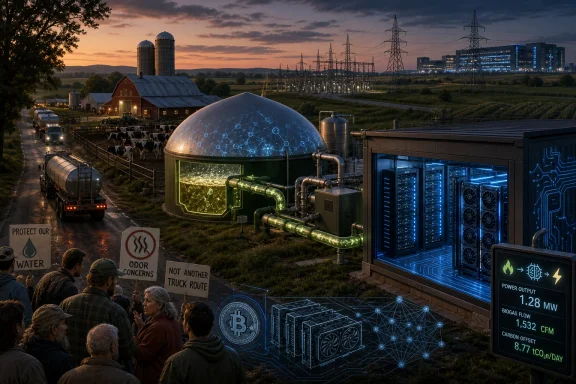
Ag-Grid Energy’s Lent Hill project is small compared with the hyperscale campuses now dominating AI headlines. The company says its system co-digests manure and food waste, produces electricity, and powers a one-megawatt data mining unit. On its own, that is not a revolution. A single modern AI campus can demand hundreds of megawatts or more.But Lent Hill matters because it demonstrates a pattern: compute can move toward stranded or locally generated energy, rather than waiting for the grid to deliver everything. Crypto mining pioneered this logic because it is unusually location-flexible. If the power is cheap enough, miners can show up almost anywhere with containers of machines.
AI data centers are less footloose. They care more about fiber, latency, redundancy, workforce access, hardware logistics, and customer geography. Still, some parts of the AI stack can tolerate more geographic flexibility than traditional enterprise computing. Training workloads, batch inference, and specialized rural compute clusters do not all need to sit in the same metro corridors as financial exchanges or cloud regions.
That is the opening Ag-Grid is trying to exploit. As Sentient reported, CEO Rashi Akki has framed the model as a way to provide value to rural communities while potentially delivering AI computing capacity over fiber. In industry language, that is a pitch for distributed energy-backed compute. In political language, it is a promise that the AI boom can bring infrastructure money to farm country.
The promise deserves scrutiny because rural communities have heard versions of it before. Waste facilities, factory farms, pipelines, transmission lines, mines, and industrial plants often arrive under the banner of local benefit. The benefits are real for some landowners, developers, and tax bases. The burdens are just as real for neighbors who get truck traffic, odor, water risk, and a reshaped local economy.
The Hyperscalers Want Clean Firm Power, Not Just Green Certificates
The manure-to-data-center idea should be read alongside the broader scramble for clean firm power. Solar and wind remain the fastest and cheapest new generation in many markets, but they do not solve every operational problem by themselves. Data centers run around the clock, and AI clusters are expensive enough that idle time is economically painful.That is why Microsoft’s partnership with Enchanted Rock in California matters. Enchanted Rock has described a renewable-natural-gas-backed microgrid designed to support Microsoft’s San Jose data center and provide resilience services. The point is not that every data center will run on manure gas. The point is that a major cloud operator was willing to put RNG into the architecture of data-center reliability.
Vanguard Renewables has gone further in its marketing, calling RNG “the fuel of the AI age.” That phrase is revealing. It positions manure and food-waste gas not as a niche agricultural emissions tool but as a scalable answer to one of the world’s fastest-growing electricity loads.
The problem is that “scalable” means different things depending on who is speaking. For a waste company, scalability means more digesters, more feedstock contracts, more gas offtake, and more monetizable waste streams. For a climate analyst, scalability also means asking what must expand to feed the system. If the answer includes bigger dairies, longer waste-hauling routes, and deeper dependence on industrial livestock, the climate claim gets more complicated.
The Climate Ledger Is Messier Than the Marketing Deck
Digesters can reduce methane from manure storage, but the climate ledger does not stop at the tank wall. World Resources Institute researchers have warned that without gas-tight storage or additional treatment, much of the methane-capture benefit can be lost downstream. WRI has estimated that digesters may reduce methane from manure storage by only about 25 percent in some practical contexts, far below the simplified story often told in project brochures.There is also the problem Brent Kim of the Johns Hopkins Center for a Livable Future described to Sentient as “pollution swapping.” A system may reduce one pollutant while increasing another. Methane can fall while ammonia, nitrous oxide, odor, nutrient runoff, or other local impacts remain or worsen.
That distinction matters because greenhouse-gas accounting tends to favor distant, modelable benefits over immediate local harms. A ton of avoided carbon-equivalent emissions can be entered into a spreadsheet. A neighbor waking up to digestate odor, a creek receiving waste discharge, or a road handling industrial truck traffic is harder to compress into a sustainability score.
Friends of the Earth has argued that dairy digesters can incentivize herd growth by turning manure into a revenue stream. Its analysis found that dairies with digesters grew herd sizes far faster than comparable baselines. Industry supporters dispute the implication that digesters cause factory-farm expansion, but the incentive question is unavoidable: when waste becomes fuel, producing more waste becomes easier to rationalize.
Rural Communities Are Being Asked to Host the Back End of the Cloud
The most important sentence in the Sentient reporting may not be about methane, AI, or crypto. It is Victoria Gehrke’s warning that small rural communities can become “sacrificial dumping grounds” for industrial waste. That is the social contract problem at the center of manure-powered compute.Data centers already externalize costs unevenly. They concentrate power demand in particular regions, strain local grids, trigger transmission fights, and sometimes compete for water. If their fuel supply chains also create incentives for large co-digesters, the footprint expands from the server hall to the farm, the road network, the waste hauler, the lagoon, and the field where digestate is spread.
Supporters of digesters argue that these facilities can help farmers manage unavoidable waste, create local revenue, and reduce emissions. That case is strongest for genuinely local, tightly managed systems that process waste already being produced and return benefits to the host community. It is weakest when regional waste streams are aggregated into large industrial facilities whose economics depend on subsidies, gas credits, and distant corporate buyers.
The Lind, Wisconsin fight described by Sentient illustrates the conflict. Vanguard Renewables’ proposed co-digester was presented as waste management and renewable energy infrastructure. Opponents saw hazardous emissions, truck traffic, water-pollution risk, and a land-use mismatch. The town denied the application in 2024, but Vanguard continues to develop a national portfolio.
That pattern will be familiar to WindowsForum readers who follow data-center siting fights in Virginia, Arizona, Georgia, and Texas. The cloud arrives as economic development. The externalities arrive as fine print.
Subsidies Are the Hidden Operating System
The manure-to-energy business is not just an engineering story. It is a subsidy architecture. Federal incentives, state low-carbon fuel programs, tax credits, loan guarantees, and renewable fuel markets can determine whether a project works on paper.California’s Low Carbon Fuel Standard has been especially important for manure-derived RNG, because it can award lucrative credits to fuels that score well under the program’s carbon-intensity model. The Inflation Reduction Act added more support for clean energy and biogas projects. State-level financing, including bond approvals, has also helped build the sector.
That makes the Trump administration USDA pause on certain biodigester loan guarantees especially notable. Inside Climate News reported in May 2026 that USDA extended a moratorium on new anaerobic-digester loans through the end of the year, citing financial-risk concerns and delinquent loans. The agency’s April 2026 notice said the pause was meant to allow additional oversight and risk review.
This is where the AI angle becomes financially potent. If transportation fuel credits weaken, loan guarantees become harder to obtain, or existing digester economics falter, data-center demand could become a new buyer of last resort. Developers do not need every hyperscaler to run on RNG. They need enough high-value offtake agreements to convince lenders that gas from manure has a durable premium market.
Akki’s comments to Sentient about wanting tax credits for electricity production for AI are a glimpse of the next lobbying frontier. The argument will sound familiar: America needs AI leadership, AI needs power, rural America has waste-derived power, therefore public policy should support the bridge. The counterargument is just as straightforward: public money should not subsidize a system that may deepen factory-farm dependence while giving data centers another way to avoid confronting demand growth.
Crypto Was the Warning Shot
The fact that Lent Hill’s first compute customer is crypto mining is not incidental. Crypto has often served as the extreme case for energy arbitrage: a mobile, power-hungry load that can monetize electricity with minimal local employment and few community services. If there is cheap power behind the meter, miners can turn it into tokens.AI is different in economic value and political legitimacy, but it shares one structural trait with crypto: its appetite can expand to meet available infrastructure. More GPUs invite more models, more inference, more products, more automated workflows, and more speculative capacity. Efficiency gains may reduce energy per task, but they can also lower costs and increase total usage.
That is why the manure-powered cryptomine should not be dismissed as a quirky rural side project. It shows how quickly a waste-energy system can be paired with a digital load that has almost no natural ceiling. Once the digester is framed as compute infrastructure, the local waste facility becomes part of the global machine-learning and crypto economy.
For sysadmins and IT pros, the lesson is not that your next Azure region will be powered by cows. It is that the physical back end of computing is becoming more heterogeneous, more political, and more exposed to energy-market risk. The days when data-center power was merely a facilities department concern are over.
The Real Green Test Is Whether Demand Gets Disciplined
The tech industry prefers supply-side climate stories because they preserve the growth narrative. If a data center can be powered by wind, solar, nuclear, geothermal, RNG, or some optimized mix, then the central business question never has to be asked: how much compute is worth building?That question is uncomfortable because AI companies are currently valued on the assumption that compute demand will keep rising. Cloud providers are racing to secure GPUs and power. Enterprise vendors are adding AI features everywhere, whether or not customers asked for them. Consumer platforms are inserting generative tools into search, productivity suites, operating systems, and social feeds.
Windows users will recognize this pattern. AI is being pushed down the stack into PCs, operating-system services, development tools, security products, and workplace software. Microsoft’s Copilot strategy, Qualcomm’s and Intel’s neural-processing-unit push, and the broader “AI PC” campaign all assume that more local and cloud inference will become normal.
If the industry’s answer to every efficiency improvement is to deploy more AI, then cleaner fuel becomes a pressure valve rather than a solution. RNG may reduce emissions in specific contexts, but it does not answer whether every workload being created is socially useful, economically durable, or worth the energy and land-use tradeoffs.
The climate test should therefore be stricter than “is this fuel lower carbon than fossil gas?” It should ask whether the project reduces total emissions without expanding harmful production systems, whether local communities consent to the infrastructure, whether alternatives would deliver greater benefit, and whether compute demand itself is being managed rather than endlessly indulged.
The Manure-Powered Cloud Leaves IT With Fewer Abstractions
For enterprise IT, the immediate operational impact is subtle but real. Data-center energy sourcing is becoming part of vendor risk, procurement ethics, and resilience planning. Customers who once asked cloud providers about uptime zones and encryption keys may increasingly ask about grid impact, backup fuel, water consumption, and local opposition.That will be uncomfortable for vendors because the answers are rarely clean. A hyperscaler may buy renewable energy annually while relying on fossil-heavy grids hourly. A data center may use RNG for backup while its primary load increases regional gas generation. A facility may claim emissions reductions while local residents bear odor, truck traffic, or water risk from the fuel supply chain.
The old cloud abstraction encouraged buyers to treat infrastructure as someone else’s problem. The AI era is reversing that. CIOs and architects may not choose the fuel for a cloud region, but they will face questions from boards, regulators, customers, and employees about the environmental footprint of AI adoption.
This does not mean every organization should halt AI projects until the grid is rebuilt. It means AI governance that ignores energy is incomplete. Model selection, inference volume, retention policies, local-versus-cloud processing, batch scheduling, and vendor choice all become part of the same conversation.
The Cow-Powered Data Center Is a Small Machine With a Long Shadow
The Lent Hill example is still a niche case, but niche cases can reveal the direction of travel before the mainstream admits it. The point is not that manure will power the AI economy. It is that AI’s power demand is large enough to make previously marginal energy sources strategically interesting.- Data centers are becoming major electricity loads, and credible forecasts show their U.S. power share rising substantially by 2030.
- Anaerobic digesters can capture methane and produce usable gas, but their climate benefits depend heavily on leakage control, waste handling, herd-size incentives, and downstream pollution.
- Renewable natural gas is attractive to data-center operators because it can work with existing gas infrastructure and provide firm or backup power.
- Rural communities may carry the local burdens of a fuel supply chain marketed to urban and corporate customers as clean energy.
- Subsidies and long-term offtake contracts will determine whether manure-to-compute remains a curiosity or becomes a larger infrastructure play.
- IT buyers should treat AI energy sourcing as a real governance issue, not a public-relations footnote.
References
- Primary source: ZME Science
Published: 2026-07-03T17:50:32.398568
Loading…
www.zmescience.com - Related coverage: eenews.net
Loading…
www.eenews.net - Related coverage: publicpower.org
Loading…
www.publicpower.org - Related coverage: eta-publications.lbl.gov
Loading…
eta-publications.lbl.gov - Related coverage: energy.gov
Loading…
www.energy.gov - Related coverage: energycentral.com
Loading…
www.energycentral.com
- Related coverage: spglobal.com
Loading…
www.spglobal.com - Related coverage: visualcapitalist.com
Loading…
www.visualcapitalist.com - Related coverage: grist.org
Loading…
grist.org - Related coverage: techradar.com
Loading…
www.techradar.com - Related coverage: axios.com
Loading…
www.axios.com - Related coverage: theatlantic.com
Inside the Dirty, Dystopian World of AI Data Centers - The Atlantic
The race to power AI is already remaking the physical world.www.theatlantic.com
- Related coverage: whitehouse.gov
Loading…
www.whitehouse.gov - Related coverage: morningstar.com
Loading…
www.morningstar.com - Related coverage: wri.org
Loading…
www.wri.org - Related coverage: vanguardrenewables.com
Loading…
www.vanguardrenewables.com - Related coverage: epa.gov
Loading…
www.epa.gov - Related coverage: foodandwaterwatch.org
Loading…
foodandwaterwatch.org