

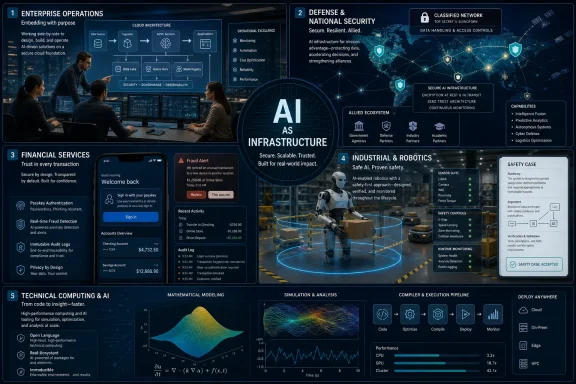
AWS, Oracle, AIB, NVIDIA and JuliaHub led the week’s enterprise technology news on July 4, 2026, with announcements spanning embedded AI engineering, defence cloud ecosystems, banking app modernization, physical-AI safety and high-performance computing infrastructure for scientific and industrial workloads. The connective tissue is not novelty for novelty’s sake. It is the hardening of AI into institutions that cannot afford demos: banks, defence agencies, logistics operators, automakers and scientific engineering teams. As Technology Magazine reported this week, the industry’s center of gravity is moving from what AI can do to whether it can be deployed safely, repeatedly and with enough operational discipline to matter.
That shift should sound familiar to WindowsForum readers. Every major platform transition eventually leaves the keynote stage and enters the tickets, audits, identity policies, procurement reviews and outage retrospectives where real technology either survives or becomes shelfware. This week’s news is a useful snapshot of that moment: cloud providers are sending engineers into customer environments, defence vendors are curating ecosystems, banks are rebuilding customer channels around resilience, and robotics companies are discovering that “AI-powered” means very little without safety architecture.
AWS’s US$1 billion Forward Deployed Engineering push is the week’s most revealing announcement because it quietly admits what many CIOs already know: the limiting factor in enterprise AI is no longer access to models. It is implementation. According to Amazon’s own announcement and reporting from Reuters, AWS is creating a new organisation that embeds engineers directly with customers to build production AI systems, with Francessca Vasquez, vice president of Frontier AI Engineering and Services, framing the effort around customers who want AI at the core of operations rather than trapped in experimentation.
That is a meaningful departure from the familiar cloud playbook. For years, hyperscalers sold primitives: compute, storage, managed databases, identity services, model endpoints and developer tooling. If customers struggled to turn those into business outcomes, the answer was usually a partner marketplace, a reference architecture, or a consulting engagement adjacent to the platform. AWS’s new FDE model collapses that distance by putting experienced engineers inside customer teams for targeted deployments.
The model is not new in spirit. Palantir made forward-deployed engineering a signature part of its operating culture, and OpenAI and Anthropic have both moved closer to large customers as enterprise AI deals become more strategic and more bespoke. What is different is AWS’s scale and the cloud provider’s ability to connect embedded engineering to the infrastructure layer, from data governance and security controls to Bedrock-style model access and agent orchestration.
AWS says the organisation is designed to compress timelines from months to days and to leave customers self-sufficient after deployments end. That second promise matters more than the first. Every enterprise has seen “accelerated transformation” become a polite synonym for dependency, where the vendor’s experts arrive, build a prototype, and leave behind a system that internal teams cannot safely extend.
The ambitious version of AWS’s plan is that FDEs become translators between frontier AI capability and the messy reality of production environments. They will need to understand not only model behavior, but also identity boundaries, data classification, audit requirements, integration debt and the politics of changing workflows. That is a much harder job than producing a chatbot demo in a clean sandbox.
That is not a failure of AWS so much as a sign of where AI is landing. Agentic systems touch permissions, business processes and exceptions. They do not merely answer questions; they initiate actions, retrieve data, trigger workflows and sometimes make recommendations that humans will treat as operational signals. The closer AI gets to the core of a company, the more it must be shaped around the company’s existing systems of record, risk tolerance and control environment.
For Windows administrators and enterprise architects, this is the part worth watching. AI adoption is increasingly becoming an integration problem, not a model-selection problem. The hard questions are about where agents run, what identities they use, how actions are logged, how prompts and outputs are retained, and whether existing security tooling can see enough to detect abuse or malfunction.
AWS’s FDE pitch therefore has two audiences. The obvious audience is the executive suite, which wants faster AI outcomes. The less obvious audience is the technical staff who will inherit those systems. If AWS can leave behind patterns, runbooks and maintainable architecture, the model could help companies escape pilot purgatory. If it leaves behind opaque agent stacks tuned by outsiders, it could become another layer of cloud-era technical debt.
The phrase “agentic AI” has been overused into near meaninglessness, but the operational implications are real. A generative AI assistant that drafts a paragraph can be wrong in ways that are embarrassing. An agent that updates a claims record, changes a logistics route, escalates a support ticket, or approves a refund can be wrong in ways that trigger financial, compliance or safety consequences. That is why embedded engineering is becoming part of the enterprise AI sales motion.
Oracle’s positioning is not subtle. The company is tying cloud, AI, cyber, secure communications, operational intelligence and autonomous systems to the needs of defence agencies and allied governments. In a world where procurement cycles are slow but geopolitical pressure is rising, the pitch is that smaller defence technology companies can scale faster by plugging into Oracle’s infrastructure, security posture and government relationships.
The defence market has become a proving ground for a broader cloud-era reality. Sovereignty, latency, accreditation and mission continuity are not edge cases; they are central buying criteria. The same cloud service that looks attractive to a commercial customer because it is scalable may look risky to a defence customer if it cannot satisfy classification, regional control, auditability or supply-chain scrutiny.
Oracle has spent years trying to differentiate itself from AWS, Microsoft Azure and Google Cloud by emphasizing database strength, enterprise relationships and sovereign cloud regions. The Defense Ecosystem extends that strategy into a partner model. Rather than saying “buy our cloud,” Oracle is effectively saying “build your mission stack around our cloud and our curated network.”
That approach also mirrors the platform behavior we see in consumer and enterprise software. The platform owner wants to be the gravity well. It wants the startups, systems integrators, security vendors and application developers to orbit its infrastructure because the ecosystem makes the platform harder to replace. In defence technology, that lock-in may be justified by security and integration requirements, but it remains lock-in all the same.
For IT pros, the lesson is not limited to defence. Highly regulated industries are moving toward packaged ecosystems because individual point solutions are too hard to validate in isolation. The question becomes whether those ecosystems improve accountability or obscure it. When a mission system fails, the root cause may sit somewhere between a cloud region, a startup’s model, a data pipeline, a network policy and a contractor’s integration layer.
Banks do not get much credit for apps that work, but they absorb instant reputational damage when apps fail. That asymmetry explains why AIB’s language around trust, security and service matters. Fagan described “job zero” as security and service, and he framed trust as the new user experience. In banking, that is not marketing fluff; it is the product.
The bank says it serves 3.4 million customers and invests hundreds of millions of euros annually in technology. It has also emphasized high availability across core services and a platform-led approach that lets the new app become the first service on a reusable digital engagement layer. The practical goal is faster iteration without turning the customer’s financial life into a beta test.
This is where banking modernization differs from ordinary app modernization. A social media app can break a feature and patch it later with limited consequence. A bank app is tied to salaries, mortgages, fraud alerts, card controls and the daily confidence people have in their financial institution. The interface is not just a convenience layer; it is a trust boundary.
AIB’s reported focus on passkey sign-in, real-time card controls, richer insights and simpler payments fits a wider shift in financial services. Customers expect the polish of consumer software, but regulators and security teams demand resilience, authentication discipline and auditability. The tension is permanent. Make security too visible and users experience friction; make it too invisible and they may not understand the risks they are accepting.
The bank’s AI use cases, as described in the coverage, include fraud detection, software engineering productivity, customer engagement and a digital assistant. Those are sensible areas because they either improve internal efficiency or operate within bounded customer-service contexts. They are not risk-free, but they are more governable than giving an autonomous system broad authority over financial decision-making.
The deeper point is organisational. AIB has consolidated cyber, resilience, physical security and IT operations into a more integrated structure because risk is increasingly systemic. Fagan’s example is blunt: a cyberattack can become an outage, and an outage can become an opportunity for fraudsters. That is exactly how modern incidents unfold.
This is why banks may ultimately be better teachers of enterprise AI discipline than the AI vendors themselves. Banks already understand that availability, identity, fraud, customer communication and regulatory exposure are connected. They cannot treat AI as a magic overlay because their operating model punishes uncontrolled change.
Windows administrators will recognise the same pattern from endpoint management and identity security. A new capability is only useful if it fits the control plane. It must be deployable, observable, reversible and supportable. AI systems that cannot answer basic questions about access, logging, rollback and responsibility will struggle in environments where uptime and trust are not optional.
That matters because robotics is where AI hype collides most directly with physics. A bad chatbot answer can mislead. A bad robot action can injure a worker, damage equipment, halt a warehouse line or create liability that no demo video can explain away. Safety is not a feature; it is the precondition for deployment.
NVIDIA is extending ideas from autonomous-vehicle safety into factories, warehouses and logistics operations. The company’s materials describe an approach that spans compute, operating system layers, sensors, simulation, inspection and safety tooling. In other words, NVIDIA is not merely selling a faster chip for robots; it is trying to define the safety stack around robotic autonomy.
That is strategically important. NVIDIA already dominates the AI accelerator conversation in data centers. Robotics gives the company a path to carry that influence into the edge, where AI systems perceive and act in real time. If Halos becomes a trusted reference architecture for physical AI safety, NVIDIA gains leverage not only in hardware, but also in certification workflows, developer tooling and deployment patterns.
Agility Robotics is a logical partner because humanoid robots attract public attention and enterprise caution in equal measure. The more human-shaped the machine, the more people expect it to navigate human spaces safely. That expectation is unforgiving. A warehouse robot that behaves unpredictably will not be judged like a server process that crashed; it will be judged like a machine that should never have been allowed near workers.
This raises a difficult question for the entire AI industry. Software companies are used to iterative deployment. Ship, observe, patch, repeat. Industrial environments tolerate iteration, but they do not tolerate uncontrolled hazard. A robot safety architecture must anticipate failures, constrain behavior and produce evidence that can satisfy internal safety teams, insurers, regulators and customers.
NVIDIA’s move therefore reflects an important maturation of the AI market. The company is not only chasing performance; it is packaging trust. That is where the money will be if humanoids and autonomous mobile robots move beyond limited pilots. Enterprises will not deploy fleets of machines because they saw a polished demo. They will deploy them when safety cases, support models and integration patterns become credible.
For WindowsForum’s IT professional audience, robotics may sound far from desktop imaging, Intune policy, Azure AD conditional access or server patching. But the underlying operational pattern is similar. The history of enterprise technology is the history of turning exciting capabilities into managed assets. Robots will need identity, update channels, telemetry, network segmentation, incident response and lifecycle management just like every other endpoint, only with higher stakes.
That convergence is coming faster than many organisations expect. Warehouses, manufacturing floors and hospitals already run mixed estates of operational technology, IoT devices, embedded systems and traditional IT. Physical AI will add a new class of endpoint that thinks, moves and acts. The IT and security teams that wait until procurement is complete will be cleaning up architecture decisions made without them.
Julia was created to address the “two-language problem,” where researchers and engineers prototype in a high-level language and then rewrite performance-critical code in a lower-level language for production. That problem is not glamorous, but it is expensive. It slows down scientific computing, quantitative analysis, simulation, optimization and engineering workflows.
JuliaHub’s positioning around climate, electrification and semiconductors points to an AI-adjacent but distinct reality: modern industry needs better computational infrastructure, not just better language models. The world’s most consequential technical work often involves simulation, modeling, compiler expertise, domain-specific math and integration with messy engineering toolchains.
This is a useful corrective to the week’s broader AI narrative. AWS is embedding engineers for agentic AI, NVIDIA is building safety stacks for robots, and banks are carefully applying AI inside trust-heavy environments. JuliaHub represents the layer where computation itself becomes the differentiator. AI may assist, but the work is grounded in physics, optimization and scientific rigor.
For developers and technical leads, this is a reminder not to let the market’s attention distort architecture decisions. Generative AI is powerful, but it is not the answer to every computational bottleneck. Sometimes the winning move is a better compiler, a faster simulation pipeline, a more expressive numerical language or a platform that lets domain experts move from research to production without translation loss.
That means the easy narratives are becoming less useful. “AI will transform everything” is too vague. “Cloud will make it simple” is too optimistic. “Robots are coming” is too theatrical. The more accurate version is that AI and cloud-native systems are being forced into the specific constraints of industries with real obligations.
In enterprise computing, the constraint is maintainability. In defence, it is mission assurance and sovereignty. In banking, it is trust and resilience. In robotics, it is safety. In scientific computing, it is performance and correctness. The vendors that win will be the ones that make those constraints part of the product rather than treating them as customer-side implementation details.
This is also why the announcements carry a subtle warning for buyers. When vendors promise acceleration, customers should ask what is being accelerated. A well-governed deployment path is valuable. A faster route to poorly understood dependency is not. Embedded engineers, curated ecosystems, app platforms and safety stacks can all reduce complexity, but they can also concentrate power in the hands of platform owners.
The history of enterprise IT suggests that both things will happen at once. Customers will gain capabilities they could not build alone, and they will inherit new forms of lock-in. The task for CIOs, CISOs and architects is not to reject the platforms, but to negotiate with eyes open.
That shift should sound familiar to WindowsForum readers. Every major platform transition eventually leaves the keynote stage and enters the tickets, audits, identity policies, procurement reviews and outage retrospectives where real technology either survives or becomes shelfware. This week’s news is a useful snapshot of that moment: cloud providers are sending engineers into customer environments, defence vendors are curating ecosystems, banks are rebuilding customer channels around resilience, and robotics companies are discovering that “AI-powered” means very little without safety architecture.
 AWS Turns AI Consulting Into an Embedded Engineering Bet
AWS’s US$1 billion Forward Deployed Engineering push is the week’s most revealing announcement because it quietly admits what many CIOs already know: the limiting factor in enterprise AI is no longer access to models. It is implementation. According to Amazon’s own announcement and reporting from Reuters, AWS is creating a new organisation that embeds engineers directly with customers to build production AI systems, with Francessca Vasquez, vice president of Frontier AI Engineering and Services, framing the effort around customers who want AI at the core of operations rather than trapped in experimentation.That is a meaningful departure from the familiar cloud playbook. For years, hyperscalers sold primitives: compute, storage, managed databases, identity services, model endpoints and developer tooling. If customers struggled to turn those into business outcomes, the answer was usually a partner marketplace, a reference architecture, or a consulting engagement adjacent to the platform. AWS’s new FDE model collapses that distance by putting experienced engineers inside customer teams for targeted deployments.
The model is not new in spirit. Palantir made forward-deployed engineering a signature part of its operating culture, and OpenAI and Anthropic have both moved closer to large customers as enterprise AI deals become more strategic and more bespoke. What is different is AWS’s scale and the cloud provider’s ability to connect embedded engineering to the infrastructure layer, from data governance and security controls to Bedrock-style model access and agent orchestration.
AWS says the organisation is designed to compress timelines from months to days and to leave customers self-sufficient after deployments end. That second promise matters more than the first. Every enterprise has seen “accelerated transformation” become a polite synonym for dependency, where the vendor’s experts arrive, build a prototype, and leave behind a system that internal teams cannot safely extend.
The ambitious version of AWS’s plan is that FDEs become translators between frontier AI capability and the messy reality of production environments. They will need to understand not only model behavior, but also identity boundaries, data classification, audit requirements, integration debt and the politics of changing workflows. That is a much harder job than producing a chatbot demo in a clean sandbox.
The Hyperscaler’s New Product Is Labor
The most striking thing about the AWS announcement is that it turns people into part of the product. Cloud computing was supposed to abstract away operational complexity; enterprise AI appears to be reintroducing complexity through the front door. The infrastructure is elastic, the models are available, the APIs are documented, and yet customers still need human engineers embedded in the business to make the system useful.That is not a failure of AWS so much as a sign of where AI is landing. Agentic systems touch permissions, business processes and exceptions. They do not merely answer questions; they initiate actions, retrieve data, trigger workflows and sometimes make recommendations that humans will treat as operational signals. The closer AI gets to the core of a company, the more it must be shaped around the company’s existing systems of record, risk tolerance and control environment.
For Windows administrators and enterprise architects, this is the part worth watching. AI adoption is increasingly becoming an integration problem, not a model-selection problem. The hard questions are about where agents run, what identities they use, how actions are logged, how prompts and outputs are retained, and whether existing security tooling can see enough to detect abuse or malfunction.
AWS’s FDE pitch therefore has two audiences. The obvious audience is the executive suite, which wants faster AI outcomes. The less obvious audience is the technical staff who will inherit those systems. If AWS can leave behind patterns, runbooks and maintainable architecture, the model could help companies escape pilot purgatory. If it leaves behind opaque agent stacks tuned by outsiders, it could become another layer of cloud-era technical debt.
The phrase “agentic AI” has been overused into near meaninglessness, but the operational implications are real. A generative AI assistant that drafts a paragraph can be wrong in ways that are embarrassing. An agent that updates a claims record, changes a logistics route, escalates a support ticket, or approves a refund can be wrong in ways that trigger financial, compliance or safety consequences. That is why embedded engineering is becoming part of the enterprise AI sales motion.
Oracle’s Defence Ecosystem Shows Where Cloud Strategy Meets Geopolitics
Oracle’s addition of 10 companies to its Defense Ecosystem sits in a different part of the tech landscape, but it reflects the same trend: platforms are no longer selling only technology; they are assembling operational coalitions. Technology Magazine reported that the new cohort joins an initiative aimed at improving defence and government technology for the United States and allied nations, following Oracle’s earlier Defense Tech Summit push.Oracle’s positioning is not subtle. The company is tying cloud, AI, cyber, secure communications, operational intelligence and autonomous systems to the needs of defence agencies and allied governments. In a world where procurement cycles are slow but geopolitical pressure is rising, the pitch is that smaller defence technology companies can scale faster by plugging into Oracle’s infrastructure, security posture and government relationships.
The defence market has become a proving ground for a broader cloud-era reality. Sovereignty, latency, accreditation and mission continuity are not edge cases; they are central buying criteria. The same cloud service that looks attractive to a commercial customer because it is scalable may look risky to a defence customer if it cannot satisfy classification, regional control, auditability or supply-chain scrutiny.
Oracle has spent years trying to differentiate itself from AWS, Microsoft Azure and Google Cloud by emphasizing database strength, enterprise relationships and sovereign cloud regions. The Defense Ecosystem extends that strategy into a partner model. Rather than saying “buy our cloud,” Oracle is effectively saying “build your mission stack around our cloud and our curated network.”
That approach also mirrors the platform behavior we see in consumer and enterprise software. The platform owner wants to be the gravity well. It wants the startups, systems integrators, security vendors and application developers to orbit its infrastructure because the ecosystem makes the platform harder to replace. In defence technology, that lock-in may be justified by security and integration requirements, but it remains lock-in all the same.
For IT pros, the lesson is not limited to defence. Highly regulated industries are moving toward packaged ecosystems because individual point solutions are too hard to validate in isolation. The question becomes whether those ecosystems improve accountability or obscure it. When a mission system fails, the root cause may sit somewhere between a cloud region, a startup’s model, a data pipeline, a network policy and a contractor’s integration layer.
AIB’s New App Makes Trust the User Interface
AIB’s digital banking story is quieter than AWS’s billion-dollar headline, but it may be more relatable to ordinary users. As FinTech Magazine detailed in an interview with AIB chief operating officer Graham Fagan, the Irish bank is rolling out a new mobile app and a broader digital engagement platform after a multi-year effort to improve digital literacy, data capability and operational resilience.Banks do not get much credit for apps that work, but they absorb instant reputational damage when apps fail. That asymmetry explains why AIB’s language around trust, security and service matters. Fagan described “job zero” as security and service, and he framed trust as the new user experience. In banking, that is not marketing fluff; it is the product.
The bank says it serves 3.4 million customers and invests hundreds of millions of euros annually in technology. It has also emphasized high availability across core services and a platform-led approach that lets the new app become the first service on a reusable digital engagement layer. The practical goal is faster iteration without turning the customer’s financial life into a beta test.
This is where banking modernization differs from ordinary app modernization. A social media app can break a feature and patch it later with limited consequence. A bank app is tied to salaries, mortgages, fraud alerts, card controls and the daily confidence people have in their financial institution. The interface is not just a convenience layer; it is a trust boundary.
AIB’s reported focus on passkey sign-in, real-time card controls, richer insights and simpler payments fits a wider shift in financial services. Customers expect the polish of consumer software, but regulators and security teams demand resilience, authentication discipline and auditability. The tension is permanent. Make security too visible and users experience friction; make it too invisible and they may not understand the risks they are accepting.
The Banking Lesson Is That AI Must Earn Its Place
AIB’s AI posture is also worth contrasting with the louder enterprise AI race. Fagan told FinTech Magazine that the bank has been deliberate rather than indiscriminately spinning up proofs of concept. That is a welcome phrase in a market where “pilot purgatory” has become the polite term for AI work that produces activity without institutional change.The bank’s AI use cases, as described in the coverage, include fraud detection, software engineering productivity, customer engagement and a digital assistant. Those are sensible areas because they either improve internal efficiency or operate within bounded customer-service contexts. They are not risk-free, but they are more governable than giving an autonomous system broad authority over financial decision-making.
The deeper point is organisational. AIB has consolidated cyber, resilience, physical security and IT operations into a more integrated structure because risk is increasingly systemic. Fagan’s example is blunt: a cyberattack can become an outage, and an outage can become an opportunity for fraudsters. That is exactly how modern incidents unfold.
This is why banks may ultimately be better teachers of enterprise AI discipline than the AI vendors themselves. Banks already understand that availability, identity, fraud, customer communication and regulatory exposure are connected. They cannot treat AI as a magic overlay because their operating model punishes uncontrolled change.
Windows administrators will recognise the same pattern from endpoint management and identity security. A new capability is only useful if it fits the control plane. It must be deployable, observable, reversible and supportable. AI systems that cannot answer basic questions about access, logging, rollback and responsibility will struggle in environments where uptime and trust are not optional.
NVIDIA Moves From Robot Brains to Robot Guardrails
NVIDIA’s Halos for Robotics announcement belongs to the same enterprise-hardening story, but in physical space. According to NVIDIA’s own materials and coverage from Axios, Halos for Robotics is a full-stack safety system for robotics and physical AI, with Agility Robotics as an early humanoid partner and Digit positioned as a production robot incorporating elements of the system.That matters because robotics is where AI hype collides most directly with physics. A bad chatbot answer can mislead. A bad robot action can injure a worker, damage equipment, halt a warehouse line or create liability that no demo video can explain away. Safety is not a feature; it is the precondition for deployment.
NVIDIA is extending ideas from autonomous-vehicle safety into factories, warehouses and logistics operations. The company’s materials describe an approach that spans compute, operating system layers, sensors, simulation, inspection and safety tooling. In other words, NVIDIA is not merely selling a faster chip for robots; it is trying to define the safety stack around robotic autonomy.
That is strategically important. NVIDIA already dominates the AI accelerator conversation in data centers. Robotics gives the company a path to carry that influence into the edge, where AI systems perceive and act in real time. If Halos becomes a trusted reference architecture for physical AI safety, NVIDIA gains leverage not only in hardware, but also in certification workflows, developer tooling and deployment patterns.
Agility Robotics is a logical partner because humanoid robots attract public attention and enterprise caution in equal measure. The more human-shaped the machine, the more people expect it to navigate human spaces safely. That expectation is unforgiving. A warehouse robot that behaves unpredictably will not be judged like a server process that crashed; it will be judged like a machine that should never have been allowed near workers.
Physical AI Forces the Industry to Grow Up Fast
The phrase physical AI is useful because it separates embodied systems from software-only agents. Once AI moves into robots, vehicles and industrial automation, evaluation changes. The system must not only produce plausible output; it must behave correctly under uncertain, changing and sometimes adversarial real-world conditions.This raises a difficult question for the entire AI industry. Software companies are used to iterative deployment. Ship, observe, patch, repeat. Industrial environments tolerate iteration, but they do not tolerate uncontrolled hazard. A robot safety architecture must anticipate failures, constrain behavior and produce evidence that can satisfy internal safety teams, insurers, regulators and customers.
NVIDIA’s move therefore reflects an important maturation of the AI market. The company is not only chasing performance; it is packaging trust. That is where the money will be if humanoids and autonomous mobile robots move beyond limited pilots. Enterprises will not deploy fleets of machines because they saw a polished demo. They will deploy them when safety cases, support models and integration patterns become credible.
For WindowsForum’s IT professional audience, robotics may sound far from desktop imaging, Intune policy, Azure AD conditional access or server patching. But the underlying operational pattern is similar. The history of enterprise technology is the history of turning exciting capabilities into managed assets. Robots will need identity, update channels, telemetry, network segmentation, incident response and lifecycle management just like every other endpoint, only with higher stakes.
That convergence is coming faster than many organisations expect. Warehouses, manufacturing floors and hospitals already run mixed estates of operational technology, IoT devices, embedded systems and traditional IT. Physical AI will add a new class of endpoint that thinks, moves and acts. The IT and security teams that wait until procurement is complete will be cleaning up architecture decisions made without them.
JuliaHub’s Story Is the Counterweight to AI’s Chatbot Obsession
The JuliaHub item in Technology Magazine’s roundup is less headline-grabbing but important for a different reason. Viral Shah’s career, from work on India’s Aadhaar infrastructure to co-creating the Julia programming language and leading JuliaHub, is a reminder that high-impact computing is not reducible to conversational AI. Some of the hardest technology problems are still numerical, scientific and industrial.Julia was created to address the “two-language problem,” where researchers and engineers prototype in a high-level language and then rewrite performance-critical code in a lower-level language for production. That problem is not glamorous, but it is expensive. It slows down scientific computing, quantitative analysis, simulation, optimization and engineering workflows.
JuliaHub’s positioning around climate, electrification and semiconductors points to an AI-adjacent but distinct reality: modern industry needs better computational infrastructure, not just better language models. The world’s most consequential technical work often involves simulation, modeling, compiler expertise, domain-specific math and integration with messy engineering toolchains.
This is a useful corrective to the week’s broader AI narrative. AWS is embedding engineers for agentic AI, NVIDIA is building safety stacks for robots, and banks are carefully applying AI inside trust-heavy environments. JuliaHub represents the layer where computation itself becomes the differentiator. AI may assist, but the work is grounded in physics, optimization and scientific rigor.
For developers and technical leads, this is a reminder not to let the market’s attention distort architecture decisions. Generative AI is powerful, but it is not the answer to every computational bottleneck. Sometimes the winning move is a better compiler, a faster simulation pipeline, a more expressive numerical language or a platform that lets domain experts move from research to production without translation loss.
The Common Thread Is Operational Reality
The week’s stories look scattered at first glance: AWS engineers, Oracle defence startups, AIB’s app, NVIDIA robot safety, JuliaHub’s computing platform. But they all point to the same industry phase. The AI era is entering its operational reality period.That means the easy narratives are becoming less useful. “AI will transform everything” is too vague. “Cloud will make it simple” is too optimistic. “Robots are coming” is too theatrical. The more accurate version is that AI and cloud-native systems are being forced into the specific constraints of industries with real obligations.
In enterprise computing, the constraint is maintainability. In defence, it is mission assurance and sovereignty. In banking, it is trust and resilience. In robotics, it is safety. In scientific computing, it is performance and correctness. The vendors that win will be the ones that make those constraints part of the product rather than treating them as customer-side implementation details.
This is also why the announcements carry a subtle warning for buyers. When vendors promise acceleration, customers should ask what is being accelerated. A well-governed deployment path is valuable. A faster route to poorly understood dependency is not. Embedded engineers, curated ecosystems, app platforms and safety stacks can all reduce complexity, but they can also concentrate power in the hands of platform owners.
The history of enterprise IT suggests that both things will happen at once. Customers will gain capabilities they could not build alone, and they will inherit new forms of lock-in. The task for CIOs, CISOs and architects is not to reject the platforms, but to negotiate with eyes open.
The Week’s Announcements Draw a Map for the Next Buying Cycle
The practical message from this week is that enterprise technology buyers should stop treating AI as a separate innovation track. It is becoming part of cloud architecture, app modernization, identity design, cyber resilience, industrial safety and developer productivity. That makes it more important, but also less magical.- AWS’s Forward Deployed Engineering organisation signals that enterprise AI adoption now depends heavily on integration skill, not merely model access.
- Oracle’s Defense Ecosystem shows that cloud platforms are increasingly selling curated operational networks for regulated and mission-critical customers.
- AIB’s new app strategy demonstrates that digital modernization in banking is ultimately a trust, resilience and security project.
- NVIDIA’s Halos for Robotics makes clear that physical AI will be judged by safety architecture as much as by model capability.
- JuliaHub’s continued focus on technical computing is a reminder that some of the most important enterprise workloads still depend on simulation, compilers and numerical performance.
- IT teams should treat agentic AI and physical AI as managed infrastructure, with identity, logging, rollback, governance and support models defined before deployment.
References
- Primary source: Technology Magazine
Published: 2026-07-04T08:50:11.913543
Loading…
technologymagazine.com - Related coverage: oracle.com
Loading…
www.oracle.com - Related coverage: fintechmagazine.com
Loading…
fintechmagazine.com - Related coverage: au.headtopics.com
Loading…
au.headtopics.com - Related coverage: ffnews.com
Loading…
ffnews.com