

Tesla will reportedly cap employee spending on AI tools at $200 per week beginning July 6, 2026, requiring approval for higher use while excluding beta versions of xAI products, according to an internal memo first reported by The Information and repeated by TipRanks and Seeking Alpha. The policy is not a retreat from AI so much as the moment Tesla’s AI evangelism ran into procurement math. For WindowsForum readers, the Tesla story matters because it turns an abstract enterprise AI debate into a familiar IT problem: unmanaged tools, runaway metering, data leakage risk, and executives who want innovation without an invoice surprise.
The most revealing part of Tesla’s reported AI spending cap is not the number itself. Two hundred dollars per week is not stingy by normal software-license standards, and for engineers working with coding assistants, model APIs, and agentic tools, it can vanish quickly. What matters is that Tesla, a company whose CEO has made AI central to its identity, is now placing a hard weekly boundary around a behavior it had recently been encouraging.
According to The Information’s reporting, Tesla has spent the past several months trying to move employees away from scattered personal AI accounts and toward company-approved systems. TipRanks says the company launched an internal AI platform called Bottle Rocket last year, giving employees access to models from OpenAI, Anthropic, xAI, and Cursor. That is exactly the shape many enterprise AI rollouts have taken: centralize access first, formalize security rules second, and then discover that convenience can be expensive at scale.
The cap also arrives with a telling exception. Beta versions of xAI products are reportedly excluded from the spending calculation, which means this is not a neutral “use less AI” order. It is a spending-control policy wrapped around a vendor-preference policy, and in Tesla’s case the favored vendor sits inside Elon Musk’s broader corporate orbit.
That does not make the cap irrational. It makes it more interesting. Tesla is trying to solve three problems at once: keep engineers using AI, keep sensitive data inside approved channels, and keep third-party model bills from turning into an open-ended tax on every software task.
That is why usage dashboards and leaderboards became so seductive. The Information has reported that some companies, including Uber, pushed employees to use AI more aggressively and tracked consumption as proof of transformation. Tesla reportedly had teams creating dashboards that ranked employees by token usage, according to the same cluster of reporting around the new spending limit.
The trouble is that token usage is not output. It is closer to electricity consumption than shipped code, and sometimes closer to noise. A developer can burn tokens exploring alternatives, debugging generated mistakes, refactoring code that did not need refactoring, or letting an agent wander through a repository with no crisp definition of success.
This is the great enterprise AI hangover of 2026. Companies spent 2023 and 2024 asking whether generative AI could be useful, then spent 2025 trying to push it into every workflow. Now the question is more brutal: useful compared with what, at what price, under whose controls, and with what evidence?
The company’s Bottle Rocket platform appears to be the central mechanism. By giving employees access to multiple model providers through an internal gateway, Tesla can standardize access, observe usage, negotiate or route costs, and enforce data-handling policies. That is the version of AI adoption that security teams can live with, even if engineers grumble about friction.
The alternative is shadow AI: employees using personal accounts, browser extensions, unmanaged APIs, and consumer-grade subscriptions to solve real work problems faster than corporate IT can approve them. Every sysadmin has seen the pattern before. First it was Dropbox, then Slack, then personal GitHub repositories, then browser-based SaaS tools, and now it is AI assistants that can ingest code, logs, designs, meeting notes, and incident reports.
Tesla’s reported restrictions on using outside AI models on company laptops and warnings against uploading confidential information to unapproved tools are therefore not bureaucratic overreach. They are table stakes. The problem is that employees often reach for unsanctioned AI not because they are reckless, but because sanctioned systems are slower, weaker, less familiar, or missing the model they believe works best.
That does not mean employees are being ordered to use Grok for everything, nor does it prove that xAI tools are being subsidized internally at the expense of better options. But it does highlight a tension that IT leaders increasingly face: the preferred vendor on a spreadsheet is not always the preferred tool in the hands of engineers. TipRanks notes that Grok reportedly remains less popular among Tesla employees than Anthropic’s Claude, despite Musk’s encouragement of xAI and Cursor.
That gap between executive preference and user preference is where enterprise software projects often go to die. If workers believe one model is better at code reasoning, another is better at summarization, and another is better for brainstorming, a single-vendor push can feel like a productivity tax. If the company’s accounting model then makes one family of tools cheaper to use or exempt from limits, usage metrics become politically distorted.
Tesla’s challenge is to avoid confusing adoption of a favored tool with adoption of the best tool for the job. That distinction matters because generative AI is not yet a commodity layer in the way email or storage became. Model behavior, context-window handling, code-generation quality, latency, privacy posture, and developer experience still vary enough that tool choice can meaningfully affect output.
The Uber example matters because it punctures one of the lazier assumptions about AI adoption. A high bill does not automatically mean a failed rollout. If a company spends heavily on tools that genuinely accelerate engineering, reduce incidents, improve customer support, or ship features faster, the expense may be justified.
But the reverse is also true. A high bill does not automatically prove transformation. Uber’s leadership has reportedly questioned whether increased AI token consumption clearly correlates with useful shipped product improvements. That is the sentence every CIO should print and tape above the AI dashboard.
Tokenmaxxing — the grimly perfect term for maximizing AI token consumption as if it were an achievement — is what happens when organizations measure the wrong thing because the right thing is harder. Productivity is stubbornly contextual. It lives in cycle time, defect rates, incident reduction, customer outcomes, developer satisfaction, and the unglamorous question of whether a team delivered the thing it promised.
The difference this time is velocity. A rogue SaaS subscription might leak documents or create compliance headaches, but a modern AI tool can ingest source code, generate executable scripts, summarize privileged emails, expose internal architecture through prompts, and create durable output that no one can easily audit after the fact. The blast radius is broader than a typical productivity app.
This is especially relevant in Microsoft-heavy environments because Windows endpoints are where much of this behavior happens. Browser access, extensions, local coding tools, PowerShell snippets generated by chatbots, clipboard flows, and unmanaged desktop clients all meet at the endpoint. The AI governance conversation is therefore not just about model providers; it is about device management, identity, logging, data loss prevention, and acceptable-use policy.
Microsoft’s own Copilot strategy has implicitly acknowledged this. The pitch for enterprise Copilot has never been merely that it writes text or summarizes meetings. It is that it fits inside identity, compliance, tenant boundaries, and administrative controls. Whether customers believe the value justifies the price is a separate matter, but the governance argument is the one Microsoft wants IT buyers to hear.
A developer who pastes a large chunk of proprietary code into an unapproved model may be increasing both the invoice and the exposure. An employee who asks an AI agent to analyze internal logs may be doing useful incident triage or casually exporting sensitive operational data. A team that lets an autonomous coding tool iterate for hours may be buying genuine acceleration or paying for a loop.
That is why spending caps can function as crude but effective governance. They force a pause. They create approval points. They make the exception visible. They give managers a reason to ask whether a workflow is valuable enough to justify more capacity.
The danger is that blunt caps punish legitimate heavy users while barely touching wasteful light users. An engineer doing serious migration work with an AI coding assistant may hit $200 quickly and produce meaningful output. A dozen employees asking low-value questions all day may stay under individual limits while still contributing little. Caps are necessary in the same way rate limits are necessary: useful as guardrails, inadequate as strategy.
A better question is simpler: what work disappeared? If AI reduces the number of manual test cases someone must write, the number of support tickets escalated to humans, the time needed to modernize a build script, or the toil in generating documentation, then the value can be observed. It may not be perfectly measurable, but it is at least attached to a workflow.
That is where many AI rollouts still look immature. They begin with access rather than use cases. They ask employees to “use AI more” rather than choosing a narrow process, defining a baseline, and measuring whether the process improves. The result is a haze of impressive demos, anecdotal wins, and budget overruns that are difficult to defend.
Tesla’s cap may force a healthier discipline. If an employee needs approval to exceed the weekly limit, the approval process can become an opportunity to ask what the AI tool is doing, whether the work is repeatable, whether the prompt and data flow are safe, and whether the result is worth institutionalizing. That is annoying for a fast-moving engineering culture, but it is how experimental tooling becomes operational infrastructure.
Employees form habits quickly. If a developer gets used to a personal Claude account, a Cursor setup, or a browser workflow that feels magical, the later arrival of internal controls can feel like regression. Even if the corporate platform is objectively safer, the user experiences it as a downgrade.
That is why AI governance has to compete on usability, not just policy. A sanctioned tool that is slow, outdated, or missing the preferred model will leak usage to unsanctioned tools. A policy that says “do not paste secrets” will fail if employees cannot easily distinguish sensitive from nonsensitive context in the flow of work. A platform that logs everything without explaining how logs are protected will create its own trust problem.
Tesla’s Bottle Rocket approach is therefore the right general shape, but the execution matters. Centralization alone does not solve shadow AI. Centralization plus fast access, strong models, clear rules, low friction, and credible privacy boundaries has a chance.
On another level, the exemption creates obvious questions. If xAI usage does not count against the cap, will employees be nudged toward it regardless of comparative quality? If Grok is less popular than Claude among engineers, will the policy change behavior or merely shift costs into a less visible bucket? If a tool is exempt because it is strategically important, how will Tesla measure whether that strategic bet is paying off?
Those questions are not unique to Tesla. Many large companies now have preferred AI vendors, internal model platforms, or strategic partnerships that influence what employees are encouraged to use. The vendor politics of AI are becoming as important as the technical benchmarks.
For IT leaders, the lesson is that neutrality must be earned. If a company says it is choosing tools based on security, cost, and performance, employees will look for evidence in the tools they are allowed to use. If the choices appear to reflect executive relationships more than workflow quality, shadow usage becomes a form of protest as much as convenience.
But AI coding tools differ from classic developer tools in one crucial respect. A compiler, IDE, or source-control system may have license costs and infrastructure costs, but the marginal act of using it is usually not metered in the same psychologically visible way. With AI, every prompt, context expansion, retry, and agent loop can become part of a consumption bill.
That changes behavior. It also changes management. A developer who once worried about CPU, memory, and build minutes may now have to think about tokens, model tiers, context size, and whether an agent is burning money while stuck in a loop. That is not necessarily bad, but it is a new kind of operational literacy.
The next mature phase of AI coding will likely look less like “everyone gets unlimited access” and more like tiered workflows. Cheap models will handle routine autocomplete and summaries. More expensive models will be reserved for complex reasoning, architecture, security review, or high-value code generation. Internal gateways will route requests based on policy, sensitivity, and cost.
In the promotional phase, the organization wants momentum. It celebrates experimentation, tolerates inefficiency, and lets champions prove what is possible. In the operational phase, the organization asks which experiments should become standard practice, which vendors should be approved, which data can be used, and how much the whole thing should cost.
Tesla appears to be entering that second phase. So is Uber. So are countless companies that spent the last two years telling employees that AI would be mandatory and are now discovering that mandatory tools need budgets, controls, and accountability.
The risk is overcorrection. If employees interpret the cap as a signal that AI use is now suspect, they may retreat from valuable experimentation. If managers approve overages inconsistently, the policy may create resentment. If the xAI carve-out looks like internal politics, the cap may reduce trust in the platform.
The organizations that handle this well will treat AI like infrastructure, not swag. They will know which models are approved, what data can be sent where, how usage is logged, who pays for overages, and which workflows justify premium tools. They will also admit that some employees need better tools than others because the value of AI is unevenly distributed.
That last point is crucial. A flat cap is administratively simple, but AI value is role-dependent. A senior engineer modernizing a critical codebase, a security analyst triaging incidents, and a finance employee summarizing routine notes do not have the same cost-benefit profile. Mature governance will look more like role-based access control than a cafeteria allowance.
For Windows environments, that means AI policy needs to show up in endpoint management, browser controls, identity groups, DLP rules, logging pipelines, and procurement systems. It also means help desks and endpoint teams will be dragged into AI governance whether or not the strategy deck mentions them.
That is why the policy lands as a broader market signal. If even aggressive AI adopters are putting spending fences around employee usage, the next phase of enterprise AI will be governed less by slogans and more by unit economics. The question will not be whether employees can use AI. It will be which AI, for what work, with whose data, at what marginal cost, and under what audit trail.
That shift will be healthy if it kills the worst habits of the first wave. Usage competitions, token leaderboards, and vague mandates to “use AI more” deserve to fade. They reward activity over outcome and create incentives that any sysadmin, developer, or operations manager can see through.
But the shift will be unhealthy if it becomes a panic clampdown. AI tools are already genuinely useful in coding, documentation, analysis, support, and operations. The companies that win will not be the ones that ban spending; they will be the ones that connect spending to work that actually moves.
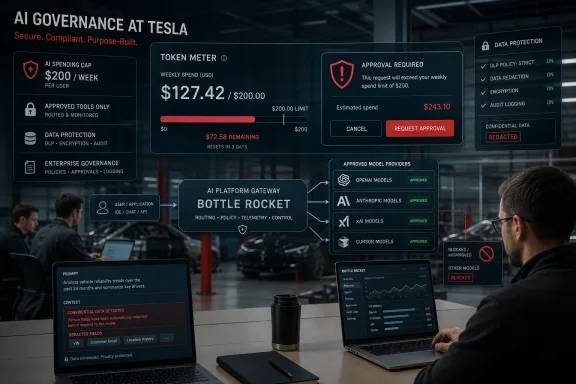 Tesla Discovers That Token Usage Is a Budget Line, Not a Culture
The most revealing part of Tesla’s reported AI spending cap is not the number itself. Two hundred dollars per week is not stingy by normal software-license standards, and for engineers working with coding assistants, model APIs, and agentic tools, it can vanish quickly. What matters is that Tesla, a company whose CEO has made AI central to its identity, is now placing a hard weekly boundary around a behavior it had recently been encouraging.According to The Information’s reporting, Tesla has spent the past several months trying to move employees away from scattered personal AI accounts and toward company-approved systems. TipRanks says the company launched an internal AI platform called Bottle Rocket last year, giving employees access to models from OpenAI, Anthropic, xAI, and Cursor. That is exactly the shape many enterprise AI rollouts have taken: centralize access first, formalize security rules second, and then discover that convenience can be expensive at scale.
The cap also arrives with a telling exception. Beta versions of xAI products are reportedly excluded from the spending calculation, which means this is not a neutral “use less AI” order. It is a spending-control policy wrapped around a vendor-preference policy, and in Tesla’s case the favored vendor sits inside Elon Musk’s broader corporate orbit.
That does not make the cap irrational. It makes it more interesting. Tesla is trying to solve three problems at once: keep engineers using AI, keep sensitive data inside approved channels, and keep third-party model bills from turning into an open-ended tax on every software task.
The First Wave of Enterprise AI Was Measured by Enthusiasm
The early corporate AI playbook was almost childishly simple: get employees to use the tools. Executives saw coding assistants, chatbots, document summarizers, and internal agents as low-friction productivity multipliers, and the easiest metric was adoption. If more people were using AI more often, the rollout looked alive.That is why usage dashboards and leaderboards became so seductive. The Information has reported that some companies, including Uber, pushed employees to use AI more aggressively and tracked consumption as proof of transformation. Tesla reportedly had teams creating dashboards that ranked employees by token usage, according to the same cluster of reporting around the new spending limit.
The trouble is that token usage is not output. It is closer to electricity consumption than shipped code, and sometimes closer to noise. A developer can burn tokens exploring alternatives, debugging generated mistakes, refactoring code that did not need refactoring, or letting an agent wander through a repository with no crisp definition of success.
This is the great enterprise AI hangover of 2026. Companies spent 2023 and 2024 asking whether generative AI could be useful, then spent 2025 trying to push it into every workflow. Now the question is more brutal: useful compared with what, at what price, under whose controls, and with what evidence?
The $200 Cap Is a Governance Tool Wearing an Accounting Mask
A weekly spending limit sounds like a finance department decision, but in practice it is also an IT architecture decision. Once a company defines which tools count, which tools are exempt, which approvals are required, and which systems are allowed on corporate laptops, it is shaping the daily behavior of developers. In that sense, Tesla’s reported cap is less about thrift than control.The company’s Bottle Rocket platform appears to be the central mechanism. By giving employees access to multiple model providers through an internal gateway, Tesla can standardize access, observe usage, negotiate or route costs, and enforce data-handling policies. That is the version of AI adoption that security teams can live with, even if engineers grumble about friction.
The alternative is shadow AI: employees using personal accounts, browser extensions, unmanaged APIs, and consumer-grade subscriptions to solve real work problems faster than corporate IT can approve them. Every sysadmin has seen the pattern before. First it was Dropbox, then Slack, then personal GitHub repositories, then browser-based SaaS tools, and now it is AI assistants that can ingest code, logs, designs, meeting notes, and incident reports.
Tesla’s reported restrictions on using outside AI models on company laptops and warnings against uploading confidential information to unapproved tools are therefore not bureaucratic overreach. They are table stakes. The problem is that employees often reach for unsanctioned AI not because they are reckless, but because sanctioned systems are slower, weaker, less familiar, or missing the model they believe works best.
Musk’s AI Ecosystem Complicates the Normal Vendor Story
In a more conventional enterprise story, Tesla would be treated simply as a customer rationalizing spend across OpenAI, Anthropic, Cursor, and other AI vendors. But Tesla is not a normal customer, because Elon Musk is also the public face of xAI. When a Tesla policy reportedly excludes beta xAI tools from the spending cap, the move inevitably looks like more than budget discipline.That does not mean employees are being ordered to use Grok for everything, nor does it prove that xAI tools are being subsidized internally at the expense of better options. But it does highlight a tension that IT leaders increasingly face: the preferred vendor on a spreadsheet is not always the preferred tool in the hands of engineers. TipRanks notes that Grok reportedly remains less popular among Tesla employees than Anthropic’s Claude, despite Musk’s encouragement of xAI and Cursor.
That gap between executive preference and user preference is where enterprise software projects often go to die. If workers believe one model is better at code reasoning, another is better at summarization, and another is better for brainstorming, a single-vendor push can feel like a productivity tax. If the company’s accounting model then makes one family of tools cheaper to use or exempt from limits, usage metrics become politically distorted.
Tesla’s challenge is to avoid confusing adoption of a favored tool with adoption of the best tool for the job. That distinction matters because generative AI is not yet a commodity layer in the way email or storage became. Model behavior, context-window handling, code-generation quality, latency, privacy posture, and developer experience still vary enough that tool choice can meaningfully affect output.
Uber’s Budget Blowout Became the Cautionary Tale
Tesla is not the only company discovering that AI enthusiasm can outrun AI budgeting. TechCrunch, ITPro, and others have reported that Uber burned through its 2026 AI budget in the first four months of the year and then moved to cap employee spending. The numbers differ by report and tool mix, but the pattern is now familiar: executives encourage broad AI usage, employees comply, and finance realizes the meter was spinning faster than anyone modeled.The Uber example matters because it punctures one of the lazier assumptions about AI adoption. A high bill does not automatically mean a failed rollout. If a company spends heavily on tools that genuinely accelerate engineering, reduce incidents, improve customer support, or ship features faster, the expense may be justified.
But the reverse is also true. A high bill does not automatically prove transformation. Uber’s leadership has reportedly questioned whether increased AI token consumption clearly correlates with useful shipped product improvements. That is the sentence every CIO should print and tape above the AI dashboard.
Tokenmaxxing — the grimly perfect term for maximizing AI token consumption as if it were an achievement — is what happens when organizations measure the wrong thing because the right thing is harder. Productivity is stubbornly contextual. It lives in cycle time, defect rates, incident reduction, customer outcomes, developer satisfaction, and the unglamorous question of whether a team delivered the thing it promised.
Windows Shops Have Seen This Movie Before
For Windows administrators and enterprise IT teams, Tesla’s AI cap should feel less like futuristic drama and more like a rerun. The basic pattern is identical to every wave of user-driven technology adoption: a new tool appears, employees discover it solves real problems, leadership blesses it, costs and risks multiply, and IT is asked to retrofit governance after the fact.The difference this time is velocity. A rogue SaaS subscription might leak documents or create compliance headaches, but a modern AI tool can ingest source code, generate executable scripts, summarize privileged emails, expose internal architecture through prompts, and create durable output that no one can easily audit after the fact. The blast radius is broader than a typical productivity app.
This is especially relevant in Microsoft-heavy environments because Windows endpoints are where much of this behavior happens. Browser access, extensions, local coding tools, PowerShell snippets generated by chatbots, clipboard flows, and unmanaged desktop clients all meet at the endpoint. The AI governance conversation is therefore not just about model providers; it is about device management, identity, logging, data loss prevention, and acceptable-use policy.
Microsoft’s own Copilot strategy has implicitly acknowledged this. The pitch for enterprise Copilot has never been merely that it writes text or summarizes meetings. It is that it fits inside identity, compliance, tenant boundaries, and administrative controls. Whether customers believe the value justifies the price is a separate matter, but the governance argument is the one Microsoft wants IT buyers to hear.
Cost Control Is Becoming the New Security Control
The old enterprise-security model treated cost and risk as separate conversations. Security teams worried about data; procurement worried about licenses; engineering worried about speed. Generative AI collapses those lanes because the act that creates cost is often the same act that creates risk: sending more context to a model.A developer who pastes a large chunk of proprietary code into an unapproved model may be increasing both the invoice and the exposure. An employee who asks an AI agent to analyze internal logs may be doing useful incident triage or casually exporting sensitive operational data. A team that lets an autonomous coding tool iterate for hours may be buying genuine acceleration or paying for a loop.
That is why spending caps can function as crude but effective governance. They force a pause. They create approval points. They make the exception visible. They give managers a reason to ask whether a workflow is valuable enough to justify more capacity.
The danger is that blunt caps punish legitimate heavy users while barely touching wasteful light users. An engineer doing serious migration work with an AI coding assistant may hit $200 quickly and produce meaningful output. A dozen employees asking low-value questions all day may stay under individual limits while still contributing little. Caps are necessary in the same way rate limits are necessary: useful as guardrails, inadequate as strategy.
The Real Metric Is Not AI Use, But Work Removed
The corporate AI debate keeps returning to productivity because it is the only argument that can support the spending. But productivity is too often treated as a vibe. Someone says a tool saves time; someone else says it creates review overhead; a dashboard shows more tokens consumed; a board deck declares transformation.A better question is simpler: what work disappeared? If AI reduces the number of manual test cases someone must write, the number of support tickets escalated to humans, the time needed to modernize a build script, or the toil in generating documentation, then the value can be observed. It may not be perfectly measurable, but it is at least attached to a workflow.
That is where many AI rollouts still look immature. They begin with access rather than use cases. They ask employees to “use AI more” rather than choosing a narrow process, defining a baseline, and measuring whether the process improves. The result is a haze of impressive demos, anecdotal wins, and budget overruns that are difficult to defend.
Tesla’s cap may force a healthier discipline. If an employee needs approval to exceed the weekly limit, the approval process can become an opportunity to ask what the AI tool is doing, whether the work is repeatable, whether the prompt and data flow are safe, and whether the result is worth institutionalizing. That is annoying for a fast-moving engineering culture, but it is how experimental tooling becomes operational infrastructure.
The Security Policy Arrived After the Habit
One of the most important details in the TipRanks summary is that Tesla’s formal data-security rules arrived alongside the move toward centralized AI access. The company reportedly warned employees not to upload confidential information into unapproved tools and limited use of outside models on company laptops. That order of operations is common, but it is also the root of many enterprise headaches.Employees form habits quickly. If a developer gets used to a personal Claude account, a Cursor setup, or a browser workflow that feels magical, the later arrival of internal controls can feel like regression. Even if the corporate platform is objectively safer, the user experiences it as a downgrade.
That is why AI governance has to compete on usability, not just policy. A sanctioned tool that is slow, outdated, or missing the preferred model will leak usage to unsanctioned tools. A policy that says “do not paste secrets” will fail if employees cannot easily distinguish sensitive from nonsensitive context in the flow of work. A platform that logs everything without explaining how logs are protected will create its own trust problem.
Tesla’s Bottle Rocket approach is therefore the right general shape, but the execution matters. Centralization alone does not solve shadow AI. Centralization plus fast access, strong models, clear rules, low friction, and credible privacy boundaries has a chance.
The xAI Exception Will Be Watched Closely
The reported xAI beta exemption is the kind of detail that will draw more attention than any procurement team probably wants. On one level, excluding beta tools from spending limits makes practical sense if Tesla wants employees to test them aggressively. Internal early access can be valuable, especially for a company with deep software, robotics, manufacturing, and autonomy ambitions.On another level, the exemption creates obvious questions. If xAI usage does not count against the cap, will employees be nudged toward it regardless of comparative quality? If Grok is less popular than Claude among engineers, will the policy change behavior or merely shift costs into a less visible bucket? If a tool is exempt because it is strategically important, how will Tesla measure whether that strategic bet is paying off?
Those questions are not unique to Tesla. Many large companies now have preferred AI vendors, internal model platforms, or strategic partnerships that influence what employees are encouraged to use. The vendor politics of AI are becoming as important as the technical benchmarks.
For IT leaders, the lesson is that neutrality must be earned. If a company says it is choosing tools based on security, cost, and performance, employees will look for evidence in the tools they are allowed to use. If the choices appear to reflect executive relationships more than workflow quality, shadow usage becomes a form of protest as much as convenience.
The AI Coding Assistant Is Becoming a Metered Coworker
Coding assistants are at the center of this spending debate because they are sticky. Once developers become accustomed to autocompletion, repo-aware chat, code explanation, test generation, and agentic refactoring, the tool stops feeling like a novelty and starts feeling like part of the workstation. That is why cost spikes can surprise executives: the most useful tools are the ones employees keep running.But AI coding tools differ from classic developer tools in one crucial respect. A compiler, IDE, or source-control system may have license costs and infrastructure costs, but the marginal act of using it is usually not metered in the same psychologically visible way. With AI, every prompt, context expansion, retry, and agent loop can become part of a consumption bill.
That changes behavior. It also changes management. A developer who once worried about CPU, memory, and build minutes may now have to think about tokens, model tiers, context size, and whether an agent is burning money while stuck in a loop. That is not necessarily bad, but it is a new kind of operational literacy.
The next mature phase of AI coding will likely look less like “everyone gets unlimited access” and more like tiered workflows. Cheap models will handle routine autocomplete and summaries. More expensive models will be reserved for complex reasoning, architecture, security review, or high-value code generation. Internal gateways will route requests based on policy, sensitivity, and cost.
Tesla’s Move Is Not Anti-AI; It Is Post-Hype AI
It is tempting to frame Tesla’s cap as a contradiction. Elon Musk tells employees to use AI, Tesla pushes internal AI systems, then the company limits AI spending. But that is not really a contradiction. It is the difference between the promotional phase of a technology and the operational phase.In the promotional phase, the organization wants momentum. It celebrates experimentation, tolerates inefficiency, and lets champions prove what is possible. In the operational phase, the organization asks which experiments should become standard practice, which vendors should be approved, which data can be used, and how much the whole thing should cost.
Tesla appears to be entering that second phase. So is Uber. So are countless companies that spent the last two years telling employees that AI would be mandatory and are now discovering that mandatory tools need budgets, controls, and accountability.
The risk is overcorrection. If employees interpret the cap as a signal that AI use is now suspect, they may retreat from valuable experimentation. If managers approve overages inconsistently, the policy may create resentment. If the xAI carve-out looks like internal politics, the cap may reduce trust in the platform.
The Practical Reading for IT Pros Is Uncomfortably Familiar
The Tesla memo should push IT teams to ask whether their own AI posture is real or merely aspirational. A policy document is not a control. A preferred-vendor announcement is not an adoption plan. A dashboard of prompts and tokens is not a productivity metric.The organizations that handle this well will treat AI like infrastructure, not swag. They will know which models are approved, what data can be sent where, how usage is logged, who pays for overages, and which workflows justify premium tools. They will also admit that some employees need better tools than others because the value of AI is unevenly distributed.
That last point is crucial. A flat cap is administratively simple, but AI value is role-dependent. A senior engineer modernizing a critical codebase, a security analyst triaging incidents, and a finance employee summarizing routine notes do not have the same cost-benefit profile. Mature governance will look more like role-based access control than a cafeteria allowance.
For Windows environments, that means AI policy needs to show up in endpoint management, browser controls, identity groups, DLP rules, logging pipelines, and procurement systems. It also means help desks and endpoint teams will be dragged into AI governance whether or not the strategy deck mentions them.
The Memo’s Real Audience Is Every Company That Said “AI-First”
Tesla’s reported cap has symbolic force because it comes from Tesla. This is not a conservative bank reluctantly allowing a chatbot behind seven approvals. This is a company whose public brand is tied to autonomy, robotics, software velocity, and Musk’s own AI ambitions.That is why the policy lands as a broader market signal. If even aggressive AI adopters are putting spending fences around employee usage, the next phase of enterprise AI will be governed less by slogans and more by unit economics. The question will not be whether employees can use AI. It will be which AI, for what work, with whose data, at what marginal cost, and under what audit trail.
That shift will be healthy if it kills the worst habits of the first wave. Usage competitions, token leaderboards, and vague mandates to “use AI more” deserve to fade. They reward activity over outcome and create incentives that any sysadmin, developer, or operations manager can see through.
But the shift will be unhealthy if it becomes a panic clampdown. AI tools are already genuinely useful in coding, documentation, analysis, support, and operations. The companies that win will not be the ones that ban spending; they will be the ones that connect spending to work that actually moves.
The Useful Lessons Hidden Inside Tesla’s $200 Line
Tesla’s weekly cap is a small policy with a large shadow. It turns the AI debate from theater into operations, which is exactly where IT professionals live.- Tesla’s reported $200-per-week limit shows that enterprise AI adoption has moved from experimentation into cost governance.
- The xAI beta exemption makes the policy partly about vendor direction, not just budget control.
- Centralized platforms such as Bottle Rocket are becoming the practical answer to shadow AI, but only if they are usable enough to keep employees inside them.
- Token consumption is a weak proxy for productivity unless it is tied to specific workflows, shipped work, or measurable toil reduction.
- Windows and enterprise endpoint teams should expect AI governance to become part of identity, device management, DLP, logging, and procurement rather than a standalone innovation project.
- The next phase of AI rollout will favor organizations that can distinguish valuable heavy use from expensive noise.
References
- Primary source: Seeking Alpha
Published: Sat, 04 Jul 2026 12:29:40 GMT
Loading…
seekingalpha.com - Independent coverage: TipRanks
Published: 2026-07-03T18:00:55.037910
Loading…
www.tipranks.com - Related coverage: investing.com
Loading…
www.investing.com - Related coverage: techjournal.org
Loading…
techjournal.org - Related coverage: techspot.com
Loading…
www.techspot.com - Related coverage: electrek.co
Loading…
electrek.co
- Related coverage: techcrunch.com
Uber caps employee AI spending after blowing through budget in 4 months | TechCrunch
Uber's cutback has occurred after the company had reportedly encouraged staff to use AI as much as possible.techcrunch.com - Related coverage: theinformation.com
Loading…
www.theinformation.com - Related coverage: winbuzzer.com
Loading…
winbuzzer.com - Related coverage: explainx.ai
Loading…
explainx.ai - Related coverage: techtimes.com
Loading…
www.techtimes.com - Related coverage: nl.investing.com
Loading…
nl.investing.com - Related coverage: gate.com
Loading…
www.gate.com - Related coverage: es.investing.com
Loading…
es.investing.com - Related coverage: tomshardware.com
Loading…
www.tomshardware.com