

Draup’s analysis of 2.85 million job descriptions from June 2025 through June 2026 found that AI is changing hiring standards for software engineering, data engineering, DevOps, and adjacent technical roles without yet producing a broad collapse in demand for tech workers. The more interesting story is not that the machines are coming for the job title. It is that they are coming for the old apprenticeship model underneath it. For Windows developers, enterprise admins, and IT teams already living inside Copilot-branded workflows, the message is blunt: the market still wants technical people, but it is redefining what “technical” means.
As reported by CoinDesk and republished in KuCoin’s news feed, Draup’s study argues that AI is not primarily shrinking the tech labor market; it is sorting skills into those that remain scarce and those that can be increasingly automated. USA Herald’s write-up of the same research highlighted the key quote from Draup CEO Vijay Swaminathan: AI is not reducing the need for technical talent, but it is changing what makes that talent valuable. That distinction matters, because the past two years of tech layoffs have made every AI hiring story sound like a eulogy. This one reads more like a warning label.
The easy headline is that AI is not killing tech jobs. It is also the least useful headline, because job counts are a lagging indicator in a market where the work itself is being carved up and reassembled in real time. A company can keep hiring software engineers while quietly removing the tasks that once trained junior engineers into senior ones.
Draup’s data says active job descriptions for software engineering, data engineering, and DevOps each exceeded 40,000 during the period it studied. That does not look like a profession being abandoned. It looks like a profession being re-priced around a different bundle of capabilities.
The old bargain in technical hiring was fairly legible. Junior workers wrote smaller pieces of code, fixed straightforward bugs, learned the build system, absorbed patterns from code review, and slowly earned exposure to architecture and product judgment. The work was not glamorous, but it created a ladder.
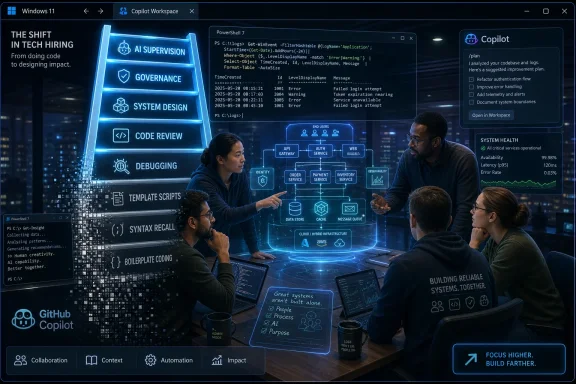
AI threatens that ladder less by replacing the person at the top than by eating the bottom rungs. Boilerplate coding, syntax recall, template work, first-pass tests, routine documentation, and repetitive configuration are precisely the categories that make modern coding assistants feel useful. They are also the categories that historically let less experienced workers become useful before they became wise.
That is why the hiring market can expand and become harsher at the same time. More postings do not automatically mean more accessible pathways. If employers increasingly expect entry-level candidates to arrive with AI tool fluency, systems thinking, debugging instincts, and business context, the definition of “entry level” becomes a small fiction HR teams keep using because the applicant tracking system requires a dropdown.
For decades, much of software hiring treated implementation speed as a proxy for competence. Could a candidate write the function? Could they remember the API? Could they produce a working solution under interview pressure? Those questions were always imperfect, but AI makes them even less diagnostic.
If a developer can ask GitHub Copilot, Cursor, Claude, or another assistant to produce a plausible first draft, the employer’s real question becomes different. Is the generated code correct? Is it maintainable? Does it fit the existing system? Does it handle failure modes, permissions, scale, compliance, localization, and the weird edge cases that only show up after deployment?
That is where Draup’s emphasis on debugging, code review judgment, system design, data governance, and model evaluation becomes important. These are not mystical “human skills” in the motivational-poster sense. They are technical skills that require context, accountability, and experience with consequences.
A Windows admin knows this pattern well. Anyone can paste a PowerShell command from a forum or ask an AI assistant to generate a remediation script. The professional skill is knowing whether that script will break Group Policy assumptions, mishandle user profiles, trip endpoint detection, expose credentials in logs, or fail across mixed Windows 10 and Windows 11 estates.
The same is true for software teams. The model can sketch the code path. It cannot own the outage, explain the regression to a customer, defend the security exception, or decide whether the feature should exist in the first place. That ownership layer is where hiring managers appear to be moving the premium.
This is not the same as saying every applicant must be a machine-learning engineer. In fact, that is one of the more persistent misunderstandings of the AI labor market. Most companies are not trying to turn every sysadmin into a transformer researcher or every .NET developer into a model trainer. They are trying to make existing roles more productive by embedding AI into normal work.
That changes the shape of competence. A developer who can use Copilot only as autocomplete is less valuable than one who can prompt it to explore a refactor, compare approaches, generate tests, and then reject half the output for good reasons. A security analyst who can summarize logs with an AI assistant still needs to know when the summary is hiding the signal. A data engineer using generated SQL still needs to understand lineage, privacy, and the cost of a bad join.
The phrase AI tool experience can sound shallow, like a line added to job descriptions by recruiters trying to look current. But underneath it is a deeper expectation: employers want people who can turn probabilistic tools into reliable work. That means knowing how to frame a task, constrain an output, verify a result, and document the reasoning.
For WindowsForum’s audience, this is especially practical. Microsoft has spent the past several product cycles threading Copilot branding through Windows, Microsoft 365, GitHub, Azure, Security, and Power Platform. Whether admins love or loathe that direction, it makes AI supervision a mainstream enterprise skill rather than a side quest for enthusiasts.
This is not a theoretical problem. The technology industry has long relied on a kind of informal apprenticeship that was never especially humane but did function. Junior employees learned by doing repetitive work, receiving review comments, fixing mistakes, and gradually being trusted with ambiguity.
If AI now handles the first drafts, the obvious test cases, the syntax lookup, and the boilerplate scaffolding, the junior worker is pushed closer to review and design earlier. In the best case, that accelerates growth. In the worst case, it creates a generation of workers expected to exercise judgment they were never given the chance to build.
Employers may tell themselves that AI allows leaner teams to do more with less. Sometimes that will be true. But if they cut too aggressively at the junior layer, they will eventually discover that senior engineers are not a naturally occurring resource. They are produced by years of exposure to messy systems, bad assumptions, broken deployments, and the discipline of repairing one’s own work.
There is a parallel in IT operations. Organizations that eliminate entry-level help desk and endpoint roles because self-service portals and AI chatbots can absorb common requests may later wonder why they cannot find administrators who understand the lived reality of users. You do not become good at enterprise systems only by reading architecture diagrams. You become good by seeing what breaks on Monday morning.
A Windows administrator may not write application code every day, but they may write PowerShell, maintain Intune policies, query Defender telemetry, automate Entra ID tasks, troubleshoot Azure Virtual Desktop, and generate reports for compliance teams. AI assistance can touch every one of those workflows. It can also make every one of them easier to damage at scale.
That is why the market’s emphasis on judgment should be reassuring and sobering in equal measure. Reassuring, because deep platform knowledge still matters. Sobering, because platform knowledge now has to include an understanding of where automation is safe, where it is brittle, and where it quietly changes the risk profile.
Consider the rise of generated scripts. An AI assistant can produce a PowerShell command to modify registry keys, rotate local admin passwords, audit BitLocker status, or bulk-change user attributes. In a lab, that can be wonderful. In production, it is a loaded tool.
The professional differentiator is no longer “can you produce a script?” It is “can you validate the script, scope it, test it, roll it back, explain it, and ensure it does not violate policy?” That is the exact kind of hybrid skill Draup’s research points toward: technical execution fused with design sense, governance, and accountability.
Draup’s dataset suggests employers are worried less about finding people who can produce more text or code and more about finding people who can make good decisions around automated output. That is a subtle but important reversal. The machine increases supply at the implementation layer, so scarcity moves upward into evaluation.
This is why “debugging” keeps surviving the hype cycle. Debugging is not merely finding a typo or reading a stack trace. It is forming a hypothesis about a system, testing it against evidence, and understanding why the system behaved differently from the designer’s intent.
AI can assist in that process. It can summarize logs, suggest likely causes, explain unfamiliar errors, and point toward relevant documentation. But debugging remains stubbornly dependent on context. The same error message can mean different things depending on deployment history, configuration drift, dependency versions, security tools, network topology, and human behavior.
That is also why system design remains valuable. AI can generate diagrams and propose architectures, but design is not just arrangement. It is tradeoff management. Cost, latency, maintainability, compliance, vendor lock-in, user experience, and operational burden all compete for attention.
The hiring market is beginning to reward people who can ask whether the generated answer is appropriate, not merely whether it is syntactically correct. That is a different kind of technical maturity, and it is harder to measure with traditional interviews.
That is not a softening of technical standards. In many roles, it is a hardening of them. A developer who understands only code may be less useful than one who understands deployment, observability, security implications, and product intent. An admin who understands only a console may be less useful than one who can translate operational risk into language finance, legal, and leadership teams understand.
The AI era rewards this broader surface area because automation reduces the cost of producing artifacts. Code, scripts, test outlines, documentation drafts, and dashboards become cheaper. The expensive part becomes deciding which artifacts are needed and whether they are trustworthy.
This is why the old division between “hard skills” and “soft skills” is increasingly misleading. Communication is not soft when a bad handoff causes an outage. Judgment is not soft when a generated configuration weakens a security boundary. Design is not soft when a database decision locks a company into years of pain.
For technical workers, the implication is uncomfortable but actionable. It is no longer enough to be the person who can do the task. You increasingly have to be the person who understands the task well enough to delegate part of it to a machine and still remain responsible for the result.
Some roles will shrink. Some teams will be asked to absorb more work. Some companies will use AI rhetoric to rationalize cuts they wanted to make anyway. And some workers doing heavily repetitive technical tasks will find that their jobs are more exposed than they were five years ago.
But the binary debate — AI kills jobs versus AI creates jobs — is too crude for what appears to be happening. The labor market is not a single dial. It is a sorting machine. Some capabilities are being commoditized, some are being amplified, and some are becoming more important precisely because automation makes mistakes easier to scale.
For IT pros, that last point is critical. A bad manual change can damage one machine. A bad automated change can damage ten thousand. AI raises the productivity ceiling, but it can also raise the blast radius.
This is why enterprise technology leaders should resist the fantasy that AI lets them run the same organization with fewer, more magical people. The better reading of Draup’s data is that organizations need to redesign work deliberately. If they do not, they will end up with AI-assisted chaos: faster tickets, faster code, faster decisions, and faster accumulation of technical debt.
This does not mean fundamentals no longer matter. Quite the opposite. Fundamentals become more important when the first draft is cheap, because the worker must know whether the first draft is wrong. A developer who never learned data structures, networking, authentication, or concurrency is not liberated by AI. They are more easily misled by it.
The better curriculum is not “stop learning to code and learn prompting.” It is “learn to code while also learning how to inspect, constrain, and challenge generated code.” That requires assignments where students and junior employees compare AI output against requirements, write tests for generated functions, identify security flaws, and explain tradeoffs.
The same applies to infrastructure and administration. A junior admin should not merely ask an assistant for an Intune policy or PowerShell script. They should learn how to stage a rollout, evaluate logs, document assumptions, test failure cases, and communicate user impact. AI can accelerate that learning if it is treated as a training partner rather than an answer vending machine.
Companies also need to expose early-career workers to design and review sooner, as Draup suggests. That does not mean throwing them into architectural authority before they are ready. It means letting them observe and participate in the reasoning process, not just the execution process.
The hidden risk of AI is that it can make work look finished before learning has happened. A junior employee can generate a polished artifact without understanding it. Managers must learn to distinguish output from comprehension.
This is already familiar to anyone who has watched cloud hiring over the past decade. Listing Azure, Kubernetes, Terraform, or DevOps on a résumé never guaranteed competence. It guaranteed only that the applicant understood the vocabulary of the market. AI tooling will follow the same path, only faster.
The better hiring process will ask candidates to reason through AI-assisted work. Show them a generated script with subtle flaws. Ask them to review an AI-written pull request. Present a plausible architecture and ask where it fails. Give them a model-generated incident summary and ask what evidence they would verify before acting.
That kind of interview is harder to standardize, but it maps better to the work. It also gives experienced candidates a chance to demonstrate the judgment Draup says remains valuable. The point is not to ban AI from the hiring process or pretend candidates will not use it. The point is to evaluate whether they can use it responsibly.
For entry-level hiring, this may require a cultural reset. If every junior candidate is expected to show senior-like judgment, companies will simply inflate requirements and complain about talent shortages. A more honest approach would define beginner judgment as the ability to ask good questions, test assumptions, and recognize uncertainty.
A company that merely tells employees to use AI will get uneven results. Some teams will accelerate useful work. Others will produce more low-quality artifacts. Security teams will discover shadow AI usage after sensitive data has already wandered into places it should not have gone.
A company that redesigns work around AI has to answer harder questions. Which tasks can be safely automated? Which require human review? What counts as acceptable evidence? Where must outputs be logged? Which AI tools are approved for which data classes? How do junior employees learn if automation handles the old practice work?
These are governance questions, but they are also productivity questions. Without clear rules, employees either avoid useful tools out of fear or use them recklessly out of pressure. Neither outcome is mature.
Microsoft-centric organizations face this more urgently because AI features increasingly arrive through platforms they already license. The procurement conversation may be less visible than it was with standalone tools. AI arrives as an update, an add-on, a preview, a tenant setting, a sidebar, or a security feature. That makes policy discipline essential.
The winners will not be the organizations that shout loudest about AI adoption. They will be the ones that know where AI belongs in the workflow, where it does not, and how human accountability survives the handoff.
The shift is especially relevant for WindowsForum readers because much of the modern Windows ecosystem sits at the intersection of endpoint management, identity, cloud, automation, developer tooling, and security. That intersection is exactly where hybrid technical judgment matters. The admin who can connect Intune policy to user behavior, Defender telemetry to incident response, and PowerShell automation to business continuity is not becoming obsolete because an assistant can write a command.
The same goes for developers. If routine code is easier to generate, then architecture, testing discipline, performance awareness, secure design, and maintainability become stronger differentiators. The code still matters, but the reasoning around it matters more.
There is a personal strategy here, but it is not a gimmick. Do not chase every AI tool as if the tool name itself were a career moat. Learn the workflow patterns underneath them: drafting, refactoring, review, test generation, documentation, log analysis, threat modeling, and decision support.
Then learn to prove your judgment. Keep examples of AI-assisted work where you improved the output, found a flaw, reduced risk, or changed direction because the generated answer was incomplete. In the next hiring market, evidence of responsible supervision may matter more than evidence of mere usage.
That is the real message hiding inside the job-posting data. AI is not ending the need for technical talent; it is stripping away the illusion that technical talent was ever just the ability to produce more code, more scripts, or more tickets. The next labor market will still reward builders, but it will reward builders who can supervise machines, understand systems, and own consequences — and that is a much higher bar than autocomplete.
As reported by CoinDesk and republished in KuCoin’s news feed, Draup’s study argues that AI is not primarily shrinking the tech labor market; it is sorting skills into those that remain scarce and those that can be increasingly automated. USA Herald’s write-up of the same research highlighted the key quote from Draup CEO Vijay Swaminathan: AI is not reducing the need for technical talent, but it is changing what makes that talent valuable. That distinction matters, because the past two years of tech layoffs have made every AI hiring story sound like a eulogy. This one reads more like a warning label.
 The AI Jobs Panic Misses the More Durable Shift
The easy headline is that AI is not killing tech jobs. It is also the least useful headline, because job counts are a lagging indicator in a market where the work itself is being carved up and reassembled in real time. A company can keep hiring software engineers while quietly removing the tasks that once trained junior engineers into senior ones.Draup’s data says active job descriptions for software engineering, data engineering, and DevOps each exceeded 40,000 during the period it studied. That does not look like a profession being abandoned. It looks like a profession being re-priced around a different bundle of capabilities.
The old bargain in technical hiring was fairly legible. Junior workers wrote smaller pieces of code, fixed straightforward bugs, learned the build system, absorbed patterns from code review, and slowly earned exposure to architecture and product judgment. The work was not glamorous, but it created a ladder.
AI threatens that ladder less by replacing the person at the top than by eating the bottom rungs. Boilerplate coding, syntax recall, template work, first-pass tests, routine documentation, and repetitive configuration are precisely the categories that make modern coding assistants feel useful. They are also the categories that historically let less experienced workers become useful before they became wise.
That is why the hiring market can expand and become harsher at the same time. More postings do not automatically mean more accessible pathways. If employers increasingly expect entry-level candidates to arrive with AI tool fluency, systems thinking, debugging instincts, and business context, the definition of “entry level” becomes a small fiction HR teams keep using because the applicant tracking system requires a dropdown.
Employers Still Want Engineers, But They Want Fewer Human Compilers
The clearest signal in Draup’s research is the decline in value of routine code writing as a standalone credential. That does not mean code no longer matters. It means code is no longer the rarest artifact in the room.For decades, much of software hiring treated implementation speed as a proxy for competence. Could a candidate write the function? Could they remember the API? Could they produce a working solution under interview pressure? Those questions were always imperfect, but AI makes them even less diagnostic.
If a developer can ask GitHub Copilot, Cursor, Claude, or another assistant to produce a plausible first draft, the employer’s real question becomes different. Is the generated code correct? Is it maintainable? Does it fit the existing system? Does it handle failure modes, permissions, scale, compliance, localization, and the weird edge cases that only show up after deployment?
That is where Draup’s emphasis on debugging, code review judgment, system design, data governance, and model evaluation becomes important. These are not mystical “human skills” in the motivational-poster sense. They are technical skills that require context, accountability, and experience with consequences.
A Windows admin knows this pattern well. Anyone can paste a PowerShell command from a forum or ask an AI assistant to generate a remediation script. The professional skill is knowing whether that script will break Group Policy assumptions, mishandle user profiles, trip endpoint detection, expose credentials in logs, or fail across mixed Windows 10 and Windows 11 estates.
The same is true for software teams. The model can sketch the code path. It cannot own the outage, explain the regression to a customer, defend the security exception, or decide whether the feature should exist in the first place. That ownership layer is where hiring managers appear to be moving the premium.
The New Barrier to Entry Is Not AI Magic, It Is AI Supervision
Draup found that tools such as GitHub Copilot, Cursor, and Claude appeared in more than 60,000 job postings across the nine categories it tracked. That is a telling number because it shows AI fluency moving from a nice-to-have experiment into the language of job requirements. Employers are no longer merely asking whether candidates can code. They are asking whether candidates can manage automation as part of the workflow.This is not the same as saying every applicant must be a machine-learning engineer. In fact, that is one of the more persistent misunderstandings of the AI labor market. Most companies are not trying to turn every sysadmin into a transformer researcher or every .NET developer into a model trainer. They are trying to make existing roles more productive by embedding AI into normal work.
That changes the shape of competence. A developer who can use Copilot only as autocomplete is less valuable than one who can prompt it to explore a refactor, compare approaches, generate tests, and then reject half the output for good reasons. A security analyst who can summarize logs with an AI assistant still needs to know when the summary is hiding the signal. A data engineer using generated SQL still needs to understand lineage, privacy, and the cost of a bad join.
The phrase AI tool experience can sound shallow, like a line added to job descriptions by recruiters trying to look current. But underneath it is a deeper expectation: employers want people who can turn probabilistic tools into reliable work. That means knowing how to frame a task, constrain an output, verify a result, and document the reasoning.
For WindowsForum’s audience, this is especially practical. Microsoft has spent the past several product cycles threading Copilot branding through Windows, Microsoft 365, GitHub, Azure, Security, and Power Platform. Whether admins love or loathe that direction, it makes AI supervision a mainstream enterprise skill rather than a side quest for enthusiasts.
Junior Roles Are Being Rewritten Before Juniors Can Grow Into Them
The most uncomfortable part of Draup’s analysis is its finding that entry-level requirements are rising fastest. That does not contradict the claim that tech demand remains strong. It exposes the market’s emerging dysfunction: companies still need future senior talent, but they are automating the work that used to create it.This is not a theoretical problem. The technology industry has long relied on a kind of informal apprenticeship that was never especially humane but did function. Junior employees learned by doing repetitive work, receiving review comments, fixing mistakes, and gradually being trusted with ambiguity.
If AI now handles the first drafts, the obvious test cases, the syntax lookup, and the boilerplate scaffolding, the junior worker is pushed closer to review and design earlier. In the best case, that accelerates growth. In the worst case, it creates a generation of workers expected to exercise judgment they were never given the chance to build.
Employers may tell themselves that AI allows leaner teams to do more with less. Sometimes that will be true. But if they cut too aggressively at the junior layer, they will eventually discover that senior engineers are not a naturally occurring resource. They are produced by years of exposure to messy systems, bad assumptions, broken deployments, and the discipline of repairing one’s own work.
There is a parallel in IT operations. Organizations that eliminate entry-level help desk and endpoint roles because self-service portals and AI chatbots can absorb common requests may later wonder why they cannot find administrators who understand the lived reality of users. You do not become good at enterprise systems only by reading architecture diagrams. You become good by seeing what breaks on Monday morning.
The Windows Stack Makes This Shift Harder to Ignore
This hiring shift lands differently in the Windows ecosystem because Microsoft is not treating AI as an optional accessory. GitHub Copilot reshaped developer workflows first, but the larger Microsoft estate now pushes AI assistance into productivity, security, cloud operations, and low-code automation. The result is a workplace where the boundary between “developer,” “admin,” and “power user” keeps blurring.A Windows administrator may not write application code every day, but they may write PowerShell, maintain Intune policies, query Defender telemetry, automate Entra ID tasks, troubleshoot Azure Virtual Desktop, and generate reports for compliance teams. AI assistance can touch every one of those workflows. It can also make every one of them easier to damage at scale.
That is why the market’s emphasis on judgment should be reassuring and sobering in equal measure. Reassuring, because deep platform knowledge still matters. Sobering, because platform knowledge now has to include an understanding of where automation is safe, where it is brittle, and where it quietly changes the risk profile.
Consider the rise of generated scripts. An AI assistant can produce a PowerShell command to modify registry keys, rotate local admin passwords, audit BitLocker status, or bulk-change user attributes. In a lab, that can be wonderful. In production, it is a loaded tool.
The professional differentiator is no longer “can you produce a script?” It is “can you validate the script, scope it, test it, roll it back, explain it, and ensure it does not violate policy?” That is the exact kind of hybrid skill Draup’s research points toward: technical execution fused with design sense, governance, and accountability.
The Job Description Is Becoming a Map of Anxiety
Job descriptions are not perfect evidence. They are aspirational documents, compliance artifacts, recruiter templates, and managerial wish lists all at once. Still, when millions of them begin to emphasize the same capabilities, they reveal what employers are worried about.Draup’s dataset suggests employers are worried less about finding people who can produce more text or code and more about finding people who can make good decisions around automated output. That is a subtle but important reversal. The machine increases supply at the implementation layer, so scarcity moves upward into evaluation.
This is why “debugging” keeps surviving the hype cycle. Debugging is not merely finding a typo or reading a stack trace. It is forming a hypothesis about a system, testing it against evidence, and understanding why the system behaved differently from the designer’s intent.
AI can assist in that process. It can summarize logs, suggest likely causes, explain unfamiliar errors, and point toward relevant documentation. But debugging remains stubbornly dependent on context. The same error message can mean different things depending on deployment history, configuration drift, dependency versions, security tools, network topology, and human behavior.
That is also why system design remains valuable. AI can generate diagrams and propose architectures, but design is not just arrangement. It is tradeoff management. Cost, latency, maintainability, compliance, vendor lock-in, user experience, and operational burden all compete for attention.
The hiring market is beginning to reward people who can ask whether the generated answer is appropriate, not merely whether it is syntactically correct. That is a different kind of technical maturity, and it is harder to measure with traditional interviews.
The “Hybrid Skills” Label Is Clumsy, But the Signal Is Real
The phrase “hybrid skills” risks becoming another corporate cliché, filed next to “digital transformation” and “future-ready workforce.” But in this case the underlying idea is concrete. Employers want workers who can connect technical systems to business outcomes while using automation without being fooled by it.That is not a softening of technical standards. In many roles, it is a hardening of them. A developer who understands only code may be less useful than one who understands deployment, observability, security implications, and product intent. An admin who understands only a console may be less useful than one who can translate operational risk into language finance, legal, and leadership teams understand.
The AI era rewards this broader surface area because automation reduces the cost of producing artifacts. Code, scripts, test outlines, documentation drafts, and dashboards become cheaper. The expensive part becomes deciding which artifacts are needed and whether they are trustworthy.
This is why the old division between “hard skills” and “soft skills” is increasingly misleading. Communication is not soft when a bad handoff causes an outage. Judgment is not soft when a generated configuration weakens a security boundary. Design is not soft when a database decision locks a company into years of pain.
For technical workers, the implication is uncomfortable but actionable. It is no longer enough to be the person who can do the task. You increasingly have to be the person who understands the task well enough to delegate part of it to a machine and still remain responsible for the result.
The Layoff Narrative Still Matters, But It Is Not the Whole Story
None of this should be read as a denial that AI is being used to justify cuts. USA Herald’s article correctly placed Draup’s findings against the backdrop of years of technology layoffs and companies promising to do more with fewer people. That context matters because executives do not deploy AI in a vacuum. They deploy it inside budgets, investor expectations, and management theories about productivity.Some roles will shrink. Some teams will be asked to absorb more work. Some companies will use AI rhetoric to rationalize cuts they wanted to make anyway. And some workers doing heavily repetitive technical tasks will find that their jobs are more exposed than they were five years ago.
But the binary debate — AI kills jobs versus AI creates jobs — is too crude for what appears to be happening. The labor market is not a single dial. It is a sorting machine. Some capabilities are being commoditized, some are being amplified, and some are becoming more important precisely because automation makes mistakes easier to scale.
For IT pros, that last point is critical. A bad manual change can damage one machine. A bad automated change can damage ten thousand. AI raises the productivity ceiling, but it can also raise the blast radius.
This is why enterprise technology leaders should resist the fantasy that AI lets them run the same organization with fewer, more magical people. The better reading of Draup’s data is that organizations need to redesign work deliberately. If they do not, they will end up with AI-assisted chaos: faster tickets, faster code, faster decisions, and faster accumulation of technical debt.
Training Has to Move From Syntax to Stewardship
If the market now values judgment, design, debugging, governance, and model evaluation, training pipelines have to change. The industry cannot keep teaching beginners as if their main competitive advantage is memorizing syntax. That battle is over.This does not mean fundamentals no longer matter. Quite the opposite. Fundamentals become more important when the first draft is cheap, because the worker must know whether the first draft is wrong. A developer who never learned data structures, networking, authentication, or concurrency is not liberated by AI. They are more easily misled by it.
The better curriculum is not “stop learning to code and learn prompting.” It is “learn to code while also learning how to inspect, constrain, and challenge generated code.” That requires assignments where students and junior employees compare AI output against requirements, write tests for generated functions, identify security flaws, and explain tradeoffs.
The same applies to infrastructure and administration. A junior admin should not merely ask an assistant for an Intune policy or PowerShell script. They should learn how to stage a rollout, evaluate logs, document assumptions, test failure cases, and communicate user impact. AI can accelerate that learning if it is treated as a training partner rather than an answer vending machine.
Companies also need to expose early-career workers to design and review sooner, as Draup suggests. That does not mean throwing them into architectural authority before they are ready. It means letting them observe and participate in the reasoning process, not just the execution process.
The hidden risk of AI is that it can make work look finished before learning has happened. A junior employee can generate a polished artifact without understanding it. Managers must learn to distinguish output from comprehension.
Hiring Filters Are About to Get Noisier
If AI tools are becoming a barrier to entry, hiring will get messier before it gets better. Candidates will add Copilot, Claude, Cursor, ChatGPT, and every fashionable tool to résumés. Recruiters will keyword-match them. Interviewers will struggle to determine whether the candidate has meaningful experience or merely knows the names.This is already familiar to anyone who has watched cloud hiring over the past decade. Listing Azure, Kubernetes, Terraform, or DevOps on a résumé never guaranteed competence. It guaranteed only that the applicant understood the vocabulary of the market. AI tooling will follow the same path, only faster.
The better hiring process will ask candidates to reason through AI-assisted work. Show them a generated script with subtle flaws. Ask them to review an AI-written pull request. Present a plausible architecture and ask where it fails. Give them a model-generated incident summary and ask what evidence they would verify before acting.
That kind of interview is harder to standardize, but it maps better to the work. It also gives experienced candidates a chance to demonstrate the judgment Draup says remains valuable. The point is not to ban AI from the hiring process or pretend candidates will not use it. The point is to evaluate whether they can use it responsibly.
For entry-level hiring, this may require a cultural reset. If every junior candidate is expected to show senior-like judgment, companies will simply inflate requirements and complain about talent shortages. A more honest approach would define beginner judgment as the ability to ask good questions, test assumptions, and recognize uncertainty.
The Companies That Win Will Redesign Work, Not Just Buy Tools
The most important audience for Draup’s findings may not be job seekers. It may be managers. Workers can adapt, but organizations decide whether AI becomes leverage or confusion.A company that merely tells employees to use AI will get uneven results. Some teams will accelerate useful work. Others will produce more low-quality artifacts. Security teams will discover shadow AI usage after sensitive data has already wandered into places it should not have gone.
A company that redesigns work around AI has to answer harder questions. Which tasks can be safely automated? Which require human review? What counts as acceptable evidence? Where must outputs be logged? Which AI tools are approved for which data classes? How do junior employees learn if automation handles the old practice work?
These are governance questions, but they are also productivity questions. Without clear rules, employees either avoid useful tools out of fear or use them recklessly out of pressure. Neither outcome is mature.
Microsoft-centric organizations face this more urgently because AI features increasingly arrive through platforms they already license. The procurement conversation may be less visible than it was with standalone tools. AI arrives as an update, an add-on, a preview, a tenant setting, a sidebar, or a security feature. That makes policy discipline essential.
The winners will not be the organizations that shout loudest about AI adoption. They will be the ones that know where AI belongs in the workflow, where it does not, and how human accountability survives the handoff.
The Signal Inside Draup’s Numbers Is a Career Survival Guide
The practical lesson from the Draup study is not to panic, and it is not to relax. It is to move deliberately toward the parts of technical work that become more valuable when routine execution gets cheaper. That is where workers have the most agency and where employers have the clearest need.The shift is especially relevant for WindowsForum readers because much of the modern Windows ecosystem sits at the intersection of endpoint management, identity, cloud, automation, developer tooling, and security. That intersection is exactly where hybrid technical judgment matters. The admin who can connect Intune policy to user behavior, Defender telemetry to incident response, and PowerShell automation to business continuity is not becoming obsolete because an assistant can write a command.
The same goes for developers. If routine code is easier to generate, then architecture, testing discipline, performance awareness, secure design, and maintainability become stronger differentiators. The code still matters, but the reasoning around it matters more.
There is a personal strategy here, but it is not a gimmick. Do not chase every AI tool as if the tool name itself were a career moat. Learn the workflow patterns underneath them: drafting, refactoring, review, test generation, documentation, log analysis, threat modeling, and decision support.
Then learn to prove your judgment. Keep examples of AI-assisted work where you improved the output, found a flaw, reduced risk, or changed direction because the generated answer was incomplete. In the next hiring market, evidence of responsible supervision may matter more than evidence of mere usage.
The New Technical Worker Is Measured by the Mistakes They Prevent
Draup’s research does not give workers a guarantee. It gives them a map of where value is moving. The safest place to stand is not beside repetitive execution, but above it, where context and accountability live.- Routine coding, manual testing, syntax recall, and template-based work are becoming weaker foundations for a long-term technical career.
- Debugging, code review, system design, data governance, and model evaluation are becoming stronger signals of durable value.
- Familiarity with tools such as GitHub Copilot, Cursor, and Claude is moving from novelty to expectation in many technical job descriptions.
- Entry-level workers face a harder market because the tasks that once trained them are increasingly the first tasks employers try to automate.
- Employers that automate junior work without redesigning training will create their own future senior-talent shortage.
- Windows, Azure, Microsoft 365, GitHub, and security teams should treat AI supervision as an operational discipline, not a productivity slogan.
That is the real message hiding inside the job-posting data. AI is not ending the need for technical talent; it is stripping away the illusion that technical talent was ever just the ability to produce more code, more scripts, or more tickets. The next labor market will still reward builders, but it will reward builders who can supervise machines, understand systems, and own consequences — and that is a much higher bar than autocomplete.
References
- Primary source: KuCoin
Published: 2026-07-04T08:50:33.458509
AI Reshapes Tech Hiring, Demand for Hybrid Skills Rises | KuCoin
CoinDesk reports:A study covering 2.85 million job descriptions shows that AI is reshaping hiring standards for tech roles, but not significantly reducing demanwww.kucoin.com - Independent coverage: USA Herald
Published: 2026-07-03T21:50:33.481382
AI Isn’t Killing Tech Jobs — But It’s Radically Changing What Employers Demand From You - USA Herald
If you work in tech, artificial intelligence might not be replacing your job — but it's fundamentally reshaping what employers expect from you. A recent analysis by the labor and market data platform Draup found that while AI is transforming technical roles, it isn't reducing overall... usaherald.com
- Related coverage: aol.com
Companies are hiring for something AI can't do, a review of millions of job listings found - AOL
AI is changing what employers want from tech workers, but demand remains strong, according to an analysis of 2.85 million job listings.www.aol.com - Related coverage: ciodive.com
AI is rendering some IT skill sets obsolete | CIO Dive
The technology is transforming tech roles, which could make some skills outdated by 2027.www.ciodive.com
- Related coverage: cio.com
AI won't fix tech talent gaps — but YOU can | CIO
AI won't magically find the right tech talent if your hiring systems are broken; it’s up to leaders to ditch degree requirements and focus on actual skills.www.cio.com
- Related coverage: techcrunch.com
AI was supposed to kill engineering jobs, but new data suggests they're the most resilient | TechCrunch
While AI dominates the layoff narrative, engineers are actually making up a larger share of new hires, according to SignalFire data.techcrunch.com
- Related coverage: coindesk.com
Tech | CoinDesk
Leader in cryptocurrency, Bitcoin, Ethereum, XRP, blockchain, DeFi, digital finance and Web 3.0 news with analysis, video and live price updates.www.coindesk.com
- Related coverage: techtimes.com
Entry-Level Tech Jobs 2026: 148,092 Cuts Expose Which Skills Still Get You Hired
Entry-level tech jobs in 2026 are not gone — they have moved. As 148,092 tech workers are displaced at 981 per day, ML engineer openings are up 59% while general software postings sit 49% belowwww.techtimes.com - Related coverage: dice.com
- Related coverage: adsknews.autodesk.com
- Related coverage: draupmedia.s3.us-east-2.amazonaws.com
