

Omar Yaghi, the 2025 Nobel Prize-winning chemist known for pioneering metal-organic frameworks, has left the University of California, Berkeley to join China’s Tsinghua University full-time and lead a new AI-focused chemistry and materials research institute in Beijing. The move, reported by the South China Morning Post and announced by Tsinghua, is not just another academic appointment. It is a symbolic transfer of scientific prestige, computational ambition, and climate-tech promise at a moment when Washington and Beijing are competing as fiercely over laboratories as they are over chips.
Yaghi’s appointment would have been notable in any year. A newly minted Nobel laureate leaving a premier American university for one of China’s most elite institutions is the kind of personnel move that university presidents, grant agencies, and science ministries notice immediately.
But the timing gives it more weight. Yaghi shared the 2025 Nobel Prize in Chemistry with Richard Robson and Susumu Kitagawa for foundational work on metal-organic frameworks, or MOFs, a class of ultra-porous crystalline materials with enormous internal surface area. These materials can be engineered to trap gases, separate molecules, catalyze reactions, harvest water from air, or store hydrogen — the kind of chemistry that sits directly on top of the world’s climate, energy, and industrial bottlenecks.
Tsinghua says Yaghi will lead a university-level AI Chemistry and Materials Research Institute known as AIMATRY, shorthand for AI, materials, and chemistry. That branding matters. China is not merely recruiting a famous chemist to decorate a faculty page; it is tying one of the world’s most celebrated materials scientists to a national bet that artificial intelligence can compress the slow, expensive, failure-heavy process of discovering useful matter.
For American science, the uncomfortable point is not that one professor changed jobs. It is that a figure whose work was nurtured in the U.S. research ecosystem has accepted China’s invitation to build the next phase of that work elsewhere.
The Nobel Committee’s recognition of Yaghi, Robson, and Kitagawa was a recognition of design logic as much as discovery. MOFs transformed porous materials from something chemists found or modified into something they could architect. That is why the field has attracted attention well beyond academic chemistry.
A material that can selectively capture carbon dioxide is not just a lab curiosity if it can be manufactured cheaply and deployed at scale. A material that can pull water from dry air is not just a clever trick if it can be made durable, safe, and energy-efficient. A material that stores hydrogen more efficiently could alter the economics of clean fuels, logistics, and industrial decarbonization.
Those are still large ifs. MOFs have spent years moving between spectacular promise and stubborn engineering constraints. Stability, cost, scalability, regeneration energy, and real-world performance remain the difference between a Nobel-winning platform and a climate-tech revolution.
That is exactly where AI enters the story. The traditional materials pipeline is painfully slow: propose a structure, synthesize it, characterize it, test it, fail often, and repeat. Tsinghua’s pitch is that machine learning can shorten that cycle by orders of magnitude, using models to predict viable structures, guide synthesis, and identify candidate materials before years vanish into trial and error.
Those statements sound almost boilerplate in 2026: AI, sustainability, talent, acceleration. But in this case the boilerplate is attached to a scientist whose field is unusually well suited to computational expansion. MOFs are modular. They are built from interchangeable chemical components. They generate vast combinatorial design spaces that no human-led lab can exhaust.
That makes them attractive terrain for machine learning, generative models, automated synthesis, and robotic labs. If AI struggles when the world is ambiguous and the feedback loop is mushy, materials chemistry offers a more disciplined target: structures, properties, reaction conditions, experimental outcomes. It is still messy, but it is the kind of mess that can be instrumented.
Tsinghua’s gain is not simply that students can now attend Yaghi’s lectures in Beijing. It is that the university can organize a research center around a scientific grammar he helped create. A Nobel laureate brings reputation, but a Nobel laureate in a field built on modular design brings a platform.
That is why the move should be read less like a retirement chair and more like a seed crystal. China has been building capacity in AI, chemistry, automation, and clean energy; Yaghi gives those pieces a globally legible focal point.
The United States remains extraordinarily strong in basic science. Its research universities still attract global talent, its venture ecosystem can commercialize discoveries at speed, and its federal agencies have long supported the kind of curiosity-driven work that later becomes strategically indispensable. Yaghi’s own career is evidence of that system’s power.
But scientific leadership is cumulative until it suddenly is not. It depends on attracting people, retaining them, funding their riskiest ideas, and giving them confidence that the next decade of work can be built without constant institutional whiplash. When a Nobel laureate moves to Beijing to lead an AI-materials institute, it is reasonable to ask whether China offered something the U.S. system did not: scale, focus, money, institutional urgency, or simply a cleaner runway.
None of this means American science is collapsing. That is too easy and too false. The more precise concern is that China is learning how to turn individual recruitment into institutional leverage, while the United States still too often treats university science as both a national asset and a political punching bag.
Modern science runs through networks. Former students become professors, lab heads, founders, collaborators, reviewers, and grant panelists. They carry techniques, taste, standards, and trust. A senior scientist’s influence is not limited to papers; it lives in the people who learned how to ask questions in that scientist’s lab.
China’s science policy has long understood this. Its universities and research institutes have aggressively recruited overseas-trained scholars, often targeting people with deep experience in U.S. and European laboratories. The aim is not merely to reverse brain drain but to import scientific culture: how to run a lab, how to publish at the frontier, how to identify a field before it becomes crowded.
Yaghi’s appointment sits squarely inside that logic. A scientist who has trained a large number of Chinese researchers can become a bridge between alumni networks, institutional capital, and national priorities. The human infrastructure already exists; Tsinghua is now giving it a headquarters.
For U.S. policymakers, this is the harder lesson. Talent controls are blunt instruments. The American research system has benefited enormously from international students and scholars, including from China. But when relationships curdle into suspicion, the same openness that made U.S. universities dominant becomes politically contested. China’s response is to make return — or relocation — more attractive.
Materials science, however, is one of the more plausible places for AI to matter. The problem space is vast, the search costs are high, and the reward for finding a better candidate material can be enormous. A model that merely improves hit rates could save years. A model that integrates prediction, synthesis planning, robotic execution, and characterization could change the structure of the lab itself.
That last point is crucial. AI in chemistry is not just ChatGPT for molecules. The serious version is a closed-loop system: algorithms propose candidates, automated platforms synthesize them, instruments measure performance, and the results feed back into the model. The lab becomes less artisanal and more cybernetic.
MOFs are particularly well suited to this approach because their modularity creates both opportunity and overload. There are countless possible combinations of metal nodes, organic linkers, pore geometries, and functional groups. The design space is too large for conventional exploration but structured enough for computational guidance.
Tsinghua’s AIMATRY will be judged on whether it can move beyond impressive predictions into reproducible, scalable materials. The world does not need another database of theoretical miracle compounds that cannot be made, cannot survive humidity, or cannot be manufactured outside a pristine lab. The hard test is whether AI can help produce materials that industry can actually use.
MOFs have long been associated with precisely these grand challenges. Their pores can be tailored to capture carbon dioxide from gas streams, separate valuable molecules, store gases, or harvest water vapor from the atmosphere. In a warming world with strained water systems and hard-to-decarbonize industries, those capabilities are not academic luxuries.
China also has strong incentives to dominate this terrain. It is the world’s largest manufacturing power, a central player in batteries and solar, and a country under intense pressure to reconcile industrial growth with carbon commitments. Materials breakthroughs are not abstractions in that context; they are inputs to national competitiveness.
The U.S. has similar incentives, of course. But China’s advantage may be the integration of research priorities with industrial scale. A promising material can move faster when the ecosystem includes manufacturers, state support, pilot projects, and procurement channels. That does not guarantee success, but it changes the odds.
This is where the appointment becomes strategically interesting. Yaghi’s work concerns materials that could help solve global environmental problems, but the capacity to develop and deploy those materials will also confer economic and geopolitical advantage. Climate technology is humanitarian in rhetoric and industrial in practice.
Science has always been international, and elite American science has always depended on people born elsewhere. Yaghi himself is a Jordanian-American chemist whose career reflects the mobility that made U.S. universities dominant. The same global circulation that helped Berkeley thrive can now help Tsinghua rise.
The policy dilemma is that openness and competition are now entangled. U.S. officials worry about intellectual property, dual-use research, and military-civil fusion. Chinese officials portray scientific recruitment as national renewal and a route to technological self-reliance. Researchers are caught between those narratives, often wanting simply to do ambitious work with stable support.
The worst response would be to pretend personnel flows do not matter. They do. Laboratories are strategic assets, and so are the people who lead them. But the second-worst response would be to choke off the openness that made American science attractive in the first place.
A durable U.S. strategy would have to do two things at once: protect genuinely sensitive research and make the country unmistakably the best place in the world to do ambitious, peaceful science. That requires more than export controls. It requires funding, visas, institutional trust, and a political culture that treats scientists as assets rather than convenient targets.
That does not mean they should become arms of the state. The independence of universities remains essential to discovery. But governments increasingly understand that the frontier of competition runs through graduate programs, shared instruments, faculty hiring, compute clusters, and cross-disciplinary institutes.
Yaghi’s appointment shows how the institute has become the preferred unit of scientific ambition. A single department is too narrow; a loose collaboration is too weak. The modern prestige play is a center with a mission, a famous director, high-performance computing, experimental facilities, and a pipeline of graduate students trained to move between code and chemistry.
This is familiar to anyone watching AI labs, quantum centers, semiconductor institutes, and bioengineering hubs. The research university is being reorganized around missions that look increasingly like national bets. Tsinghua’s AI-materials institute fits that pattern exactly.
For WindowsForum readers who live closer to servers than synthesis benches, the analogy is obvious. Compute changed software first, then biology, then design, and now it is pushing deeper into the physical sciences. The laboratory is becoming another kind of platform, and the countries that build the best platforms will shape what the next industrial stack looks like.
They will need to understand molecules, data, instruments, robotics, and deployment constraints. They will be comfortable moving from a model’s prediction to a glovebox, from a crystal structure to a manufacturing process, from a climate claim to an adsorption isotherm. That hybrid skill set is rare and increasingly valuable.
If Tsinghua becomes a magnet for that training, the effects will compound. Students go where the best people, tools, and problems are. Postdocs follow prestige and opportunity. Companies follow talent. Governments follow results.
This is why the appointment should worry U.S. science leaders without inducing panic. The issue is not whether China can hire one Nobel laureate. It is whether China can create environments where the next generation believes the future of AI-driven materials science is being built there.
America’s answer cannot be nostalgia for a unipolar scientific era. It has to be institutional seriousness. The U.S. still has extraordinary advantages, but advantages decay when treated as birthrights.
A Nobel Prize confers legitimacy. Tsinghua’s appointment converts that legitimacy into institutional direction. The combination of AI, MOFs, climate applications, and Chinese state-aligned scientific ambition creates a story that will travel far beyond chemistry departments.
For investors, it signals that materials discovery remains a serious frontier for AI rather than a side quest. For universities, it raises the bar for what a competitive research environment looks like. For policymakers, it is a reminder that science competition is not only about restricting adversaries but also about attracting and retaining the people capable of building the future.
The practical stakes are not abstract. Better carbon-capture materials, water-harvesting systems, hydrogen storage media, catalysts, and separations technologies could reshape entire industries. The country that moves fastest from discovery to deployment will not just publish papers; it will set standards, build supply chains, and capture markets.
That is why Yaghi’s move should be seen as both scientific news and industrial news. Chemistry is becoming computational, computation is becoming strategic, and strategic technologies increasingly begin inside universities.
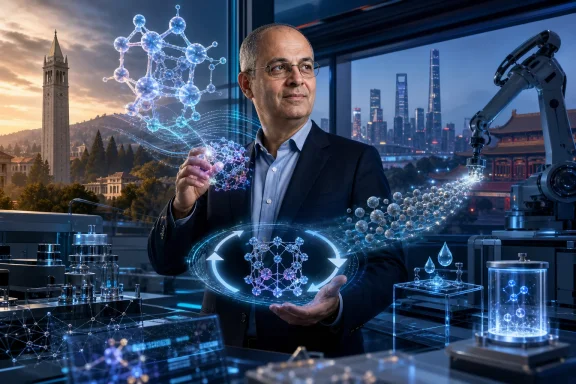 A Nobel Laureate Becomes a Geopolitical Signal
Yaghi’s appointment would have been notable in any year. A newly minted Nobel laureate leaving a premier American university for one of China’s most elite institutions is the kind of personnel move that university presidents, grant agencies, and science ministries notice immediately.But the timing gives it more weight. Yaghi shared the 2025 Nobel Prize in Chemistry with Richard Robson and Susumu Kitagawa for foundational work on metal-organic frameworks, or MOFs, a class of ultra-porous crystalline materials with enormous internal surface area. These materials can be engineered to trap gases, separate molecules, catalyze reactions, harvest water from air, or store hydrogen — the kind of chemistry that sits directly on top of the world’s climate, energy, and industrial bottlenecks.
Tsinghua says Yaghi will lead a university-level AI Chemistry and Materials Research Institute known as AIMATRY, shorthand for AI, materials, and chemistry. That branding matters. China is not merely recruiting a famous chemist to decorate a faculty page; it is tying one of the world’s most celebrated materials scientists to a national bet that artificial intelligence can compress the slow, expensive, failure-heavy process of discovering useful matter.
For American science, the uncomfortable point is not that one professor changed jobs. It is that a figure whose work was nurtured in the U.S. research ecosystem has accepted China’s invitation to build the next phase of that work elsewhere.
The Chemistry Is About Space, but the Politics Is About Speed
Metal-organic frameworks are often described with analogies because their defining property is hard to visualize at human scale. They are molecular scaffolds: metal ions or clusters linked by organic molecules into regular, porous architectures. Their internal cavities can be tuned, almost like designing rooms for particular guests.The Nobel Committee’s recognition of Yaghi, Robson, and Kitagawa was a recognition of design logic as much as discovery. MOFs transformed porous materials from something chemists found or modified into something they could architect. That is why the field has attracted attention well beyond academic chemistry.
A material that can selectively capture carbon dioxide is not just a lab curiosity if it can be manufactured cheaply and deployed at scale. A material that can pull water from dry air is not just a clever trick if it can be made durable, safe, and energy-efficient. A material that stores hydrogen more efficiently could alter the economics of clean fuels, logistics, and industrial decarbonization.
Those are still large ifs. MOFs have spent years moving between spectacular promise and stubborn engineering constraints. Stability, cost, scalability, regeneration energy, and real-world performance remain the difference between a Nobel-winning platform and a climate-tech revolution.
That is exactly where AI enters the story. The traditional materials pipeline is painfully slow: propose a structure, synthesize it, characterize it, test it, fail often, and repeat. Tsinghua’s pitch is that machine learning can shorten that cycle by orders of magnitude, using models to predict viable structures, guide synthesis, and identify candidate materials before years vanish into trial and error.
Tsinghua Is Buying More Than a CV
The South China Morning Post reported that Yaghi will head a team focused on using AI to transform the design and synthesis of new materials. At his appointment ceremony, according to Tsinghua, he said he hoped to develop materials addressing water scarcity, carbon neutrality, and sustainable development, while also training young scientists in AI-driven chemistry.Those statements sound almost boilerplate in 2026: AI, sustainability, talent, acceleration. But in this case the boilerplate is attached to a scientist whose field is unusually well suited to computational expansion. MOFs are modular. They are built from interchangeable chemical components. They generate vast combinatorial design spaces that no human-led lab can exhaust.
That makes them attractive terrain for machine learning, generative models, automated synthesis, and robotic labs. If AI struggles when the world is ambiguous and the feedback loop is mushy, materials chemistry offers a more disciplined target: structures, properties, reaction conditions, experimental outcomes. It is still messy, but it is the kind of mess that can be instrumented.
Tsinghua’s gain is not simply that students can now attend Yaghi’s lectures in Beijing. It is that the university can organize a research center around a scientific grammar he helped create. A Nobel laureate brings reputation, but a Nobel laureate in a field built on modular design brings a platform.
That is why the move should be read less like a retirement chair and more like a seed crystal. China has been building capacity in AI, chemistry, automation, and clean energy; Yaghi gives those pieces a globally legible focal point.
Berkeley’s Loss Is Also a Warning About the Research Climate
Yaghi was previously the James and Neeltje Tretter Professor of Chemistry at UC Berkeley, one of America’s most important public research universities and a historic engine of scientific talent. Berkeley’s reputation is not diminished by one departure. But the move lands amid a wider anxiety that U.S. universities are being asked to win a global science race while absorbing political attacks, funding uncertainty, immigration friction, and compliance burdens.The United States remains extraordinarily strong in basic science. Its research universities still attract global talent, its venture ecosystem can commercialize discoveries at speed, and its federal agencies have long supported the kind of curiosity-driven work that later becomes strategically indispensable. Yaghi’s own career is evidence of that system’s power.
But scientific leadership is cumulative until it suddenly is not. It depends on attracting people, retaining them, funding their riskiest ideas, and giving them confidence that the next decade of work can be built without constant institutional whiplash. When a Nobel laureate moves to Beijing to lead an AI-materials institute, it is reasonable to ask whether China offered something the U.S. system did not: scale, focus, money, institutional urgency, or simply a cleaner runway.
None of this means American science is collapsing. That is too easy and too false. The more precise concern is that China is learning how to turn individual recruitment into institutional leverage, while the United States still too often treats university science as both a national asset and a political punching bag.
The Talent Pipeline Is the Story Behind the Appointment
One detail in the South China Morning Post report deserves more attention than it will probably get: Zhou Zihui, a postdoctoral researcher at UC Berkeley, said Yaghi had trained around 200 researchers, nearly half of whom were Chinese. That number, if accurate, turns the appointment into more than a single-person transfer.Modern science runs through networks. Former students become professors, lab heads, founders, collaborators, reviewers, and grant panelists. They carry techniques, taste, standards, and trust. A senior scientist’s influence is not limited to papers; it lives in the people who learned how to ask questions in that scientist’s lab.
China’s science policy has long understood this. Its universities and research institutes have aggressively recruited overseas-trained scholars, often targeting people with deep experience in U.S. and European laboratories. The aim is not merely to reverse brain drain but to import scientific culture: how to run a lab, how to publish at the frontier, how to identify a field before it becomes crowded.
Yaghi’s appointment sits squarely inside that logic. A scientist who has trained a large number of Chinese researchers can become a bridge between alumni networks, institutional capital, and national priorities. The human infrastructure already exists; Tsinghua is now giving it a headquarters.
For U.S. policymakers, this is the harder lesson. Talent controls are blunt instruments. The American research system has benefited enormously from international students and scholars, including from China. But when relationships curdle into suspicion, the same openness that made U.S. universities dominant becomes politically contested. China’s response is to make return — or relocation — more attractive.
AI Chemistry Is Not a Buzzword When the Lab Can Close the Loop
There is plenty of hype in AI-for-science. Every discipline now has grant proposals promising foundation models, autonomous discovery, and compressed innovation cycles. Some of that will age badly. Some of it already has.Materials science, however, is one of the more plausible places for AI to matter. The problem space is vast, the search costs are high, and the reward for finding a better candidate material can be enormous. A model that merely improves hit rates could save years. A model that integrates prediction, synthesis planning, robotic execution, and characterization could change the structure of the lab itself.
That last point is crucial. AI in chemistry is not just ChatGPT for molecules. The serious version is a closed-loop system: algorithms propose candidates, automated platforms synthesize them, instruments measure performance, and the results feed back into the model. The lab becomes less artisanal and more cybernetic.
MOFs are particularly well suited to this approach because their modularity creates both opportunity and overload. There are countless possible combinations of metal nodes, organic linkers, pore geometries, and functional groups. The design space is too large for conventional exploration but structured enough for computational guidance.
Tsinghua’s AIMATRY will be judged on whether it can move beyond impressive predictions into reproducible, scalable materials. The world does not need another database of theoretical miracle compounds that cannot be made, cannot survive humidity, or cannot be manufactured outside a pristine lab. The hard test is whether AI can help produce materials that industry can actually use.
Climate Technology Gives the Move Its Moral Vocabulary
Yaghi’s stated goals — water shortages, carbon neutrality, sustainable development — are not incidental. They make the appointment politically and morally legible. A Nobel chemist moving from Berkeley to Beijing to build AI-designed materials might otherwise be framed narrowly as a talent-war story; climate technology gives it a broader public justification.MOFs have long been associated with precisely these grand challenges. Their pores can be tailored to capture carbon dioxide from gas streams, separate valuable molecules, store gases, or harvest water vapor from the atmosphere. In a warming world with strained water systems and hard-to-decarbonize industries, those capabilities are not academic luxuries.
China also has strong incentives to dominate this terrain. It is the world’s largest manufacturing power, a central player in batteries and solar, and a country under intense pressure to reconcile industrial growth with carbon commitments. Materials breakthroughs are not abstractions in that context; they are inputs to national competitiveness.
The U.S. has similar incentives, of course. But China’s advantage may be the integration of research priorities with industrial scale. A promising material can move faster when the ecosystem includes manufacturers, state support, pilot projects, and procurement channels. That does not guarantee success, but it changes the odds.
This is where the appointment becomes strategically interesting. Yaghi’s work concerns materials that could help solve global environmental problems, but the capacity to develop and deploy those materials will also confer economic and geopolitical advantage. Climate technology is humanitarian in rhetoric and industrial in practice.
The U.S.–China Science Relationship Keeps Refusing Simple Narratives
It is tempting to turn Yaghi’s move into a morality play. One version says China is poaching the fruits of American openness. Another says the United States is driving away global talent through suspicion and underinvestment. Both contain fragments of truth; neither is sufficient.Science has always been international, and elite American science has always depended on people born elsewhere. Yaghi himself is a Jordanian-American chemist whose career reflects the mobility that made U.S. universities dominant. The same global circulation that helped Berkeley thrive can now help Tsinghua rise.
The policy dilemma is that openness and competition are now entangled. U.S. officials worry about intellectual property, dual-use research, and military-civil fusion. Chinese officials portray scientific recruitment as national renewal and a route to technological self-reliance. Researchers are caught between those narratives, often wanting simply to do ambitious work with stable support.
The worst response would be to pretend personnel flows do not matter. They do. Laboratories are strategic assets, and so are the people who lead them. But the second-worst response would be to choke off the openness that made American science attractive in the first place.
A durable U.S. strategy would have to do two things at once: protect genuinely sensitive research and make the country unmistakably the best place in the world to do ambitious, peaceful science. That requires more than export controls. It requires funding, visas, institutional trust, and a political culture that treats scientists as assets rather than convenient targets.
Universities Are Becoming Strategic Infrastructure
For decades, universities could present themselves as above geopolitical competition, even when funded by defense agencies or embedded in national innovation systems. That posture is harder to sustain now. Tsinghua, Berkeley, MIT, Stanford, Oxford, ETH Zurich, and their peers are not just educational institutions; they are infrastructure for technological power.That does not mean they should become arms of the state. The independence of universities remains essential to discovery. But governments increasingly understand that the frontier of competition runs through graduate programs, shared instruments, faculty hiring, compute clusters, and cross-disciplinary institutes.
Yaghi’s appointment shows how the institute has become the preferred unit of scientific ambition. A single department is too narrow; a loose collaboration is too weak. The modern prestige play is a center with a mission, a famous director, high-performance computing, experimental facilities, and a pipeline of graduate students trained to move between code and chemistry.
This is familiar to anyone watching AI labs, quantum centers, semiconductor institutes, and bioengineering hubs. The research university is being reorganized around missions that look increasingly like national bets. Tsinghua’s AI-materials institute fits that pattern exactly.
For WindowsForum readers who live closer to servers than synthesis benches, the analogy is obvious. Compute changed software first, then biology, then design, and now it is pushing deeper into the physical sciences. The laboratory is becoming another kind of platform, and the countries that build the best platforms will shape what the next industrial stack looks like.
The Real Competition Is Over the Next Generation of Builders
The most consequential part of Yaghi’s new role may not be the materials his team discovers first. It may be the researchers it trains. A center built around AI-driven chemistry will produce scientists who think differently from traditional synthetic chemists and differently from pure machine-learning engineers.They will need to understand molecules, data, instruments, robotics, and deployment constraints. They will be comfortable moving from a model’s prediction to a glovebox, from a crystal structure to a manufacturing process, from a climate claim to an adsorption isotherm. That hybrid skill set is rare and increasingly valuable.
If Tsinghua becomes a magnet for that training, the effects will compound. Students go where the best people, tools, and problems are. Postdocs follow prestige and opportunity. Companies follow talent. Governments follow results.
This is why the appointment should worry U.S. science leaders without inducing panic. The issue is not whether China can hire one Nobel laureate. It is whether China can create environments where the next generation believes the future of AI-driven materials science is being built there.
America’s answer cannot be nostalgia for a unipolar scientific era. It has to be institutional seriousness. The U.S. still has extraordinary advantages, but advantages decay when treated as birthrights.
The Appointment Changes the Weather Around AI and Materials
Yaghi’s move does not prove that China will dominate AI chemistry. It does not prove that MOFs will deliver on every climate promise. It does not prove that American universities are losing their edge. But it changes the weather around all three debates.A Nobel Prize confers legitimacy. Tsinghua’s appointment converts that legitimacy into institutional direction. The combination of AI, MOFs, climate applications, and Chinese state-aligned scientific ambition creates a story that will travel far beyond chemistry departments.
For investors, it signals that materials discovery remains a serious frontier for AI rather than a side quest. For universities, it raises the bar for what a competitive research environment looks like. For policymakers, it is a reminder that science competition is not only about restricting adversaries but also about attracting and retaining the people capable of building the future.
The practical stakes are not abstract. Better carbon-capture materials, water-harvesting systems, hydrogen storage media, catalysts, and separations technologies could reshape entire industries. The country that moves fastest from discovery to deployment will not just publish papers; it will set standards, build supply chains, and capture markets.
That is why Yaghi’s move should be seen as both scientific news and industrial news. Chemistry is becoming computational, computation is becoming strategic, and strategic technologies increasingly begin inside universities.
The Signal From Beijing Is Clearer Than the Response From Washington
The concrete lessons from Yaghi’s appointment are narrower than the symbolism but more useful. They point to a world in which talent, compute, chemistry, and climate policy are converging faster than many institutions are prepared to admit.- Tsinghua has recruited Omar Yaghi full-time to lead a new AI chemistry and materials institute, turning a Nobel laureate’s reputation into a platform for accelerated materials discovery.
- Yaghi’s Nobel-winning field, metal-organic frameworks, is unusually compatible with AI-guided design because its modular chemistry creates a vast but structured search space.
- The move strengthens China’s position in climate-relevant materials research, especially in areas such as carbon capture, water harvesting, hydrogen storage, and molecular separations.
- The departure from UC Berkeley is not evidence of American collapse, but it is a warning that U.S. science leadership depends on sustained funding, openness, immigration stability, and institutional confidence.
- The most important long-term impact may be the training of young researchers who can work fluently across machine learning, synthesis, automation, and industrial deployment.
- The U.S.–China research rivalry will be decided less by slogans than by which system builds the most attractive laboratories for ambitious scientists.
References
- Primary source: South China Morning Post
Published: 2026-07-04T13:40:16.663899
Loading…
amp.scmp.com - Related coverage: scmp.com
Loading…
www.scmp.com - Related coverage: tsinghua.edu.cn
Loading…
www.tsinghua.edu.cn - Related coverage: acs.org
Loading…
www.acs.org - Related coverage: news.berkeley.edu
Loading…
news.berkeley.edu - Related coverage: chemistryworld.com
Loading…
www.chemistryworld.com
- Related coverage: axial.acs.org
Loading…
axial.acs.org - Related coverage: washingtonpost.com
Loading…
www.washingtonpost.com - Related coverage: sciencenews.org
Loading…
www.sciencenews.org - Related coverage: elpais.com
Loading…
elpais.com - Related coverage: livescience.com
Loading…
www.livescience.com - Related coverage: cadenaser.com
Loading…
cadenaser.com - Related coverage: huffingtonpost.es
Loading…
www.huffingtonpost.es