

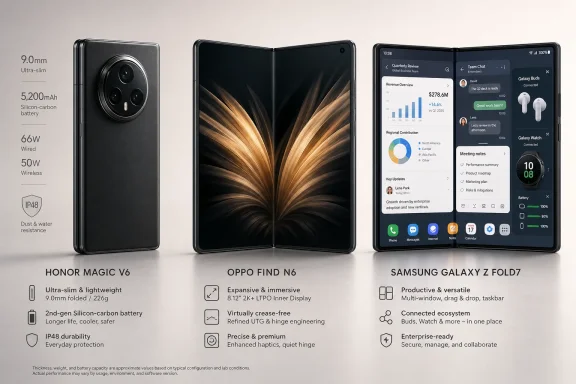
Honor’s Magic V6, Oppo’s Find N6, and Samsung’s Galaxy Z Fold7 represent three competing 2026 book-style foldable strategies, with Honor chasing thinness and endurance, Oppo emphasizing display feel and hinge refinement, and Samsung leaning on mature software, app support, and ecosystem integration. That split matters because the foldable phone is no longer a single experiment looking for a buyer. It is becoming three different products wearing the same silhouette. As Notebookcheck’s comparison makes clear, the real decision is not which company has “won” foldables, but which compromise a buyer is willing to live with every day.
The first era of foldable phones was defined by whether the thing could survive being folded at all. Early buyers paid flagship money for visible creases, fragile inner screens, awkward aspect ratios, mediocre cameras, and software that treated the large display as a novelty rather than a workplace. In 2026, that debate feels quaint.
The Honor Magic V6, Oppo Find N6, and Galaxy Z Fold7 all assume the basic premise has been accepted: a phone can become a small tablet, and enough people now want that device to be polished rather than merely possible. What differs is the engineering religion behind each one. Honor is trying to make the foldable disappear into the dimensions of a regular flagship; Oppo is trying to make the act of opening it feel premium and natural; Samsung is trying to make the foldable behave like a mature computing platform.
That makes this comparison more interesting than a spec-table shootout. The three devices are not simply racing toward the same destination. They are revealing what each manufacturer thinks the mainstream foldable buyer actually fears: bulk, display compromises, or software uncertainty.
That is why Honor’s battery story matters so much. Thin foldables often come with an implicit apology: yes, the design is elegant, but endurance suffers. Honor is attempting to break that link by pairing miniaturization with a very large silicon-carbon battery, a combination the company has heavily promoted in its official material and launch messaging.
Notebookcheck’s framing of the Magic V6 as the endurance-and-slimness candidate is therefore not incidental. It is the core of Honor’s pitch. The company wants to say that the practical objections are gone: the phone is not too thick, the battery is not too small, and the body is not too delicate.
The IP69 rating is part of that same argument. Foldables have long carried an aura of fragility, and durability ratings have become a shorthand for whether a manufacturer is still asking buyers to treat the device like jewelry. Honor’s stronger dust and water resistance positioning gives the Magic V6 a useful badge in a category where reassurance is almost as important as engineering.
But the compromise is equally revealing. Notebookcheck points to weaknesses in the inner display’s day-to-day readability and cooling under sustained load. Those are not small caveats for a phone whose entire reason to exist is the large interior screen. If the big panel is sometimes harder to read than its peak-brightness numbers imply, Honor’s spec-sheet triumph becomes more complicated in use.
The hinge and crease are central to that identity. Reviewers have repeatedly treated Oppo’s foldable hardware as among the best in the business for making the folded display feel less compromised. A barely visible crease is not just cosmetic; it changes how the device feels under the finger and how quickly the brain stops noticing the foldable mechanism.
That is where Oppo’s approach may be the most mature. Honor wants buyers to marvel at the slimness. Samsung wants buyers to trust the software. Oppo wants the hardware interaction to fade into comfort. The Find N6’s strongest case is that opening, holding, and using the large screen should feel more natural than it does on rivals.
Notebookcheck’s comparison highlights the Find N6’s display uniformity and haptics as areas where Oppo feels especially convincing. That matters because foldables are sensory products. A phone this expensive cannot merely benchmark well; it has to feel worth opening dozens of times a day.
The drawback is that Oppo’s balance can look less dramatic on paper. It lacks the Honor’s most extreme battery-and-durability story, and it does not have Samsung’s long-established foldable software reputation. Oppo may have built the most harmonious object of the three, but harmony is harder to market than a giant battery, an IP69 badge, or a famous ecosystem.
The Fold7’s advantage is software maturity. Samsung’s One UI implementation for foldables has been refined across multiple generations, and the company’s multitasking model remains the benchmark many rivals are still measured against. The taskbar, multi-window behavior, app continuity, and broader Android foldable polish are not glamorous in the same way as a thinner hinge, but they decide whether the large screen becomes useful after the novelty fades.
Samsung also benefits from ecosystem gravity. For users already carrying Galaxy Buds, Galaxy Watch devices, Samsung tablets, Windows PCs with Phone Link, or SmartThings gear, the Fold7 is less a standalone gadget than a node in an existing system. That makes the purchase easier to justify for buyers who value continuity over adventurous hardware.
The problem is that Samsung’s maturity increasingly comes with visible hardware conservatism. Chinese manufacturers have moved quickly on battery capacity, charging speed, crease reduction, and body thickness. Samsung has improved the Fold line, but it often does so in increments that look cautious beside Honor and Oppo.
That caution may be strategic. Samsung sells foldables globally, supports them widely, and must satisfy carriers, enterprise buyers, and long-term update expectations. But for enthusiasts comparing hardware ambition, the Fold7 can feel like the safest answer rather than the most exciting one.
A book-style foldable is expected to behave like a phone when closed and like a tablet when open. That means more screen area, more multitasking, more video, more reading, and more temptation to use the device as a primary computing surface. The battery is not merely powering a bigger phone; it is powering a different usage pattern.
Honor understands this. The Magic V6’s large battery is not just a spec flex. It is an attempt to solve the anxiety that comes with using the inner display heavily. A foldable that punishes users for unfolding it is a foldable that quietly trains them not to use the feature they paid for.
Oppo appears to aim for a middle path, with enough endurance to be credible but not the same headline-grabbing battery claim. Samsung, meanwhile, continues to rely on optimization, software control, and ecosystem efficiency more than raw capacity and charging bravado. That may be acceptable for many buyers, but it leaves Samsung vulnerable in a comparison where Chinese rivals look more aggressive.
Charging speed compounds the issue. Foldable buyers tend to be power users, and power users notice when a top-tier device needs more time near an outlet than competing hardware. Samsung’s slower charging posture remains one of the easiest criticisms for rivals to exploit.
A display can be extremely bright in controlled conditions and still feel less effortless in real use. Foldables are especially exposed here because the inner display is large, flexible, and often used at odd angles. A panel that looks excellent indoors may be less convincing in a car, beside a window, or under harsh overhead light.
Oppo’s advantage, according to the comparison, is not simply that the Find N6 has an impressive display. It is that the display behaves consistently. Uniform brightness and a less intrusive crease create the impression of polish, and in foldables polish often beats raw measurement.
Samsung’s display reputation remains strong, and the Fold7’s panels benefit from Samsung’s long experience in OLED manufacturing. But Samsung’s problem is no longer basic quality. It is that rivals have caught up enough that the company cannot win the display argument by default.
This is where the Find N6 may have the strongest emotional pull. A foldable’s interior screen is the magic trick. If Oppo makes that screen feel flatter, cleaner, and more pleasant than the others, it wins the moment that made the category worth buying.
The Fold7 is not merely a phone that opens. It is a device built around the assumption that users will run multiple apps, drag content between windows, resume tasks across displays, and expect third-party apps to behave intelligently. Samsung’s advantage is years of iteration and developer pressure, not one single feature.
Honor and Oppo have improved substantially, and Chinese Android skins have become far more capable than the stereotypes suggest. But foldables punish rough edges. A strange app layout, inconsistent window behavior, or awkward transition from outer to inner display can make a $2,000-class device feel unfinished.
This is especially important for WindowsForum’s core audience. IT pros, admins, developers, and technically fluent users are exactly the people most likely to exploit a foldable as more than a media consumption gadget. They are also the people most likely to notice when software workflows break down.
Samsung’s long-term update strategy strengthens that case. Foldables are expensive, and buyers increasingly expect premium devices to remain viable for years. Honor and Oppo may win hardware rounds, but Samsung’s software runway can still be the safer investment for people who keep phones longer or deploy them into business environments.
That does not automatically make the Fold7 the best device. It makes it the easiest to approve. Procurement departments do not buy hinges in isolation; they buy support channels, security posture, warranty paths, update cadence, and predictable regional availability.
Honor and Oppo face a steeper climb here, particularly in markets where distribution is uneven or where Chinese OEMs encounter regulatory, carrier, or corporate policy friction. Even when their hardware is better, the device may be harder to standardize across a workforce. That matters for the kind of buyer who sees a foldable as a mobile productivity endpoint rather than a personal indulgence.
Samsung’s foldable software also aligns with business use in a way that feels less improvised. Multi-window workflows, stylus-adjacent productivity expectations, integration with Microsoft services, and mature Android enterprise support give the Fold7 a practical advantage. It may not thrill the spec maximalist, but it reassures the person responsible for supporting 500 devices.
That is the hidden reason Samsung remains dangerous. The foldable market is no longer only about who builds the coolest object. It is about who can make the object boring enough for organizations to trust.
Samsung’s Fold7 improved the camera story with a more ambitious main sensor than earlier Fold generations, but the broader category still struggles to match dedicated camera flagships. Honor and Oppo have strong imaging credentials in their conventional premium phones, yet foldables force compromises that are harder to hide.
Oppo may have the most natural route to camera credibility because its recent flagship camera phones have earned praise for image processing and hardware choices. Honor’s large rear camera module signals seriousness as well. But none of these devices should be judged as pure camera phones first.
The more honest framing is that all three are productivity-first luxury devices with good-to-very-good cameras. That may sound like faint praise, but it reflects the physics of the category. A foldable buyer is paying for screen versatility, not only for the best possible telephoto stack.
Still, camera compromises are dangerous because they puncture the flagship illusion. When a buyer spends this much, every missing capability feels amplified. The winner is not necessarily the phone with the most dramatic camera claim, but the one whose compromises are least visible in daily shooting.
Samsung has an advantage here because its devices are widely sold, widely promoted, and frequently bundled or discounted through carriers and retailers. The sticker price may be high, but the real market price often becomes more flexible over time. That makes the Fold7 easier to recommend to buyers who want the category’s safest software experience without paying launch-day money.
Honor and Oppo can look more compelling to enthusiasts willing to import, shop carefully, or prioritize hardware characteristics above all else. But pricing, warranty support, and regional software expectations complicate those purchases. A foldable is not a $200 experiment; support risk matters.
The looming-successor problem also cuts both ways. Samsung buyers may hesitate if a new model is close. But that same cycle can make the current Fold cheaper and more rational. Foldables are now mature enough that last year’s model can be a smart buy rather than a museum piece.
That may be uncomfortable for hardware romantics, but it is good for the market. Foldables will not become mainstream because every buyer chases the newest hinge. They will become mainstream when the previous flagship becomes affordable enough to feel sane.
Honor’s Magic V6 may be the most impressive engineering object. Its thinness, battery capacity, and durability rating make it feel like the device designed to silence skeptics. It is the foldable for people who want proof that the category has solved its original hardware sins.
Oppo’s Find N6 may be the most pleasant physical product. Its display behavior, hinge refinement, crease control, and haptics suggest a company obsessing over the moments when the user directly touches the foldable mechanism. It is the phone for people who care less about winning one headline spec and more about how the device feels unfolded at 10 p.m. on the couch.
Samsung’s Galaxy Z Fold7 may be the most dependable computing platform. It is not the boldest hardware statement here, but it is the one most likely to integrate cleanly into an existing digital life. It is the foldable for people who want the least friction after purchase.
That means there is no universal winner. There are only different definitions of progress.
 The Foldable War Has Moved From Spectacle to Trade-Offs
The first era of foldable phones was defined by whether the thing could survive being folded at all. Early buyers paid flagship money for visible creases, fragile inner screens, awkward aspect ratios, mediocre cameras, and software that treated the large display as a novelty rather than a workplace. In 2026, that debate feels quaint.The Honor Magic V6, Oppo Find N6, and Galaxy Z Fold7 all assume the basic premise has been accepted: a phone can become a small tablet, and enough people now want that device to be polished rather than merely possible. What differs is the engineering religion behind each one. Honor is trying to make the foldable disappear into the dimensions of a regular flagship; Oppo is trying to make the act of opening it feel premium and natural; Samsung is trying to make the foldable behave like a mature computing platform.
That makes this comparison more interesting than a spec-table shootout. The three devices are not simply racing toward the same destination. They are revealing what each manufacturer thinks the mainstream foldable buyer actually fears: bulk, display compromises, or software uncertainty.
Honor Builds the Foldable for People Who Still Hate Foldables
Honor’s Magic V6 is the most aggressive answer to the most obvious complaint about book-style foldables: they have historically felt like two phones taped together. The device’s selling point is not just that it is thin, but that it is thin enough to challenge the psychological barrier that has kept many ordinary flagship buyers away. A foldable that feels close to a conventional slab when closed changes the conversation before the screen is even opened.That is why Honor’s battery story matters so much. Thin foldables often come with an implicit apology: yes, the design is elegant, but endurance suffers. Honor is attempting to break that link by pairing miniaturization with a very large silicon-carbon battery, a combination the company has heavily promoted in its official material and launch messaging.
Notebookcheck’s framing of the Magic V6 as the endurance-and-slimness candidate is therefore not incidental. It is the core of Honor’s pitch. The company wants to say that the practical objections are gone: the phone is not too thick, the battery is not too small, and the body is not too delicate.
The IP69 rating is part of that same argument. Foldables have long carried an aura of fragility, and durability ratings have become a shorthand for whether a manufacturer is still asking buyers to treat the device like jewelry. Honor’s stronger dust and water resistance positioning gives the Magic V6 a useful badge in a category where reassurance is almost as important as engineering.
But the compromise is equally revealing. Notebookcheck points to weaknesses in the inner display’s day-to-day readability and cooling under sustained load. Those are not small caveats for a phone whose entire reason to exist is the large interior screen. If the big panel is sometimes harder to read than its peak-brightness numbers imply, Honor’s spec-sheet triumph becomes more complicated in use.
Oppo Treats the Hinge as the Main Character
Oppo’s Find N6 takes a less theatrical route. It does not appear to be chasing Honor’s most extreme thinness claim, and that may be the point. Oppo has spent multiple generations making its Find N line feel less like a technical demonstration and more like an object designed around the hand.The hinge and crease are central to that identity. Reviewers have repeatedly treated Oppo’s foldable hardware as among the best in the business for making the folded display feel less compromised. A barely visible crease is not just cosmetic; it changes how the device feels under the finger and how quickly the brain stops noticing the foldable mechanism.
That is where Oppo’s approach may be the most mature. Honor wants buyers to marvel at the slimness. Samsung wants buyers to trust the software. Oppo wants the hardware interaction to fade into comfort. The Find N6’s strongest case is that opening, holding, and using the large screen should feel more natural than it does on rivals.
Notebookcheck’s comparison highlights the Find N6’s display uniformity and haptics as areas where Oppo feels especially convincing. That matters because foldables are sensory products. A phone this expensive cannot merely benchmark well; it has to feel worth opening dozens of times a day.
The drawback is that Oppo’s balance can look less dramatic on paper. It lacks the Honor’s most extreme battery-and-durability story, and it does not have Samsung’s long-established foldable software reputation. Oppo may have built the most harmonious object of the three, but harmony is harder to market than a giant battery, an IP69 badge, or a famous ecosystem.
Samsung Wins by Making the Weird Thing Boring
Samsung’s Galaxy Z Fold7 is the conservative device in this comparison, but that word should not be mistaken for an insult. In foldables, conservative can mean dependable. Samsung has spent years turning an experimental category into a repeatable product line, and the Fold7 benefits from that institutional memory.The Fold7’s advantage is software maturity. Samsung’s One UI implementation for foldables has been refined across multiple generations, and the company’s multitasking model remains the benchmark many rivals are still measured against. The taskbar, multi-window behavior, app continuity, and broader Android foldable polish are not glamorous in the same way as a thinner hinge, but they decide whether the large screen becomes useful after the novelty fades.
Samsung also benefits from ecosystem gravity. For users already carrying Galaxy Buds, Galaxy Watch devices, Samsung tablets, Windows PCs with Phone Link, or SmartThings gear, the Fold7 is less a standalone gadget than a node in an existing system. That makes the purchase easier to justify for buyers who value continuity over adventurous hardware.
The problem is that Samsung’s maturity increasingly comes with visible hardware conservatism. Chinese manufacturers have moved quickly on battery capacity, charging speed, crease reduction, and body thickness. Samsung has improved the Fold line, but it often does so in increments that look cautious beside Honor and Oppo.
That caution may be strategic. Samsung sells foldables globally, supports them widely, and must satisfy carriers, enterprise buyers, and long-term update expectations. But for enthusiasts comparing hardware ambition, the Fold7 can feel like the safest answer rather than the most exciting one.
Battery Life Is Becoming the New Foldable Battleground
For years, the foldable conversation revolved around the hinge. Then it revolved around the crease. Now the center of gravity is shifting toward battery life, because endurance is where the foldable’s dual identity becomes most punishing.A book-style foldable is expected to behave like a phone when closed and like a tablet when open. That means more screen area, more multitasking, more video, more reading, and more temptation to use the device as a primary computing surface. The battery is not merely powering a bigger phone; it is powering a different usage pattern.
Honor understands this. The Magic V6’s large battery is not just a spec flex. It is an attempt to solve the anxiety that comes with using the inner display heavily. A foldable that punishes users for unfolding it is a foldable that quietly trains them not to use the feature they paid for.
Oppo appears to aim for a middle path, with enough endurance to be credible but not the same headline-grabbing battery claim. Samsung, meanwhile, continues to rely on optimization, software control, and ecosystem efficiency more than raw capacity and charging bravado. That may be acceptable for many buyers, but it leaves Samsung vulnerable in a comparison where Chinese rivals look more aggressive.
Charging speed compounds the issue. Foldable buyers tend to be power users, and power users notice when a top-tier device needs more time near an outlet than competing hardware. Samsung’s slower charging posture remains one of the easiest criticisms for rivals to exploit.
Displays Are No Longer About Peak Brightness Alone
The foldable display war has become more subtle. Peak brightness numbers still dominate marketing, but everyday readability depends on uniformity, reflectivity, dimming behavior, crease visibility, panel calibration, and how the screen performs across mixed lighting. That is why Notebookcheck’s criticism of the Magic V6’s inner display matters.A display can be extremely bright in controlled conditions and still feel less effortless in real use. Foldables are especially exposed here because the inner display is large, flexible, and often used at odd angles. A panel that looks excellent indoors may be less convincing in a car, beside a window, or under harsh overhead light.
Oppo’s advantage, according to the comparison, is not simply that the Find N6 has an impressive display. It is that the display behaves consistently. Uniform brightness and a less intrusive crease create the impression of polish, and in foldables polish often beats raw measurement.
Samsung’s display reputation remains strong, and the Fold7’s panels benefit from Samsung’s long experience in OLED manufacturing. But Samsung’s problem is no longer basic quality. It is that rivals have caught up enough that the company cannot win the display argument by default.
This is where the Find N6 may have the strongest emotional pull. A foldable’s interior screen is the magic trick. If Oppo makes that screen feel flatter, cleaner, and more pleasant than the others, it wins the moment that made the category worth buying.
Software Is the Difference Between a Big Screen and a Small Computer
Hardware gets buyers into a store. Software decides whether they keep using the large display six months later. That is Samsung’s home turf, and it remains the hardest part of the foldable experience for rivals to copy.The Fold7 is not merely a phone that opens. It is a device built around the assumption that users will run multiple apps, drag content between windows, resume tasks across displays, and expect third-party apps to behave intelligently. Samsung’s advantage is years of iteration and developer pressure, not one single feature.
Honor and Oppo have improved substantially, and Chinese Android skins have become far more capable than the stereotypes suggest. But foldables punish rough edges. A strange app layout, inconsistent window behavior, or awkward transition from outer to inner display can make a $2,000-class device feel unfinished.
This is especially important for WindowsForum’s core audience. IT pros, admins, developers, and technically fluent users are exactly the people most likely to exploit a foldable as more than a media consumption gadget. They are also the people most likely to notice when software workflows break down.
Samsung’s long-term update strategy strengthens that case. Foldables are expensive, and buyers increasingly expect premium devices to remain viable for years. Honor and Oppo may win hardware rounds, but Samsung’s software runway can still be the safer investment for people who keep phones longer or deploy them into business environments.
The Enterprise Buyer Still Sees Samsung First
For consumers, the Fold7’s ecosystem advantage may be a matter of convenience. For business buyers, it can be a matter of policy. Samsung has built years of enterprise credibility through Knox, update commitments, carrier relationships, device management support, and broad availability.That does not automatically make the Fold7 the best device. It makes it the easiest to approve. Procurement departments do not buy hinges in isolation; they buy support channels, security posture, warranty paths, update cadence, and predictable regional availability.
Honor and Oppo face a steeper climb here, particularly in markets where distribution is uneven or where Chinese OEMs encounter regulatory, carrier, or corporate policy friction. Even when their hardware is better, the device may be harder to standardize across a workforce. That matters for the kind of buyer who sees a foldable as a mobile productivity endpoint rather than a personal indulgence.
Samsung’s foldable software also aligns with business use in a way that feels less improvised. Multi-window workflows, stylus-adjacent productivity expectations, integration with Microsoft services, and mature Android enterprise support give the Fold7 a practical advantage. It may not thrill the spec maximalist, but it reassures the person responsible for supporting 500 devices.
That is the hidden reason Samsung remains dangerous. The foldable market is no longer only about who builds the coolest object. It is about who can make the object boring enough for organizations to trust.
The Camera Race Is Not the Main Story, But It Still Haunts the Category
Foldables remain trapped by a camera paradox. They are among the most expensive phones sold, yet they often lag the best slab flagships in camera hardware because hinges, batteries, weight targets, and thermal constraints consume the design budget. Buyers notice that mismatch.Samsung’s Fold7 improved the camera story with a more ambitious main sensor than earlier Fold generations, but the broader category still struggles to match dedicated camera flagships. Honor and Oppo have strong imaging credentials in their conventional premium phones, yet foldables force compromises that are harder to hide.
Oppo may have the most natural route to camera credibility because its recent flagship camera phones have earned praise for image processing and hardware choices. Honor’s large rear camera module signals seriousness as well. But none of these devices should be judged as pure camera phones first.
The more honest framing is that all three are productivity-first luxury devices with good-to-very-good cameras. That may sound like faint praise, but it reflects the physics of the category. A foldable buyer is paying for screen versatility, not only for the best possible telephoto stack.
Still, camera compromises are dangerous because they puncture the flagship illusion. When a buyer spends this much, every missing capability feels amplified. The winner is not necessarily the phone with the most dramatic camera claim, but the one whose compromises are least visible in daily shooting.
Price Turns Philosophy Into a Purchase
Notebookcheck’s comparison notes that Samsung’s foldable is currently the most attractive option on price, even as a successor looms. That is the kind of sentence that changes the practical recommendation. The best foldable in theory is not always the best foldable when discounts arrive.Samsung has an advantage here because its devices are widely sold, widely promoted, and frequently bundled or discounted through carriers and retailers. The sticker price may be high, but the real market price often becomes more flexible over time. That makes the Fold7 easier to recommend to buyers who want the category’s safest software experience without paying launch-day money.
Honor and Oppo can look more compelling to enthusiasts willing to import, shop carefully, or prioritize hardware characteristics above all else. But pricing, warranty support, and regional software expectations complicate those purchases. A foldable is not a $200 experiment; support risk matters.
The looming-successor problem also cuts both ways. Samsung buyers may hesitate if a new model is close. But that same cycle can make the current Fold cheaper and more rational. Foldables are now mature enough that last year’s model can be a smart buy rather than a museum piece.
That may be uncomfortable for hardware romantics, but it is good for the market. Foldables will not become mainstream because every buyer chases the newest hinge. They will become mainstream when the previous flagship becomes affordable enough to feel sane.
The Spec Sheet Says Less Than the Hand Does
The danger in comparing foldables is treating them like ordinary phones with one extra screen. They are not. Their success depends on weight distribution, hinge resistance, cover-screen width, unfolded grip, crease feel, thermal behavior, and whether the software invites or discourages multitasking.Honor’s Magic V6 may be the most impressive engineering object. Its thinness, battery capacity, and durability rating make it feel like the device designed to silence skeptics. It is the foldable for people who want proof that the category has solved its original hardware sins.
Oppo’s Find N6 may be the most pleasant physical product. Its display behavior, hinge refinement, crease control, and haptics suggest a company obsessing over the moments when the user directly touches the foldable mechanism. It is the phone for people who care less about winning one headline spec and more about how the device feels unfolded at 10 p.m. on the couch.
Samsung’s Galaxy Z Fold7 may be the most dependable computing platform. It is not the boldest hardware statement here, but it is the one most likely to integrate cleanly into an existing digital life. It is the foldable for people who want the least friction after purchase.
That means there is no universal winner. There are only different definitions of progress.
Three Foldables, Three Warnings for the Next Buying Cycle
The clearest lesson from this comparison is that foldables have become mature enough to segment like laptops. Nobody expects the thinnest ultrabook, the workstation, and the gaming machine to make the same compromises. Book-style foldables are starting to split the same way.- Honor’s Magic V6 is the most compelling choice for buyers who want extreme thinness, unusually strong durability claims, and class-leading battery ambition in a book-style foldable.
- Oppo’s Find N6 appears to offer the most balanced physical experience, especially for users who care about display uniformity, hinge feel, haptics, and a less intrusive crease.
- Samsung’s Galaxy Z Fold7 remains the safest software and ecosystem bet, particularly for users who rely on multitasking, long updates, app optimization, and broader device integration.
- Samsung’s weaker battery and charging posture remains a real opening for Chinese rivals, especially among power users who unfold their devices constantly.
- The best choice depends less on raw performance than on which compromise will annoy the buyer least after the novelty of the folding screen wears off.
References
- Primary source: Notebookcheck
Published: 2026-07-04T14:10:23.266645
A direct comparison of three foldable phones from Honor, Oppo, and Samsung - Notebookcheck News
The Honor Magic V6, Oppo Find N6, and Samsung Galaxy Z Fold7 showcase different approaches in the foldable segment. While Honor focuses on slim design and battery life, Oppo counters with its display and haptic feedback, and Samsung with software maturity and its ecosystem. However, no device is... www.notebookcheck.net
- Related coverage: digitalcameraworld.com
Best flip phones & best fold phones | Digital Camera World
They're super-fashionable, and for good reason. We reveal the best flip phone & best folding phone right nowwww.digitalcameraworld.com - Related coverage: creativebloq.com
Honor Magic V6 review: Forget the iPhone Fold! | Creative Bloq
With its strong camera and thin, crisp display, the V6 is the foldable king.www.creativebloq.com - Related coverage: t3.com
Honor Magic V6 review: The fanciest of foldables | T3
With a fancy on-sale discount that's hard to ignorewww.t3.com - Related coverage: news.samsung.com
[Galaxy Unpacked 2025] A First Look at the Galaxy Z Fold7: Unfolding a New Standard in Foldable Design – Samsung Global Newsroom
On July 9, Samsung Electronics unveiled the Galaxy Z Fold7 at Galaxy Unpacked 2025 in Broonews.samsung.com
- Related coverage: honor.com
HONOR Magic V6 Unfold the Real Magic - HONOR Global
Meet the HONOR Magic V6 — the thinner foldable at just 8.75mm and 219g. Engineered with Anti-Scratch NanoCrystal Shield, driven by the Snapdragon® 8 Elite Gen 5 Mobile Platform, equipped with a 6660mAh battery for all-day use, and certified IP68 & IP69 water and dust resistance. Explore the...www.honor.com
- Related coverage: techradar.com
Hands-on with the Honor Magic V6 — the stunning new foldable with 'world’s thinnest mobile phone battery' | TechRadar
Plus, an interview with Honor product expert, Hope Caowww.techradar.com - Related coverage: oppo.com
OPPO Find N6- 規格 | OPPO 香港
OPPO Find N6 的規格:驍龍 8 Elite Gen 5 晶片,IP56/IP58/IP59 防水防塵,6000mAh 電池,80W SUPERVOOC 閃充。www.oppo.com
- Related coverage: newmobilespecs.com
OPPO Find N6 Full specifications
Newmobilespecs.com - Upcoming, Mobile Phones, Smartphones, Specifications, Prices, Compare detailed, Features, Photos, Reviews, News.www.newmobilespecs.com
- Related coverage: samsungmobilepress.com
Samsung Galaxy Z Fold7: Raising the Bar for Smartphones | Samsung Mobile Press
Samsung has launched Galaxy Z Fold7 the thinnest and lightest Galaxy Z Fold to date with AI innovation and an immersive foldable display. It uses the new One UI 8 and features a 200 MP camera.www.samsungmobilepress.com - Related coverage: techadvisor.com
Honor Magic V6 Review: The Ultimate Foldable... Almost - Tech Advisor
From performance to battery life and cameras, the Magic V6 won't leave you wanting more. But it comes at a cost - literallywww.techadvisor.com - Related coverage: androidcentral.com
I used the OPPO Find N6 — this is the creaseless foldable I've always wanted | Android Central
With the Find N6, OPPO somehow managed to deliver a foldable with a creaseless inner panel, and it is a delight to use.www.androidcentral.com - Related coverage: oppojapan.com
- Related coverage: littlebigreddot.com
honor magic v6 singapores first foldable with ip68 ip69 dual water resistance launches 4 june
PDF documentlittlebigreddot.com
- Related coverage: ashgabattimes.com
- Related coverage: image-us.samsung.com