

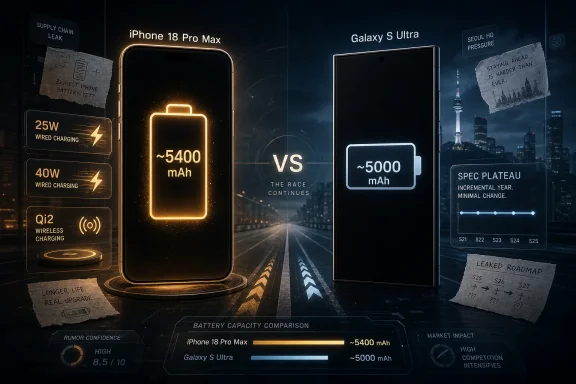
Apple’s rumored iPhone 18 Pro Max battery increase to roughly 5,400 mAh, reported by SamMobile from the current leak circuit, would put Apple ahead of Samsung’s Galaxy S Ultra line on a spec Samsung once treated as home turf. The bigger story is not that one unannounced phone may beat another unannounced phone by a few hundred milliamp-hours. It is that Apple has started competing more openly on the kind of hardware numbers Samsung fans used to take for granted. If those rumors hold, Samsung’s long strategy of saving practical upgrades for the Ultra tier — or delaying them for generations — suddenly looks less like discipline and more like complacency.
For years, Apple’s answer to spec-sheet comparisons was almost theological: trust the integration, trust the silicon, trust iOS, trust the experience. Samsung, by contrast, sold abundance. More screen, more cameras, more zoom, more battery, more ways to multitask, more features visible from across the carrier store.
That division was never perfectly true, but it was useful. Apple was the company that made a 60Hz phone feel expensive for too long; Samsung was the company that could point to 120Hz, big panels, fast-ish charging, stylus support, and folding hardware. The Galaxy pitch worked because it made the iPhone feel conservative.
SamMobile’s argument lands because that old polarity has started to wobble. Apple’s iPhone 17 generation already pushed the mainstream iPhone line harder on charging and wireless charging, with Apple’s own technical specifications listing fast-charge support with a 40W adapter or higher and Qi2 wireless charging up to 25W on the standard iPhone 17. MacRumors also reported Apple-confirmed battery capacities for the iPhone 17 family, including a 5,088 mAh figure for the eSIM-only iPhone 17 Pro Max.
That does not make Apple a spec-first company overnight. It does mean Apple has stopped leaving so many easy numbers on the table. When the iPhone can claim 25W wireless charging across most of the line while Samsung is still tiering the feature, the discussion changes from “Apple is behind” to “why is Samsung still rationing this?”
Samsung can fairly argue that capacity is not endurance. A more efficient chip, better panel, and smarter power management can do more for real-world runtime than a slightly larger cell. The Galaxy S26 Ultra reviews and spec roundups this year generally treated Samsung’s 5,000 mAh decision as acceptable because the phone moved elsewhere, including faster wired charging on the Ultra.
But consumer psychology is not a lab chart. Battery capacity is one of the few phone specs ordinary buyers understand immediately. If Apple ships a Pro Max with a visibly larger cell while Samsung’s Ultra stays flat, Samsung loses a symbolic contest it trained its own audience to care about.
That is why the iPhone 18 rumor matters even before it becomes a product. If the iPhone 18 Pro Max really lands around 5,425 mAh, as SamMobile relays, and if the Galaxy S27 Ultra remains at 5,000 or 5,200 mAh, Samsung will be defending its flagship battery strategy against Apple instead of the other way around. For a company that spent the last decade using the Galaxy Ultra as the “everything phone,” that is an uncomfortable inversion.
Samsung has made the Fold thinner, lighter, tougher, and more polished. The Galaxy Z Fold 7 was widely praised for becoming the first Samsung foldable that felt less like a compromise in the hand. But the 4,400 mAh battery remained the line’s most obvious unfinished sentence, and reviewers from outlets such as Tom’s Guide and TechRadar called out the trade-off directly.
The rumored Fold 8 improvement that SamMobile describes — around 5,000 mAh for an Ultra-style successor and around 4,800 mAh for a wider Fold model — would be welcome. It would also arrive after years of Samsung asking users to pay laptop money for a phone that still carried a battery capacity closer to a conventional handset. In foldables, Samsung has not merely been conservative; it has been conservative while charging like a pioneer.
Apple’s rumored foldable battery figure, reportedly around 5,500 mAh, is therefore more than a leak-war trophy. Apple has not even shipped a foldable yet, but the rumor already creates a benchmark Samsung must answer. If Apple enters Samsung’s category with a bigger battery on day one, Samsung’s first-mover advantage becomes less about innovation and more about how slowly it chose to iterate after getting there first.
Still, six years of 25W charging on the base Galaxy S model is not a safety philosophy; it is a product segmentation strategy. Samsung’s Plus and Ultra models gradually moved higher, and the Galaxy S26 Ultra finally pushed wired charging further, but the base model has too often felt artificially restrained. In a market where many Chinese Android vendors have normalized much faster charging, Samsung’s position increasingly resembles a premium brand trying not to disturb its accessory and tiering matrix.
Apple’s move to 40W-class fast charging behavior on the iPhone 17 family sharpened the contrast. Apple did not become Oppo or OnePlus, but it crossed the psychological line from “slow but adequate” to “modern enough.” More importantly, Apple did it across the range in a way Samsung often avoids.
Wireless charging tells the same story. Samsung’s flagships sat at 15W for years, while Apple turned MagSafe into a mainstream accessory ecosystem and then moved toward broader Qi2 support. The Galaxy S26 Ultra’s 25W wireless charging is real progress, but reports from SamMobile, Android Central, and Android Authority have also described the compatibility caveats around chargers, cases, and Qi2.2 behavior.
That is the awkward thing about late upgrades: they arrive with less goodwill. Had Samsung led the Qi2 transition cleanly, users might have forgiven friction as the cost of being early. When the company moves after Apple has already normalized magnetic wireless charging as a consumer habit, compatibility headaches feel less like frontier pain and more like avoidable lag.
That made sense when the Ultra was an unapologetic enthusiast device. It makes less sense when the entire Galaxy S line is priced as premium hardware and when Apple is spreading more of its practical upgrades across the iPhone family. A standard iPhone with 120Hz, 25W Qi2 wireless charging, improved durability, and a modern battery story is a very different competitor from the old “good enough” iPhone.
The anti-reflective display example is especially revealing. Samsung and Corning made a genuinely noticeable improvement with Gorilla Armor on the Galaxy S24 Ultra, with Samsung’s own newsroom emphasizing its anti-reflective properties and durability. Anyone who used the S24 Ultra outdoors could see that this was not a gimmick.
Yet Samsung kept the best version of that experience Ultra-only. Apple, by contrast, has increasingly treated display readability and durability improvements as line-level selling points. When a feature affects every single glance at the phone, reserving it for the most expensive model starts to look less like premium differentiation and more like withholding.
When Apple improves wireless charging, it can lean on MagSafe, Qi2, accessory makers, retail packaging, and years of user behavior. When Apple increases battery capacity, it can pair that with tight control over silicon, display behavior, background task management, and system-level power policy. The number matters, but the ecosystem turns the number into a story.
Samsung has its own ecosystem, and it is far more capable than skeptics admit. Galaxy phones, tablets, watches, Buds, SmartThings, DeX, Windows integration, and Google’s AI stack form a formidable universe. But Samsung’s hardware decisions sometimes feel like they are made by a committee protecting product tiers rather than a company trying to simplify the user’s life.
That is where Apple’s recent spec push is dangerous. Apple does not need to beat Samsung in every category. It only needs to erase the easy Galaxy talking points while preserving the iPhone’s traditional strengths in software support, resale value, chip performance, and accessory consistency. Once that happens, Samsung has to win on execution, not just abundance.
But rumors matter in smartphones because the industry operates on long lead times and public expectation. A leak about a larger iPhone battery does not merely predict a product; it pressures competitors, accessory makers, carriers, analysts, and fans to reframe what “normal” should be. By the time a phone launches, the narrative may already be priced in.
Samsung knows this game because Samsung helped perfect it. The company has benefited for years from early leaks that framed Galaxy devices as more ambitious than the iPhone. Now the same dynamic is working against it. If every credible pre-launch comparison says Apple is moving faster on batteries and charging, Samsung loses mindshare before Unpacked begins.
There is also a difference between a wild rumor and a plausible trend. Apple has already moved on charging and wireless charging. Samsung has already shown a willingness to upgrade some charging behavior while keeping battery capacities conservative. The rumored iPhone 18 and Galaxy S27 numbers fit an existing pattern, which is why they feel more consequential than ordinary leak-cycle noise.
Charging is similarly constrained. Faster charging creates more heat, stresses cells, requires careful power negotiation, and can complicate warranty assumptions across global markets. Samsung’s caution after the Note 7 era is not paranoia; it is institutional memory.
But technical constraints do not absolve product strategy. Samsung chose to make foldables thinner before making them longer-lasting. It chose to keep the S Ultra’s battery capacity effectively stable while camera bumps grew and AI features became the marketing centerpiece. It chose to differentiate wireless charging speeds and display treatments across models.
Those choices may be defensible one by one. Together, they create the impression that Samsung has optimized for bill of materials, segmentation, and industrial design more than for the obvious daily frustrations of its most loyal customers. Apple’s rumored battery leap is powerful because it attacks that impression directly.
But being first creates a debt. Once a category matures, the pioneer has to prove it can refine as well as invent. The Fold line is now old enough that “foldables are hard” no longer explains every compromise. The Ultra line is established enough that a static battery figure now reads as a decision, not a limitation.
Apple is historically comfortable arriving late and making the late arrival feel normal. It did this with large phones, OLED, widgets, always-on displays, USB-C, and high-refresh-rate screens. If it does the same with foldables — arriving after Samsung, but with better battery life, strong app continuity, and fewer obvious spec caveats — Samsung will face the most painful kind of competition: a rival that learned from its mistakes.
That does not mean Apple will automatically win foldables. Apple’s first foldable could be too expensive, too cautious, too locked down, or too late. Samsung’s experience with hinges, displays, repair logistics, and multitasking is real. But experience is only an advantage if it produces better products, not merely more generations.
This frustration is sharpened by the broader Android market. Honor, Oppo, Vivo, OnePlus, and Xiaomi have all pushed battery and charging numbers aggressively, often using silicon-carbon battery technology to fit larger capacities into thinner designs. These devices do not always reach the United States in full force, and they may not match Samsung on software support or carrier compatibility, but they prove that the hardware envelope has moved.
Samsung cannot simply say “Apple is slower” anymore. Apple is not the only comparison, and in some areas it is no longer the weaker one. The Galaxy line is being squeezed from both sides: Chinese Android brands push raw hardware, while Apple pushes integration plus increasingly respectable specs.
That is a dangerous middle position. Samsung risks becoming the company that is not as aggressive as the Android upstarts and not as vertically integrated as Apple. The antidote is not to chase every number blindly; it is to stop treating obvious user-facing upgrades as annual bargaining chips.
Battery life and charging are not vanity specs when a phone is used for MFA prompts, hotspot duty, Teams calls, remote desktop sessions, field work, passkeys, mobile device management, and travel. A phone that dies early or charges slowly is an operational problem. A foldable with weak endurance is not a pocket PC; it is a demo device with a countdown timer.
Samsung has spent years courting Windows users with Link to Windows integration, DeX, enterprise management hooks, Knox, and productivity-forward foldables. That pitch depends on trust that Galaxy hardware can behave like serious work equipment. If Apple starts offering better endurance while narrowing the productivity gap through iCloud for Windows, passkeys, Microsoft 365 integration, and cross-platform apps, Samsung loses one of its cleanest enterprise arguments.
The same logic applies to accessories. Qi2 and magnetic charging are not just consumer conveniences; they are fleet simplifiers. Standardized chargers, docks, stands, car mounts, and desk setups reduce friction. If Apple’s ecosystem feels more predictable while Samsung’s 25W wireless charging depends on the right case, pad, adapter, and handshake, IT departments notice.
But Samsung does need to rediscover the difference between meaningful differentiation and irritating withholding. Ultra models should be better because they offer genuinely expensive or specialized capabilities: advanced camera hardware, larger displays, stylus integration, satellite-grade materials, or unusually high-end panels. They should not be the only models where Samsung permits the obvious version of a good idea.
A healthier Galaxy strategy would treat battery, charging, readability, and durability as baseline premium expectations. Then Samsung could differentiate on cameras, productivity modes, AI workflows, and form factors without making buyers feel punished for choosing the smaller or cheaper flagship. Apple’s recent behavior shows the value of raising the floor.
The rumored Galaxy S27 changes mentioned by SamMobile — including a new 16MP front camera for Pro and Ultra models and possible Privacy Display expansion across the line — would be signs of movement. But the battery and charging questions are bigger because they affect every owner every day. A sharper selfie camera is nice; a phone that lasts longer and charges predictably is fundamental.
Apple appears to understand this. Its recent upgrades do not make the iPhone feel like a gaming-phone spec monster; they make it feel less annoying. That is far more threatening to Samsung than a flashy one-off number, because Samsung’s advantage has always depended on the iPhone retaining a few obvious annoyances.
Samsung’s answer should not be panic. It should be discipline of a different sort. Instead of conserving upgrades for marketing beats, Samsung should identify the specs that users experience dozens of times a day and move them across the lineup faster.
That is especially true now that AI is absorbing so much flagship messaging. Galaxy AI, Apple Intelligence, Gemini, Copilot, and on-device models all need power, thermals, memory, and user trust. A phone marketed as an AI companion cannot be timid about battery. The more computation moves on-device, the less convincing it becomes to ship yesterday’s endurance assumptions in tomorrow’s flagship.
 Apple Has Learned to Speak Samsung’s Old Language
For years, Apple’s answer to spec-sheet comparisons was almost theological: trust the integration, trust the silicon, trust iOS, trust the experience. Samsung, by contrast, sold abundance. More screen, more cameras, more zoom, more battery, more ways to multitask, more features visible from across the carrier store.That division was never perfectly true, but it was useful. Apple was the company that made a 60Hz phone feel expensive for too long; Samsung was the company that could point to 120Hz, big panels, fast-ish charging, stylus support, and folding hardware. The Galaxy pitch worked because it made the iPhone feel conservative.
SamMobile’s argument lands because that old polarity has started to wobble. Apple’s iPhone 17 generation already pushed the mainstream iPhone line harder on charging and wireless charging, with Apple’s own technical specifications listing fast-charge support with a 40W adapter or higher and Qi2 wireless charging up to 25W on the standard iPhone 17. MacRumors also reported Apple-confirmed battery capacities for the iPhone 17 family, including a 5,088 mAh figure for the eSIM-only iPhone 17 Pro Max.
That does not make Apple a spec-first company overnight. It does mean Apple has stopped leaving so many easy numbers on the table. When the iPhone can claim 25W wireless charging across most of the line while Samsung is still tiering the feature, the discussion changes from “Apple is behind” to “why is Samsung still rationing this?”
Samsung’s Battery Stagnation Is Now Visible From Space
The Galaxy S Ultra battery story is almost comically static. Since the original Galaxy S20 Ultra in 2020, Samsung’s top slab flagship has largely orbited the same 5,000 mAh figure, generation after generation. The company has improved efficiency, displays, chipsets, thermals, and software behavior, but the number printed on the spec sheet has barely moved.Samsung can fairly argue that capacity is not endurance. A more efficient chip, better panel, and smarter power management can do more for real-world runtime than a slightly larger cell. The Galaxy S26 Ultra reviews and spec roundups this year generally treated Samsung’s 5,000 mAh decision as acceptable because the phone moved elsewhere, including faster wired charging on the Ultra.
But consumer psychology is not a lab chart. Battery capacity is one of the few phone specs ordinary buyers understand immediately. If Apple ships a Pro Max with a visibly larger cell while Samsung’s Ultra stays flat, Samsung loses a symbolic contest it trained its own audience to care about.
That is why the iPhone 18 rumor matters even before it becomes a product. If the iPhone 18 Pro Max really lands around 5,425 mAh, as SamMobile relays, and if the Galaxy S27 Ultra remains at 5,000 or 5,200 mAh, Samsung will be defending its flagship battery strategy against Apple instead of the other way around. For a company that spent the last decade using the Galaxy Ultra as the “everything phone,” that is an uncomfortable inversion.
The Fold Line Shows the Cost of Playing It Safe
The Galaxy Z Fold battery problem is even harder to excuse because the device itself asks more from the user. A foldable has two displays, a larger internal canvas, heavier multitasking ambitions, and a price that still screams early-adopter premium. Yet Samsung held the Fold line at 4,400 mAh from the Galaxy Z Fold 3 through the Galaxy Z Fold 7.Samsung has made the Fold thinner, lighter, tougher, and more polished. The Galaxy Z Fold 7 was widely praised for becoming the first Samsung foldable that felt less like a compromise in the hand. But the 4,400 mAh battery remained the line’s most obvious unfinished sentence, and reviewers from outlets such as Tom’s Guide and TechRadar called out the trade-off directly.
The rumored Fold 8 improvement that SamMobile describes — around 5,000 mAh for an Ultra-style successor and around 4,800 mAh for a wider Fold model — would be welcome. It would also arrive after years of Samsung asking users to pay laptop money for a phone that still carried a battery capacity closer to a conventional handset. In foldables, Samsung has not merely been conservative; it has been conservative while charging like a pioneer.
Apple’s rumored foldable battery figure, reportedly around 5,500 mAh, is therefore more than a leak-war trophy. Apple has not even shipped a foldable yet, but the rumor already creates a benchmark Samsung must answer. If Apple enters Samsung’s category with a bigger battery on day one, Samsung’s first-mover advantage becomes less about innovation and more about how slowly it chose to iterate after getting there first.
Charging Is Where Samsung’s Caution Looks Most Dated
Charging speed is a perfect example of Samsung’s institutional caution. The company has real reasons to be conservative: thermal limits, battery longevity, safety reputation, global certification, and the long shadow of the Galaxy Note 7. No serious observer should pretend battery engineering is just a matter of turning a dial.Still, six years of 25W charging on the base Galaxy S model is not a safety philosophy; it is a product segmentation strategy. Samsung’s Plus and Ultra models gradually moved higher, and the Galaxy S26 Ultra finally pushed wired charging further, but the base model has too often felt artificially restrained. In a market where many Chinese Android vendors have normalized much faster charging, Samsung’s position increasingly resembles a premium brand trying not to disturb its accessory and tiering matrix.
Apple’s move to 40W-class fast charging behavior on the iPhone 17 family sharpened the contrast. Apple did not become Oppo or OnePlus, but it crossed the psychological line from “slow but adequate” to “modern enough.” More importantly, Apple did it across the range in a way Samsung often avoids.
Wireless charging tells the same story. Samsung’s flagships sat at 15W for years, while Apple turned MagSafe into a mainstream accessory ecosystem and then moved toward broader Qi2 support. The Galaxy S26 Ultra’s 25W wireless charging is real progress, but reports from SamMobile, Android Central, and Android Authority have also described the compatibility caveats around chargers, cases, and Qi2.2 behavior.
That is the awkward thing about late upgrades: they arrive with less goodwill. Had Samsung led the Qi2 transition cleanly, users might have forgiven friction as the cost of being early. When the company moves after Apple has already normalized magnetic wireless charging as a consumer habit, compatibility headaches feel less like frontier pain and more like avoidable lag.
Feature Rationing Is Becoming Samsung’s Weakest Habit
The battery argument is easy to quantify, but SamMobile’s broader point is about rationing. Samsung has a habit of turning useful quality-of-life features into Ultra privileges, even when those features would improve the mainstream Galaxy experience. The Ultra buyer gets the good glass, the better camera stack, the newest display tricks, and the fullest charging story; everyone else gets a carefully trimmed version.That made sense when the Ultra was an unapologetic enthusiast device. It makes less sense when the entire Galaxy S line is priced as premium hardware and when Apple is spreading more of its practical upgrades across the iPhone family. A standard iPhone with 120Hz, 25W Qi2 wireless charging, improved durability, and a modern battery story is a very different competitor from the old “good enough” iPhone.
The anti-reflective display example is especially revealing. Samsung and Corning made a genuinely noticeable improvement with Gorilla Armor on the Galaxy S24 Ultra, with Samsung’s own newsroom emphasizing its anti-reflective properties and durability. Anyone who used the S24 Ultra outdoors could see that this was not a gimmick.
Yet Samsung kept the best version of that experience Ultra-only. Apple, by contrast, has increasingly treated display readability and durability improvements as line-level selling points. When a feature affects every single glance at the phone, reserving it for the most expensive model starts to look less like premium differentiation and more like withholding.
Apple’s Advantage Is Not Just Bigger Batteries
The temptation is to reduce the whole fight to milliamp-hours. That would be a mistake. Apple’s deeper advantage is that it can make a spec upgrade feel like part of a coherent platform move.When Apple improves wireless charging, it can lean on MagSafe, Qi2, accessory makers, retail packaging, and years of user behavior. When Apple increases battery capacity, it can pair that with tight control over silicon, display behavior, background task management, and system-level power policy. The number matters, but the ecosystem turns the number into a story.
Samsung has its own ecosystem, and it is far more capable than skeptics admit. Galaxy phones, tablets, watches, Buds, SmartThings, DeX, Windows integration, and Google’s AI stack form a formidable universe. But Samsung’s hardware decisions sometimes feel like they are made by a committee protecting product tiers rather than a company trying to simplify the user’s life.
That is where Apple’s recent spec push is dangerous. Apple does not need to beat Samsung in every category. It only needs to erase the easy Galaxy talking points while preserving the iPhone’s traditional strengths in software support, resale value, chip performance, and accessory consistency. Once that happens, Samsung has to win on execution, not just abundance.
The Rumor Mill Is Not a Roadmap, but It Moves the Market Anyway
None of the Galaxy S27, Fold 8, iPhone 18, or Apple foldable battery figures should be treated as settled fact. The current claims are rumors, supply-chain whispers, prototype chatter, and publication-to-publication relay. Samsung and Apple can change capacities, charging limits, thermal targets, and model names before launch.But rumors matter in smartphones because the industry operates on long lead times and public expectation. A leak about a larger iPhone battery does not merely predict a product; it pressures competitors, accessory makers, carriers, analysts, and fans to reframe what “normal” should be. By the time a phone launches, the narrative may already be priced in.
Samsung knows this game because Samsung helped perfect it. The company has benefited for years from early leaks that framed Galaxy devices as more ambitious than the iPhone. Now the same dynamic is working against it. If every credible pre-launch comparison says Apple is moving faster on batteries and charging, Samsung loses mindshare before Unpacked begins.
There is also a difference between a wild rumor and a plausible trend. Apple has already moved on charging and wireless charging. Samsung has already shown a willingness to upgrade some charging behavior while keeping battery capacities conservative. The rumored iPhone 18 and Galaxy S27 numbers fit an existing pattern, which is why they feel more consequential than ordinary leak-cycle noise.
Samsung’s Conservatism Has Technical Roots, but Commercial Consequences
It is worth being fair to Samsung. Bigger batteries are not free. They compete with camera modules, vapor chambers, antennas, S Pen storage, foldable hinge structures, speakers, haptics, and the relentless consumer demand for thinner phones. A foldable with a meaningfully larger battery may become heavier, thicker, more expensive, or harder to cool.Charging is similarly constrained. Faster charging creates more heat, stresses cells, requires careful power negotiation, and can complicate warranty assumptions across global markets. Samsung’s caution after the Note 7 era is not paranoia; it is institutional memory.
But technical constraints do not absolve product strategy. Samsung chose to make foldables thinner before making them longer-lasting. It chose to keep the S Ultra’s battery capacity effectively stable while camera bumps grew and AI features became the marketing centerpiece. It chose to differentiate wireless charging speeds and display treatments across models.
Those choices may be defensible one by one. Together, they create the impression that Samsung has optimized for bill of materials, segmentation, and industrial design more than for the obvious daily frustrations of its most loyal customers. Apple’s rumored battery leap is powerful because it attacks that impression directly.
The Galaxy Brand Cannot Live on Firsts Forever
Samsung’s greatest strength in the smartphone era has been its willingness to ship. Big phones, OLED, styluses, curved displays, periscope zoom, multitasking, foldables — Samsung often moved before the market was fully ready. That gave Galaxy devices an aura of momentum, even when some experiments aged poorly.But being first creates a debt. Once a category matures, the pioneer has to prove it can refine as well as invent. The Fold line is now old enough that “foldables are hard” no longer explains every compromise. The Ultra line is established enough that a static battery figure now reads as a decision, not a limitation.
Apple is historically comfortable arriving late and making the late arrival feel normal. It did this with large phones, OLED, widgets, always-on displays, USB-C, and high-refresh-rate screens. If it does the same with foldables — arriving after Samsung, but with better battery life, strong app continuity, and fewer obvious spec caveats — Samsung will face the most painful kind of competition: a rival that learned from its mistakes.
That does not mean Apple will automatically win foldables. Apple’s first foldable could be too expensive, too cautious, too locked down, or too late. Samsung’s experience with hinges, displays, repair logistics, and multitasking is real. But experience is only an advantage if it produces better products, not merely more generations.
Android Enthusiasts Are Running Out of Patience for Artificial Gaps
Samsung’s most loyal customers are not asking for fantasy hardware. They are asking why a $1,000-plus phone still carries compromises that cheaper competitors have solved, why the base flagship remains capped in obvious ways, and why a foldable that costs more than a gaming laptop still has a modest battery.This frustration is sharpened by the broader Android market. Honor, Oppo, Vivo, OnePlus, and Xiaomi have all pushed battery and charging numbers aggressively, often using silicon-carbon battery technology to fit larger capacities into thinner designs. These devices do not always reach the United States in full force, and they may not match Samsung on software support or carrier compatibility, but they prove that the hardware envelope has moved.
Samsung cannot simply say “Apple is slower” anymore. Apple is not the only comparison, and in some areas it is no longer the weaker one. The Galaxy line is being squeezed from both sides: Chinese Android brands push raw hardware, while Apple pushes integration plus increasingly respectable specs.
That is a dangerous middle position. Samsung risks becoming the company that is not as aggressive as the Android upstarts and not as vertically integrated as Apple. The antidote is not to chase every number blindly; it is to stop treating obvious user-facing upgrades as annual bargaining chips.
The Windows Crowd Should Care More Than It Thinks
At first glance, this looks like a phone-enthusiast food fight. For WindowsForum readers, it is more relevant than that. Smartphones are now endpoints in the same productivity, authentication, messaging, and device-management ecosystem that IT pros already support.Battery life and charging are not vanity specs when a phone is used for MFA prompts, hotspot duty, Teams calls, remote desktop sessions, field work, passkeys, mobile device management, and travel. A phone that dies early or charges slowly is an operational problem. A foldable with weak endurance is not a pocket PC; it is a demo device with a countdown timer.
Samsung has spent years courting Windows users with Link to Windows integration, DeX, enterprise management hooks, Knox, and productivity-forward foldables. That pitch depends on trust that Galaxy hardware can behave like serious work equipment. If Apple starts offering better endurance while narrowing the productivity gap through iCloud for Windows, passkeys, Microsoft 365 integration, and cross-platform apps, Samsung loses one of its cleanest enterprise arguments.
The same logic applies to accessories. Qi2 and magnetic charging are not just consumer conveniences; they are fleet simplifiers. Standardized chargers, docks, stands, car mounts, and desk setups reduce friction. If Apple’s ecosystem feels more predictable while Samsung’s 25W wireless charging depends on the right case, pad, adapter, and handshake, IT departments notice.
The Upgrade Samsung Needs Is Philosophical
Samsung does not need to become Apple. It should not sand away the Galaxy identity in pursuit of Cupertino-style minimalism. The best Samsung phones are interesting precisely because they are more configurable, more ambitious, and more willing to expose power-user features.But Samsung does need to rediscover the difference between meaningful differentiation and irritating withholding. Ultra models should be better because they offer genuinely expensive or specialized capabilities: advanced camera hardware, larger displays, stylus integration, satellite-grade materials, or unusually high-end panels. They should not be the only models where Samsung permits the obvious version of a good idea.
A healthier Galaxy strategy would treat battery, charging, readability, and durability as baseline premium expectations. Then Samsung could differentiate on cameras, productivity modes, AI workflows, and form factors without making buyers feel punished for choosing the smaller or cheaper flagship. Apple’s recent behavior shows the value of raising the floor.
The rumored Galaxy S27 changes mentioned by SamMobile — including a new 16MP front camera for Pro and Ultra models and possible Privacy Display expansion across the line — would be signs of movement. But the battery and charging questions are bigger because they affect every owner every day. A sharper selfie camera is nice; a phone that lasts longer and charges predictably is fundamental.
The Spec Race Is Back, but the Winner Will Be the Company That Hides It Best
The old spec race was loud. It was megapixels, gigahertz, cores, screen inches, and benchmark charts. The new spec race is quieter because the most important numbers are tied to lived experience: battery capacity, charging time, outdoor visibility, thermal stability, repairability, update longevity, and accessory compatibility.Apple appears to understand this. Its recent upgrades do not make the iPhone feel like a gaming-phone spec monster; they make it feel less annoying. That is far more threatening to Samsung than a flashy one-off number, because Samsung’s advantage has always depended on the iPhone retaining a few obvious annoyances.
Samsung’s answer should not be panic. It should be discipline of a different sort. Instead of conserving upgrades for marketing beats, Samsung should identify the specs that users experience dozens of times a day and move them across the lineup faster.
That is especially true now that AI is absorbing so much flagship messaging. Galaxy AI, Apple Intelligence, Gemini, Copilot, and on-device models all need power, thermals, memory, and user trust. A phone marketed as an AI companion cannot be timid about battery. The more computation moves on-device, the less convincing it becomes to ship yesterday’s endurance assumptions in tomorrow’s flagship.
The Battery Leak That Should Make Seoul Uneasy
SamMobile’s piece is persuasive because it is not really about Apple winning a spreadsheet. It is about Samsung being forced to confront the habits that made the spreadsheet vulnerable in the first place. The concrete lessons are plain enough.- Apple’s rumored iPhone 18 Pro Max battery would turn one of Samsung’s traditional strengths into a direct comparison Samsung may not win.
- Samsung’s 5,000 mAh Ultra plateau has lasted long enough that efficiency arguments no longer fully answer consumer frustration.
- The Galaxy Z Fold line’s long stay at 4,400 mAh has made battery life the most obvious weakness in Samsung’s most futuristic phone category.
- Charging upgrades that arrive late and vary by model feel less generous when Apple spreads similar practical improvements more broadly.
- Anti-reflective glass, privacy display technology, and reliable wireless charging are everyday usability features, not mere Ultra-tier ornaments.
- Samsung’s best response is not to chase every rumor, but to raise the baseline for all premium Galaxy models before Apple defines that baseline for it.
References
- Primary source: SamMobile
Published: Sat, 04 Jul 2026 19:18:00 GMT
Loading…
www.sammobile.com - Related coverage: whathifi.com
Loading…
www.whathifi.com - Related coverage: androidcentral.com
Loading…
www.androidcentral.com - Related coverage: androidauthority.com
Loading…
www.androidauthority.com - Related coverage: phonearena.com
Loading…
www.phonearena.com - Related coverage: tomsguide.com
Loading…
www.tomsguide.com
- Related coverage: techradar.com
Loading…
www.techradar.com - Related coverage: ashgabattimes.com
Loading…
ashgabattimes.com - Official source: apple.com
Loading…
www.apple.com - Official source: support.apple.com
Loading…
support.apple.com - Related coverage: news.samsung.com
Loading…
news.samsung.com - Related coverage: corning.com
Loading…
www.corning.com - Related coverage: samsung.com
Loading…
www.samsung.com - Related coverage: as.com
Loading…
as.com - Related coverage: telatechnology.com
Loading…
www.telatechnology.com