

Apple and Microsoft have raised or announced higher prices on major consumer hardware in late June 2026, with Apple increasing Mac and iPad prices immediately and Microsoft saying Xbox console prices will rise worldwide on August 1. The proximate cause is not a new chip breakthrough, a redesign, or a premium feature bundle. It is the same dull, brutal constraint now shaping the entire electronics market: memory and storage are being pulled toward AI infrastructure faster than consumer-device supply chains can absorb. As WIRED argues in its latest reporting, the price of everyday gadgets is beginning to reflect a data-center economy that most consumers never asked to subsidize.
That is the uncomfortable part. The AI boom has been sold to the public as an application layer: smarter search, better copilots, faster code completion, prettier images, and maybe a chatbot in every productivity suite. But the first unavoidable bill is arriving in hardware aisles, back-to-school shopping carts, and IT procurement spreadsheets. The memory shortage is turning AI from a cloud abstraction into a checkout-line surcharge.
For years, consumer electronics pricing followed a familiar rhythm. New models launched at a premium, older models dropped, and storage or memory upgrades carried margins so fat they became a punchline. Buyers could wait out the first wave, shop refurbished, or count on holiday discounts to soften the blow.
That cycle is breaking because the scarce component is not a niche part in one product category. DRAM, NAND flash, HBM, and related memory supply sit underneath almost everything that computes: laptops, tablets, consoles, phones, GPUs, servers, cars, routers, and medical equipment. When AI data centers start drinking from that same well with industrial-scale thirst, the market does not politely isolate the pain inside hyperscaler budgets.
WIRED frames the current moment as another round of consumer electronics price increases, but the more important point is that this round looks less like a temporary tariff shock and more like a structural repricing. Shawn DuBravac, chief economist at the Global Electronics Association, told the magazine that waiting out “little blips” may no longer work. That is the line every buyer should linger over.
The component shortage is not just about more people wanting laptops. It is about a higher-paying customer class arriving with urgent orders, long contracts, and strategic importance. AI server buildouts need vast quantities of high-performance memory, and the semiconductor supply chain cannot instantly switch on new capacity without years of planning, capital spending, equipment constraints, and yield risk.
The result is a market in which consumer gadgets are competing with AI clusters. The laptop on a student’s desk and the accelerator rack in a cloud region are not the same product, but they increasingly depend on the same upstream capacity. The cloud won’t feel expensive only when you subscribe to an AI service. It will feel expensive when the base iPad costs more.
MacRumors reported that Apple raised prices on 14 products, including Macs, iPads, Apple TV, HomePod models, and Vision Pro. TechRepublic and other outlets reported that Apple attributed the move to the rapid expansion of AI data centers and an extraordinary surge in demand for memory and storage. The company’s reported language was unusually blunt for Apple: it had shielded customers so far, but component increases had become too large and too fast to keep eating.
That framing should be read carefully. Apple is not saying it suddenly discovered inflation. It is saying a core input cost moved so violently that even Apple’s supply-chain machine had to pass it through.
For WindowsForum readers, Apple’s move is important even if you do not own a Mac. Apple often sits at the premium end of the consumer market, but it also has enough buying power to stabilize its own lane. If Apple cannot fully insulate its customers, smaller PC makers, motherboard vendors, handheld manufacturers, storage brands, and peripheral companies have even less room to maneuver.
This is also why the “just don’t buy Apple” reaction misses the broader story. A MacBook price increase may be the headline, but the pressure is not confined to Cupertino. Windows laptops with 16 GB or 32 GB of RAM, gaming handhelds with fast LPDDR memory, SSD-heavy workstations, NAS upgrades, and graphics cards with large VRAM pools all live under the same weather system.
The practical lesson is that Apple did not create the shortage. It merely made it legible to the mainstream buyer.
GameSpot reported that Microsoft will increase Xbox console prices worldwide starting August 1, after previous increases in 2025. Gematsu and Game Informer similarly reported that Microsoft tied the new move to console storage and memory costs, with the company saying those costs had risen more than 2.5 times and could rise again by fall 2027. That is not the language of a short bump in freight rates. It is the language of a vendor trying to reset expectations.
Consoles are especially exposed because their hardware configurations are fixed and storage-heavy. A laptop maker can nudge configurations, change suppliers, push customers toward lower-memory SKUs, or quietly alter promotion timing. A console platform has far less room to hide. If the bill of materials goes up, the platform owner can absorb the hit, raise prices, reduce bundles, or shift the economics somewhere else.
Microsoft has already pushed hard into Game Pass, cloud gaming, PC releases, and a less console-centric Xbox identity. In that context, a hardware price increase is not only about component costs. It reinforces the direction Microsoft has been traveling for years: Xbox is less a box than an ecosystem, and the box itself is becoming a more expensive entry point.
That creates an awkward moment for consumers. The traditional console pitch was simplicity and price certainty. Buy the box, keep it for years, and trust that the platform holder subsidized the hardware because it would make money on games and services. If consoles become more expensive late in the cycle, the bargain starts to look more like PC gaming without the upgrade flexibility.
For Microsoft, the optics are even trickier because Windows PCs and Xbox consoles now share more strategic overlap. Handheld gaming PCs, living-room PCs, cloud streaming clients, and next-generation Xbox rumors all sit in the same conversation. If memory prices keep rising, every version of “affordable gaming hardware” becomes harder to defend.
Memory is both commodity-like and deeply specialized. Buyers talk about gigabytes as if every gigabyte were interchangeable, but modern electronics depend on a layered market of DRAM, NAND, LPDDR, GDDR, HBM, and controller ecosystems. AI has made the top end of that market dramatically more valuable, especially high-bandwidth memory used with accelerators. Capacity and investment follow the money.
When suppliers see hyperscalers, AI labs, and server OEMs willing to pay for guaranteed volume, consumer electronics lose some of their historical priority. That does not mean memory makers stop serving laptops and consoles. It means the marginal wafer, the next allocation decision, and the next capacity expansion are increasingly judged against data-center demand.
The downstream effects are messy. A phone maker may delay a storage bump. A PC OEM may make 8 GB configurations linger longer than they should. A console maker may raise prices. A retailer may reduce discounts. A refurbisher may see used-device values climb because new-device prices make secondhand hardware look rational.
That last point is central to WIRED’s reporting. The magazine spoke with recommerce executives who said refurbished and used-device markets are strengthening as consumers look for relief. Sean Cleland of B-Stock told WIRED that used smartphones are selling for 10 to 20 percent more than they were in December 2025, a reversal of the usual depreciation pattern. In other words, the shortage is not only raising new prices. It is changing the slope of used prices too.
This is what makes the current squeeze different from a normal product-cycle annoyance. The market is repricing time. Waiting no longer automatically gives you a better deal, because the replacement cost of new hardware is rising and dragging used hardware along behind it.
That shift is good in several ways. Refurbished devices extend product lifecycles, reduce e-waste, and reward manufacturers that provide long software support. A three-year-old business laptop with a replaceable SSD and a supported Windows release can be a far better buy than a new low-end machine starved for RAM. A previous-generation phone with a healthy battery and security updates can beat a new budget phone built to hit a price point.
But the refurbished boom is not a magic escape hatch. If demand rises sharply and supply is finite, secondhand prices climb. WIRED’s reporting makes clear that recommerce firms are already seeing that effect. The more buyers flee new-device inflation, the less “cheap” refurbished gear remains.
This creates a sorting problem. The best refurbished buys will increasingly be devices with durable specifications: enough RAM, enough storage, good battery replacement options, and a long runway of OS and security updates. The worst buys will be old hardware that looks inexpensive only because it is close to aging out of support.
Windows users should be especially careful here. Windows 11’s hardware requirements already turned support status into a buying criterion, and the coming years will only intensify that. A cheap refurbished laptop is not cheap if it is stuck on an unsupported OS, limited to soldered 8 GB RAM, or saddled with a worn battery that costs half the device price to replace.
The resale boom also changes the trade-in calculation. If used phones, tablets, and laptops are holding value better than expected, old hardware sitting in a drawer is not just clutter. It is a small hedge against the next purchase. The rational move may be to sell or trade in sooner rather than wait for depreciation to resume.
That means lead times, configuration discipline, and total cost of ownership matter more than usual. The old consumer habit of buying the cheapest available model and replacing it later becomes riskier when replacement prices are rising. Spending a bit more for sufficient RAM and storage may be painful now, but underbuying could be more expensive if upgrades are impossible and future models cost more.
This is particularly true for Windows laptops. The industry has spent years normalizing soldered memory, sealed designs, and configuration ladders that push buyers toward higher-margin models. In a memory shortage, those choices become more consequential. A laptop with 8 GB of non-upgradable RAM may be a false economy if Windows, browsers, Teams, security software, and AI-assisted apps continue to expand their appetite.
IT departments know this logic already. Sysadmins buy standard configurations not because they enjoy bureaucracy, but because support costs explode when fleets are fragmented, underpowered, or prematurely obsolete. The consumer market is now being forced to learn a smaller version of that lesson.
The same applies to storage. SSD prices can move quickly, and cloud storage does not eliminate local needs. Game installs, media libraries, development environments, virtual machines, offline files, and Windows feature updates all have a way of consuming the space buyers thought they could live without. In a rising-price market, “I’ll add storage later” only works if the device actually allows it.
The most rational advice is not panic-buying. It is specification honesty. Buy what you need for the life you expect the device to have, not the minimum configuration that gets you through checkout.
But tariffs and freight costs do not fully explain why memory-heavy products are under such visible pressure. They are accelerants. The memory shortage is the multiplier.
That distinction matters because it changes what consumers and businesses should expect. A tariff can be revised, paused, absorbed, or routed around over time. Shipping costs can fall if energy markets cool or capacity improves. A memory capacity imbalance driven by AI infrastructure demand is harder to unwind because it reflects strategic investment by the largest companies in technology.
The AI buildout is not a single product launch. It is a multi-year arms race among cloud providers, model developers, chip designers, governments, and enterprises. Even if some AI startups fail and some speculative projects collapse, the underlying demand for compute is unlikely to vanish overnight. The bubble can deflate and still leave behind a much larger data-center footprint than existed before.
That is why the “AI bubble” phrase can mislead consumers. A financial bubble bursting would not automatically restore 2024 component pricing. Memory fabs, server contracts, hyperscaler road maps, and enterprise AI commitments all operate on long horizons. Once the supply chain has repriced around those expectations, retail hardware may not snap back.
In plain English: some of this may be cyclical, but not all of it is temporary.
That could mean fewer discounts, less RAM at the entry level, smaller SSDs, weaker bundles, shorter promotional windows, or bigger jumps between configurations. A laptop that remains “from $699” may quietly become less attractive if the model worth owning is now $999. The shelf tag stays familiar while the practical price rises.
Windows enthusiasts have seen this movie before. The base SKU exists to advertise a number; the sane SKU is the one with enough RAM, storage, screen quality, and ports to survive real use. In a memory-constrained market, the gap between those two SKUs may widen.
This will be especially important as local AI features become more common. Microsoft’s Copilot+ PC push has already tied certain Windows experiences to NPUs and minimum memory expectations. Whether or not every user cares about those features today, OEMs will use AI readiness as a segmentation tool. Higher-memory machines may be marketed not merely as faster, but as future-proof.
That marketing should be treated with skepticism. Some AI PCs will be useful. Some will be ordinary laptops with a new sticker and a higher price. The buyer’s job is to separate durable hardware value from trend packaging.
The irony is that the same AI wave driving memory shortages will also be used to sell more expensive PCs. Consumers may pay more because AI servers consumed the memory supply, then pay more again because their next device is branded as AI-capable. That is not conspiracy; it is how platform transitions monetize both cause and cure.
Many organizations are still cleaning up aging fleets, standardizing on Windows 11, and preparing for the next round of hardware requirements. If device prices rise while budgets remain fixed, the temptation will be to extend hardware lifecycles again. That can be sensible when machines are capable and supported. It can be dangerous when it leaves users on slow, unsupported, or unreliable endpoints.
Security teams will recognize the pattern. Hardware deferrals often become software risk. Old devices miss firmware updates, lack modern security features, or cannot run current endpoint protection comfortably. Underpowered machines also create user resistance, which leads to workarounds, shadow IT, and productivity losses that never show up in the procurement spreadsheet.
The memory shortage also complicates standardization. If preferred laptop configurations become constrained or expensive, IT may be pushed toward alternate models. That creates more driver variation, more imaging complexity, more spare-part fragmentation, and more support edge cases.
Larger buyers can negotiate, forecast, and lock supply. Smaller businesses and schools cannot always do that. They buy closer to need, often through retail or channel partners, and are more exposed to sudden price moves. A district planning a cart of student laptops or a small firm replacing a dozen aging machines may find that last year’s budget math no longer works.
The lesson for IT pros is not to overbuy blindly. It is to move hardware planning higher on the risk register. Memory and storage assumptions now belong in budget conversations, not just spec sheets.
Rising memory prices challenge that culture. If new devices cost more and used devices hold value longer, maintenance becomes economically rational again. Battery replacements, SSD upgrades, RAM upgrades where possible, thermal cleaning, and OS tune-ups all become part of a more serious ownership model.
This is good news for repair advocates, but it comes with a caveat. The industry’s design choices limit how much users can benefit. Soldered RAM, paired components, serialized repairs, glued batteries, and firmware locks all reduce the ability to ride out a price spike. A device that cannot be upgraded becomes a hostage to its original configuration.
That should influence buying decisions now. A slightly thicker laptop with accessible storage may be more valuable than a sleeker model that traps the buyer in today’s SSD price. A desktop PC with standard DIMM slots and M.2 bays may age more gracefully than an all-in-one designed like an appliance. A handheld gaming PC with replaceable storage may be easier to justify than one that treats capacity as destiny.
The industry will not reverse years of integration overnight. But buyers can reward designs that preserve options. In a volatile component market, upgradeability is not nostalgia. It is insurance.
For WindowsForum’s audience, this is familiar terrain. Enthusiasts have always known that a system’s useful life depends less on the CPU alone than on memory, storage, thermals, drivers, and firmware support. The mainstream market is now being forced to learn that the hard way.
The evidence points to a real constraint. Apple’s public pricing moves, Microsoft’s Xbox announcement, WIRED’s reporting on recommerce pricing, and broader industry discussion around AI data-center demand all tell the same story: memory is expensive, allocation is tight, and consumer devices are no longer first in line.
That does not mean every gadget should be bought immediately. It means the old default assumption — waiting always helps — is weaker than it used to be. If a product category has not yet seen a price increase, it may still be exposed. If it already has, the new price may become the floor for a while rather than a temporary ceiling.
The smartest buyers will separate wants from needs. A working phone with software support does not need to be replaced because headlines are scary. A dying laptop needed for school or work should not be postponed indefinitely in the hope of a discount that may never arrive. A console purchase can wait if the game library is not urgent, but the August 1 Xbox date gives buyers a concrete deadline to evaluate.
This is the kind of market where planning beats panic. Know the specs you need, track prices from reputable sellers, consider refurbished options carefully, and avoid low-memory configurations that will age badly. The worst outcome is not paying more. It is paying more for a device that was already underconfigured on day one.
That is the uncomfortable part. The AI boom has been sold to the public as an application layer: smarter search, better copilots, faster code completion, prettier images, and maybe a chatbot in every productivity suite. But the first unavoidable bill is arriving in hardware aisles, back-to-school shopping carts, and IT procurement spreadsheets. The memory shortage is turning AI from a cloud abstraction into a checkout-line surcharge.
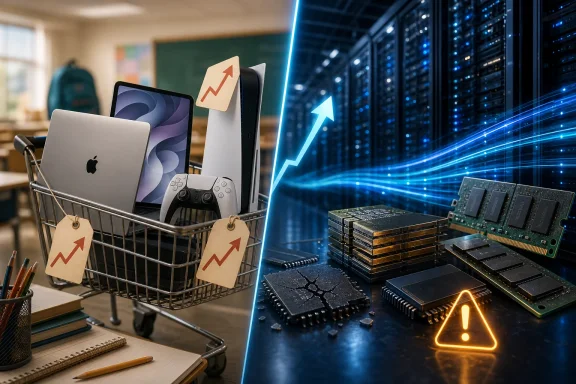 The AI Boom Has Escaped the Data Center
For years, consumer electronics pricing followed a familiar rhythm. New models launched at a premium, older models dropped, and storage or memory upgrades carried margins so fat they became a punchline. Buyers could wait out the first wave, shop refurbished, or count on holiday discounts to soften the blow.That cycle is breaking because the scarce component is not a niche part in one product category. DRAM, NAND flash, HBM, and related memory supply sit underneath almost everything that computes: laptops, tablets, consoles, phones, GPUs, servers, cars, routers, and medical equipment. When AI data centers start drinking from that same well with industrial-scale thirst, the market does not politely isolate the pain inside hyperscaler budgets.
WIRED frames the current moment as another round of consumer electronics price increases, but the more important point is that this round looks less like a temporary tariff shock and more like a structural repricing. Shawn DuBravac, chief economist at the Global Electronics Association, told the magazine that waiting out “little blips” may no longer work. That is the line every buyer should linger over.
The component shortage is not just about more people wanting laptops. It is about a higher-paying customer class arriving with urgent orders, long contracts, and strategic importance. AI server buildouts need vast quantities of high-performance memory, and the semiconductor supply chain cannot instantly switch on new capacity without years of planning, capital spending, equipment constraints, and yield risk.
The result is a market in which consumer gadgets are competing with AI clusters. The laptop on a student’s desk and the accelerator rack in a cloud region are not the same product, but they increasingly depend on the same upstream capacity. The cloud won’t feel expensive only when you subscribe to an AI service. It will feel expensive when the base iPad costs more.
Apple’s Price Hikes Made the Invisible Shortage Visible
Apple’s late-June price increases matter because Apple is usually the company that turns supply-chain stress into controlled choreography. It has the purchasing scale, supplier leverage, margin structure, and inventory discipline to absorb shocks longer than most rivals. When Apple finally moves prices across Macs, iPads, and other devices, it is not merely a retail adjustment. It is a signal.MacRumors reported that Apple raised prices on 14 products, including Macs, iPads, Apple TV, HomePod models, and Vision Pro. TechRepublic and other outlets reported that Apple attributed the move to the rapid expansion of AI data centers and an extraordinary surge in demand for memory and storage. The company’s reported language was unusually blunt for Apple: it had shielded customers so far, but component increases had become too large and too fast to keep eating.
That framing should be read carefully. Apple is not saying it suddenly discovered inflation. It is saying a core input cost moved so violently that even Apple’s supply-chain machine had to pass it through.
For WindowsForum readers, Apple’s move is important even if you do not own a Mac. Apple often sits at the premium end of the consumer market, but it also has enough buying power to stabilize its own lane. If Apple cannot fully insulate its customers, smaller PC makers, motherboard vendors, handheld manufacturers, storage brands, and peripheral companies have even less room to maneuver.
This is also why the “just don’t buy Apple” reaction misses the broader story. A MacBook price increase may be the headline, but the pressure is not confined to Cupertino. Windows laptops with 16 GB or 32 GB of RAM, gaming handhelds with fast LPDDR memory, SSD-heavy workstations, NAS upgrades, and graphics cards with large VRAM pools all live under the same weather system.
The practical lesson is that Apple did not create the shortage. It merely made it legible to the mainstream buyer.
Xbox Is the Console Market’s Warning Siren
Microsoft’s Xbox price increase lands differently because consoles are supposed to get cheaper over time. That has been part of the implicit bargain for decades: early adopters pay more, manufacturing improves, bundles get better, and the late-cycle buyer gets value. A console rising in price deep into its life is a sign that the old economics are under stress.GameSpot reported that Microsoft will increase Xbox console prices worldwide starting August 1, after previous increases in 2025. Gematsu and Game Informer similarly reported that Microsoft tied the new move to console storage and memory costs, with the company saying those costs had risen more than 2.5 times and could rise again by fall 2027. That is not the language of a short bump in freight rates. It is the language of a vendor trying to reset expectations.
Consoles are especially exposed because their hardware configurations are fixed and storage-heavy. A laptop maker can nudge configurations, change suppliers, push customers toward lower-memory SKUs, or quietly alter promotion timing. A console platform has far less room to hide. If the bill of materials goes up, the platform owner can absorb the hit, raise prices, reduce bundles, or shift the economics somewhere else.
Microsoft has already pushed hard into Game Pass, cloud gaming, PC releases, and a less console-centric Xbox identity. In that context, a hardware price increase is not only about component costs. It reinforces the direction Microsoft has been traveling for years: Xbox is less a box than an ecosystem, and the box itself is becoming a more expensive entry point.
That creates an awkward moment for consumers. The traditional console pitch was simplicity and price certainty. Buy the box, keep it for years, and trust that the platform holder subsidized the hardware because it would make money on games and services. If consoles become more expensive late in the cycle, the bargain starts to look more like PC gaming without the upgrade flexibility.
For Microsoft, the optics are even trickier because Windows PCs and Xbox consoles now share more strategic overlap. Handheld gaming PCs, living-room PCs, cloud streaming clients, and next-generation Xbox rumors all sit in the same conversation. If memory prices keep rising, every version of “affordable gaming hardware” becomes harder to defend.
The Memory Shortage Is Not a Normal Consumer-Tech Squeeze
The tempting move is to file this under inflation and move on. That is too easy. General inflation raises the cost of many things at once; this shortage is a targeted reshaping of the technology stack’s most fundamental inputs.Memory is both commodity-like and deeply specialized. Buyers talk about gigabytes as if every gigabyte were interchangeable, but modern electronics depend on a layered market of DRAM, NAND, LPDDR, GDDR, HBM, and controller ecosystems. AI has made the top end of that market dramatically more valuable, especially high-bandwidth memory used with accelerators. Capacity and investment follow the money.
When suppliers see hyperscalers, AI labs, and server OEMs willing to pay for guaranteed volume, consumer electronics lose some of their historical priority. That does not mean memory makers stop serving laptops and consoles. It means the marginal wafer, the next allocation decision, and the next capacity expansion are increasingly judged against data-center demand.
The downstream effects are messy. A phone maker may delay a storage bump. A PC OEM may make 8 GB configurations linger longer than they should. A console maker may raise prices. A retailer may reduce discounts. A refurbisher may see used-device values climb because new-device prices make secondhand hardware look rational.
That last point is central to WIRED’s reporting. The magazine spoke with recommerce executives who said refurbished and used-device markets are strengthening as consumers look for relief. Sean Cleland of B-Stock told WIRED that used smartphones are selling for 10 to 20 percent more than they were in December 2025, a reversal of the usual depreciation pattern. In other words, the shortage is not only raising new prices. It is changing the slope of used prices too.
This is what makes the current squeeze different from a normal product-cycle annoyance. The market is repricing time. Waiting no longer automatically gives you a better deal, because the replacement cost of new hardware is rising and dragging used hardware along behind it.
Refurbished Gear Is No Longer Just the Frugal Option
The refurbished market used to occupy a slightly apologetic corner of consumer tech. It was where budget buyers, repair advocates, and sustainability-minded shoppers went after deciding that the latest model was unnecessary. Now it is becoming a mainstream hedge against hardware inflation.That shift is good in several ways. Refurbished devices extend product lifecycles, reduce e-waste, and reward manufacturers that provide long software support. A three-year-old business laptop with a replaceable SSD and a supported Windows release can be a far better buy than a new low-end machine starved for RAM. A previous-generation phone with a healthy battery and security updates can beat a new budget phone built to hit a price point.
But the refurbished boom is not a magic escape hatch. If demand rises sharply and supply is finite, secondhand prices climb. WIRED’s reporting makes clear that recommerce firms are already seeing that effect. The more buyers flee new-device inflation, the less “cheap” refurbished gear remains.
This creates a sorting problem. The best refurbished buys will increasingly be devices with durable specifications: enough RAM, enough storage, good battery replacement options, and a long runway of OS and security updates. The worst buys will be old hardware that looks inexpensive only because it is close to aging out of support.
Windows users should be especially careful here. Windows 11’s hardware requirements already turned support status into a buying criterion, and the coming years will only intensify that. A cheap refurbished laptop is not cheap if it is stuck on an unsupported OS, limited to soldered 8 GB RAM, or saddled with a worn battery that costs half the device price to replace.
The resale boom also changes the trade-in calculation. If used phones, tablets, and laptops are holding value better than expected, old hardware sitting in a drawer is not just clutter. It is a small hedge against the next purchase. The rational move may be to sell or trade in sooner rather than wait for depreciation to resume.
Back-to-School Buyers Are About to Meet Enterprise Procurement Logic
The timing is brutal. The price increases are arriving just ahead of back-to-school shopping and the long runway into the holiday cycle. Families looking for tablets, laptops, and consoles are encountering a market that behaves less like seasonal retail and more like enterprise procurement.That means lead times, configuration discipline, and total cost of ownership matter more than usual. The old consumer habit of buying the cheapest available model and replacing it later becomes riskier when replacement prices are rising. Spending a bit more for sufficient RAM and storage may be painful now, but underbuying could be more expensive if upgrades are impossible and future models cost more.
This is particularly true for Windows laptops. The industry has spent years normalizing soldered memory, sealed designs, and configuration ladders that push buyers toward higher-margin models. In a memory shortage, those choices become more consequential. A laptop with 8 GB of non-upgradable RAM may be a false economy if Windows, browsers, Teams, security software, and AI-assisted apps continue to expand their appetite.
IT departments know this logic already. Sysadmins buy standard configurations not because they enjoy bureaucracy, but because support costs explode when fleets are fragmented, underpowered, or prematurely obsolete. The consumer market is now being forced to learn a smaller version of that lesson.
The same applies to storage. SSD prices can move quickly, and cloud storage does not eliminate local needs. Game installs, media libraries, development environments, virtual machines, offline files, and Windows feature updates all have a way of consuming the space buyers thought they could live without. In a rising-price market, “I’ll add storage later” only works if the device actually allows it.
The most rational advice is not panic-buying. It is specification honesty. Buy what you need for the life you expect the device to have, not the minimum configuration that gets you through checkout.
Tariffs, Oil, and Shipping Still Matter — But AI Is the Multiplier
WIRED notes that the current price wave follows last year’s tariff pressure and sits alongside higher oil prices that affect shipping. Those factors matter. Electronics are global products, and the final retail price reflects a chain of currencies, duties, logistics, inventory costs, retail margins, and political risk.But tariffs and freight costs do not fully explain why memory-heavy products are under such visible pressure. They are accelerants. The memory shortage is the multiplier.
That distinction matters because it changes what consumers and businesses should expect. A tariff can be revised, paused, absorbed, or routed around over time. Shipping costs can fall if energy markets cool or capacity improves. A memory capacity imbalance driven by AI infrastructure demand is harder to unwind because it reflects strategic investment by the largest companies in technology.
The AI buildout is not a single product launch. It is a multi-year arms race among cloud providers, model developers, chip designers, governments, and enterprises. Even if some AI startups fail and some speculative projects collapse, the underlying demand for compute is unlikely to vanish overnight. The bubble can deflate and still leave behind a much larger data-center footprint than existed before.
That is why the “AI bubble” phrase can mislead consumers. A financial bubble bursting would not automatically restore 2024 component pricing. Memory fabs, server contracts, hyperscaler road maps, and enterprise AI commitments all operate on long horizons. Once the supply chain has repriced around those expectations, retail hardware may not snap back.
In plain English: some of this may be cyclical, but not all of it is temporary.
PC Makers Will Try to Hide the Pain in Configurations
Apple and Microsoft made explicit price moves, which are easy to cover and easy to resent. PC makers have subtler tools. They can keep headline prices stable while changing what the headline buys.That could mean fewer discounts, less RAM at the entry level, smaller SSDs, weaker bundles, shorter promotional windows, or bigger jumps between configurations. A laptop that remains “from $699” may quietly become less attractive if the model worth owning is now $999. The shelf tag stays familiar while the practical price rises.
Windows enthusiasts have seen this movie before. The base SKU exists to advertise a number; the sane SKU is the one with enough RAM, storage, screen quality, and ports to survive real use. In a memory-constrained market, the gap between those two SKUs may widen.
This will be especially important as local AI features become more common. Microsoft’s Copilot+ PC push has already tied certain Windows experiences to NPUs and minimum memory expectations. Whether or not every user cares about those features today, OEMs will use AI readiness as a segmentation tool. Higher-memory machines may be marketed not merely as faster, but as future-proof.
That marketing should be treated with skepticism. Some AI PCs will be useful. Some will be ordinary laptops with a new sticker and a higher price. The buyer’s job is to separate durable hardware value from trend packaging.
The irony is that the same AI wave driving memory shortages will also be used to sell more expensive PCs. Consumers may pay more because AI servers consumed the memory supply, then pay more again because their next device is branded as AI-capable. That is not conspiracy; it is how platform transitions monetize both cause and cure.
Enterprise IT Faces a Budget Shock With a Security Tail
For businesses, the memory shortage is not just a purchasing inconvenience. It collides with refresh cycles, Windows migration planning, endpoint security, and compliance deadlines.Many organizations are still cleaning up aging fleets, standardizing on Windows 11, and preparing for the next round of hardware requirements. If device prices rise while budgets remain fixed, the temptation will be to extend hardware lifecycles again. That can be sensible when machines are capable and supported. It can be dangerous when it leaves users on slow, unsupported, or unreliable endpoints.
Security teams will recognize the pattern. Hardware deferrals often become software risk. Old devices miss firmware updates, lack modern security features, or cannot run current endpoint protection comfortably. Underpowered machines also create user resistance, which leads to workarounds, shadow IT, and productivity losses that never show up in the procurement spreadsheet.
The memory shortage also complicates standardization. If preferred laptop configurations become constrained or expensive, IT may be pushed toward alternate models. That creates more driver variation, more imaging complexity, more spare-part fragmentation, and more support edge cases.
Larger buyers can negotiate, forecast, and lock supply. Smaller businesses and schools cannot always do that. They buy closer to need, often through retail or channel partners, and are more exposed to sudden price moves. A district planning a cart of student laptops or a small firm replacing a dozen aging machines may find that last year’s budget math no longer works.
The lesson for IT pros is not to overbuy blindly. It is to move hardware planning higher on the risk register. Memory and storage assumptions now belong in budget conversations, not just spec sheets.
The Upgrade Culture Is Being Forced to Grow Up
Consumer tech spent a decade teaching people to replace rather than maintain. Phones became sealed slabs, laptops became thinner and less repairable, consoles became storage-hungry appliances, and subscriptions softened the sense of ownership. Cheap components helped mask the waste.Rising memory prices challenge that culture. If new devices cost more and used devices hold value longer, maintenance becomes economically rational again. Battery replacements, SSD upgrades, RAM upgrades where possible, thermal cleaning, and OS tune-ups all become part of a more serious ownership model.
This is good news for repair advocates, but it comes with a caveat. The industry’s design choices limit how much users can benefit. Soldered RAM, paired components, serialized repairs, glued batteries, and firmware locks all reduce the ability to ride out a price spike. A device that cannot be upgraded becomes a hostage to its original configuration.
That should influence buying decisions now. A slightly thicker laptop with accessible storage may be more valuable than a sleeker model that traps the buyer in today’s SSD price. A desktop PC with standard DIMM slots and M.2 bays may age more gracefully than an all-in-one designed like an appliance. A handheld gaming PC with replaceable storage may be easier to justify than one that treats capacity as destiny.
The industry will not reverse years of integration overnight. But buyers can reward designs that preserve options. In a volatile component market, upgradeability is not nostalgia. It is insurance.
For WindowsForum’s audience, this is familiar terrain. Enthusiasts have always known that a system’s useful life depends less on the CPU alone than on memory, storage, thermals, drivers, and firmware support. The mainstream market is now being forced to learn that the hard way.
The New Rule Is to Buy Deliberately, Not Late
There is a fine line between useful urgency and retailer-friendly fear. “Buy now before prices rise” is one of the oldest sales tactics in the business, and it deserves suspicion. But suspicion should not become denial.The evidence points to a real constraint. Apple’s public pricing moves, Microsoft’s Xbox announcement, WIRED’s reporting on recommerce pricing, and broader industry discussion around AI data-center demand all tell the same story: memory is expensive, allocation is tight, and consumer devices are no longer first in line.
That does not mean every gadget should be bought immediately. It means the old default assumption — waiting always helps — is weaker than it used to be. If a product category has not yet seen a price increase, it may still be exposed. If it already has, the new price may become the floor for a while rather than a temporary ceiling.
The smartest buyers will separate wants from needs. A working phone with software support does not need to be replaced because headlines are scary. A dying laptop needed for school or work should not be postponed indefinitely in the hope of a discount that may never arrive. A console purchase can wait if the game library is not urgent, but the August 1 Xbox date gives buyers a concrete deadline to evaluate.
This is the kind of market where planning beats panic. Know the specs you need, track prices from reputable sellers, consider refurbished options carefully, and avoid low-memory configurations that will age badly. The worst outcome is not paying more. It is paying more for a device that was already underconfigured on day one.
The Checkout Cart Is Now Part of the AI Supply Chain
The useful lesson from this price wave is narrower than “everything is expensive” and broader than “Apple raised prices.” Consumers and IT buyers are being pulled into the economics of AI infrastructure whether they use AI tools or not.- Apple’s June 2026 price increases turned the memory shortage into a mainstream consumer issue, not just a semiconductor-industry concern.
- Microsoft’s August 1 Xbox price increase shows that even late-cycle console hardware is no longer protected from rising memory and storage costs.
- Refurbished and used devices may remain attractive, but stronger demand is already pushing secondhand prices higher in some categories.
- Windows PC buyers should be wary of cheap configurations with soldered 8 GB RAM or cramped SSDs, because underbuying now may force a more expensive replacement later.
- IT departments should treat memory and storage volatility as a procurement risk that affects refresh cycles, security posture, and support complexity.
- Upgradeability, repairability, and long software support are becoming financial features, not just enthusiast preferences.
References
- Primary source: WIRED
Published: Fri, 03 Jul 2026 11:00:00 GMT
All Your Favorite Gadgets Are Getting Way More Expensive … Again | WIRED
Thanks to the AI-driven chip shortage, prices for phones, computers, and consoles are sky-high—and still climbing.www.wired.com - Related coverage: techradar.com
Apple may have a plan to 'ease frustration over price hikes and longer delivery times' with its Macs — but I wouldn't count on it working | TechRadar
Data centers to eat more of your RAM dinnerswww.techradar.com - Related coverage: tomsguide.com
'I am thinking about bailing on Apple' — customers react to Apple's painful price hikes | Tom's Guide
With some Apple devices becoming $1,300 more expensive overnight, Tom's Guide readers weren't shy in expressing their feelings.www.tomsguide.com - Related coverage: kiplinger.com
Artificial Intelligence is Raising Cyber Threats | Kiplinger
AI-enabled attacks are coming faster and more often. Here’s a security update and some advice on how to be prepared.www.kiplinger.com - Related coverage: techrepublic.com
Apple Raises Prices on Macs, iPads as Data Centers Drive Memory Shortage
Apple raised prices on Macs, iPads, and other devices as AI data center demand drives up memory chip costs across consumer electronics.www.techrepublic.com
- Related coverage: gematsu.com
Xbox Series global price increase announced - Gematsu
Microsoft will increase the price of Xbox Series consoles worldwide for a third time starting August 1, following a global price increase back in May 2025 and a…www.gematsu.com
- Related coverage: gameinformer.com
Xbox Consoles Are Getting Another Price Increase In August
The ongoing component crisis has prompted Microsoft to raise the prices of Xbox hardware yet again.gameinformer.com - Related coverage: gamermarkt.com
Xbox Price Hike August 2026: New Console Prices Revealed
Microsoft is raising Xbox Series S and X prices by up to $150 on August 1, 2026. Here are the new prices, the reason behind the hike, and what it means for gamers.www.gamermarkt.com - Related coverage: techcrunch.com
Xbox follows Apple with price increases | TechCrunch
The company says the increases are being driven by rising memory and console storage prices, with costs more than 2.5x higher than previous levels.techcrunch.com - Related coverage: washingtonpost.com
- Related coverage: dotesports.com
Xbox raises prices by up to $150 amid memory cost crisis
Xbox console prices are increasing by up to $150 from August 1, 2026, as memory costs soar. The 2TB model is also being discontinued.dotesports.com - Related coverage: kvia.com
Apple is hiking the prices of MacBooks and iPads due to the memory chip shortage - KVIA
By Jordan Valinsky, CNN New York (CNN) — Apple has hiked prices on some of its most popular products, including the MacBook and iPad, because of the rising costs of memory and storage chips sparked by the AI boom. Beginning immediately, the price increases affect the Neo, its entry level...kvia.com