

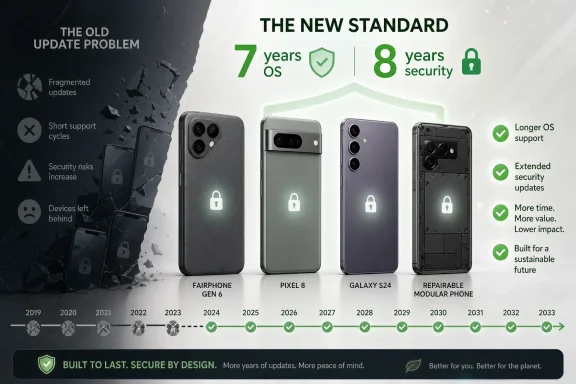
Android’s longest software-support promises now stretch to eight years of total security coverage on Fairphone’s Gen. 6, while Google, Samsung, Honor, and Motorola have pushed several recent flagships to seven years of Android and security updates. That is the plain answer behind BGR’s latest roundup, but the more interesting story is not a leaderboard. It is that Android’s historic weakness has become a purchasing argument, a regulatory pressure valve, and a quiet admission that phones are no longer disposable two-year gadgets.
For more than a decade, the iPhone enjoyed the simple reputational advantage: buy Apple, get updates for years; buy Android, hope your carrier, chip vendor, and handset maker all remain interested. That reputation was not invented by Cupertino marketing. It reflected a fragmented Android supply chain in which even premium phones could age out of major platform updates while their batteries, cameras, and displays were still perfectly usable.
That world has not disappeared, especially at the cheaper end of the Android market. But as BGR notes in its survey of long-supported Android phones, the ceiling has moved dramatically. Google’s Pixel 8-era seven-year promise forced the issue, Samsung matched it at scale, Honor adopted it for parts of its flagship Magic line in Europe, Motorola has reportedly used the Motorola Signature to reset expectations for its own premium tier, and Fairphone has gone one year further on security support.
The Android update story used to be a defensive conversation. Reviewers would praise the hardware, then add the familiar caveat: maybe you will get two major releases, maybe three, and maybe the security patches will thin out once the next model ships. That mattered less when phones were cheaper, mobile threats felt abstract to mainstream buyers, and annual hardware leaps were obvious.
The economics have changed. A flagship phone now costs laptop money, carriers stretch financing plans over three years, and even midrange devices are good enough for ordinary users to keep well past the old upgrade cycle. A handset that loses security updates after three years is no longer merely “old”; it is artificially retired while the hardware may still be viable.
Google’s seven-year pledge for Pixel 8 and later phones marked the psychological break. The company’s own support documentation says Pixel 8 and later models receive seven years of OS and security updates from their first availability on the Google Store in the United States, with Pixel Drops potentially adding features along the way. That gave Android, for the first time, a simple answer to the iPhone comparison: we can promise it in writing.
Samsung’s response made the promise mainstream. Beginning with the Galaxy S24 family, Samsung moved its flagship support window to seven generations of OS upgrades and seven years of security updates, a commitment it has carried through later premium Galaxy lines. Because Samsung sells Android phones in far greater volume than Google, its move turned a Pixel differentiator into a market expectation.
Fairphone says the Gen. 6 is supported until 2033, with at least seven Android upgrades and an additional year of security updates. Its own support pages describe Android 15 as the launch version, Android 16 as already rolling out in 2026, and security updates continuing for at least eight years. In a market trained to treat software support as a cost center, Fairphone is treating it as the product.
That distinction matters. A seven-year Android promise on a sealed-glass flagship is useful, but it can be undermined by a battery that becomes impractical or expensive to replace in year five. Fairphone’s modular design and spare-parts model make the software promise more credible because the company is also addressing the physical failure points that usually push people toward replacement.
There is a catch, and it is the kind that spec-sheet buyers should not ignore. Long support does not turn a midrange chip into a 2033 flagship. The more honest version of Fairphone’s pitch is not “buy this and it will feel new forever,” but “buy this and you will not be forced off supported software while the device is still serviceable.” That is a different bargain, but for the right buyer it may be the more mature one.
The move was partly about trust. Google has killed enough products, reworked enough messaging apps, and shifted enough hardware strategies that a long written commitment carries more weight than another launch-stage promise about AI or camera magic. For Pixel buyers, the seven-year window says the phone is not just a yearly showcase for Android; it is supposed to be a long-lived computing device.
It was also a platform signal to other manufacturers. If Google can support its own Android phones for seven years, rival vendors have less room to argue that long support is technically unreasonable. Samsung, Honor, and others still have different hardware stacks, update skins, markets, and carrier relationships, but the benchmark moved in public.
The Pixel advantage remains clearest for users who want updates early and cleanly. Google controls Android, ships Pixels as reference-like devices, and uses Pixel Drops to deliver features outside the annual OS cycle. In practice, that means the Pixel promise is not just about the final year of support; it is about the quality and timing of support throughout the phone’s life.
Samsung’s seven-year pledge also lands differently because Galaxy phones are deeply customized. One UI is not a thin coat of paint over Android; it is an ecosystem of Samsung apps, device settings, multitasking features, security tools, and AI-branded services. Supporting seven generations of OS upgrades therefore means maintaining a large software surface for a long time.
For enterprise and education buyers, that matters more than the marketing copy suggests. A longer support runway makes device fleets easier to amortize, reduces forced refresh pressure, and gives IT departments more flexibility when budgets tighten. It also makes Android more credible in environments where iPhone longevity has historically simplified procurement conversations.
Still, Samsung’s promise should not be confused with a guarantee that every feature will arrive on every supported phone. The industry has already normalized the idea that some AI functions, camera features, or performance-sensitive tools require newer hardware. Seven years of updates keeps a device secure and current; it does not repeal the silicon hierarchy.
But regional language matters. Honor’s own announcement tied the policy to EU markets, and buyers outside those markets should read the local support terms rather than assuming a global blanket promise. Android’s update problem has always been partly geographic: the same brand can behave differently across Europe, Asia, the Middle East, and North America.
Motorola is the more dramatic case because its update reputation has lagged its hardware appeal. According to Android Central’s reporting around CES 2026, the Motorola Signature was announced with seven years of OS and security updates, putting at least one Motorola premium phone on par with Pixel and Galaxy flagships. That is a striking move from a company often criticized for thinner support on otherwise attractive devices.
The question is whether Motorola turns that into a policy or leaves it as a halo feature. A single premium model with seven years of support is good news for that model’s buyers, but it does not transform the Moto G shelf at a big-box store. Android’s real progress will be measured by how far these guarantees travel down the product stack, not just by how high the flagship numbers climb.
That history is why the Android shift matters. For years, Apple did not need a written seven-year promise because its track record did the talking. Android vendors, by contrast, needed explicit guarantees to overcome consumer skepticism and to compensate for a more fragmented ecosystem.
Now the comparison has inverted in one narrow but important respect. Google, Samsung, Fairphone, Honor, and some others can point to public support windows that are as long as, or longer than, what Apple typically states upfront. That does not automatically make Android better supported in practice, but it removes one of the iPhone’s cleanest talking points.
The difference is cultural as much as technical. Apple sells continuity as part of the iPhone identity; Android vendors are now selling longevity as a feature they can quantify. One is trust through habit, the other is trust through contract. Buyers should value both, but they should not confuse either with immortality.
That is why Fairphone’s extra year matters even if it sounds modest. Seven years of Android upgrades and eight years of security coverage means the final stretch of ownership is not treated as an afterthought. For users who keep phones until they break, or who pass old devices to family members, that last year can be the difference between a responsibly reused device and an unsupported liability.
For sysadmins, the distinction is even sharper. An unsupported phone is not just a personal risk; it can become an endpoint problem. Mobile device management policies, conditional access rules, and compliance requirements often depend on current patch levels, not sentimental attachment to working hardware.
The consumer market still talks too loosely about “updates” as if all updates are equal. They are not. A phone can miss a flashy feature and remain perfectly safe; a phone missing security patches has crossed a more serious line. The best support policies are the ones that are clear about both OS upgrades and security maintenance.
This is where Fairphone’s argument is strongest and where the largest vendors still have work to do. Samsung and Google have improved repair options over the years, and right-to-repair pressure has forced the industry to become less hostile to parts and manuals. But most mainstream phones are still designed first for thinness, water resistance, and manufacturing efficiency, not year-seven maintenance.
A seven-year support promise therefore shifts responsibility onto the entire ownership ecosystem. If replacement batteries are expensive, scarce, or difficult to install, the software pledge becomes less useful. If trade-in programs remain the default path, long support risks becoming a marketing claim rather than a sustainability achievement.
The next honest phone comparison should include not just camera samples and benchmark charts, but battery replacement cost, parts availability, bootloader policy, repair documentation, and update frequency. Longevity is not one number. It is a system.
BGR’s roundup points out that vendors are expanding stronger support beyond the most expensive models, with some midrange and entry-level devices reaching up to six years of support. That is arguably more important than whether a $1,300 flagship gets one additional OS version. A cheap phone with a short patch window can become obsolete faster than its owner’s budget can absorb.
Samsung has been especially important here because it sells across nearly every price tier. When longer update windows reach Galaxy A-series devices and rugged enterprise models, the effect is broader than a niche premium announcement. Google’s A-series Pixels have also helped normalize the idea that a less expensive Android phone should not be disposable.
The risk is that support becomes another confusing upsell. Consumers may see “seven years” in one ad, “six years” in another, and “three OS upgrades” buried in fine print elsewhere. Android vendors should publish support policies in plain language on every product page, with the launch OS, final guaranteed OS version, and security end date stated clearly.
Update speed matters. Monthly patches that arrive two months late are not the same as monthly patches that arrive on time. Major OS upgrades that show up quickly in year one but crawl in year four will reveal how seriously a vendor treats the back half of its commitment.
Feature parity will become another battleground. Vendors will be tempted to preserve the formal update count while reserving marquee features for newer hardware. Some of that will be technically justified, especially for AI workloads and camera processing; some of it will be segmentation dressed up as engineering.
The burden should be on manufacturers to explain the difference. If a feature requires newer silicon, say so. If it is being withheld for product-positioning reasons, users will notice. Long support raises expectations, and vague excuses will age badly.
Buyers comparing long-supported Android phones should treat the headline year count as the start of the conversation, not the end.
For more than a decade, the iPhone enjoyed the simple reputational advantage: buy Apple, get updates for years; buy Android, hope your carrier, chip vendor, and handset maker all remain interested. That reputation was not invented by Cupertino marketing. It reflected a fragmented Android supply chain in which even premium phones could age out of major platform updates while their batteries, cameras, and displays were still perfectly usable.
That world has not disappeared, especially at the cheaper end of the Android market. But as BGR notes in its survey of long-supported Android phones, the ceiling has moved dramatically. Google’s Pixel 8-era seven-year promise forced the issue, Samsung matched it at scale, Honor adopted it for parts of its flagship Magic line in Europe, Motorola has reportedly used the Motorola Signature to reset expectations for its own premium tier, and Fairphone has gone one year further on security support.
 Android’s Old Update Problem Has Become a Competitive Weapon
The Android update story used to be a defensive conversation. Reviewers would praise the hardware, then add the familiar caveat: maybe you will get two major releases, maybe three, and maybe the security patches will thin out once the next model ships. That mattered less when phones were cheaper, mobile threats felt abstract to mainstream buyers, and annual hardware leaps were obvious.The economics have changed. A flagship phone now costs laptop money, carriers stretch financing plans over three years, and even midrange devices are good enough for ordinary users to keep well past the old upgrade cycle. A handset that loses security updates after three years is no longer merely “old”; it is artificially retired while the hardware may still be viable.
Google’s seven-year pledge for Pixel 8 and later phones marked the psychological break. The company’s own support documentation says Pixel 8 and later models receive seven years of OS and security updates from their first availability on the Google Store in the United States, with Pixel Drops potentially adding features along the way. That gave Android, for the first time, a simple answer to the iPhone comparison: we can promise it in writing.
Samsung’s response made the promise mainstream. Beginning with the Galaxy S24 family, Samsung moved its flagship support window to seven generations of OS upgrades and seven years of security updates, a commitment it has carried through later premium Galaxy lines. Because Samsung sells Android phones in far greater volume than Google, its move turned a Pixel differentiator into a market expectation.
Fairphone Wins the Numbers Game by Refusing the Usual Phone Business
Fairphone’s Gen. 6 is the oddball in BGR’s list because it does not win by brute force. It is not the fastest Android phone, not the most camera-obsessed, and not the default carrier-store recommendation in the United States. Its pitch is more subversive: the phone should be repairable, the parts should be replaceable, and the software should not become the reason you throw away otherwise working hardware.Fairphone says the Gen. 6 is supported until 2033, with at least seven Android upgrades and an additional year of security updates. Its own support pages describe Android 15 as the launch version, Android 16 as already rolling out in 2026, and security updates continuing for at least eight years. In a market trained to treat software support as a cost center, Fairphone is treating it as the product.
That distinction matters. A seven-year Android promise on a sealed-glass flagship is useful, but it can be undermined by a battery that becomes impractical or expensive to replace in year five. Fairphone’s modular design and spare-parts model make the software promise more credible because the company is also addressing the physical failure points that usually push people toward replacement.
There is a catch, and it is the kind that spec-sheet buyers should not ignore. Long support does not turn a midrange chip into a 2033 flagship. The more honest version of Fairphone’s pitch is not “buy this and it will feel new forever,” but “buy this and you will not be forced off supported software while the device is still serviceable.” That is a different bargain, but for the right buyer it may be the more mature one.
Google Turned Android Longevity Into a Platform Promise
Google’s role in this shift is both obvious and overdue. Android could never fully escape its update reputation while the company making Android offered shorter guarantees than Apple routinely delivered without a formal pledge. The Pixel 8 changed that by tying seven years of updates to Google’s own phone hardware, Tensor silicon strategy, and feature-drop cadence.The move was partly about trust. Google has killed enough products, reworked enough messaging apps, and shifted enough hardware strategies that a long written commitment carries more weight than another launch-stage promise about AI or camera magic. For Pixel buyers, the seven-year window says the phone is not just a yearly showcase for Android; it is supposed to be a long-lived computing device.
It was also a platform signal to other manufacturers. If Google can support its own Android phones for seven years, rival vendors have less room to argue that long support is technically unreasonable. Samsung, Honor, and others still have different hardware stacks, update skins, markets, and carrier relationships, but the benchmark moved in public.
The Pixel advantage remains clearest for users who want updates early and cleanly. Google controls Android, ships Pixels as reference-like devices, and uses Pixel Drops to deliver features outside the annual OS cycle. In practice, that means the Pixel promise is not just about the final year of support; it is about the quality and timing of support throughout the phone’s life.
Samsung Made Seven Years Matter Because Samsung Sells the Phones
If Google created the modern Android update benchmark, Samsung made it commercially unavoidable. A Pixel promise can be dismissed as an enthusiast-friendly policy from the platform owner. A Galaxy S promise applies to the phones many people actually buy, finance, deploy, manage, and hand down.Samsung’s seven-year pledge also lands differently because Galaxy phones are deeply customized. One UI is not a thin coat of paint over Android; it is an ecosystem of Samsung apps, device settings, multitasking features, security tools, and AI-branded services. Supporting seven generations of OS upgrades therefore means maintaining a large software surface for a long time.
For enterprise and education buyers, that matters more than the marketing copy suggests. A longer support runway makes device fleets easier to amortize, reduces forced refresh pressure, and gives IT departments more flexibility when budgets tighten. It also makes Android more credible in environments where iPhone longevity has historically simplified procurement conversations.
Still, Samsung’s promise should not be confused with a guarantee that every feature will arrive on every supported phone. The industry has already normalized the idea that some AI functions, camera features, or performance-sensitive tools require newer hardware. Seven years of updates keeps a device secure and current; it does not repeal the silicon hierarchy.
Honor and Motorola Show the Promise Is Spreading Unevenly
The next phase is messier. Honor announced in 2025 that it would offer seven years of Android OS and security updates for its flagship Magic series starting in European Union markets. BGR points to the Honor Magic V6 as part of this new class of long-supported Android hardware, and that is a meaningful shift for a brand competing in premium foldables and high-end slab phones.But regional language matters. Honor’s own announcement tied the policy to EU markets, and buyers outside those markets should read the local support terms rather than assuming a global blanket promise. Android’s update problem has always been partly geographic: the same brand can behave differently across Europe, Asia, the Middle East, and North America.
Motorola is the more dramatic case because its update reputation has lagged its hardware appeal. According to Android Central’s reporting around CES 2026, the Motorola Signature was announced with seven years of OS and security updates, putting at least one Motorola premium phone on par with Pixel and Galaxy flagships. That is a striking move from a company often criticized for thinner support on otherwise attractive devices.
The question is whether Motorola turns that into a policy or leaves it as a halo feature. A single premium model with seven years of support is good news for that model’s buyers, but it does not transform the Moto G shelf at a big-box store. Android’s real progress will be measured by how far these guarantees travel down the product stack, not just by how high the flagship numbers climb.
The iPhone Comparison Is Finally More Complicated Than Apple Wins
Apple still deserves credit for making long phone support feel normal. The company rarely frames iPhone updates as a year-count guarantee, but iPhones have routinely received major iOS releases for five or six years, and sometimes longer. BGR notes that the 2019 iPhone 11 series is set to run iOS 27 in 2026, bringing it close to seven years of major platform support.That history is why the Android shift matters. For years, Apple did not need a written seven-year promise because its track record did the talking. Android vendors, by contrast, needed explicit guarantees to overcome consumer skepticism and to compensate for a more fragmented ecosystem.
Now the comparison has inverted in one narrow but important respect. Google, Samsung, Fairphone, Honor, and some others can point to public support windows that are as long as, or longer than, what Apple typically states upfront. That does not automatically make Android better supported in practice, but it removes one of the iPhone’s cleanest talking points.
The difference is cultural as much as technical. Apple sells continuity as part of the iPhone identity; Android vendors are now selling longevity as a feature they can quantify. One is trust through habit, the other is trust through contract. Buyers should value both, but they should not confuse either with immortality.
Security Updates Are the Real Lifespan of a Phone
Major Android versions get the attention because they bring visible changes. Security updates are the real safety line. Once a phone stops receiving them, every month increases the gap between the device in your hand and the vulnerabilities being fixed elsewhere.That is why Fairphone’s extra year matters even if it sounds modest. Seven years of Android upgrades and eight years of security coverage means the final stretch of ownership is not treated as an afterthought. For users who keep phones until they break, or who pass old devices to family members, that last year can be the difference between a responsibly reused device and an unsupported liability.
For sysadmins, the distinction is even sharper. An unsupported phone is not just a personal risk; it can become an endpoint problem. Mobile device management policies, conditional access rules, and compliance requirements often depend on current patch levels, not sentimental attachment to working hardware.
The consumer market still talks too loosely about “updates” as if all updates are equal. They are not. A phone can miss a flashy feature and remain perfectly safe; a phone missing security patches has crossed a more serious line. The best support policies are the ones that are clear about both OS upgrades and security maintenance.
Long Support Exposes the Battery and Repair Bottleneck
The software race also exposes a hardware contradiction. A phone promised updates until 2033 needs a battery strategy for 2030. Lithium-ion cells degrade, USB-C ports wear, displays crack, and camera modules fail regardless of how noble the update policy sounds.This is where Fairphone’s argument is strongest and where the largest vendors still have work to do. Samsung and Google have improved repair options over the years, and right-to-repair pressure has forced the industry to become less hostile to parts and manuals. But most mainstream phones are still designed first for thinness, water resistance, and manufacturing efficiency, not year-seven maintenance.
A seven-year support promise therefore shifts responsibility onto the entire ownership ecosystem. If replacement batteries are expensive, scarce, or difficult to install, the software pledge becomes less useful. If trade-in programs remain the default path, long support risks becoming a marketing claim rather than a sustainability achievement.
The next honest phone comparison should include not just camera samples and benchmark charts, but battery replacement cost, parts availability, bootloader policy, repair documentation, and update frequency. Longevity is not one number. It is a system.
Midrange Phones Are Where the Update War Gets Interesting
Flagship support gets headlines because flagship buyers spend the most. But the bigger social and security impact comes from midrange and entry-level Android phones. Those are the devices most likely to be kept longer, handed down, bought unlocked on sale, or used in cost-sensitive organizations.BGR’s roundup points out that vendors are expanding stronger support beyond the most expensive models, with some midrange and entry-level devices reaching up to six years of support. That is arguably more important than whether a $1,300 flagship gets one additional OS version. A cheap phone with a short patch window can become obsolete faster than its owner’s budget can absorb.
Samsung has been especially important here because it sells across nearly every price tier. When longer update windows reach Galaxy A-series devices and rugged enterprise models, the effect is broader than a niche premium announcement. Google’s A-series Pixels have also helped normalize the idea that a less expensive Android phone should not be disposable.
The risk is that support becomes another confusing upsell. Consumers may see “seven years” in one ad, “six years” in another, and “three OS upgrades” buried in fine print elsewhere. Android vendors should publish support policies in plain language on every product page, with the launch OS, final guaranteed OS version, and security end date stated clearly.
Seven Years Is a Promise, Not a Performance Review
The industry has now made enough long-term commitments that the next phase will be accountability. A seven-year pledge made in 2024, 2025, or 2026 will not be fully judged until the early 2030s. In the meantime, buyers and reviewers should watch the middle years, not just the launch announcement.Update speed matters. Monthly patches that arrive two months late are not the same as monthly patches that arrive on time. Major OS upgrades that show up quickly in year one but crawl in year four will reveal how seriously a vendor treats the back half of its commitment.
Feature parity will become another battleground. Vendors will be tempted to preserve the formal update count while reserving marquee features for newer hardware. Some of that will be technically justified, especially for AI workloads and camera processing; some of it will be segmentation dressed up as engineering.
The burden should be on manufacturers to explain the difference. If a feature requires newer silicon, say so. If it is being withheld for product-positioning reasons, users will notice. Long support raises expectations, and vague excuses will age badly.
The Fine Print Now Belongs on the Spec Sheet
The most concrete lesson from BGR’s list is that update policy has become a core specification. It belongs next to RAM, storage, display brightness, and camera hardware because it determines how long the phone remains a safe, current device.Buyers comparing long-supported Android phones should treat the headline year count as the start of the conversation, not the end.
- Fairphone Gen. 6 currently offers the strongest headline guarantee in this group, with support to 2033, at least seven Android upgrades, and eight years of security coverage.
- Google’s Pixel 8 and later phones offer seven years of OS and security updates, with the added advantage of direct platform-owner control and Pixel feature drops.
- Samsung’s recent Galaxy flagships offer seven generations of OS upgrades and seven years of security updates, making long support available at far larger Android scale.
- Honor’s seven-year Magic-series policy is significant, but buyers should verify regional terms because the company’s announcement began with EU markets.
- Motorola’s seven-year Motorola Signature promise is encouraging, but it will matter more if Motorola extends the policy beyond one premium halo device.
- A long software promise is most valuable when the phone also has realistic battery replacement, repair options, and parts availability.
References
- Primary source: bgr.com
Published: Sat, 04 Jul 2026 10:47:00 GMT
5 Android Phones With The Longest Software Support Guarantees
Seven years of Android updates used to be rare. Now it's becoming common across flagships, foldables, and even budget phones.www.bgr.com - Related coverage: androidcentral.com
Best Google Pixel phones | Android Central
Google makes some of the most exciting phones you can get in the world of Android. Here are some of the best Google Pixel phones you should consider.www.androidcentral.com - Related coverage: support.fairphone.com
Fairphone's Operating System – Support
By default the Fairphone comes with Android OS and a set of preinstalled Google Mobile Apps. You can download additional apps on your...support.fairphone.com - Related coverage: tech.yahoo.com
5 Android Phones With The Longest Software Support Guarantees
Seven years of software updates has become the new baseline for some Android phones, and at least one option actually goes even further than that.tech.yahoo.com - Related coverage: sammobile.com
Samsung Galaxy S26 series software update policy explained - SamMobile
Samsung is continuing its commitment to users and the environment with the Galaxy S26 software update policy. - SamMobilewww.sammobile.com - Related coverage: tomsguide.com
9 phones with the longest software support — Samsung, iPhone, Pixel and more | Tom's Guide
The longer phones are supported with new software, the longer you can keep it. Here are the phones with the longest supportwww.tomsguide.com
- Related coverage: fairphone.com
Software longevity | Fairphone
Software is just as important in keeping our phones working well for the long term.www.fairphone.com - Related coverage: digitalcameraworld.com
Samsung Galaxy S26 Ultra review: a 9/10 phone with an 8/10 camera | Digital Camera World
After six weeks with Samsung's Galaxy S26 Ultra, AirDrop support and the impressive Privacy Display help it stand out despite a mixed camera experiencewww.digitalcameraworld.com - Official source: support.google.com
- Related coverage: samsung.com
Galaxy S24: Processor & OS Updates | Samsung Gulf
FAQ to learn more about S24 series Processors and OS Update.www.samsung.com - Related coverage: honor.com
Honor MagicOS/Magic UI Security Updates | Honor Official Site
Honor will release monthly and quarterly security updates for the following products. Monthly and quarterly security updates include patches for security issues related to the Android operating system, as well as patches released by Honor for security issues specific to its products.www.honor.com - Related coverage: techradar.com
Samsung's One UI 7 update is finally coming to older Galaxy phones in the US | TechRadar
The long wait seems to be coming to an endwww.techradar.com - Related coverage: t3.com
"The start of something new": OnePlus rival's 'Signature' new flagship makes a worthy case | T3
The start of something new for Motorola?www.t3.com - Related coverage: notebookcheck.net
Android 16 arriving on Fairphone 6 with many new features - Notebookcheck News
Although the Fairphone 6 promises eight years of update support, major Android updates don’t arrive very quickly for this mid-range phone with a sustainability focus. With Android 17 just months away from its debut, Android 16 is now almost ready to roll out to the Fairphone 6. www.notebookcheck.net
- Related coverage: androidauthority.com
Fairphone Gen 6 is getting Android 16 this April
Fairphone has confirmed to Android Authority that its Fairphone Gen 6 will get Android 16 starting this spring.www.androidauthority.com - Related coverage: androidheadlines.com
Fairphone 6 Launches With 5-Year Warranty & 8 Years of Updates
Fairphone 6 has launched with a 120Hz display, Snapdragon 7s Gen 3 SoC, dual-rear camera setup, and more, for €599 (∼ $696). www.androidheadlines.com