

Cumbria Constabulary’s Cyber and Digital Crime Unit is offering ransomware-focused advice to schools, businesses, charities, hospitality firms and residents across Cumbria in early July 2026, following a national awareness campaign warning that ransomware remains one of the UK’s most serious cyber threats. The move, reported by the News & Star and aligned with National Cyber Security Centre and law-enforcement guidance, is small in geography but large in implication. It shows how ransomware response is moving from specialist incident teams into local policing, school outreach and business continuity planning. That shift matters because the next ransomware victim is less likely to be a faceless enterprise than a payroll clerk, headteacher, hotel manager or charity trustee with too little time and too many systems to protect.
Ransomware used to be described as a technical problem: malware gets in, files get encrypted, a ransom note appears. That description is still true, but it is no longer sufficient. Modern ransomware is an organised-crime business model that reaches into local economies, public services and small organisations that often lack dedicated security teams.
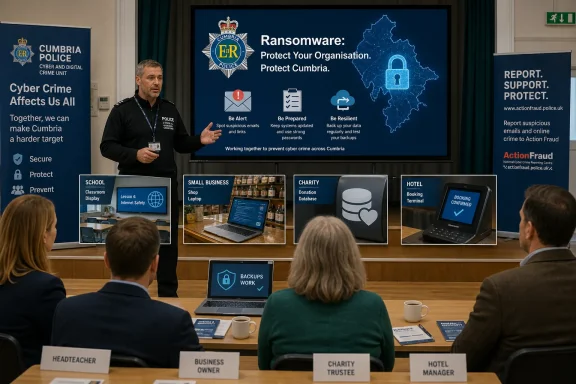
Cumbria Constabulary’s campaign is notable because it treats cyber resilience as community safety work. Detective Constable Lee Fearn and the county’s Cyber and Digital Crime Unit are not presenting themselves as a replacement for managed service providers or commercial security vendors. They are positioning the police as a practical bridge between national guidance and the organisations most likely to be overwhelmed when an attack happens.
That is the right framing. A ransomware incident is not merely an IT outage; it is a business crisis, a safeguarding issue, a data-protection problem and sometimes a public-service interruption. When a school cannot access records, a charity loses donor information, or a hotel cannot process bookings, the blast radius extends well beyond the compromised machines.
The News & Star report says Cumbria officers have already contacted businesses, schools and charities, with hospitality firms due to be contacted in the coming weeks. That sequencing tells its own story. Schools and charities hold sensitive information but often operate with stretched budgets, while hospitality businesses combine payment systems, booking platforms, seasonal staffing and high operational pressure — an attractive mix for criminals looking for weak points.
That is why the Cumbria campaign’s emphasis on prevention and awareness matters. Telling organisations what to do after encryption is useful, but the decisive work happens earlier. Staff need to recognise suspicious email, administrators need to restrict privileges, leaders need to know where backups are stored, and suppliers need to be held to basic security expectations.
The National Cyber Security Centre’s public guidance has long stressed preparation: offline or protected backups, incident-response planning, patch management, multifactor authentication, and rehearsed recovery. These are not glamorous controls. They are the digital equivalent of locks, fire drills and insurance documents — boring right up until they become existential.
Local police outreach can help translate that national advice into something a headteacher or shop owner will actually act on. The challenge is not that ransomware guidance is unavailable. The challenge is that many organisations do not know which guidance applies to them, who should own it, or what “good enough” looks like before a crisis.
A ransomware crew does not need to understand pedagogy to understand leverage. If attackers can disrupt attendance systems, special educational needs records, finance data or parent communications, they can create panic quickly. Even where backups exist, restoration can be slow if the school lacks a tested recovery plan.
The risk is not limited to encryption. Data theft has become central to ransomware operations, with criminals threatening to publish sensitive information if victims refuse to pay. In an educational setting, that raises the stakes dramatically. The exposure of children’s records, staff HR data or safeguarding notes is not an abstract compliance issue; it is a direct harm.
That is why police-led sessions for pupils, parents and teachers are more than a public-relations exercise. Good cyber hygiene in schools has a cultural component. Pupils need to understand account security, staff need to spot social engineering, and leadership teams need to treat cyber incidents as part of safeguarding and continuity planning rather than as a problem for “the IT person.”
The Cumbria advice points businesses under active ransomware attack to Report Fraud on 0300 123 2040, with a dedicated 24/7 line for businesses, charities and organisations facing a live cyber attack. That instruction is important because it gives victims a first call that is not the attacker, not a panicked Google search, and not an unvetted “recovery” firm.
The official line from the National Cyber Security Centre and UK law enforcement remains clear: they do not encourage, endorse or condone paying ransom demands. The reason is not moral posturing. Payment does not guarantee decryption, does not guarantee stolen data will be deleted, may leave systems compromised, and can feed the criminal market that created the attack.
There is also a practical governance issue. A ransom decision made in panic can collide with sanctions rules, insurance conditions, data-protection duties and regulatory reporting obligations. The boardroom fantasy that payment is a shortcut back to normal has been punctured repeatedly. Sometimes it buys a decryption key; it rarely buys certainty.
The hospitality sector also runs on reputation and availability. A ransomware attack during a busy period can do immediate damage even if no data is ultimately published. Lost bookings, cancelled events, payment disruption and angry guests can turn a technical incident into a commercial wound within hours.
Smaller hospitality firms may rely on third-party providers for almost everything: card payments, reservations, websites, accounting and outsourced IT support. That can reduce internal burden, but it can also create confusion during an incident. Who has logs? Who can disable accounts? Who restores backups? Who tells customers?
Those questions should be answered before the first ransom note appears. Local police cannot rewrite every supplier contract or redesign every network, but they can prod businesses toward the conversations they have been postponing. In ransomware defence, a nudge toward preparation is often more valuable than a glossy threat briefing.
That unevenness is where ransomware thrives. Criminals do not need every target to be weak; they need enough targets to be underprepared. Automated scanning, credential theft and phishing can find the vulnerable faster than local organisations can patch, train or budget.
Cumbria’s approach acknowledges the gap between national cyber strategy and local operational reality. It is one thing for the NCSC to publish authoritative guidance. It is another for a small organisation to know how to implement it with limited money, legacy software and a staff member who wears three other hats.
The danger for policymakers is assuming that advice equals resilience. Advice is necessary, but it is not self-executing. Resilience requires ownership, time, money and repetition — especially in sectors where turnover is high and technical confidence is low.
A credible ransomware posture starts with knowing what must be restored first. For a school, that might be safeguarding records, communications and attendance. For a hotel, it might be booking data and payment operations. For a charity, it might be beneficiary records, donor systems and payroll.
Backups are the obvious foundation, but the detail matters. Are they offline or otherwise protected from the attacker? Has anyone tested restoration? Are administrator credentials separated? Does the organisation know how long it would take to rebuild core services?
The less dramatic controls matter too. Multifactor authentication can block stolen-password attacks. Timely patching can close known entry points. Least-privilege access can stop one compromised account from becoming a domain-wide disaster. Staff training can reduce the odds that the first malicious email becomes the first compromised mailbox.
Local policing can reduce that hesitation. A named cyber unit, a local contact address and an offer of short awareness sessions make the system feel less remote. That is especially valuable in counties where organisations may not have direct relationships with national cyber bodies or specialist incident responders.
There is, however, a delicate balance. Police must be clear about what they can and cannot provide. They can advise, signpost, collect reports, support prevention and investigate where possible. They cannot guarantee recovery, replace professional incident response, or make underfunded infrastructure secure by goodwill alone.
DC Fearn’s reported comment that Cumbria Police wants to supplement service providers rather than replace them is therefore important. The most effective model is cooperative: police for reporting and prevention, NCSC for national guidance, service providers for technical controls, and organisational leaders for ownership.
Many attacks succeed not because Windows is inherently undefendable, but because identity, patching, remote access and backup practices are messy. Remote Desktop exposed too broadly, reused passwords, stale administrator accounts, unpatched VPN appliances, weak email filtering and flat networks remain depressingly common. The endpoint is often where the damage becomes visible, not where the risk began.
Microsoft-heavy environments have strong defensive options if they are configured with intent. Multifactor authentication, role-based access, attack-surface reduction rules, tamper protection, device compliance policies and controlled folder access can all help. But an unreviewed Microsoft 365 tenant with legacy authentication, overprivileged accounts and no tested recovery plan is still a soft target.
The lesson is not “buy more security.” It is “make the security you already own real.” Many organisations pay for capabilities they have never switched on, tuned or monitored. Ransomware crews are counting on that difference between licensing and implementation.
Those actions matter, but they happen far from the daily reality of a local organisation trying to keep systems running. The more durable work is mundane: contact lists, training sessions, reporting routes, backup tests, supplier conversations and leadership briefings. Cumbria’s campaign sits in that less glamorous but more repeatable space.
This is also where public messaging has to improve. Too much cyber advice is written as though every organisation has a chief information security officer. The organisations Cumbria is targeting may have no such person. They need advice that maps to job roles they actually have: headteacher, office manager, finance lead, trustee, hotel owner, receptionist, outsourced IT technician.
If local cyber units can make national guidance legible to those people, they can reduce harm even without arresting a single ransomware operator. Prevention is hard to measure, but the absence of a ruined week, a leaked dataset or a closed business is still a public good.
 Local Policing Has Become the Front Door for a Global Crime
Ransomware used to be described as a technical problem: malware gets in, files get encrypted, a ransom note appears. That description is still true, but it is no longer sufficient. Modern ransomware is an organised-crime business model that reaches into local economies, public services and small organisations that often lack dedicated security teams.Cumbria Constabulary’s campaign is notable because it treats cyber resilience as community safety work. Detective Constable Lee Fearn and the county’s Cyber and Digital Crime Unit are not presenting themselves as a replacement for managed service providers or commercial security vendors. They are positioning the police as a practical bridge between national guidance and the organisations most likely to be overwhelmed when an attack happens.
That is the right framing. A ransomware incident is not merely an IT outage; it is a business crisis, a safeguarding issue, a data-protection problem and sometimes a public-service interruption. When a school cannot access records, a charity loses donor information, or a hotel cannot process bookings, the blast radius extends well beyond the compromised machines.
The News & Star report says Cumbria officers have already contacted businesses, schools and charities, with hospitality firms due to be contacted in the coming weeks. That sequencing tells its own story. Schools and charities hold sensitive information but often operate with stretched budgets, while hospitality businesses combine payment systems, booking platforms, seasonal staffing and high operational pressure — an attractive mix for criminals looking for weak points.
The Ransom Note Is the Last Symptom, Not the First Event
The public image of ransomware remains the locked screen: a demand for cryptocurrency, a ticking clock, and the promise that payment will restore access. By the time that screen appears, however, the meaningful failure has usually already happened. Attackers may have phished credentials, exploited an unpatched remote-access service, moved laterally through the network, disabled backups, and copied sensitive data.That is why the Cumbria campaign’s emphasis on prevention and awareness matters. Telling organisations what to do after encryption is useful, but the decisive work happens earlier. Staff need to recognise suspicious email, administrators need to restrict privileges, leaders need to know where backups are stored, and suppliers need to be held to basic security expectations.
The National Cyber Security Centre’s public guidance has long stressed preparation: offline or protected backups, incident-response planning, patch management, multifactor authentication, and rehearsed recovery. These are not glamorous controls. They are the digital equivalent of locks, fire drills and insurance documents — boring right up until they become existential.
Local police outreach can help translate that national advice into something a headteacher or shop owner will actually act on. The challenge is not that ransomware guidance is unavailable. The challenge is that many organisations do not know which guidance applies to them, who should own it, or what “good enough” looks like before a crisis.
Schools Are Not Soft Targets by Accident
Schools appear in ransomware stories for a reason. They run complicated networks, manage sensitive data about children and families, depend on ageing infrastructure, and often have limited in-house technical capacity. They also have predictable pressure points: term dates, exams, safeguarding duties, payroll cycles and communications with parents.A ransomware crew does not need to understand pedagogy to understand leverage. If attackers can disrupt attendance systems, special educational needs records, finance data or parent communications, they can create panic quickly. Even where backups exist, restoration can be slow if the school lacks a tested recovery plan.
The risk is not limited to encryption. Data theft has become central to ransomware operations, with criminals threatening to publish sensitive information if victims refuse to pay. In an educational setting, that raises the stakes dramatically. The exposure of children’s records, staff HR data or safeguarding notes is not an abstract compliance issue; it is a direct harm.
That is why police-led sessions for pupils, parents and teachers are more than a public-relations exercise. Good cyber hygiene in schools has a cultural component. Pupils need to understand account security, staff need to spot social engineering, and leadership teams need to treat cyber incidents as part of safeguarding and continuity planning rather than as a problem for “the IT person.”
Small Businesses Need a Plan Before They Need a Negotiator
For small and medium-sized businesses, the ransomware trap is often speed. A business discovers that files are inaccessible, phones are ringing, invoices cannot be issued, bookings cannot be checked, and staff are asking whether they should turn machines off. In that moment, it is too late to invent a crisis process.The Cumbria advice points businesses under active ransomware attack to Report Fraud on 0300 123 2040, with a dedicated 24/7 line for businesses, charities and organisations facing a live cyber attack. That instruction is important because it gives victims a first call that is not the attacker, not a panicked Google search, and not an unvetted “recovery” firm.
The official line from the National Cyber Security Centre and UK law enforcement remains clear: they do not encourage, endorse or condone paying ransom demands. The reason is not moral posturing. Payment does not guarantee decryption, does not guarantee stolen data will be deleted, may leave systems compromised, and can feed the criminal market that created the attack.
There is also a practical governance issue. A ransom decision made in panic can collide with sanctions rules, insurance conditions, data-protection duties and regulatory reporting obligations. The boardroom fantasy that payment is a shortcut back to normal has been punctured repeatedly. Sometimes it buys a decryption key; it rarely buys certainty.
Hospitality Is an Obvious Next Stop
Cumbria’s plan to contact the hospitality sector in the coming weeks is not incidental. Hotels, pubs, restaurants and tourism operators are highly digitised businesses that do not always think of themselves that way. Booking systems, point-of-sale terminals, supplier portals, guest Wi-Fi, payroll platforms and cloud email are all part of the attack surface.The hospitality sector also runs on reputation and availability. A ransomware attack during a busy period can do immediate damage even if no data is ultimately published. Lost bookings, cancelled events, payment disruption and angry guests can turn a technical incident into a commercial wound within hours.
Smaller hospitality firms may rely on third-party providers for almost everything: card payments, reservations, websites, accounting and outsourced IT support. That can reduce internal burden, but it can also create confusion during an incident. Who has logs? Who can disable accounts? Who restores backups? Who tells customers?
Those questions should be answered before the first ransom note appears. Local police cannot rewrite every supplier contract or redesign every network, but they can prod businesses toward the conversations they have been postponing. In ransomware defence, a nudge toward preparation is often more valuable than a glossy threat briefing.
The Public Sector Is Learning That Cyber Resilience Is Unevenly Distributed
National campaigns often speak as though “organisations” are a single category. They are not. A large enterprise may have a security operations centre, incident-retainer contracts and a board risk committee. A village school, local charity or independent hotel may have a part-time administrator, a cloud email subscription and a support contract whose terms nobody has read closely.That unevenness is where ransomware thrives. Criminals do not need every target to be weak; they need enough targets to be underprepared. Automated scanning, credential theft and phishing can find the vulnerable faster than local organisations can patch, train or budget.
Cumbria’s approach acknowledges the gap between national cyber strategy and local operational reality. It is one thing for the NCSC to publish authoritative guidance. It is another for a small organisation to know how to implement it with limited money, legacy software and a staff member who wears three other hats.
The danger for policymakers is assuming that advice equals resilience. Advice is necessary, but it is not self-executing. Resilience requires ownership, time, money and repetition — especially in sectors where turnover is high and technical confidence is low.
The “Don’t Pay” Message Needs a Recovery Message Beside It
The instruction not to pay a ransom is sound, but it can sound hollow to an organisation staring at locked systems without usable backups. If the only alternative to paying is collapse, the criminal has already won the argument. That is why anti-payment guidance must be paired with practical recovery planning.A credible ransomware posture starts with knowing what must be restored first. For a school, that might be safeguarding records, communications and attendance. For a hotel, it might be booking data and payment operations. For a charity, it might be beneficiary records, donor systems and payroll.
Backups are the obvious foundation, but the detail matters. Are they offline or otherwise protected from the attacker? Has anyone tested restoration? Are administrator credentials separated? Does the organisation know how long it would take to rebuild core services?
The less dramatic controls matter too. Multifactor authentication can block stolen-password attacks. Timely patching can close known entry points. Least-privilege access can stop one compromised account from becoming a domain-wide disaster. Staff training can reduce the odds that the first malicious email becomes the first compromised mailbox.
Cybercrime Is Now a Local Trust Problem
One reason police involvement matters is trust. Many ransomware victims hesitate to report, particularly small businesses worried about reputational damage or organisations afraid of being blamed. That silence benefits attackers and deprives authorities of intelligence.Local policing can reduce that hesitation. A named cyber unit, a local contact address and an offer of short awareness sessions make the system feel less remote. That is especially valuable in counties where organisations may not have direct relationships with national cyber bodies or specialist incident responders.
There is, however, a delicate balance. Police must be clear about what they can and cannot provide. They can advise, signpost, collect reports, support prevention and investigate where possible. They cannot guarantee recovery, replace professional incident response, or make underfunded infrastructure secure by goodwill alone.
DC Fearn’s reported comment that Cumbria Police wants to supplement service providers rather than replace them is therefore important. The most effective model is cooperative: police for reporting and prevention, NCSC for national guidance, service providers for technical controls, and organisational leaders for ownership.
Windows Shops Should Read This as an Operational Warning
For WindowsForum.com readers, the obvious temptation is to translate this into a checklist of endpoint tools: Defender settings, EDR agents, BitLocker, Group Policy, conditional access, backup software. Those matter. But the Cumbria story is a reminder that ransomware is as much about operations as tooling.Many attacks succeed not because Windows is inherently undefendable, but because identity, patching, remote access and backup practices are messy. Remote Desktop exposed too broadly, reused passwords, stale administrator accounts, unpatched VPN appliances, weak email filtering and flat networks remain depressingly common. The endpoint is often where the damage becomes visible, not where the risk began.
Microsoft-heavy environments have strong defensive options if they are configured with intent. Multifactor authentication, role-based access, attack-surface reduction rules, tamper protection, device compliance policies and controlled folder access can all help. But an unreviewed Microsoft 365 tenant with legacy authentication, overprivileged accounts and no tested recovery plan is still a soft target.
The lesson is not “buy more security.” It is “make the security you already own real.” Many organisations pay for capabilities they have never switched on, tuned or monitored. Ransomware crews are counting on that difference between licensing and implementation.
The Cumbria Model Is Modest, Which Is Why It Matters
There is nothing spectacular about a police cyber unit offering awareness training and guidance. That is precisely the point. Ransomware defence cannot depend only on spectacular interventions: international takedowns, decryptor releases, sanctions, arrests and government announcements.Those actions matter, but they happen far from the daily reality of a local organisation trying to keep systems running. The more durable work is mundane: contact lists, training sessions, reporting routes, backup tests, supplier conversations and leadership briefings. Cumbria’s campaign sits in that less glamorous but more repeatable space.
This is also where public messaging has to improve. Too much cyber advice is written as though every organisation has a chief information security officer. The organisations Cumbria is targeting may have no such person. They need advice that maps to job roles they actually have: headteacher, office manager, finance lead, trustee, hotel owner, receptionist, outsourced IT technician.
If local cyber units can make national guidance legible to those people, they can reduce harm even without arresting a single ransomware operator. Prevention is hard to measure, but the absence of a ruined week, a leaked dataset or a closed business is still a public good.
Cumbria’s Ransomware Warning Lands Where the Real Work Begins
The practical message from this campaign is not that Cumbria faces a unique ransomware wave. It is that the ransomware threat has become ordinary enough to require ordinary institutions — schools, small businesses, charities, hotels and local police — to build muscle memory before an attack.- Organisations in Cumbria can contact the Cumbria Police Cyber and Digital Crime Unit for cyber-awareness support and ransomware guidance.
- Businesses, charities and other organisations facing a live ransomware attack should report it immediately through Report Fraud on 0300 123 2040.
- The National Cyber Security Centre and UK law enforcement advise against paying ransom demands because payment does not guarantee recovery or data protection.
- Schools should treat ransomware planning as part of safeguarding, continuity and data-protection work, not merely as an IT department concern.
- Small businesses should test backups, secure administrator accounts and agree incident roles before disruption begins.
- Hospitality firms should review booking, payment, supplier and guest-data dependencies before the busy season turns a cyber incident into a business emergency.
References
- Primary source: News & Star
Published: 2026-07-04T14:20:13.916766
Loading…
www.newsandstar.co.uk - Related coverage: gov.uk
Loading…
www.gov.uk - Related coverage: cityoflondon.police.uk
Loading…
www.cityoflondon.police.uk - Related coverage: tomshardware.com
Loading…
www.tomshardware.com - Related coverage: techradar.com
Loading…
www.techradar.com