

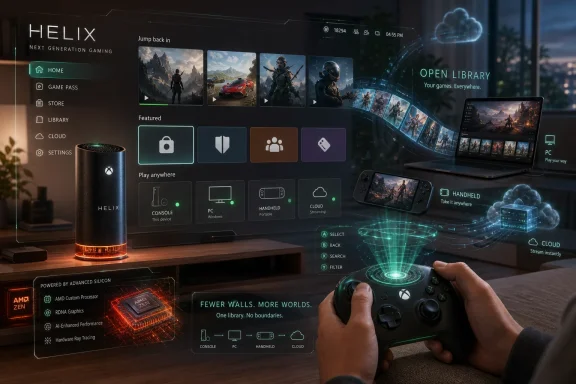
Microsoft has confirmed a next-generation Xbox hardware program built with AMD, but the louder “Project Helix” story now circulating across gaming sites blends official Xbox promises with reporting and speculation about a PC-console hybrid that Microsoft has not fully announced. That distinction matters because the next Xbox is no longer just a box under the television; it is a test of whether Microsoft can turn Windows, Game Pass, cloud streaming, PC storefronts, and console compatibility into one coherent product. The company’s public language points toward openness, portability, and silicon co-design, while the rumor mill has supplied the codename, the missing hardware shape, and the anxiety. The real story is not that Microsoft has “confirmed everything” about Helix; it is that Xbox is preparing to stop behaving like a traditional console business.
The cleanest verified fact is the AMD partnership. In June 2025, Xbox president Sarah Bond announced through Xbox Wire that Microsoft had entered a strategic, multi-year agreement with AMD to co-engineer silicon for future Xbox devices, including living-room consoles, handheld devices, cloud infrastructure, and accessories. That was not a vague “we are thinking about the future” statement; it was Microsoft publicly committing to another generation of first-party Xbox hardware.
What Microsoft did not do in that announcement was publish a full console specification, a release date, a price, a disc-drive policy, or a definitive list of supported PC storefronts. Bond’s phrasing was deliberately ecosystem-wide. She talked about Xbox experiences “not locked to a single store” and not tied to one device, which is a meaningful shift from the old console model but still short of saying the next Xbox will simply be a Windows gaming PC in console clothing.
That gap is where “Project Helix” has grown. Reporting from outlets including Windows Central, TechRadar, TechSpot, and Tom’s Hardware has treated Helix as the codename for Microsoft’s next-generation Xbox effort, with some reports describing it as a hybrid console capable of playing both Xbox and PC games. NoobFeed’s July 4 article collects many of those claims into a single forward-looking narrative, but the strongest parts of that narrative still rest on a mixture of official Xbox statements, industry reporting, and inference.
That does not make the story empty. It makes it more interesting. Microsoft is telling the market that Xbox will continue as hardware, but the hardware is being framed as a gateway into a wider Windows-and-cloud gaming platform rather than as a closed appliance with a single storefront and a seven-year software cycle.
The next Xbox appears to be aimed at a different bargain. Microsoft wants the user to think less about where a game technically lives and more about whether their Xbox identity follows them across devices. Game Pass, Xbox Play Anywhere, cloud saves, cross-play, and day-one PC releases have all been moving the company toward that model for years.
That is why the AMD announcement landed differently from an ordinary chip supplier deal. Microsoft did not say “AMD will power our next console” and stop there. It described a portfolio spanning console, handheld, PC, cloud, and accessories, while also emphasizing backward compatibility with existing Xbox libraries. That is the language of a platform owner trying to stretch the definition of its platform until it includes machines that previously sat outside the console category.
The tension is obvious. If Xbox becomes too much like a PC, Microsoft loses the simplicity that made consoles attractive. If Xbox stays too much like a console, Microsoft cannot credibly claim it is building the most open gaming ecosystem in the living room. Helix, whatever its final retail name, is the attempt to thread that needle.
That idea is plausible because Microsoft has already moved in this direction on Windows handhelds. The ROG Xbox Ally effort and the Xbox full-screen experience for Windows 11 show Microsoft trying to make a controller-first interface that can launch games from multiple PC libraries. Xbox Wire described that full-screen experience as a way to reduce friction and help players access games across popular PC storefronts.
But “popular PC storefronts” on a Windows handheld and “Steam on the next Xbox console” are not the same product promise. A handheld running Windows can inherit the messiness of the PC because buyers understand they are buying a PC-like device. A living-room Xbox has to meet a higher standard of reliability, parental control, suspend-and-resume behavior, controller navigation, system updates, and support.
If Microsoft truly allows Steam, Epic Games Store, Battle.net, and other launchers on a living-room Xbox, it will be making the boldest move in modern console history. It would also be inviting every old Windows gaming problem into the room: launcher updates, account conflicts, anti-cheat compatibility, mod support, graphics settings, driver assumptions, and games that technically run but feel wrong on a television.
That is why Microsoft’s official “not locked to a single store” language is powerful but carefully non-specific. It signals a philosophy. It does not yet guarantee the frictionless, anything-goes PC-console merger that excited fans are imagining.
Windows is where PC gaming lives at scale. It is where Steam became the default store, where modding culture flourished, where competitive shooters and strategy games grew up, and where hardware innovation moves faster than console generations. If Microsoft can wrap Windows gaming in an Xbox-quality shell, it could offer something no traditional console has offered: PC breadth with console ritual.
The problem is that Windows has never been good at disappearing. It updates, nags, enumerates devices, exposes file systems, throws permission prompts, and sometimes behaves like a general-purpose operating system at precisely the moment a player wants an appliance. SteamOS has gained attention on handhelds because it does less in the foreground, even when its compatibility layer is doing remarkable work underneath.
Microsoft understands this, which is why the Xbox full-screen experience matters more than it may look at first glance. It is not merely a launcher. It is a prototype for hiding Windows from people who do not want Windows while preserving Windows for the developers, storefronts, and games that depend on it.
That is a hard product problem. A console interface cannot just be pretty; it must be boringly reliable. The test for Helix is whether Microsoft can make Windows feel like Xbox without making Xbox feel like a compromised PC.
Reports have pointed to improved ray tracing, AI-assisted upscaling, faster storage pipelines, and more efficient rendering. Those are credible directions because they align with where the whole industry is moving. Nvidia pushed AI upscaling into the mainstream with DLSS; AMD has been iterating on FSR; Microsoft controls DirectX; and game file sizes and asset streaming demands continue to balloon.
Still, the hardware story is not where Microsoft’s risk lies. A faster GPU is expected. Better ray tracing is expected. More AI in the rendering pipeline is expected. The rare opportunity is to make those improvements serve a platform that spans console games, PC games, cloud games, and older Xbox libraries.
If Helix ships as an expensive high-end console that only plays a familiar set of Xbox titles with prettier lighting, it will be strategically underwhelming. If it ships as a Windows PC with Xbox branding and a pile of rough edges, it will be strategically confused. The point of the AMD deal is not simply power; it is control over the hardware foundation for a broader Xbox identity.
This is not just consumer-friendly branding. It is strategic necessity. If Xbox is moving toward a more open and potentially more digital future, backward compatibility is the bridge that prevents existing customers from feeling abandoned. It says: yes, the platform is changing, but your past purchases still count.
That becomes especially important if the all-digital rumors prove true. Windows Central and TechRadar have reported on Microsoft’s alleged “Positron” disc-to-digital work and the possibility that Helix may ship without a disc drive. Tom’s Hardware has been more cautious, noting reporting that Microsoft may not have made a final call on the drive question.
The distinction matters because physical media is not merely a nostalgic concern. For many players, discs represent lending, resale, collecting, offline installation, and a sense of ownership that digital licenses do not fully replace. A disc-to-digital conversion program could soften the blow, but it would not be the same as native disc support.
If Microsoft removes the drive, it will need to overcompensate with compatibility, account portability, consumer rights messaging, and practical migration tools. Otherwise, the company risks repeating the trust problems that haunted the Xbox One launch era, when Microsoft’s digital ambitions arrived before the audience was ready to believe in them.
Console discs have become strange objects. Many modern discs are licenses plus partial data rather than complete archival copies. Day-one patches, server dependencies, and live-service design have already weakened the old idea that a disc equals permanent ownership. Yet the disc still matters because it preserves some user agency inside a platform economy that increasingly wants every transaction tied to an account.
Microsoft knows this. That is why a rumored disc-to-digital path makes strategic sense. It gives the company a way to say it has not forgotten physical buyers while still designing future hardware around digital distribution. The catch is that conversion programs tend to be full of fine print: eligible titles, account binding, region limits, authentication requirements, and publisher participation.
For collectors and preservationists, those details are not minor. They are the whole story. A future Xbox with no disc drive but a generous conversion program would be very different from a future Xbox with no disc drive and a vague promise that “your library comes with you.”
The physical media debate will therefore become a referendum on Microsoft’s credibility. Players may accept an all-digital future if they believe Microsoft is protecting their libraries. They will resist it if they think the company is using openness on the PC side to distract from enclosure on the ownership side.
A hybrid Xbox could make Game Pass feel less like “Netflix for console games” and more like a default identity layer for gaming across devices. Buy a Helix-style console, sign in, and your subscription, cloud saves, PC-compatible titles, console titles, and streaming options all appear behind one interface. That is the dream.
The business logic is obvious. Microsoft wants recurring revenue, not just hardware-margin drama every seven years. It wants players who remain in the Xbox ecosystem even when they buy games on PC, stream from the cloud, or use handheld devices. A next-gen Xbox that can bridge those worlds would make Game Pass more defensible and more central.
But the strategy has a built-in contradiction. If the box is truly open to Steam and other stores, Game Pass must compete on value and convenience rather than forced default status. That could be healthy for consumers, but it also means Microsoft would be building a console that deliberately weakens the old platform-holder advantage.
That is the gamble. Microsoft may be betting that the future profit pool is not the 30 percent cut on every console transaction but the identity, services, cloud infrastructure, and cross-device loyalty around gaming. If so, Helix is less a console than a storefront détente wrapped in Xbox hardware.
But developers also know what fragmentation looks like. If Helix supports Xbox-native games, PC games, cloud play, multiple storefronts, varying input schemes, and perhaps multiple hardware tiers, testing becomes more complicated. Certification may become less rigid, but support expectations may become messier.
A traditional console gives developers a stable target. A PC gives developers scale but also variability. A hybrid Xbox has to decide which side of that bargain it wants to preserve. If Microsoft promises console reliability while enabling PC openness, it will need developer tools that make the hybrid model feel like an advantage rather than a support burden.
This is where the reported developer hardware timeline matters. TechRadar reported that Microsoft discussed alpha hardware going to studios in 2027, based on industry event remarks. If accurate, that suggests Microsoft knows the developer transition will not be trivial.
The next Xbox cannot be revealed six months before launch and expect the ecosystem to improvise. If the device really changes the application model, storefront model, or compatibility expectations, studios will need time to adapt. Microsoft’s messaging to developers may end up being more important than its messaging to consumers.
That is why a conventional Xbox Series X successor would be difficult to sell. More teraflops, better ray tracing, and faster load times are welcome, but they do not automatically solve Xbox’s market-position problem. Microsoft has spent the last decade telling players that Xbox is available on PC, phone, cloud, and handheld; it can hardly turn around and argue that the next sealed living-room box is the whole story.
A hybrid console is risky, but it is at least a differentiated thesis. Sony can make a more powerful PlayStation. Nintendo can make a more Nintendo-like Nintendo. Microsoft’s credible advantage is that it owns Windows, Xbox, DirectX, Game Pass, Azure, and a deep relationship with AMD.
The challenge is that strategic advantage does not automatically become product elegance. Microsoft has often been better at platform architecture than consumer simplicity. Helix will need both.
The living room is less forgiving. A handheld owner may accept troubleshooting because the whole category still feels enthusiast-driven. A family using a television console expects instant-on behavior, obvious account switching, simple downloads, clean parental controls, and predictable controller support.
That makes the full-screen Windows gaming experience a crucial rehearsal. If Microsoft can improve it across handhelds, laptops, desktops, and TV-connected PCs, it will have the software foundation for a Helix-like console. If the experience remains a launcher veneer over Windows complexity, the next Xbox will inherit the wrong lessons.
The best version of Helix would not ask players to choose between Xbox mode and Windows mode every time they sit down. It would know when to hide complexity and when to expose it. That sounds simple; it is one of the hardest interface problems in consumer computing.
The practical question is whether AI makes games better on the machine people actually buy. If it produces cleaner images at stable frame rates, reduces storage pressure, improves accessibility, or helps developers ship across Xbox and PC more efficiently, players will accept it. If it becomes a buzzword attached to blurry upscaling and inconsistent latency, they will not.
There is also a trust issue. AI in game development has become culturally charged, especially when it touches art, voice, writing, or labor. AI in rendering and performance is less controversial, but Microsoft will still need to be precise. Players may welcome machine-learning upscaling; they may be less enthusiastic about vague promises that AI will transform everything.
The smartest Xbox pitch would keep the AI story practical. Better lighting. Better frame pacing. Smaller downloads where possible. Faster resume. Smarter cloud scaling. The less Microsoft makes AI sound like magic, the more credible it will be.
Can a player buy the box, sign in, and immediately understand what games they own? Can they launch a Steam game with a controller and no desktop detour? Can a parent restrict purchases and chat across Xbox and PC titles? Can a suspended game resume reliably after a system update? Can developers predict how their games behave across the platform?
These are not glamorous questions, but they are the difference between a platform and a science project. Microsoft has the technical pieces to build something formidable. The risk is that the pieces remain visible.
The old console model worked because it hid complexity. The PC model works because it permits complexity. Helix is rumored to sit between them, which means Microsoft must decide exactly which complexities are worth preserving and which must be buried forever.
That pitch allows Microsoft to talk about backward compatibility without sounding trapped in the past. It allows the company to talk about PC stores without making the device feel like homework. It allows Game Pass, cloud gaming, and Windows compatibility to become benefits rather than competing identities.
The worst pitch would be a pile of platform nouns. Xbox plus PC plus Steam plus cloud plus AI plus backward compatibility plus Game Pass plus Windows is not a product; it is a conference slide. Microsoft needs a single sentence ordinary buyers can understand.
The likely sentence is something like: your Xbox library, your PC games, and your Game Pass subscription on one device built for the living room. If Microsoft can make that true, Helix deserves the hype. If it cannot, the project risks becoming another example of Microsoft seeing the future clearly and shipping it awkwardly.
Microsoft benefits from the buzz, but it also inherits the pressure. If the official reveal is more conservative than the rumor cycle, some fans will feel misled even if Microsoft never made the bolder claims. That is the danger of a semi-official narrative where corporate hints, developer chatter, and media extrapolation all blur together.
The company should clarify the basics sooner rather than later. Not the full specification, necessarily, but the product philosophy. Is the next Xbox a console that can access PC stores, a PC that can behave like a console, or a family of devices under one Xbox platform identity?
Those are different products. They imply different expectations, different support models, and different buyer groups. Microsoft can keep the codename mystique for a while, but it cannot keep the category ambiguous forever.
 Microsoft Has Confirmed the Direction, Not the Mythology
The cleanest verified fact is the AMD partnership. In June 2025, Xbox president Sarah Bond announced through Xbox Wire that Microsoft had entered a strategic, multi-year agreement with AMD to co-engineer silicon for future Xbox devices, including living-room consoles, handheld devices, cloud infrastructure, and accessories. That was not a vague “we are thinking about the future” statement; it was Microsoft publicly committing to another generation of first-party Xbox hardware.What Microsoft did not do in that announcement was publish a full console specification, a release date, a price, a disc-drive policy, or a definitive list of supported PC storefronts. Bond’s phrasing was deliberately ecosystem-wide. She talked about Xbox experiences “not locked to a single store” and not tied to one device, which is a meaningful shift from the old console model but still short of saying the next Xbox will simply be a Windows gaming PC in console clothing.
That gap is where “Project Helix” has grown. Reporting from outlets including Windows Central, TechRadar, TechSpot, and Tom’s Hardware has treated Helix as the codename for Microsoft’s next-generation Xbox effort, with some reports describing it as a hybrid console capable of playing both Xbox and PC games. NoobFeed’s July 4 article collects many of those claims into a single forward-looking narrative, but the strongest parts of that narrative still rest on a mixture of official Xbox statements, industry reporting, and inference.
That does not make the story empty. It makes it more interesting. Microsoft is telling the market that Xbox will continue as hardware, but the hardware is being framed as a gateway into a wider Windows-and-cloud gaming platform rather than as a closed appliance with a single storefront and a seven-year software cycle.
Xbox Is Trying to Escape the Console Box Without Abandoning It
For two decades, the console bargain was simple: the hardware was subsidized or tightly controlled, the software store was centralized, and the living-room experience was predictable. Microsoft participated in that bargain even when it dressed Xbox in PC language. The original Xbox was famously PC-like under the hood, but the business model was still console-first.The next Xbox appears to be aimed at a different bargain. Microsoft wants the user to think less about where a game technically lives and more about whether their Xbox identity follows them across devices. Game Pass, Xbox Play Anywhere, cloud saves, cross-play, and day-one PC releases have all been moving the company toward that model for years.
That is why the AMD announcement landed differently from an ordinary chip supplier deal. Microsoft did not say “AMD will power our next console” and stop there. It described a portfolio spanning console, handheld, PC, cloud, and accessories, while also emphasizing backward compatibility with existing Xbox libraries. That is the language of a platform owner trying to stretch the definition of its platform until it includes machines that previously sat outside the console category.
The tension is obvious. If Xbox becomes too much like a PC, Microsoft loses the simplicity that made consoles attractive. If Xbox stays too much like a console, Microsoft cannot credibly claim it is building the most open gaming ecosystem in the living room. Helix, whatever its final retail name, is the attempt to thread that needle.
The PC Storefront Claim Is the Sharp Edge of the Whole Strategy
The most consequential Helix rumor is not better ray tracing, faster storage, or AI upscaling. Those are expected generational improvements. The disruptive claim is that the next Xbox could run PC games natively and expose players to storefronts beyond Microsoft’s own Xbox store.That idea is plausible because Microsoft has already moved in this direction on Windows handhelds. The ROG Xbox Ally effort and the Xbox full-screen experience for Windows 11 show Microsoft trying to make a controller-first interface that can launch games from multiple PC libraries. Xbox Wire described that full-screen experience as a way to reduce friction and help players access games across popular PC storefronts.
But “popular PC storefronts” on a Windows handheld and “Steam on the next Xbox console” are not the same product promise. A handheld running Windows can inherit the messiness of the PC because buyers understand they are buying a PC-like device. A living-room Xbox has to meet a higher standard of reliability, parental control, suspend-and-resume behavior, controller navigation, system updates, and support.
If Microsoft truly allows Steam, Epic Games Store, Battle.net, and other launchers on a living-room Xbox, it will be making the boldest move in modern console history. It would also be inviting every old Windows gaming problem into the room: launcher updates, account conflicts, anti-cheat compatibility, mod support, graphics settings, driver assumptions, and games that technically run but feel wrong on a television.
That is why Microsoft’s official “not locked to a single store” language is powerful but carefully non-specific. It signals a philosophy. It does not yet guarantee the frictionless, anything-goes PC-console merger that excited fans are imagining.
Windows Is Both the Weapon and the Liability
The biggest advantage Microsoft has over Sony and Nintendo is Windows. The biggest obstacle Microsoft has is also Windows.Windows is where PC gaming lives at scale. It is where Steam became the default store, where modding culture flourished, where competitive shooters and strategy games grew up, and where hardware innovation moves faster than console generations. If Microsoft can wrap Windows gaming in an Xbox-quality shell, it could offer something no traditional console has offered: PC breadth with console ritual.
The problem is that Windows has never been good at disappearing. It updates, nags, enumerates devices, exposes file systems, throws permission prompts, and sometimes behaves like a general-purpose operating system at precisely the moment a player wants an appliance. SteamOS has gained attention on handhelds because it does less in the foreground, even when its compatibility layer is doing remarkable work underneath.
Microsoft understands this, which is why the Xbox full-screen experience matters more than it may look at first glance. It is not merely a launcher. It is a prototype for hiding Windows from people who do not want Windows while preserving Windows for the developers, storefronts, and games that depend on it.
That is a hard product problem. A console interface cannot just be pretty; it must be boringly reliable. The test for Helix is whether Microsoft can make Windows feel like Xbox without making Xbox feel like a compromised PC.
AMD Gives Microsoft a Silicon Story, but Software Will Decide the Console
The AMD partnership gives Microsoft credibility on the hardware roadmap. AMD already powers Xbox Series X and Series S, PlayStation 5, many gaming PCs, and a growing field of handheld gaming devices. A custom AMD design for the next Xbox would let Microsoft optimize around graphics performance, CPU efficiency, AI acceleration, ray tracing, and memory bandwidth in a way that commodity PC hardware cannot always match.Reports have pointed to improved ray tracing, AI-assisted upscaling, faster storage pipelines, and more efficient rendering. Those are credible directions because they align with where the whole industry is moving. Nvidia pushed AI upscaling into the mainstream with DLSS; AMD has been iterating on FSR; Microsoft controls DirectX; and game file sizes and asset streaming demands continue to balloon.
Still, the hardware story is not where Microsoft’s risk lies. A faster GPU is expected. Better ray tracing is expected. More AI in the rendering pipeline is expected. The rare opportunity is to make those improvements serve a platform that spans console games, PC games, cloud games, and older Xbox libraries.
If Helix ships as an expensive high-end console that only plays a familiar set of Xbox titles with prettier lighting, it will be strategically underwhelming. If it ships as a Windows PC with Xbox branding and a pile of rough edges, it will be strategically confused. The point of the AMD deal is not simply power; it is control over the hardware foundation for a broader Xbox identity.
Backward Compatibility Is the Trust Anchor Microsoft Cannot Afford to Lose
Microsoft has spent years making backward compatibility part of Xbox’s moral pitch. While Sony has leaned heavily on exclusives and Nintendo on differentiated hardware, Microsoft has repeatedly told players that their libraries matter. That message appears again in the next-generation hardware language, where Bond emphasized compatibility with existing Xbox games.This is not just consumer-friendly branding. It is strategic necessity. If Xbox is moving toward a more open and potentially more digital future, backward compatibility is the bridge that prevents existing customers from feeling abandoned. It says: yes, the platform is changing, but your past purchases still count.
That becomes especially important if the all-digital rumors prove true. Windows Central and TechRadar have reported on Microsoft’s alleged “Positron” disc-to-digital work and the possibility that Helix may ship without a disc drive. Tom’s Hardware has been more cautious, noting reporting that Microsoft may not have made a final call on the drive question.
The distinction matters because physical media is not merely a nostalgic concern. For many players, discs represent lending, resale, collecting, offline installation, and a sense of ownership that digital licenses do not fully replace. A disc-to-digital conversion program could soften the blow, but it would not be the same as native disc support.
If Microsoft removes the drive, it will need to overcompensate with compatibility, account portability, consumer rights messaging, and practical migration tools. Otherwise, the company risks repeating the trust problems that haunted the Xbox One launch era, when Microsoft’s digital ambitions arrived before the audience was ready to believe in them.
The Disc Drive Fight Is Really About Ownership
The argument over an all-digital Xbox is often framed as a simple market trend: physical game sales have declined, PC gaming is already digital, and console players increasingly buy downloads. All of that is true. It is also incomplete.Console discs have become strange objects. Many modern discs are licenses plus partial data rather than complete archival copies. Day-one patches, server dependencies, and live-service design have already weakened the old idea that a disc equals permanent ownership. Yet the disc still matters because it preserves some user agency inside a platform economy that increasingly wants every transaction tied to an account.
Microsoft knows this. That is why a rumored disc-to-digital path makes strategic sense. It gives the company a way to say it has not forgotten physical buyers while still designing future hardware around digital distribution. The catch is that conversion programs tend to be full of fine print: eligible titles, account binding, region limits, authentication requirements, and publisher participation.
For collectors and preservationists, those details are not minor. They are the whole story. A future Xbox with no disc drive but a generous conversion program would be very different from a future Xbox with no disc drive and a vague promise that “your library comes with you.”
The physical media debate will therefore become a referendum on Microsoft’s credibility. Players may accept an all-digital future if they believe Microsoft is protecting their libraries. They will resist it if they think the company is using openness on the PC side to distract from enclosure on the ownership side.
Game Pass Makes More Sense in a Hybrid Xbox Than in a Traditional One
Game Pass has always been slightly awkward inside the classic console model. It works well as a subscription, but a fixed console generation limits the service’s reach. Microsoft’s broader gaming strategy makes more sense if Xbox hardware becomes one access point among several rather than the center of the universe.A hybrid Xbox could make Game Pass feel less like “Netflix for console games” and more like a default identity layer for gaming across devices. Buy a Helix-style console, sign in, and your subscription, cloud saves, PC-compatible titles, console titles, and streaming options all appear behind one interface. That is the dream.
The business logic is obvious. Microsoft wants recurring revenue, not just hardware-margin drama every seven years. It wants players who remain in the Xbox ecosystem even when they buy games on PC, stream from the cloud, or use handheld devices. A next-gen Xbox that can bridge those worlds would make Game Pass more defensible and more central.
But the strategy has a built-in contradiction. If the box is truly open to Steam and other stores, Game Pass must compete on value and convenience rather than forced default status. That could be healthy for consumers, but it also means Microsoft would be building a console that deliberately weakens the old platform-holder advantage.
That is the gamble. Microsoft may be betting that the future profit pool is not the 30 percent cut on every console transaction but the identity, services, cloud infrastructure, and cross-device loyalty around gaming. If so, Helix is less a console than a storefront détente wrapped in Xbox hardware.
Developers Will Welcome the Reach and Fear the Fragmentation
For developers, a unified Xbox-PC target sounds attractive. Fewer hard walls between console and PC could mean larger reachable audiences, easier cross-save support, and more flexible deployment. Microsoft’s control of DirectX, Windows, Xbox services, and Azure gives it a technical stack few competitors can match.But developers also know what fragmentation looks like. If Helix supports Xbox-native games, PC games, cloud play, multiple storefronts, varying input schemes, and perhaps multiple hardware tiers, testing becomes more complicated. Certification may become less rigid, but support expectations may become messier.
A traditional console gives developers a stable target. A PC gives developers scale but also variability. A hybrid Xbox has to decide which side of that bargain it wants to preserve. If Microsoft promises console reliability while enabling PC openness, it will need developer tools that make the hybrid model feel like an advantage rather than a support burden.
This is where the reported developer hardware timeline matters. TechRadar reported that Microsoft discussed alpha hardware going to studios in 2027, based on industry event remarks. If accurate, that suggests Microsoft knows the developer transition will not be trivial.
The next Xbox cannot be revealed six months before launch and expect the ecosystem to improvise. If the device really changes the application model, storefront model, or compatibility expectations, studios will need time to adapt. Microsoft’s messaging to developers may end up being more important than its messaging to consumers.
Sony and Nintendo Make Microsoft’s Weirdness Necessary
Microsoft is not making these moves in a vacuum. Sony remains strong in high-end console identity, first-party prestige, and global brand loyalty. Nintendo occupies its own orbit, proving again and again that differentiated hardware and beloved software can beat raw performance. Microsoft is the company most in need of a new console argument.That is why a conventional Xbox Series X successor would be difficult to sell. More teraflops, better ray tracing, and faster load times are welcome, but they do not automatically solve Xbox’s market-position problem. Microsoft has spent the last decade telling players that Xbox is available on PC, phone, cloud, and handheld; it can hardly turn around and argue that the next sealed living-room box is the whole story.
A hybrid console is risky, but it is at least a differentiated thesis. Sony can make a more powerful PlayStation. Nintendo can make a more Nintendo-like Nintendo. Microsoft’s credible advantage is that it owns Windows, Xbox, DirectX, Game Pass, Azure, and a deep relationship with AMD.
The challenge is that strategic advantage does not automatically become product elegance. Microsoft has often been better at platform architecture than consumer simplicity. Helix will need both.
The Xbox Ally Was the Dress Rehearsal
The ROG Xbox Ally line should be understood as more than a branded handheld. It is Microsoft testing how much Xbox identity can be layered over Windows before consumers reject the seams. The device category is perfect for experimentation because handheld PC buyers already tolerate some roughness in exchange for flexibility.The living room is less forgiving. A handheld owner may accept troubleshooting because the whole category still feels enthusiast-driven. A family using a television console expects instant-on behavior, obvious account switching, simple downloads, clean parental controls, and predictable controller support.
That makes the full-screen Windows gaming experience a crucial rehearsal. If Microsoft can improve it across handhelds, laptops, desktops, and TV-connected PCs, it will have the software foundation for a Helix-like console. If the experience remains a launcher veneer over Windows complexity, the next Xbox will inherit the wrong lessons.
The best version of Helix would not ask players to choose between Xbox mode and Windows mode every time they sit down. It would know when to hide complexity and when to expose it. That sounds simple; it is one of the hardest interface problems in consumer computing.
The AI Pitch Must Prove It Is More Than Generational Perfume
Every hardware cycle now arrives with an AI story. Some of it is real, some of it is marketing perfume, and most of it is difficult for ordinary players to evaluate before launch. Microsoft and AMD will almost certainly emphasize AI-enhanced performance, upscaling, frame generation, asset handling, and perhaps developer tooling.The practical question is whether AI makes games better on the machine people actually buy. If it produces cleaner images at stable frame rates, reduces storage pressure, improves accessibility, or helps developers ship across Xbox and PC more efficiently, players will accept it. If it becomes a buzzword attached to blurry upscaling and inconsistent latency, they will not.
There is also a trust issue. AI in game development has become culturally charged, especially when it touches art, voice, writing, or labor. AI in rendering and performance is less controversial, but Microsoft will still need to be precise. Players may welcome machine-learning upscaling; they may be less enthusiastic about vague promises that AI will transform everything.
The smartest Xbox pitch would keep the AI story practical. Better lighting. Better frame pacing. Smaller downloads where possible. Faster resume. Smarter cloud scaling. The less Microsoft makes AI sound like magic, the more credible it will be.
The Next Xbox Will Be Judged by Friction, Not Spec Sheets
The enthusiast internet loves specifications because they are easy to compare. Compute units, memory bandwidth, storage speed, ray-tracing performance, and AI TOPS will all have their moment. But the success of a hybrid Xbox will be decided by friction.Can a player buy the box, sign in, and immediately understand what games they own? Can they launch a Steam game with a controller and no desktop detour? Can a parent restrict purchases and chat across Xbox and PC titles? Can a suspended game resume reliably after a system update? Can developers predict how their games behave across the platform?
These are not glamorous questions, but they are the difference between a platform and a science project. Microsoft has the technical pieces to build something formidable. The risk is that the pieces remain visible.
The old console model worked because it hid complexity. The PC model works because it permits complexity. Helix is rumored to sit between them, which means Microsoft must decide exactly which complexities are worth preserving and which must be buried forever.
The Helix Story Microsoft Can Actually Sell
The strongest consumer pitch is not “this is a PC.” Most console buyers do not want to buy a PC. The stronger pitch is: this is the Xbox that can play more of your games, in more places, with fewer walls.That pitch allows Microsoft to talk about backward compatibility without sounding trapped in the past. It allows the company to talk about PC stores without making the device feel like homework. It allows Game Pass, cloud gaming, and Windows compatibility to become benefits rather than competing identities.
The worst pitch would be a pile of platform nouns. Xbox plus PC plus Steam plus cloud plus AI plus backward compatibility plus Game Pass plus Windows is not a product; it is a conference slide. Microsoft needs a single sentence ordinary buyers can understand.
The likely sentence is something like: your Xbox library, your PC games, and your Game Pass subscription on one device built for the living room. If Microsoft can make that true, Helix deserves the hype. If it cannot, the project risks becoming another example of Microsoft seeing the future clearly and shipping it awkwardly.
The Rumors Leave Microsoft With a Narrow Landing Zone
The current reporting has created expectations that may be difficult to satisfy. Enthusiasts now imagine a premium Xbox that runs PC games, supports multiple stores, preserves backward compatibility, uses custom AMD silicon, leans into AI upscaling, and possibly solves the disc transition. That is an enormous promise, especially when much of it has not been confirmed in final retail terms.Microsoft benefits from the buzz, but it also inherits the pressure. If the official reveal is more conservative than the rumor cycle, some fans will feel misled even if Microsoft never made the bolder claims. That is the danger of a semi-official narrative where corporate hints, developer chatter, and media extrapolation all blur together.
The company should clarify the basics sooner rather than later. Not the full specification, necessarily, but the product philosophy. Is the next Xbox a console that can access PC stores, a PC that can behave like a console, or a family of devices under one Xbox platform identity?
Those are different products. They imply different expectations, different support models, and different buyer groups. Microsoft can keep the codename mystique for a while, but it cannot keep the category ambiguous forever.
The Concrete Signal Beneath the Helix Noise
The useful way to read the Helix story is to separate official commitments from plausible direction and unresolved risk. Microsoft has confirmed enough to show that Xbox hardware is not dead. It has not confirmed enough to justify treating every Helix rumor as settled fact.- Microsoft has officially announced a multi-year AMD partnership for future Xbox silicon across consoles, handheld devices, cloud, and related hardware.
- Microsoft has publicly emphasized an Xbox future that is not locked to one store or tied to one device, but it has not published a final storefront policy for the next console.
- Reports describing Project Helix as a PC-console hybrid are plausible because they align with Microsoft’s Windows gaming work, but the exact retail implementation remains unconfirmed.
- The rumored loss of a disc drive would be a major ownership shift, and any disc-to-digital program would need unusually clear rules to avoid consumer backlash.
- The hardest engineering problem is not raw performance; it is making Windows-based openness feel as simple and dependable as a console.
- Backward compatibility is the trust mechanism Microsoft must preserve if it wants players to accept a more digital and more fluid Xbox platform.
References
- Primary source: NoobFeed
Published: 2026-07-04T17:40:15.234780
Loading…
www.noobfeed.com - Related coverage: techradar.com
Loading…
www.techradar.com - Related coverage: windowscentral.com
New details emerge on Xbox 'Positron', Microsoft's disc-to-digital program — as it seems likely Xbox Helix will drop discs too | Windows Central
Xbox Helix is likely to be joining PlayStation 5 in dropping discs. A new report describes how Microsoft plans to mitigate the issue.www.windowscentral.com - Related coverage: tomshardware.com
Loading…
www.tomshardware.com - Related coverage: news.xbox.com
Loading…
news.xbox.com - Official source: news.microsoft.com
Loading…
news.microsoft.com
- Related coverage: techspot.com
Microsoft confirms "Project Helix," a next-gen Xbox that runs both Xbox and PC games | TechSpot
Asha Sharma, who recently replaced Phil Spencer as the head of Microsoft's Xbox division, provided a short update on the company's next-generation console. Revealing the codename "Project...www.techspot.com - Related coverage: xboxera.com
Loading…
xboxera.com - Related coverage: techxplore.com
Loading…
techxplore.com