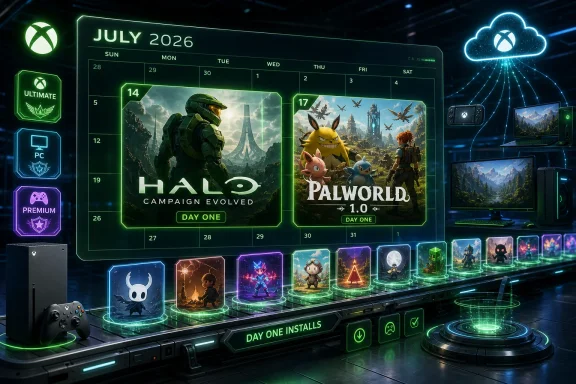
Microsoft’s July 2026 Game Pass slate currently has a dozen confirmed additions, led by Halo: Campaign Evolved on July 28 and Palworld’s 1.0 launch on July 10 across the service’s higher-value tiers. The month is not merely busy; it is a clean illustration of what Game Pass has become after years of Microsoft trying to make the subscription feel inevitable. As reported by TechnoBezz and corroborated by Xbox Wire’s own Halo announcements, July is built around a simple pitch: one restored franchise pillar, one viral survival hit reaching maturity, and a conveyor belt of smaller day-one bets.
That combination matters because Game Pass has spent the last few years oscillating between two identities. Sometimes it looks like a Netflix-style library play, where quantity and back catalog depth do the selling. Other months, it looks like a launch platform, where Microsoft uses day-one access to turn subscription membership into the default way to encounter new games. July 2026 is very much the second version.
The obvious headline is Halo: Campaign Evolved, but the broader story is cadence. Tony Hawk’s Pro Skater 3+4 opened the month on July 2 for Game Pass Premium, while Winds of Arcana: Ruination follows on July 6 across Ultimate, PC, and Premium. Palworld 1.0 lands July 10, then the schedule keeps moving through Ascend to Zero, Denshattack!, Fogpiercer, The Planet Crafter, Tears of Metal, Halo, and Mistfall Hunter.
That is a lot of inventory for one month, but it is also a lot of positioning. Microsoft is not just adding games; it is giving every kind of subscriber a reason to check the app repeatedly. There is nostalgia for lapsed Xbox loyalists, survival crafting for the Discord crowd, roguelike experimentation for the indie audience, and a late-month first-party spectacle designed to dominate the conversation.
The rhythm is important. Game Pass months can feel oddly lopsided when Microsoft drops one large game and pads the rest of the calendar with marginal catalog additions. July 2026, at least on paper, avoids that trap by spreading attention across the month. The result is a service that feels less like a static library and more like a release calendar.
That is exactly the experience Microsoft has wanted Game Pass to create since the beginning. The subscription works best when it changes user behavior — when players stop asking whether to buy a game and start asking whether it is already included. July’s lineup is constructed to reinforce that reflex.
The remake’s structure says as much about modern Xbox as it does about Halo. Campaign Evolved is not being sold as the return of Halo multiplayer dominance. It is being framed as a rebuilt, expanded narrative product: remastered visuals, reworked controls, rebuilt cinematics, and new story missions under the Operation: METEORITE banner.
That decision looks conservative at first glance. Halo without multiplayer sounds like a retreat from the arena in which the franchise once defined console shooters. But it may also be the clearest admission Microsoft and Halo Studios could make about where the brand still has durable power. The original campaign remains iconic in a way that is easier to preserve, reframe, and resell than a multiplayer ecosystem that would have to compete against entrenched live-service giants.
Operation: METEORITE is the interesting compromise. According to Xbox Wire and Halo Waypoint, the three-mission arc is set before the events of Combat Evolved and brings Master Chief and Sergeant Johnson into a new prequel scenario. That gives Halo Studios a way to honor the 2001 original while signaling that this is not just another coat of visual varnish.
The PlayStation 5 release also changes the symbolic value of the remake. Halo on PlayStation would have been heresy in the Xbox 360 era. In 2026, it is simply Microsoft’s multiplatform strategy becoming visible through its most famous green helmet.
That matters because Game Pass has always been unusually well suited to games with curiosity-driven appeal. Palworld became a phenomenon because it was easy to understand, easy to meme, and easy to try. Subscription access lowers the friction even further. Players who might hesitate at a full purchase price can treat the 1.0 launch as an event rather than a transaction.
There is a different risk here than with Halo. A remake of Combat Evolved has a built-in audience and a clear identity. Palworld’s challenge is whether a viral early-access explosion can mature into a stable long-term game. The 1.0 label creates expectations: more polish, better structure, and enough new material to bring back players who already satisfied their initial curiosity.
For Microsoft, the upside is obvious. If Palworld 1.0 lands well, Game Pass gets to position itself not just as a place where finished blockbusters arrive, but as a place where living games cross major thresholds. That is valuable because it gives the subscription a role in a game’s lifecycle, not merely its launch window.
This is the part of the Game Pass model that is easiest to undersell and hardest to replicate. A subscription does not need every one of these games to become a breakout. It needs enough of them to feel discoverable, timely, and varied. When the service works, smaller games benefit from being installed on a platform where players are already browsing for something new.
That is why the calendar matters more than any individual mid-month title. Microsoft is creating a sequence of small decisions. Try this on Monday. Download that on Wednesday. Check again next week. The company wants Game Pass to become habit-forming, and habit is built through recurring novelty.
There is also a portfolio logic at work. A time-bending roguelike, a stylish skating game, a survival terraforming title, and a dark fantasy action release are not interchangeable. They create breadth without requiring Microsoft to spend blockbuster money on every slot. For subscribers, that breadth is part of the perceived value; for developers, it is the promise of visibility in a crowded market.
The unanswered question is whether visibility translates into durable audiences. Game Pass can put a game in front of millions of potential players, but it cannot force long-term engagement. That burden still falls on the game.
This is the quiet complication in Microsoft’s subscription story. Game Pass used to be easy to explain: pay for the service, get the games. As the library, pricing, cloud features, day-one access, and platform splits have grown more complicated, the value proposition has become more conditional. Which tier you have now affects whether July looks like a jackpot or a partial menu.
That is not unique to Microsoft. Every mature subscription eventually discovers segmentation, because companies like recurring revenue but love upsell paths even more. The danger is that segmentation can undermine the simplicity that made the product attractive in the first place.
For Windows users and PC-first players, July is still strong. Halo’s day-one PC Game Pass availability gives Microsoft a marquee release on its own PC subscription at the same time the game heads to Steam and PlayStation. That is the modern Xbox paradox: Microsoft wants its games everywhere, but it still wants the cheapest and most frictionless version of that access to run through its own subscription rails.
The result is a platform strategy that no longer depends solely on console exclusivity. Instead, Xbox tries to own the account, the entitlement, the save file, the launcher relationship, and the monthly payment.
That uncertainty is baked into the service. Game Pass is sold as abundance, but it is governed by licensing, publishing priorities, and rotation economics. Subscribers enjoy the buffet, then occasionally discover that something they meant to play is leaving before they touched it.
For enthusiasts, that creates a different kind of backlog pressure. Owning games creates a pile of shame. Subscribing creates a queue with expiration dates. The psychology is not necessarily worse, but it is different, and Microsoft rarely dwells on it when promoting the latest wave of arrivals.
July’s additions make that trade-off more visible. The more Game Pass feels like a premiere destination, the more users expect stability from the library. But the economics of subscription catalogs rarely reward permanence for everything. The trick is making the arrivals feel exciting enough that departures feel like churn rather than loss.
That calculus works best when the new slate has genuine weight. July 2026 appears to have it.
Campaign Evolved sits at the intersection of those eras. It uses the original Xbox’s defining game as raw material for a 2026 release strategy that would have been almost unthinkable twenty years ago. The same product can be nostalgia bait, Game Pass fuel, PC content, cloud content, and a PlayStation release.
That is not a betrayal so much as a reclassification. Halo is no longer primarily a reason to buy an Xbox console. It is a reason to enter Microsoft’s gaming ecosystem by whichever door is nearest. For some players that door is a Series X. For others it is a Windows PC, a cloud session, or even a rival console.
Whether that strengthens Halo is an open question. Wider availability can expand the audience, but it can also dilute the aura that exclusivity once created. Microsoft appears to have decided that the latter trade-off is acceptable. In a market where hardware margins are tight and development budgets keep rising, the old model looks increasingly sentimental.
Game Pass is the bridge between those eras. It lets Microsoft say Halo is everywhere while still making the subscription feel like the preferred route.
That is cleaner than many Game Pass months, which can feel assembled from leftovers, contractual obligations, and one large marketing beat. July has a stronger editorial shape. It tells subscribers when to pay attention and gives them several different reasons to care.
There are still caveats. Microsoft can announce a strong month without solving the deeper questions around price, tier confusion, developer economics, or long-term catalog stability. A busy July does not prove the model is healthy forever. It proves that, when Microsoft lines up the right mix of titles, Game Pass can still feel like the most aggressive consumer offering in mainstream gaming.
That distinction matters. Game Pass does not need every month to be July 2026. But it needs enough months like this to justify the subscription’s place in players’ budgets as streaming, cloud storage, productivity suites, and other recurring charges compete for the same household money.
The next test is whether July becomes a template or an exception. If Halo lands cleanly, Palworld 1.0 brings players back, and the indie slate produces even one breakout, Microsoft will have a strong case that Game Pass remains more than a catalog with a marketing budget. It will look like a release platform with enough gravity to bend the gaming calendar around itself — and that, more than any single title, is the future Xbox has been trying to sell.
That combination matters because Game Pass has spent the last few years oscillating between two identities. Sometimes it looks like a Netflix-style library play, where quantity and back catalog depth do the selling. Other months, it looks like a launch platform, where Microsoft uses day-one access to turn subscription membership into the default way to encounter new games. July 2026 is very much the second version.
 Microsoft Turns July Into a Subscription Stress Test
The obvious headline is Halo: Campaign Evolved, but the broader story is cadence. Tony Hawk’s Pro Skater 3+4 opened the month on July 2 for Game Pass Premium, while Winds of Arcana: Ruination follows on July 6 across Ultimate, PC, and Premium. Palworld 1.0 lands July 10, then the schedule keeps moving through Ascend to Zero, Denshattack!, Fogpiercer, The Planet Crafter, Tears of Metal, Halo, and Mistfall Hunter.That is a lot of inventory for one month, but it is also a lot of positioning. Microsoft is not just adding games; it is giving every kind of subscriber a reason to check the app repeatedly. There is nostalgia for lapsed Xbox loyalists, survival crafting for the Discord crowd, roguelike experimentation for the indie audience, and a late-month first-party spectacle designed to dominate the conversation.
The rhythm is important. Game Pass months can feel oddly lopsided when Microsoft drops one large game and pads the rest of the calendar with marginal catalog additions. July 2026, at least on paper, avoids that trap by spreading attention across the month. The result is a service that feels less like a static library and more like a release calendar.
That is exactly the experience Microsoft has wanted Game Pass to create since the beginning. The subscription works best when it changes user behavior — when players stop asking whether to buy a game and start asking whether it is already included. July’s lineup is constructed to reinforce that reflex.
Halo Is the Hook, but the Campaign-Only Bet Is the Tell
Halo: Campaign Evolved is the most consequential addition because it carries both emotional weight and strategic baggage. Xbox Wire has described the game as a full Unreal Engine 5 remake of Halo: Combat Evolved’s campaign, with a July 28 launch across Xbox Series X|S, PC, cloud, Steam, PlayStation 5, and Game Pass Ultimate and PC Game Pass. That is a remarkable sentence for anyone who remembers when Halo was less a game than the Xbox platform’s founding myth.The remake’s structure says as much about modern Xbox as it does about Halo. Campaign Evolved is not being sold as the return of Halo multiplayer dominance. It is being framed as a rebuilt, expanded narrative product: remastered visuals, reworked controls, rebuilt cinematics, and new story missions under the Operation: METEORITE banner.
That decision looks conservative at first glance. Halo without multiplayer sounds like a retreat from the arena in which the franchise once defined console shooters. But it may also be the clearest admission Microsoft and Halo Studios could make about where the brand still has durable power. The original campaign remains iconic in a way that is easier to preserve, reframe, and resell than a multiplayer ecosystem that would have to compete against entrenched live-service giants.
Operation: METEORITE is the interesting compromise. According to Xbox Wire and Halo Waypoint, the three-mission arc is set before the events of Combat Evolved and brings Master Chief and Sergeant Johnson into a new prequel scenario. That gives Halo Studios a way to honor the 2001 original while signaling that this is not just another coat of visual varnish.
The PlayStation 5 release also changes the symbolic value of the remake. Halo on PlayStation would have been heresy in the Xbox 360 era. In 2026, it is simply Microsoft’s multiplatform strategy becoming visible through its most famous green helmet.
Palworld’s 1.0 Moment Tests the Other Side of Game Pass
If Halo represents institutional memory, Palworld represents the subscription’s ability to capture internet momentum. The July 10 1.0 release marks the survival sandbox’s formal exit from early access, with TechnoBezz reporting a new region, more Pals, and a more developed narrative structure. PC Gamer has also noted the scale of the 1.0 changes, suggesting this is not a ceremonial version bump.That matters because Game Pass has always been unusually well suited to games with curiosity-driven appeal. Palworld became a phenomenon because it was easy to understand, easy to meme, and easy to try. Subscription access lowers the friction even further. Players who might hesitate at a full purchase price can treat the 1.0 launch as an event rather than a transaction.
There is a different risk here than with Halo. A remake of Combat Evolved has a built-in audience and a clear identity. Palworld’s challenge is whether a viral early-access explosion can mature into a stable long-term game. The 1.0 label creates expectations: more polish, better structure, and enough new material to bring back players who already satisfied their initial curiosity.
For Microsoft, the upside is obvious. If Palworld 1.0 lands well, Game Pass gets to position itself not just as a place where finished blockbusters arrive, but as a place where living games cross major thresholds. That is valuable because it gives the subscription a role in a game’s lifecycle, not merely its launch window.
The Indie Conveyor Belt Is Doing More Work Than It Looks
The middle of the July calendar is full of names that do not carry Halo’s cultural weight or Palworld’s viral history. Ascend to Zero arrives July 13 with its time-freezing roguelike combat hook. Denshattack!, delayed from June, arrives July 15 with a style that immediately invites Jet Set Radio comparisons. Fogpiercer follows July 17, The Planet Crafter lands July 21, and Tears of Metal hits July 22.This is the part of the Game Pass model that is easiest to undersell and hardest to replicate. A subscription does not need every one of these games to become a breakout. It needs enough of them to feel discoverable, timely, and varied. When the service works, smaller games benefit from being installed on a platform where players are already browsing for something new.
That is why the calendar matters more than any individual mid-month title. Microsoft is creating a sequence of small decisions. Try this on Monday. Download that on Wednesday. Check again next week. The company wants Game Pass to become habit-forming, and habit is built through recurring novelty.
There is also a portfolio logic at work. A time-bending roguelike, a stylish skating game, a survival terraforming title, and a dark fantasy action release are not interchangeable. They create breadth without requiring Microsoft to spend blockbuster money on every slot. For subscribers, that breadth is part of the perceived value; for developers, it is the promise of visibility in a crowded market.
The unanswered question is whether visibility translates into durable audiences. Game Pass can put a game in front of millions of potential players, but it cannot force long-term engagement. That burden still falls on the game.
Tiering Is Now Part of the Message
The July lineup also shows how much Game Pass has become a tier-management exercise. Halo: Campaign Evolved is positioned for Ultimate and PC Game Pass. Tony Hawk’s Pro Skater 3+4 is noted for Premium access. Winds of Arcana: Ruination is spread across Ultimate, PC, and Premium. The names matter, but so does where they land.This is the quiet complication in Microsoft’s subscription story. Game Pass used to be easy to explain: pay for the service, get the games. As the library, pricing, cloud features, day-one access, and platform splits have grown more complicated, the value proposition has become more conditional. Which tier you have now affects whether July looks like a jackpot or a partial menu.
That is not unique to Microsoft. Every mature subscription eventually discovers segmentation, because companies like recurring revenue but love upsell paths even more. The danger is that segmentation can undermine the simplicity that made the product attractive in the first place.
For Windows users and PC-first players, July is still strong. Halo’s day-one PC Game Pass availability gives Microsoft a marquee release on its own PC subscription at the same time the game heads to Steam and PlayStation. That is the modern Xbox paradox: Microsoft wants its games everywhere, but it still wants the cheapest and most frictionless version of that access to run through its own subscription rails.
The result is a platform strategy that no longer depends solely on console exclusivity. Instead, Xbox tries to own the account, the entitlement, the save file, the launcher relationship, and the monthly payment.
The Disappearing-Games Anxiety Never Goes Away
Every big Game Pass addition arrives with the same shadow: removals. TechnoBezz points to Pure Xbox’s early August departure predictions, based on the familiar one-year rotation pattern, while noting that Microsoft had not confirmed those removals at the time of reporting. Pure Xbox itself reportedly frames those predictions cautiously, with a historical accuracy range that can vary widely.That uncertainty is baked into the service. Game Pass is sold as abundance, but it is governed by licensing, publishing priorities, and rotation economics. Subscribers enjoy the buffet, then occasionally discover that something they meant to play is leaving before they touched it.
For enthusiasts, that creates a different kind of backlog pressure. Owning games creates a pile of shame. Subscribing creates a queue with expiration dates. The psychology is not necessarily worse, but it is different, and Microsoft rarely dwells on it when promoting the latest wave of arrivals.
July’s additions make that trade-off more visible. The more Game Pass feels like a premiere destination, the more users expect stability from the library. But the economics of subscription catalogs rarely reward permanence for everything. The trick is making the arrivals feel exciting enough that departures feel like churn rather than loss.
That calculus works best when the new slate has genuine weight. July 2026 appears to have it.
Xbox’s Old Identity Is Becoming Raw Material
Halo’s return also frames a larger transformation in Microsoft’s gaming business. The old Xbox identity was built around hardware, exclusives, and a few signature franchises that made the console feel culturally necessary. The new Xbox identity is built around access, subscriptions, cloud support, PC availability, and selective multiplatform releases.Campaign Evolved sits at the intersection of those eras. It uses the original Xbox’s defining game as raw material for a 2026 release strategy that would have been almost unthinkable twenty years ago. The same product can be nostalgia bait, Game Pass fuel, PC content, cloud content, and a PlayStation release.
That is not a betrayal so much as a reclassification. Halo is no longer primarily a reason to buy an Xbox console. It is a reason to enter Microsoft’s gaming ecosystem by whichever door is nearest. For some players that door is a Series X. For others it is a Windows PC, a cloud session, or even a rival console.
Whether that strengthens Halo is an open question. Wider availability can expand the audience, but it can also dilute the aura that exclusivity once created. Microsoft appears to have decided that the latter trade-off is acceptable. In a market where hardware margins are tight and development budgets keep rising, the old model looks increasingly sentimental.
Game Pass is the bridge between those eras. It lets Microsoft say Halo is everywhere while still making the subscription feel like the preferred route.
The July Calendar Gives Microsoft a Rarely Clean Story
The most useful way to read July is not as a list of 12 games, but as a staged argument for Game Pass. The first week says the service has recognizable names. The second week says it has live games reaching major milestones. The middle of the month says it can surface indies at a steady clip. The end of the month says Xbox can still create a tentpole moment.That is cleaner than many Game Pass months, which can feel assembled from leftovers, contractual obligations, and one large marketing beat. July has a stronger editorial shape. It tells subscribers when to pay attention and gives them several different reasons to care.
There are still caveats. Microsoft can announce a strong month without solving the deeper questions around price, tier confusion, developer economics, or long-term catalog stability. A busy July does not prove the model is healthy forever. It proves that, when Microsoft lines up the right mix of titles, Game Pass can still feel like the most aggressive consumer offering in mainstream gaming.
That distinction matters. Game Pass does not need every month to be July 2026. But it needs enough months like this to justify the subscription’s place in players’ budgets as streaming, cloud storage, productivity suites, and other recurring charges compete for the same household money.
The Month Belongs to Players Who Actually Download
July’s value will not be measured by the press graphic. It will be measured by whether subscribers actually play across the range Microsoft is offering. A service can look generous while still producing decision fatigue.- Halo: Campaign Evolved is the month’s flagship, arriving July 28 as a rebuilt campaign-first remake with new Operation: METEORITE missions.
- Palworld’s July 10 version 1.0 launch is the clearest test of whether an early-access phenomenon can convert curiosity into renewed commitment.
- Tony Hawk’s Pro Skater 3+4 and Winds of Arcana: Ruination give the month an immediate opening rhythm before the heavier late-July releases arrive.
- The mid-month run of Ascend to Zero, Denshattack!, Fogpiercer, The Planet Crafter, and Tears of Metal gives Game Pass the variety that makes a subscription feel alive.
- Shift at Midnight, Speedrunners 2: King of Speed, and Wuthering Waves remain July titles without fixed dates, which means Microsoft still has some calendar ambiguity to resolve.
- Any August removals remain unconfirmed until Microsoft says so, even if one-year-cycle predictions give subscribers a useful warning system.
The next test is whether July becomes a template or an exception. If Halo lands cleanly, Palworld 1.0 brings players back, and the indie slate produces even one breakout, Microsoft will have a strong case that Game Pass remains more than a catalog with a marketing budget. It will look like a release platform with enough gravity to bend the gaming calendar around itself — and that, more than any single title, is the future Xbox has been trying to sell.
References
- Primary source: Technobezz
Published: 2026-07-04T21:30:17.186207
Xbox Game Pass Adds 12 Titles in July 2026 Including Halo Campaign Evolved on July 28 | Technobezz
Xbox Game Pass delivers 12 games in July 2026, including the Halo: Combat Evolved remake on July 28.www.technobezz.com - Related coverage: gamesradar.com
Upcoming Xbox Series X games for 2026 and beyond | GamesRadar+
Here are all of the upcoming Xbox Series X games landing in 2026 and beyond, from Fable to Assassin's Creed Black Flag Resyncedwww.gamesradar.com - Related coverage: pcgamer.com
July may be seriously lacking big new game releases, but co-op horror fans are feastin' | PC Gamer
Our July 2026 new PC game release date calendar includes several co-op horror staff picks, Palworld 1.0, and a lengthy list of new game updates and DLC.www.pcgamer.com - Related coverage: gematsu.com
Halo: Campaign Evolved launches July 28 - Gematsu
Halo: Campaign Evolved, a full remake of the Halo: Combat Evolved campaign, will launch for PlayStation 5, Xbox Series, and PC via Steam and Microsoft Store on…www.gematsu.com - Related coverage: techspot.com
The Halo remake launches July 28 with new missions, four-player co-op, and Unreal Engine 5 visuals | TechSpot
Microsoft has spent the past few weeks showing off the drastic changes it has made to Halo: Combat Evolved's lighting, characters, environments, textures, and other visual elements....www.techspot.com - Related coverage: gameluster.com
Halo: Campaign Evolved Launches July 28, 2026 on Xbox, PlayStation and PC | GameLuster
Halo: Campaign Evolved Release Date Set for July 28, 2026gameluster.com
- Related coverage: gamespot.com
New Prologue Missions For Halo: Campaign Evolved Revealed, Releasing In July - GameSpot
The remake of the Xbox classic's single-player campaign launches this summerwww.gamespot.com - Related coverage: shattered.io
Halo: Campaign Evolved on PS5: $49.99, July 28 [2026]
Halo: Campaign Evolved launches July 28, 2026 on PS5, the first Halo ever on PlayStation. Full $49.99 pricing, editions, missions and market analysis.shattered.io - Related coverage: halopedia.org
Halo: Campaign Evolved - Game - Halopedia, the Halo wiki
Halo: Campaign Evolved is an upcoming first-person shooter game developed by Halo Studios and published by Xbox Game Studios. It is a remake of the original Halo: Combat Evolved, recreated in Unreal Engine 5, following up on the Project Foundry demo...www.halopedia.org - Related coverage: aidigitalkeys.com
Halo Campaign Evolved — Release Date, Platforms, Editions & Everything Confirmed (2026) – AIDigitalKeys
Halo Campaign Evolved launches July 28, 2026 on PS5, Xbox and PC. Full remake in Unreal Engine 5, 3 new missions, Game Pass day one — here's every confirmed detail before launch. aidigitalkeys.com
- Related coverage: maxlevelgg.com
All XBOX Game Pass Games Arriving in July 2026 - MaxLevelGamingCommunity
Xbox Game Pass July lineup is here. Check out all 13 confirmed games arriving in July 2026, including Palworld, Halo: Campaign Evolved, etc.www.maxlevelgg.com
- Related coverage: halowaypoint.com
Halo: Campaign Evolved
www.halowaypoint.com
- Related coverage: n-3ds.com
Halo Campaign Evolved : le remake UE5 du 28 juillet | N-3DS
Halo Campaign Evolved sort le 28 juillet 2026 sous Unreal Engine 5, et débarque pour la première fois sur PlayStation 5. Fin de 25 ans d'exclusivité Xbox.www.n-3ds.com - Related coverage: inews.zoombangla.com
Xbox Game Pass July 2026 Adds Tony Hawks, Palworld 1.0, and Halo Campaign Evolved
Xbox Game Pass adds Tony Hawks Pro Skater 3+4, Palworld 1.0, and Halo Campaign Evolved in July 2026 with over a dozen new titles.inews.zoombangla.com - Related coverage: engadget.com
Halo: Campaign Evolved Hits PS5, Xbox And PC On July 28
Take a peek at the new missions in the refreshed Halo.www.engadget.com - Related coverage: techradar.com
Halo Campaign Evolved creative director says the remake will have 'all the original content' and new features to bring it into more of a modern shooter' | TechRadar
Halo Campaign Evolved isn't just a simple remake, but a blend of original content and new features designed for a modern shooter.www.techradar.com - Related coverage: windowscentral.com
New Halo leak claims Xbox is making Halo 2 and Halo 3 remakes after Campaign Evolved — "Active development is underway," here's what we know | Windows Central
Xbox and Halo Studios are reportedly making remakes of Halo 2 and Halo 3, which are in "early development."www.windowscentral.com - Related coverage: as.com
- Related coverage: news.xbox.com
- Related coverage: xbox.com
Buy Halo: The Master Chief Collection | Xbox
Six games, one epic saga. The Master Chief's entire story is brought together and optimized for Xbox Series X|S. : Featuring Halo: Reach, Halo: Combat Evolved Anniversary, Halo 2: Anniversary, Halo 3, Halo 3: ODST Campaign, and Halo 4, this is the definitive Halo experience.www.xbox.com - Related coverage: epix.xbox.com
- Related coverage: ashgabattimes.com
Loading…
ashgabattimes.com