

Android Authority’s Sanuj Bhatia reported that Android Auto users can still sideload unofficial dashboard apps in 2026 by enabling developer options, allowing unknown sources, and installing tools such as Android Auto Apps Downloader. The discovery is less a “hidden feature” than a reminder that Google’s car platform is built on Android’s old tension between openness and control. What makes the story matter is not that YouTube can be made to appear on a car screen; it is that the most safety-sensitive computer many people use every day is still porous enough to invite a shadow app ecosystem.
Android Auto has always been sold as restraint by design. It takes the phone, strips it down to what Google considers drivable, and projects a curated interface onto the vehicle’s screen: navigation, music, calls, messages, voice commands, and a small universe of approved apps. The entire bargain is that your phone may be infinitely distracting, but your dashboard should not be.
Bhatia’s Android Authority piece punctures that tidy story. By walking through Android developer settings, Android Auto’s own developer menu, and the third-party Android Auto Apps Downloader project, he shows that users can install apps Google does not distribute through Play for the car interface. The examples are not subtle: CarStream for YouTube, AAMirror for phone-screen mirroring, and Fermata Auto for local video, IPTV, browser access, and other multimedia features.
That is where the story becomes more than a weekend hack. Google is not merely policing taste when it limits Android Auto apps. It is policing a context: a moving vehicle, a driver, passengers, road rules, liability, and a consumer electronics industry that keeps discovering new reasons to put more glass in front of people.
The uncomfortable part is that the unofficial ecosystem exists because the official one has long lagged what users already expect their screens to do. Once a car has a bright, wide, touch-capable display, the desire to use it like a tablet is inevitable. Google can delay that expectation, constrain it, and wrap it in safety language, but it cannot pretend the hardware does not invite the behavior.
There is no root exploit in that chain. There is no elaborate firmware flashing ritual. The whole thing works because Android’s long-standing model allows users, if they insist, to install software from outside Google’s storefront. Android Auto inherits enough of that flexibility to make the dashboard less locked down than Google’s product surface suggests.
That is both the beauty and the danger of Android. The same openness that lets a power user rescue an old device, install a niche tool, or escape a vendor’s app-store politics also lets a driver put a video browser on the center stack. The platform’s technical affordances do not care whether the user is experimenting at a desk or sitting at a red light.
AAAD’s GitHub description frames the project plainly as a way to download and install apps made specifically for Android Auto outside the Google Play Store. Its catalog has included familiar names from the Android Auto tinkering scene: CarStream, Fermata Auto, AAMirror, Screen2Auto, performance monitors, browser tools, and other utilities that live in the gray space between enthusiast convenience and platform violation.
Google’s own developer documentation, meanwhile, emphasizes driver-optimized experiences and distraction rules. That split is the heart of the issue. Official Android Auto is a policy regime; unofficial Android Auto is a technical possibility space. The former says what should happen in a car. The latter reveals what can happen.
The irony is that Google is now preparing to bring video to Android Auto officially, but on its own terms. Reporting from 9to5Google, Android Central, TechRadar, and others around Google’s 2026 Android Auto roadmap described support for video apps, including YouTube, in compatible vehicles from brands such as BMW, Ford, Genesis, Hyundai, Kia, Mahindra, Mercedes-Benz, Renault, Škoda, Tata, and Volvo. The crucial constraint is that video is meant for parked use.
That distinction matters more than the app icon. Google is not saying video has no place in the car; it is saying video has no place in the driver’s active visual field while the car is moving. For electric vehicles charging at a station, rideshare downtime, school pickup lines, or passengers in parked cars, the use case is obvious. For a driver at 45 mph, it is a lawsuit waiting for a plaintiff.
This is why the unofficial apps feel like a preview of a future arriving without the guardrails. Users want the dashboard to behave like every other screen they own. Google wants the dashboard to behave like a regulated appliance. Automakers, meanwhile, want bigger, richer, more differentiated infotainment systems without becoming responsible for every bad decision made through them.
The sideloading scene collapses those timelines. It gives users tomorrow’s entertainment features yesterday, without the parked-state checks, app review, interface constraints, or manufacturer validation that make those features politically and legally survivable.
This is easy to mock until you remember the environment. A car interface is used peripherally, intermittently, and under stress. The user may be navigating unfamiliar roads, merging, watching pedestrians, or dealing with weather. Every extra layer of interaction competes with a task that can kill people.
Google’s app categories and Android for Cars guidance are built around that reality. Navigation apps, media apps, messaging apps, calling apps, and parked experiences are not merely product categories. They are risk buckets. A podcast queue and a video browser are both “media” in the abstract, but they demand radically different amounts of visual attention.
That is also why screen mirroring is such a red flag. AAMirror and similar tools are fascinating because they erase the boundary between the phone and the car display. But that boundary is the entire point of Android Auto. The phone is a general-purpose distraction machine; Android Auto is supposed to be the filtered version that survives the drive.
Once mirroring is in play, every app becomes a car app. That includes apps whose designers never considered glance time, touch target size, voice fallback, motion states, or the cognitive load of a driver operating them. The issue is not that a browser can show Netflix or Prime Video. The issue is that a browser can show anything.
It is tempting to frame this as the usual cat-and-mouse game between a platform owner and hobbyists. There is some truth to that. Google has never loved software paths it cannot review, monetize, or support. A third-party installer that tells users to disable Play Protect is exactly the kind of thing that makes a platform security team reach for the red pen.
But the car context changes the moral calculus. On a phone, sideloading a flaky video app is mostly your problem. On a dashboard, the blast radius expands to passengers, other drivers, pedestrians, insurers, automakers, and regulators. Google has strong self-interested reasons to clamp down, but it also has legitimate safety reasons.
The strongest argument against Google is not that it blocks CarStream. It is that the official platform has been slow to offer safe, sanctioned versions of things people clearly want. Parked video, richer media layouts, better passenger affordances, and more flexible dashboard personalization are not inherently reckless. They become reckless when the only way to get them is through software Google neither validates nor reliably contains.
That is the classic platform failure mode. If legitimate demand is ignored long enough, unofficial supply fills the gap. Then the platform owner points to the dangers of the unofficial supply as proof that the demand should have been constrained all along.
That shift makes the dashboard a strategic battleground. Automakers want brand control and data. Google wants services, assistant integration, maps, media, and developer gravity. Drivers want convenience. Passengers want entertainment. Regulators want fewer deaths. These priorities are not naturally aligned.
The sideloading story is a small crack that reveals the pressure behind the glass. Once users see the dashboard as a screen, they expect it to behave like a screen. Once Google sees the dashboard as a driving interface, it must prevent it from behaving like a screen at exactly the wrong moment.
The modern vehicle is full of these contradictions. A massive infotainment panel is sold as premium, futuristic, and software-defined. Then the software must spend much of its time pretending the panel is not too capable. The hardware says “cinema.” The safety model says “radio.”
That tension will only get sharper as EV charging, autonomous-driving features, passenger displays, cloud gaming, video conferencing, and AI assistants move deeper into vehicles. The parked car is already becoming a living room. The moving car, however, still needs to be a machine operated under public safety constraints.
The problem is that a car is not just another endpoint. It is an endpoint traveling through public space at speed. The ethical line is different from installing a custom shell on Windows, flashing a router, or loading an APK on a spare handset. The user’s freedom intersects with everyone else’s risk.
That does not mean all unofficial Android Auto experimentation is equally reckless. A performance monitor, a better contact launcher, or a passenger-oriented tool may pose a different risk profile than a video player that remains active in motion. But unofficial software ecosystems rarely enforce those distinctions cleanly. The same pathway that enables a harmless utility can enable the browser, the mirror, and the video stream.
This is where the “Google doesn’t want you to know” framing is fun but incomplete. Google almost certainly does not want mainstream users treating Android Auto like a jailbreak target. Yet the more important issue is that Google does not want to normalize the idea that the car display is simply an Android tablet with a steering wheel nearby.
Power users can understand a hack and still decline to use it. That may be the most mature response here. The knowledge is interesting. The routine use case is much harder to defend.
Disabling a platform protection layer to put unofficial software on a dashboard should give any sysadmin pause. Even if the specific app is benign, the behavior pattern is bad hygiene: download an APK, bypass the primary store, grant permissions, suppress warnings, and trust a niche distribution chain. That is the same muscle memory attackers rely on in less playful contexts.
The car connection can create a false sense of separation. Users may think of Android Auto apps as living “in the car,” but the phone remains central to the projection model. Compromising the phone, weakening its protections, or training the user to ignore install warnings has consequences beyond the dashboard.
For enterprise fleets, that risk is even clearer. A managed Android device connected to a vehicle should not become a playground for unofficial installers. Mobile device management policies, app allowlists, Play Protect enforcement, and Android Auto restrictions exist precisely to keep consumer experimentation from turning into support tickets or liability exposure.
There is also the problem of update fragility. Unofficial Android Auto apps often depend on implementation details Google can change without notice. That means an app may work today, vanish tomorrow, reappear after a workaround, and then break again after a Play services or Android Auto update. For a hobbyist, that is tinkering. For anyone who expects reliability, it is a nonstarter.
That is a tacit admission that the old dashboard minimalism was never going to hold forever. Cars now spend meaningful time stationary while occupied, especially EVs at chargers. Displays are larger and better. Passengers expect entertainment. Automakers want to advertise software features after the sale. Google cannot keep saying “maps and music only” while the rest of the vehicle becomes a software lounge.
But official support also lets Google draw a bright line: entertainment while parked, reduced distraction while moving. According to reporting around Google’s 2026 announcements, some video experiences are expected to transition into audio-only modes when driving begins. That is exactly the kind of compromise the unofficial ecosystem usually lacks.
This is how mature platforms absorb hacks. They identify the user demand, reject the unsafe implementation, and ship a constrained version that satisfies enough people to shrink the workaround market. Apple did this repeatedly with iOS features that began as jailbreak tweaks. Microsoft has done it with power-user utilities. Google now appears to be doing it, slowly, in the car.
The challenge is timing. If Google moves too slowly, users keep reaching for AAAD and its successors. If Google moves too quickly, regulators and safety advocates will accuse it of turning cars into rolling theaters. The company has to make the parked car more useful without making the moving car more dangerous.
Google’s problem is that curiosity does not wait for product roadmaps. If Android Auto is going to become a richer in-car platform, the company has to move faster on legitimate parked and passenger experiences while staying ruthless about motion-state safety. Otherwise the dashboard’s future will keep arriving first through the side door, where the apps are more exciting, the rules are weaker, and the road outside the windshield has not become any less real.
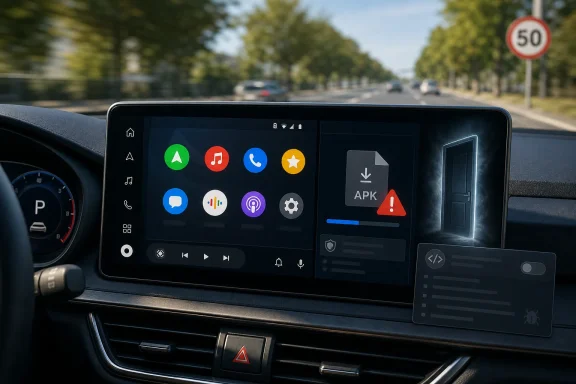 Google’s Dashboard Walled Garden Has a Side Door
Android Auto has always been sold as restraint by design. It takes the phone, strips it down to what Google considers drivable, and projects a curated interface onto the vehicle’s screen: navigation, music, calls, messages, voice commands, and a small universe of approved apps. The entire bargain is that your phone may be infinitely distracting, but your dashboard should not be.Bhatia’s Android Authority piece punctures that tidy story. By walking through Android developer settings, Android Auto’s own developer menu, and the third-party Android Auto Apps Downloader project, he shows that users can install apps Google does not distribute through Play for the car interface. The examples are not subtle: CarStream for YouTube, AAMirror for phone-screen mirroring, and Fermata Auto for local video, IPTV, browser access, and other multimedia features.
That is where the story becomes more than a weekend hack. Google is not merely policing taste when it limits Android Auto apps. It is policing a context: a moving vehicle, a driver, passengers, road rules, liability, and a consumer electronics industry that keeps discovering new reasons to put more glass in front of people.
The uncomfortable part is that the unofficial ecosystem exists because the official one has long lagged what users already expect their screens to do. Once a car has a bright, wide, touch-capable display, the desire to use it like a tablet is inevitable. Google can delay that expectation, constrain it, and wrap it in safety language, but it cannot pretend the hardware does not invite the behavior.
The Hack Is Simple Because Android Is Still Android
The sideloading path Bhatia describes is familiar to anyone who has spent time around Android phones. Enable developer mode on the handset by tapping the build number repeatedly. Open Android Auto’s additional settings, unlock its developer menu, and enable unknown sources. Install AAAD from outside the Play Store, grant the permissions it needs, and use it as an unofficial catalog for Android Auto-capable apps.There is no root exploit in that chain. There is no elaborate firmware flashing ritual. The whole thing works because Android’s long-standing model allows users, if they insist, to install software from outside Google’s storefront. Android Auto inherits enough of that flexibility to make the dashboard less locked down than Google’s product surface suggests.
That is both the beauty and the danger of Android. The same openness that lets a power user rescue an old device, install a niche tool, or escape a vendor’s app-store politics also lets a driver put a video browser on the center stack. The platform’s technical affordances do not care whether the user is experimenting at a desk or sitting at a red light.
AAAD’s GitHub description frames the project plainly as a way to download and install apps made specifically for Android Auto outside the Google Play Store. Its catalog has included familiar names from the Android Auto tinkering scene: CarStream, Fermata Auto, AAMirror, Screen2Auto, performance monitors, browser tools, and other utilities that live in the gray space between enthusiast convenience and platform violation.
Google’s own developer documentation, meanwhile, emphasizes driver-optimized experiences and distraction rules. That split is the heart of the issue. Official Android Auto is a policy regime; unofficial Android Auto is a technical possibility space. The former says what should happen in a car. The latter reveals what can happen.
The Most Revealing App Is the One Google Is Already Bringing Back
CarStream is the headline grabber because it does the thing everyone understands immediately: it puts YouTube on the car display. Bhatia notes that it can work even while the car is in motion, which is precisely the behavior Google’s official model tries to prevent. As a consumer trick, it is impressive. As a driving feature, it is indefensible.The irony is that Google is now preparing to bring video to Android Auto officially, but on its own terms. Reporting from 9to5Google, Android Central, TechRadar, and others around Google’s 2026 Android Auto roadmap described support for video apps, including YouTube, in compatible vehicles from brands such as BMW, Ford, Genesis, Hyundai, Kia, Mahindra, Mercedes-Benz, Renault, Škoda, Tata, and Volvo. The crucial constraint is that video is meant for parked use.
That distinction matters more than the app icon. Google is not saying video has no place in the car; it is saying video has no place in the driver’s active visual field while the car is moving. For electric vehicles charging at a station, rideshare downtime, school pickup lines, or passengers in parked cars, the use case is obvious. For a driver at 45 mph, it is a lawsuit waiting for a plaintiff.
This is why the unofficial apps feel like a preview of a future arriving without the guardrails. Users want the dashboard to behave like every other screen they own. Google wants the dashboard to behave like a regulated appliance. Automakers, meanwhile, want bigger, richer, more differentiated infotainment systems without becoming responsible for every bad decision made through them.
The sideloading scene collapses those timelines. It gives users tomorrow’s entertainment features yesterday, without the parked-state checks, app review, interface constraints, or manufacturer validation that make those features politically and legally survivable.
Android Auto’s Safety Model Depends on Boredom
The official Android Auto experience is intentionally boring. Its app templates are constrained. Its interactions are shallow. Its message handling is mediated through voice. Its media controls are large, repetitive, and predictable. That boredom is not a failure of imagination; it is the product requirement.This is easy to mock until you remember the environment. A car interface is used peripherally, intermittently, and under stress. The user may be navigating unfamiliar roads, merging, watching pedestrians, or dealing with weather. Every extra layer of interaction competes with a task that can kill people.
Google’s app categories and Android for Cars guidance are built around that reality. Navigation apps, media apps, messaging apps, calling apps, and parked experiences are not merely product categories. They are risk buckets. A podcast queue and a video browser are both “media” in the abstract, but they demand radically different amounts of visual attention.
That is also why screen mirroring is such a red flag. AAMirror and similar tools are fascinating because they erase the boundary between the phone and the car display. But that boundary is the entire point of Android Auto. The phone is a general-purpose distraction machine; Android Auto is supposed to be the filtered version that survives the drive.
Once mirroring is in play, every app becomes a car app. That includes apps whose designers never considered glance time, touch target size, voice fallback, motion states, or the cognitive load of a driver operating them. The issue is not that a browser can show Netflix or Prime Video. The issue is that a browser can show anything.
Google’s Crackdowns Are Not Just Control Freakery
Bhatia notes that Google regularly patches sideloading routes and that recent Android updates may already break some setups. Reddit threads and enthusiast communities tell the same story in messier form: apps disappear from launchers, Android Auto updates change behavior, workarounds work until they do not, and users shuffle between installers, downgraded versions, dongles, and obscure toggles.It is tempting to frame this as the usual cat-and-mouse game between a platform owner and hobbyists. There is some truth to that. Google has never loved software paths it cannot review, monetize, or support. A third-party installer that tells users to disable Play Protect is exactly the kind of thing that makes a platform security team reach for the red pen.
But the car context changes the moral calculus. On a phone, sideloading a flaky video app is mostly your problem. On a dashboard, the blast radius expands to passengers, other drivers, pedestrians, insurers, automakers, and regulators. Google has strong self-interested reasons to clamp down, but it also has legitimate safety reasons.
The strongest argument against Google is not that it blocks CarStream. It is that the official platform has been slow to offer safe, sanctioned versions of things people clearly want. Parked video, richer media layouts, better passenger affordances, and more flexible dashboard personalization are not inherently reckless. They become reckless when the only way to get them is through software Google neither validates nor reliably contains.
That is the classic platform failure mode. If legitimate demand is ignored long enough, unofficial supply fills the gap. Then the platform owner points to the dangers of the unofficial supply as proof that the demand should have been constrained all along.
The Car Screen Has Become the New Phone Lock Screen
The bigger trend is that car displays are becoming general-purpose computing surfaces. Android Auto began as a projection system: your phone remained the brain, and the car acted as the display. Android Automotive OS goes further, putting Google’s operating environment directly into the vehicle. Apple’s next-generation CarPlay ambitions push in the same direction from the other side of the aisle.That shift makes the dashboard a strategic battleground. Automakers want brand control and data. Google wants services, assistant integration, maps, media, and developer gravity. Drivers want convenience. Passengers want entertainment. Regulators want fewer deaths. These priorities are not naturally aligned.
The sideloading story is a small crack that reveals the pressure behind the glass. Once users see the dashboard as a screen, they expect it to behave like a screen. Once Google sees the dashboard as a driving interface, it must prevent it from behaving like a screen at exactly the wrong moment.
The modern vehicle is full of these contradictions. A massive infotainment panel is sold as premium, futuristic, and software-defined. Then the software must spend much of its time pretending the panel is not too capable. The hardware says “cinema.” The safety model says “radio.”
That tension will only get sharper as EV charging, autonomous-driving features, passenger displays, cloud gaming, video conferencing, and AI assistants move deeper into vehicles. The parked car is already becoming a living room. The moving car, however, still needs to be a machine operated under public safety constraints.
Enthusiasts Should Recognize the Difference Between Capability and Wisdom
WindowsForum readers do not need a lecture on sideloading as a concept. The PC tradition is built on the idea that owners should be able to run what they want on hardware they bought. Many Android enthusiasts feel the same way about their phones, and with good reason. A locked-down computing device is often safer, but it is also less personal, less repairable, and less interesting.The problem is that a car is not just another endpoint. It is an endpoint traveling through public space at speed. The ethical line is different from installing a custom shell on Windows, flashing a router, or loading an APK on a spare handset. The user’s freedom intersects with everyone else’s risk.
That does not mean all unofficial Android Auto experimentation is equally reckless. A performance monitor, a better contact launcher, or a passenger-oriented tool may pose a different risk profile than a video player that remains active in motion. But unofficial software ecosystems rarely enforce those distinctions cleanly. The same pathway that enables a harmless utility can enable the browser, the mirror, and the video stream.
This is where the “Google doesn’t want you to know” framing is fun but incomplete. Google almost certainly does not want mainstream users treating Android Auto like a jailbreak target. Yet the more important issue is that Google does not want to normalize the idea that the car display is simply an Android tablet with a steering wheel nearby.
Power users can understand a hack and still decline to use it. That may be the most mature response here. The knowledge is interesting. The routine use case is much harder to defend.
The Installer Is Also a Security Story
The safety debate tends to dominate Android Auto sideloading, but the security angle is not a footnote. AAAD is installed outside the Play Store. Users may need to grant unknown-app installation permissions. Bhatia’s walkthrough also notes that users may be asked to disable Google Play Protect, which is a major line to cross for a convenience feature.Disabling a platform protection layer to put unofficial software on a dashboard should give any sysadmin pause. Even if the specific app is benign, the behavior pattern is bad hygiene: download an APK, bypass the primary store, grant permissions, suppress warnings, and trust a niche distribution chain. That is the same muscle memory attackers rely on in less playful contexts.
The car connection can create a false sense of separation. Users may think of Android Auto apps as living “in the car,” but the phone remains central to the projection model. Compromising the phone, weakening its protections, or training the user to ignore install warnings has consequences beyond the dashboard.
For enterprise fleets, that risk is even clearer. A managed Android device connected to a vehicle should not become a playground for unofficial installers. Mobile device management policies, app allowlists, Play Protect enforcement, and Android Auto restrictions exist precisely to keep consumer experimentation from turning into support tickets or liability exposure.
There is also the problem of update fragility. Unofficial Android Auto apps often depend on implementation details Google can change without notice. That means an app may work today, vanish tomorrow, reappear after a workaround, and then break again after a Play services or Android Auto update. For a hobbyist, that is tinkering. For anyone who expects reliability, it is a nonstarter.
Google’s Official Video Pivot Is the Real Tell
The most important detail in the broader Android Auto roadmap is not that Google is allowing video. It is that Google is allowing video under a framework it controls. Parked-state behavior, supported vehicles, app categories, audio handoff, and distribution through approved channels are the pieces that make video acceptable to the platform owner.That is a tacit admission that the old dashboard minimalism was never going to hold forever. Cars now spend meaningful time stationary while occupied, especially EVs at chargers. Displays are larger and better. Passengers expect entertainment. Automakers want to advertise software features after the sale. Google cannot keep saying “maps and music only” while the rest of the vehicle becomes a software lounge.
But official support also lets Google draw a bright line: entertainment while parked, reduced distraction while moving. According to reporting around Google’s 2026 announcements, some video experiences are expected to transition into audio-only modes when driving begins. That is exactly the kind of compromise the unofficial ecosystem usually lacks.
This is how mature platforms absorb hacks. They identify the user demand, reject the unsafe implementation, and ship a constrained version that satisfies enough people to shrink the workaround market. Apple did this repeatedly with iOS features that began as jailbreak tweaks. Microsoft has done it with power-user utilities. Google now appears to be doing it, slowly, in the car.
The challenge is timing. If Google moves too slowly, users keep reaching for AAAD and its successors. If Google moves too quickly, regulators and safety advocates will accuse it of turning cars into rolling theaters. The company has to make the parked car more useful without making the moving car more dangerous.
The Dashboard Hack Leaves Five Uncomfortable Lessons
The Android Authority experiment is useful precisely because it does not end with a triumphant recommendation. Bhatia found the apps impressive and then warned most people away from them. That ambivalence is the correct posture for a feature that is technically possible, culturally inevitable, and operationally risky.- Android Auto sideloading is real, relatively accessible, and does not require rooting the phone in the workflow described by Android Authority.
- The most attention-grabbing unofficial apps are aimed at video, browsing, and screen mirroring, which are exactly the categories Google has the strongest incentive to restrict while driving.
- Google’s upcoming official support for parked video shows that the company understands the demand, but wants the feature inside a safety and compatibility framework.
- Users who disable Play Protect or install APKs from unofficial channels are accepting security tradeoffs that go beyond the car screen.
- Enterprise and fleet administrators should treat unofficial Android Auto app paths as policy violations, not harmless personalization.
- The long-term answer is not pretending drivers do not want richer car screens, but making the richer features context-aware, auditable, and hard to misuse.
Google’s problem is that curiosity does not wait for product roadmaps. If Android Auto is going to become a richer in-car platform, the company has to move faster on legitimate parked and passenger experiences while staying ruthless about motion-state safety. Otherwise the dashboard’s future will keep arriving first through the side door, where the apps are more exciting, the rules are weaker, and the road outside the windshield has not become any less real.
References
- Primary source: Android Authority
Published: Sun, 05 Jul 2026 11:10:23 GMT
Loading…
www.androidauthority.com - Related coverage: aaad-app.com
Loading…
aaad-app.com - Related coverage: aaad.app
Loading…
www.aaad.app - Related coverage: cartechstudio.com
Loading…
cartechstudio.com - Related coverage: android-auto-apps-downloader-aaad.en.uptodown.com
Loading…
android-auto-apps-downloader-aaad.en.uptodown.com - Related coverage: developer.android.com
Loading…
developer.android.com