

Google is rolling out Android 17's first Pixel release alongside Gemma 4 12B, a local multimodal AI model for 16GB laptops, bringing floating app windows, screen reaction recording, foldable display changes, and more on-device intelligence to phones and PCs in mid-2026. The announcement, amplified by Zoombangla and corroborated by Google’s own Gemma materials and Android-focused reporting, is less about one feature drop than a platform bet. Google is trying to make AI feel like part of the operating system rather than a button that summons a remote chatbot. That shift will matter most when the novelty fades and users start judging AI by latency, privacy, battery life, and whether it actually helps them finish work.
For the past two years, consumer AI has mostly felt like a cloud service wearing different costumes. You typed into a web app, waited for a server somewhere to answer, and hoped the response was useful enough to justify the round trip. Android 17 and Gemma 4 12B point in a different direction: the model is coming closer to the device, and the device is being redesigned around that assumption.
That does not mean the cloud disappears. Google’s most capable Gemini experiences still depend on remote infrastructure, subscriptions, and the enormous economics of hyperscale AI. But the center of gravity is shifting. The phone is no longer just a microphone, camera, and screen attached to someone else’s intelligence; it is becoming a local inference machine with system privileges.
This is why the Android 17 rollout is strategically more interesting than the usual annual Android feature checklist. Floating windows, foldable refinements, screen reactions, and smarter app context all look like interface features. Underneath, they are signals that Android is being prepared for a world where AI watches the user’s context, understands the screen, and acts inside the operating system.
On a large-screen foldable or tablet, this is easy to understand. Users want chat, maps, video, email, and documents to coexist without the clumsy app-switching dance that still defines much of mobile computing. On a standard phone, the payoff is subtler but potentially more important: the operating system starts to behave less like a stack of full-screen silos and more like a desktop-lite workspace.
The AI angle is not that a model magically invents multitasking. It is that context-aware behavior becomes necessary once apps are allowed to float, shrink, expand, and move across folded and unfolded states. A system that knows which app should remain visible, which input mode matters, and which screen posture is useful can make multitasking feel intentional instead of fiddly.
That distinction matters for Windows users watching from the PC side. Microsoft has spent decades making overlapping windows feel natural with a keyboard and mouse. Google is trying to make the same idea workable on glass, hinges, cameras, and thumbs — and AI is becoming the lubricant that makes the interface less brittle.
But it also represents a larger pattern. Android is increasingly treating camera, screen, audio, and app context as composable system resources. Once the operating system can capture a reaction overlay without sending everything through a third-party editing pipeline, it creates a new layer of local media intelligence.
That raises obvious privacy questions. A feature that records a face while the user consumes content must be legible, controllable, and difficult to trigger accidentally. Google’s pitch around on-device processing is meant to calm those concerns, but local processing is not a privacy guarantee by itself. It is an architectural advantage that still depends on permissions, defaults, retention policies, and user trust.
For IT admins, this is where consumer convenience turns into governance work. A phone that can summarize, record, react, translate, and manipulate media locally is powerful. It is also harder to monitor with old assumptions that sensitive processing happens only in the cloud.
Games are a particularly hard case because they are sensitive to timing, orientation, and interface disruption. If Android can preserve state and adapt layouts when a device folds or unfolds, the same machinery can improve productivity apps, media editors, video calls, and enterprise dashboards. The gaming use case is the demo; the platform capability is the real story.
This also explains why Google keeps pushing Pixel hardware even though Samsung remains the dominant foldable player. Pixel devices let Google define the reference experience. Once that experience exists, OEMs can extend it, skin it, or compete with it — but they are reacting to a baseline Google controls.
The Windows analogy is again instructive. Microsoft learned with Surface that hardware can be a way to pressure the ecosystem, not merely a profit center. Google’s Pixel line now plays a similar role for Android AI: not the volume leader, but the place where the future is made visible first.
The model’s importance lies in its middle position. Tiny mobile models can be fast and private but limited. Huge frontier models can reason broadly but require cloud infrastructure or expensive hardware. A 12-billion-parameter local model is an attempt to make “good enough, right here, right now” intelligence widely available.
For developers, that changes the economics of experimentation. Local inference means fewer API calls, lower recurring costs, and more predictable behavior when connectivity is bad or data cannot leave the machine. It also invites a different application style: tools that draft, classify, search, summarize, and reason inside the user’s own environment.
This is where Google’s open-model strategy becomes important. Gemma is not Gemini, and Google is careful about that distinction. But open-weight models give developers something they can inspect, tune, package, and deploy in ways that a closed cloud chatbot cannot easily support.
But privacy-conscious users should resist the temptation to treat “on-device” as a synonym for “safe.” A local model can still be embedded in an app with aggressive telemetry. A local assistant can still surface sensitive data to the wrong user. A local summarizer can still create new records that become discoverable, syncable, or leakable.
The better way to think about on-device AI is as a new control point. It gives platform vendors, developers, and enterprises more options. It does not eliminate the need for policy, auditability, encryption, app vetting, or user education.
For WindowsForum readers, this should sound familiar. The PC world has spent decades learning that local computation is empowering and risky in equal measure. Android is now inheriting that same bargain at smartphone scale.
Google’s advantage is depth in AI research and infrastructure. Its disadvantage is Android fragmentation. A Pixel-first rollout can show what is possible, but the Android installed base spans wildly different chips, memory configurations, OEM skins, regional policies, and update schedules.
That is why Gemma 4 12B matters beyond Android phones. By targeting ordinary laptops with 16GB of memory, Google can push local AI through the developer ecosystem even when phone hardware varies. The model becomes a bridge: train developers to build local-first AI workflows on PCs, then let smaller variants and optimized runtimes bring pieces of that experience to mobile.
Microsoft is pursuing a related idea through Copilot+ PCs and NPUs. Apple is doing it through tight integration across silicon, OS, and apps. Google’s version is messier, more open, and potentially broader — which is exactly the Android story in miniature.
That weakens Google’s ability to make a single consumer promise. A Pixel 10 user may get Android 17’s best multitasking and AI features quickly, while another Android owner may see a modified version months later, or not at all. The more AI depends on hardware acceleration and memory, the more uneven the experience can become.
Still, fragmentation can also be a strength. OEMs can adapt features to foldables, gaming phones, tablets, rugged devices, and enterprise handsets. If Google defines the core AI hooks well, Android vendors can compete on implementation rather than reinventing every layer.
The risk is that the AI stack becomes another compatibility maze. Developers do not want to test every feature against every vendor’s interpretation of “local intelligence.” Google’s challenge is to make Android’s AI capabilities feel like a platform, not a collection of demos.
Android 17 and Gemma 4 12B make that problem more urgent. A user with a capable phone or laptop may soon be able to summarize confidential notes, analyze screenshots, draft responses, classify documents, or process meeting audio without touching a corporate AI service. That is useful, but it also means policy enforcement can no longer assume that blocking a web endpoint blocks AI usage.
Enterprises will need clearer rules about local models. Is local inference allowed on managed devices? Can employees load open-weight models? Which data classes may be processed by on-device AI? Should outputs be treated as derived confidential data? These are not theoretical governance questions anymore.
There is also a support burden. When AI features are embedded in the OS, help desks inherit them. Users will ask why a feature is missing, why it behaves differently across devices, why battery life changed, or why a managed policy disables something advertised on television.
The harder part is product design. A local model is not infinite. It has memory limits, performance tradeoffs, quantization quirks, device-specific acceleration paths, and variable quality across tasks. Developers must decide when to use local inference, when to call the cloud, and how to explain the difference without making users think about model routing.
Gemma 4 12B gives developers a credible target for mainstream laptops, but phones will remain more constrained. Smaller Gemma-derived models may handle narrower tasks beautifully, while bigger reasoning workflows still need cloud help. The best apps will hide that complexity while preserving user choice.
This is where platform vendors can either help or make a mess. If Google provides stable APIs, strong tooling, and predictable performance profiles, developers can build durable software. If every feature depends on device-specific magic, local AI becomes yet another compatibility tax.
Android 17’s most important AI features may therefore be the least theatrical ones. Better multitasking, smarter layout adaptation, local reactions, offline model access, and lower-latency assistance are not science fiction. They are the kind of incremental improvements that can make a device feel modern.
That is also why Google’s strategy is plausible. The company does not need every Android user to run a frontier model locally. It needs enough local intelligence in enough places that Android starts to feel context-aware by default. Once that happens, cloud AI becomes an escalation path rather than the starting point.
The danger is overpromising. “AI agent” remains a slippery phrase, and users are learning to be skeptical. If Android 17 feels like a set of helpful system upgrades, Google wins trust. If it feels like branding pasted over inconsistent features, the backlash will be swift.
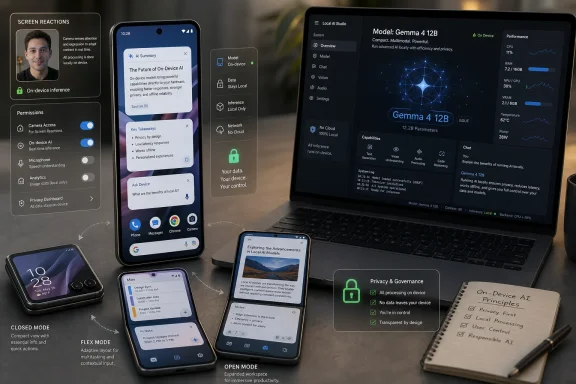 Google Is Moving AI From the Data Center Into the Default Experience
For the past two years, consumer AI has mostly felt like a cloud service wearing different costumes. You typed into a web app, waited for a server somewhere to answer, and hoped the response was useful enough to justify the round trip. Android 17 and Gemma 4 12B point in a different direction: the model is coming closer to the device, and the device is being redesigned around that assumption.That does not mean the cloud disappears. Google’s most capable Gemini experiences still depend on remote infrastructure, subscriptions, and the enormous economics of hyperscale AI. But the center of gravity is shifting. The phone is no longer just a microphone, camera, and screen attached to someone else’s intelligence; it is becoming a local inference machine with system privileges.
This is why the Android 17 rollout is strategically more interesting than the usual annual Android feature checklist. Floating windows, foldable refinements, screen reactions, and smarter app context all look like interface features. Underneath, they are signals that Android is being prepared for a world where AI watches the user’s context, understands the screen, and acts inside the operating system.
Android 17 Makes Multitasking Look Like an AI Problem
The most visible Android 17 change is the expansion of floating app windows, described in early coverage as a way to keep apps open side-by-side or in persistent bubbles. Android has flirted with this idea for years, and Samsung, Lenovo, Xiaomi, and other Android vendors have long shipped their own versions of floating windows. What changes now is Google bringing the model closer to the platform baseline.On a large-screen foldable or tablet, this is easy to understand. Users want chat, maps, video, email, and documents to coexist without the clumsy app-switching dance that still defines much of mobile computing. On a standard phone, the payoff is subtler but potentially more important: the operating system starts to behave less like a stack of full-screen silos and more like a desktop-lite workspace.
The AI angle is not that a model magically invents multitasking. It is that context-aware behavior becomes necessary once apps are allowed to float, shrink, expand, and move across folded and unfolded states. A system that knows which app should remain visible, which input mode matters, and which screen posture is useful can make multitasking feel intentional instead of fiddly.
That distinction matters for Windows users watching from the PC side. Microsoft has spent decades making overlapping windows feel natural with a keyboard and mouse. Google is trying to make the same idea workable on glass, hinges, cameras, and thumbs — and AI is becoming the lubricant that makes the interface less brittle.
Screen Reactions Turn the Camera Into a System Feature
Screen Reactions, the feature that can record a user’s face while watching or browsing content, sounds like creator bait. In one sense, it is. Reaction videos are a native internet format now, and baking the mechanic into Android lowers the friction for social posting.But it also represents a larger pattern. Android is increasingly treating camera, screen, audio, and app context as composable system resources. Once the operating system can capture a reaction overlay without sending everything through a third-party editing pipeline, it creates a new layer of local media intelligence.
That raises obvious privacy questions. A feature that records a face while the user consumes content must be legible, controllable, and difficult to trigger accidentally. Google’s pitch around on-device processing is meant to calm those concerns, but local processing is not a privacy guarantee by itself. It is an architectural advantage that still depends on permissions, defaults, retention policies, and user trust.
For IT admins, this is where consumer convenience turns into governance work. A phone that can summarize, record, react, translate, and manipulate media locally is powerful. It is also harder to monitor with old assumptions that sensitive processing happens only in the cloud.
Foldables Are Becoming the Test Lab for Adaptive Android
Foldables remain a small slice of the smartphone market, but they are disproportionately important to Android’s future. They force the OS to solve problems that slab phones can avoid: changing aspect ratios, continuity between displays, app resizing, and input modes that can shift mid-session. Android 17’s foldable gaming and layout improvements should be read in that context.Games are a particularly hard case because they are sensitive to timing, orientation, and interface disruption. If Android can preserve state and adapt layouts when a device folds or unfolds, the same machinery can improve productivity apps, media editors, video calls, and enterprise dashboards. The gaming use case is the demo; the platform capability is the real story.
This also explains why Google keeps pushing Pixel hardware even though Samsung remains the dominant foldable player. Pixel devices let Google define the reference experience. Once that experience exists, OEMs can extend it, skin it, or compete with it — but they are reacting to a baseline Google controls.
The Windows analogy is again instructive. Microsoft learned with Surface that hardware can be a way to pressure the ecosystem, not merely a profit center. Google’s Pixel line now plays a similar role for Android AI: not the volume leader, but the place where the future is made visible first.
Gemma 4 12B Is Google’s Local-AI Bridge Between Phones and PCs
Gemma 4 12B may be the more consequential announcement for developers. Google describes it as a compact, multimodal model designed to run locally on machines with around 16GB of memory. That puts it squarely in the range of mainstream laptops, small workstations, and enthusiast desktops rather than only high-end AI rigs.The model’s importance lies in its middle position. Tiny mobile models can be fast and private but limited. Huge frontier models can reason broadly but require cloud infrastructure or expensive hardware. A 12-billion-parameter local model is an attempt to make “good enough, right here, right now” intelligence widely available.
For developers, that changes the economics of experimentation. Local inference means fewer API calls, lower recurring costs, and more predictable behavior when connectivity is bad or data cannot leave the machine. It also invites a different application style: tools that draft, classify, search, summarize, and reason inside the user’s own environment.
This is where Google’s open-model strategy becomes important. Gemma is not Gemini, and Google is careful about that distinction. But open-weight models give developers something they can inspect, tune, package, and deploy in ways that a closed cloud chatbot cannot easily support.
The Privacy Pitch Is Real, but It Is Not Magic
Google’s argument for on-device AI is straightforward: if the model runs locally, sensitive inputs do not always need to travel to remote servers. That can reduce latency and limit exposure. It can also make AI features work offline or in degraded network conditions.But privacy-conscious users should resist the temptation to treat “on-device” as a synonym for “safe.” A local model can still be embedded in an app with aggressive telemetry. A local assistant can still surface sensitive data to the wrong user. A local summarizer can still create new records that become discoverable, syncable, or leakable.
The better way to think about on-device AI is as a new control point. It gives platform vendors, developers, and enterprises more options. It does not eliminate the need for policy, auditability, encryption, app vetting, or user education.
For WindowsForum readers, this should sound familiar. The PC world has spent decades learning that local computation is empowering and risky in equal measure. Android is now inheriting that same bargain at smartphone scale.
Apple Forced the Industry to Talk About Local Intelligence
Google’s timing is not accidental. Apple’s “private cloud plus on-device” AI framing changed the competitive conversation, even when Apple’s rollout was uneven and constrained by hardware requirements. Once Apple made privacy-preserving local intelligence a consumer marketing point, Google had to answer in platform terms.Google’s advantage is depth in AI research and infrastructure. Its disadvantage is Android fragmentation. A Pixel-first rollout can show what is possible, but the Android installed base spans wildly different chips, memory configurations, OEM skins, regional policies, and update schedules.
That is why Gemma 4 12B matters beyond Android phones. By targeting ordinary laptops with 16GB of memory, Google can push local AI through the developer ecosystem even when phone hardware varies. The model becomes a bridge: train developers to build local-first AI workflows on PCs, then let smaller variants and optimized runtimes bring pieces of that experience to mobile.
Microsoft is pursuing a related idea through Copilot+ PCs and NPUs. Apple is doing it through tight integration across silicon, OS, and apps. Google’s version is messier, more open, and potentially broader — which is exactly the Android story in miniature.
Pixel Gets the Future First, Everyone Else Gets the Negotiation
Android rollouts always come with an asterisk. Pixel owners get the cleanest and earliest experience. Other Android users wait for Samsung, OnePlus, Xiaomi, Motorola, carrier testing, regional certification, and vendor priorities. Android 17 will not arrive as one universal event.That weakens Google’s ability to make a single consumer promise. A Pixel 10 user may get Android 17’s best multitasking and AI features quickly, while another Android owner may see a modified version months later, or not at all. The more AI depends on hardware acceleration and memory, the more uneven the experience can become.
Still, fragmentation can also be a strength. OEMs can adapt features to foldables, gaming phones, tablets, rugged devices, and enterprise handsets. If Google defines the core AI hooks well, Android vendors can compete on implementation rather than reinventing every layer.
The risk is that the AI stack becomes another compatibility maze. Developers do not want to test every feature against every vendor’s interpretation of “local intelligence.” Google’s challenge is to make Android’s AI capabilities feel like a platform, not a collection of demos.
The Enterprise Problem Is No Longer Whether AI Arrives
For sysadmins, the practical issue is not whether users will bring AI into the workplace. They already have. The issue is whether that AI runs in sanctioned cloud tools, unsanctioned browser tabs, personal phones, local models, or some messy combination of all four.Android 17 and Gemma 4 12B make that problem more urgent. A user with a capable phone or laptop may soon be able to summarize confidential notes, analyze screenshots, draft responses, classify documents, or process meeting audio without touching a corporate AI service. That is useful, but it also means policy enforcement can no longer assume that blocking a web endpoint blocks AI usage.
Enterprises will need clearer rules about local models. Is local inference allowed on managed devices? Can employees load open-weight models? Which data classes may be processed by on-device AI? Should outputs be treated as derived confidential data? These are not theoretical governance questions anymore.
There is also a support burden. When AI features are embedded in the OS, help desks inherit them. Users will ask why a feature is missing, why it behaves differently across devices, why battery life changed, or why a managed policy disables something advertised on television.
Developers Get a Bigger Canvas and a Harder Compatibility Matrix
For developers, the upside is obvious. Local models enable features that feel immediate and private: semantic search over personal files, offline drafting, local image understanding, real-time translation, accessibility assistance, and app automation that does not require sending user data to a remote API.The harder part is product design. A local model is not infinite. It has memory limits, performance tradeoffs, quantization quirks, device-specific acceleration paths, and variable quality across tasks. Developers must decide when to use local inference, when to call the cloud, and how to explain the difference without making users think about model routing.
Gemma 4 12B gives developers a credible target for mainstream laptops, but phones will remain more constrained. Smaller Gemma-derived models may handle narrower tasks beautifully, while bigger reasoning workflows still need cloud help. The best apps will hide that complexity while preserving user choice.
This is where platform vendors can either help or make a mess. If Google provides stable APIs, strong tooling, and predictable performance profiles, developers can build durable software. If every feature depends on device-specific magic, local AI becomes yet another compatibility tax.
The AI Phone Race Will Be Won by Boring Reliability
The smartphone industry loves spectacle: cinematic demos, voice assistants that book trips, models that identify objects in real time, and agents that promise to do everything short of making coffee. Most users, however, reward boring reliability. They want the thing to work quickly, privately, and without embarrassing mistakes.Android 17’s most important AI features may therefore be the least theatrical ones. Better multitasking, smarter layout adaptation, local reactions, offline model access, and lower-latency assistance are not science fiction. They are the kind of incremental improvements that can make a device feel modern.
That is also why Google’s strategy is plausible. The company does not need every Android user to run a frontier model locally. It needs enough local intelligence in enough places that Android starts to feel context-aware by default. Once that happens, cloud AI becomes an escalation path rather than the starting point.
The danger is overpromising. “AI agent” remains a slippery phrase, and users are learning to be skeptical. If Android 17 feels like a set of helpful system upgrades, Google wins trust. If it feels like branding pasted over inconsistent features, the backlash will be swift.
The Real Android 17 Story Fits in the Gaps Between the Demos
Google’s latest move is not just a Pixel feature drop or a Gemma model release; it is a preview of how general-purpose devices are being reorganized around local inference.- Android 17 begins its rollout on Pixel devices first, with broader Android availability depending on manufacturers and update schedules.
- Floating app windows and bubbles make Android feel more like a flexible workspace, especially on foldables and larger screens.
- Screen Reactions shows how camera, display, and recording features are becoming system-level tools rather than isolated app tricks.
- Gemma 4 12B gives developers a local multimodal model target for ordinary 16GB laptops, reducing dependence on cloud APIs for some workloads.
- On-device AI improves the privacy and latency story, but it does not remove the need for permissions, management, and sensible data policies.
- The competitive fight with Apple and Microsoft is shifting from who has the flashiest chatbot to who can make AI feel native, dependable, and governed.
References
- Primary source: iNews Zoombangla
Published: 2026-07-05T13:30:14.599752
Google Rolls Out Android 17 and Gemma 4 with Advanced AI Features for Devices
Google Android 17 and Gemma 4 bring AI to Pixel devices with floating app windows, screen reactions, and on-device language models.inews.zoombangla.com - Related coverage: androidauthority.com
Google's latest on-device AI model is custom-made for your laptop
Google has released the Gemma 4 12B multimodal agentic AI model that's designed to run on consumer laptops without dedicated AI hardware.www.androidauthority.com - Related coverage: blog.google
Introducing Gemma 4 12B
An overview of Gemma 4 12B, a model designed to bring high-performance multimodal intelligence directly to your laptop.blog.google - Related coverage: ai.google.dev
- Related coverage: techspot.com
Android 17 arrives on Pixel with floating apps, foldable features, and new AI tools | TechSpot
That context matters for understanding what this update actually is. Android, at least in its pure form, is no longer what most users interact with. On Pixel...www.techspot.com - Related coverage: arstechnica.com
Google's new Gemma 4 12B model is designed to run on any laptop with 16GB of RAM - Ars Technica
Gemma 4 12B uses a new encoding scheme and token prediction to punch above its weight.arstechnica.com
- Related coverage: androidcentral.com
I finally enjoy multitasking on my Pixel thanks to Android 17's app bubbles | Android Central
I love Google's take on floating windows in Android 17, and they make multitasking fun. Here's how to use them.www.androidcentral.com - Related coverage: techtimes.com
Google Gemma 4 12B Brings Multimodal AI to 16GB Laptops, Free Under Apache 2.0
Google Gemma 4 12B, released June 3, is an open-weight multimodal model that processes text, images, audio, and video in a single encoder-free transformer, and runs locally on any laptop with 16GB ofwww.techtimes.com - Related coverage: nexchron.com
Google Releases Gemma 4 12B Open Multimodal AI
Google's Gemma 4 12B, released June 3 under Apache 2.0, adds audio, vision, and 256K context to a freely licensable model for edge and agentic use.nexchron.com - Related coverage: techradar.com
7 of the best Android 17 features available now — from Bubbles to Screen Reactions | TechRadar
Expect new tools and upgraded abilitieswww.techradar.com - Related coverage: zeronoise.ai
- Related coverage: insiderllm.com