

OpenAI released GPT-5.5 on April 23, 2026, one week after Anthropic launched Claude Opus 4.7 on April 16, putting the two most visible frontier AI labs into a direct comparison across benchmarks, coding tools, subscriptions, APIs, and enterprise workflows. Mashable framed the matchup as a split decision: GPT-5.5 wins more headline tests, while Claude Opus 4.7 still looks unusually strong where software agents have to plan, edit, test, and recover. That is the right surface read, but the more interesting story is not which chatbot “wins.” It is that frontier AI is now being judged less like a search engine and more like infrastructure.
The old consumer question — “Which model gives the better answer?” — is rapidly becoming too small for the market these companies are building. OpenAI wants GPT-5.5 to feel like the default work layer inside ChatGPT and Codex; Anthropic wants Claude Opus 4.7 to be the dependable high-end reasoning engine inside Claude, Claude Code, and cloud platforms. For Windows users, developers, and IT departments, the choice is no longer just personality, prose style, or one-off accuracy. It is about toolchains, cost predictability, safety posture, coding reliability, and how much autonomy an organization is willing to hand to a model that can now operate across files, terminals, browsers, and business documents.
Mashable’s comparison lands in the middle of a strange maturity phase for AI models. The benchmarks keep improving, but the practical meaning of those gains is getting harder to explain to normal users and even to many enterprise buyers. A few percentage points on GPQA Diamond or Humanity’s Last Exam may be meaningful to model researchers, but they do not automatically tell a sysadmin whether a model can safely refactor a PowerShell deployment script or analyze a tenant migration plan without inventing facts.
OpenAI’s own announcement described GPT-5.5 as its “smartest and most intuitive” model yet, with emphasis on agentic coding, computer use, knowledge work, and early scientific research. Anthropic, in its Claude Opus 4.7 launch, leaned into coding, agents, vision, and multi-step work, arguing that its model had become more thorough and consistent on tasks that matter in production. The similarity in language is telling. Both labs know the market has moved beyond clever chat.
Mashable’s numbers show why GPT-5.5 has an easy marketing argument. It reportedly leads Opus 4.7 on Terminal-Bench 2.0, BrowseComp, Humanity’s Last Exam without tools, and ARC-AGI-2 verified results. Those are not trivial wins. Terminal work, browsing reliability, and abstract reasoning all map to real product claims: models that can operate software, research across the web, and solve novel problems with less babysitting.
But Claude’s win on SWE-Bench Pro, as presented by Mashable, matters disproportionately because coding is where frontier models are becoming budgets rather than toys. A model that fixes more real software issues, survives longer agentic runs, and handles test loops more reliably can be worth more than a model that posts a cleaner sweep across general benchmarks. Developers do not buy benchmark averages; they buy fewer broken builds.
That is the emerging contradiction. GPT-5.5 appears to be the broader benchmark leader in Mashable’s comparison, while Claude Opus 4.7 remains credible as the specialist that developers may still trust more for deep code work. In older software categories, that would be an ordinary product split. In AI, it is more destabilizing, because the vendors are selling general intelligence while customers are buying narrow reliability.
This matters because most users do not experience AI as a raw model. They experience it as an app with buttons, memory, connectors, file upload limits, image tools, coding workspaces, and subscription tiers. GPT-5.5 may not itself be an image model, but ChatGPT’s surrounding product stack means a user can move from research to charting to image creation to code generation without switching vendors. In consumer and small-business markets, that continuity is powerful.
For WindowsForum readers, the parallel is obvious. Nobody evaluates Windows purely as a kernel. They evaluate it as Explorer, Settings, Defender, WSL, PowerShell, Office integration, driver support, update behavior, and the long tail of things that either make daily work easier or more maddening. OpenAI is trying to make ChatGPT the same sort of operating layer for knowledge work: not just the smartest model, but the place where the work happens.
That strategy explains why OpenAI can tolerate some ambiguity in model-by-model comparisons. Even if Claude Opus 4.7 is better at a subset of advanced coding tasks, GPT-5.5 inside ChatGPT may still be more useful to a marketing manager, analyst, student, consultant, or IT generalist. Breadth wins when the user does not want to assemble a stack.
The Codex angle sharpens that. OpenAI is not merely attaching GPT-5.5 to a chat window; it is using the model to extend a developer workflow that increasingly resembles an AI-native IDE assistant. When a model can inspect code, run commands, reason about errors, and iterate on fixes, the user is no longer asking for snippets. The user is delegating a slice of software maintenance.
That is where the stakes rise. A general workbench that can write documents, inspect spreadsheets, generate code, execute terminal tasks, and summarize security advisories is not just convenient. It becomes a governance challenge. The more OpenAI wins by integration, the more IT departments will ask how to audit that integration.
That is why Mashable’s conclusion — GPT-5.5 for everyday professional work, Claude Opus 4.7 for advanced and agentic coding — feels plausible. Claude’s appeal is not merely that it can write good code. It is that many developers perceive it as better at maintaining intent across a messy task: reading an existing codebase, proposing a plan, making edits, checking the result, and explaining what changed.
Anthropic’s official messaging around Opus 4.7 emphasized stronger performance across coding, agents, vision, and multi-step tasks. The company also talked about greater thoroughness and consistency, which are less glamorous words than “intelligence” but more relevant to production. An AI agent that succeeds nine times and silently damages the tenth run is not a productivity tool. It is an incident waiting for a root-cause analysis.
Claude Code is central here. Anthropic’s coding product has become one of the clearest examples of the frontier model as a working agent rather than a chatbot. When developers talk about Claude’s strengths, they often mean the cadence of using it in a repo: ask, inspect, edit, test, revise. That loop is where small differences in judgment become large differences in trust.
The tension is that Anthropic is also operating under a more visible safety narrative. Reporting from outlets including ITPro and Tom’s Guide highlighted Anthropic’s distinction between generally available Opus models and more restricted Mythos-class capabilities, especially around cyber risk. Whether one sees that as responsible deployment or product segmentation with a safety gloss, it affects how enterprises read the roadmap.
Anthropic’s pitch is that restraint is part of the product. OpenAI’s pitch is that capability plus iterative deployment gets users to the future faster. Neither position is neutral. Each is a commercial strategy wrapped in a philosophy of risk.
This is one of the least understood parts of AI procurement. A model that charges more per output token but uses fewer tokens, needs fewer retries, or completes tasks with less scaffolding may be cheaper in real workflows. Conversely, a model with a cheaper rate card can become expensive if it rambles, fails validations, or requires repeated prompts to reach production quality.
OpenAI has argued that GPT-5.5 is more token-efficient even as its API pricing rose relative to earlier models. That claim matters because frontier AI pricing is shifting from novelty subscription economics to workload economics. The enterprise buyer does not care whether a million tokens sounds cheap. The buyer cares how many tickets, code reviews, support summaries, or document analyses a monthly budget can actually process.
Anthropic’s Opus 4.7 pricing stability is useful, but stability at the rate-card level is not the same as stability at the invoice level. Depending on tokenizer behavior and task style, the same text can produce different token counts across model families. The practical advice for IT teams is boring but unavoidable: run your own workload traces before declaring either model cheaper.
Subscriptions complicate the comparison further. ChatGPT Plus, Pro, Business, and Enterprise users get different levels of access to GPT-5.5 variants, while Claude gates Opus 4.7 behind Pro and Max tiers. For a solo user, this is a monthly subscription choice. For an organization, it is an access-control, compliance, and data-handling choice.
There is also a hidden cost in platform fragmentation. A developer team may prefer Claude Code, while a sales team prefers ChatGPT’s broader app integrations, while legal wants the model with the strongest document review behavior, while security wants the tightest controls. The “best model” can quickly become four overlapping subscriptions and a procurement headache.
Arena-style comparisons tend to reward what a user can see in a single interaction: clarity, helpfulness, style, apparent correctness. But agentic work often fails later. A model can sound confident, propose a smart plan, and then make a subtle mistake in step 12 of a terminal workflow. The most important difference between models may not appear in a head-to-head chat answer.
Verified benchmarks such as ARC Prize, SWE-Bench, Terminal-Bench, and BrowseComp try to address that by measuring performance against structured tasks. They are more rigorous than vibes, but they still compress the messy reality of deployment into a score. The result is an ecosystem where every lab can find a set of numbers that tells a flattering story.
OpenAI can point to GPT-5.5’s apparent dominance across several broad and verified evaluations. Anthropic can point to coding and agentic performance where Claude remains formidable. Independent evaluators can point out that self-reported scores, test conditions, tool access, and model variants make direct comparisons difficult. All of these things can be true at the same time.
The deeper issue is that benchmarks are becoming part of product marketing before they become operational guidance. A CIO does not need to know whether GPT-5.5 beats Claude Opus 4.7 by a few points on a general reasoning test. A CIO needs to know which model is less likely to mishandle confidential attachments, overrun a budget, produce insecure code, or require human cleanup that erases the productivity gain.
That does not make benchmarks useless. It makes them the beginning of due diligence, not the end.
Claude’s strength in agentic coding is not surprising. Anthropic has built a strong identity around long-context reasoning and careful task execution, and Claude Code gives the model a first-party environment where those traits matter. Developers are not merely asking Claude to explain APIs; they are asking it to operate inside projects.
OpenAI’s GPT-5.5 counters with strong Terminal-Bench 2.0 performance, Codex integration, and a broader tool ecosystem. If the model can operate a terminal more reliably, it can move beyond static code suggestions into build, test, and repair loops. That is the difference between a fancy autocomplete and an AI junior engineer that can at least attempt the grunt work.
The right comparison may not be “Which model writes better code?” It may be “Which model fails in ways your team can tolerate?” Some models produce verbose but understandable changes. Some make smaller edits but miss architectural context. Some are excellent at greenfield prototypes and weaker at maintaining old enterprise code. Some can run tests but misread the failure. These are not benchmark trivia; they are workflow design constraints.
Windows developers have a particularly complex version of this problem. Real-world Windows work often spans PowerShell, C#, WinUI, legacy .NET Framework, registry behavior, Group Policy, Azure identity, Intune, winget, WSL, and vendor-specific management tools. A model that is strong in generic Python benchmark tasks may still stumble when asked to reason about Windows servicing channels or MSI deployment edge cases.
That is why IT pros should test both models against their own dullest tasks, not their flashiest demos. Ask them to explain a failed Intune deployment. Ask them to review a PowerShell script that touches user profiles. Ask them to summarize a Microsoft security advisory and produce a remediation checklist. The winner may not be the model with the most impressive public score.
For many users, that breadth is decisive. If you are preparing a presentation, analyzing a CSV, drafting an email campaign, producing a product image, and debugging a script, ChatGPT’s integrated environment reduces friction. The user does not have to think about which model does which job. The product absorbs the complexity.
Claude is not standing still. Anthropic’s Claude Design push and document-analysis strengths show that it understands the same direction of travel. But Claude’s differentiation still feels more concentrated around depth of reasoning, document handling, coding discipline, and a style many users describe as more measured. That can be more valuable than extra buttons.
The danger for OpenAI is that breadth can become sprawl. As ChatGPT accumulates tools, integrations, memories, connectors, coding environments, image systems, and enterprise controls, it becomes more powerful but also harder to reason about. Users may love the convenience; administrators may see a growing attack surface and a governance puzzle.
The danger for Anthropic is the opposite. A reputation for carefulness and coding quality can be commercially strong, but if the surrounding product feels less complete, Claude risks becoming the tool specialists admire while the broader workforce defaults to ChatGPT. In platform markets, the best component does not always beat the most available system.
That is the Microsoft lesson hiding under this AI story. Windows did not win every technical argument; it won distribution, compatibility, developer attention, and enterprise manageability. The same forces are forming around AI assistants now.
For security-minded readers, the key issue is not whether one lab is “safer” in the abstract. It is whether the model’s capabilities are legible enough to manage. A coding agent that can inspect repositories, run shell commands, and suggest exploit-adjacent fixes is useful for defenders and attractive to attackers. The same model that helps a blue team triage vulnerabilities can help a less benign user automate reconnaissance.
Anthropic’s handling of Mythos-linked capabilities gives it a more conservative public posture. The company has been more explicit about holding back or modifying access to certain powerful capabilities. That may reassure some enterprise buyers, especially in regulated sectors. It may frustrate others who want maximum capability and believe controls should be implemented at the customer level.
OpenAI’s posture is more accelerationist, though not reckless in its own framing. The company tends to argue that broad deployment, monitoring, and rapid iteration are part of safety. That approach has the advantage of getting tools into users’ hands quickly and learning from real-world use. It also means society becomes the test environment sooner.
The Windows analogy here is patch management. There is always a tension between shipping the fix and breaking the fleet. Move too slowly and users remain exposed. Move too quickly and you create operational risk. Frontier AI safety now has the same uncomfortable rhythm, except the “patch” may be a model behavior change that affects coding, research, security analysis, and business automation all at once.
Enterprises should stop treating AI safety documents as public-relations appendices. They are now part of the product spec.
For consumers and general knowledge workers, GPT-5.5’s case is strong. ChatGPT offers a broader work environment, more adjacent tools, and better coverage across everyday tasks. If your use is research, writing, spreadsheet analysis, presentations, light coding, brainstorming, and image-assisted projects, OpenAI’s ecosystem is hard to beat.
For developers, Claude Opus 4.7 deserves serious testing. If your workflow centers on complex refactoring, long-lived repo work, agentic coding sessions, and careful reasoning across many files, Anthropic’s model may still be the more trusted collaborator. Its advantage may not show up every time, but when it does, it shows up in fewer wrong turns.
For enterprises, neither model should be adopted on faith. The choice should be workload-specific and policy-specific. Run pilots on real internal tasks, measure retries and human correction time, track token consumption, and evaluate administrative controls. A benchmark table cannot tell you how a model behaves against your legacy scripts, your ticket backlog, your legal templates, or your security standards.
For developers building products on top of these APIs, price and latency may matter as much as raw intelligence. GPT-5.5’s higher output-token price may be offset by efficiency in some workloads; Claude’s lower output price may be offset by other tokenization or behavior differences. The only honest answer is to instrument the application and compare total task cost.
For IT departments, the governance question is unavoidable. If users are already pasting code, contracts, logs, and customer data into AI tools, the organization does not have a model-selection problem. It has a shadow-AI problem. Choosing between GPT-5.5 and Claude Opus 4.7 should happen alongside access policies, retention settings, audit practices, and user training.
The old consumer question — “Which model gives the better answer?” — is rapidly becoming too small for the market these companies are building. OpenAI wants GPT-5.5 to feel like the default work layer inside ChatGPT and Codex; Anthropic wants Claude Opus 4.7 to be the dependable high-end reasoning engine inside Claude, Claude Code, and cloud platforms. For Windows users, developers, and IT departments, the choice is no longer just personality, prose style, or one-off accuracy. It is about toolchains, cost predictability, safety posture, coding reliability, and how much autonomy an organization is willing to hand to a model that can now operate across files, terminals, browsers, and business documents.
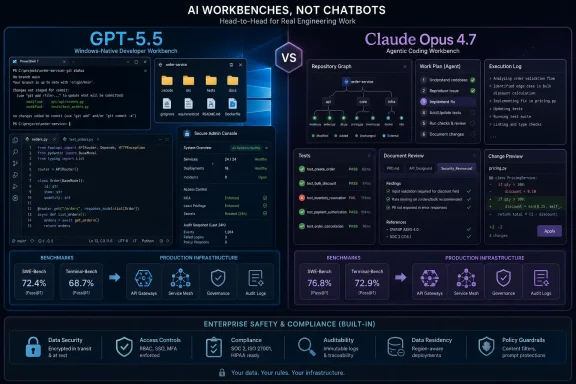 The Benchmark War Now Has a Productivity Problem
Mashable’s comparison lands in the middle of a strange maturity phase for AI models. The benchmarks keep improving, but the practical meaning of those gains is getting harder to explain to normal users and even to many enterprise buyers. A few percentage points on GPQA Diamond or Humanity’s Last Exam may be meaningful to model researchers, but they do not automatically tell a sysadmin whether a model can safely refactor a PowerShell deployment script or analyze a tenant migration plan without inventing facts.OpenAI’s own announcement described GPT-5.5 as its “smartest and most intuitive” model yet, with emphasis on agentic coding, computer use, knowledge work, and early scientific research. Anthropic, in its Claude Opus 4.7 launch, leaned into coding, agents, vision, and multi-step work, arguing that its model had become more thorough and consistent on tasks that matter in production. The similarity in language is telling. Both labs know the market has moved beyond clever chat.
Mashable’s numbers show why GPT-5.5 has an easy marketing argument. It reportedly leads Opus 4.7 on Terminal-Bench 2.0, BrowseComp, Humanity’s Last Exam without tools, and ARC-AGI-2 verified results. Those are not trivial wins. Terminal work, browsing reliability, and abstract reasoning all map to real product claims: models that can operate software, research across the web, and solve novel problems with less babysitting.
But Claude’s win on SWE-Bench Pro, as presented by Mashable, matters disproportionately because coding is where frontier models are becoming budgets rather than toys. A model that fixes more real software issues, survives longer agentic runs, and handles test loops more reliably can be worth more than a model that posts a cleaner sweep across general benchmarks. Developers do not buy benchmark averages; they buy fewer broken builds.
That is the emerging contradiction. GPT-5.5 appears to be the broader benchmark leader in Mashable’s comparison, while Claude Opus 4.7 remains credible as the specialist that developers may still trust more for deep code work. In older software categories, that would be an ordinary product split. In AI, it is more destabilizing, because the vendors are selling general intelligence while customers are buying narrow reliability.
OpenAI Is Selling the Default Workbench
OpenAI’s advantage is not simply GPT-5.5. It is ChatGPT as a distribution surface. A model inside ChatGPT can call tools, generate images through adjacent systems, work with files, browse, analyze data, and increasingly sit beside the user as a general-purpose assistant. That broader package is why Mashable gives GPT-5.5 the edge for everyday professional work.This matters because most users do not experience AI as a raw model. They experience it as an app with buttons, memory, connectors, file upload limits, image tools, coding workspaces, and subscription tiers. GPT-5.5 may not itself be an image model, but ChatGPT’s surrounding product stack means a user can move from research to charting to image creation to code generation without switching vendors. In consumer and small-business markets, that continuity is powerful.
For WindowsForum readers, the parallel is obvious. Nobody evaluates Windows purely as a kernel. They evaluate it as Explorer, Settings, Defender, WSL, PowerShell, Office integration, driver support, update behavior, and the long tail of things that either make daily work easier or more maddening. OpenAI is trying to make ChatGPT the same sort of operating layer for knowledge work: not just the smartest model, but the place where the work happens.
That strategy explains why OpenAI can tolerate some ambiguity in model-by-model comparisons. Even if Claude Opus 4.7 is better at a subset of advanced coding tasks, GPT-5.5 inside ChatGPT may still be more useful to a marketing manager, analyst, student, consultant, or IT generalist. Breadth wins when the user does not want to assemble a stack.
The Codex angle sharpens that. OpenAI is not merely attaching GPT-5.5 to a chat window; it is using the model to extend a developer workflow that increasingly resembles an AI-native IDE assistant. When a model can inspect code, run commands, reason about errors, and iterate on fixes, the user is no longer asking for snippets. The user is delegating a slice of software maintenance.
That is where the stakes rise. A general workbench that can write documents, inspect spreadsheets, generate code, execute terminal tasks, and summarize security advisories is not just convenient. It becomes a governance challenge. The more OpenAI wins by integration, the more IT departments will ask how to audit that integration.
Anthropic Is Selling Trust in the Long Run
Anthropic’s case for Claude Opus 4.7 is narrower but not weaker. The company has spent years positioning Claude as the model family for careful reasoning, long context, coding, and enterprise-grade safety. Opus 4.7 continues that posture: less about dazzling breadth, more about getting complex work done without losing the plot.That is why Mashable’s conclusion — GPT-5.5 for everyday professional work, Claude Opus 4.7 for advanced and agentic coding — feels plausible. Claude’s appeal is not merely that it can write good code. It is that many developers perceive it as better at maintaining intent across a messy task: reading an existing codebase, proposing a plan, making edits, checking the result, and explaining what changed.
Anthropic’s official messaging around Opus 4.7 emphasized stronger performance across coding, agents, vision, and multi-step tasks. The company also talked about greater thoroughness and consistency, which are less glamorous words than “intelligence” but more relevant to production. An AI agent that succeeds nine times and silently damages the tenth run is not a productivity tool. It is an incident waiting for a root-cause analysis.
Claude Code is central here. Anthropic’s coding product has become one of the clearest examples of the frontier model as a working agent rather than a chatbot. When developers talk about Claude’s strengths, they often mean the cadence of using it in a repo: ask, inspect, edit, test, revise. That loop is where small differences in judgment become large differences in trust.
The tension is that Anthropic is also operating under a more visible safety narrative. Reporting from outlets including ITPro and Tom’s Guide highlighted Anthropic’s distinction between generally available Opus models and more restricted Mythos-class capabilities, especially around cyber risk. Whether one sees that as responsible deployment or product segmentation with a safety gloss, it affects how enterprises read the roadmap.
Anthropic’s pitch is that restraint is part of the product. OpenAI’s pitch is that capability plus iterative deployment gets users to the future faster. Neither position is neutral. Each is a commercial strategy wrapped in a philosophy of risk.
The Numbers Look Clean Until You Try to Buy Them
Mashable’s comparison gives API prices that are easy to quote: GPT-5.5 starts at $5 per million input tokens and $30 per million output tokens, while Claude Opus 4.7 is listed at $5 per million input tokens and $25 per million output tokens. On paper, Claude is cheaper on output. In practice, token efficiency, tool behavior, retries, verbosity, and context handling can swamp the sticker price.This is one of the least understood parts of AI procurement. A model that charges more per output token but uses fewer tokens, needs fewer retries, or completes tasks with less scaffolding may be cheaper in real workflows. Conversely, a model with a cheaper rate card can become expensive if it rambles, fails validations, or requires repeated prompts to reach production quality.
OpenAI has argued that GPT-5.5 is more token-efficient even as its API pricing rose relative to earlier models. That claim matters because frontier AI pricing is shifting from novelty subscription economics to workload economics. The enterprise buyer does not care whether a million tokens sounds cheap. The buyer cares how many tickets, code reviews, support summaries, or document analyses a monthly budget can actually process.
Anthropic’s Opus 4.7 pricing stability is useful, but stability at the rate-card level is not the same as stability at the invoice level. Depending on tokenizer behavior and task style, the same text can produce different token counts across model families. The practical advice for IT teams is boring but unavoidable: run your own workload traces before declaring either model cheaper.
Subscriptions complicate the comparison further. ChatGPT Plus, Pro, Business, and Enterprise users get different levels of access to GPT-5.5 variants, while Claude gates Opus 4.7 behind Pro and Max tiers. For a solo user, this is a monthly subscription choice. For an organization, it is an access-control, compliance, and data-handling choice.
There is also a hidden cost in platform fragmentation. A developer team may prefer Claude Code, while a sales team prefers ChatGPT’s broader app integrations, while legal wants the model with the strongest document review behavior, while security wants the tightest controls. The “best model” can quickly become four overlapping subscriptions and a procurement headache.
Leaderboards Are Becoming Less Democratic
Mashable notes the Arena leaderboard, where Claude Opus 4.7 Thinking held the top overall spot at the time of its comparison, while other Anthropic models also ranked highly. That kind of leaderboard is useful because it captures broad human preference. It is also increasingly limited because frontier AI products are no longer just text generators responding to isolated prompts.Arena-style comparisons tend to reward what a user can see in a single interaction: clarity, helpfulness, style, apparent correctness. But agentic work often fails later. A model can sound confident, propose a smart plan, and then make a subtle mistake in step 12 of a terminal workflow. The most important difference between models may not appear in a head-to-head chat answer.
Verified benchmarks such as ARC Prize, SWE-Bench, Terminal-Bench, and BrowseComp try to address that by measuring performance against structured tasks. They are more rigorous than vibes, but they still compress the messy reality of deployment into a score. The result is an ecosystem where every lab can find a set of numbers that tells a flattering story.
OpenAI can point to GPT-5.5’s apparent dominance across several broad and verified evaluations. Anthropic can point to coding and agentic performance where Claude remains formidable. Independent evaluators can point out that self-reported scores, test conditions, tool access, and model variants make direct comparisons difficult. All of these things can be true at the same time.
The deeper issue is that benchmarks are becoming part of product marketing before they become operational guidance. A CIO does not need to know whether GPT-5.5 beats Claude Opus 4.7 by a few points on a general reasoning test. A CIO needs to know which model is less likely to mishandle confidential attachments, overrun a budget, produce insecure code, or require human cleanup that erases the productivity gain.
That does not make benchmarks useless. It makes them the beginning of due diligence, not the end.
Coding Is the First Real Agentic Battleground
Software development is where the GPT-5.5 versus Opus 4.7 rivalry becomes most concrete. Code has structure, tests, version control, logs, and failure modes that can be inspected. That makes it a natural proving ground for AI agents, because the work can be delegated in bounded ways and checked afterward.Claude’s strength in agentic coding is not surprising. Anthropic has built a strong identity around long-context reasoning and careful task execution, and Claude Code gives the model a first-party environment where those traits matter. Developers are not merely asking Claude to explain APIs; they are asking it to operate inside projects.
OpenAI’s GPT-5.5 counters with strong Terminal-Bench 2.0 performance, Codex integration, and a broader tool ecosystem. If the model can operate a terminal more reliably, it can move beyond static code suggestions into build, test, and repair loops. That is the difference between a fancy autocomplete and an AI junior engineer that can at least attempt the grunt work.
The right comparison may not be “Which model writes better code?” It may be “Which model fails in ways your team can tolerate?” Some models produce verbose but understandable changes. Some make smaller edits but miss architectural context. Some are excellent at greenfield prototypes and weaker at maintaining old enterprise code. Some can run tests but misread the failure. These are not benchmark trivia; they are workflow design constraints.
Windows developers have a particularly complex version of this problem. Real-world Windows work often spans PowerShell, C#, WinUI, legacy .NET Framework, registry behavior, Group Policy, Azure identity, Intune, winget, WSL, and vendor-specific management tools. A model that is strong in generic Python benchmark tasks may still stumble when asked to reason about Windows servicing channels or MSI deployment edge cases.
That is why IT pros should test both models against their own dullest tasks, not their flashiest demos. Ask them to explain a failed Intune deployment. Ask them to review a PowerShell script that touches user profiles. Ask them to summarize a Microsoft security advisory and produce a remediation checklist. The winner may not be the model with the most impressive public score.
The Feature-Set Fight Favors OpenAI, But Not Always the User
Mashable gives GPT-5.5 the edge for everyday professional work largely because ChatGPT has the broader feature set. That is fair. OpenAI’s consumer product has become a Swiss Army knife: documents, coding, images, search, data analysis, custom workflows, and integrations all orbit the same account.For many users, that breadth is decisive. If you are preparing a presentation, analyzing a CSV, drafting an email campaign, producing a product image, and debugging a script, ChatGPT’s integrated environment reduces friction. The user does not have to think about which model does which job. The product absorbs the complexity.
Claude is not standing still. Anthropic’s Claude Design push and document-analysis strengths show that it understands the same direction of travel. But Claude’s differentiation still feels more concentrated around depth of reasoning, document handling, coding discipline, and a style many users describe as more measured. That can be more valuable than extra buttons.
The danger for OpenAI is that breadth can become sprawl. As ChatGPT accumulates tools, integrations, memories, connectors, coding environments, image systems, and enterprise controls, it becomes more powerful but also harder to reason about. Users may love the convenience; administrators may see a growing attack surface and a governance puzzle.
The danger for Anthropic is the opposite. A reputation for carefulness and coding quality can be commercially strong, but if the surrounding product feels less complete, Claude risks becoming the tool specialists admire while the broader workforce defaults to ChatGPT. In platform markets, the best component does not always beat the most available system.
That is the Microsoft lesson hiding under this AI story. Windows did not win every technical argument; it won distribution, compatibility, developer attention, and enterprise manageability. The same forces are forming around AI assistants now.
Safety Is No Longer a Separate Chapter
The GPT-5.5 and Claude Opus 4.7 releases both arrived with safety narratives, but those narratives are becoming harder to separate from product strategy. OpenAI emphasizes iterative deployment and safeguards. Anthropic emphasizes capability control, staged release, and a more explicit concern about cyber and agentic misuse. The difference is not just philosophical. It affects what users can access, when they can access it, and under what restrictions.For security-minded readers, the key issue is not whether one lab is “safer” in the abstract. It is whether the model’s capabilities are legible enough to manage. A coding agent that can inspect repositories, run shell commands, and suggest exploit-adjacent fixes is useful for defenders and attractive to attackers. The same model that helps a blue team triage vulnerabilities can help a less benign user automate reconnaissance.
Anthropic’s handling of Mythos-linked capabilities gives it a more conservative public posture. The company has been more explicit about holding back or modifying access to certain powerful capabilities. That may reassure some enterprise buyers, especially in regulated sectors. It may frustrate others who want maximum capability and believe controls should be implemented at the customer level.
OpenAI’s posture is more accelerationist, though not reckless in its own framing. The company tends to argue that broad deployment, monitoring, and rapid iteration are part of safety. That approach has the advantage of getting tools into users’ hands quickly and learning from real-world use. It also means society becomes the test environment sooner.
The Windows analogy here is patch management. There is always a tension between shipping the fix and breaking the fleet. Move too slowly and users remain exposed. Move too quickly and you create operational risk. Frontier AI safety now has the same uncomfortable rhythm, except the “patch” may be a model behavior change that affects coding, research, security analysis, and business automation all at once.
Enterprises should stop treating AI safety documents as public-relations appendices. They are now part of the product spec.
The Better Model Depends on the Job You Are Actually Delegating
The clean answer to Mashable’s headline is that GPT-5.5 is probably the better general-purpose choice, while Claude Opus 4.7 remains the more compelling choice for certain high-end coding and agentic workflows. But that answer needs an asterisk large enough to be useful. The best model is not the one that wins the most columns in a comparison table; it is the one whose failures you can detect, afford, and correct.For consumers and general knowledge workers, GPT-5.5’s case is strong. ChatGPT offers a broader work environment, more adjacent tools, and better coverage across everyday tasks. If your use is research, writing, spreadsheet analysis, presentations, light coding, brainstorming, and image-assisted projects, OpenAI’s ecosystem is hard to beat.
For developers, Claude Opus 4.7 deserves serious testing. If your workflow centers on complex refactoring, long-lived repo work, agentic coding sessions, and careful reasoning across many files, Anthropic’s model may still be the more trusted collaborator. Its advantage may not show up every time, but when it does, it shows up in fewer wrong turns.
For enterprises, neither model should be adopted on faith. The choice should be workload-specific and policy-specific. Run pilots on real internal tasks, measure retries and human correction time, track token consumption, and evaluate administrative controls. A benchmark table cannot tell you how a model behaves against your legacy scripts, your ticket backlog, your legal templates, or your security standards.
For developers building products on top of these APIs, price and latency may matter as much as raw intelligence. GPT-5.5’s higher output-token price may be offset by efficiency in some workloads; Claude’s lower output price may be offset by other tokenization or behavior differences. The only honest answer is to instrument the application and compare total task cost.
For IT departments, the governance question is unavoidable. If users are already pasting code, contracts, logs, and customer data into AI tools, the organization does not have a model-selection problem. It has a shadow-AI problem. Choosing between GPT-5.5 and Claude Opus 4.7 should happen alongside access policies, retention settings, audit practices, and user training.
The Winner Is the One Your Workflow Can Survive
The comparison between GPT-5.5 and Claude Opus 4.7 is useful because it forces the market to become more specific. The age of asking which chatbot is “smarter” is giving way to a more practical question: which system can be trusted with a particular class of work under a particular set of constraints?- GPT-5.5 looks like the stronger all-around professional assistant, especially when ChatGPT’s surrounding tools are part of the evaluation.
- Claude Opus 4.7 remains a serious contender for advanced coding and long-running agentic workflows, where reliability across steps can matter more than general benchmark breadth.
- API pricing cannot be compared honestly without measuring token efficiency, retries, task completion rates, and the amount of human cleanup required.
- Benchmarks are useful signals, but they are increasingly inadequate substitutes for workload-specific testing.
- Enterprise buyers should evaluate these models as platforms with governance implications, not as isolated chat interfaces.
- Windows developers and administrators should test both models against real Microsoft-stack tasks before trusting either with production-adjacent work.
References
- Primary source: Mashable
Published: Sat, 04 Jul 2026 09:00:00 GMT
OpenAI’s GPT-5.5 vs Claude Opus 4.7: Which is better? | Mashable
How does GPT-5.5 compare to Claude Opus 4.7? We take a look at benchmarks, leaderboards, and overall feature set.mashable.com - Official source: openai.com
Introducing GPT-5.5 | OpenAI
Introducing GPT-5.5, our smartest model yet—faster, more capable, and built for complex tasks like coding, research, and data analysis across tools.openai.com - Related coverage: axios.com
OpenAI releases "Spud" GPT-5.5 model
AI releases are getting faster, more efficient and more powerful.www.axios.com
- Related coverage: techradar.com
'We love you, and we want you to win' — OpenAI releases GPT-5.5 for ChatGPT | TechRadar
GPT-5.5 aims to smooth out the experience rather than reinvent it.www.techradar.com - Official source: www-cdn.anthropic.com
- Official source: anthropic.com
Introducing Claude Opus 4.7 \ Anthropic
Our latest model, Claude Opus 4.7, is now generally available. Opus 4.7 is a notable improvement on Opus 4.6 in advanced software engineering, with particular gains on the most difficult tasks.www.anthropic.com
- Related coverage: aws.amazon.com
Claude Opus 4.7 is now available in Amazon Bedrock - AWS
Discover more about what's new at AWS with Claude Opus 4.7 is now available in Amazon Bedrockaws.amazon.com
- Related coverage: claudeai.dev
What's new in Claude Opus 4.7 | Claude AI Dev
Claude Opus 4.7 was announced by Anthropic on April 16, 2026 as the company's latest generally available flagship Opus model. The release is positioned as a practical upgrade over Opus 4.6 rather than a brand-new family: same headline API pricing, same 1M-token context window, but...claudeai.dev - Related coverage: venturebeat.com
Anthropic releases Claude Opus 4.7, narrowly retaking lead for most powerful generally available LLM | VentureBeat
Opus 4.7 utilizes an updated tokenizer that improves text processing efficiency, though it can increase the token count of certain inputs by 1.0–1.35x.venturebeat.com - Related coverage: automationatlas.io
Anthropic Claude Opus 4.7 Released (April 2026) | Automation Atlas
Anthropic released Claude Opus 4.7 in April 2026 with a 1M context window and tool-use improvements. What it means for Claude Code and agent platforms. automationatlas.io
- Related coverage: allthings.how
Claude Opus 4.7 Pricing: Same Rate Card, Bigger Bill
The sticker price matches Opus 4.6, but a new tokenizer can push real costs up by as much as 35 percent per request.allthings.how - Related coverage: computingforgeeks.com
Claude Opus 4.7: Features, Benchmarks, How to Use | ComputingForGeeks
Explore Claude Opus 4.7 benchmarks, new xhigh effort and /ultrareview, and learn how to switch to Opus 4.7 in Claude Code and Claude apps today.computingforgeeks.com - Related coverage: 9to5mac.com
Anthropic reveals new Opus 4.7 model with focus on advanced software engineering - 9to5Mac
Anthropic has announced its latest AI model with Claude Opus 4.7. The new version arrives two months after the previous...9to5mac.com - Related coverage: robotsatlas.com
- Related coverage: itpro.com
‘We experimented with efforts to differentially reduce these capabilities’: Anthropic toned down Opus 4.7’s cyber uses in wake of Claude Mythos release | IT Pro
Anthropic claims it used new techniques to “differentially reduce” the cyber capabilities of its Opus 4.7 model in the wake of the Claude Mythos release.www.itpro.com - Related coverage: tomshardware.com
Claude Fable 5 brings Mythos to the masses — Anthropic's new frontier model is 'state-of-the-art on nearly all tested benchmarks' | Tom's Hardware
Queries regarding cybersecurity, biology and chemistry, and distillation will be redirected to the prior-gen Opus 4.8, howeverwww.tomshardware.com - Related coverage: digital520.com