

Micro-Star International, the Taiwan-based PC hardware maker better known as MSI, is leaning harder into gaming laptops, desktop components, peripherals, creator systems, and software utilities in 2026 as it tries to turn enthusiast brand loyalty into a broader global PC ecosystem. AD HOC NEWS framed the company this week as a hardware specialist strengthening its position around gaming and high-performance computing, but the more interesting story is not that MSI sells gaming gear. It is that the company is trying to make the PC upgrade cycle feel less like a pile of parts and more like a coherent platform.
That is a difficult trick in the Windows world. Unlike Apple, MSI does not control the operating system, the CPU roadmap, the GPU architecture, or the storefront where most games are bought. Its power comes from something messier but still valuable: the trust of buyers who care about thermals, BIOS options, display refresh rates, power limits, fan curves, RGB control, and whether a laptop can hold its clock speed when the marketing slide has gone cold.
MSI’s public company story begins with familiar nouns: laptops, motherboards, graphics cards, desktops, monitors, keyboards, mice, power supplies, cases, SSDs, networking gear, and newer categories such as handheld gaming PCs. Its own company materials describe a portfolio that stretches from gaming and creator machines to business productivity, AIoT, servers, and smart energy products. But the gravitational center remains obvious: MSI is a company built around people who buy PCs because they want performance they can feel.
That matters because the PC industry is not a single market. A corporate fleet buyer wants stability, warranty coverage, manageability, and predictable cost. A school wants durability and price. A gamer wants frame rates, cooling, upgradability, and the feeling that the machine is tuned rather than merely assembled. MSI has spent decades serving the last group, and that audience is both demanding and unusually willing to pay for differentiation.
AD HOC NEWS is right to describe MSI as a brand focused on gaming hardware and high-performance computing. The harder question is whether that focus is enough in a market where every major vendor now sells a “gaming” laptop, every motherboard vendor has an RGB control suite, and every PC maker has discovered the words creator and AI PC. In 2026, the dragon logo alone is not a strategy. The strategy is to make each product category reinforce the next purchase.
A gaming laptop buyer can become a monitor buyer. A motherboard buyer can become a graphics card buyer. A graphics card buyer can become a power supply, case, cooler, and peripheral buyer. If MSI can keep that buyer inside its software and support orbit, the company gains something more durable than a one-off sale.
That limitation is also the opportunity. The Windows enthusiast market exists precisely because no single vendor owns the whole thing. Users mix a Ryzen processor with an Nvidia GPU, an MSI motherboard with a Corsair case, a Samsung SSD, a Logitech mouse, and a Windows build that may or may not behave after Patch Tuesday. The ecosystem is not vertically integrated; it is negotiated.
MSI’s job is to reduce the friction in that negotiation. Its software utilities, BIOS features, thermal designs, performance profiles, and component branding are all attempts to impose a little order on the chaos of the DIY and gaming PC world. Nobody should pretend this is the same as owning the platform, but it is not meaningless either. For an enthusiast, a good BIOS screen, stable firmware, sensible fan control, and reliable GPU cooling can matter more than a vague promise of “AI-powered productivity.”
This is where MSI’s software layer becomes more than decoration. The company’s configuration tools for performance modes, temperature monitoring, lighting control, and system tuning are often treated as accessory features. In practice, they are the interface between the marketing claim and the user’s lived experience. A laptop advertised as powerful is judged not only by benchmark charts, but by how loud it gets, how hot the keyboard feels, and whether performance collapses after ten minutes of load.
This is why the creator category has become so attractive for gaming hardware companies. It lets them sell performance without the teenage bedroom aesthetic. It also gives them a way to reach buyers who need horsepower but do not want a chassis covered in angular vents and programmable lights. MSI has spent years trying to broaden that identity, and its own brand materials now put gaming, content creation, business productivity, AIoT, and smart energy under the same corporate umbrella.
The risk is dilution. If every product is for gamers, creators, professionals, students, executives, streamers, and AI developers, then the brand stops saying anything specific. MSI’s strongest position remains where the buyer understands the hardware trade-offs and cares about the details. The creator segment works best for MSI when it is not a lifestyle costume, but a quieter expression of the same performance-first engineering.
That is also why gaming laptops remain such a useful representative product. They compress the entire MSI argument into one object: CPU and GPU power, display speed, cooling, keyboard feel, software control, chassis design, battery compromise, fan noise, and price. A gaming notebook is not merely a portable desktop. It is a bundle of engineering decisions where the vendor’s priorities are exposed quickly.
Tom’s Hardware reported in 2025, citing DigiTimes, that MSI was on track to ship more than 10 million motherboards that year, a milestone that would put it in rare company alongside Gigabyte. The same report described momentum in graphics cards and notebooks while noting that MSI was taking a more measured approach to AI servers than some Taiwan-based peers. Whether every forecast lands perfectly is less important than the strategic pattern: MSI is trying to grow without abandoning the hardware categories that made it credible.
Motherboards are not glamorous to mainstream buyers, but they are central to enthusiast trust. They decide what CPUs and memory standards a user can adopt, how stable overclocking feels, how many expansion options exist, and how much pain a BIOS update can cause. In the DIY market, a motherboard brand can become a habit. Once a builder trusts a vendor’s layout, firmware cadence, and support experience, switching becomes less automatic.
Graphics cards play a similar role, though with less control over the underlying silicon. Nvidia and AMD define the architecture, but board partners compete on cooling, noise, power delivery, factory tuning, warranty, and availability. MSI’s long-running graphics card presence gives it a seat in one of the most emotionally charged corners of PC buying, where performance anxiety and price sensitivity collide.
That is understandable from a business perspective and dangerous from a brand perspective. High-end gaming hardware is where margins live, but entry-level hardware is where many users begin their relationship with a brand. If the first MSI product becomes too expensive, the upgrade loop weakens before it starts. A company cannot build an ecosystem only for buyers who can absorb every component shock.
The industry context is brutal. Memory pricing, GPU supply constraints, tariff uncertainty, and the transition to new architectures can all distort the final price on a shelf. Vendors are not simply choosing higher prices because they feel like it. Still, consumers experience supply-chain complexity as a number at checkout, and that number competes with consoles, used hardware, cloud gaming subscriptions, and the decision to keep an existing PC another year.
MSI’s challenge is to preserve the sense that its products justify their premium. Better cooling, stronger power delivery, quieter operation, repairability, firmware stability, and better software can defend a higher price. Cosmetic differentiation alone cannot. The moment a buyer thinks the dragon badge is doing more work than the engineering, the ecosystem pitch starts to look like a margin pitch.
The temptation is to treat AI as the next gaming: a broad upgrade catalyst that convinces users their existing machines are suddenly inadequate. But gaming had a clear consumer feedback loop. A better GPU meant higher settings, higher frame rates, or access to games that previously ran poorly. AI PCs still need that kind of everyday clarity.
For MSI, the smarter play is not to pretend that an NPU alone will sell a gaming laptop. It is to integrate AI features where they actually help the user experience: noise suppression, camera effects, power management, performance tuning, content workflows, local inference for developers, and system monitoring that does not feel like bloatware. Enthusiasts are allergic to vague claims. They want the setting, the benchmark, the wattage, and the result.
There is also an enterprise angle. MSI’s official materials and recent Computex messaging point to products beyond consumer gaming, including servers, networking, industrial computing, and edge applications. That diversification may matter if consumer PC demand weakens. But the more MSI chases enterprise AI, the more it must compete with vendors that have deeper datacenter relationships and stronger services businesses.
The trap is also obvious. Windows remains awkward on handhelds compared with purpose-built console interfaces or Valve’s SteamOS experience. Hardware vendors can improve controls, screens, cooling, and performance, but they cannot fully solve the operating system problem alone. A Windows handheld lives or dies partly on Microsoft’s willingness to make Windows feel less like a desktop OS squeezed into a small device.
That makes handhelds a perfect example of MSI’s ecosystem ceiling. The company can build impressive hardware, but user experience depends on layers it does not control. If MSI’s software can smooth the experience, manage performance profiles, and make game launching less painful, it adds value. If the device feels like a tiny laptop with joysticks attached, the ecosystem story weakens.
Still, handhelds matter because they show MSI looking beyond the traditional tower-and-laptop rhythm. Younger players do not necessarily think of PC gaming as a beige box or even a desk setup. They expect play to move across screens. MSI has to follow that behavior without losing the hardware seriousness that separates it from novelty gadget makers.
That can be useful. It can also be maddening. Enthusiasts know the pain of overlapping utilities from motherboard vendors, GPU vendors, peripheral makers, Windows itself, and chipset suppliers. One tool wants to manage lighting, another wants to manage updates, another wants to inject overlays, and another decides it needs a background service at startup. The dream of an ecosystem can become the reality of five resident processes and a tray full of icons.
MSI is not alone in this. Asus, Gigabyte, Lenovo, HP, Dell, Razer, Corsair, Logitech, and others all want to own a slice of the user’s control surface. The difference is that MSI’s audience is more likely to notice when the software gets in the way. A casual user may ignore a clumsy utility. An enthusiast will uninstall it, replace it, complain about it, and remember.
This is where MSI can win credibility cheaply compared with hardware redesigns. Lightweight utilities, transparent update behavior, clean uninstall routines, documented settings, and fewer unnecessary services would do more for long-term loyalty than another animation around a performance toggle. In the enthusiast market, restraint is a feature.
A motherboard can become a commodity if buyers see only chipset and price. A graphics card can become a commodity if every cooler is “good enough” and availability dominates brand preference. A gaming laptop can become a commodity if all vendors offer similar CPUs, GPUs, screens, and chassis claims. MSI’s job is to make the differences visible enough to matter.
The company’s broad product catalog helps. It lets MSI spread brand recognition across multiple purchase moments and reduces dependence on a single category. But breadth also increases execution risk. A weak software experience, a thermal controversy, poor support, or inconsistent quality in one line can bleed into perceptions of the whole ecosystem.
Investors also need to watch the margin mix. A strategic shift toward higher-end products can improve profitability if demand holds. If demand softens, it can leave the company overexposed to buyers most likely to delay upgrades. Gaming is resilient, but it is not immune to macro pressure, component inflation, or the simple fact that many PCs bought during recent upgrade cycles still work well enough.
That creates a chance for MSI to grow up without becoming dull. A professional workstation aesthetic does not have to mean weak hardware. A creator laptop does not have to pretend gaming DNA is embarrassing. A business machine can still benefit from cooling expertise learned in gaming systems. The best version of MSI’s future is not a split personality; it is a performance company with multiple costumes.
There is a lesson here from the broader PC market. The most successful Windows hardware brands are not necessarily the ones with the loudest claims. They are the ones that make users feel a predictable relationship between specification, price, reliability, and support. Enthusiasts will forgive trade-offs if they are honest. They are far less forgiving when a product promises desktop-class performance and delivers throttling, noise, or firmware weirdness.
MSI’s 40th anniversary messaging at Computex 2026 leaned into full-stack integration, AI applications, handhelds, advanced thermals, components, networking, and edge computing. That is ambitious and appropriately modern. But for the core audience, the verdict will still arrive in familiar places: BIOS forums, teardown videos, driver pages, RMA stories, benchmark loops, and the temperature readout after an hour of gaming.
That is a difficult trick in the Windows world. Unlike Apple, MSI does not control the operating system, the CPU roadmap, the GPU architecture, or the storefront where most games are bought. Its power comes from something messier but still valuable: the trust of buyers who care about thermals, BIOS options, display refresh rates, power limits, fan curves, RGB control, and whether a laptop can hold its clock speed when the marketing slide has gone cold.
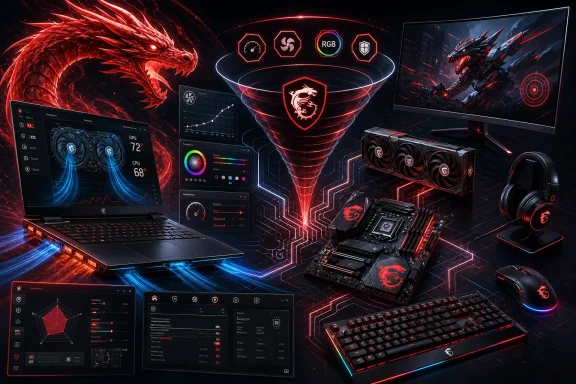 MSI’s Real Product Is the Enthusiast Upgrade Loop
MSI’s public company story begins with familiar nouns: laptops, motherboards, graphics cards, desktops, monitors, keyboards, mice, power supplies, cases, SSDs, networking gear, and newer categories such as handheld gaming PCs. Its own company materials describe a portfolio that stretches from gaming and creator machines to business productivity, AIoT, servers, and smart energy products. But the gravitational center remains obvious: MSI is a company built around people who buy PCs because they want performance they can feel.That matters because the PC industry is not a single market. A corporate fleet buyer wants stability, warranty coverage, manageability, and predictable cost. A school wants durability and price. A gamer wants frame rates, cooling, upgradability, and the feeling that the machine is tuned rather than merely assembled. MSI has spent decades serving the last group, and that audience is both demanding and unusually willing to pay for differentiation.
AD HOC NEWS is right to describe MSI as a brand focused on gaming hardware and high-performance computing. The harder question is whether that focus is enough in a market where every major vendor now sells a “gaming” laptop, every motherboard vendor has an RGB control suite, and every PC maker has discovered the words creator and AI PC. In 2026, the dragon logo alone is not a strategy. The strategy is to make each product category reinforce the next purchase.
A gaming laptop buyer can become a monitor buyer. A motherboard buyer can become a graphics card buyer. A graphics card buyer can become a power supply, case, cooler, and peripheral buyer. If MSI can keep that buyer inside its software and support orbit, the company gains something more durable than a one-off sale.
The Windows PC Ecosystem Was Never Going to Be Apple’s Ecosystem
When PC vendors talk about ecosystems, the word can sound borrowed from companies with tighter control. Apple can design the chip, the operating system, the laptop, the app distribution model, and the services layer. MSI cannot do that. It builds in the unruly bazaar of Windows, Intel, AMD, Nvidia, Realtek, Microsoft updates, firmware patches, driver packages, and retailers racing each other on discounts.That limitation is also the opportunity. The Windows enthusiast market exists precisely because no single vendor owns the whole thing. Users mix a Ryzen processor with an Nvidia GPU, an MSI motherboard with a Corsair case, a Samsung SSD, a Logitech mouse, and a Windows build that may or may not behave after Patch Tuesday. The ecosystem is not vertically integrated; it is negotiated.
MSI’s job is to reduce the friction in that negotiation. Its software utilities, BIOS features, thermal designs, performance profiles, and component branding are all attempts to impose a little order on the chaos of the DIY and gaming PC world. Nobody should pretend this is the same as owning the platform, but it is not meaningless either. For an enthusiast, a good BIOS screen, stable firmware, sensible fan control, and reliable GPU cooling can matter more than a vague promise of “AI-powered productivity.”
This is where MSI’s software layer becomes more than decoration. The company’s configuration tools for performance modes, temperature monitoring, lighting control, and system tuning are often treated as accessory features. In practice, they are the interface between the marketing claim and the user’s lived experience. A laptop advertised as powerful is judged not only by benchmark charts, but by how loud it gets, how hot the keyboard feels, and whether performance collapses after ten minutes of load.
Gaming Is Still the Brand Engine, Even When the Pitch Says Creator
MSI’s expansion into creator and professional systems is not a retreat from gaming. It is a recognition that gaming hardware and creator hardware increasingly share the same foundation. A machine that can push high frame rates through a discrete GPU can also accelerate rendering, encoding, 3D work, and AI-assisted creative tools. The difference is often industrial design, display tuning, port selection, acoustics, and how aggressively the product shouts from across the room.This is why the creator category has become so attractive for gaming hardware companies. It lets them sell performance without the teenage bedroom aesthetic. It also gives them a way to reach buyers who need horsepower but do not want a chassis covered in angular vents and programmable lights. MSI has spent years trying to broaden that identity, and its own brand materials now put gaming, content creation, business productivity, AIoT, and smart energy under the same corporate umbrella.
The risk is dilution. If every product is for gamers, creators, professionals, students, executives, streamers, and AI developers, then the brand stops saying anything specific. MSI’s strongest position remains where the buyer understands the hardware trade-offs and cares about the details. The creator segment works best for MSI when it is not a lifestyle costume, but a quieter expression of the same performance-first engineering.
That is also why gaming laptops remain such a useful representative product. They compress the entire MSI argument into one object: CPU and GPU power, display speed, cooling, keyboard feel, software control, chassis design, battery compromise, fan noise, and price. A gaming notebook is not merely a portable desktop. It is a bundle of engineering decisions where the vendor’s priorities are exposed quickly.
The Component Business Gives MSI a Moat That Pure PC Brands Lack
MSI’s advantage over many PC sellers is that it is not only a laptop brand. It is deeply embedded in the component market, especially motherboards and graphics cards. That gives the company a different relationship with enthusiasts, system builders, and the upgrade cycle. A user may not buy a new laptop every year, but a desktop builder can touch MSI repeatedly through boards, GPUs, monitors, cases, power supplies, and accessories.Tom’s Hardware reported in 2025, citing DigiTimes, that MSI was on track to ship more than 10 million motherboards that year, a milestone that would put it in rare company alongside Gigabyte. The same report described momentum in graphics cards and notebooks while noting that MSI was taking a more measured approach to AI servers than some Taiwan-based peers. Whether every forecast lands perfectly is less important than the strategic pattern: MSI is trying to grow without abandoning the hardware categories that made it credible.
Motherboards are not glamorous to mainstream buyers, but they are central to enthusiast trust. They decide what CPUs and memory standards a user can adopt, how stable overclocking feels, how many expansion options exist, and how much pain a BIOS update can cause. In the DIY market, a motherboard brand can become a habit. Once a builder trusts a vendor’s layout, firmware cadence, and support experience, switching becomes less automatic.
Graphics cards play a similar role, though with less control over the underlying silicon. Nvidia and AMD define the architecture, but board partners compete on cooling, noise, power delivery, factory tuning, warranty, and availability. MSI’s long-running graphics card presence gives it a seat in one of the most emotionally charged corners of PC buying, where performance anxiety and price sensitivity collide.
The Price Problem Is Becoming the Strategy Problem
The catch is that enthusiast loyalty has limits. PCWorld and Tom’s Hardware both reported earlier this year that MSI was planning gaming product price increases in the range of 15 to 30 percent, citing comments attributed to company leadership and pressure from memory and GPU shortages. Those reports also suggested MSI would shift more attention toward midrange and high-end products rather than lower-margin budget models.That is understandable from a business perspective and dangerous from a brand perspective. High-end gaming hardware is where margins live, but entry-level hardware is where many users begin their relationship with a brand. If the first MSI product becomes too expensive, the upgrade loop weakens before it starts. A company cannot build an ecosystem only for buyers who can absorb every component shock.
The industry context is brutal. Memory pricing, GPU supply constraints, tariff uncertainty, and the transition to new architectures can all distort the final price on a shelf. Vendors are not simply choosing higher prices because they feel like it. Still, consumers experience supply-chain complexity as a number at checkout, and that number competes with consoles, used hardware, cloud gaming subscriptions, and the decision to keep an existing PC another year.
MSI’s challenge is to preserve the sense that its products justify their premium. Better cooling, stronger power delivery, quieter operation, repairability, firmware stability, and better software can defend a higher price. Cosmetic differentiation alone cannot. The moment a buyer thinks the dragon badge is doing more work than the engineering, the ecosystem pitch starts to look like a margin pitch.
AI PCs Are a Test of Discipline, Not Just Ambition
Every PC company now has to say something about AI. Microsoft has pushed Copilot+ PCs, silicon vendors are building neural processing units into client processors, and hardware makers are refreshing lines around local AI acceleration whether or not everyday users asked for it. MSI has joined that conversation, including at major trade shows where it has shown AI PCs, gaming handhelds, enterprise systems, and edge-computing concepts.The temptation is to treat AI as the next gaming: a broad upgrade catalyst that convinces users their existing machines are suddenly inadequate. But gaming had a clear consumer feedback loop. A better GPU meant higher settings, higher frame rates, or access to games that previously ran poorly. AI PCs still need that kind of everyday clarity.
For MSI, the smarter play is not to pretend that an NPU alone will sell a gaming laptop. It is to integrate AI features where they actually help the user experience: noise suppression, camera effects, power management, performance tuning, content workflows, local inference for developers, and system monitoring that does not feel like bloatware. Enthusiasts are allergic to vague claims. They want the setting, the benchmark, the wattage, and the result.
There is also an enterprise angle. MSI’s official materials and recent Computex messaging point to products beyond consumer gaming, including servers, networking, industrial computing, and edge applications. That diversification may matter if consumer PC demand weakens. But the more MSI chases enterprise AI, the more it must compete with vendors that have deeper datacenter relationships and stronger services businesses.
Handhelds Show the Promise and the Trap of Ecosystem Thinking
The rise of Windows gaming handhelds is a useful case study for MSI’s broader ambition. Devices like MSI’s Claw line put the company into a category shaped by the success of Valve’s Steam Deck and the response from Windows OEMs. The appeal is obvious: a handheld can extend a PC gaming library into a more console-like form factor, bringing MSI into a new daily-use context.The trap is also obvious. Windows remains awkward on handhelds compared with purpose-built console interfaces or Valve’s SteamOS experience. Hardware vendors can improve controls, screens, cooling, and performance, but they cannot fully solve the operating system problem alone. A Windows handheld lives or dies partly on Microsoft’s willingness to make Windows feel less like a desktop OS squeezed into a small device.
That makes handhelds a perfect example of MSI’s ecosystem ceiling. The company can build impressive hardware, but user experience depends on layers it does not control. If MSI’s software can smooth the experience, manage performance profiles, and make game launching less painful, it adds value. If the device feels like a tiny laptop with joysticks attached, the ecosystem story weakens.
Still, handhelds matter because they show MSI looking beyond the traditional tower-and-laptop rhythm. Younger players do not necessarily think of PC gaming as a beige box or even a desk setup. They expect play to move across screens. MSI has to follow that behavior without losing the hardware seriousness that separates it from novelty gadget makers.
Windows Users Should Care Because Vendor Utilities Are Becoming the Control Plane
For WindowsForum readers, the practical consequence is not simply which MSI laptop looks good this year. It is that OEM utilities are becoming the control plane for more of the PC experience. Fan curves, GPU modes, charging limits, display profiles, firmware updates, RGB lighting, keyboard macros, audio processing, and performance presets increasingly run through vendor software.That can be useful. It can also be maddening. Enthusiasts know the pain of overlapping utilities from motherboard vendors, GPU vendors, peripheral makers, Windows itself, and chipset suppliers. One tool wants to manage lighting, another wants to manage updates, another wants to inject overlays, and another decides it needs a background service at startup. The dream of an ecosystem can become the reality of five resident processes and a tray full of icons.
MSI is not alone in this. Asus, Gigabyte, Lenovo, HP, Dell, Razer, Corsair, Logitech, and others all want to own a slice of the user’s control surface. The difference is that MSI’s audience is more likely to notice when the software gets in the way. A casual user may ignore a clumsy utility. An enthusiast will uninstall it, replace it, complain about it, and remember.
This is where MSI can win credibility cheaply compared with hardware redesigns. Lightweight utilities, transparent update behavior, clean uninstall routines, documented settings, and fewer unnecessary services would do more for long-term loyalty than another animation around a performance toggle. In the enthusiast market, restraint is a feature.
Investors See a Hardware Brand Trying to Avoid Becoming a Commodity
AD HOC NEWS presented the investor angle cautiously, noting MSI’s Taiwan listing under ISIN TW0002377009 and the importance of gaming hardware demand, supplier relationships, and adaptation to new processor and graphics architectures. That is the right frame, because MSI’s opportunity and vulnerability are the same: it sells differentiated hardware in markets that can become brutally commoditized.A motherboard can become a commodity if buyers see only chipset and price. A graphics card can become a commodity if every cooler is “good enough” and availability dominates brand preference. A gaming laptop can become a commodity if all vendors offer similar CPUs, GPUs, screens, and chassis claims. MSI’s job is to make the differences visible enough to matter.
The company’s broad product catalog helps. It lets MSI spread brand recognition across multiple purchase moments and reduces dependence on a single category. But breadth also increases execution risk. A weak software experience, a thermal controversy, poor support, or inconsistent quality in one line can bleed into perceptions of the whole ecosystem.
Investors also need to watch the margin mix. A strategic shift toward higher-end products can improve profitability if demand holds. If demand softens, it can leave the company overexposed to buyers most likely to delay upgrades. Gaming is resilient, but it is not immune to macro pressure, component inflation, or the simple fact that many PCs bought during recent upgrade cycles still work well enough.
The Dragon Brand Still Has Room to Grow Up
MSI’s brand identity has always leaned into performance theater: aggressive design, gaming language, high-refresh displays, thermal branding, RGB, and the sense that the machine is built for people who know what they are doing. That has served the company well, but the market is maturing. Many of the people who grew up building gaming PCs are now professionals, parents, developers, creators, and IT decision-makers.That creates a chance for MSI to grow up without becoming dull. A professional workstation aesthetic does not have to mean weak hardware. A creator laptop does not have to pretend gaming DNA is embarrassing. A business machine can still benefit from cooling expertise learned in gaming systems. The best version of MSI’s future is not a split personality; it is a performance company with multiple costumes.
There is a lesson here from the broader PC market. The most successful Windows hardware brands are not necessarily the ones with the loudest claims. They are the ones that make users feel a predictable relationship between specification, price, reliability, and support. Enthusiasts will forgive trade-offs if they are honest. They are far less forgiving when a product promises desktop-class performance and delivers throttling, noise, or firmware weirdness.
MSI’s 40th anniversary messaging at Computex 2026 leaned into full-stack integration, AI applications, handhelds, advanced thermals, components, networking, and edge computing. That is ambitious and appropriately modern. But for the core audience, the verdict will still arrive in familiar places: BIOS forums, teardown videos, driver pages, RMA stories, benchmark loops, and the temperature readout after an hour of gaming.
The MSI Bet Comes Down to These Purchases
The practical read on MSI is not that it is becoming a software company or an AI company. It is that MSI is trying to make its hardware catalog behave like a connected funnel, where one good experience nudges a buyer toward the next MSI-branded device. That can work, but only if the company keeps the enthusiast bargain intact.- MSI’s strongest position remains gaming and performance hardware, where buyers are willing to reward real engineering differences.
- The company’s ecosystem strategy depends on software utilities that simplify control rather than adding background clutter.
- Higher prices may protect margins, but they risk weakening the entry-level path that brings new users into the brand.
- Creator and professional systems make sense when they translate gaming-grade performance into quieter, more restrained designs.
- AI PC branding will matter only where it produces visible benefits in performance, workflow, battery life, or local processing.
- Windows users should judge MSI less by slogans and more by thermals, firmware quality, support behavior, and long-term software maintenance.