

PC Gamer’s Andy Edser argued on July 4, 2026, that gaming handheld PCs have become the consumer hardware category most visibly punished by the memory-price crisis, with once-expensive devices now looking rational only because their rivals have moved into absurd territory. The uncomfortable punchline is that a $1,000 Asus ROG Xbox Ally X can now be framed as the “best value” handheld not because it is cheap, but because the market around it has broken. This is what happens when a young PC category depends on exactly the components—LPDDR memory, NAND storage, compact high-performance boards—that AI infrastructure has made scarce. Handheld PCs were supposed to bring PC gaming down from the desk; instead, they are being dragged upward into boutique pricing.
The modern handheld gaming PC was always a compromise machine. Valve’s Steam Deck proved that enough PC could fit into a comfortable portable shell, and competitors then rushed in with Windows devices that promised sharper screens, faster chips, higher refresh rates, and broader game compatibility. For a while, the compromise felt negotiable: accept less performance than a gaming laptop, tolerate shorter battery life than a console, and get something uniquely flexible in return.
That equation depended on prices staying anchored. A handheld PC is not a laptop replacement for most buyers, nor is it a living-room console with a decade of platform gravity behind it. It is an indulgence, often a second or third gaming device, justified by convenience and novelty as much as raw capability.
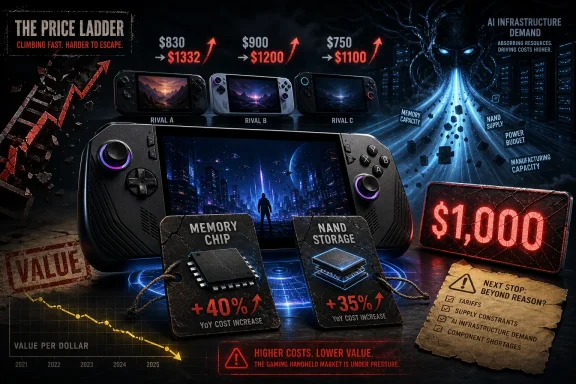
PC Gamer’s latest column lands because it catches the market at the moment that justification starts to fail. Edser points to the Lenovo Legion Go S SteamOS, praised at an $830 MSRP, now listed at $1,332. He cites the MSI Claw 8 AI+, previously expensive at $900, now difficult to find below $1,200. The next Panther Lake-powered MSI handheld, he notes, is appearing at $1,799 preorder pricing.
Those figures do more than make buyers wince. They change the category’s identity. A handheld PC at $500 to $700 competes with consoles, tablets, and entry gaming laptops; a handheld PC at $1,200 to $1,800 competes with full-size gaming notebooks, premium desktops, and the common sense of anyone who already owns a competent PC.
The ROG Xbox Ally X has a strong case on specifications. PC Gamer describes an AMD Ryzen Z2 Extreme APU with RDNA 3.5 graphics, 24 GB of LPDDR5x-8000 memory, and a 1 TB SSD. In handheld terms, that is serious hardware: enough memory to reduce the compromises that dog cheaper devices, enough storage to avoid immediate micro-management, and enough graphics capability to make modern games plausible without pretending the laws of thermals have been repealed.
The device also benefits from timing. If Asus and Microsoft can hold the line at $1,000 while rivals drift above it, the Ally X becomes a price island. That does not make it affordable; it makes it comparatively less irrational.
There is a broader lesson here for Windows hardware watchers. A device can become “good value” without getting better, cheaper, or more durable. It only needs the rest of the shelf to get worse. That is the danger of analyzing this market one product at a time: every review can be defensible while the category as a whole becomes harder to recommend.
LPDDR is not an optional luxury in this class. It is system memory and graphics memory at once, feeding integrated GPUs that depend heavily on bandwidth. Cut capacity too far and Windows handhelds choke on modern games, background services, launchers, overlays, and shader compilation. Cut speed too far and the GPU loses the bandwidth it needs to breathe.
NAND storage is just as unforgiving. A 512 GB handheld may look tolerable on paper until the buyer installs a few contemporary PC games and discovers that “portable library” really means “portable uninstall queue.” A 1 TB SSD has become less a premium flourish than the minimum configuration that avoids making the device feel compromised on day one.
That is why the AI-driven memory crunch is so poisonous for handhelds. The parts most exposed to price pressure are the parts these devices cannot gracefully downgrade. A manufacturer can trim a screen, simplify packaging, or shave battery capacity, but memory and storage define whether the experience feels modern at all.
That matters because consumer PC hardware is not the most profitable destination for advanced memory right now. AI accelerators need huge volumes of HBM. Servers need DRAM and enterprise SSDs. Cloud operators can pay more, commit earlier, and absorb higher component costs into infrastructure spending that is being justified by trillion-dollar platform bets.
A handheld maker cannot do that. It sells to consumers who compare the price against a Steam sale backlog, a PlayStation, an Xbox, a Switch successor, or a laptop. Every additional dollar in memory cost has to be eaten by the vendor, passed to the buyer, or offset elsewhere in the design.
The result is a market where the richest customers upstream distort prices for everyone downstream. The handheld buyer is not competing with another gamer for memory. Indirectly, that buyer is competing with an AI data center.
Windows handhelds have a harder assignment. They need to run Windows, vendor utilities, driver stacks, game launchers, anti-cheat systems, overlays, update agents, and the occasional desktop dialog box that was never meant to be poked with a thumbstick. Microsoft’s Xbox full-screen experience on the ROG Xbox Ally line is a meaningful attempt to sand down those edges, and PC Gamer is right to credit it as better than the old Windows-handheld mess.
But a better shell does not make Windows light. The operating system still benefits from more RAM, faster storage, and stronger silicon than a tightly controlled console-style environment would require. That raises the floor for acceptable hardware, which raises the floor for acceptable pricing.
This is the awkward strategic tension for Microsoft and its partners. Windows gives handhelds their broad compatibility pitch, especially for Game Pass, anti-cheat-heavy multiplayer games, and non-Steam storefronts. Yet Windows also makes it harder to build the cheap, efficient, focused device that might survive a component crisis.
And yet Valve’s position is more resilient than the spec sheet suggests. Steam Deck buyers are not just buying an APU and a screen; they are buying the most mature handheld PC software experience in the market. The suspend behavior, controller integration, shader handling, store interface, community profiles, and general predictability all matter more on a handheld than they do on a desktop.
That software cushion lets Valve tolerate weaker silicon longer than a Windows rival can. It also gives Valve more freedom to wait out a bad component market rather than rush a Steam Deck 2 into hostile pricing. If memory and storage costs remain ugly into 2027 or 2028, patience may look less like conservatism and more like discipline.
The problem is that patience does not help buyers who want something now. For them, the market has split into two unsatisfying choices: pay laptop money for a faster Windows handheld, or pay too much for an older SteamOS device whose value increasingly rests on experience rather than horsepower.
The memory crisis compresses that ladder from below. If the parts needed for a decent baseline machine get expensive, the entry tier either vanishes or becomes disappointing. If the entry tier becomes disappointing, reviewers stop recommending it. If reviewers stop recommending it, the category stops recruiting new buyers.
That is the danger PC Gamer is circling. Once the cheapest recommendable handheld sits near $1,000, the market no longer looks like an expanding consumer category. It looks like a niche for enthusiasts with disposable income and unusually specific use cases.
The knock-on effects are predictable. Smaller production runs make economies of scale harder. Higher prices reduce impulse purchases. Lower volumes make accessories and software optimization less attractive. Developers still support PC broadly, of course, but they have fewer reasons to treat handheld PC ergonomics, presets, and power scaling as first-order concerns.
A $900 handheld that seemed expensive but justifiable last year may look like a bargain now. A $1,000 model may deserve praise because everything else is worse. A $1,799 preorder device may be technically impressive and commercially ridiculous at the same time.
That creates a broken curve. Review scores can drift upward for products that merely hold price while competitors inflate. Buyers then see “best value” attached to devices that still cost more than many full PCs. The language of consumer advice starts to detach from the reality of household budgets.
This is not a failure of reviewers so much as a failure of the market conditions they are forced to describe. But it does mean readers should parse handheld recommendations differently in 2026. “Best value” may mean “least distorted by the current supply chain,” not “good deal.”
If handhelds are getting squeezed, other categories will feel it too. Thin-and-light laptops with soldered LPDDR, compact workstations, AI PCs with higher baseline memory requirements, and mini PCs with premium integrated graphics all live in adjacent territory. The same memory-market forces that make a handheld expensive can make fleet refreshes harder to budget.
For IT departments, the lesson is not “buy handhelds now.” It is that memory and SSD assumptions baked into procurement cycles may be stale. The old habit of treating RAM and storage as predictable line items is less safe when AI infrastructure buyers are absorbing future supply through long-term commitments.
There is also a software planning angle. Windows 11, local AI features, browser workloads, collaboration tools, security agents, and virtualization all push memory requirements upward. If hardware prices rise at the same moment baseline memory needs increase, organizations face a squeeze that looks familiar to handheld buyers: the cheap configuration exists, but it may no longer be the responsible one.
The timing, however, is vicious. Microsoft and Asus are trying to define a mainstream Windows handheld experience just as mainstream pricing becomes harder to sustain. A $600 ROG Xbox Ally with a weaker Ryzen Z2 A chip may lure some buyers, but PC Gamer’s skepticism is understandable: underpowered handhelds age quickly, and Windows does not forgive limited headroom.
The $1,000 Ally X is the more convincing product. It is also the one whose price makes the entire strategy feel fragile. If component costs force that MSRP upward, Microsoft’s handheld push risks becoming another premium PC initiative admired by enthusiasts and ignored by everyone else.
That would be a missed opportunity. Microsoft has the ecosystem, developer relationships, cloud gaming infrastructure, and Game Pass subscription base to make handheld Windows gaming less chaotic. But software polish cannot fully compensate for a bill of materials moving in the wrong direction.
A PC handheld has to run a sprawling library across wildly inconsistent software assumptions. It must convince buyers that portability is worth compatibility headaches, battery compromises, and high prices. It also competes against the buyer’s existing PC in a way a Nintendo device usually does not.
That does not mean PC handhelds are doomed. Their flexibility is real, and for many enthusiasts it is the entire point. The ability to run Steam, Game Pass, Epic, GOG, emulators, mods, cloud services, and desktop apps on one portable device is compelling.
But flexibility is less powerful when every configuration choice costs more. Console makers can amortize, subsidize, and optimize around fixed targets. PC handheld makers must keep chasing general-purpose performance in a market that is punishing general-purpose memory buyers.
That would not be a failure in absolute terms. A boutique handheld market can support excellent devices, clever engineering, and passionate communities. It can push AMD, Intel, Microsoft, Valve, Asus, Lenovo, and MSI toward better low-power performance and better portable interfaces.
But it would be a retreat from the larger promise. The dream was not merely that wealthy enthusiasts could buy beautiful portable PCs. The dream was that PC gaming could become more accessible, more flexible, and less tied to a desk without requiring laptop money.
Memory inflation attacks that dream directly. It raises the price of adequacy. It makes compromise feel stingier. It turns every product launch into a negotiation between engineering ambition and buyer exhaustion.
If Asus can maintain the $1,000 price, the Ally X may become the device reviewers point to when asked what a no-excuses Windows handheld looks like in 2026. If the price rises, the category loses one of its last clean reference points. Either way, the device now carries more symbolic weight than a single SKU should.
PC Gamer’s column is valuable because it refuses to treat this as normal premiumization. The issue is not simply that companies are charging what the market will bear. It is that the market is being reshaped by upstream forces that handheld buyers neither created nor benefit from.
That distinction matters. Enthusiasts can accept paying more for better screens, better chips, better batteries, and better controls. Paying more because AI infrastructure has vacuumed up memory supply feels different. It feels like being taxed by someone else’s gold rush.
The broader story is that price has become the lead feature. Not screen technology. Not frame generation. Not Xbox integration. Not SteamOS polish. Price.
That is a bad sign for any young hardware category. Mature products can survive periods where pricing dominates the conversation because buyers understand their use cases. Emerging categories need aspiration, experimentation, and word of mouth. They need people saying, “You should try this,” not, “You can justify this only because everything else got worse.”
 The Handheld PC Boom Meets a Supply Chain Built for Someone Else
The modern handheld gaming PC was always a compromise machine. Valve’s Steam Deck proved that enough PC could fit into a comfortable portable shell, and competitors then rushed in with Windows devices that promised sharper screens, faster chips, higher refresh rates, and broader game compatibility. For a while, the compromise felt negotiable: accept less performance than a gaming laptop, tolerate shorter battery life than a console, and get something uniquely flexible in return.That equation depended on prices staying anchored. A handheld PC is not a laptop replacement for most buyers, nor is it a living-room console with a decade of platform gravity behind it. It is an indulgence, often a second or third gaming device, justified by convenience and novelty as much as raw capability.
PC Gamer’s latest column lands because it catches the market at the moment that justification starts to fail. Edser points to the Lenovo Legion Go S SteamOS, praised at an $830 MSRP, now listed at $1,332. He cites the MSI Claw 8 AI+, previously expensive at $900, now difficult to find below $1,200. The next Panther Lake-powered MSI handheld, he notes, is appearing at $1,799 preorder pricing.
Those figures do more than make buyers wince. They change the category’s identity. A handheld PC at $500 to $700 competes with consoles, tablets, and entry gaming laptops; a handheld PC at $1,200 to $1,800 competes with full-size gaming notebooks, premium desktops, and the common sense of anyone who already owns a competent PC.
The $1,000 “Value” Device Is a Warning, Not a Victory
The strangest detail in PC Gamer’s argument is also the most revealing: the Asus ROG Xbox Ally X, criticized at launch for its high price, now looks like the sensible option at $1,000. That is not a redemption arc. It is market inflation doing editorial violence to the word value.The ROG Xbox Ally X has a strong case on specifications. PC Gamer describes an AMD Ryzen Z2 Extreme APU with RDNA 3.5 graphics, 24 GB of LPDDR5x-8000 memory, and a 1 TB SSD. In handheld terms, that is serious hardware: enough memory to reduce the compromises that dog cheaper devices, enough storage to avoid immediate micro-management, and enough graphics capability to make modern games plausible without pretending the laws of thermals have been repealed.
The device also benefits from timing. If Asus and Microsoft can hold the line at $1,000 while rivals drift above it, the Ally X becomes a price island. That does not make it affordable; it makes it comparatively less irrational.
There is a broader lesson here for Windows hardware watchers. A device can become “good value” without getting better, cheaper, or more durable. It only needs the rest of the shelf to get worse. That is the danger of analyzing this market one product at a time: every review can be defensible while the category as a whole becomes harder to recommend.
Memory Is the Handheld’s Hidden Bill of Materials
The memory crisis hits handheld PCs with particular force because these devices do not have much room to hide. A desktop can be sold with user-upgradable DIMMs, a cheap SSD, or a barebones configuration that enthusiasts improve later. A handheld is much closer to a phone or console: soldered memory, tight thermal envelopes, custom board layouts, and a spec sheet that must be decided before the product ships.LPDDR is not an optional luxury in this class. It is system memory and graphics memory at once, feeding integrated GPUs that depend heavily on bandwidth. Cut capacity too far and Windows handhelds choke on modern games, background services, launchers, overlays, and shader compilation. Cut speed too far and the GPU loses the bandwidth it needs to breathe.
NAND storage is just as unforgiving. A 512 GB handheld may look tolerable on paper until the buyer installs a few contemporary PC games and discovers that “portable library” really means “portable uninstall queue.” A 1 TB SSD has become less a premium flourish than the minimum configuration that avoids making the device feel compromised on day one.
That is why the AI-driven memory crunch is so poisonous for handhelds. The parts most exposed to price pressure are the parts these devices cannot gracefully downgrade. A manufacturer can trim a screen, simplify packaging, or shave battery capacity, but memory and storage define whether the experience feels modern at all.
AI’s Appetite Has Repriced the Cheap Seats
The memory shortage is not simply a story about gamers paying more because vendors discovered pricing power. TrendForce has reported that AI server demand is pushing DRAM suppliers to reallocate capacity toward high-bandwidth memory and server products, with conventional DRAM and NAND prices rising across the stack. Tom’s Hardware, TechSpot, and other component-market watchers have described the same pattern: hyperscalers and AI infrastructure buyers are signing long-term supply agreements, while consumer electronics makers fight over what remains.That matters because consumer PC hardware is not the most profitable destination for advanced memory right now. AI accelerators need huge volumes of HBM. Servers need DRAM and enterprise SSDs. Cloud operators can pay more, commit earlier, and absorb higher component costs into infrastructure spending that is being justified by trillion-dollar platform bets.
A handheld maker cannot do that. It sells to consumers who compare the price against a Steam sale backlog, a PlayStation, an Xbox, a Switch successor, or a laptop. Every additional dollar in memory cost has to be eaten by the vendor, passed to the buyer, or offset elsewhere in the design.
The result is a market where the richest customers upstream distort prices for everyone downstream. The handheld buyer is not competing with another gamer for memory. Indirectly, that buyer is competing with an AI data center.
Windows Handhelds Carry More Software Weight Than Steam Deck Ever Did
The pricing squeeze would be less severe if every handheld PC could run lean. Valve’s Steam Deck remains important because SteamOS lets older, lower-power hardware feel coherent. It is not magic, and compatibility still has edges, but the system is designed around a console-like interface and a known hardware target.Windows handhelds have a harder assignment. They need to run Windows, vendor utilities, driver stacks, game launchers, anti-cheat systems, overlays, update agents, and the occasional desktop dialog box that was never meant to be poked with a thumbstick. Microsoft’s Xbox full-screen experience on the ROG Xbox Ally line is a meaningful attempt to sand down those edges, and PC Gamer is right to credit it as better than the old Windows-handheld mess.
But a better shell does not make Windows light. The operating system still benefits from more RAM, faster storage, and stronger silicon than a tightly controlled console-style environment would require. That raises the floor for acceptable hardware, which raises the floor for acceptable pricing.
This is the awkward strategic tension for Microsoft and its partners. Windows gives handhelds their broad compatibility pitch, especially for Game Pass, anti-cheat-heavy multiplayer games, and non-Steam storefronts. Yet Windows also makes it harder to build the cheap, efficient, focused device that might survive a component crisis.
Valve’s Old Hardware Is Now Protected by Its Software
PC Gamer’s comparison with the Steam Deck OLED is brutal but fair. At $949 for the 1 TB model, the Steam Deck OLED’s older internals are increasingly difficult to justify on performance-per-dollar grounds. A nicer screen and SteamOS polish remain real advantages, but nearly four years after the original Steam Deck, the hardware base is showing its age.And yet Valve’s position is more resilient than the spec sheet suggests. Steam Deck buyers are not just buying an APU and a screen; they are buying the most mature handheld PC software experience in the market. The suspend behavior, controller integration, shader handling, store interface, community profiles, and general predictability all matter more on a handheld than they do on a desktop.
That software cushion lets Valve tolerate weaker silicon longer than a Windows rival can. It also gives Valve more freedom to wait out a bad component market rather than rush a Steam Deck 2 into hostile pricing. If memory and storage costs remain ugly into 2027 or 2028, patience may look less like conservatism and more like discipline.
The problem is that patience does not help buyers who want something now. For them, the market has split into two unsatisfying choices: pay laptop money for a faster Windows handheld, or pay too much for an older SteamOS device whose value increasingly rests on experience rather than horsepower.
The Category’s Original Promise Was Price Elasticity
Handheld PCs became exciting because they looked elastic. You could imagine a mainstream tier, an enthusiast tier, and a premium tier, with each buyer choosing a level of compromise. The Steam Deck sat at the accessible end. The ROG Ally and Legion Go pushed higher. Boutique machines from smaller vendors occupied the expensive fringe.The memory crisis compresses that ladder from below. If the parts needed for a decent baseline machine get expensive, the entry tier either vanishes or becomes disappointing. If the entry tier becomes disappointing, reviewers stop recommending it. If reviewers stop recommending it, the category stops recruiting new buyers.
That is the danger PC Gamer is circling. Once the cheapest recommendable handheld sits near $1,000, the market no longer looks like an expanding consumer category. It looks like a niche for enthusiasts with disposable income and unusually specific use cases.
The knock-on effects are predictable. Smaller production runs make economies of scale harder. Higher prices reduce impulse purchases. Lower volumes make accessories and software optimization less attractive. Developers still support PC broadly, of course, but they have fewer reasons to treat handheld PC ergonomics, presets, and power scaling as first-order concerns.
Reviewers Are Being Forced to Grade on a Broken Curve
Edser’s most interesting complaint is not just that prices are high. It is that high prices make reviewing harder. A reviewer can measure frame rates, noise, thermals, battery life, screen quality, and ergonomics, but the final recommendation depends on value—and value is unstable when component markets are convulsing.A $900 handheld that seemed expensive but justifiable last year may look like a bargain now. A $1,000 model may deserve praise because everything else is worse. A $1,799 preorder device may be technically impressive and commercially ridiculous at the same time.
That creates a broken curve. Review scores can drift upward for products that merely hold price while competitors inflate. Buyers then see “best value” attached to devices that still cost more than many full PCs. The language of consumer advice starts to detach from the reality of household budgets.
This is not a failure of reviewers so much as a failure of the market conditions they are forced to describe. But it does mean readers should parse handheld recommendations differently in 2026. “Best value” may mean “least distorted by the current supply chain,” not “good deal.”
The Enterprise Lesson Is About More Than Gaming
WindowsForum readers who do not care about gaming handhelds should still pay attention. These devices are a visible early warning system for broader PC pricing pressure. They concentrate memory, storage, display, battery, cooling, and miniaturized motherboard costs into a single consumer product with little margin for substitution.If handhelds are getting squeezed, other categories will feel it too. Thin-and-light laptops with soldered LPDDR, compact workstations, AI PCs with higher baseline memory requirements, and mini PCs with premium integrated graphics all live in adjacent territory. The same memory-market forces that make a handheld expensive can make fleet refreshes harder to budget.
For IT departments, the lesson is not “buy handhelds now.” It is that memory and SSD assumptions baked into procurement cycles may be stale. The old habit of treating RAM and storage as predictable line items is less safe when AI infrastructure buyers are absorbing future supply through long-term commitments.
There is also a software planning angle. Windows 11, local AI features, browser workloads, collaboration tools, security agents, and virtualization all push memory requirements upward. If hardware prices rise at the same moment baseline memory needs increase, organizations face a squeeze that looks familiar to handheld buyers: the cheap configuration exists, but it may no longer be the responsible one.
Microsoft’s Xbox Handheld Bet Arrives at the Worst Possible Moment
The ROG Xbox Ally line is strategically important for Microsoft because it represents a partial admission that Windows needs a better living-room and handheld face. Xbox branding, a full-screen interface, and closer Asus partnership all point toward a future where Windows gaming devices behave less like awkward miniature laptops.The timing, however, is vicious. Microsoft and Asus are trying to define a mainstream Windows handheld experience just as mainstream pricing becomes harder to sustain. A $600 ROG Xbox Ally with a weaker Ryzen Z2 A chip may lure some buyers, but PC Gamer’s skepticism is understandable: underpowered handhelds age quickly, and Windows does not forgive limited headroom.
The $1,000 Ally X is the more convincing product. It is also the one whose price makes the entire strategy feel fragile. If component costs force that MSRP upward, Microsoft’s handheld push risks becoming another premium PC initiative admired by enthusiasts and ignored by everyone else.
That would be a missed opportunity. Microsoft has the ecosystem, developer relationships, cloud gaming infrastructure, and Game Pass subscription base to make handheld Windows gaming less chaotic. But software polish cannot fully compensate for a bill of materials moving in the wrong direction.
Nintendo Shows the Advantage of Not Being a PC
The contrast with console handhelds is unavoidable. Nintendo’s model has always been different: fixed hardware, massive software attach rates, first-party exclusives, long product cycles, and a tolerance for lower specifications if the experience is coherent. That structure gives console makers tools PC handheld vendors lack.A PC handheld has to run a sprawling library across wildly inconsistent software assumptions. It must convince buyers that portability is worth compatibility headaches, battery compromises, and high prices. It also competes against the buyer’s existing PC in a way a Nintendo device usually does not.
That does not mean PC handhelds are doomed. Their flexibility is real, and for many enthusiasts it is the entire point. The ability to run Steam, Game Pass, Epic, GOG, emulators, mods, cloud services, and desktop apps on one portable device is compelling.
But flexibility is less powerful when every configuration choice costs more. Console makers can amortize, subsidize, and optimize around fixed targets. PC handheld makers must keep chasing general-purpose performance in a market that is punishing general-purpose memory buyers.
The Boutique Future Is Plausible—and Smaller Than the Hype
The harshest possibility is that PC handhelds settle into the same cultural space as mechanical keyboards, sim-racing rigs, high-end VR headsets, or small-form-factor PCs. Beloved by enthusiasts. Covered heavily by specialist media. Technically fascinating. Commercially real, but not mass-market in the way the Steam Deck briefly made seem possible.That would not be a failure in absolute terms. A boutique handheld market can support excellent devices, clever engineering, and passionate communities. It can push AMD, Intel, Microsoft, Valve, Asus, Lenovo, and MSI toward better low-power performance and better portable interfaces.
But it would be a retreat from the larger promise. The dream was not merely that wealthy enthusiasts could buy beautiful portable PCs. The dream was that PC gaming could become more accessible, more flexible, and less tied to a desk without requiring laptop money.
Memory inflation attacks that dream directly. It raises the price of adequacy. It makes compromise feel stingier. It turns every product launch into a negotiation between engineering ambition and buyer exhaustion.
The Ally X Becomes the Market’s Uncomfortable Benchmark
For now, the ROG Xbox Ally X occupies a strange but important place. It is expensive enough to make the average buyer hesitate, powerful enough to make cheaper devices look compromised, and stable enough in price to make inflated rivals look worse. That combination makes it the benchmark by default.If Asus can maintain the $1,000 price, the Ally X may become the device reviewers point to when asked what a no-excuses Windows handheld looks like in 2026. If the price rises, the category loses one of its last clean reference points. Either way, the device now carries more symbolic weight than a single SKU should.
PC Gamer’s column is valuable because it refuses to treat this as normal premiumization. The issue is not simply that companies are charging what the market will bear. It is that the market is being reshaped by upstream forces that handheld buyers neither created nor benefit from.
That distinction matters. Enthusiasts can accept paying more for better screens, better chips, better batteries, and better controls. Paying more because AI infrastructure has vacuumed up memory supply feels different. It feels like being taxed by someone else’s gold rush.
The Price Tag Is Now the Product Story
The practical buying advice is grim but simple. If you already own a capable gaming PC and only casually want a handheld, waiting is rational. If you need portable PC gaming now, the least bad choice may indeed be a $1,000 device that would have sounded overpriced in calmer times. If you are shopping the low end, scrutiny matters more than ever, because cheap handhelds can become expensive disappointments when memory, storage, and performance are all constrained.The broader story is that price has become the lead feature. Not screen technology. Not frame generation. Not Xbox integration. Not SteamOS polish. Price.
That is a bad sign for any young hardware category. Mature products can survive periods where pricing dominates the conversation because buyers understand their use cases. Emerging categories need aspiration, experimentation, and word of mouth. They need people saying, “You should try this,” not, “You can justify this only because everything else got worse.”
The Handheld Buyer’s New Reality Is Written in Memory Chips
The concrete lessons from this moment are not subtle, but they are easy to ignore when a shiny new device arrives with better sticks, triggers, and benchmark charts. The handheld PC market is still inventive, but it is no longer insulated from the component economics reshaping the rest of computing.- A $1,000 Windows handheld can now look competitive because rival devices have risen far above their original comfort zones.
- LPDDR memory and NAND storage are not secondary specs in handheld PCs; they are core performance and usability constraints.
- AI server demand is pulling memory supply toward buyers with deeper pockets and longer procurement horizons than consumer hardware vendors.
- SteamOS gives Valve a software advantage that can partially offset aging hardware, while Windows handhelds need stronger specifications to feel equally smooth.
- Buyers should treat 2026 handheld “value” claims as relative judgments inside a distorted market, not proof that prices are healthy.
- If memory shortages persist into 2027 or 2028, handheld PCs may remain vibrant for enthusiasts while drifting away from mainstream affordability.
References
- Primary source: PC Gamer
Published: Sat, 04 Jul 2026 13:00:00 GMT
Somehow, the $1,000 Asus ROG Ally Xbox X is the best value gaming handheld I can think of right now | PC Gamer
Handheld gaming PC pricing is ridonculous.www.pcgamer.com - Related coverage: tomshardware.com
SK hynix, Samsung, Micron among semiconductor industry group lobbying against government intervention on domestic memory chip supply — says move would worsen situation, suggests tax deductions on consumer electronics instead | Tom's Hardware
Memory chip manufacturers are discouraging the government from meddling with the industry.www.tomshardware.com - Related coverage: windowscentral.com
"A distorted market crippled by the behavior of DRAM oligopolists": A new lawsuit is going after RAM makers for their alleged price and supply fixing | Windows Central
Samsung, SK hynix, and Micron are under fire for alleged bad business practices, and it's not the first time it's happened.www.windowscentral.com - Related coverage: ibselectronics.com
- Related coverage: astutegroup.com
AI-driven HBM demand continues to distort global memory allocation and server supply - Astute Group
The global memory market remains under severe supply pressure as AI infrastructure investment absorbs increasing volumes of DRAM, NAND Flash and high-bandwidth memory (HBM) capacity, according to TrendForce. Memory contract prices rose sharply during the first half of 2026, with supply...www.astutegroup.com - Related coverage: spglobal.com
- Related coverage: trendforce.com
[News] Memory Shortages Reportedly Spark CSP Buying Spree; 2027 Supply Contracts Eyed as Early as Q1
As demand for AI servers continues to surge, memory capacity has become exceptionally tight. According to Commercial Times, U.S. and Chinese cloud ser...www.trendforce.com - Related coverage: igorslab.de
Memory bottlenecks until at least Q4 2027, significantly higher prices expected in 2026-2027|igor´sLAB
The current situation on the DRAM and NAND markets paints a clearly tense picture. The data center industry's demand for high-capacity memory technology, which has been rising for months, is leading to a structural bottleneck that affects both DDR5 and DDR4 and, according to…www.igorslab.de - Related coverage: safety-vision-public.s3.us-east-2.amazonaws.com
Memory Shortage Article March 13 18e9f98bcd
PDF documentsafety-vision-public.s3.us-east-2.amazonaws.com
- Related coverage: 0e190a550a8c4c8c4b93-fcd009c875a5577fd4fe2f5b7e3bf4eb.ssl.cf2.rackcdn.com
EINPresswire 900045103 rising memory costs and their growing impact on phones pcs ssds and gaming hardware in 2026 yy ic market analysis 2
PDF document0e190a550a8c4c8c4b93-fcd009c875a5577fd4fe2f5b7e3bf4eb.ssl.cf2.rackcdn.com