

About one-third of working-age Coloradans used major AI tools in the first quarter of 2026, according to Microsoft’s May report on U.S. AI diffusion, putting Colorado slightly above the national average and near the upper tier of American states. The Denver Gazette framed the finding as a local adoption story, but the more interesting read is geographic: Colorado is not simply “using AI.” It is reproducing, county by county, the same digital fault lines that have shaped broadband, remote work, tech hiring, and cloud-era productivity for two decades.
Microsoft’s report, Measuring AI Diffusion Across U.S. Geographies, estimates that 32.3 percent of Colorado’s working-age population actively used major AI services during the first quarter of 2026, compared with 31.3 percent nationally. That sounds like a modest lead. In practice, it is a reminder that AI adoption is no longer confined to Silicon Valley, Seattle, New York, or Austin — but also that “broad adoption” is not the same thing as equal adoption.
The state’s numbers tell a familiar Colorado story. Boulder County, Broomfield, Larimer, Denver, Douglas, Gunnison, and El Paso look like early adopters because they are dense with universities, professional services, technology workers, defense contractors, finance offices, research institutions, and digitally mediated work. Custer, Jackson, Kiowa, and Hinsdale lag because the new AI economy still travels fastest through the same old channels: good connectivity, high-trust institutions, white-collar workflows, and people whose jobs already happen on screens.
Microsoft’s top-line number for Colorado — 32.3 percent AI user share — places the state above the U.S. average and, according to the Denver Gazette’s summary of the report, 15th nationally for working-age users. That is respectable, but not shocking. Colorado has spent years positioning itself as a technology-adjacent economy: not quite California, not quite Washington, but increasingly attractive to software workers, aerospace firms, federal labs, startups, and remote professionals.
The important word in Microsoft’s metric is diffusion. This is not just a tally of accounts or app downloads. Microsoft says its estimates combine anonymized, aggregated telemetry on active use of major AI tools with statistical modeling to normalize adoption across states, counties, and metro areas. The report includes services such as ChatGPT, Google Gemini, Claude, and Microsoft Copilot, which means it is trying to measure behavior across the generative AI mainstream rather than simply Microsoft’s own product footprint.
That makes the report more useful than a vendor victory lap, though not immune from vendor framing. Microsoft has every incentive to describe AI as an economic opportunity that can be expanded with investment, training, infrastructure, and trust-building. But the data itself points to something more complicated: AI is already widely available, yet its use remains shaped by local economies and social geography.
Colorado, in that sense, is a near-perfect case study. The state has a strong urban corridor, a major research university in Boulder, a large public university system, a growing Denver tech and startup scene, military and aerospace activity around Colorado Springs, and rural counties where population, infrastructure, and labor markets look very different. If AI were simply a matter of curiosity and free web access, the state map would be flatter. It is not.
This is the Front Range pattern with a few mountain-community exceptions. Boulder has the University of Colorado Boulder, a startup ecosystem, federal labs, climate and aerospace research, software firms, and a resident base that skews highly educated. Broomfield sits between Denver and Boulder and has long been shaped by technology, telecom, and professional employment. Larimer County has Colorado State University and a Fort Collins economy that mixes education, research, tech, and advanced services.
Denver’s 34.4 percent user share is interesting because it is not the state leader. That should temper the reflexive assumption that the biggest city automatically dominates. AI adoption appears to be especially strong where urban scale combines with university culture, technical labor, and a high concentration of work that can absorb chatbots, coding assistants, research tools, summarizers, and workflow copilots immediately.
El Paso County’s 34.2 percent also fits the pattern, but in a slightly different way. Colorado Springs is not Boulder, yet its defense, aerospace, cybersecurity, military, and engineering footprint gives AI a plausible workday use case. Generative AI is not only a consumer novelty; it is a documentation aid, coding assistant, briefing tool, data wrangler, translation layer, and first-draft machine. Places with those tasks have more reasons to experiment.
The temptation is to explain the gap with broadband alone. Connectivity matters, and rural internet access remains uneven across the country. But Microsoft’s report points to several factors, including access and trust, and that broader explanation is more persuasive. AI adoption requires a device, bandwidth, awareness, perceived usefulness, and enough institutional or workplace permission to make experimentation feel worthwhile rather than risky.
Rural counties also have different occupational mixes. If a county’s working life is more heavily concentrated in agriculture, construction, mining, oil and gas, manufacturing, tourism, or local services, the immediate use case for a text-and-code AI assistant may be less obvious than it is for a consultant, software developer, student, grant writer, analyst, marketer, lawyer, or health administrator. That does not mean AI has no role in those industries. It means the route into daily work is less direct.
The divide also reflects confidence. Microsoft’s report cites survey data showing that 53 percent of urban respondents said AI was likely to act in the public’s best interest, compared with 38 percent of rural respondents. That is a large trust gap, and it matters because AI products ask users to do something psychologically unusual: hand half-formed questions, business problems, personal dilemmas, or work documents to a remote system whose training data, governance, and failure modes are mostly invisible.
If you already distrust the institutions selling the future, AI can look less like a productivity tool and more like another extraction layer. That attitude is not irrational. The technology industry has often treated rural communities as late-stage markets rather than design centers, and the benefits of platform shifts have not always landed where the disruption did.
This is not proof that one industry causes adoption and another prevents it. Microsoft is careful on that point, and it should be. But the association is strong enough to make the real issue visible: generative AI currently fits most cleanly into occupations where language, documents, code, search, analysis, and administrative workflows already dominate.
That helps explain why Colorado’s statewide figure is above average. The Denver Gazette notes that Colorado has higher-than-average concentrations of several industries associated with AI adoption, including professional, scientific and technical services, information, finance, and corporate management. That occupational structure gives the state a larger pool of workers who can use AI without waiting for robotics, embedded sensors, specialized industrial systems, or custom enterprise integrations.
For WindowsForum readers, this is where the story becomes practical. The first wave of generative AI adoption is not primarily about replacing operating systems, rewriting enterprise architecture, or deploying science-fiction agents. It is about adding AI to the work people already do in browsers, Office documents, Teams chats, IDEs, ticketing systems, CRMs, intranets, and search boxes.
That is why Microsoft cares so much. If AI adoption follows the shape of everyday knowledge work, then Windows, Microsoft 365, GitHub, Azure, Copilot, Edge, Teams, and enterprise identity systems become distribution channels. The company’s report may be about geography, but the business strategy behind it is about embedding AI where authenticated work already lives.
College communities are especially important in Microsoft’s national findings. The report says AI adoption is strongly connected with younger populations and notes that many of the highest-ranking counties are home to colleges or universities. Nationally, counties where more than 10 percent of residents are ages 18 to 24 averaged 28.6 percent AI user share, compared with 20.3 percent in counties with smaller young-adult populations.
This fits what anyone watching universities has already seen. Students use AI to brainstorm, summarize, translate, debug, outline, argue, cheat, study, and accelerate routine academic labor. Faculty and administrators use it more unevenly, often while arguing about policy. The result is messy, but the adoption engine is powerful: a large population of young adults, many of them digitally fluent, under constant pressure to produce text, code, research, presentations, and analysis.
Gunnison County’s 34.3 percent figure is notable in this light. It is not a huge urban county, but it is home to Western Colorado University. That does not single-handedly explain the number, but it reinforces Microsoft’s broader point that college communities can punch above their population weight in AI adoption.
The deeper lesson is that AI spreads through communities of practice. It spreads when classmates compare prompts, when coworkers share shortcuts, when managers tolerate experimentation, when professors build assignments around it, when IT departments provision tools, and when local employers start asking applicants whether they can use it. Adoption is social before it is statistical.
If urban residents are more likely to believe AI will act in the public interest, they are more likely to try it, forgive its mistakes, and push institutions to incorporate it. If rural residents are more skeptical, they may avoid tools that could help in some contexts — or they may be spared some of the risks of premature automation. Neither side has a monopoly on wisdom.
AI boosters often treat skepticism as a deficit to be corrected through education. That is too easy. Many concerns about AI are grounded in real failures: hallucinated answers, opaque data practices, biased outputs, insecure integrations, unclear copyright boundaries, overconfident medical or legal guidance, and employers using productivity rhetoric to justify surveillance or headcount cuts.
At the same time, blanket rejection has costs. If AI becomes a routine layer in education, government services, small-business administration, health navigation, and job applications, communities with lower adoption may find themselves disadvantaged not because the tools are magical, but because systems around them begin to assume AI fluency. The digital divide is rarely only about access to hardware. It is about the hidden curriculum that forms around new tools.
For IT leaders, trust is not a public-relations problem. It is a deployment requirement. Workers are more likely to use AI responsibly when they know what tools are approved, what data can be entered, when outputs must be verified, and who is accountable when something goes wrong. In the absence of that guidance, adoption becomes shadow IT with a chatbot interface.
That distinction matters because the AI economy is full of inflated language. Vendors speak of transformation, automation, agents, and productivity revolutions. Adoption data shows something narrower but more solid: people are trying the tools often enough to count.
Trying is not transformation. A student using ChatGPT to rephrase a paragraph, a developer using Copilot to autocomplete boilerplate, a manager asking Gemini to summarize a meeting, and a small-business owner using Claude to draft a marketing email all show adoption. Whether those uses compound into durable productivity gains is a harder question.
This is where Microsoft’s geography report should be paired with local fieldwork. Which Colorado employers are training workers rather than merely buying licenses? Which school districts are clarifying AI rules instead of banning and quietly tolerating it? Which rural health systems are using AI safely? Which counties are adopting AI in public administration? Which small businesses are seeing returns?
The map can tell us where usage is likely happening. It cannot tell us whether the benefits are landing broadly or being captured by the already advantaged.
If roughly one-third of working-age users are already using major AI tools, then organizations should assume employees are experimenting whether or not procurement has approved a standard platform. That is especially true in Colorado’s higher-adoption counties, where professional services, tech, education, health care, finance, and government-adjacent work are common.
The question for administrators is no longer whether users will touch AI. It is whether they will do so inside governed environments. That means identity, logging, data-loss prevention, retention rules, sensitivity labels, acceptable-use policies, browser controls, endpoint security, and vendor risk reviews. In other words, AI becomes another layer in the stack that sysadmins already own.
Microsoft’s advantage is that it can offer AI as part of that stack. Its challenge is that trust in the stack is not automatic. Windows users remember forced defaults, telemetry fights, confusing account prompts, and feature rollouts that blurred the line between assistance and intrusion. If Microsoft wants Copilot to be treated as infrastructure rather than clutter, it has to make the governance story better than the marketing story.
The same applies beyond Microsoft. OpenAI, Google, Anthropic, and a growing set of enterprise AI vendors are all competing for user habits. The winning tools in businesses and schools may not be the ones with the flashiest demos. They may be the ones that IT departments can audit, constrain, explain, and support without turning every help desk into an AI ethics board.
A rancher, county clerk, home-health worker, mechanic, school administrator, and construction contractor do not need the same AI pitch as a software engineer in Boulder. They need tools that solve local problems with clear boundaries and low friction. If the dominant examples remain writing emails faster and summarizing PDFs, the technology will continue to look like something built for someone else.
There is also a cost issue. Many of the most useful AI services are moving toward paid tiers, enterprise bundles, usage caps, premium models, and specialized integrations. Free access can spark experimentation, but sustained productivity often depends on better models, secure connectors, and workflow integration. That tends to favor larger organizations and wealthier districts.
Public institutions may become crucial intermediaries. Libraries, community colleges, extension programs, school districts, workforce centers, and local governments can translate AI from national hype into practical local capability. But they will need support, because asking under-resourced institutions to close the AI divide while vendors monetize the upside is not a serious strategy.
Colorado’s geography makes this tension obvious. The same state can contain Boulder’s research density, Denver’s professional labor market, Colorado Springs’ defense ecosystem, resort-town service economies, agricultural counties, mountain communities, and sparsely populated rural regions. A single statewide adoption number cannot describe that complexity.
The cautionary reading is that mainstream adoption may still widen gaps. If the places with the strongest institutions, highest education levels, densest professional networks, and best digital infrastructure adopt AI faster, they may also capture more of whatever productivity gains the technology produces. The same places that were well positioned for remote work, cloud software, and the knowledge economy are again well positioned for the next platform shift.
That does not mean rural counties are doomed or urban counties are guaranteed prosperity. AI could help rural doctors, teachers, clerks, farmers, and small businesses if the tools are trustworthy, affordable, and adapted to local workflows. But diffusion is not destiny. It is a starting condition.
The uncomfortable point is that AI does not automatically democratize expertise. It can lower barriers for individuals while raising the baseline expectations for everyone. If employers, schools, and government agencies begin assuming AI-assisted productivity, then people without access, training, trust, or relevant use cases may fall behind even if the tools are technically available.
That is why Microsoft’s report matters beyond Microsoft. It gives policymakers, educators, and IT leaders an early map of where the new layer is taking hold. The question is whether they use that map to broaden capability or merely to sell more subscriptions into the counties already ahead.
Microsoft’s report, Measuring AI Diffusion Across U.S. Geographies, estimates that 32.3 percent of Colorado’s working-age population actively used major AI services during the first quarter of 2026, compared with 31.3 percent nationally. That sounds like a modest lead. In practice, it is a reminder that AI adoption is no longer confined to Silicon Valley, Seattle, New York, or Austin — but also that “broad adoption” is not the same thing as equal adoption.
The state’s numbers tell a familiar Colorado story. Boulder County, Broomfield, Larimer, Denver, Douglas, Gunnison, and El Paso look like early adopters because they are dense with universities, professional services, technology workers, defense contractors, finance offices, research institutions, and digitally mediated work. Custer, Jackson, Kiowa, and Hinsdale lag because the new AI economy still travels fastest through the same old channels: good connectivity, high-trust institutions, white-collar workflows, and people whose jobs already happen on screens.
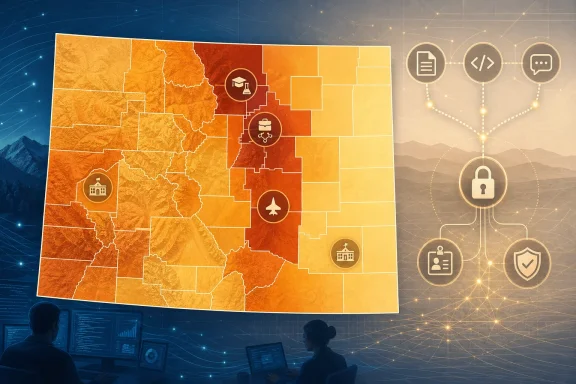 Colorado Is Above Average, but the Average Hides the Story
Microsoft’s top-line number for Colorado — 32.3 percent AI user share — places the state above the U.S. average and, according to the Denver Gazette’s summary of the report, 15th nationally for working-age users. That is respectable, but not shocking. Colorado has spent years positioning itself as a technology-adjacent economy: not quite California, not quite Washington, but increasingly attractive to software workers, aerospace firms, federal labs, startups, and remote professionals.The important word in Microsoft’s metric is diffusion. This is not just a tally of accounts or app downloads. Microsoft says its estimates combine anonymized, aggregated telemetry on active use of major AI tools with statistical modeling to normalize adoption across states, counties, and metro areas. The report includes services such as ChatGPT, Google Gemini, Claude, and Microsoft Copilot, which means it is trying to measure behavior across the generative AI mainstream rather than simply Microsoft’s own product footprint.
That makes the report more useful than a vendor victory lap, though not immune from vendor framing. Microsoft has every incentive to describe AI as an economic opportunity that can be expanded with investment, training, infrastructure, and trust-building. But the data itself points to something more complicated: AI is already widely available, yet its use remains shaped by local economies and social geography.
Colorado, in that sense, is a near-perfect case study. The state has a strong urban corridor, a major research university in Boulder, a large public university system, a growing Denver tech and startup scene, military and aerospace activity around Colorado Springs, and rural counties where population, infrastructure, and labor markets look very different. If AI were simply a matter of curiosity and free web access, the state map would be flatter. It is not.
The Front Range Becomes an AI Adoption Corridor
The counties leading Colorado’s AI adoption map are not random. Boulder County’s 43.7 percent user share is the state’s highest, followed by Broomfield County at 38.8 percent and Larimer County at 35.9 percent. Denver, Douglas, Gunnison, and El Paso also sit above the state average or very close to it, according to the figures summarized by the Denver Gazette.This is the Front Range pattern with a few mountain-community exceptions. Boulder has the University of Colorado Boulder, a startup ecosystem, federal labs, climate and aerospace research, software firms, and a resident base that skews highly educated. Broomfield sits between Denver and Boulder and has long been shaped by technology, telecom, and professional employment. Larimer County has Colorado State University and a Fort Collins economy that mixes education, research, tech, and advanced services.
Denver’s 34.4 percent user share is interesting because it is not the state leader. That should temper the reflexive assumption that the biggest city automatically dominates. AI adoption appears to be especially strong where urban scale combines with university culture, technical labor, and a high concentration of work that can absorb chatbots, coding assistants, research tools, summarizers, and workflow copilots immediately.
El Paso County’s 34.2 percent also fits the pattern, but in a slightly different way. Colorado Springs is not Boulder, yet its defense, aerospace, cybersecurity, military, and engineering footprint gives AI a plausible workday use case. Generative AI is not only a consumer novelty; it is a documentation aid, coding assistant, briefing tool, data wrangler, translation layer, and first-draft machine. Places with those tasks have more reasons to experiment.
Rural Colorado Shows the Limits of “AI for Everyone”
Microsoft’s report found that metropolitan counties in Colorado averaged a 33.7 percent AI user share, micropolitan counties averaged 22.6 percent, and rural counties averaged just 17.1 percent. That is not a rounding error. It is a structural divide.The temptation is to explain the gap with broadband alone. Connectivity matters, and rural internet access remains uneven across the country. But Microsoft’s report points to several factors, including access and trust, and that broader explanation is more persuasive. AI adoption requires a device, bandwidth, awareness, perceived usefulness, and enough institutional or workplace permission to make experimentation feel worthwhile rather than risky.
Rural counties also have different occupational mixes. If a county’s working life is more heavily concentrated in agriculture, construction, mining, oil and gas, manufacturing, tourism, or local services, the immediate use case for a text-and-code AI assistant may be less obvious than it is for a consultant, software developer, student, grant writer, analyst, marketer, lawyer, or health administrator. That does not mean AI has no role in those industries. It means the route into daily work is less direct.
The divide also reflects confidence. Microsoft’s report cites survey data showing that 53 percent of urban respondents said AI was likely to act in the public’s best interest, compared with 38 percent of rural respondents. That is a large trust gap, and it matters because AI products ask users to do something psychologically unusual: hand half-formed questions, business problems, personal dilemmas, or work documents to a remote system whose training data, governance, and failure modes are mostly invisible.
If you already distrust the institutions selling the future, AI can look less like a productivity tool and more like another extraction layer. That attitude is not irrational. The technology industry has often treated rural communities as late-stage markets rather than design centers, and the benefits of platform shifts have not always landed where the disruption did.
Microsoft’s Map Is Also a Map of Work That Happens on Screens
The report’s industry findings are among its most important. Microsoft researchers found that counties with larger shares of professional and technical services, information work, health care, and finance tend to have higher AI usage. Counties with more manufacturing, agriculture, construction, mining, oil, and gas employment generally show lower levels of use.This is not proof that one industry causes adoption and another prevents it. Microsoft is careful on that point, and it should be. But the association is strong enough to make the real issue visible: generative AI currently fits most cleanly into occupations where language, documents, code, search, analysis, and administrative workflows already dominate.
That helps explain why Colorado’s statewide figure is above average. The Denver Gazette notes that Colorado has higher-than-average concentrations of several industries associated with AI adoption, including professional, scientific and technical services, information, finance, and corporate management. That occupational structure gives the state a larger pool of workers who can use AI without waiting for robotics, embedded sensors, specialized industrial systems, or custom enterprise integrations.
For WindowsForum readers, this is where the story becomes practical. The first wave of generative AI adoption is not primarily about replacing operating systems, rewriting enterprise architecture, or deploying science-fiction agents. It is about adding AI to the work people already do in browsers, Office documents, Teams chats, IDEs, ticketing systems, CRMs, intranets, and search boxes.
That is why Microsoft cares so much. If AI adoption follows the shape of everyday knowledge work, then Windows, Microsoft 365, GitHub, Azure, Copilot, Edge, Teams, and enterprise identity systems become distribution channels. The company’s report may be about geography, but the business strategy behind it is about embedding AI where authenticated work already lives.
Boulder’s Lead Is Less About Hype Than Institutional Density
Boulder County’s 43.7 percent user share is striking, but it should not be read as a simple measure of tech enthusiasm. Boulder is a dense institutional ecosystem. Universities, labs, startups, federal research relationships, venture networks, climate science, aerospace, software, and professional services all create conditions where new tools spread quickly.College communities are especially important in Microsoft’s national findings. The report says AI adoption is strongly connected with younger populations and notes that many of the highest-ranking counties are home to colleges or universities. Nationally, counties where more than 10 percent of residents are ages 18 to 24 averaged 28.6 percent AI user share, compared with 20.3 percent in counties with smaller young-adult populations.
This fits what anyone watching universities has already seen. Students use AI to brainstorm, summarize, translate, debug, outline, argue, cheat, study, and accelerate routine academic labor. Faculty and administrators use it more unevenly, often while arguing about policy. The result is messy, but the adoption engine is powerful: a large population of young adults, many of them digitally fluent, under constant pressure to produce text, code, research, presentations, and analysis.
Gunnison County’s 34.3 percent figure is notable in this light. It is not a huge urban county, but it is home to Western Colorado University. That does not single-handedly explain the number, but it reinforces Microsoft’s broader point that college communities can punch above their population weight in AI adoption.
The deeper lesson is that AI spreads through communities of practice. It spreads when classmates compare prompts, when coworkers share shortcuts, when managers tolerate experimentation, when professors build assignments around it, when IT departments provision tools, and when local employers start asking applicants whether they can use it. Adoption is social before it is statistical.
The Trust Gap May Matter More Than the Usage Gap
The most politically sensitive part of Microsoft’s report is not that cities use more AI than rural areas. That was predictable. The sharper finding is that trust in AI appears to differ by geography in ways that could harden existing economic divisions.If urban residents are more likely to believe AI will act in the public interest, they are more likely to try it, forgive its mistakes, and push institutions to incorporate it. If rural residents are more skeptical, they may avoid tools that could help in some contexts — or they may be spared some of the risks of premature automation. Neither side has a monopoly on wisdom.
AI boosters often treat skepticism as a deficit to be corrected through education. That is too easy. Many concerns about AI are grounded in real failures: hallucinated answers, opaque data practices, biased outputs, insecure integrations, unclear copyright boundaries, overconfident medical or legal guidance, and employers using productivity rhetoric to justify surveillance or headcount cuts.
At the same time, blanket rejection has costs. If AI becomes a routine layer in education, government services, small-business administration, health navigation, and job applications, communities with lower adoption may find themselves disadvantaged not because the tools are magical, but because systems around them begin to assume AI fluency. The digital divide is rarely only about access to hardware. It is about the hidden curriculum that forms around new tools.
For IT leaders, trust is not a public-relations problem. It is a deployment requirement. Workers are more likely to use AI responsibly when they know what tools are approved, what data can be entered, when outputs must be verified, and who is accountable when something goes wrong. In the absence of that guidance, adoption becomes shadow IT with a chatbot interface.
The Report Measures Usage, Not Transformation
Microsoft’s numbers are useful, but they should not be overread. A 32.3 percent AI user share does not mean one-third of Coloradans are using AI well, using it at work, saving time, earning more, or producing better decisions. It means they crossed a threshold of active use that Microsoft’s model can detect and estimate.That distinction matters because the AI economy is full of inflated language. Vendors speak of transformation, automation, agents, and productivity revolutions. Adoption data shows something narrower but more solid: people are trying the tools often enough to count.
Trying is not transformation. A student using ChatGPT to rephrase a paragraph, a developer using Copilot to autocomplete boilerplate, a manager asking Gemini to summarize a meeting, and a small-business owner using Claude to draft a marketing email all show adoption. Whether those uses compound into durable productivity gains is a harder question.
This is where Microsoft’s geography report should be paired with local fieldwork. Which Colorado employers are training workers rather than merely buying licenses? Which school districts are clarifying AI rules instead of banning and quietly tolerating it? Which rural health systems are using AI safely? Which counties are adopting AI in public administration? Which small businesses are seeing returns?
The map can tell us where usage is likely happening. It cannot tell us whether the benefits are landing broadly or being captured by the already advantaged.
The Windows Angle Is Policy, Identity, and Manageability
For Windows enthusiasts, the AI story often arrives as a product story: Copilot in Windows, Copilot in Microsoft 365, AI PCs with neural processing units, new Start menu behaviors, Recall controversies, Edge integrations, and a steady drip of model-powered features. The Colorado data points to a broader enterprise reality. AI adoption is becoming a management problem.If roughly one-third of working-age users are already using major AI tools, then organizations should assume employees are experimenting whether or not procurement has approved a standard platform. That is especially true in Colorado’s higher-adoption counties, where professional services, tech, education, health care, finance, and government-adjacent work are common.
The question for administrators is no longer whether users will touch AI. It is whether they will do so inside governed environments. That means identity, logging, data-loss prevention, retention rules, sensitivity labels, acceptable-use policies, browser controls, endpoint security, and vendor risk reviews. In other words, AI becomes another layer in the stack that sysadmins already own.
Microsoft’s advantage is that it can offer AI as part of that stack. Its challenge is that trust in the stack is not automatic. Windows users remember forced defaults, telemetry fights, confusing account prompts, and feature rollouts that blurred the line between assistance and intrusion. If Microsoft wants Copilot to be treated as infrastructure rather than clutter, it has to make the governance story better than the marketing story.
The same applies beyond Microsoft. OpenAI, Google, Anthropic, and a growing set of enterprise AI vendors are all competing for user habits. The winning tools in businesses and schools may not be the ones with the flashiest demos. They may be the ones that IT departments can audit, constrain, explain, and support without turning every help desk into an AI ethics board.
Rural Adoption Will Not Be Fixed by Chatbots Alone
The easiest policy response to Microsoft’s report is to call for rural AI training. Training helps, but it is not enough. A rural county with lower AI adoption may need broadband investment, local technical support, industry-specific tools, trusted community institutions, school and library access, small-business assistance, and examples that make sense outside white-collar office work.A rancher, county clerk, home-health worker, mechanic, school administrator, and construction contractor do not need the same AI pitch as a software engineer in Boulder. They need tools that solve local problems with clear boundaries and low friction. If the dominant examples remain writing emails faster and summarizing PDFs, the technology will continue to look like something built for someone else.
There is also a cost issue. Many of the most useful AI services are moving toward paid tiers, enterprise bundles, usage caps, premium models, and specialized integrations. Free access can spark experimentation, but sustained productivity often depends on better models, secure connectors, and workflow integration. That tends to favor larger organizations and wealthier districts.
Public institutions may become crucial intermediaries. Libraries, community colleges, extension programs, school districts, workforce centers, and local governments can translate AI from national hype into practical local capability. But they will need support, because asking under-resourced institutions to close the AI divide while vendors monetize the upside is not a serious strategy.
Colorado’s geography makes this tension obvious. The same state can contain Boulder’s research density, Denver’s professional labor market, Colorado Springs’ defense ecosystem, resort-town service economies, agricultural counties, mountain communities, and sparsely populated rural regions. A single statewide adoption number cannot describe that complexity.
The Colorado Map Is a Warning Against Lazy AI Optimism
The optimistic reading of Microsoft’s report is that AI has gone mainstream. One-third adoption among working-age Coloradans is not fringe behavior. The tools have crossed from novelty into daily or semi-regular use for a large portion of the population.The cautionary reading is that mainstream adoption may still widen gaps. If the places with the strongest institutions, highest education levels, densest professional networks, and best digital infrastructure adopt AI faster, they may also capture more of whatever productivity gains the technology produces. The same places that were well positioned for remote work, cloud software, and the knowledge economy are again well positioned for the next platform shift.
That does not mean rural counties are doomed or urban counties are guaranteed prosperity. AI could help rural doctors, teachers, clerks, farmers, and small businesses if the tools are trustworthy, affordable, and adapted to local workflows. But diffusion is not destiny. It is a starting condition.
The uncomfortable point is that AI does not automatically democratize expertise. It can lower barriers for individuals while raising the baseline expectations for everyone. If employers, schools, and government agencies begin assuming AI-assisted productivity, then people without access, training, trust, or relevant use cases may fall behind even if the tools are technically available.
That is why Microsoft’s report matters beyond Microsoft. It gives policymakers, educators, and IT leaders an early map of where the new layer is taking hold. The question is whether they use that map to broaden capability or merely to sell more subscriptions into the counties already ahead.
The Numbers That Should Shape Colorado’s AI Debate
The practical lesson from Microsoft’s Colorado data is not that the state should celebrate being slightly above average. It is that adoption is now large enough to require governance and uneven enough to require intervention. The next phase will be less about whether people have heard of AI and more about whether communities can use it safely, productively, and on terms that fit their economies.- Colorado’s 32.3 percent AI user share puts the state above the national average, but the statewide number masks a much wider county-level divide.
- Boulder County’s 43.7 percent user share shows how universities, research institutions, startups, and professional work can accelerate AI adoption.
- Rural Colorado’s 17.1 percent average user share suggests that availability alone is not enough to produce meaningful diffusion.
- The strongest adoption patterns follow work that already happens through documents, code, data, messaging, search, and administrative systems.
- Trust is becoming an infrastructure issue, because users who do not trust AI tools are less likely to experiment with them and less likely to benefit from legitimate uses.
- IT departments should assume AI usage is already present and focus on governance, approved tools, data protection, and user education rather than denial.
References
- Primary source: Denver Gazette
Published: 2026-07-06T01:39:12.206755
Loading…
www.denvergazette.com - Official source: microsoft.com
Loading…
www.microsoft.com - Official source: blogs.microsoft.com
The state of global AI diffusion in 2026 - Microsoft On the Issues
Today we published our latest Global AI Diffusion Report. The global adoption of artificial intelligence continued to rise in the first quarter of 2026. During the quarter, AI usage increased by 1.5 percentage points from 16.3% to 17.8% of the world’s working age population. Intensity of use...blogs.microsoft.com - Related coverage: axios.com
Loading…
www.axios.com - Related coverage: fortune.com
Loading…
fortune.com - Related coverage: oracore.dev
Loading…
oracore.dev