

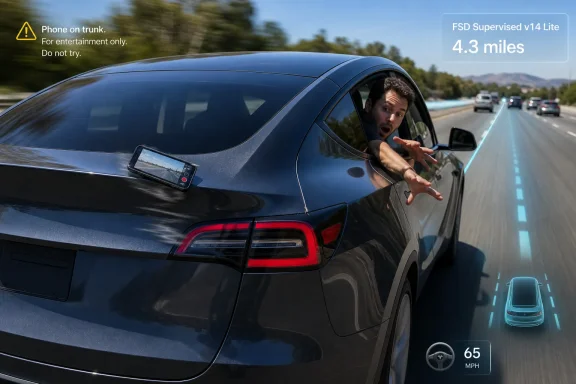
A Tesla-shared clip posted on July 5, 2026 showed a smartphone accidentally left on a Model Y tailgate surviving a 4.3-mile drive, including highway speeds, while the company credited the unlikely ride to the smoothness of FSD Supervised. It is the sort of internet-perfect artifact Tesla loves: funny, visual, instantly legible, and just dangerous enough to make everyone say, “Please don’t try this.” But underneath the stunt value sits a more serious point about the direction of driver-assistance software. Tesla is no longer merely selling autonomy as a destination; it is selling composure as evidence that the machine is getting closer.
As reported by Basenor and attributed to Tesla’s own July 5 post, the phone-on-tailgate moment arrived as Tesla has been pushing FSD Supervised v14 Lite toward Hardware 3 vehicles, the older computer platform fitted to millions of cars. Electrek, Tesla Oracle, and other Tesla-focused outlets have separately reported that the first v14 Lite builds began reaching early-access HW3 owners in late June 2026, with firmware 2026.20.5.1 described as the bridge between newer v14 driving behavior and older onboard compute. That timing matters. A loose phone is not a safety study, but it is a very efficient demonstration of the problem Tesla says it has been trying to solve.
The old critique of Tesla’s Full Self-Driving program was not only that it was incomplete. It was that it often felt incomplete. A human driver can forgive a system that needs supervision; passengers are much less forgiving of abrupt braking, indecisive lane placement, late steering corrections, or the uncanny rhythm of a car that seems to change its mind every half-second.
That is why the tailgate clip landed with more force than a typical social media novelty. The phone survived because the car apparently did not lurch, brake hard, or make a steering correction aggressive enough to overcome the friction holding the device in place. Physics did the rest, helped by the Model Y’s bodywork and whatever phone case was involved.
No serious engineer would treat this as a controlled measurement. The road surface, wind, phone position, speed profile, traffic behavior, and luck all matter. But as a piece of product theater, it is unusually well matched to the software story Tesla wants to tell: FSD Supervised is becoming less theatrical behind the wheel.
That distinction is important. A system can make the technically correct maneuver and still feel bad. It can stay within a lane but oscillate inside it, stop safely but too abruptly, or merge legally but with the nervousness of a student driver. Tesla’s challenge has always been partly technical and partly experiential, because autonomy has to win trust through the body before it wins arguments through metrics.
That is a different kind of progress from the headline feats Tesla fans usually celebrate. For years, FSD discourse has revolved around whether the car can handle unprotected left turns, dense urban streets, construction zones, roundabouts, school buses, and the unpredictable ballet of human road behavior. Those remain the hard problems. But the daily confidence problem is much smaller and much more relentless.
Owners notice whether the car’s steering inputs feel human. Passengers notice whether the system brakes like a chauffeur or like a novice. Nearby drivers notice whether the Tesla hesitates at a merge or holds its line cleanly. The phone on the tailgate turns that subjective impression into a simple visual metaphor.
It also reveals why “smoothness” is not a cosmetic feature. Smooth driving reduces passenger discomfort, lowers the chance of surprising other road users, and makes supervision less exhausting. A driver monitoring an automated system is more likely to stay engaged when the car behaves predictably than when every intersection feels like a negotiation.
That “Lite” suffix is doing a lot of work. It signals progress without pretending the older platform is equivalent to the newer Hardware 4 cars. It also gives Tesla room to deliver meaningful behavioral improvements without resolving the larger and more expensive question of whether legacy owners will eventually need hardware retrofits for anything approaching unsupervised autonomy.
For HW3 owners, the practical question is not whether a phone can stay on a tailgate. It is whether their cars now drive with fewer false slowdowns, cleaner lane centering, more natural speed choices, and better judgment in everyday scenarios. Those are the things that determine whether FSD feels like a daily tool or a rolling beta test.
Tesla’s software strategy has always relied on the idea that cars improve after purchase. That promise is powerful when updates arrive and visible when they do not. HW3 owners have spent years watching newer hardware receive the newest capabilities first, and v14 Lite appears designed to narrow that psychological and functional gap.
Tesla knows this, and so do most serious observers. But social media collapses nuance. A clip that should mean “this ride was extremely smooth” can quickly become “FSD is now safe enough to trust,” which is not the same claim.
The company’s own naming still matters here: FSD Supervised. The driver remains responsible. The system requires active supervision. The car is not autonomous in the everyday meaning of the word, even if Tesla’s branding continues to push hard against the boundary between assistance and autonomy.
That boundary is not pedantic. Regulators, insurers, fleet operators, and safety researchers all care about the difference between a system that helps a driver and one that replaces one. Tesla’s marketing often lives in the emotional space between those categories, and the phone clip is a perfect example of why that space is so potent.
If FSD makes a passenger tense, the driver turns it off. If it phantom brakes too often, the subscription gets canceled. If it handles 90 percent of a commute well but botches the same awkward merge every morning, trust erodes faster than statistics can repair it. Autonomy does not only fail through crashes; it fails through annoyance.
That is why v14 Lite’s reported emphasis on smoother steering and fewer false slowdowns is commercially meaningful. Tesla does not need every supervised FSD user to believe the car is ready to drive itself everywhere. It needs them to believe the software is good enough to keep using, good enough to pay for, and good enough to recommend.
The tailgate phone clip compresses that pitch into seconds. The car is calm. The road passes underneath. The phone stays put. It is not proof of autonomy, but it is proof of a kind of polish users can understand without reading release notes.
That group is enormous. Reporting around the v14 Lite rollout has repeatedly put the HW3 installed base at roughly 4 million vehicles globally. Even if that number is approximate, it captures the scale of Tesla’s obligation. This is not a niche maintenance update for a forgotten product line; it is a software credibility test across one of the largest partially automated fleets on the road.
For those owners, v14 Lite may feel like overdue recognition. It suggests Tesla is still trying to extract more capability from HW3 rather than simply treating it as obsolete. But it also sharpens the question of ceilings. If v14 Lite delivers smoother supervised driving but not the full v14 experience, then the gap between “improved” and “promised” remains politically and legally charged.
Tesla’s advantage is that software can change quickly. Its liability is that memory does not. Owners remember what they were told when they paid thousands of dollars for FSD capability, and a smoother supervised system may not satisfy everyone who believed they were buying a future autonomous car.
But smoothness can also be deceptive. A system can be confidently wrong. It can make an unsafe decision elegantly. It can fail to perceive something important and proceed without hesitation, which may feel smoother than cautious braking until the moment it is not.
This is the core dilemma for advanced driver assistance. Human trust is calibrated through behavior we can feel, but machine risk is buried in scenarios we may not encounter until too late. A car that drives beautifully for 99 trips can still make the 100th trip the one that matters.
So the phone clip should be read carefully. It is evidence of ride quality, not evidence of comprehensive safety. It suggests improvements in control behavior, not the elimination of supervision. It is a data point in the user-experience column, not a substitute for transparent safety reporting.
That strategy has strengths. It makes progress feel tangible. It turns software updates into events. It gives owners the sense that they are participating in a live technological project rather than merely operating a finished appliance.
It also creates a credibility problem. Anecdotes travel faster than caveats, and Tesla’s most enthusiastic audience often fills in the gaps with conclusions the evidence does not support. When a phone stays on a tailgate, the internet sees a miracle of smooth driving; a safety engineer sees an uncontrolled observation with a sample size of one.
The truth sits between those reactions. The clip is not meaningless just because it is anecdotal. Consumer technology is often judged first by lived experience. But Tesla’s autonomy claims have accumulated enough regulatory scrutiny, lawsuits, and public confusion that the company has little margin for ambiguity.
A smoother system is a real achievement. A system that requires an attentive human driver is not self-driving in the ordinary sense. Tesla’s language asks consumers to hold both ideas at once, and the company’s supporters often do so more comfortably than regulators or safety advocates.
This is not just a branding debate. Words shape behavior. If drivers overestimate the system, supervision degrades. If passengers misunderstand the system, social pressure may push drivers to trust it too much. If policymakers see a gap between marketing and operation, Tesla invites intervention it might otherwise avoid.
The phone clip is charming precisely because it seems low-stakes. But it exists inside a high-stakes naming environment. Every proof point for FSD’s competence also amplifies the need to be clear about what the system still is not.
The v14 Lite rollout fits that story well. Older vehicles receiving materially improved driving behavior through an over-the-air update is exactly the kind of thing that differentiates Tesla from traditional automakers. Even when competitors add driver-assistance features, few can make a five-year-old car feel dramatically different overnight.
That matters for used-car values, subscription revenue, owner loyalty, and the perception that Tesla vehicles are software products as much as transportation products. A used Model Y or Model 3 with HW3 may not become a robotaxi, but it may become a better commuter car if v14 Lite delivers on its smoother control goals.
The challenge is that Tesla rarely wants to stop at the modest version of the argument. The company’s culture, investor story, and CEO-level messaging all push toward autonomy as transformation. Yet the strongest evidence today may be incremental: fewer jerks, better lane discipline, calmer braking, and, yes, a phone that did not slide away.
That physicality matters in automotive technology. Cars are not apps. Their software expresses itself through mass, velocity, friction, and consequence. A line of code becomes a steering input; a model prediction becomes a braking event; a confidence threshold becomes a passenger’s raised eyebrow.
Tesla’s long-term bet is that enough of those physical expressions will improve fast enough to keep users engaged until autonomy becomes more capable and more broadly accepted. V14 Lite is part of that bet, especially for owners who feared their older hardware would be left behind. The phone clip is the meme version of the same claim.
There is a reason it resonated. It gives Tesla a way to say “our car drives smoothly” without saying it. The phone says it instead.
Tesla’s July 5 clip will be remembered as a funny little FSD moment, but its real significance is that it shows how the autonomy race is being fought in increasingly subtle terrain: not just whether the car can complete a route, but whether it can do so with the calmness people associate with competence. If v14 Lite brings that composure to millions of Hardware 3 cars, Tesla will have bought itself time, goodwill, and another chapter in the software-upgrade story. If it does not, the phone on the tailgate will remain what it first appeared to be: a lucky object on a smooth day, briefly carrying the weight of a much larger promise.
As reported by Basenor and attributed to Tesla’s own July 5 post, the phone-on-tailgate moment arrived as Tesla has been pushing FSD Supervised v14 Lite toward Hardware 3 vehicles, the older computer platform fitted to millions of cars. Electrek, Tesla Oracle, and other Tesla-focused outlets have separately reported that the first v14 Lite builds began reaching early-access HW3 owners in late June 2026, with firmware 2026.20.5.1 described as the bridge between newer v14 driving behavior and older onboard compute. That timing matters. A loose phone is not a safety study, but it is a very efficient demonstration of the problem Tesla says it has been trying to solve.
 Tesla Turns Smoothness Into a Proof Point
The old critique of Tesla’s Full Self-Driving program was not only that it was incomplete. It was that it often felt incomplete. A human driver can forgive a system that needs supervision; passengers are much less forgiving of abrupt braking, indecisive lane placement, late steering corrections, or the uncanny rhythm of a car that seems to change its mind every half-second.That is why the tailgate clip landed with more force than a typical social media novelty. The phone survived because the car apparently did not lurch, brake hard, or make a steering correction aggressive enough to overcome the friction holding the device in place. Physics did the rest, helped by the Model Y’s bodywork and whatever phone case was involved.
No serious engineer would treat this as a controlled measurement. The road surface, wind, phone position, speed profile, traffic behavior, and luck all matter. But as a piece of product theater, it is unusually well matched to the software story Tesla wants to tell: FSD Supervised is becoming less theatrical behind the wheel.
That distinction is important. A system can make the technically correct maneuver and still feel bad. It can stay within a lane but oscillate inside it, stop safely but too abruptly, or merge legally but with the nervousness of a student driver. Tesla’s challenge has always been partly technical and partly experiential, because autonomy has to win trust through the body before it wins arguments through metrics.
The Phone Survived Because the Car Did Not Perform
The striking thing about the clip is not that the Model Y did something dramatic. It is that, apparently, it did not. The best version of supervised driving software is often boring: smooth acceleration, predictable lane centering, gradual braking, and a lack of last-second theatrics.That is a different kind of progress from the headline feats Tesla fans usually celebrate. For years, FSD discourse has revolved around whether the car can handle unprotected left turns, dense urban streets, construction zones, roundabouts, school buses, and the unpredictable ballet of human road behavior. Those remain the hard problems. But the daily confidence problem is much smaller and much more relentless.
Owners notice whether the car’s steering inputs feel human. Passengers notice whether the system brakes like a chauffeur or like a novice. Nearby drivers notice whether the Tesla hesitates at a merge or holds its line cleanly. The phone on the tailgate turns that subjective impression into a simple visual metaphor.
It also reveals why “smoothness” is not a cosmetic feature. Smooth driving reduces passenger discomfort, lowers the chance of surprising other road users, and makes supervision less exhausting. A driver monitoring an automated system is more likely to stay engaged when the car behaves predictably than when every intersection feels like a negotiation.
V14 Lite Is Really About an Old Promise Meeting Old Hardware
The v14 Lite rollout gives the phone clip its broader context. Hardware 3, also called AI3 in Tesla’s internal naming, represents a vast installed base of vehicles sold during years when Tesla repeatedly argued that its cars had the hardware needed for Full Self-Driving. According to Electrek and other outlets tracking the rollout, v14 Lite is meant to bring newer v14-style behavior to those older cars, even as it remains a supervised Level 2 driver-assistance system.That “Lite” suffix is doing a lot of work. It signals progress without pretending the older platform is equivalent to the newer Hardware 4 cars. It also gives Tesla room to deliver meaningful behavioral improvements without resolving the larger and more expensive question of whether legacy owners will eventually need hardware retrofits for anything approaching unsupervised autonomy.
For HW3 owners, the practical question is not whether a phone can stay on a tailgate. It is whether their cars now drive with fewer false slowdowns, cleaner lane centering, more natural speed choices, and better judgment in everyday scenarios. Those are the things that determine whether FSD feels like a daily tool or a rolling beta test.
Tesla’s software strategy has always relied on the idea that cars improve after purchase. That promise is powerful when updates arrive and visible when they do not. HW3 owners have spent years watching newer hardware receive the newest capabilities first, and v14 Lite appears designed to narrow that psychological and functional gap.
A Viral Clip Is Not a Validation Suite
The risk in Tesla’s framing is obvious. A smartphone surviving 4.3 miles on a tailgate says something about that particular drive, not about system safety across millions of edge cases. It does not prove that FSD Supervised handles emergency vehicles correctly, understands every work zone, or avoids the many oddities of real roads.Tesla knows this, and so do most serious observers. But social media collapses nuance. A clip that should mean “this ride was extremely smooth” can quickly become “FSD is now safe enough to trust,” which is not the same claim.
The company’s own naming still matters here: FSD Supervised. The driver remains responsible. The system requires active supervision. The car is not autonomous in the everyday meaning of the word, even if Tesla’s branding continues to push hard against the boundary between assistance and autonomy.
That boundary is not pedantic. Regulators, insurers, fleet operators, and safety researchers all care about the difference between a system that helps a driver and one that replaces one. Tesla’s marketing often lives in the emotional space between those categories, and the phone clip is a perfect example of why that space is so potent.
The Real Competition Is Passenger Trust
Tesla’s autonomy debate often gets reduced to a race: Tesla versus Waymo, camera-only versus lidar, consumer vehicles versus geofenced robotaxis. Those comparisons matter, but the consumer FSD experience has another competitor: the human being sitting in the driver’s seat.If FSD makes a passenger tense, the driver turns it off. If it phantom brakes too often, the subscription gets canceled. If it handles 90 percent of a commute well but botches the same awkward merge every morning, trust erodes faster than statistics can repair it. Autonomy does not only fail through crashes; it fails through annoyance.
That is why v14 Lite’s reported emphasis on smoother steering and fewer false slowdowns is commercially meaningful. Tesla does not need every supervised FSD user to believe the car is ready to drive itself everywhere. It needs them to believe the software is good enough to keep using, good enough to pay for, and good enough to recommend.
The tailgate phone clip compresses that pitch into seconds. The car is calm. The road passes underneath. The phone stays put. It is not proof of autonomy, but it is proof of a kind of polish users can understand without reading release notes.
Hardware 3 Owners Are the Audience That Matters
The most consequential audience for this moment is not the Tesla superfan with a new Hardware 4 Model Y. It is the owner of a 2019, 2020, 2021, or 2022 Tesla who bought into the FSD story and has been waiting to see whether older hardware would be meaningfully carried forward.That group is enormous. Reporting around the v14 Lite rollout has repeatedly put the HW3 installed base at roughly 4 million vehicles globally. Even if that number is approximate, it captures the scale of Tesla’s obligation. This is not a niche maintenance update for a forgotten product line; it is a software credibility test across one of the largest partially automated fleets on the road.
For those owners, v14 Lite may feel like overdue recognition. It suggests Tesla is still trying to extract more capability from HW3 rather than simply treating it as obsolete. But it also sharpens the question of ceilings. If v14 Lite delivers smoother supervised driving but not the full v14 experience, then the gap between “improved” and “promised” remains politically and legally charged.
Tesla’s advantage is that software can change quickly. Its liability is that memory does not. Owners remember what they were told when they paid thousands of dollars for FSD capability, and a smoother supervised system may not satisfy everyone who believed they were buying a future autonomous car.
Smoothness Is a Safety Signal, But Not Safety Itself
It is tempting to treat smooth driving as a proxy for safe driving, and there is some truth in that instinct. Abruptness often indicates uncertainty, poor prediction, late decision-making, or inadequate planning. A car that moves fluidly through traffic may be showing that its model of the world is more stable.But smoothness can also be deceptive. A system can be confidently wrong. It can make an unsafe decision elegantly. It can fail to perceive something important and proceed without hesitation, which may feel smoother than cautious braking until the moment it is not.
This is the core dilemma for advanced driver assistance. Human trust is calibrated through behavior we can feel, but machine risk is buried in scenarios we may not encounter until too late. A car that drives beautifully for 99 trips can still make the 100th trip the one that matters.
So the phone clip should be read carefully. It is evidence of ride quality, not evidence of comprehensive safety. It suggests improvements in control behavior, not the elimination of supervision. It is a data point in the user-experience column, not a substitute for transparent safety reporting.
Tesla’s Best Marketing Still Comes From the Road
One reason the clip works is that it does not look like a polished advertisement in the traditional sense. Tesla has long benefited from product moments that feel discovered rather than scripted, whether shared by owners, influencers, engineers, or the company’s own social accounts. The brand’s strongest claims often travel through anecdote before they travel through documentation.That strategy has strengths. It makes progress feel tangible. It turns software updates into events. It gives owners the sense that they are participating in a live technological project rather than merely operating a finished appliance.
It also creates a credibility problem. Anecdotes travel faster than caveats, and Tesla’s most enthusiastic audience often fills in the gaps with conclusions the evidence does not support. When a phone stays on a tailgate, the internet sees a miracle of smooth driving; a safety engineer sees an uncontrolled observation with a sample size of one.
The truth sits between those reactions. The clip is not meaningless just because it is anecdotal. Consumer technology is often judged first by lived experience. But Tesla’s autonomy claims have accumulated enough regulatory scrutiny, lawsuits, and public confusion that the company has little margin for ambiguity.
The Name Still Does Tesla No Favors
Full Self-Driving remains one of the most contested product names in the technology world. Tesla has softened the operational reality by appending “Supervised,” but the phrase still carries a promise larger than the product can currently fulfill. That tension is visible every time Tesla celebrates a driving-assistance milestone.A smoother system is a real achievement. A system that requires an attentive human driver is not self-driving in the ordinary sense. Tesla’s language asks consumers to hold both ideas at once, and the company’s supporters often do so more comfortably than regulators or safety advocates.
This is not just a branding debate. Words shape behavior. If drivers overestimate the system, supervision degrades. If passengers misunderstand the system, social pressure may push drivers to trust it too much. If policymakers see a gap between marketing and operation, Tesla invites intervention it might otherwise avoid.
The phone clip is charming precisely because it seems low-stakes. But it exists inside a high-stakes naming environment. Every proof point for FSD’s competence also amplifies the need to be clear about what the system still is not.
The Software Story Is Stronger Than the Autonomy Story
Tesla’s most defensible argument right now may not be that FSD is close to replacing humans everywhere. It may be that Tesla has built the world’s most aggressively iterated consumer driving-assistance platform. That is a narrower claim, but it is also easier to support.The v14 Lite rollout fits that story well. Older vehicles receiving materially improved driving behavior through an over-the-air update is exactly the kind of thing that differentiates Tesla from traditional automakers. Even when competitors add driver-assistance features, few can make a five-year-old car feel dramatically different overnight.
That matters for used-car values, subscription revenue, owner loyalty, and the perception that Tesla vehicles are software products as much as transportation products. A used Model Y or Model 3 with HW3 may not become a robotaxi, but it may become a better commuter car if v14 Lite delivers on its smoother control goals.
The challenge is that Tesla rarely wants to stop at the modest version of the argument. The company’s culture, investor story, and CEO-level messaging all push toward autonomy as transformation. Yet the strongest evidence today may be incremental: fewer jerks, better lane discipline, calmer braking, and, yes, a phone that did not slide away.
A Small Object Exposes a Big Product Shift
The phone-on-tailgate moment is memorable because it turns a software abstraction into a physical test. Most users cannot evaluate neural network architecture or planning stacks. They can evaluate whether their coffee spills, whether their passenger grabs the door handle, and whether a forgotten phone somehow survives a highway run.That physicality matters in automotive technology. Cars are not apps. Their software expresses itself through mass, velocity, friction, and consequence. A line of code becomes a steering input; a model prediction becomes a braking event; a confidence threshold becomes a passenger’s raised eyebrow.
Tesla’s long-term bet is that enough of those physical expressions will improve fast enough to keep users engaged until autonomy becomes more capable and more broadly accepted. V14 Lite is part of that bet, especially for owners who feared their older hardware would be left behind. The phone clip is the meme version of the same claim.
There is a reason it resonated. It gives Tesla a way to say “our car drives smoothly” without saying it. The phone says it instead.
The Tailgate Test Gives Tesla a Useful, Limited Win
The practical reading is narrower than Tesla fans may want and more positive than Tesla skeptics may concede.- The clip is a vivid demonstration of smooth control behavior during one specific Model Y drive, not a general validation of FSD safety.
- The timing strengthens Tesla’s v14 Lite narrative because HW3 owners are watching closely for evidence that older cars are receiving meaningful software improvements.
- The most important user-facing gains are likely to be reduced jerkiness, steadier lane placement, fewer false slowdowns, and more natural speed choices.
- FSD Supervised remains a driver-assistance system that requires active human oversight, regardless of how polished individual drives may appear.
- Tesla’s biggest challenge is turning viral evidence of smoothness into sustained trust across ordinary roads, ordinary owners, and millions of older vehicles.
Tesla’s July 5 clip will be remembered as a funny little FSD moment, but its real significance is that it shows how the autonomy race is being fought in increasingly subtle terrain: not just whether the car can complete a route, but whether it can do so with the calmness people associate with competence. If v14 Lite brings that composure to millions of Hardware 3 cars, Tesla will have bought itself time, goodwill, and another chapter in the software-upgrade story. If it does not, the phone on the tailgate will remain what it first appeared to be: a lucky object on a smooth day, briefly carrying the weight of a much larger promise.
References
- Primary source: BASENOR - Tesla Accessories
Published: 2026-07-05T19:10:15.305000
Loading…
www.basenor.com - Related coverage: teslaoracle.com
Loading…
www.teslaoracle.com - Related coverage: electrek.co
Loading…
electrek.co - Related coverage: eletric-vehicles.com
Loading…
eletric-vehicles.com - Related coverage: elektroquatsch.de
Loading…
www.elektroquatsch.de - Related coverage: notateslaapp.com
Loading…
www.notateslaapp.com